The Grand Canyon doesn’t always impress. Amery Bohling recalls, “As a kid I got a geode from the canyon.” It was only after art school that she (re)discovered the canyon. Now, 20 years later, she is one of the country’s most eminent interpreters (in paint) of its geological, historical and atmospheric vastness.
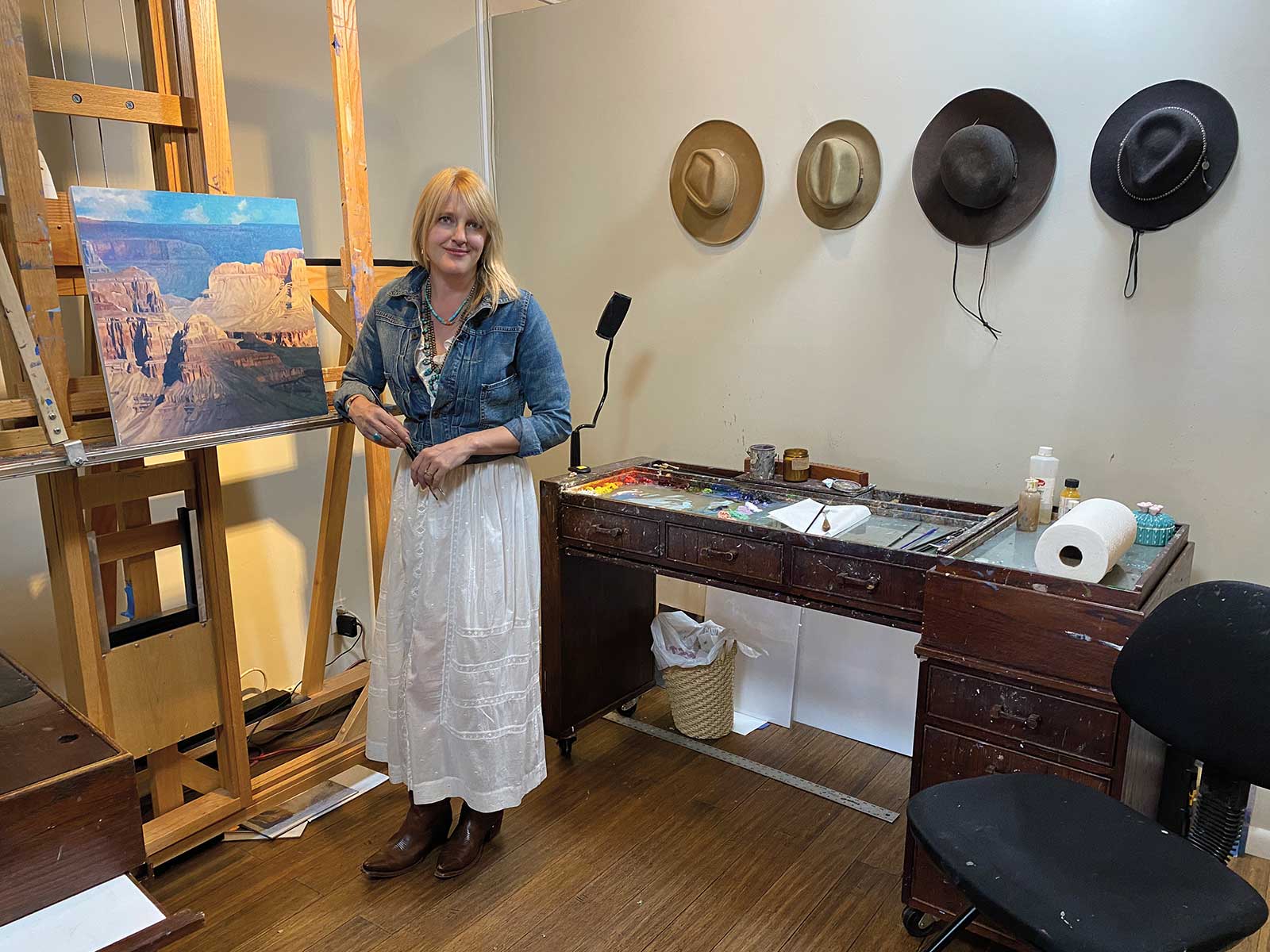
Amery Bohling in her Scottsdale, Arizona, studio. Jewelry by Territorial Indian Arts & Antiques
Romantic paintings of the canyon abound. “Naturally, the canyon is romantic,” she says. “There is the story of the people who’ve been there and the Native Americans who’ve lived there. It’s not a tiring subject. In the past, my paintings were probably romantic, but I’m more accurate now.”
She has progressed from impressionistic landscapes to using more saturated colors and greater contrast. It is the intense contrasts as well as the subtle contrasts of hazy days that make her paintings stand out. “It is my nature to paint tightly,” she says, “but I admire the watercolor paintings of John Singer Sargent with their lost and found edges where the forms are not necessarily correct but implied. When I was younger, I tried to paint like artists I admired but it was a shoe that didn’t fit. I tried to find the same thing in my own work, pulling something from their style that I could try—artistic brushwork, using two colors that are so close in value that you lose the edge, painting in thin colors.
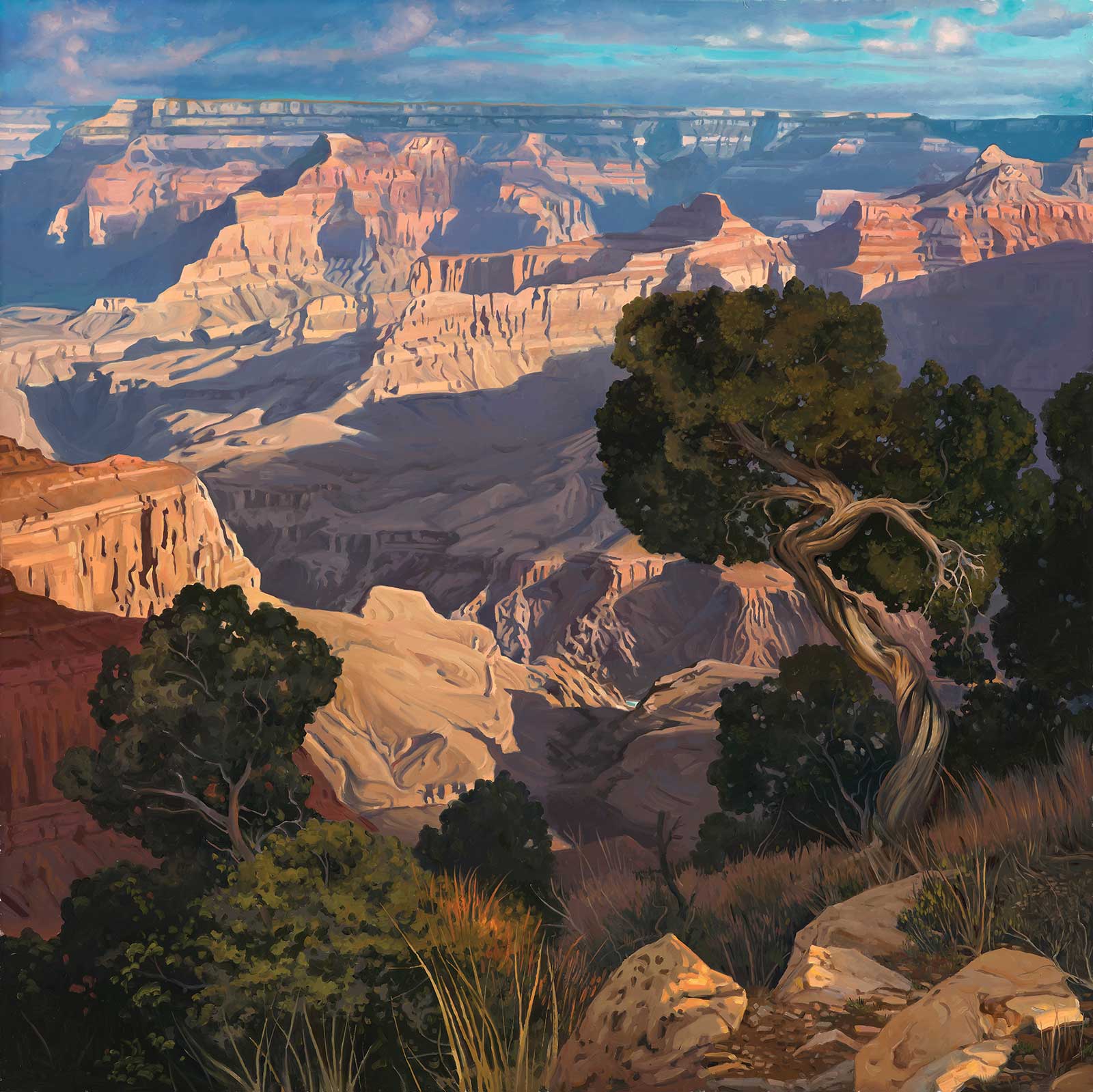
Weathered Silhouettes, oil, 40 x 40 in.
“Scott Christensen taught me the importance of painting on site and I often return to the canyon to experience it again and to make sketches and photos. I have a reverence for the canyon, the beauty of how the water carves its way through, it colors. Sometimes when I return to the studio and look at my photos, they don’t impress me as much. I want to paint the feeling I had when I was there and how I saw things then. I learned how to play with the colors, to exaggerate a little and twist the view with a bit of distortion.”
Among the places she returns to often is Moran Point. Located on the South Rim, it commemorates the Hudson River painter Thomas Moran whose paintings popularized Yellowstone and the Grand Canyon. Moran wrote of his modus operandi. “In working I use my memory. This I have trained from youth, so that while sketching I impress indelibly upon my memory the features of the landscape and the combinations of coloring so that when back in the studio the watercolor will recall vividly all the striking peculiarities of the scenes visited.”
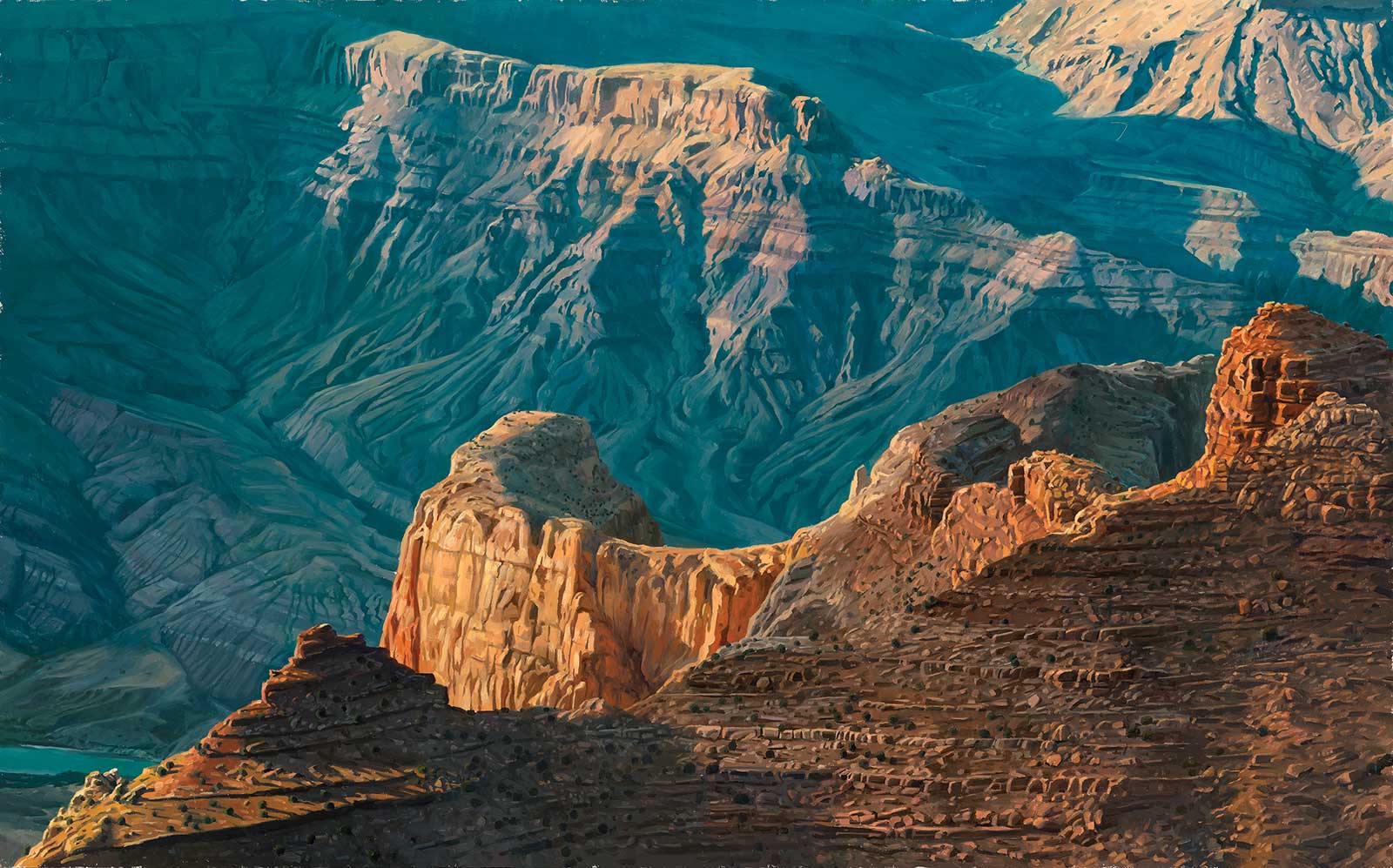
Lipan Point Reverie, oil, 24 x 40 in.
A visitor to Moran’s studio commented, “using small brushes, he would finish one square of the canvas inch by inch before moving over to another square, and the peaks of sunlit mountains would appear finished on one part of the canvas before the other parts of it had been touched.”
Bohling used to paint with acrylic underpainting, applying the detail in oil on top. At other times, she paints “from a point on a stark white canvas. Having a white canvas forces me to pay attention—to make it as good as I can make it.”
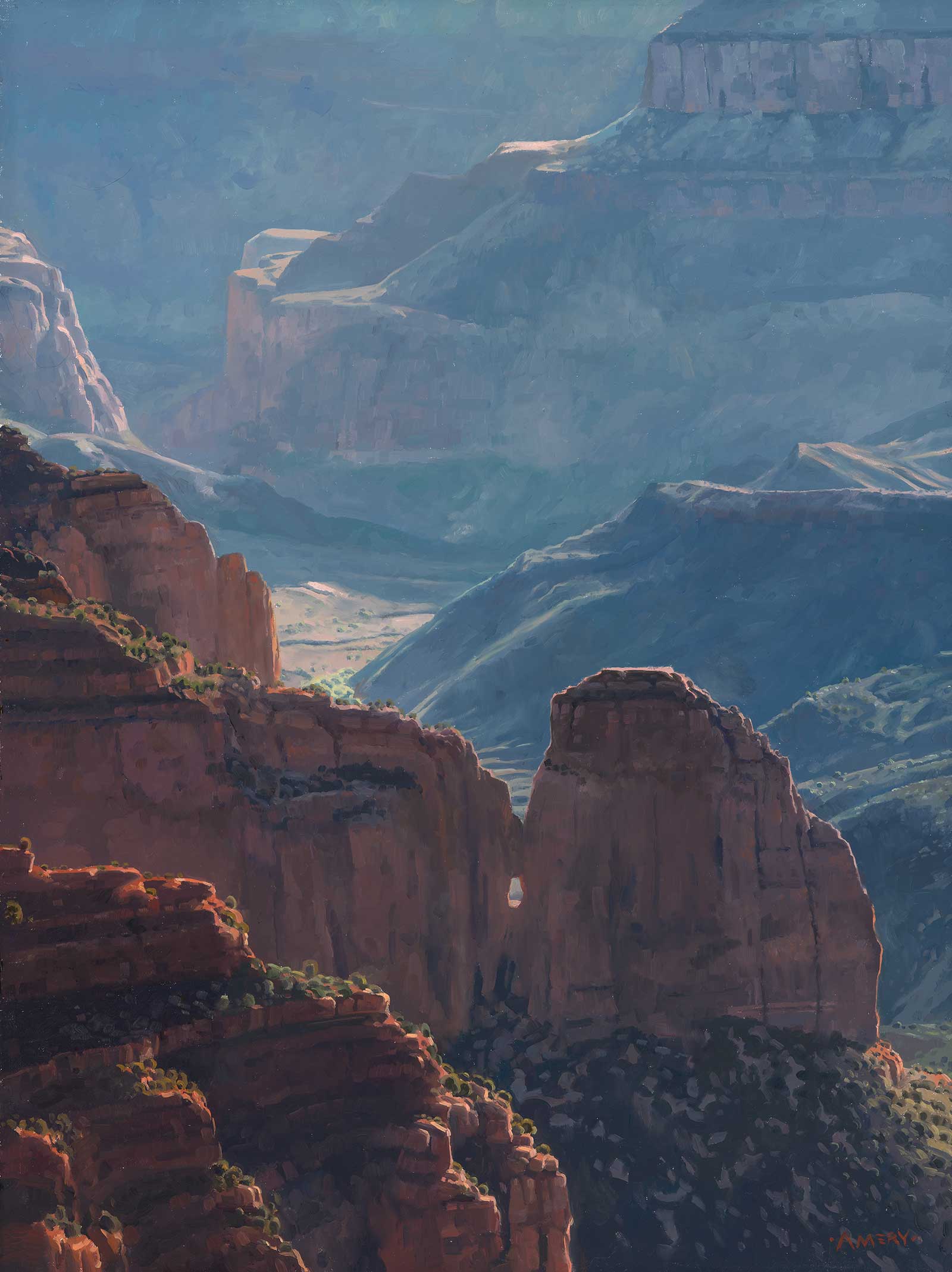
Distant Winds, Ancient Walls, oil 24 x 18 in.
She painted her first painting of the canyon as she returned from a workshop with Scott Christensen. “I took two of his two-week-long classes. He really worked with me on composition, how to paint the distance and working with a minimal palette. Many of my key colors are ones I picked up from his class.”
Returning to Arizona from a workshop in Jackson Hole, Wyoming, she saw a turnoff for the North Rim of the canyon. On the last day the North Rim was open for the season, she was given a cabin overlooking the canyon. She sold that first painting inspired by the view.
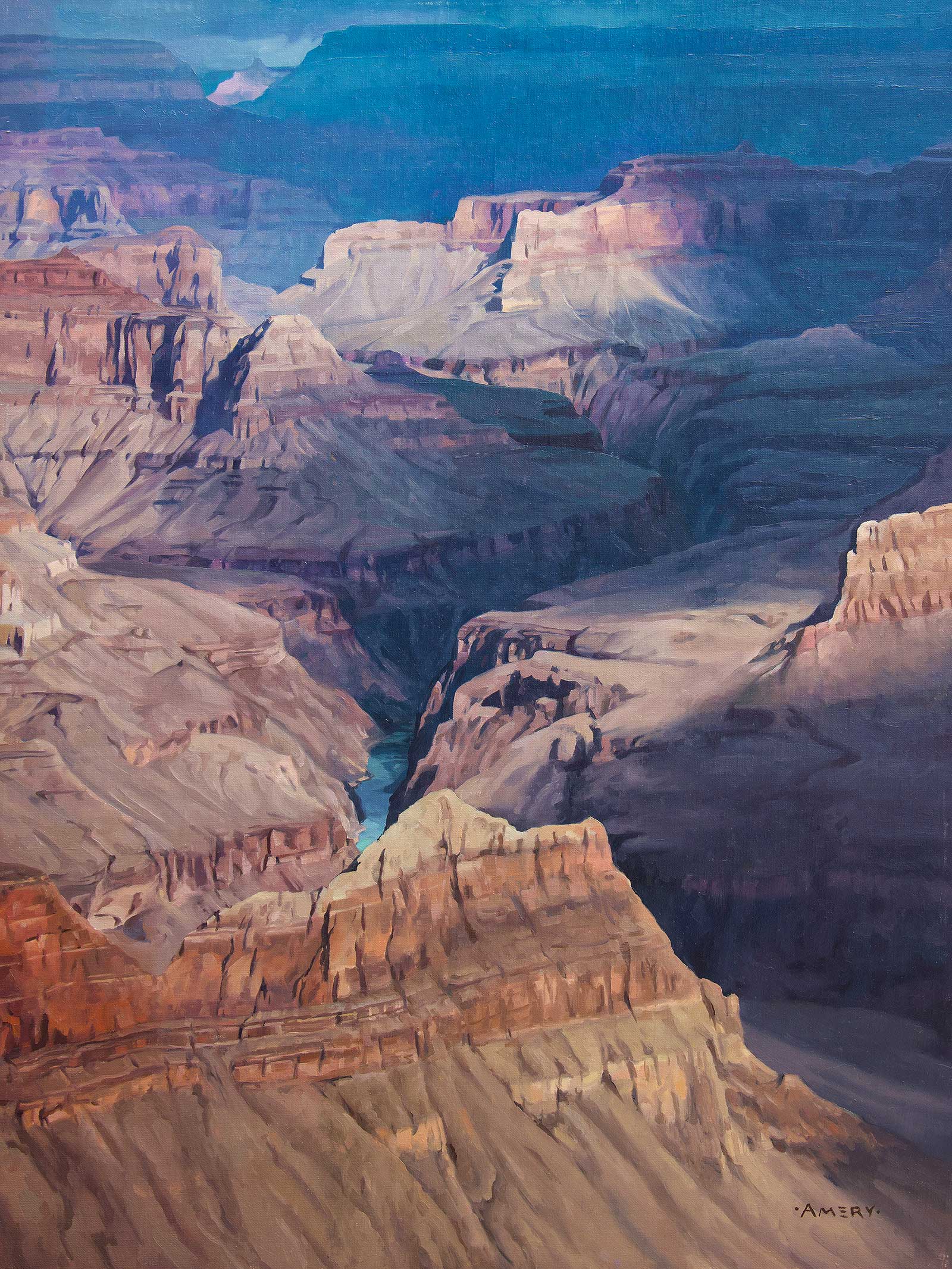
Born From Mud and Lightning, oil, 24 x 18 in.
Returning to sites multiple times, we experience them in different seasons, weather conditions and even states of mind. Bohling recalls being at the North Rim during a snowstorm. “It was socked in. You couldn’t see the canyon and no one was outside. From the lodge patio I walked out to a diving board type of point. It was all white. I couldn’t see anything. But I could hear the wind. It was a perfect moment.”
Staying in a bunkhouse at Havasupai Gardens on the South Rim in more auspicious weather, she recalls lying in the grass with curious deer eating nearby. “I felt most at peace there. It was like going home. This is where I’m supposed to be, wandering around in the quiet. I want to put that feeling of being connected into my paintings,” she says. “There is a sense of wonder. How could these colors be possible? You catch your breath at how steep it can be and realize how easy it would be to fall. I go to the canyon a lot and have a reverence for it. People sometimes make bad decisions and don’t survive. It’s tragic and so avoidable.”
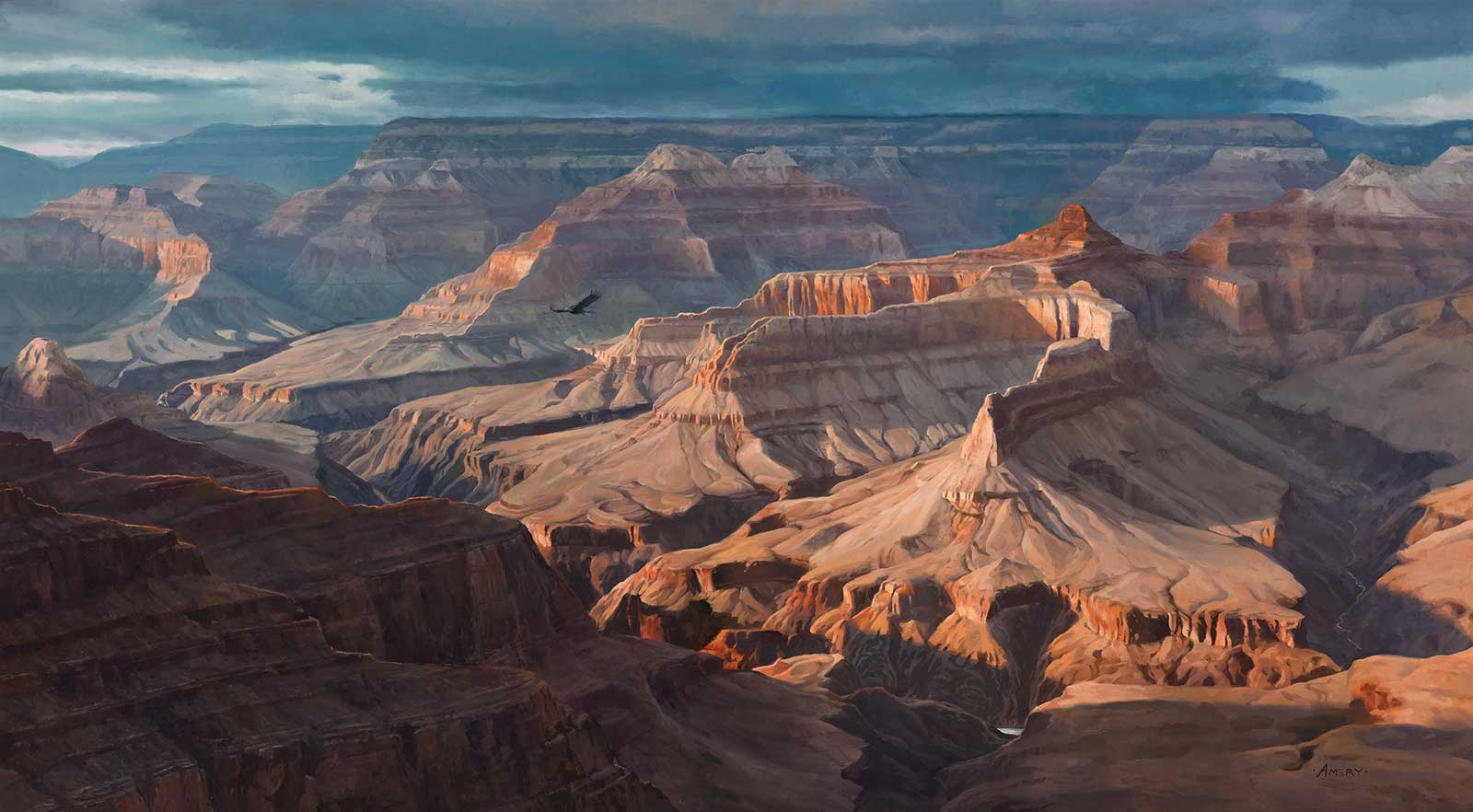
The Guardian, oil, 26 x 47 in.
When she was there most recently, she became acquainted with the work of Mary Jane Colter, the architect who worked with the Fred Harvey Company to create buildings throughout the park and establishing a style for buildings that would be built throughout the park system. Bohling discovered that Colter, doing men’s work in a male environment, was an avid smoker and liked to take smoking breaks “for some peace and quiet.” She found the site of two of Colter’s benches and visited them for her own moment of quiet.
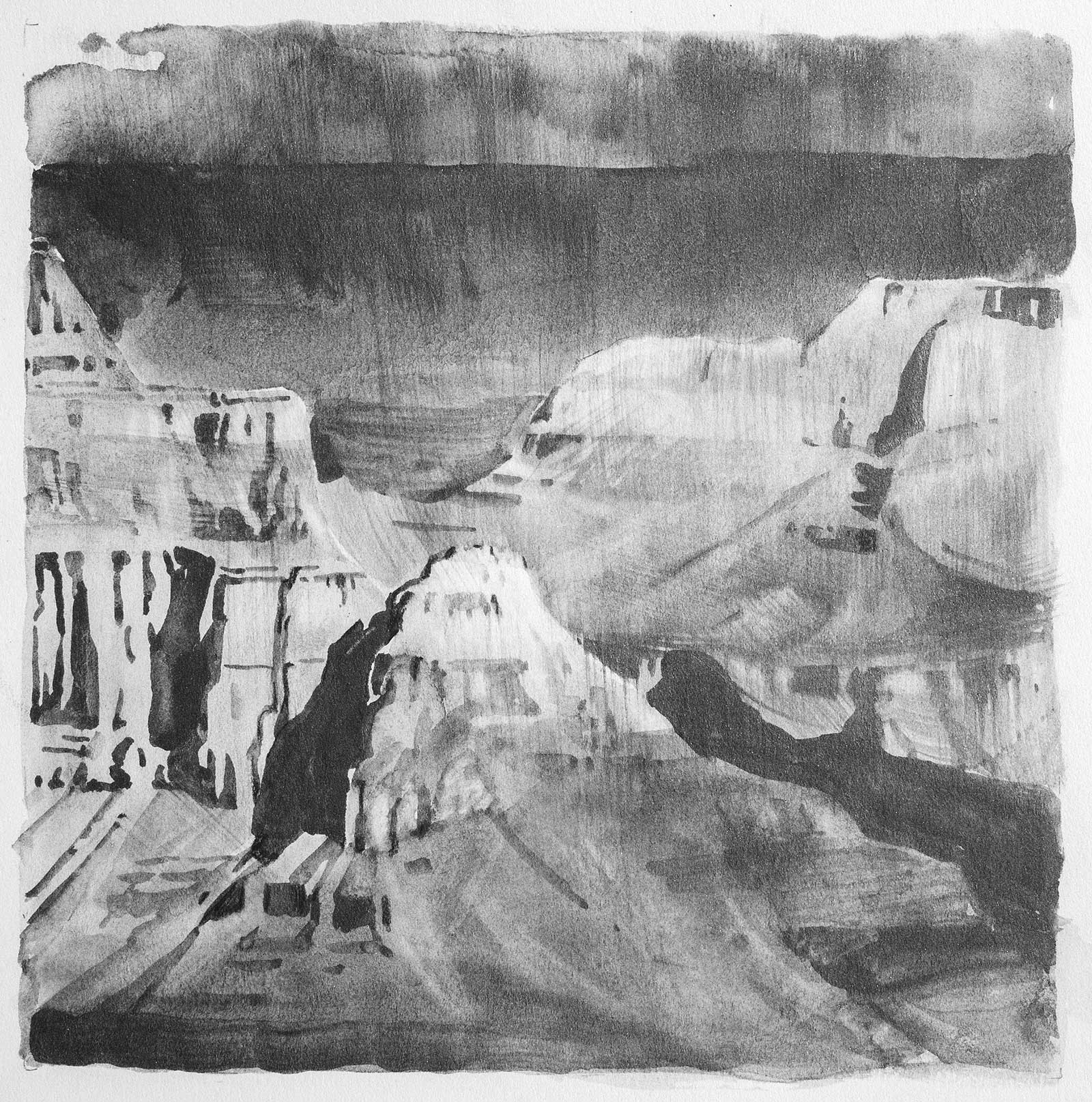
Canyon, graphite, 8 x 8 in.
The extraordinary detail and gradations of light in her painting, Lipan Point Reverie, are typical of her work. Warm light strikes the stone in the foreground and casts deep shadows. She softens the same intense light in the distance by using blues to create atmosphere.
Atmospheric haze permeates the entire vista of Distant Winds, Ancient Walls,detail vanishing into the pinks and blues of the far distance.
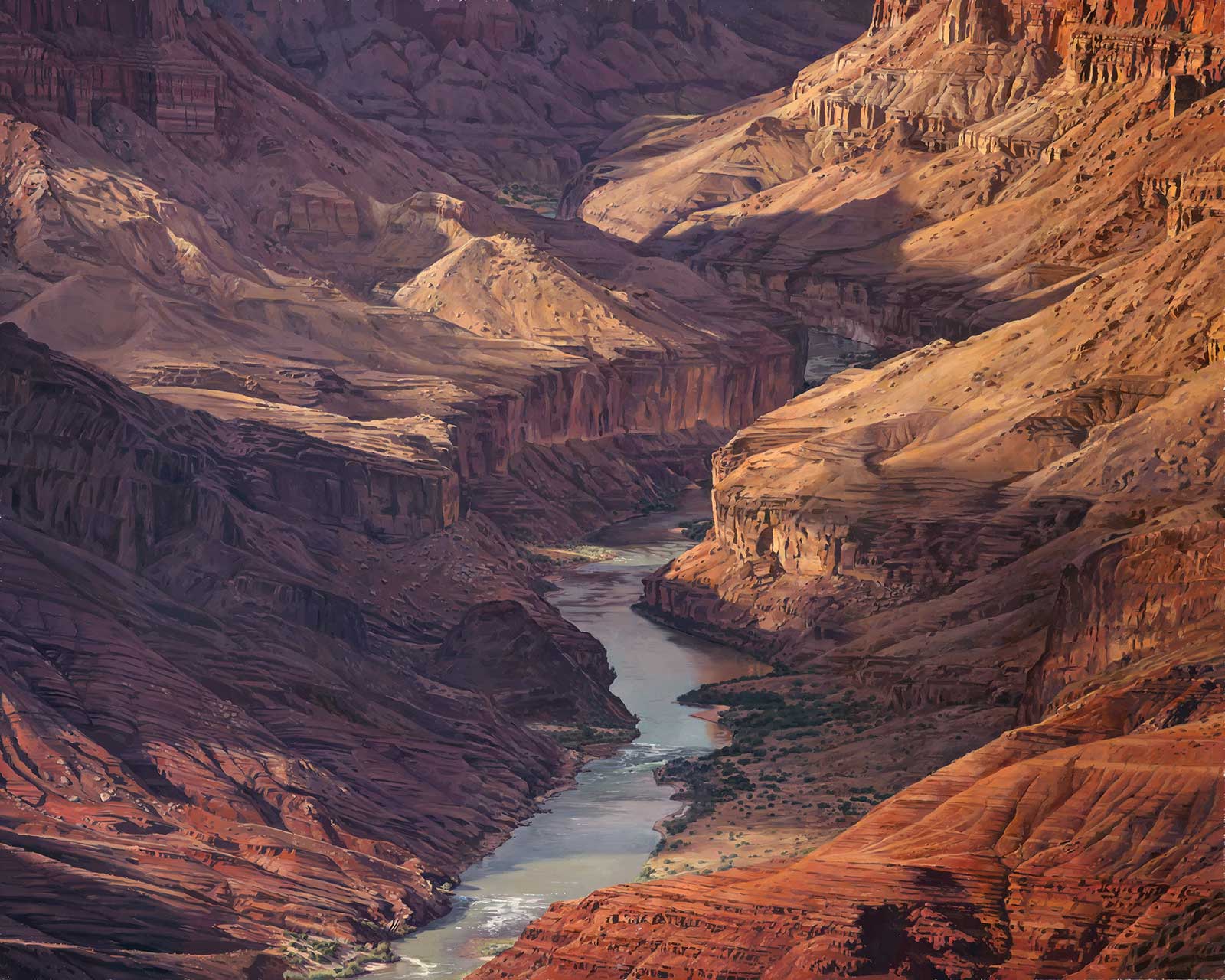
Reverence, oil, 40 x 50 in.
Bohling’s paintings of the Grand Canyon surpass the often-monolithic representations of others, revealing the strata laid down over millions of years and their changing response to weather and light. Her own emotional and spiritual response to the canyon echoes the feelings of the Indigenous tribes who called it home, and revere it as a sacred place and the source of their being. She is inspired to paint the canyon and to share her visual and spiritual feelings with other people. —
Powered by Froala Editor


