Great stories originate from great experiences, but they also come from being around the right people. And listening carefully.
New Mexico artist Kim Wiggins has heard some remarkable tales in his 65 years, including many from his parents—Walt Wiggins, a well-respected adventure writer, and Roynel Wiggins, a talented rodeo cowgirl—as well as their famous friends who influenced his own art career. He heard even more stories from his grandfather, who made a monumental impact on Wiggins’ life.
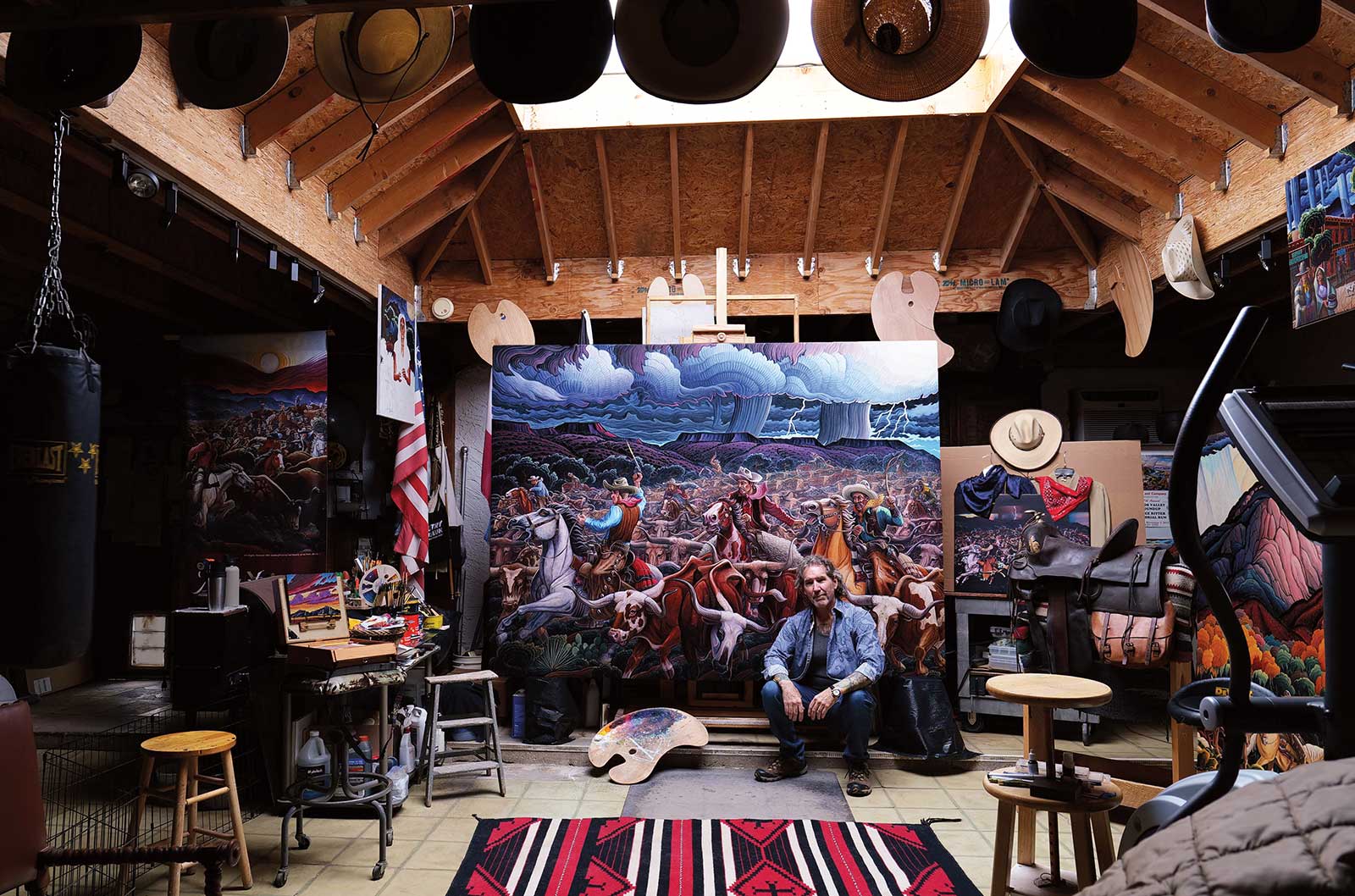
Kim Wiggins in his New Mexico studio with Chisholm Trail on the easel.
“That generation were raconteurs. They were natural storytellers. My grandfather, Walter Chesser, was a sheeprancher and a cowboy. He went on his first cattle drive at 14 years old to Abilene, Kansas, back before the range was all fenced off,” Wiggins says. “He would tell these wild stories. Once he rode into town very late and everyone headed to the hotel to get a room. He was the youngest, which meant he got the last pick. He had to beg the hotel owner for a room. ‘I have nothing left,’ the hotel owner told him. Well, he begged and pleaded some more and, finally, the hotel owner told him, ‘I have one bunk upstairs you can share, but you’re going to regret it.’ My grandfather, as tired as he was, he would have slept anywhere so he took it. Back then the cowboys would often share bunks, so he went into the room and there was the guy in the bed already. My grandfather put his saddle in the corner and got into bed in his long johns. He woke up in the middle of the night and the guy was freezing cold—he was dead! He scrambled out of bed and jumped out the window and fell into the street. ‘There’s a dead man up there! There’s a dead man up there!’ The hotel owner came out yelling, ‘Get in here! What’s wrong with you? They didn’t have room at the morgue, so they had to put him up there. I said you’d regret it.’”
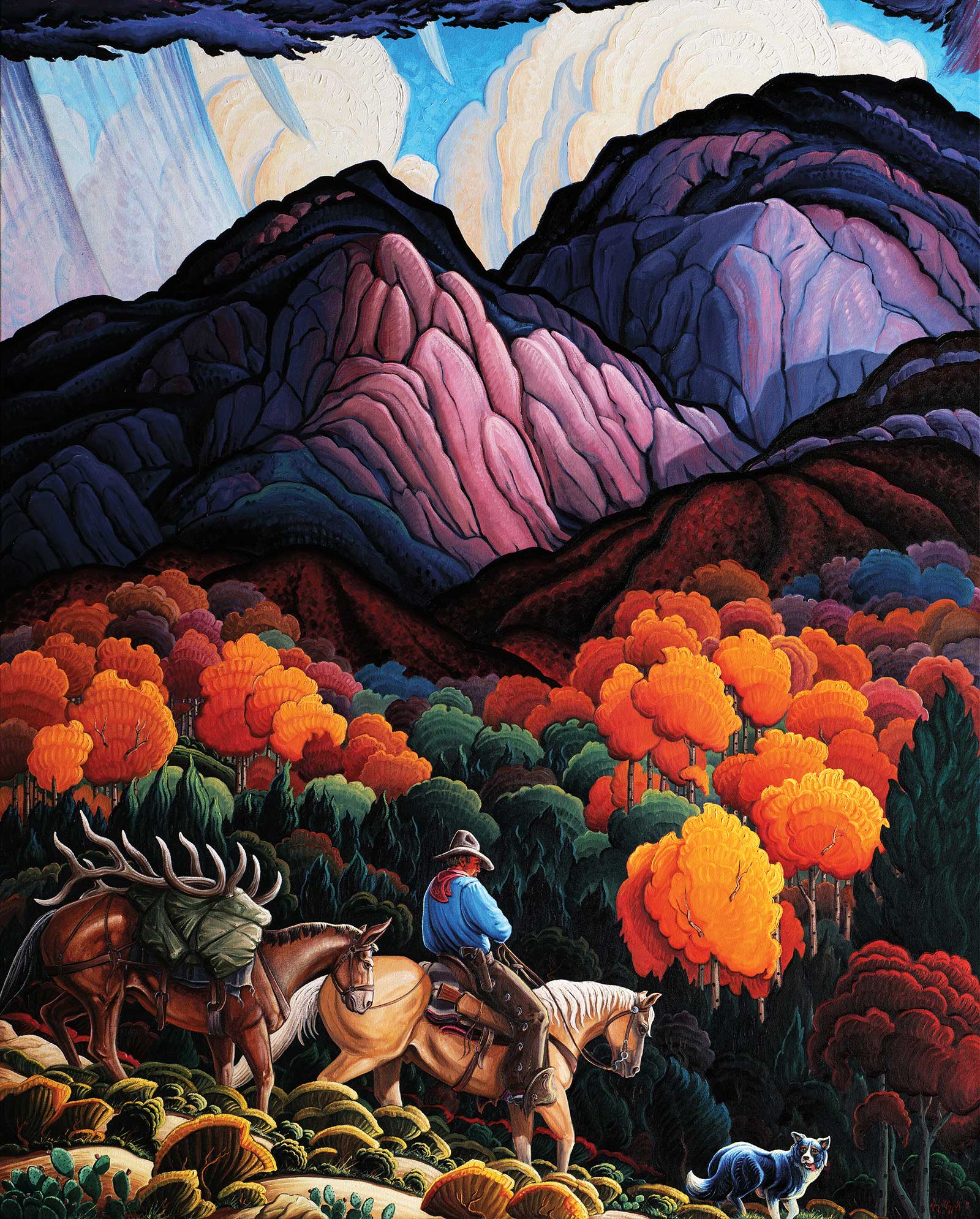
The Land of Buck Dunton, oil, 60 x 48 in.
The story, perfect in its delivery and punchline, is the kind of tale only a cowboy with experience would know. A question begged to be asked: Did Wiggins believe it? Not that his grandfather lied to him, but maybe he embellished here and there.
Wiggins ponders this for a moment.
“He was a great storyteller. Was he really a cowboy? Yes. Did he work for the San Simon Cattle Company? He sure did and was even listed as one of their cowboys. Did he embellish the story? I don’t know, but I know he experienced a lot out of life and that wasn’t the only good story he told me,” Wiggins says, adding that he is inclined to believe his grandfather’s exact account, and if there were any embellishments at all it was in the delivery of the story itself. “The way a story is told is what helps it persist. And my grandfather knew how to tell a story.”
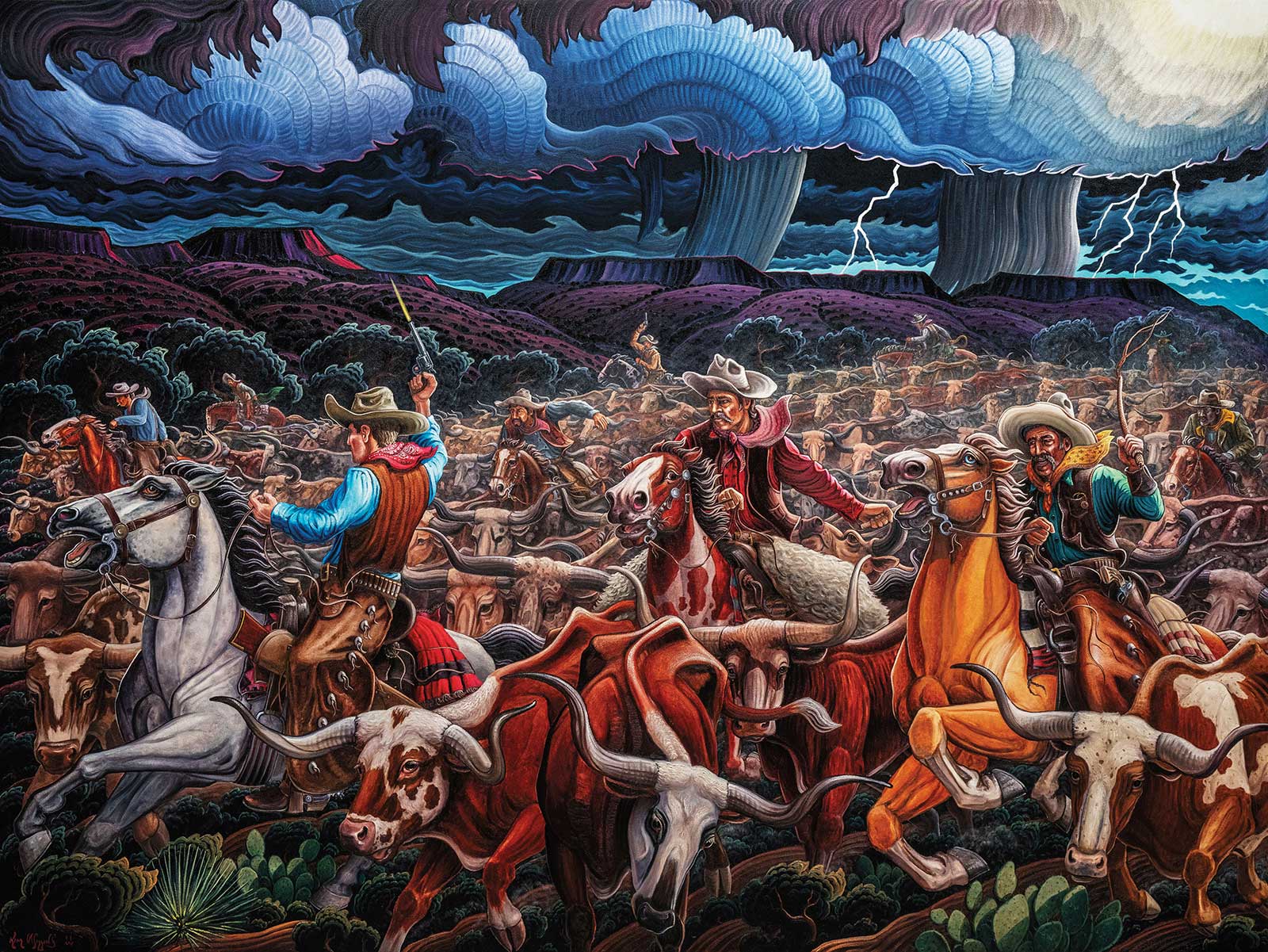
Chisholm Trail, oil, 72 x 96 in.
For Wiggins, an artist whose storytelling language is visual in nature, this idea that reality and its reflection could differ, sometimes greatly, can be seen in his paintings. The artist takes the Southwest and runs it headfirst through his mind’s machinery that transforms this iconic imagery into completely unique visions of the West. His “embellishments” include a genre-bending color palette that is absolutely fearless, a bendy and uneven stylization of the landscape, heightened action that can condense epic narrative into a single composition bursting with life, brushstrokes that add uniform texture to his scenery and clouds, and a delicate sensibility for what makes the Southwest so pure and transcendent. Wiggins is also unapologetically sentimental about his love for his subjects—the long-forgotten romance of the West is not lost on him.
All of this will be on view at a new solo exhibition for the artist on November 9 at Legacy Gallery in Scottsdale, Arizona. Titled The Unexpected West,the show will feature more than 20 new works. It’s not Wiggins’ largest show—years ago, before he was so celebrated in the West, he had a New York City show with 40 paintings—but he freely acknowledges it’s his most important, with large masterworks and incredibly varied subject matter, from the Arizona desert to Santa Fe nights to images far outside the West. With the spirit of his grandfather smiling down at him, they’re all opportunities for stories to be told and embellished upon.
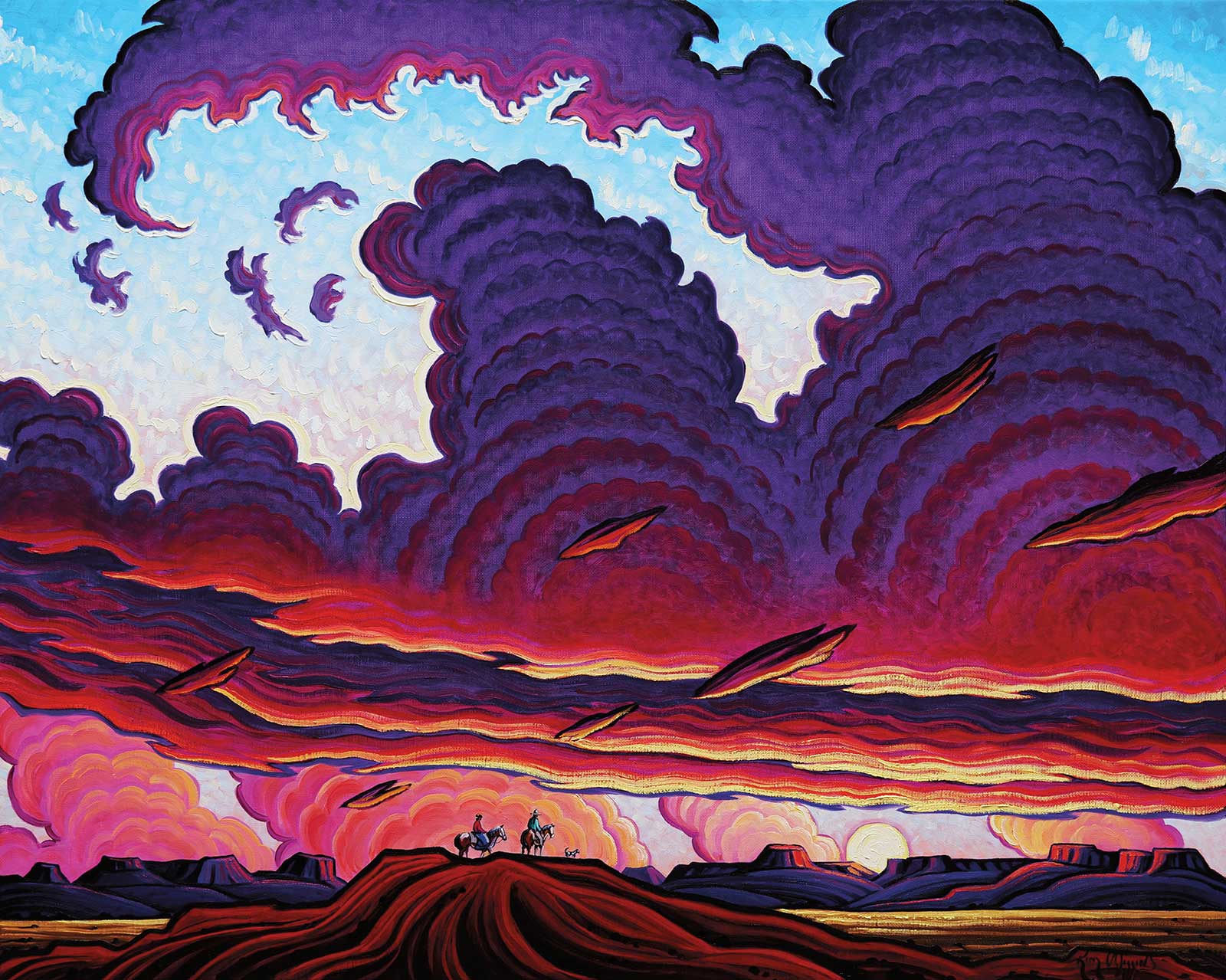
Navajo Dawn, oil, 24 x 30 in.
“My subjects are different than most Western artists, that’s why it’s called The Unexpected West. It’s more than a cowboy and an Indian on a horse, and certainly more than what you see in a John Ford or John Wayne film. These works span time and cross boundaries. They involve wars and migrations of people, businessmen and soldiers, cowboys and poets, farming and ranching, religion and industry, and the history of all those things,” Wiggins says. He points to one of the works, Along Tornado Alley, as an example of how his mind drifts outside the normal parameters of “Western art.” In another work, The Spiritualist, he turns his attention to a Southern bayou and Cajun seer surrounded by magpies. In yet another, he paints the sign for the highway attraction “The Thing,” which occupies a fuzzier and more mysterious part of Western lore.
In his largest work in the show, Chisholm Trail, a behemoth measuring 8 feet wide, Wiggins paints 10 cowboys (three featured prominently in the center) and what must certainly be more than 100 cattle thrashing under a tumultuous thunderhead. He says the show was built around the painting, which is meant to “embody the very heartbeat of the Old West.”
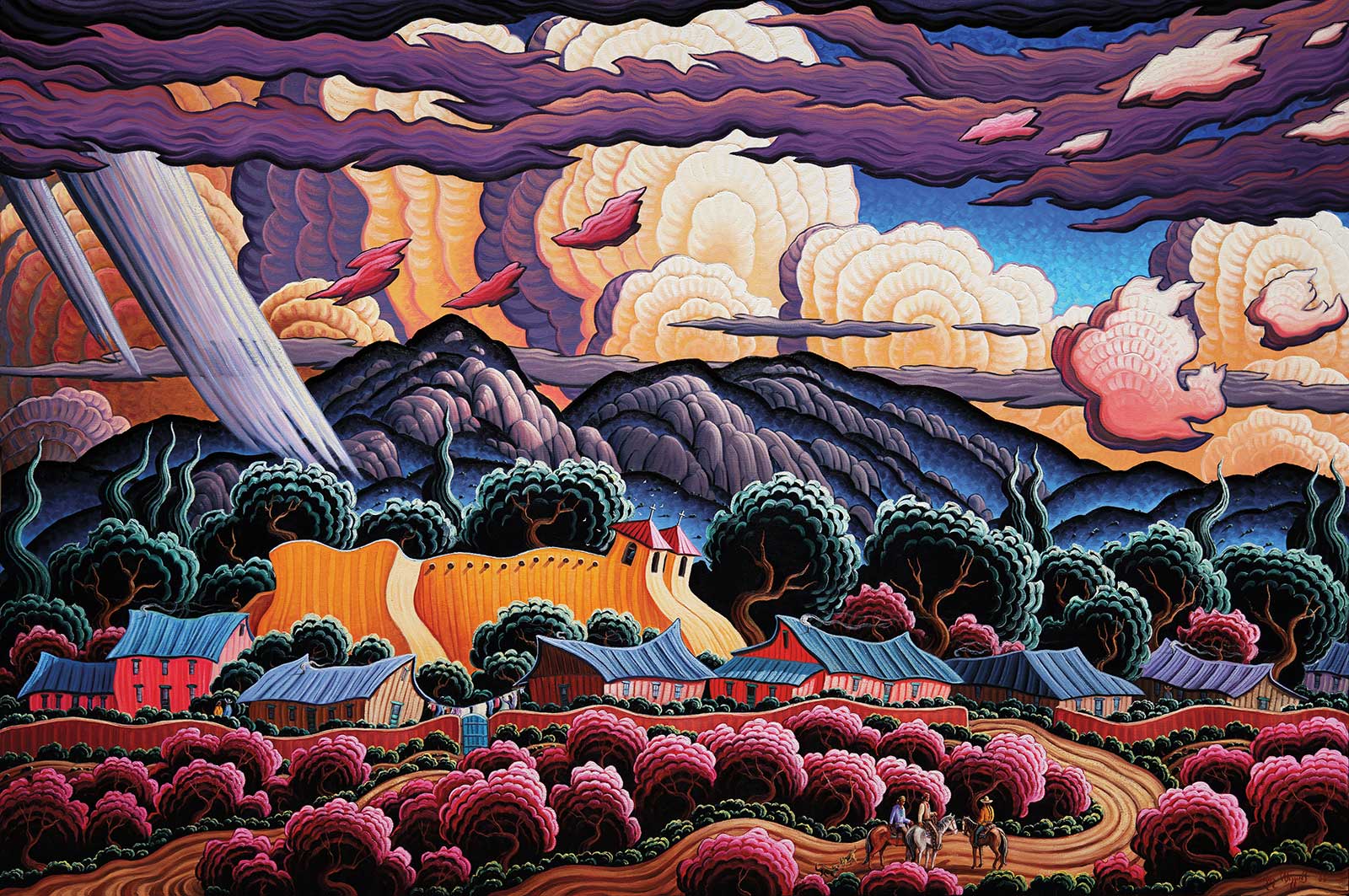
Spring Along the Llano Quemado, oil, 48 x 72 in.
“Much of the history of the American West centers on and around the life of the cowboy. Today he has come to symbolize the spirit of the American West. The birth of the truly great American cattle drives began in late 1866. Massive herds of longhorn cattle were gathered in Texas and driven to isolated military outposts, reservations and burgeoning Western cow towns. The Chisholm Trail was one of those key cattle trails traversing the untamed West. This monumental painting is the largest work I’ve done in 12 years,” he says. “Chisholm Trail depicts a massive stampede along a difficult journey from South Texas to Abilene, Kansas. It symbolizes the fiery passion, grit and self-determination which formed the American West. Through the centuries the cattle stampede has come to embody mankind’s ability to overcome unsurmountable odds amid life’s most daunting challenges.”
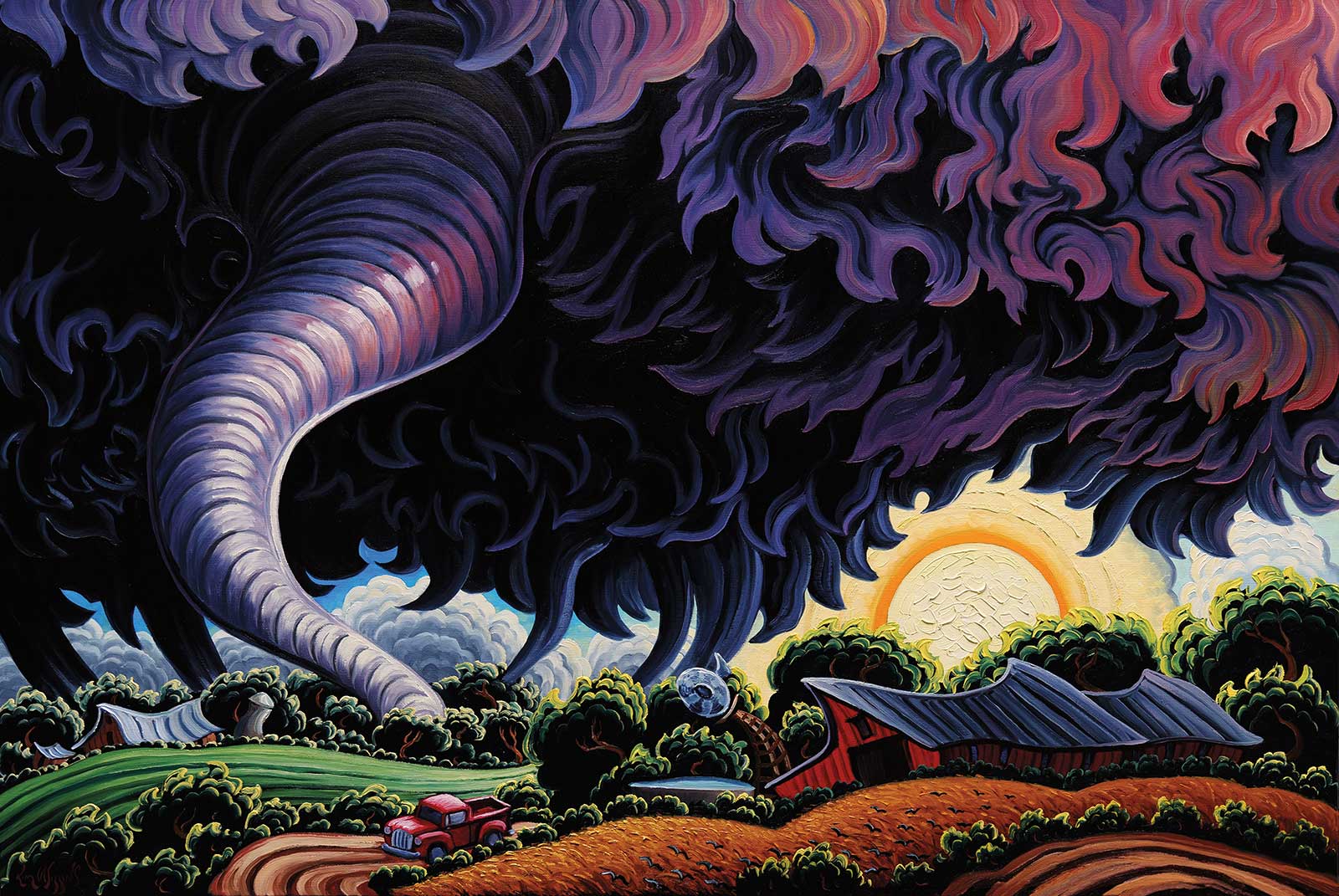
Along Tornado Alley, oil, 24 x 36 in.
Wiggins has had his own unsurmountable odds in his career, and yet he’s found a way to persevere. He frequently talks about his early impressionist period, during which he couldn’t recognize his own work from across a room. That realization devastated him, which is how he found his way to his more unique way of painting. Less discussed is that storied earlier background and all the famous people he was surrounded by. Both his parents were talented, and his father went on legendary quests for men’s adventure magazines, from boar hunts in Hawaii and moose hunts in Canada to cattle drives in the West and treks deep into the jungles of South America. And then there were all the famous artists that Wiggins had met or had access to: William Lumpkins, Thomas Hart Benton, Alexandre Hogue, Georgia O’Keeffe, Peter Hurd, Henriette Wyeth and many others. How did Wiggins ever find his own voice amid so much fame and talent?
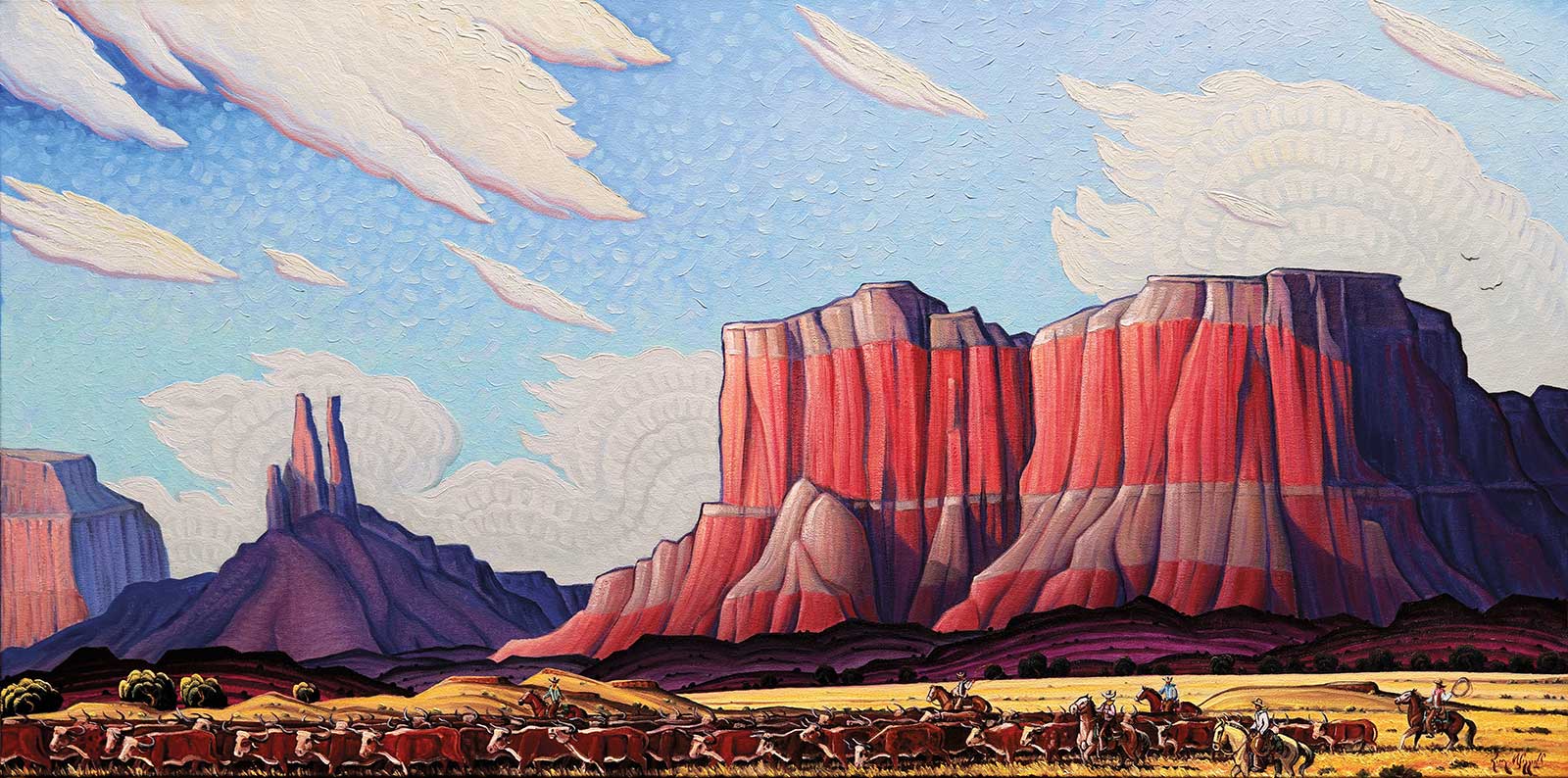
End of the Day, oil, 24 x 48 in.
“I felt overshadowed being around so many great people. But none of the people I had met, at least in my eyes, could compete with my father. In one year alone he had 13 magazine covers. He was huge in my eyes. My parents did know so many people, particularly because of my father’s job and I never realized how important they were until I was older. Competition wasn’t something I really thought about, but I think it did register on my life,” Wiggins says. “My father died when I was 33 years old. I never painted a horse until after my father passed away. It shows how intimidated I was, because my father knew horses like nobody’s business. I did show him my paintings. The day before he passed away, I took him a painting. It was a symbolic kind of still life. He looked at it and smiled. I had worked with him the last eight years of his life. Every day I was there with him. He told me, ‘The word critique comes from the word criticism. It only works if there is honesty. Whatever I tell you, don’t change the painting. Use it as guidance to change the next one.’”
Through grit and determination, as well as some energetic reinvention, Wiggins has found himself to the top of the Western art world, where his works tell his story for him. For his part, he doesn’t take a lot of the credit. He praises his children and his wife Maria for supporting him through all the ups and downs. And he credits a higher power frequently.
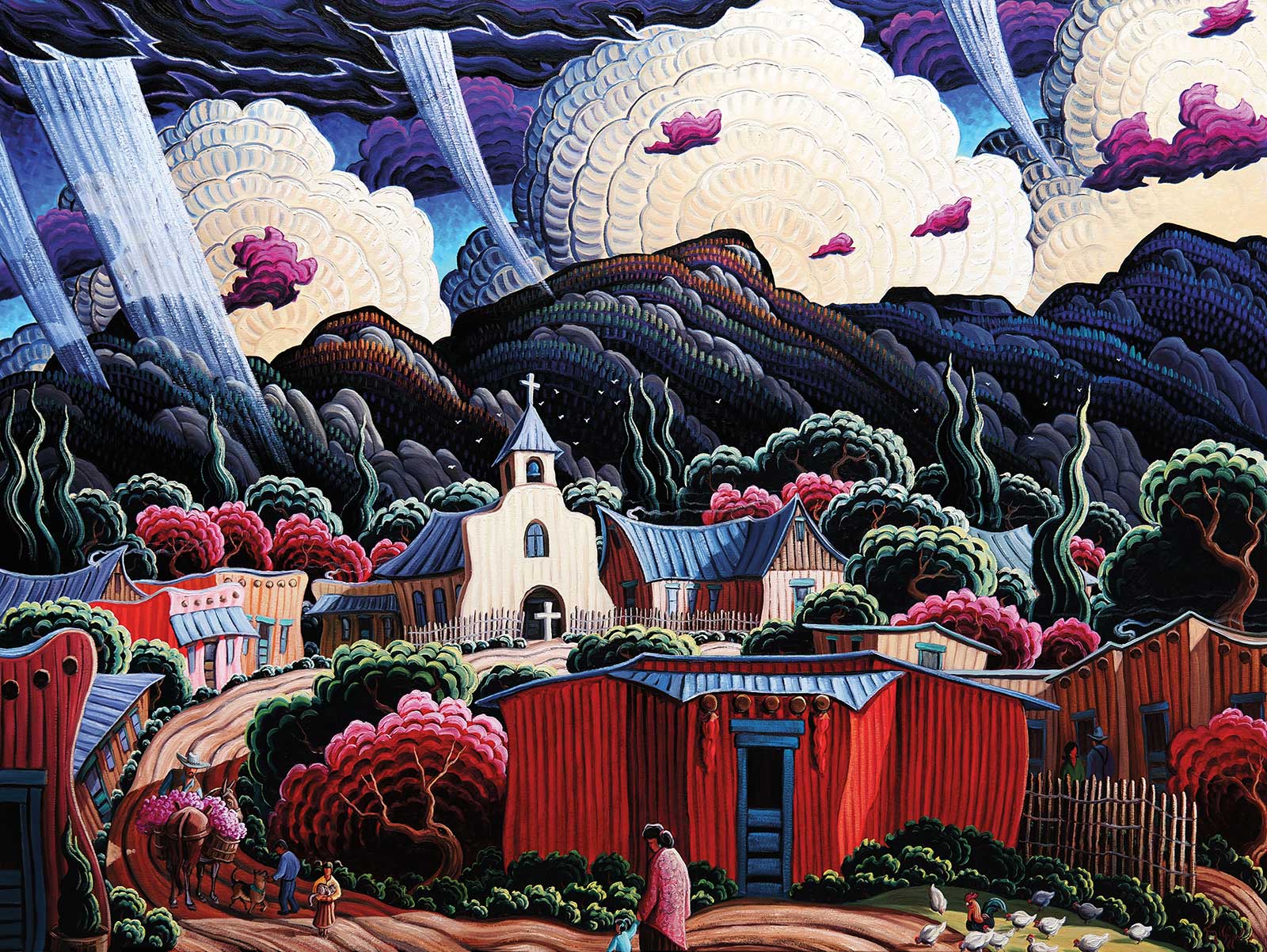
Fall in Rio Arriba, oil, 36 x 48 in.
“I recognize my skill as a gifting from God. Like any gift, I have to have the discipline of hard work. I’ve put in my 10,000 hours,” he says. “I’ve also been given mentors and people to help me. No man is an island. The reason I think this gift has been given to me is because I am supposed to record and create a record of the society we live in. I’m meant to record these stories because I believe the West is the most iconic aspect of who we are as a people today. I’m not just talking Russell, Remington and Leigh. I’m talking about potters, weavers, painters, artists of all kinds. It’s everyone. The West is the greatest foundation of our society. It’s how we identify as a people. It’s who we are. It’s our story.” —
Kim Wiggins: The Unexpected West
November 9, 2024
Legacy Gallery
7178 E. Main Street, Scottsdale, AZ 85251
(480) 945-1113, www.legacygallery.com
Powered by Froala Editor


