A quick Google search will tell you Carrie Wild is from Michigan. As a kid, she showed horses and loved drawing. In high school, she picked up a camera and later a brush. Internet biographies are peppered with points of parity like “loves of the outdoors” and “passion for art from an early age.” If you were to read everything that’s been written about Wild (hypothetically speaking, of course), you’d be left with a sense that she’s like most other artists. Take a look at her work, and you’d wonder if there’s more to the story.
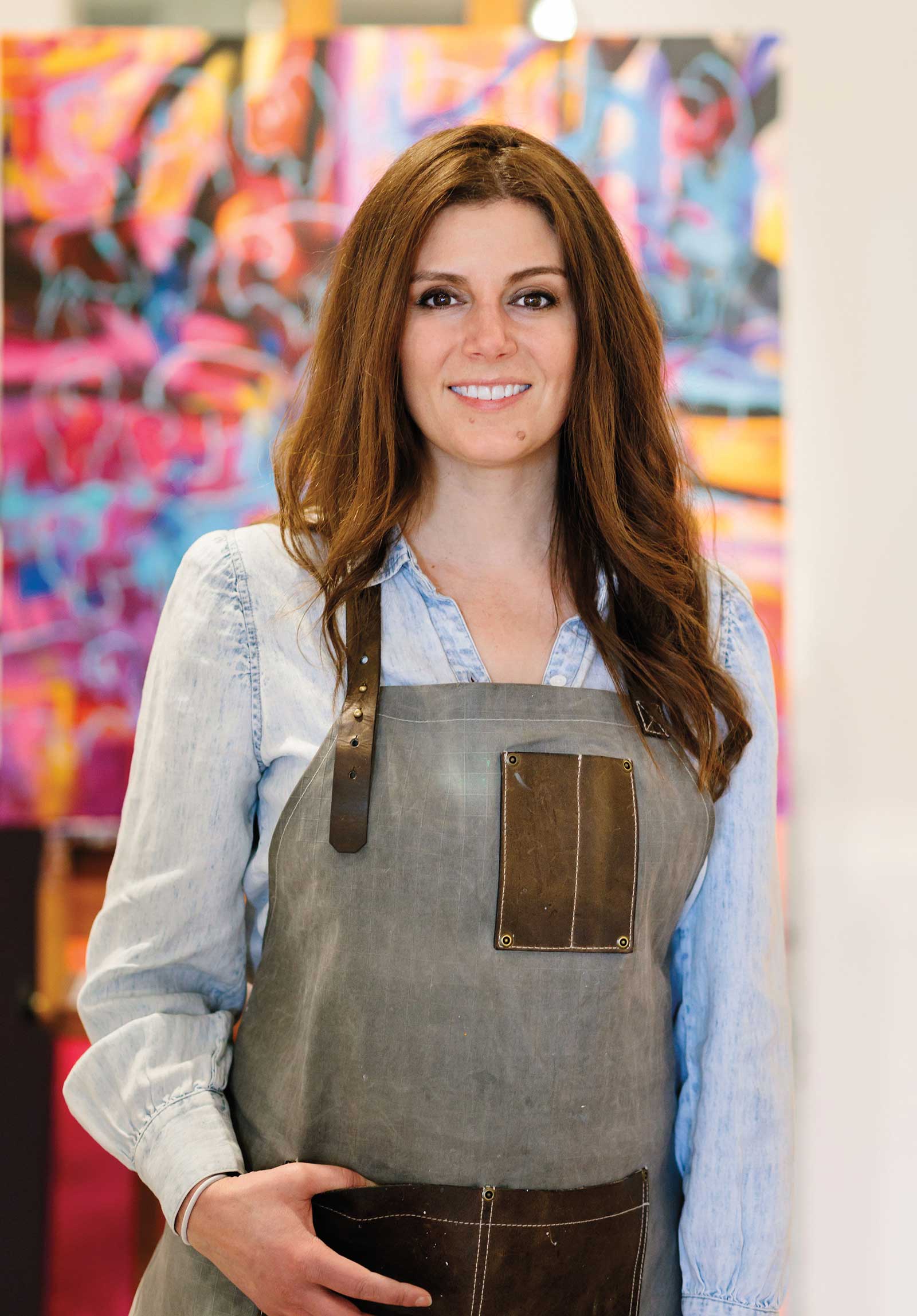
Carrie Wild in her Wyoming studio. Courtesy the artist.
“Intimidating” is a word used to describe Wild, who juggles four galleries, two kids and an art practice of her own. It’s tough to get her on the phone, but when you do, you leave the conversation feeling like you should grab a beer next time you’re in the same place. Folks who initially find her intimidating often feel the same way once they’ve broken through.
Wild is generous when speaking about other artists. She hates talking about herself. Artists she represents will tell you she’s open to experimentation as long as nobody brings in a green canvas. As a painter herself, she’s sympathetic to the struggle—even when they drop off “sopping wet” work to her growing empire of galleries across the West. Talk to enough people in Jackson, Wyoming, where she calls home, and you’ll discover she’s a polarizing figure in the local art community. Powerful women and painters who stray from the straight and narrow road of realism often are.
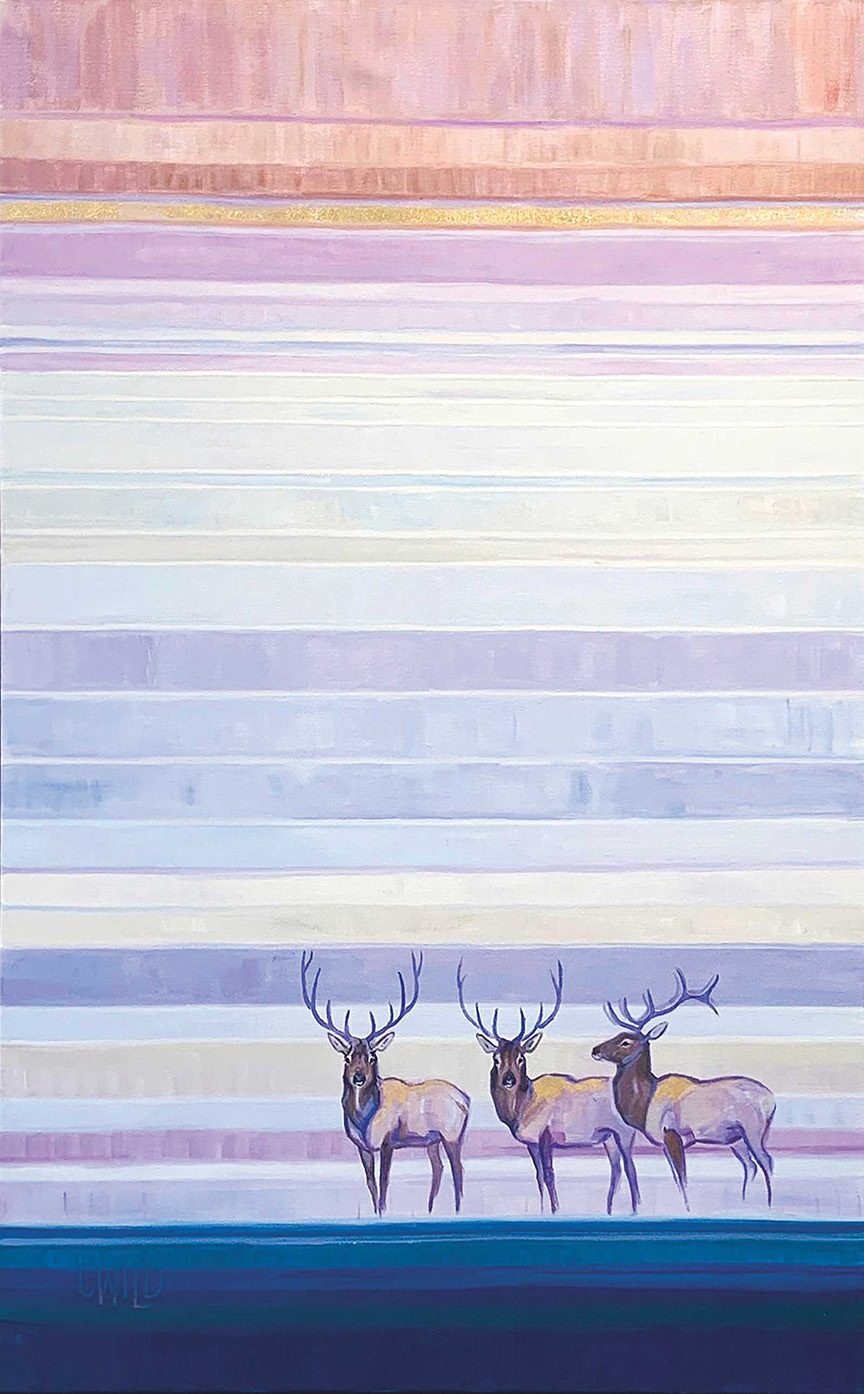
Up With the Sun, ca. 2020, acrylic and gold leaf on canvas, 48 x 30 in.
As an artist, Wild is best known for her Rendezvous series—canvases packed with contour drawings of wildlife—sometimes backed by a neutral wash of cave-wall white, sometimes screaming with color and flecks of gold. A glance at Gallery Wild’s sold section tells you she’s turned out at least 100 pieces in this style, probably more if you can decode the numbering system she uses for titles.
These pared-down forms come from observing wildlife from a distance, she explains. All you see are their edges, movement and interaction with the light and one another. Photographing wildlife informs her work, and, as the legend goes, led to a very Wyoming romance. When Wild met Jason Williams, an outdoor guide and wildlife photographer, she invited herself to tag along and take reference photos. Wolves, second dates and marriage ensued.
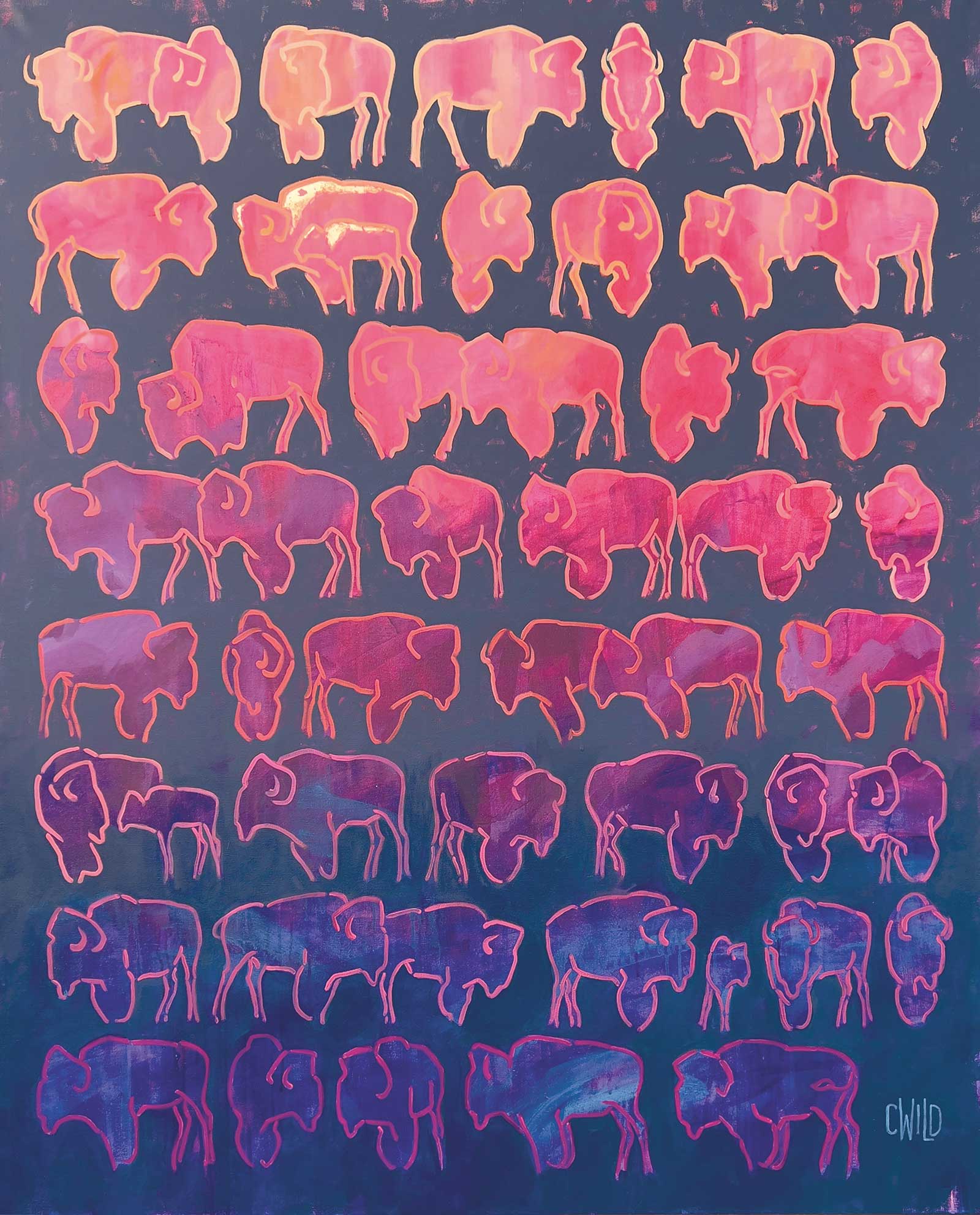
Rendezvous in Color Fifty One.0, 2023, acrylic and gold leaf on canvas, 60 x 48 in.
Deceptively simple, Wild’s contour paintings of bear and bison distill the figure down to its most essential, like Picasso’s study of the bull. If you think your kid could do that, you probably haven’t spent much time with a brush in hand. If you have, you’ll appreciate the skill it takes to get it right in a single stroke. Calligraphers across Asian and Arab cultures spend lifetimes perfecting each gesture. Similarly, Wild’s hand is studied and steady.
Wild’s repertoire includes fully rendered forms as well—her herds of elk in pastel bands of color are particularly successful in execution. Tammi Hanawalt, curator at the National Museum of Wildlife Art, cites Wild’s knowledge of art history. “I think it’s interesting how she uses colors like color field artists, catching different layers of color in the landscape and kind of zeroing in on that,” says Hanawalt. “How to use color, how we think about color, the colors she chooses, they’re really bold and they’re attractive. I think that is a really interesting approach on how to broaden our understanding of wildlife art by giving us a different perspective and a different perception of it.”
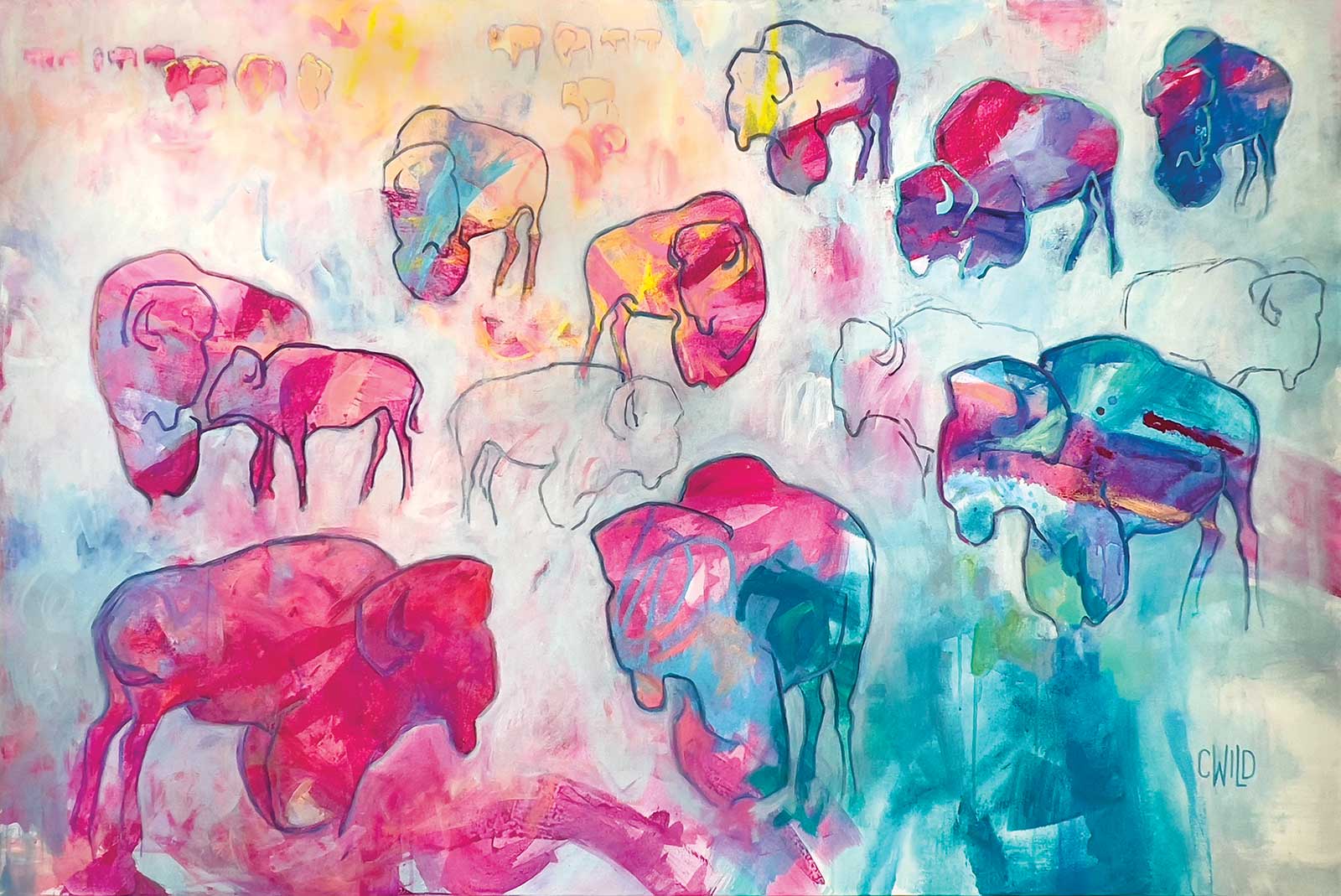
Lives in Daydreams, 2024, acrylic and gold leaf on canvas, 48 x 72 in.
A bison composition in candied, Warhol color will be part of this year’s Western Visions show. When Wild’s work is at the museum, visitors take notice. “Realism is pretty prevalent in our shows—with wildlife art—so seeing something that’s a little bit different is really attractive to people,” Hanawalt continues, adding that being a woman in the genre also sets Wild apart. “It’s still a male-dominated field, I think.”
With eponymous galleries in Jackson and Santa Fe, running Altamira Fine Art with Williams, a solo exhibition during this year’s Jackson Hole Fall Arts Festival, and a body of work to create for the Coors Western Art Exhibit & Sale in January, Wild has no time for boredom. A day in the life might entail shipping and receiving, hanging shows at any of her four galleries, checking in on her multiple stables of artists, fielding calls from press, taking her car to the shop, raising two girls and working on her own art.
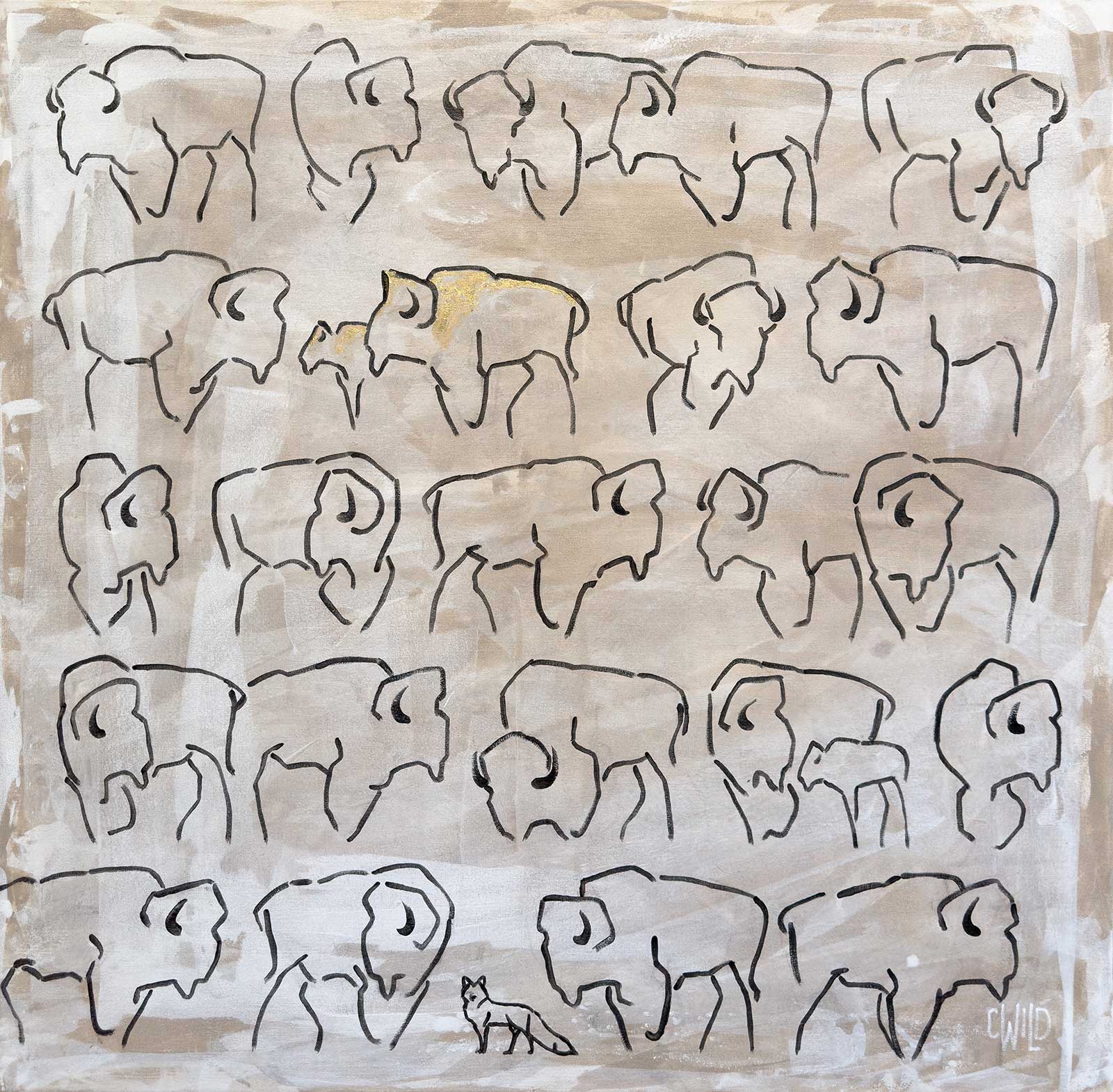
Rendezvous Twenty Five.4 and a Fox, 2024, acrylic and gold leaf on canvas, 40 x 40 in.
Wild’s studio is in her gallery, so even when she carves out time to paint, interruptions are probable. “Anyone can walk into my studio,” says Wild. “I found over the years that I would take art into a gallery and then I would never see it again and there was a loss of connection for me.” Opening her studio to the public flipped the script. “I really enjoyed seeing that interaction and passing on the energy of my inspiration in my moments in nature that I was translating onto the canvas,” she adds.
Idaho artist Aaron Hazel and Wild were in orbit for a few years before working together. They ran into one another at events and were with the same gallery in Bozeman before Wild opened her own space. “I liked her work. I thought her work popped and had such a spirit and energy to it. I knew she was kind of killing it. I think that everyone kind of knew that,” says Hazel, who was impressed with everything about her. “Carrie Wild: A, what a great name, and B, she was doing really well. She was in magazines and things already. But you know she’s not that old. So I was like, man, she’s already opening her own gallery. This is crazy.”
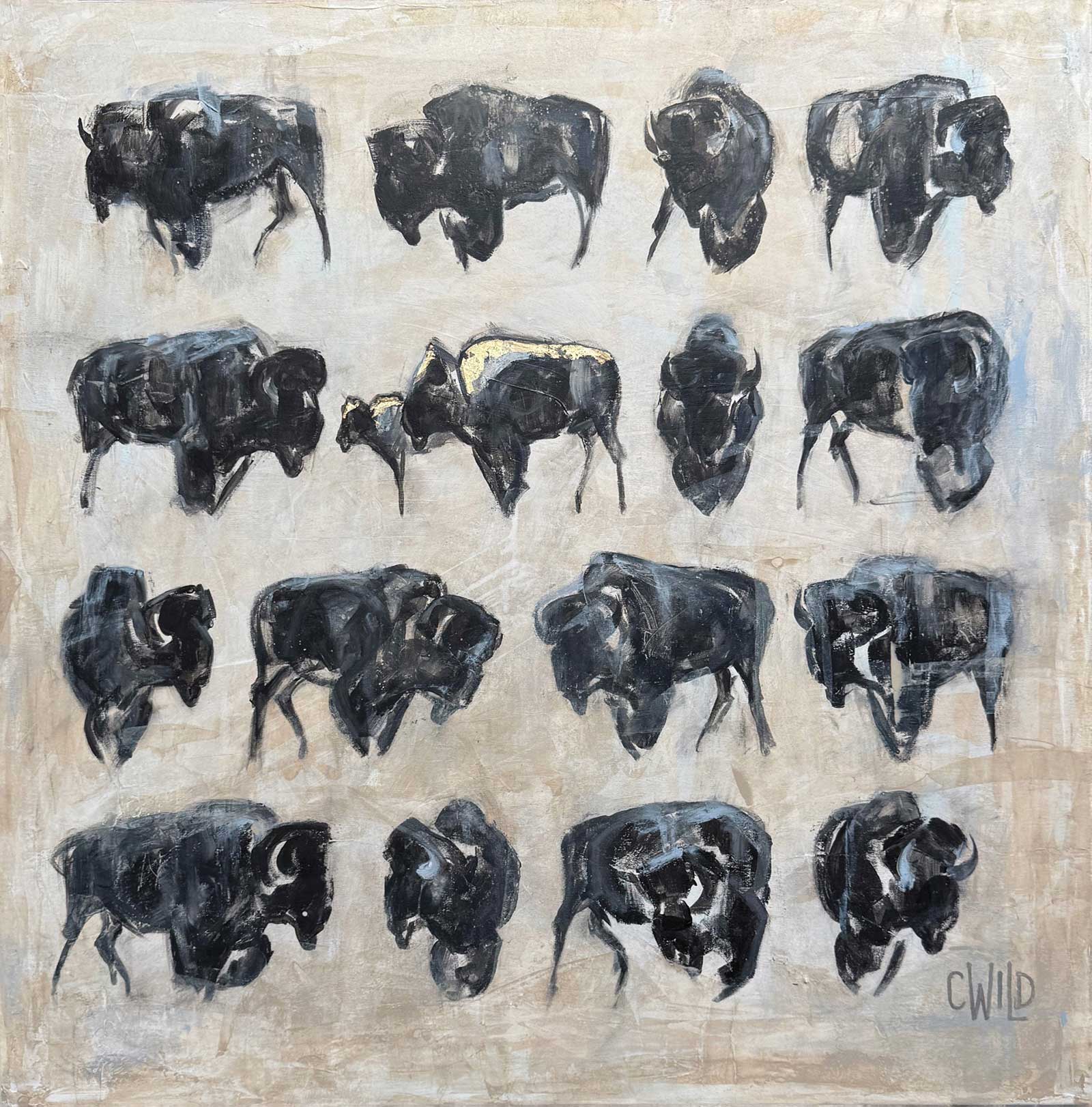
Rendezvous Seventeen.0, 2024, acrylic and gold leaf on canvas, 30 x 30 in.
Hazel had other representation in Jackson at the time, but kept Gallery Wild on his radar as they began to exhibit other artists in addition to Wild’s work. “So she initially brought on just mainly wildlife artists and then a lot of women artists. I thought that was super inspirational because most of the artists were women, and so that was pretty sweet, how she’s representing Western women in Western art,” Hazel remembers. Later, Gallery Wild broadened its programming to include neon, landscapes and, with Hazel, figures. Its current roster celebrates wildlife, preservation and regionality.
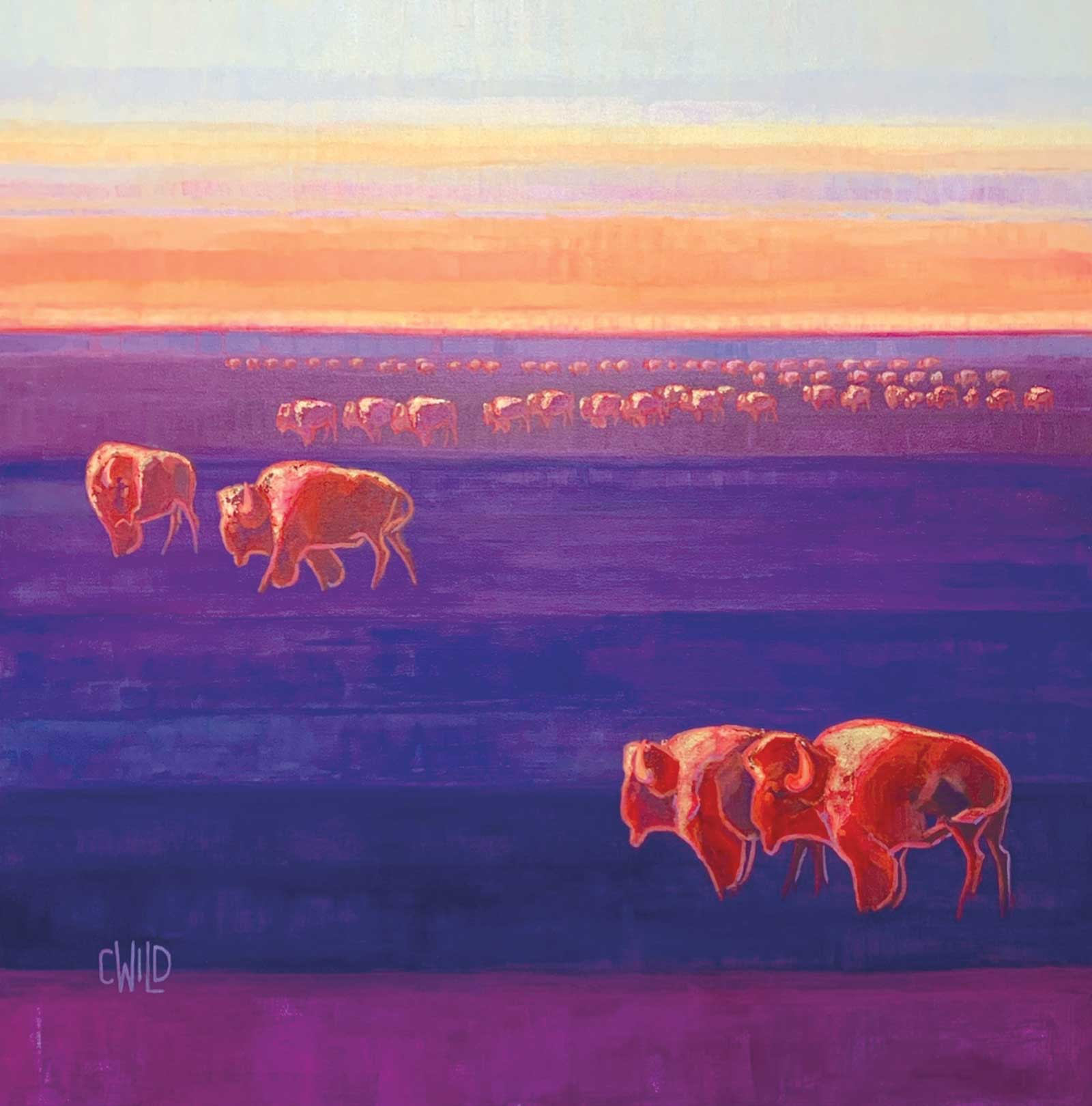
The Wind Roams Free, acrylic and gold leaf on canvas, 48 x 48 in.
“[The gallery is] light, bright, airy, the music, there’s windows everywhere, and it’s approachable,” says Hazel. “I think that’s what made it so exciting to be a part of. I feel like when you walk in Gallery Wild—and that’s thanks to her and her team—you just feel at peace and you feel welcome and you can just kind of hang out. I think the art reflects that. There’s a fun element to it.”
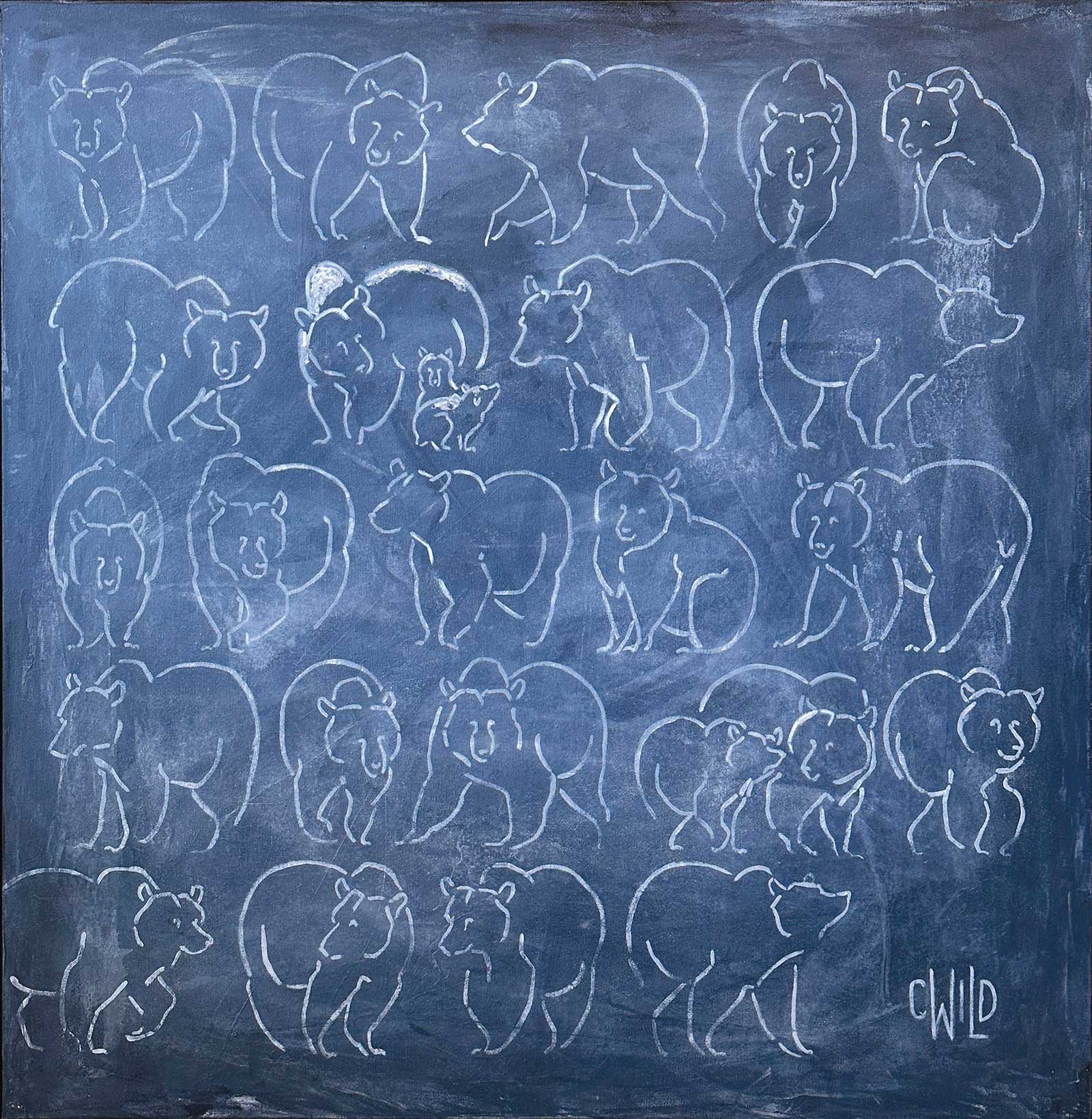
Rendezvous Nocturne Grizzlies Twenty Six.0, 2023, acrylic and silver leaf on canvas, 36 x 36 in.
When Wild and Williams bought Altamira Fine Art last year—with locations in Santa Fe and Scottsdale, Arizona—they brought that same down-to-earth sensibility. “I got the news that Altamira was being sold and there was this really successful, energetic young couple taking over,” Arizona artist Geoffrey Gersten says. “I was very, very cautious at first. And then I found out they were just totally lovely people who are really trying to actually have a relationship with the artists in a way that I’ve never experienced before.” Normally, when a gallery owner comes by your studio it’s to have a serious discussion, says Gersten. Wild and Williams just came by to hang out.
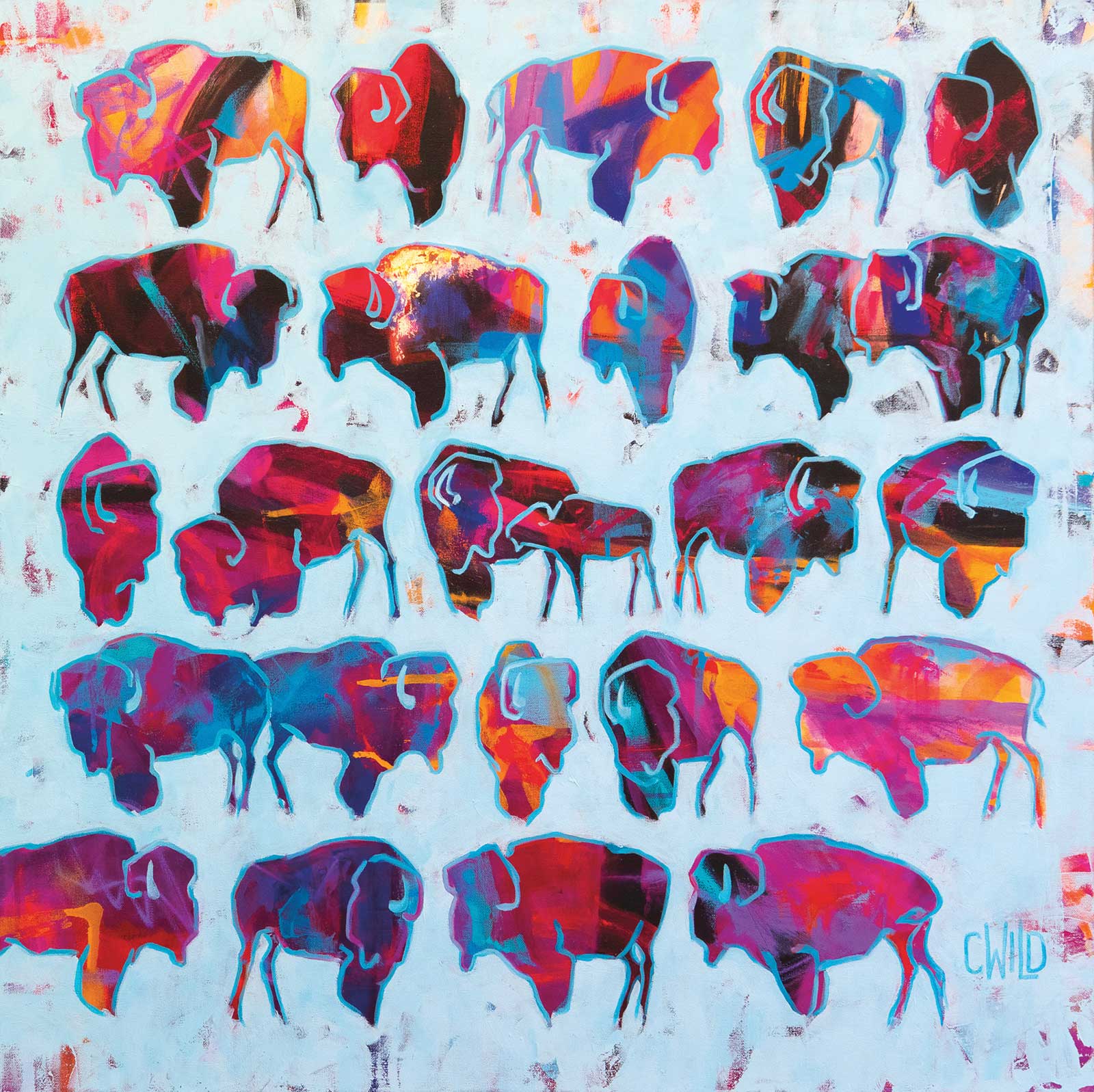
Rendezvous in Color Twenty Five, ca. 2019, acrylic and gold leaf on canvas, 36 x 36 in.
“At the same time, she’s working with all these other artists, and running the galleries, and the staff, and accounting, and expenses, and labor, and everything is so much work,” says Gersten, who owned a gallery years ago and now leaves it to the pros. “Somehow she manages to also paint and focus on creating something beautiful—which is, in its own way, like a hero’s journey.”
“Whether she’s putting them in a positive or using negative space, she does this sort of repetition of the animals and they’re very exciting. They’re really beautiful to look at. I mean, when you see them, they’re all so signature. You know immediately that’s Carrie Wild,” says Gersten. “She has accomplished something that hardly any artist actually creates, which is a signature look that is really identifiable.” Gersten recalls an adage about finding something you love, isolating it, making it your own, and propagating it. “That’s what she did. And that’s really hard to do. It sounds easy, but it’s not,” he says.
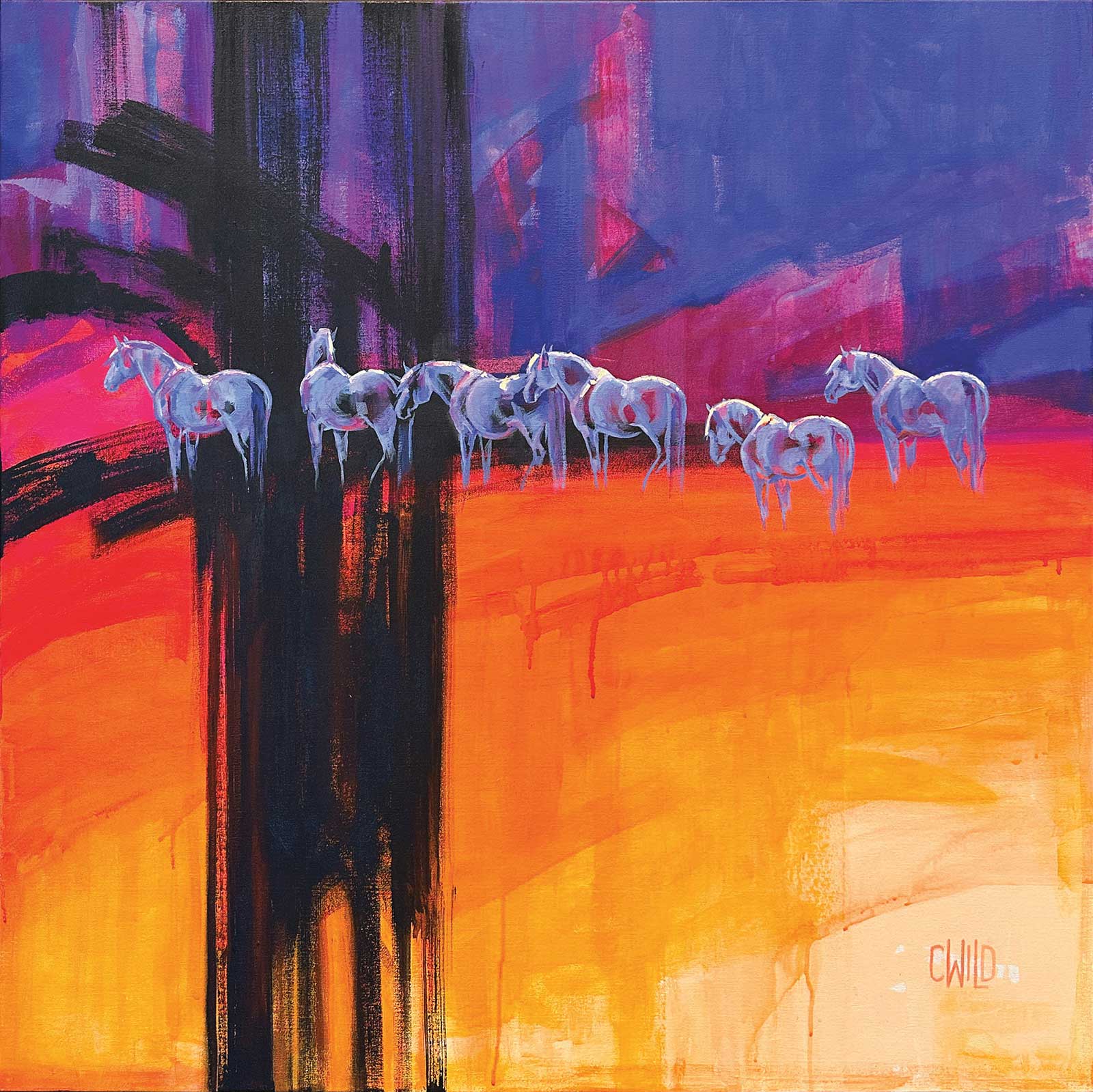
Twilight Lineage, 2024, acrylic and gold leaf on canvas, 40 x 40 in.
For Wild, the art part is what makes it all worth it. “My joy is watching people look at my work, and you just see a smile come on their face and you see them fall in love. And it’s pretty great and fulfilling and that’s a big reason why I do this,” she says. “I create art because I love it, but then part of that process is sending it off to be loved by someone else so that there’s room for me to keep going and keep creating and keep sharing that feeling.”
Wild’s latest show, Gradation, is on view at Gallery Wild in Jackson, Wyoming, September 11 through 18 with an opening reception September 11 from 2 to 6 p.m. —
Carrie Wild: Gradation
September 11-18, 2024
Gallery Wild
80 W. Broadway, Jackson, WY 83001
(307) 203-2322, www.gallerywild.com
Powered by Froala Editor


