Silas Thompson’s life and art have always been shaped by the contours of the Snake River, which arcs across the whole of southern Idaho. It’s where he was born and raised, where he started a family of his own, and where he established himself as an artist.
He married young, balancing his growing family with a warehouse job and art classes at community college. “I realized it was going to take me six years to get a two-year art degree, so I started doing commissions for co-workers,” he says. “Portraits of grandparents, really whatever I could pick up.” But everything changed when he was offered a paid apprenticeship with an established artist. He packed up the family and moved an hour down the Snake River to start learning his trade.
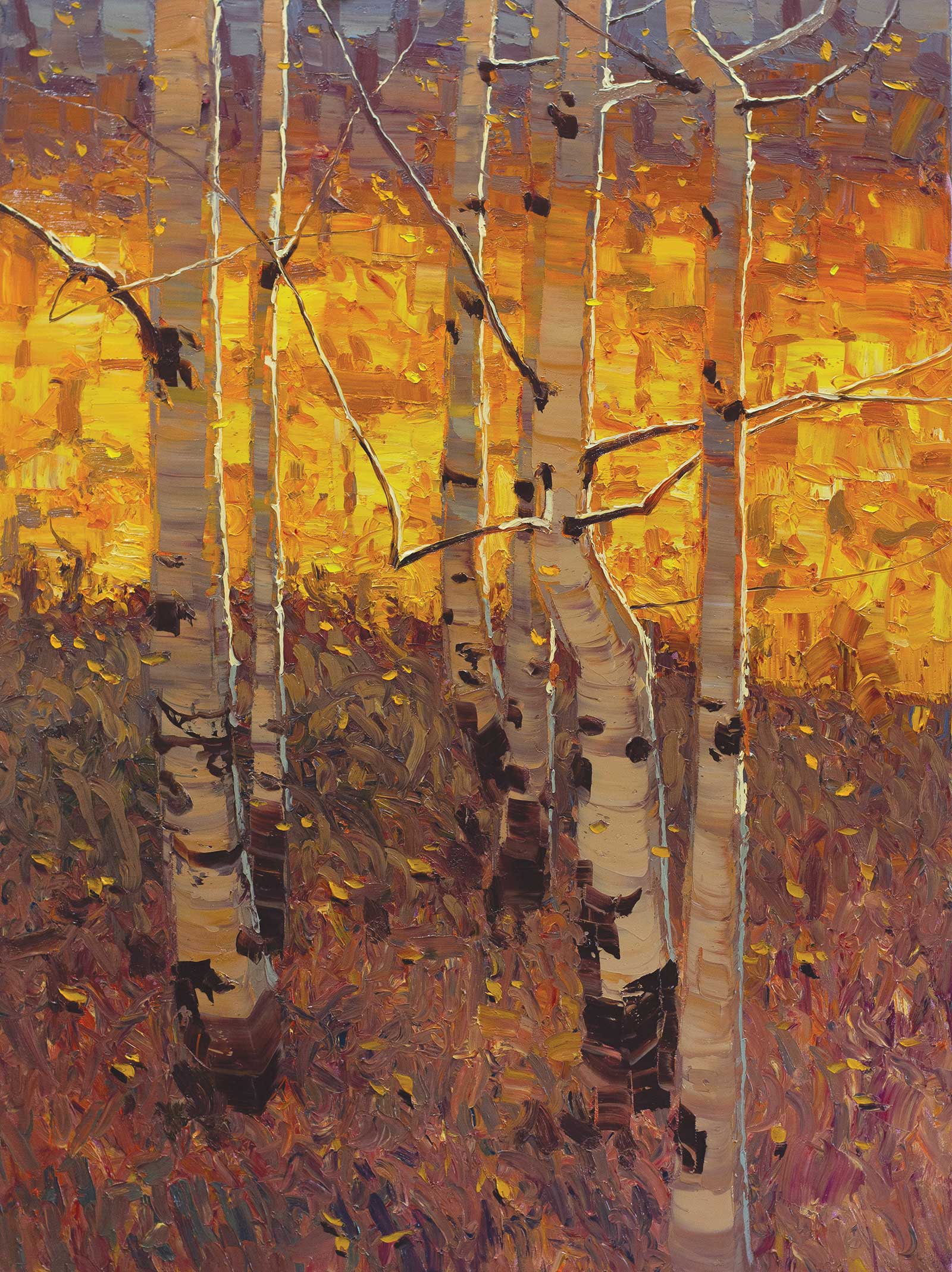
Crescendo, oil on canvas, 40 x 30 in.
“I was at that apprenticeship for a little under four years, and a lot of it was just the business side of art,” Thompson says. He did the framing and delivery and worked with gallery contacts. “I got to see the inner workings of what it takes to be successful as an artist, and I spent 40 or 60 hours a week in the studio watching other artists paint and painting myself,” he adds. “It was a really great education.”
At the end of the apprenticeship, Thompson and his family moved downriver again. “We live out in the country, and I purchased a couple of grain bins and retrofitted them to be a studio,” he says. “I paint and do some small-scale farming, and over the course of these last 10 years, I’ve gradually worked with more galleries and had more opportunities to build my career as an artist.” This August, his work will be featured in a solo show at Gallery Wild in Jackson, Wyoming.
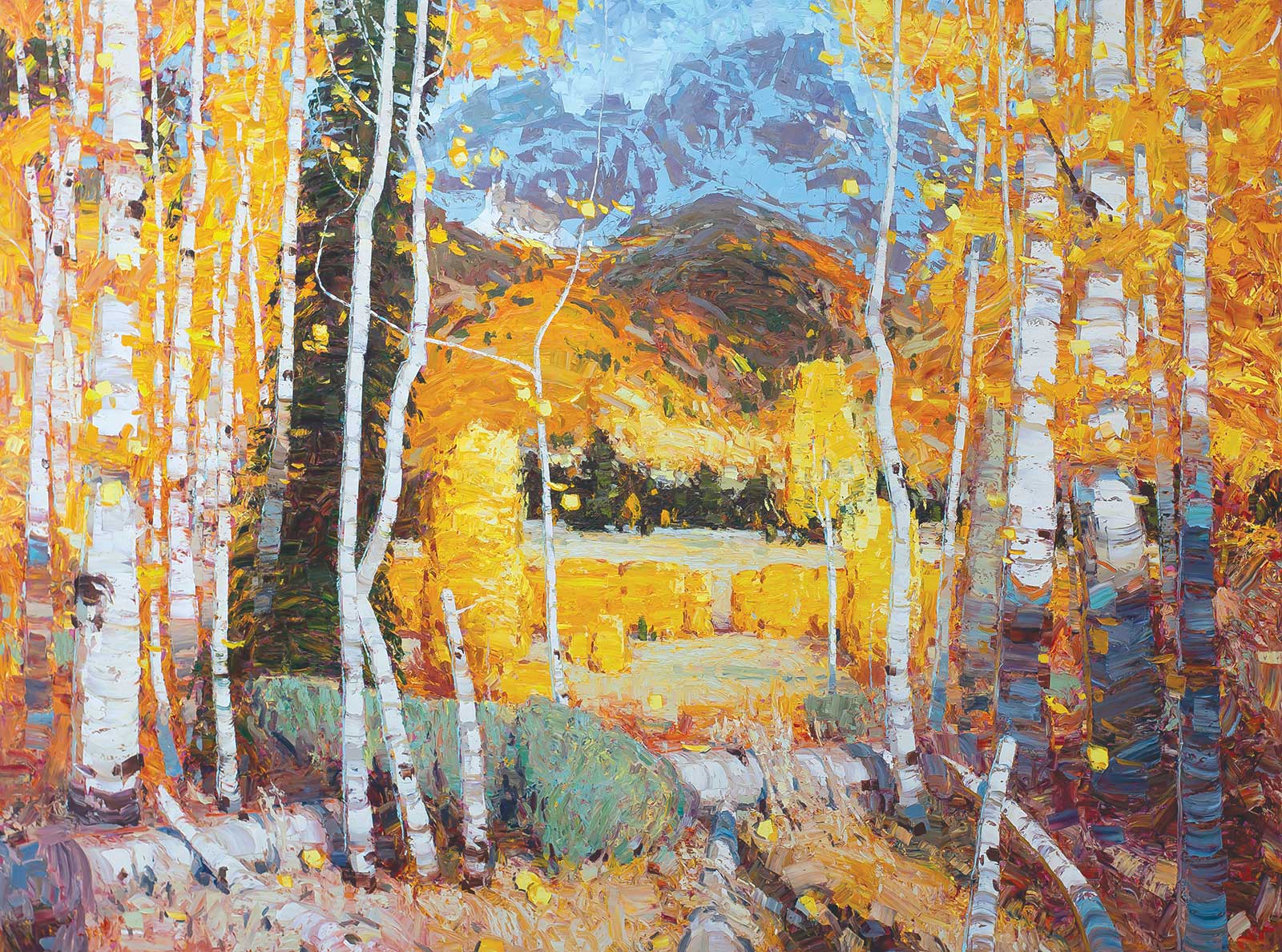
Within the Hall of Gold, oil on canvas, 70 x 94 in.
“Silas’ work is all about the grandeur of the outdoors,” says Abby Mitchell, gallery manager. “He’s completely inspired by the vastness of open spaces—big skies, leaves of all colors, shadows and the way things interact with each other. His work is heavily textured, and having it here in the gallery, I am enamored by each and every brush stroke.”
Much of Thompson’s work for his upcoming solo show will focus on the metaphor of flame. “I think nature is just ripe with so many metaphors, and when you take a moment to be in nature, it can be instructive or inspiring or helpful,” he says. Many of his new paintings feature autumnal forests in the last flame of life before the annual cycle of death and resurrection begins again.
One recurring motif is the aspen tree. “Design-wise, aspens are really fascinating,” he says. “In a world that is often perceived horizontally, they’re an anomaly. Vertical elements in a horizontal world.” But his fascination with aspen trees goes beyond the visual intrigue.
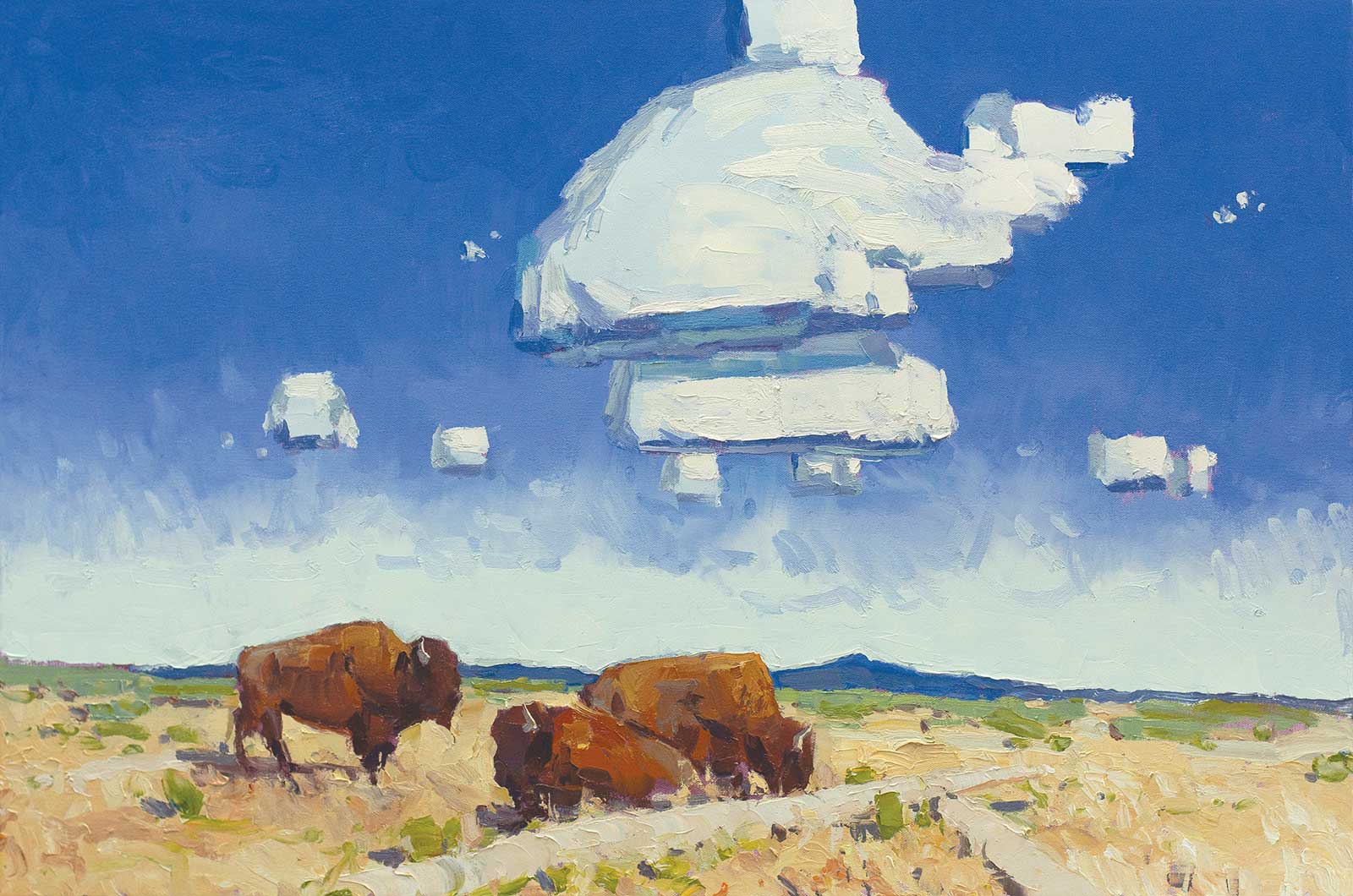
Roaming Giants, oil on canvas, 24 x 36 in.
Thompson often finds himself thinking about how aspen groves, with their interconnected root systems, are the largest living organisms in North America. “One aspen grove can be the size of a thousand blue whales when you add it all up. I just find them interesting on pretty much every level, which is why I keep going back to them.”
While many more traditional landscape painters go out on location to do field studies before going back to the studio to create a larger work based on the study, Thompson approaches his work a bit differently. While he does spend time in the field, his aim is not to faithfully recreate the scene. Instead, he does what he refers to as “composing.”
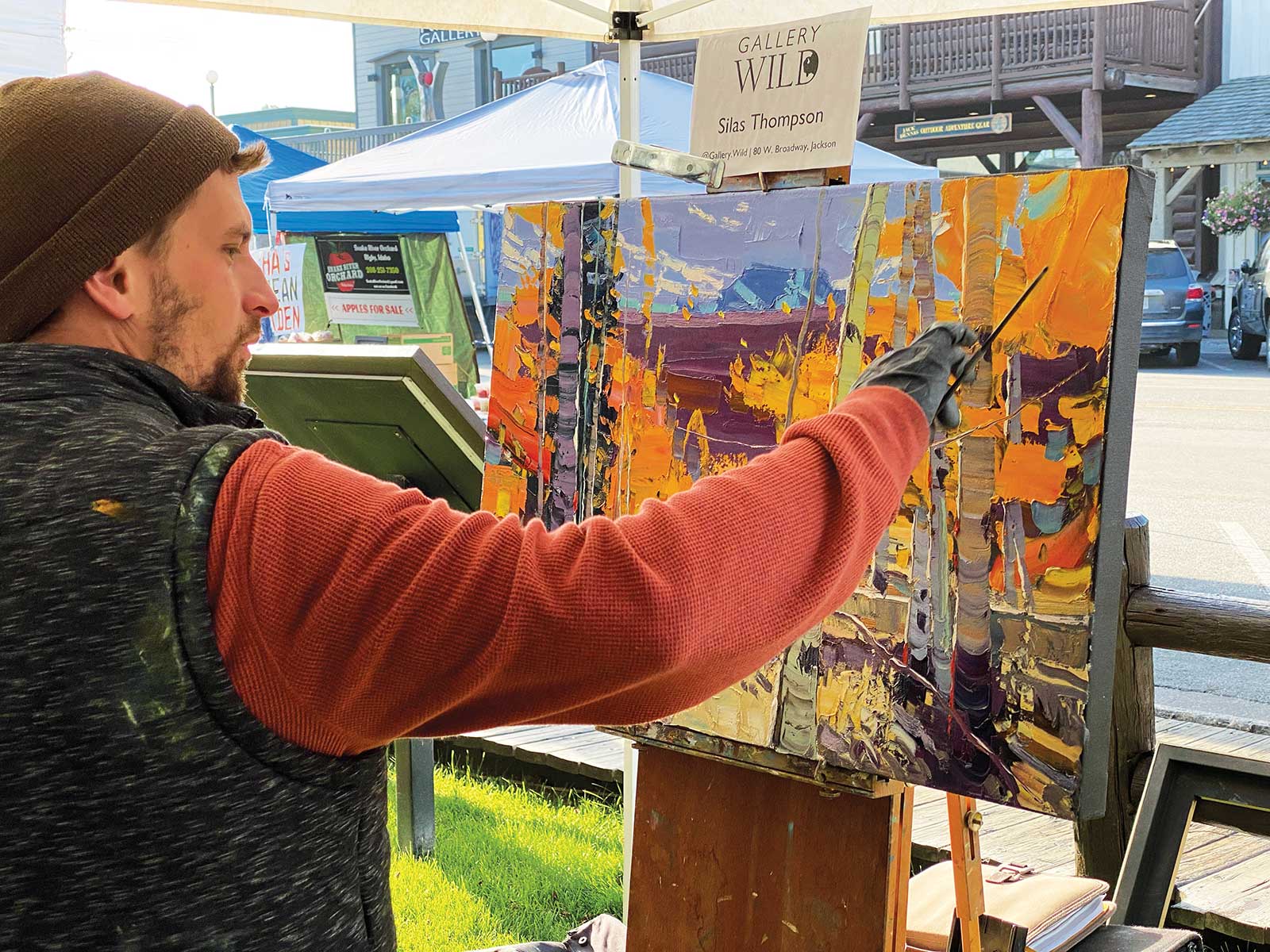
Silas Thompson in Jackson Hole, Wyoming, in 2021.
Typically, he’ll pull up three or four different images of a place he felt inspired by, then pull them together to create something different and new. The result is a landscape that represents more of a memory of a place than an accurate depiction of a specific location. He explains, “I think of photorealism like a university lecture, which can be super informative and have a lot of educational value, and then abstract art is more listening to a foreign language, which is beautiful, but you don’t necessarily understand it.” Thompson views his own work as falling somewhere in the middle, like sitting down on a park bench and having a conversation with the viewer.
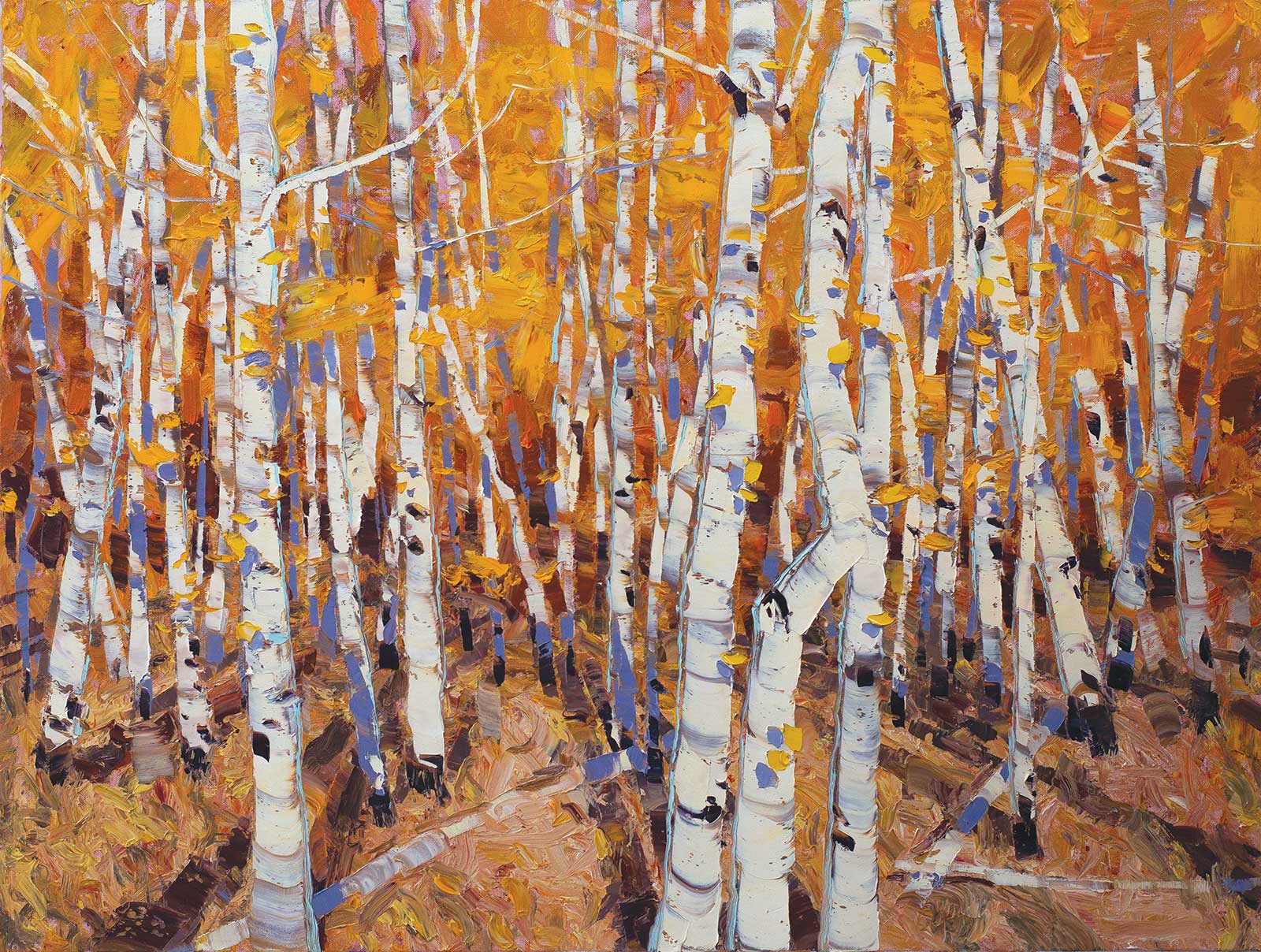
Gave Everything, oil on canvas, 30 x 40 in.
The largest painting on view at the Gallery Wild show is Within the Halls of Gold, a depiction of the Teton mountain range that towers over the viewer at 70 by 94 inches. The title plays on the concept of royalty and the metaphors of a kingdom. “This expanse of the landscape felt reminiscent of a large chamber with columns, to me. It inspired this feeling of being within something, totally engulfed,” Thompson says.
Mitchell adds, “The scale of it is jaw-dropping, and it’s sure to capture everyone’s attention. It makes you feel as if you could step over the frame and through the leaves into this magical world. It’s a very ethereal piece.”
That feeling of stepping into another world is why Thompson loves painting in a large format. “I would paint everything at this size if there were more large walls made for that size,” he admits. He finds the process of creating large paintings to be exciting, and sometimes terrifying. “There can be a heightened sense of risk and danger, but without risk and danger, there’s no beauty and no reward.”
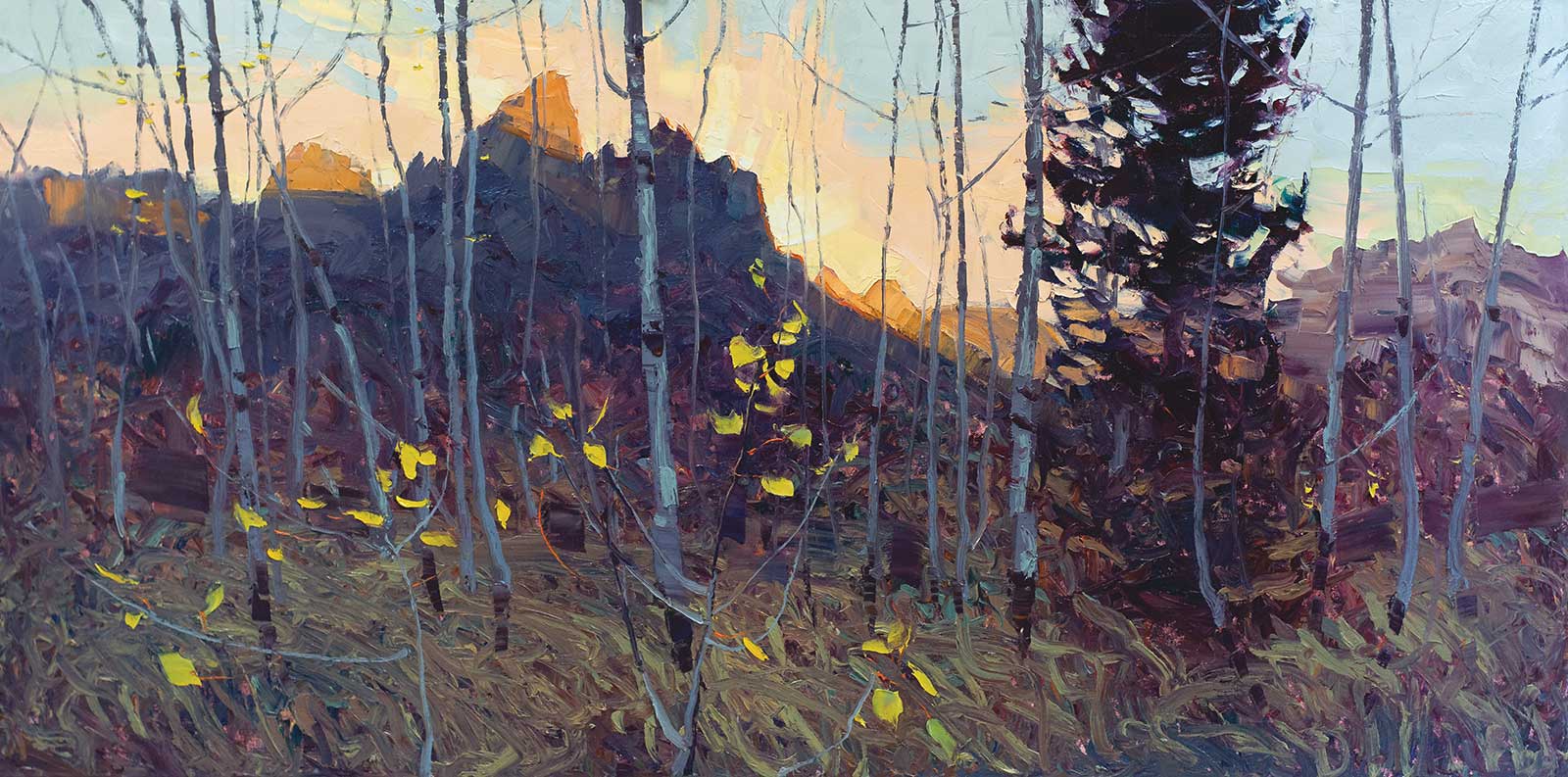
Finale, oil on canvas, 36 x 60 in.
In Roaming Giants, Thompson departs from his typical subject matter to portray a trio of bison on the plains, with giant, puffy clouds casting a shadow over them. “Sometimes, in his landscapes, Silas will include a glimpse of an animal hidden in the foliage or under a log, so it’s really fun to see him put the wildlife on center stage in this piece,” Mitchell says. When viewing the painting in person, the clouds pack a particular punch. “He paints the clouds as if they are an object rather than a puff of air, and they are really emphasized with thick globs of paint.”
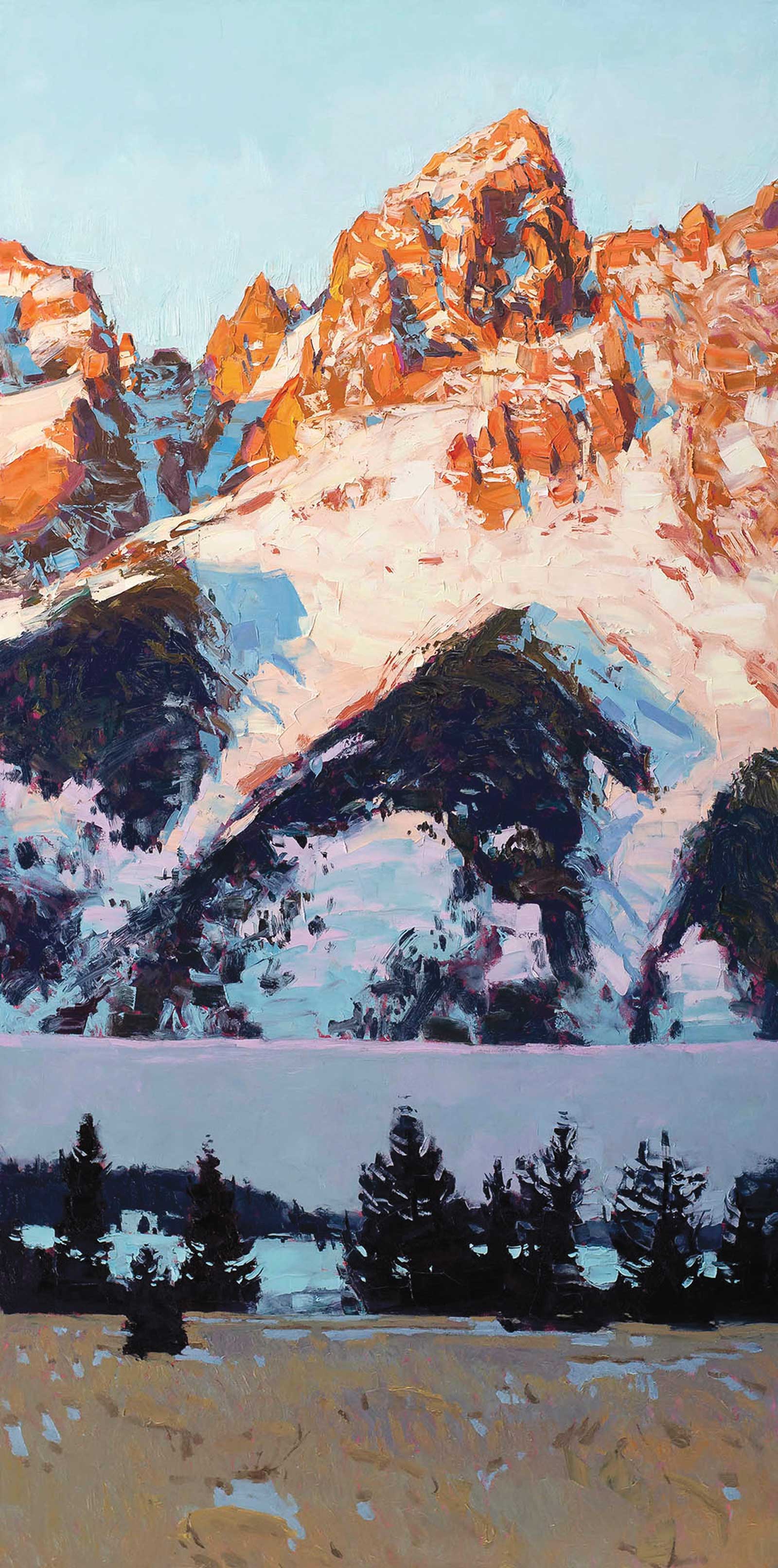
The Western Gate, oil on canvas, 72 x 36 in.
Thompson says the title is intended to prompt viewers into questioning what the subject of the painting really is—the bison or the clouds? “Of course, it can be both,” he says. “I definitely stepped out of my comfort zone for this painting, but I wanted to portray the awesome nature of reality. We have these powerful beasts that are still out there roaming the plains, and above them, we have these enormous cumulonimbus clouds.” With Roaming Giants, he manages to capture the grandeur of both these forces of nature at once.
In Finale,Thompson portrays aspen trees, this time without the blaze of fall. “The title plays on the idea of the theater,” he says. “It’s interesting to think of my paintings as a play, where viewers can step outside of reality for a moment and see a whole cycle of birth to death all at once.” This scene represents both the finale of the day and the finale of the seasons. The trees have lost all but a few of their leaves, and the entire landscape has fallen into shadow as the sun dips behind a mountain peak, reminding the viewer of the temporary nature of their circumstances.
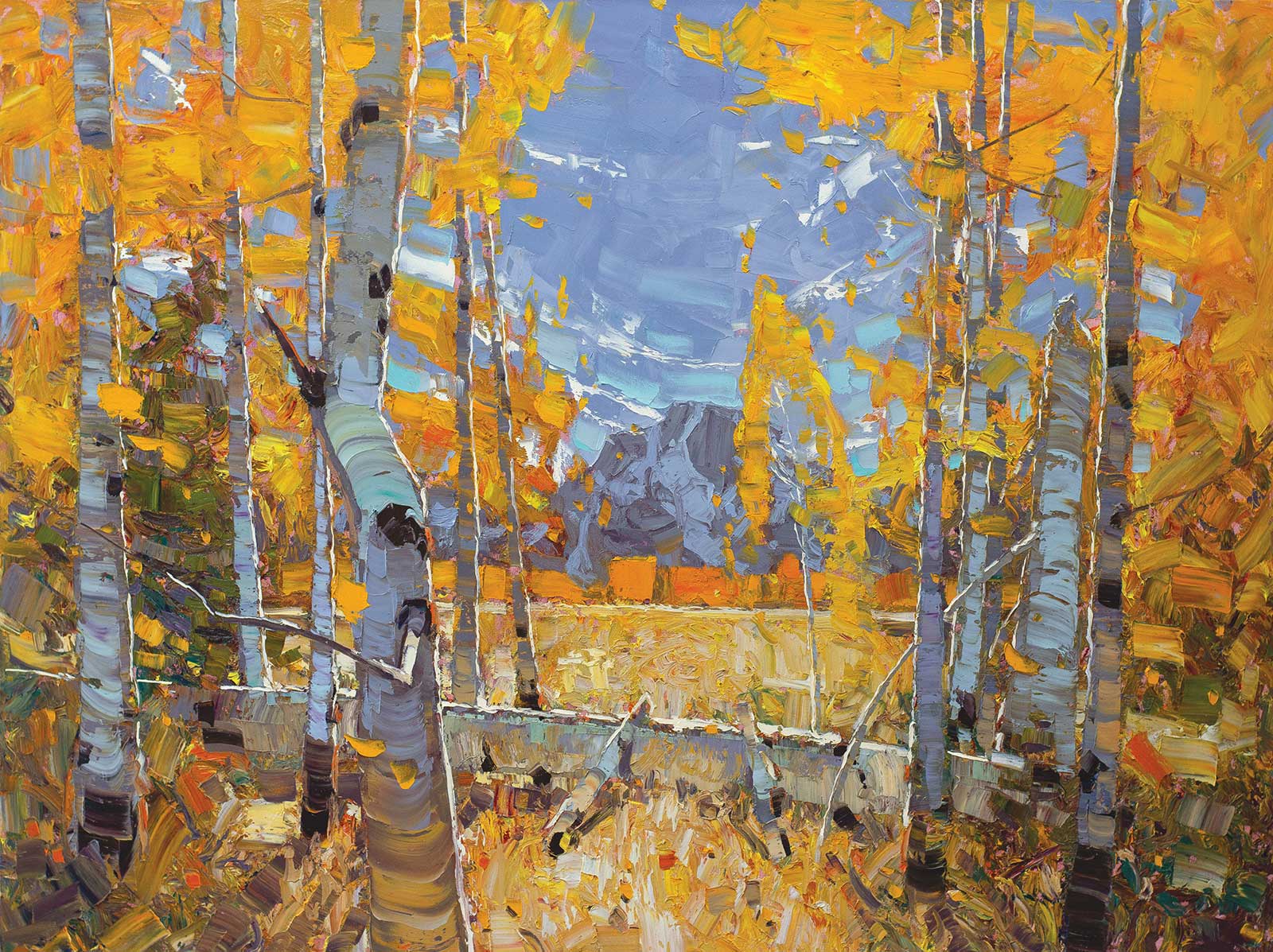
Final Act, oil on canvas, 36 x 60 in.
Thompson’s solo show will hang at Gallery Wild from August 1 to 10, and Mitchell encourages people to come out and see it in person. She says, “I think that viewers will walk away being reminded of what it feels like to be out in open spaces and inspired to have wild experiences of their own.” —
Silas Thompson
August 1-10, 2024
Gallery Wild
80 W. Broadway Jackson, WY 83001
(307) 203-2322, www.gallerywild.com
Powered by Froala Editor


