Sean Michael Chavez paints the forgotten original cowboys of the West. “I’m consistently and constantly surprised at how many people don’t realize the origins of the cowboy,” he says. “Popular culture has done a really good job of creating a hidden history and reforming the reality of the West. The history of the vaquero has been erased.”
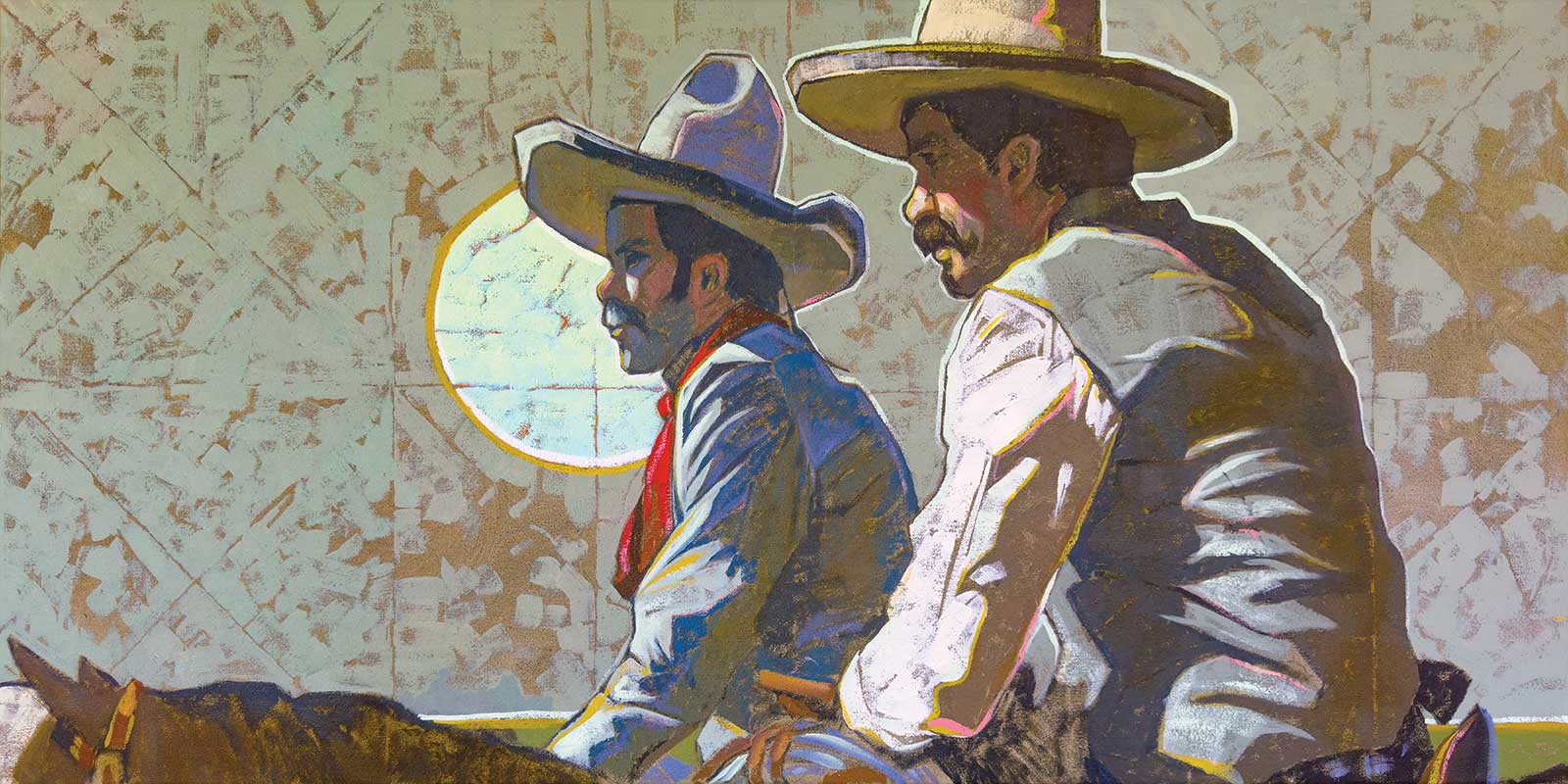
Los Hermanos, oil on linen, 20 x 40 in.
A native of Albuquerque, New Mexico, and of Hispanic heritage (his name “Sean Michael” comes from his mother’s Irish side of the family), he set out to find where he could fit in as a Western painter and how he could contribute something different. He found the connection through his Chavez history and the history of the vaquero in the West.
He considers himself an armchair historian but has done extensive research into the subject, notably in the writings of Arnold R. Rojas (1896-1988) who worked on cattle ranches and gathered stories of the last vaqueros around the campfire and in the bunkhouse. He wrote from experience with a little tale-telling thrown in.
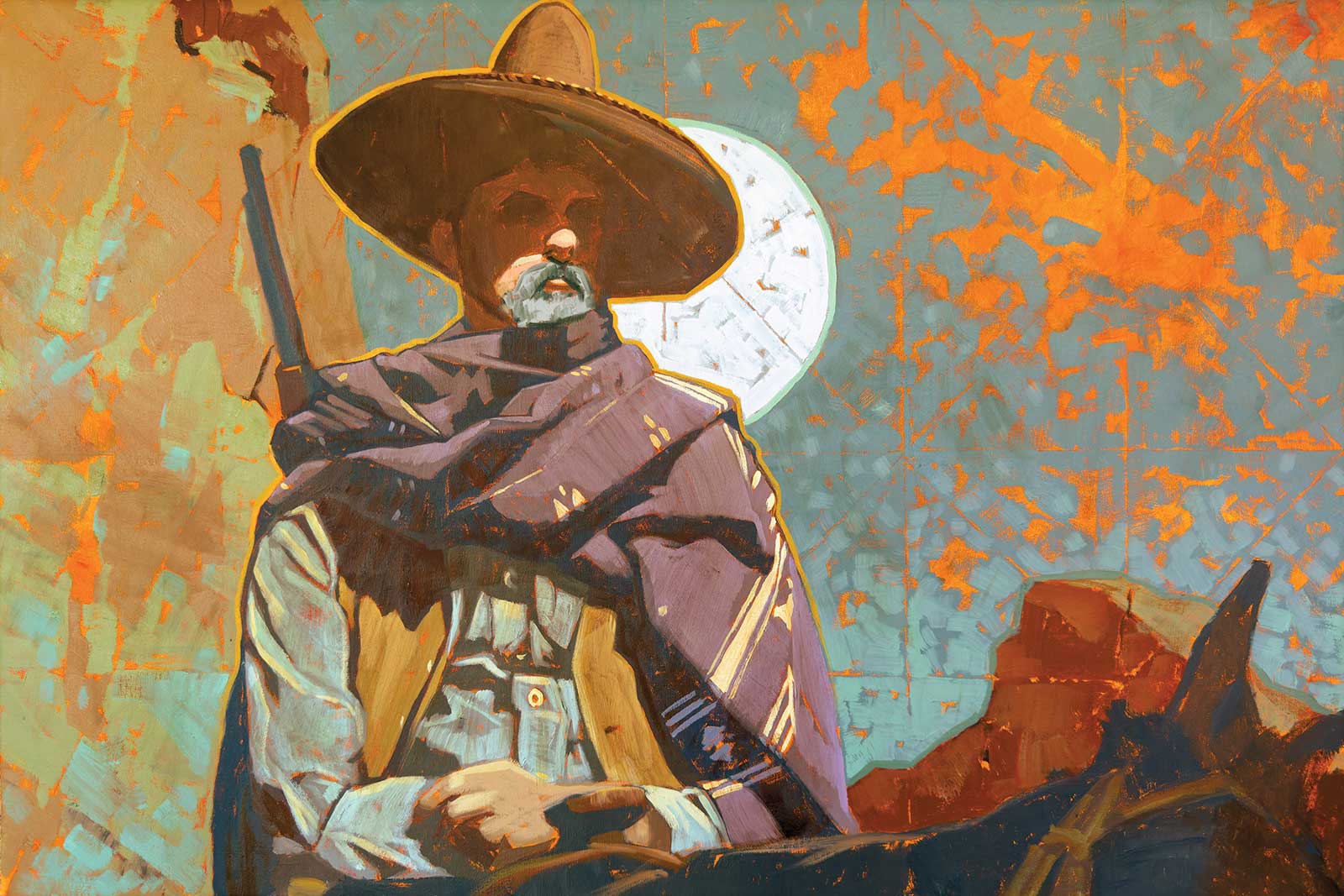
Evening Encounter, oil on linen, 20 x 30 in.
“I have written my stories as seen through the eyes of old vaqueros,” he wrote, “they are something of the splendor of those days, for there will never be another cattle ranching era in California that produced such men. Their sayings, proverbs and maxims woven into the fabric of California legends and folklore were so much a part of the vaquero’s daily life that he applied them in all his dealing with men, horses, cattle and other denizens of the ranches.”
Chavez writes, “It is ironic that the history of the vaquero is a hidden one. Without the vaquero, the West and the cowboy as we know it doesn’t exist and neither does Western art. It is my honor to be painting this subject with the same sense of duty and connection to place that the original cowboy must have felt. The work must be done. It’s a passion. I’m happy to be doing it.”
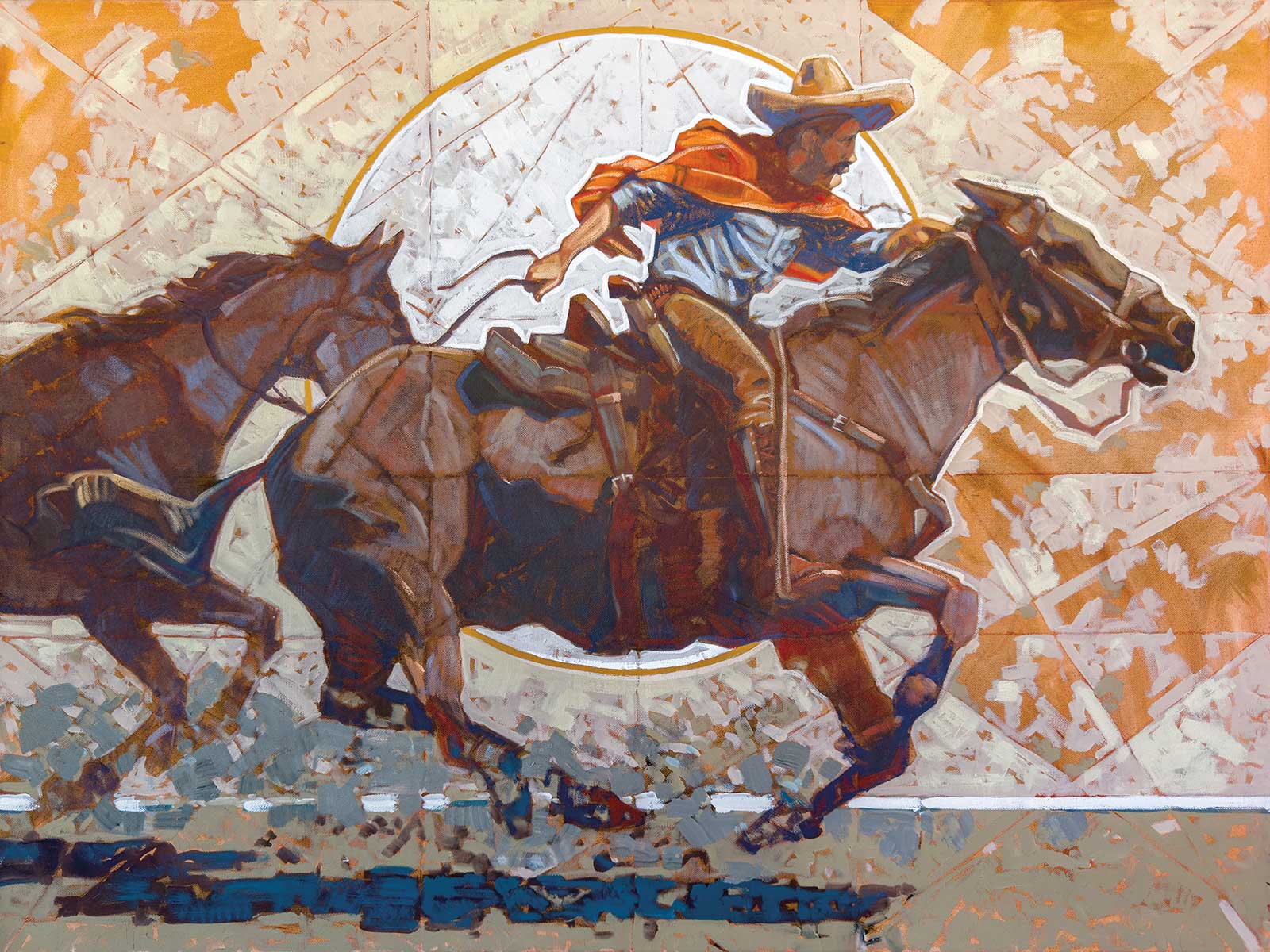
Takeback, oil on linen, 30 x 40 in.
His design background and intense, deep interest in the history of art come together in compositions that are in an instantly recognizable style that is uniquely his own. “My work is a combination of old and new,” he explains. “It is a mix of the traditional and the contemporary. Working from both ends of the spectrum, the result is my unique vision and experience of being native to the Southwest and more specifically, to the beautiful place known as New Mexico.”
Artists often use proportioning formulas such as the Fibonacci sequence named after an Italian mathematician in the Middle Ages. It is a series of numbers in which each number is the sum of the two that precede it (e.g. 0, 1, 1, 2, 3, 5, 8…). The Golden Section is a mathematical ratio that occurs throughout nature and is considered to be pleasing to the eye.
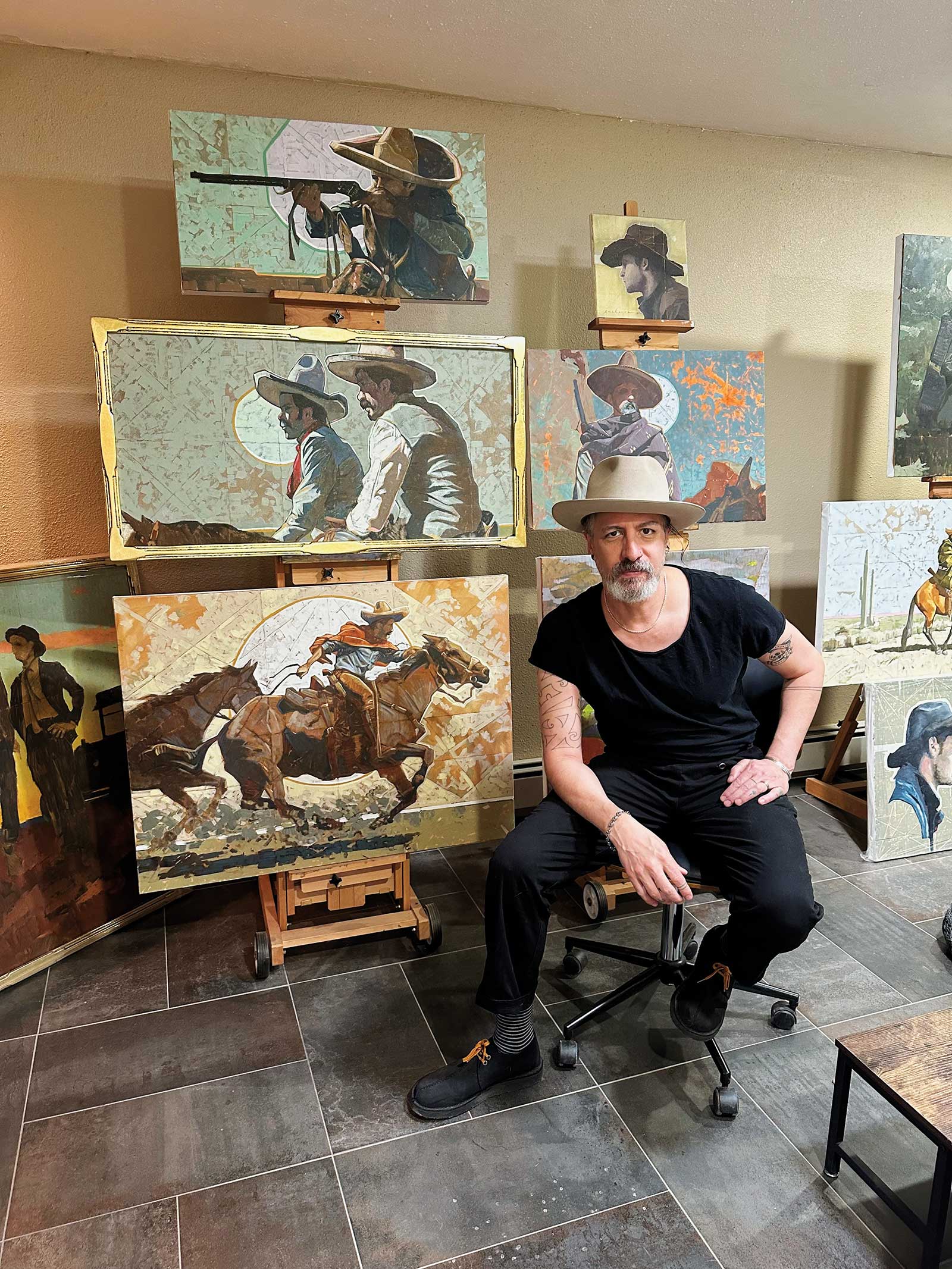
Sean Michael Chavez in his Albuquerque, New Mexico, studio. Photo by John O’Hern.
In paintings such as Los Hermanos, a grid divides the area of the canvas, with a nod to 20th-century abstract expressionists who often layered paint gesturally and left areas of the canvas bare. He considers the grid an armature on which he can compose a painting—sometimes following the geometry of the grid and, at other times, creating with a musical rhythm. In Takeback, a vaquero retrieves his stolen horse. The scne is painted over the defining grid. With a reference to the iconinc film of a horse galloping by Eadweard Muybridge in 1887, Chavez paints the horse with all four hooves off the ground suggesting motion even more strongly with the abstract application of paint on the horse’s legs and the churned-up ground.
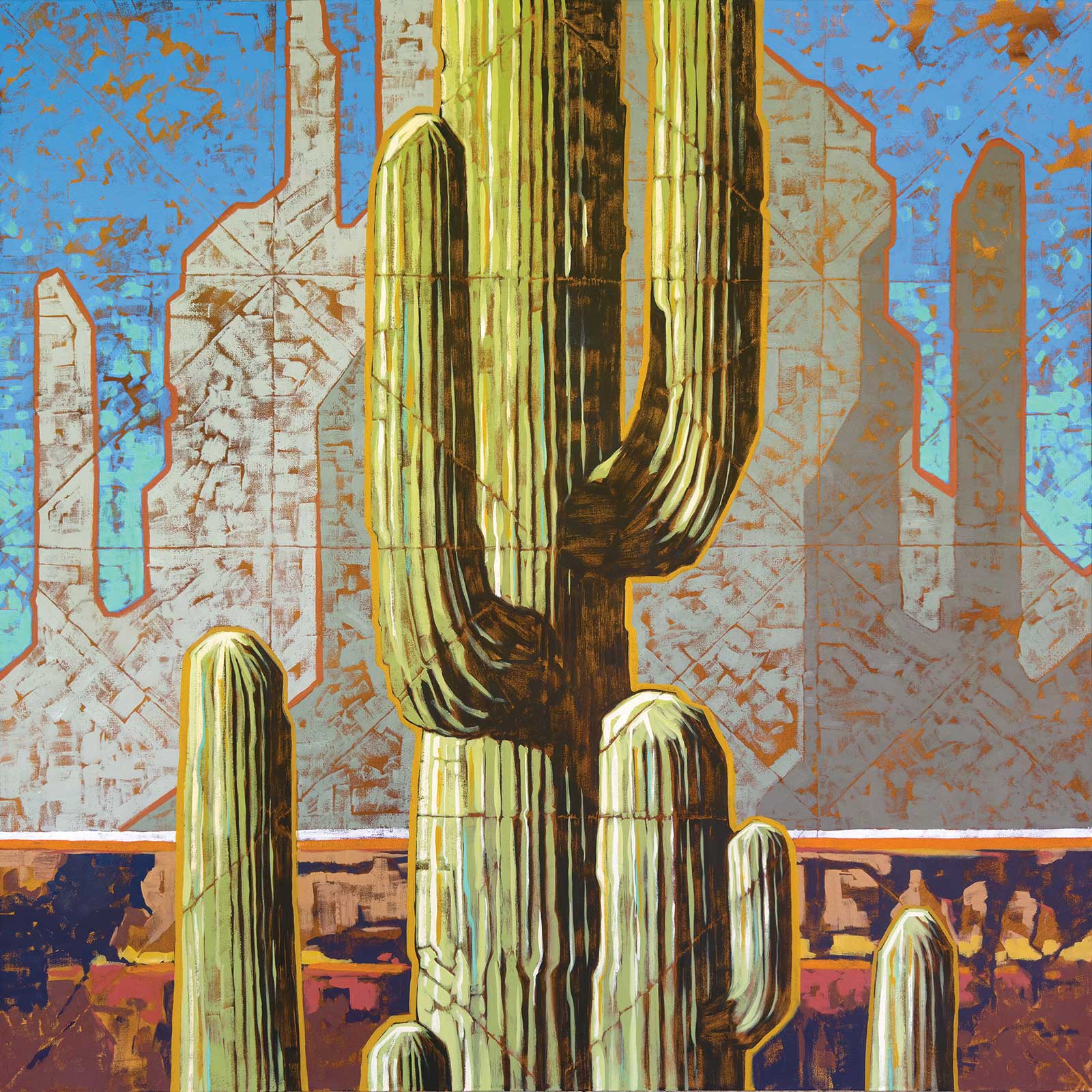
Saguaro Grande, oil on linen, 48 x 48 in.
As for influences in the art of the American West, Chavez says, “You can’t avoid Maynard Dixon. He influenced every corner of Western art.” He takes me into the living room where there is a bookcase of reference books from his career in design and his interest in the art of the West. A book on Frederic Remington illustrates the artist’s paintings of Mexican vaqueros based on his sketches from a trip in 1889. A painting in the Metropolitan Museum of Art depicts a vaquero draped in a colorful serape much like the one worn by the rider in Takeback.
When Chavez was in his 20s, he had what he calls a “Warhol-esque sort of ambition” to make a $1 million from his art by the time he was 30. “But once I got to a certain age,” he admits, “I realized that that was a lot harder to do than I realized.” He attended the ArtCenter College of Design in Pasadena, California, and worked for a period in the design field until he knew he had to “get back to where my real heart was.”
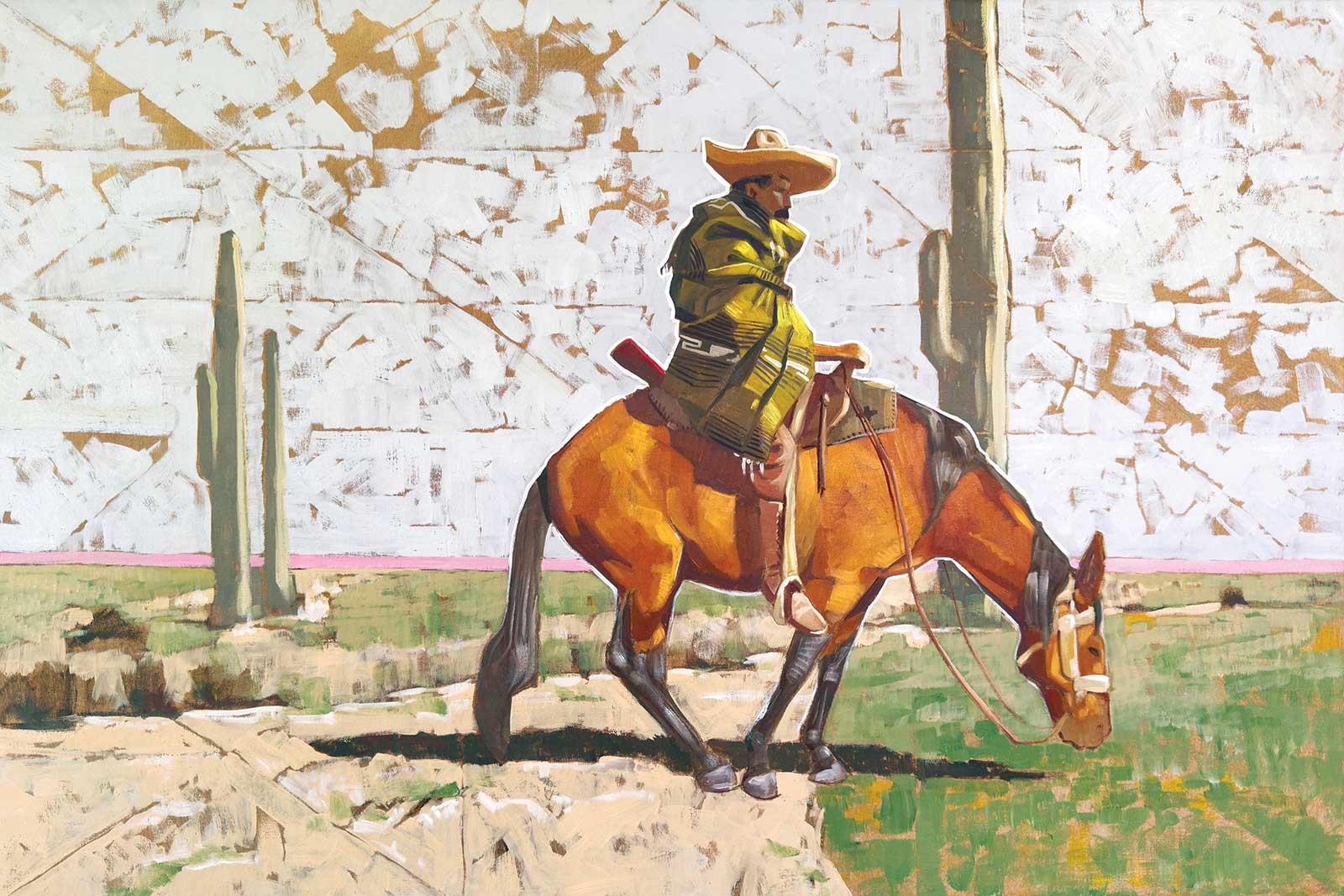
Study for Mesa Verde, oil on linen, 24 x 36 in.
His heart is in the West and his passion and skill have begun to reap rewards. “My in-laws live in the Oklahoma City area so I often visited the National Cowboy & Western Heritage Museum, never thinking that I would have the opportunity to hang my own paintings there.” He has since exhibited in the museum’s Small Works, Great Wonders exhibitions and, this year, he was invited as one of four new artists to exhibit in its prestigious Prix de West exhibition in 2025. “If you happened to see me just a few moments later,” he relates, “you will have noticed a couple of tears that I did my best to hide. To hear my name in that hall was a very, very special moment for me.”
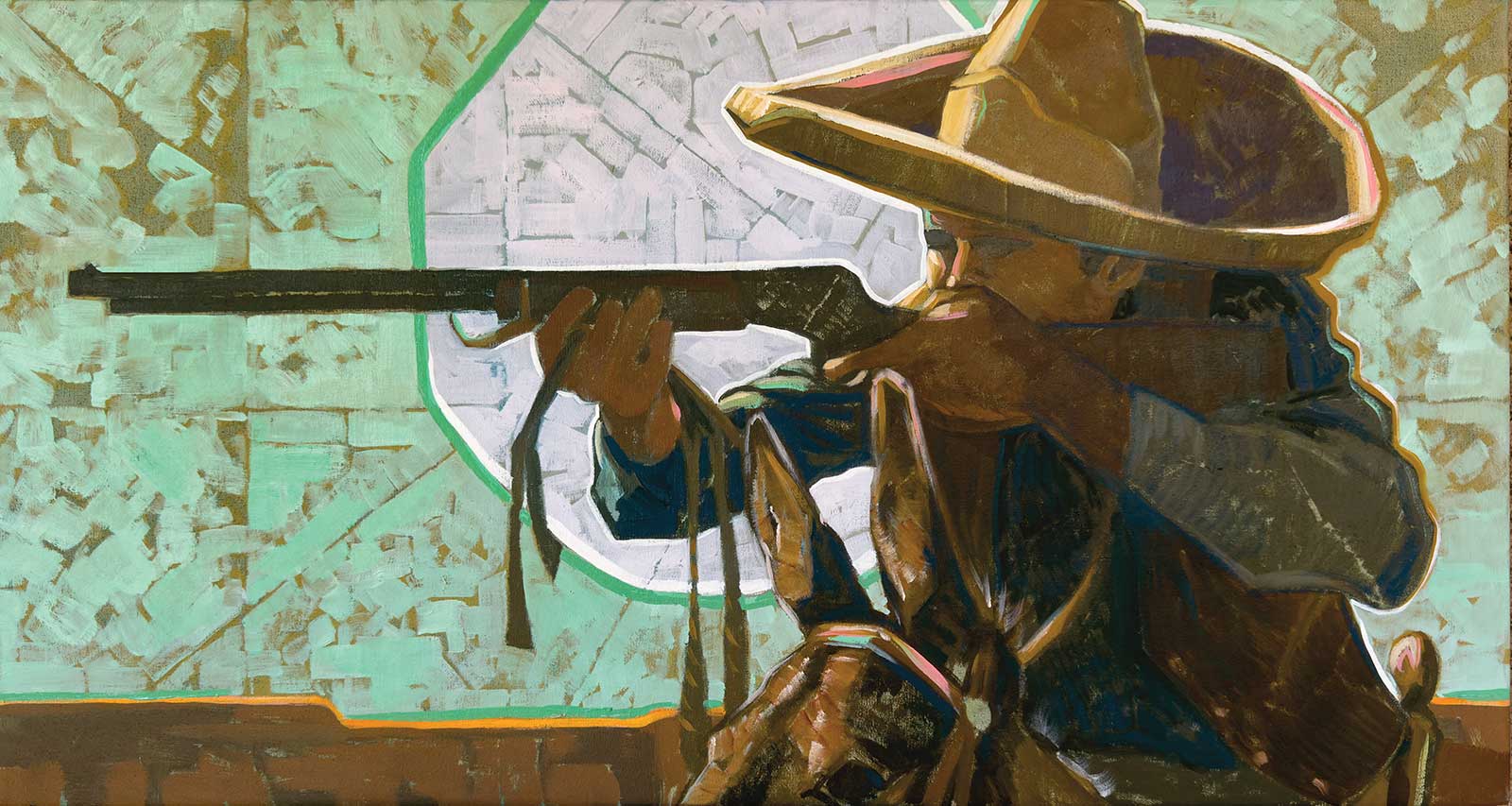
Ears Up, Arms Up, oil on linen, 16 x 30 in.
As for the future, he wants to continue to explore. “I’ve strategically created a style or a couple of different styles that are a little bit different from each other that I can kind of bounce back and forth among. I’m introducing more and more color over time and getting a little bit brighter, getting a little bit tighter, reinforcing some of what makes my paintings unique. If I make a mistake on a particular painting, something that wasn’t intended but has something valuable in it, I try to embrace it.”
Double Down, an exhibition of 13 of his new paintings, will be shown at Acosta Strong Fine Art in Santa Fe, New Mexico, August 5 to August 19, with an artist reception on August 9 from 5 to 7 p.m. —
Sean Michael Chavez: Double Down
Acosta Strong Fine Art
200 Canyon Road, Santa Fe, NM 87501
(505) 982-2795, www.acostastrong.com
Powered by Froala Editor


