Some of the earliest artworks ever created—cave paintings, Native American pictographs and sculptural figurative objects—are often rough shapes, simple silhouettes and rudimentary forms that show only arms, legs and torsos. With the exception of the occasional mouth or set of eyes, faces were largely not rendered at all. Many modern-day artists might have the answer as to why: “Faces are difficult.”
As evidence to their difficulty, consider our present-day understanding of how our eyes and brains work. For instance, faces are often hard to duplicate convincingly because our brains are so good at spotting errors or inconsistencies. Robot engineers, animators and CGI artists have a name for this: “uncanny valley,” which is the gulf that separates basic representations from more realistic depictions of the human form. Essentially, the more realistic a human face or form becomes, the more difficult it becomes to make it lifelike. Our brains, adept at seeing real human faces, trigger warnings when we see fakes.
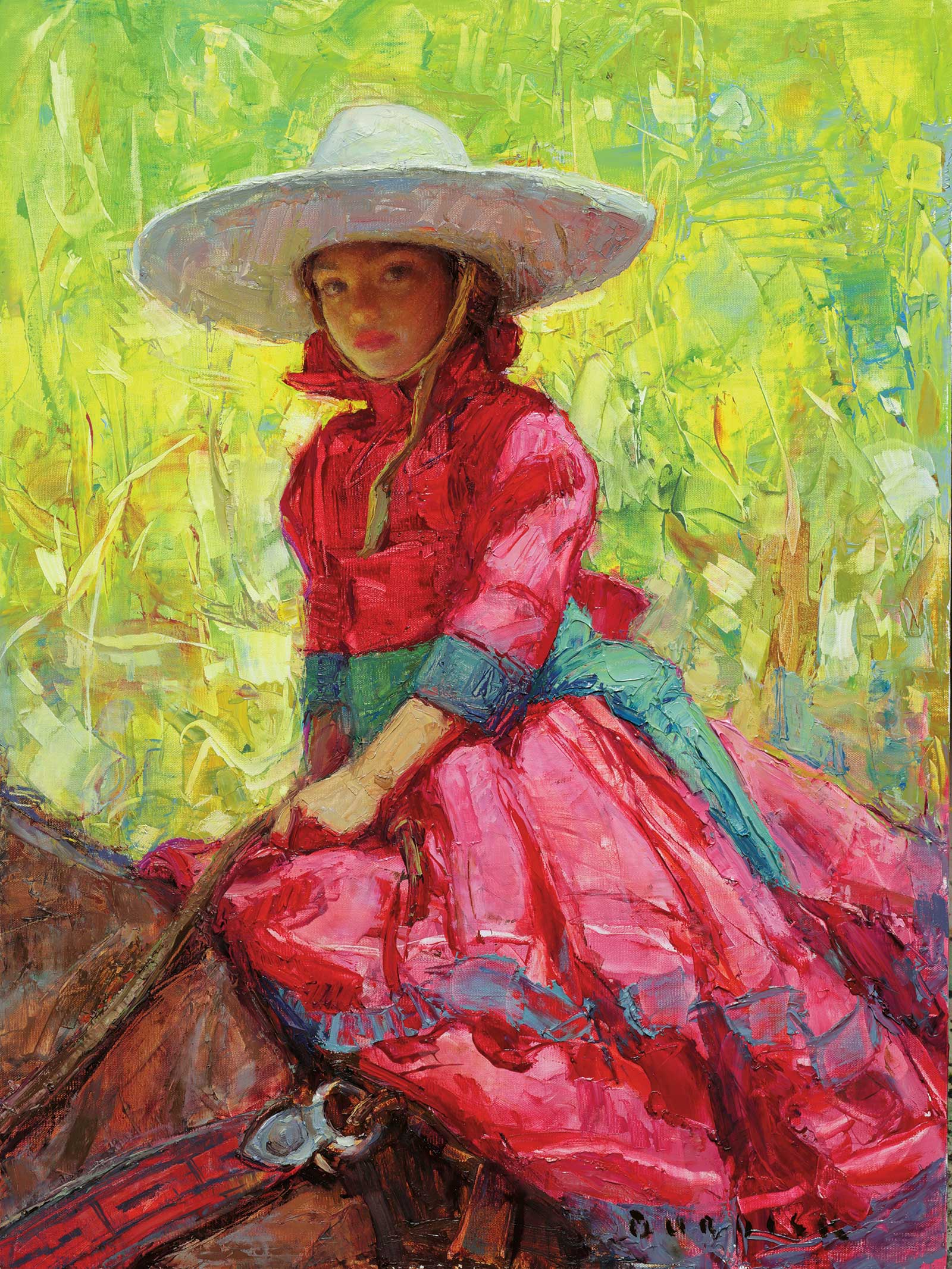
Mark Sublette Medicine Man Gallery, Fiesta Rider, oil, 24 x 18 in., by Scott Burdick.
In the fine art world, though, artists have done what cave painters, engineers and animators struggled with in their respective times: artists have created convincing depictions of the human face. And the results are remarkable. Of course, this is not a new skill, with works by Rembrandt, Vermeer and Leonardo da Vinci as proof. Today a rich tradition continues within the genres of figurative, portraiture and faces.
In Western art, consider the work of Scott Burdick, who has new work at Mark Sublette Medicine Man Gallery in Tucson, Arizona. One of his new paintings is Fiesta Rider, which shows a young girl on a horse. Her delicate face, shrouded in shadow, seems to glow from beneath her hat. “I suppose I’ve always been most interested in painting people. I love meeting people, hearing their stories, learning about different cultures and trying to convey that individuality through my work. For me, faces are nearly always the center of interest in my paintings. Capturing just the right expression and emotion can sometimes be quite elusive, and Fiesta Rider is a good example of this,” Burdick says. “Last year, my wife, artist Susan Lyon, was teaching a workshop at Hindes Fine Art. One afternoon, the class all went to a fiesta event where this little girl and three generations of the women in her family rode side-saddle at astonishing speed in elaborate configurations. It was truly wondrous to watch. Afterward, Susan and I met the family and took some photos of them for a possible painting. A few months later in my studio, I started this painting and filmed it in progress as a lesson for Susan’s Patreon site. Everything went quickly, except that I just couldn’t get the little girl’s face the way I wanted it. I would paint it, come back the next day, repaint it completely again, and again, and again. I think I did it over about five or six times, which isn’t unusual for me.”
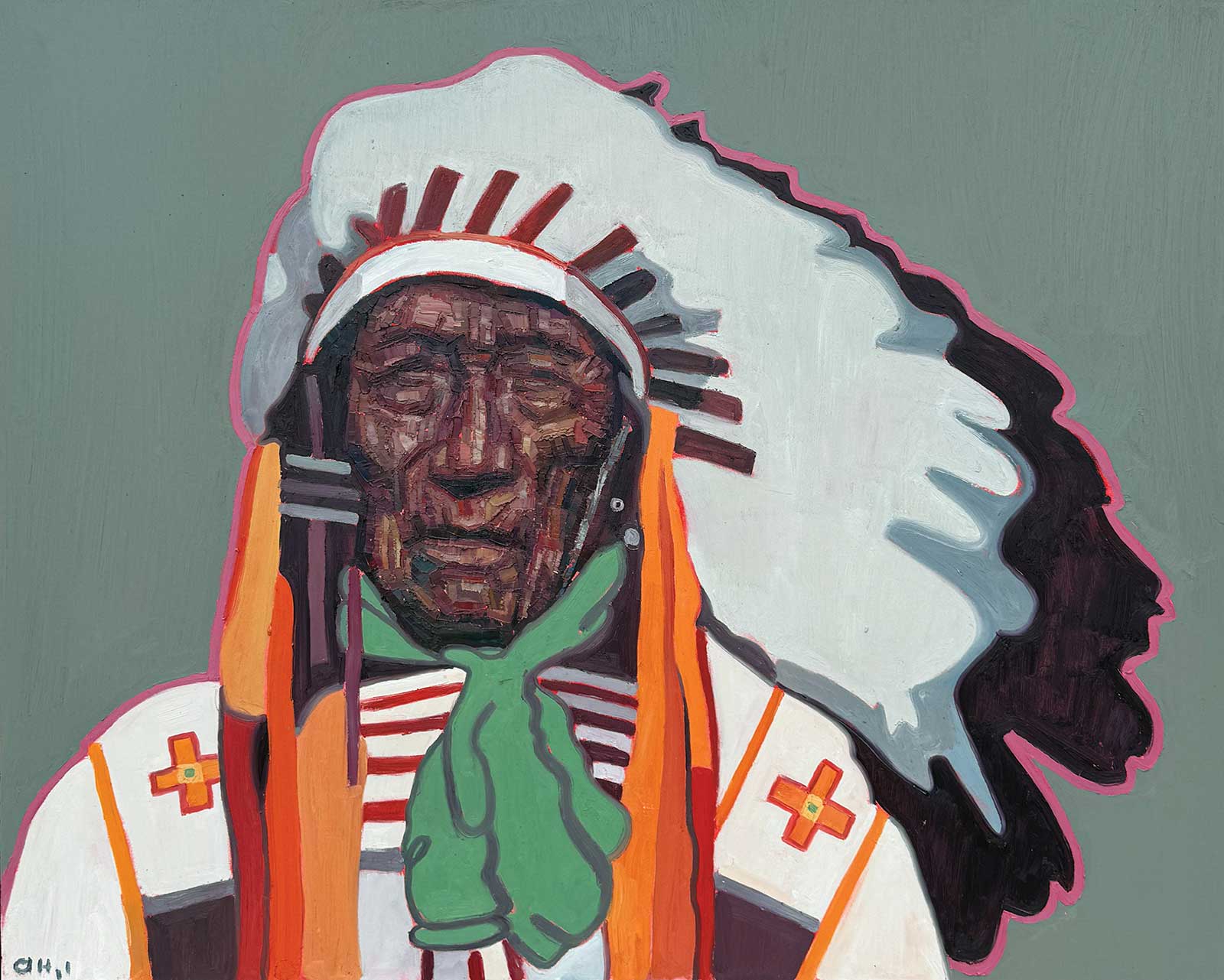
Gallery Wild, Chief Bell Rock, 60 x 48 in., by Aaron Hazel.
Burdick, undaunted by the challenge, continued the painting. “I’m not sure I can put into words exactly what was wrong with the early versions. A face and the emotion it conveys is so elusive that all I can say is that I want it to feel alive and unique. Not a ‘type’ or a mere prop in a scene, but a living, breathing human being out there in the world somewhere. Everything else surrounding the face—even the colors and technique I choose—is meant to accentuate that individual portrait in time and place. Sometimes I succeed, and sometimes I don’t, but I’m always excited for the excuse to keep meeting people and learning about things I’d never have imagined otherwise.”
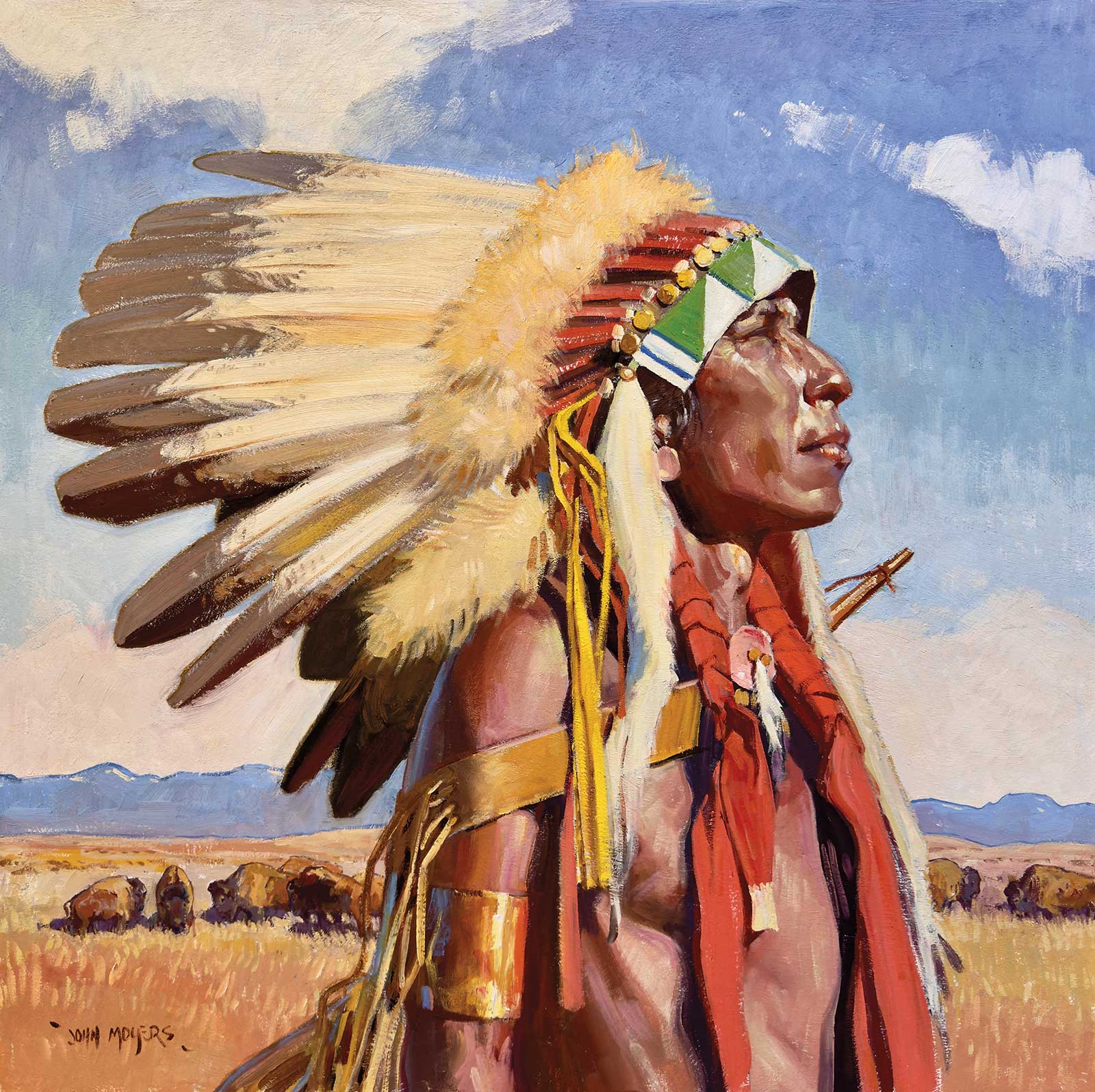
Legacy Gallery, Once Upon a Time, oil, 36 x 36 in., by John Moyers
Burdick’s paintings are often looser, which is a sweet spot for him when it comes to his figures. But other artists can go tighter and more detailed, such as Mikel Donahue’s stunning portrait of sculptor and fellow Cowboy Artists of America member Bill Nebeker, while other artists go even looser, like Aaron Hazel who uses chunks of color to build the portraits that he sends to Gallery Wild. These works show, as well as countless others, that artists are still finding new ways to paint the face and the figure. There is no end in sight.
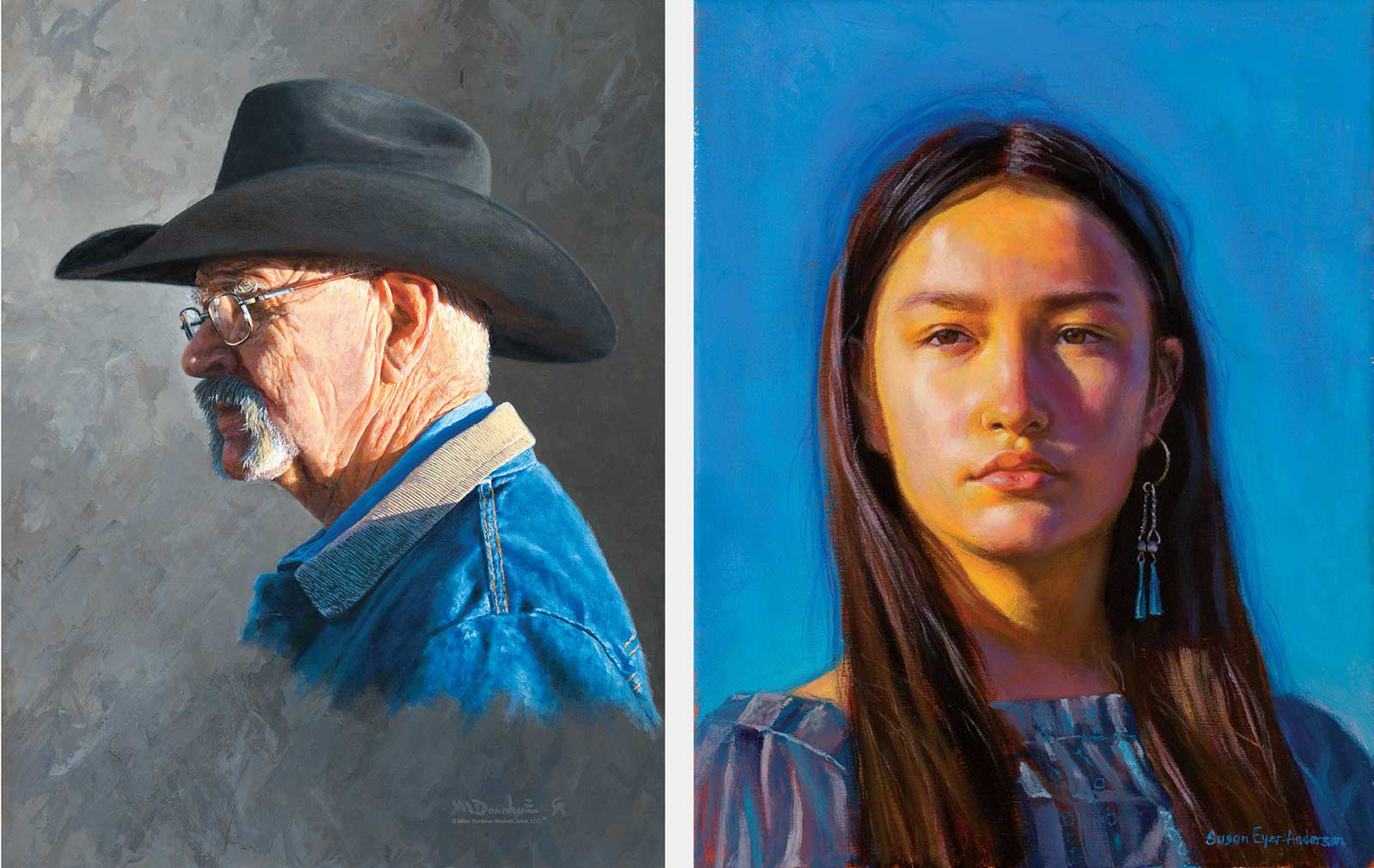
Mikel Donahue, Bill, oil, 14 x 10 in. Private collection; Susan Eyer-Anderson, Prairie Rose, oil on linen, 18 x 14 in.
At Legacy Gallery, the gallery celebrates the enduring legacy of Western art and its diverse interpretations. “Our curated collection offers a glimpse into the multifaceted essence of the West, from a graphite sketch capturing the rugged spirit of a cowboy, to an oil painting depicting Navajo sheepherders in their timeless routines,” says general manager, Cyndi Hall. “The West is a tapestry of evolving cultures, striving to honor their rich heritage while embracing modernity. It is the brilliant sunlight casting a glow on a weathered face, and the dust settling on a collar as a storm rolls in.” Through Legacy’s featured pieces—like Carrie Ballantyne’s Iconic, John Moyers’s Once Upon a Time and Blair Buswell’s Sentinel Bust—“each artist tells a unique story, illustrating that the West means something different to everyone, yet remains a powerful symbol of resilience and change,” Hall says.
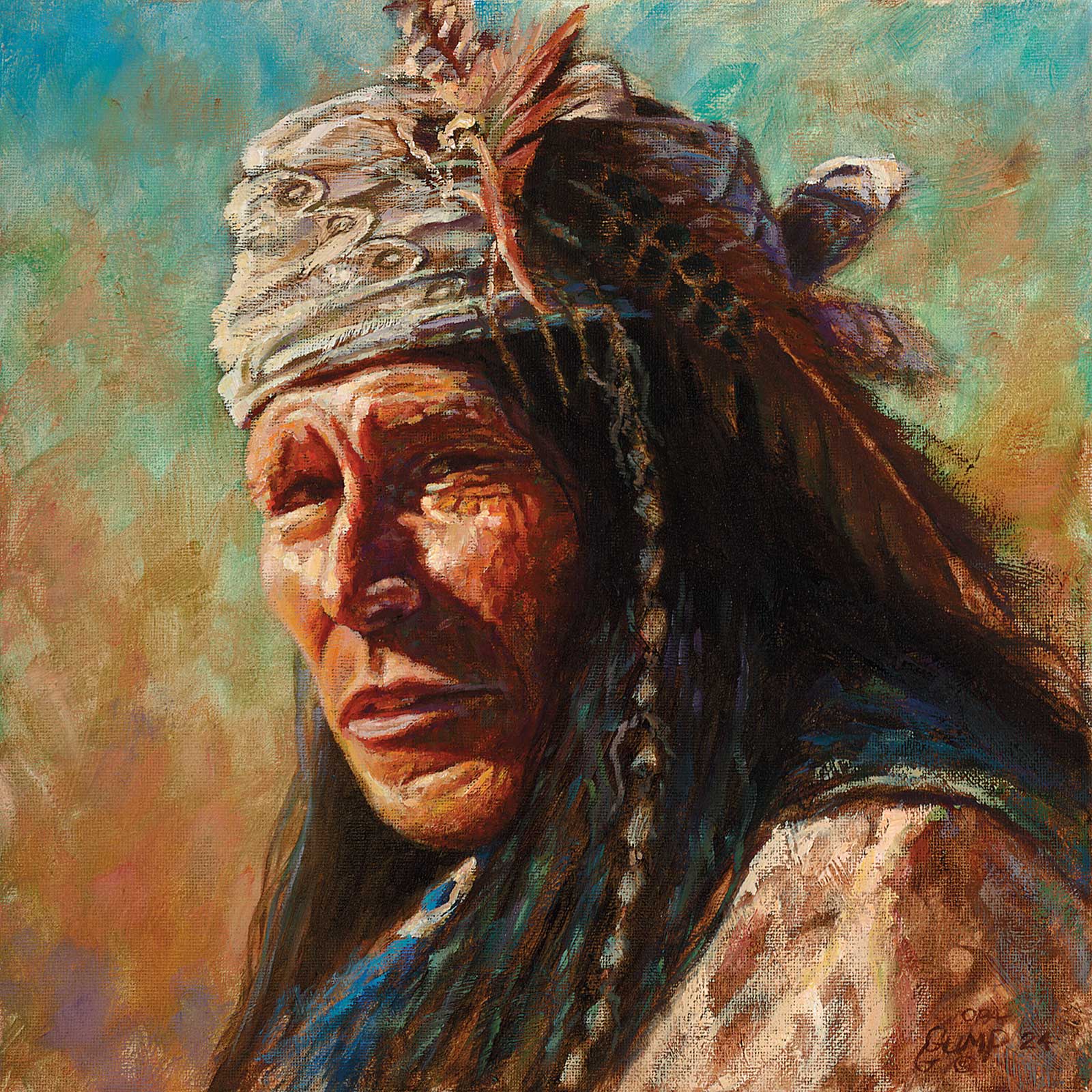
Gump Gallery and Studio of Fine Art, Seldom Seen, oil on canvas, 12 x 12 in., by Tim Gump.
Artist Tim Gump of Gump Gallery and Studio of Fine Art often wondered what it would have been like to have lived in the time period that he likes to paint. “I want my paintings to take the viewers back as it does me, and prompt them to ask questions the piece generates that only their heart and feelings can answer,” the artist notes. “When this occurs, the art has made a connection and done its job. Certainly art can tell stories and provide an explanation, but with portrait works, emotions of the subject become personal and can provoke excitement, drama or mystery. They will draw you in and make a distinct connection that elicits a closer examination of the piece and the period.”
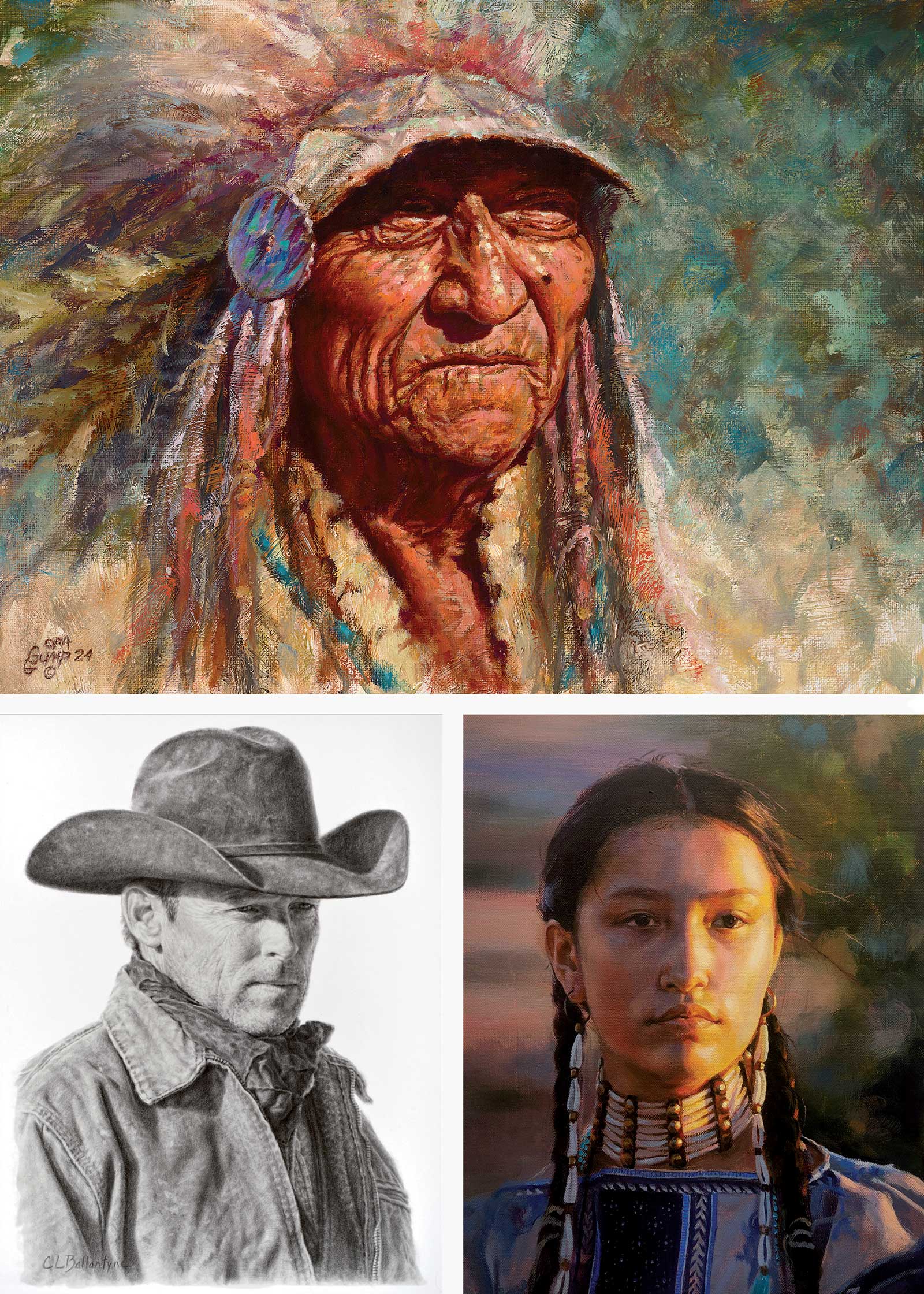
Top: Gump Gallery and Studio of Fine Art, Take No More, oil on canvas, 12 x 16 in., by Tim Gump. Bottom: Legacy Gallery, Iconic, graphite, 17 x 13 in., by Carrie Ballantyne; Susan Eyer-Anderson, Prairie Princess, oil on linen, 16 x 11 in.
Gump shares that his paintings like Take No More depicts a Native American elder as he gazes with emptiness, “being left with no options for his people and their disappearing land,” he says. “Seldom Seen stresses the rare glimpse of an Apache who is very illusive.”
Susan Eyer-Anderson was born in Los Angeles but now lives in Big Bear Lake, California, where most of her family has lived for decades. “The artist’s art education was more unconventional than most, in that “I have had no formal training whatsoever (other than art classes in high school),” she admits. “Instead, I was raised by two artists who were art center graduates, and they taught me everything I know so far. I try to paint the beauty and wonder in life that I see around me. Life is so precious, fragile and fleeting.”
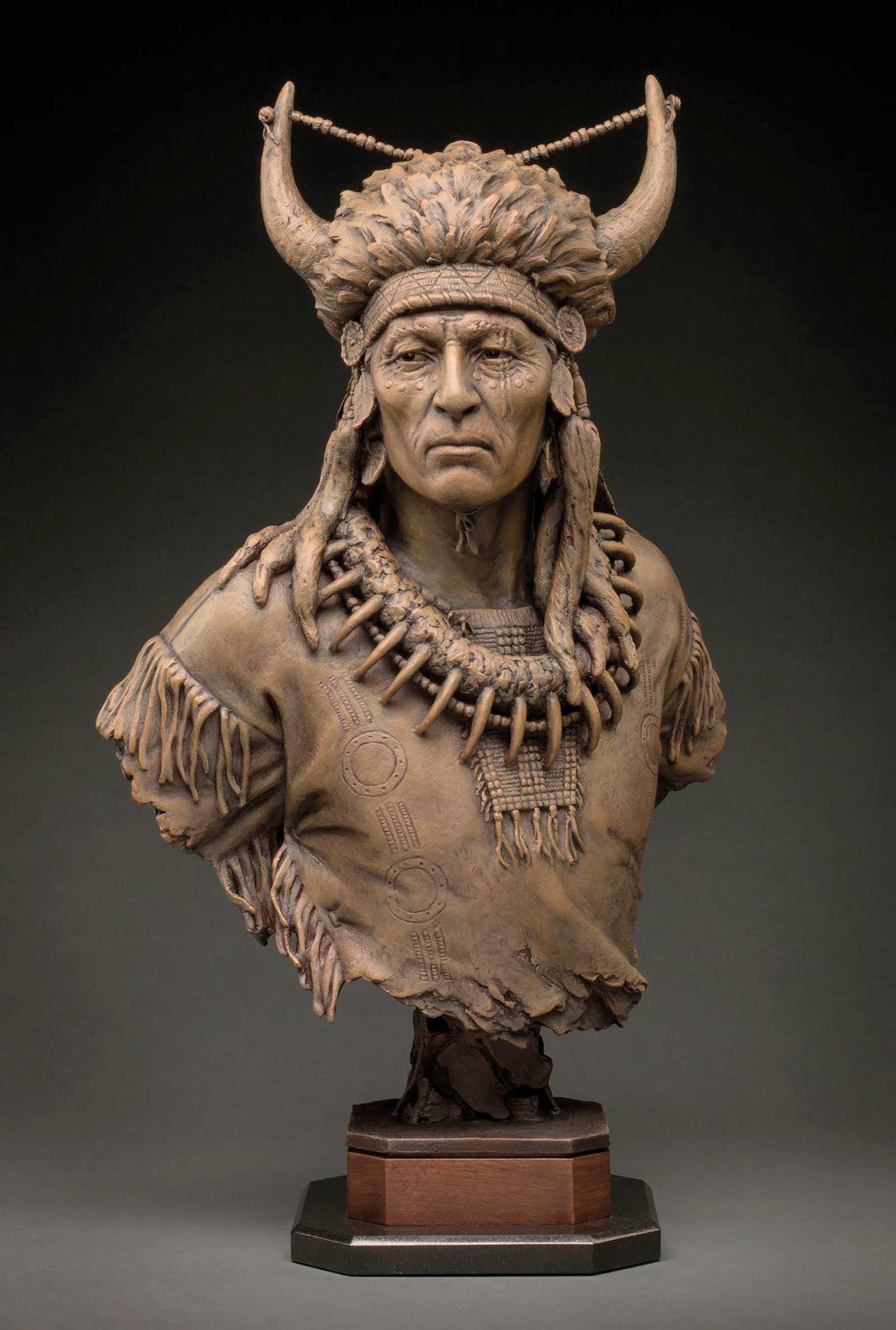
Legacy Gallery, Sentinel Bust, bronze, ed. of 22, 26 x 12 x 14 in, by Blair Buswell.
Collectors should take note of Eyer-Anderson’s impressive Western portraits like Prairie Princess, of a young Cheyenne girl in the golden light of sunset on the prairie; and Prairie Rose, depicting another Native American girl set against a bright blue background. —
Featured Artists & Galleries
Gallery Wild
80 W. Broadway Avenue, Jackson, WY 83001
(307) 203-2322 and 203 Canyon Road, Santa Fe, NM 87501
(505) 467-8297, www.gallerywild.com
Gump Gallery and Studio of Fine Art
4348 Crossroad, Fairview, WV 26570
(304) 657-5827, gumpgallerywv@gmail.com
www.gumpgallery.com
Legacy Gallery
7178 Main Street, Scottsdale, AZ 85251
(480) 945-1113 and 225 Canyon Road, Santa Fe, NM 87501
(505) 986-9833, www.legacygallery.com
Mark Sublette Medicine Man Gallery
6872 E. Sunrise Drive, Suite #130, Tucson, AZ 85750
(520) 722-7798, www.medicinemangallery.com
Mikel Donahue
www.mikeldonahue.com
(918) 640-2738
boots@valornet.com
Powered by Froala Editor


