Penelope Gottlieb dives deep into her research on invasive plants and endangered species. Her discoveries enrich her paintings on digital appropriations of John James Audubon’s iconic prints of birds. She says, “By problematizing the renowned ornithologist’s idyllic representations of natural history, I present a revisionist vision of nature in its current state of compromise and literal bondage…I see it as a duet—a conversation with another artist.”
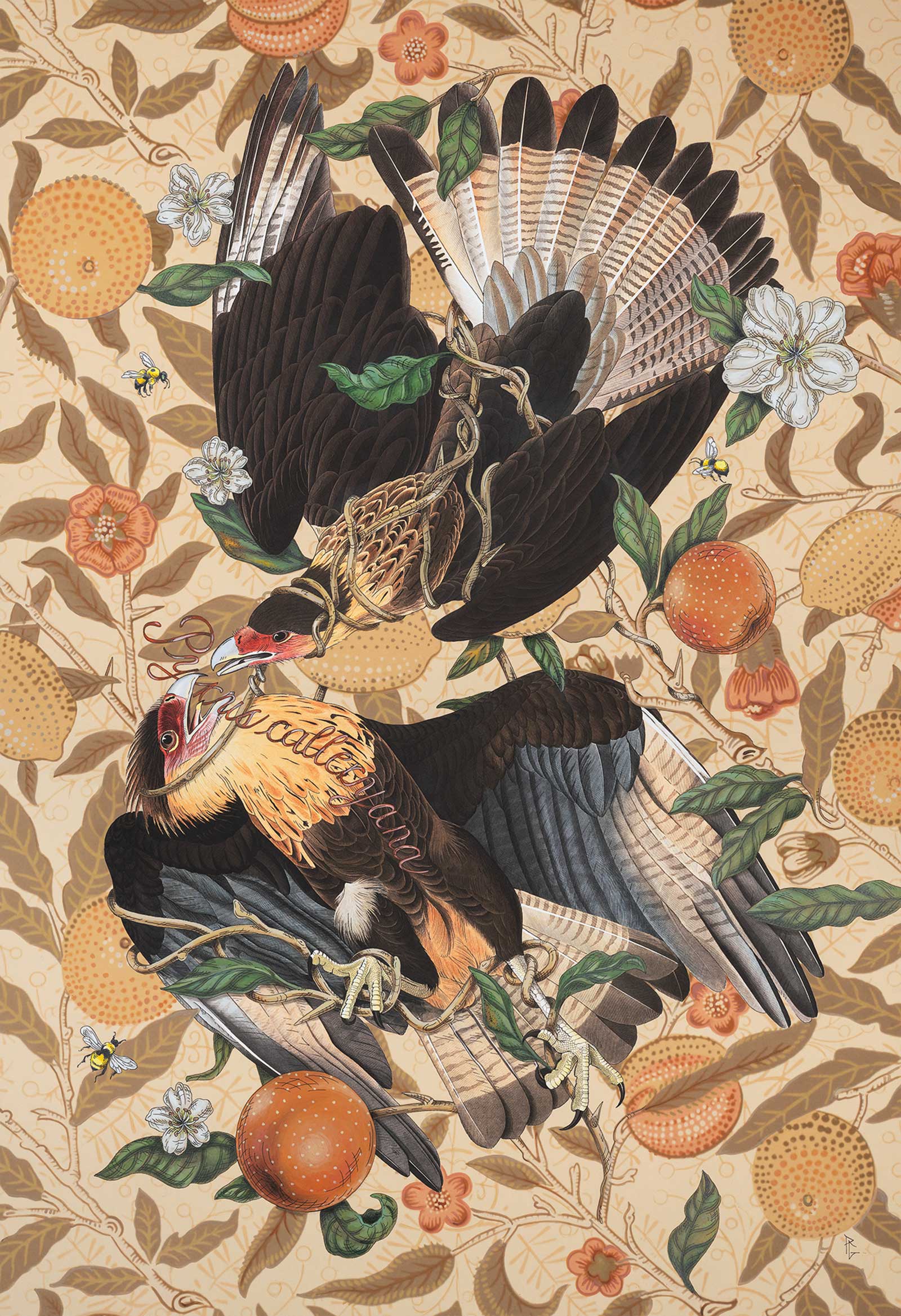
Pyrus calleryana, acrylic and ink over a digital reproduction of a John James Audubon print, 38 x 26 in.
The Bradford pear (Pyrus calleryana), native to China and Vietnam, was introduced into the United States in 1918 as a possible solution to a disease that was devasting American pear crops. Botanists developed cultivars that grew into uniform shapes, had abundant spring blossoms and were sterile and non-invasive. They became the ornamental tree of choice in American suburbs. The trees had a mind of their own, however, and began spreading across the countryside with thorny, brittle branches and flowers that smelled like dead fish. It has been named an invasive plant in 29 states and in Washington, D.C., and is now banned in Ohio, Pennsylvania and South Carolina.
Gottlieb’s Pyrus calleryana, 2024, depicts the plant ensnaring Audubon’s Brasilian Caracara Eagle, itself an endangered species. She has added the beautiful but smelly blossoms of the plant as well as its speckled fruit.
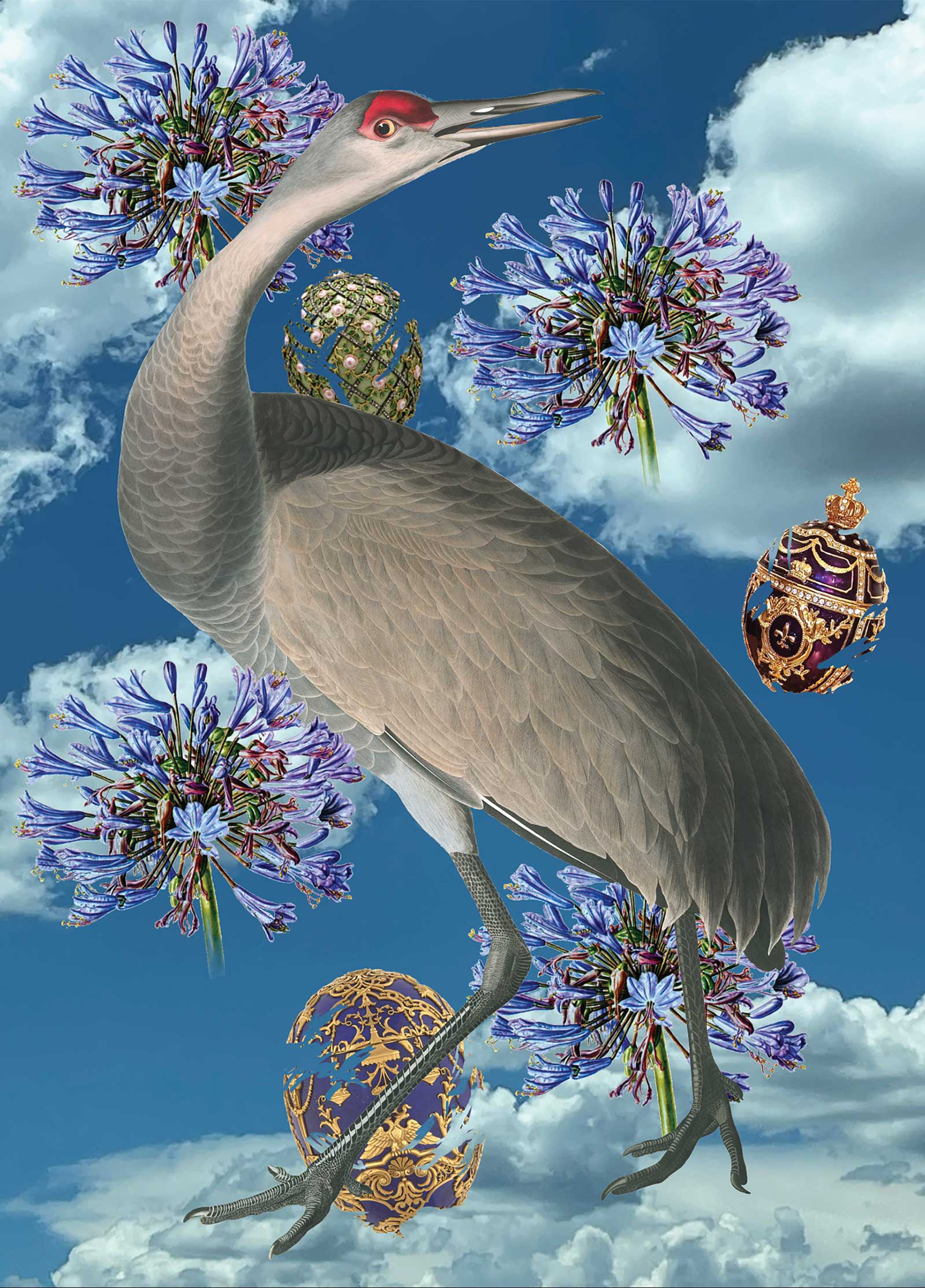
Agapanthus praecox, acrylic and ink over a digital reproduction of a John James Audubon print, 60 x 40 in.
“I was thinking about William Morris and the Arts & Crafts Movement. Nature was the basis of his designs. I accommodated his Fruit design and flipped it to enhance the composition, even adding some thorns to the stems,” says the artist. She painted Bradford pear fruit that echoes the pomegranates in Morris’s design. “I also added bumblebees,” she explains, “because I had been reading about their being vulnerable.”
Audubon’s Sand Hill Crane appears in her painting Agapanthus praecox placed against an image of clouds she photographed in New Mexico. Blue agapanthus blossoms, a popular highlight in many gardens, appear against the clouds. The plant symbolizes love and represents beauty, purity and fertility—despite the fact that parts of it can be toxic to people and pets.
Nature as decoration appears in her rendition of jeweled Imperial Russian Easter Eggsby Peter Carl Fabergé, placed by Audubon’s taxidermized crane—their decadence crumbling.
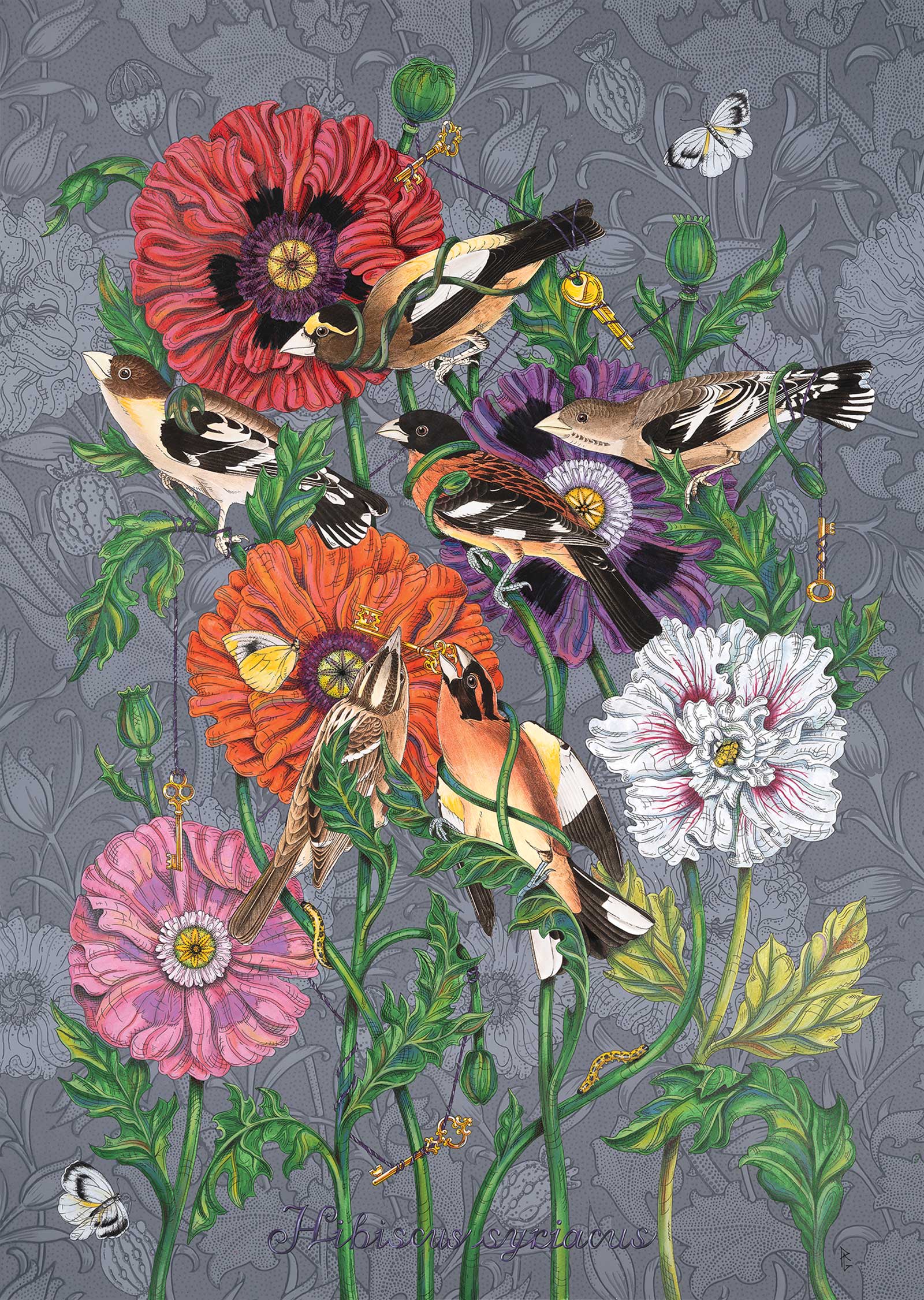
Hibiscus syriacus, acrylic and ink over a digital reproduction of a John James Audubon print, 38 x 26 in.
“When I made the decision on what I was going to paint,” Gottlieb says, “I knew it was not going to be pretty pictures of the nature that I love. I wanted to make them relevant to my research and what I was thinking about.
“It is my intention to awaken some of the conflicting feelings that lie hidden beneath the surface of our inherent attitudes, and those inured by our inherited representations of nature and history. In this way, these altered plates seek to compel a more critical understanding of our world, and of the roles we play as artists and as people living in it.”
Her recent work will be shown in the exhibition Penelope Gottlieb: A Delicate Balance at Gerald Peters Gallery in Santa Fe, New Mexico, July 14 through September 28. —
Gerald Peters Gallery 1005 Paseo de Peralta » Santa Fe, NM 87501 » (505) 954-5700 » www.gpgallery.com
Powered by Froala Editor


