In 1958, Arizona Senator Barry Goldwater wrote to Joe Noggle in Prescott, Arizona, congratulating him on a plaque he designed honoring Teddy Roosevelt. “I am sure that Teddy, from his place in Heaven, is just as happy over this recognition as we are in Arizona are,” Goldwater wrote.
The plaque features a portrait of Roosevelt sculpted by George Phippen. Its production was rocky, but it was the beginning of an extraordinary history of lost-wax bronze casting in Prescott that continues today.
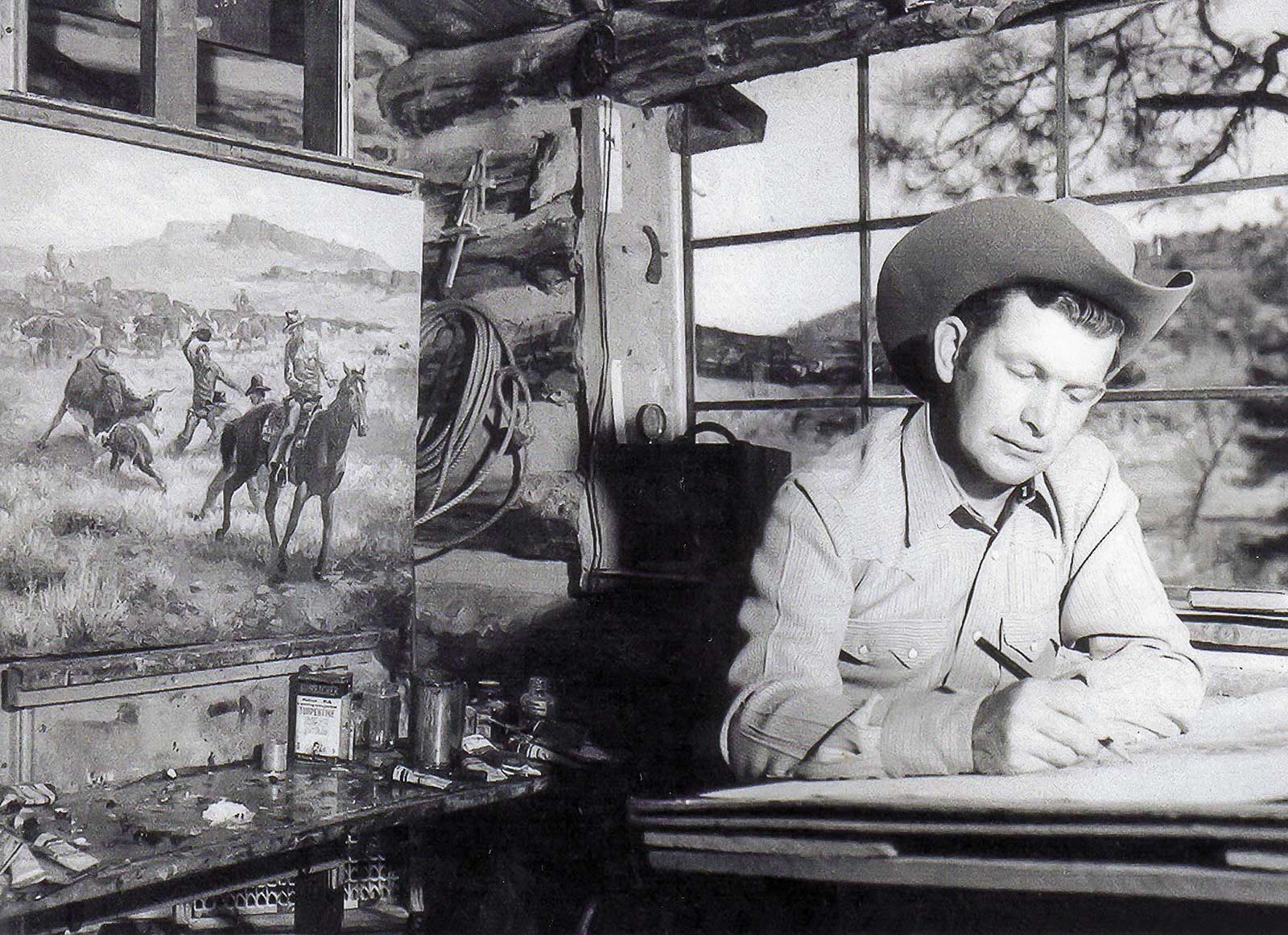
George Phippen in his studio. The artist was known for both his paintings and works in bronze.
The lost-wax process is thousands of years old but was a new experience for three intrepid pioneers in Prescott. Merry Nebeker, the wife of sculptor Bill Nebeker, describes the men: “Joe Noggle, a local contractor and former foundryman from Michigan; Joe Vest, a silversmith and engineering genius who could make anything work; and George Phippen, the painter of cowboys and Indians for the famous Brown & Bigalow calendars. They took the challenge to begin a journey of discovering how to cast artistic and complicated Phippen clay sculptures in the small Noggle foundry on the grounds of Sharlot Hall Museum.”
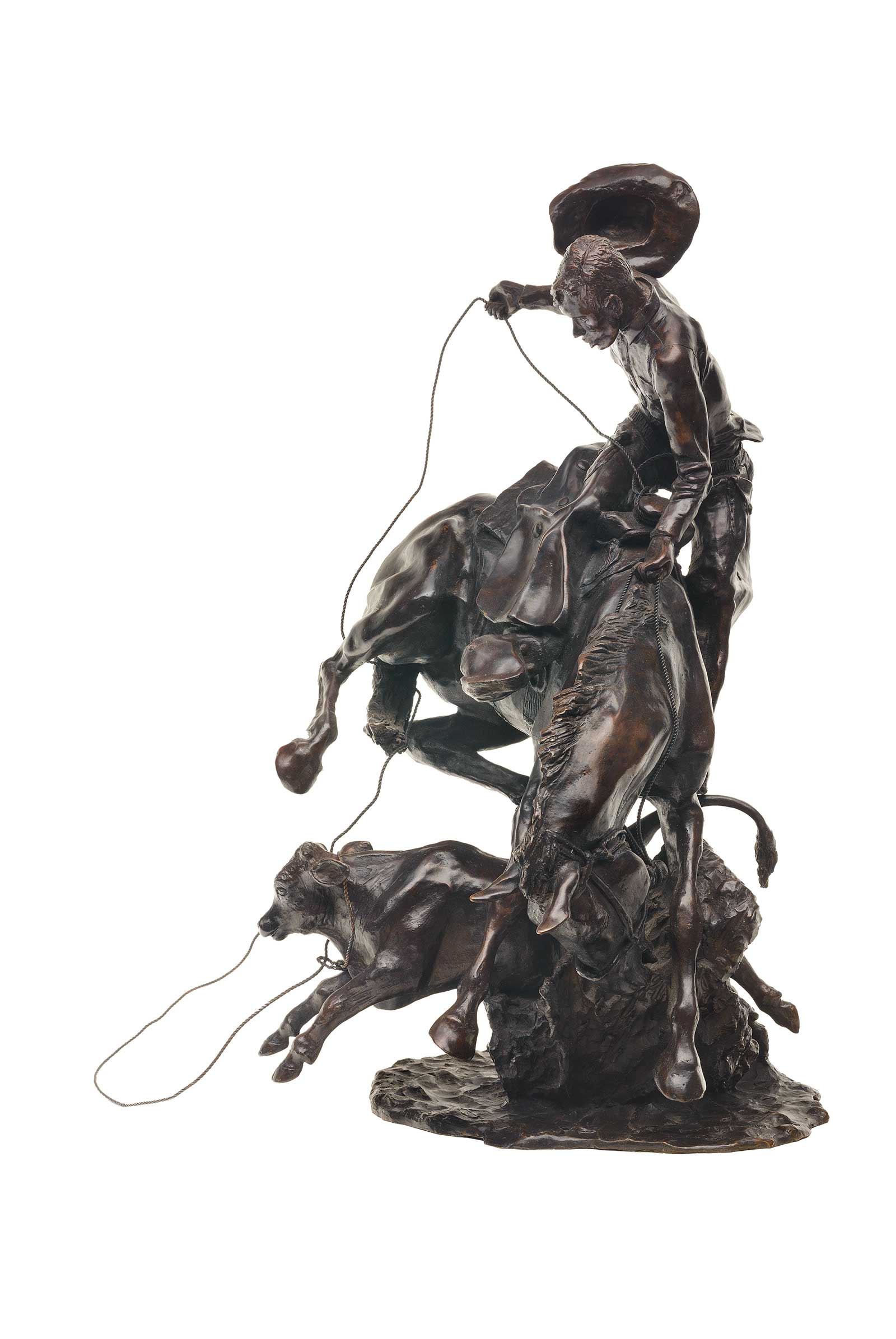
George Phippen (1915-1966), Cowboy in a Storm, bronze, 18 in. Courtesy Coeur d’Alene Art Auction, Coeur d’Alene, ID.
Through a process of trial and error, the men produced Noggle’s plaque with Phippen’s bas-relief portrait—a sculpture raised only slightly from a flat surface. Noggle’s daughter, Ruth, wrote for the Sharlot Hall Museum: “1958 was the centenary of Theodore Roosevelt’s birth and the Arizona Game Protective Association (AGPA) planned a bronze plaque to commemorate his establishment of the Grand Canyon National Game Preserve within the present boundary of North Kaibab National Forest. William H. (Bill) Beers was AGPA president and they decided to place the plaque at Jacob Lake, a small town within Kaibab North…Roosevelt was revered in Prescott and the United States not only for his leadership with the Arizona Rough Riders during the Spanish-American War in 1898, and for being a Nobel Peace Prize recipient, but also for his aggressive conservation policies. During his two terms (1901-1909), he set aside 120,000,000 acres of prime land that included the Grand Canyon Forest Reserve and the Game Preserve.”
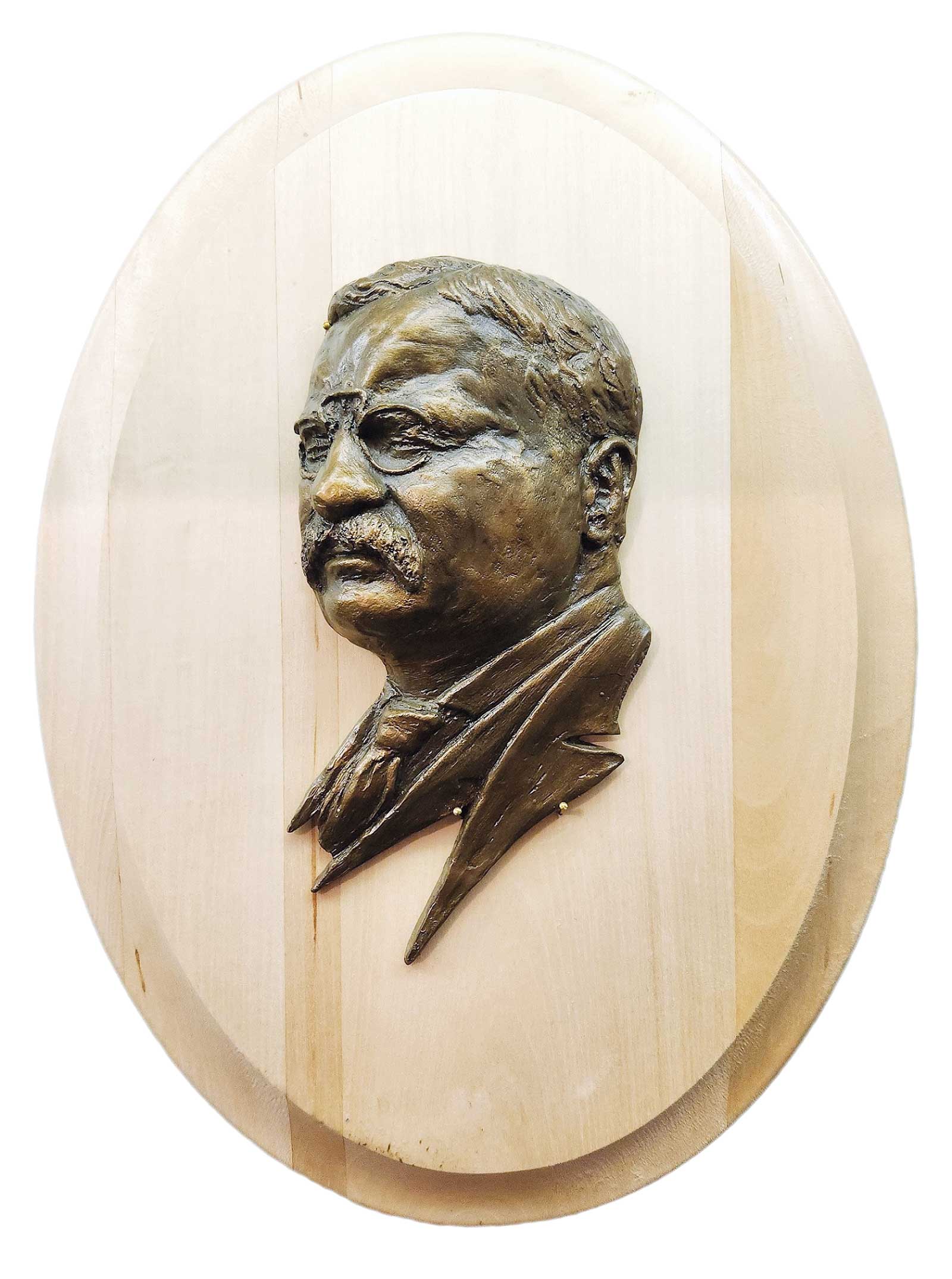
George Phippen (1915-1966), Teddy Roosevelt, bronze. Courtesy Bill and Merry Nebeker.
Merry Nebeker continues the history: “In May of 1961, Phippen was living in Skull Valley and wanted his foundry to be closer so he could try new techniques, but it wasn’t until 1965 that his dream of a foundry at his home was realized. Bear Paw Bronze began in an old tin shed with a dirt floor. Mr. Phippen’s brother, Harold, and George’s sons Loren and Ernie, began the fledgling foundry with little money and less knowledge. After Mr. Phippen died in April of 1966, Ernie continued to cast his father’s remaining bronze editions when Loren was drafted into the Army, with the help of two new apprentice sculptors, Bill Nebeker and Pat Haptonstall. Both became award-winning members of the Cowboy Artists of America, which had been the organization Mr. Phippen served as the first founding president.”
Merry continues: “An old adage says, ‘Despise not the small beginning.’ That proved true in this case, as dozens of the famous foundries and bronze sculptors of today can trace their roots back to Phippen’s tiny seed as entrepreneur and an artistic visionary.”
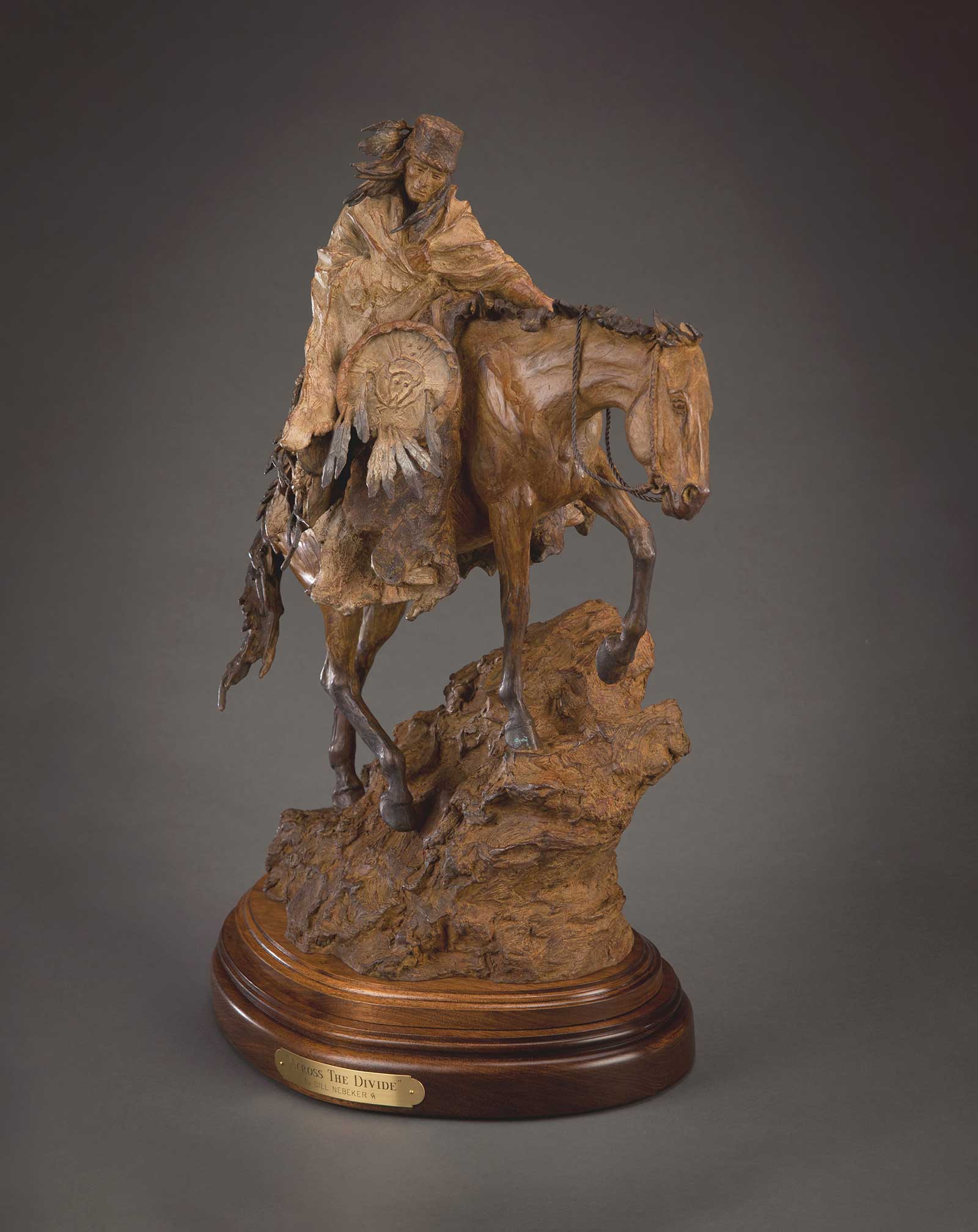
Bill Nebeker, Across the Divide, bronze, 23 x 16 x 9 in. Courtesy the artist.
When Ernie Phippen died in 1974, Merry Nebeker relates, “Nebeker, Haptonstall and CAA artist Bill Owen bought the foundry from Ernie’s widow, calling it Cowboy Casting. These three men ran it for a few years, hiring new employees, John Skurja and Ralph Simpson, and changed the name to Thumb Butte Bronze. Several years later, Skurja opened his own Skurja Art Castings in Prescott and Jim LaFuze bought into the business.” Today, Thumb Butte Bronze is still operating, with the daughter of Jim LaFuze casting the majority of Nebeker’s bronze works.
Bill Nebeker had been inspired to begin sculpting when he attended an exhibition by Phippen. His sculptures, from pedestal size to the monumental, are rich with detail and tell stories of the cowboys, ranchers and Indigenous people of the West. In his bronze, Across the Divide, a Blackfoot braves the frigid winter wrapped in a buffalo hide and a wool blanket searching for a mountain pass to lead his people to safety from pursuing soldiers.
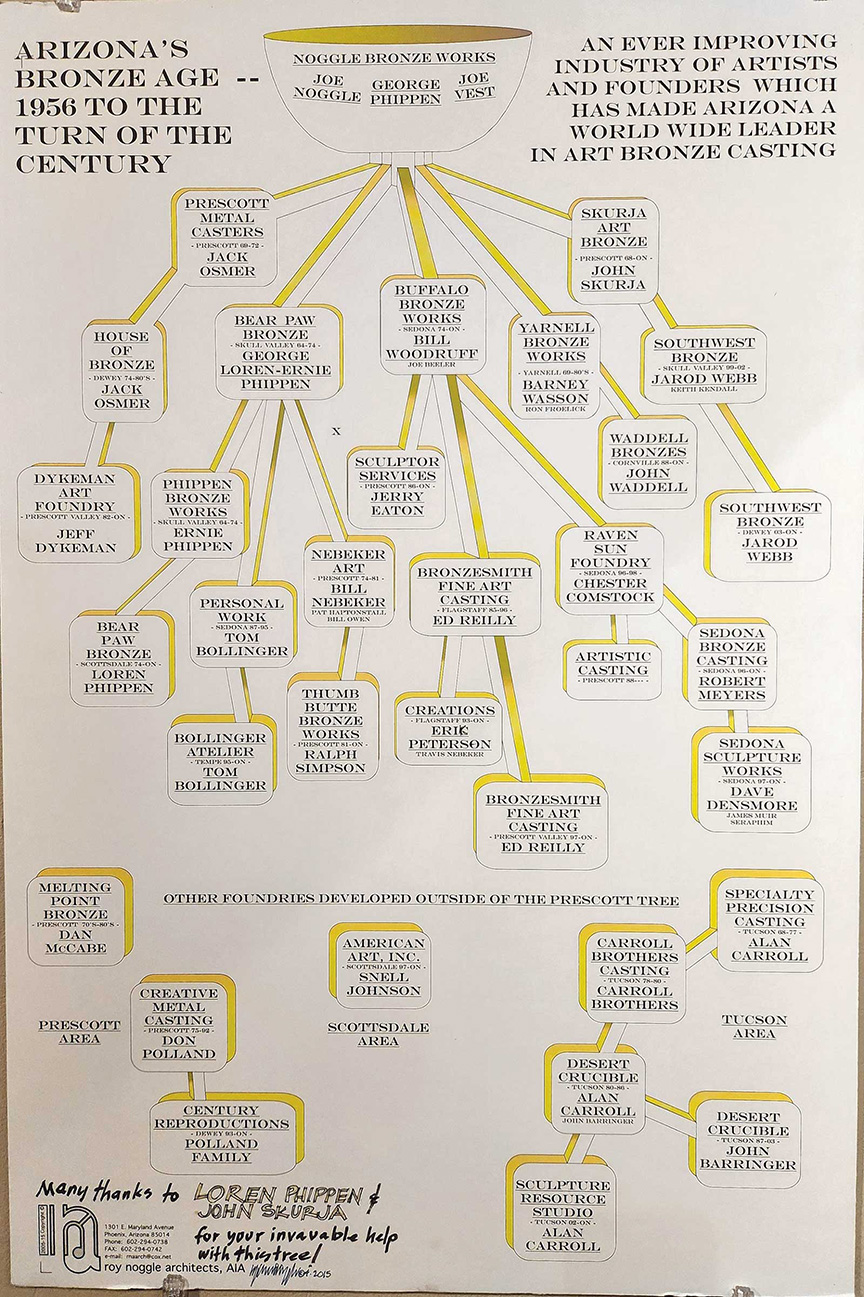
Roy Noggle’s “family tree” of Prescott foundries, Arizona’s Bronze Age—1956 to the Turn of the Century.
In 2019, Nebeker was commissioned to enlarge his small sculpture If Horses Could Talk to a 14-foot-tall bronze to greet visitors at the Prescott Regional Airport. His wife writes, “Bill has been a hunter since he was a boy with his father, then with his friends for 50 years and now continues today with his son and grandsons. In this larger-than-life, 5,000-pound bronze sculpture, he recreates an event he has seen, and probably had happen to him during his hunting trips. We see a cowboy scanning the distance with binoculars looking for mule deer as his horse stands beside him looking over the edge of the high outcropping they are upon. Below, the horse sees a large mule deer buck sneaking away out of the view of his cowboy hunter. With a bit of humor, we are the unseen observers wondering what would happen ‘if horses could talk.’”
One of the foundries descended from Noggle Bronze Works, and one still flourishing today, is Bronzesmith Fine Art Gallery and Foundry which casts the work of some of the West’s finest sculptors, including that of its owner, Ed Reilly.
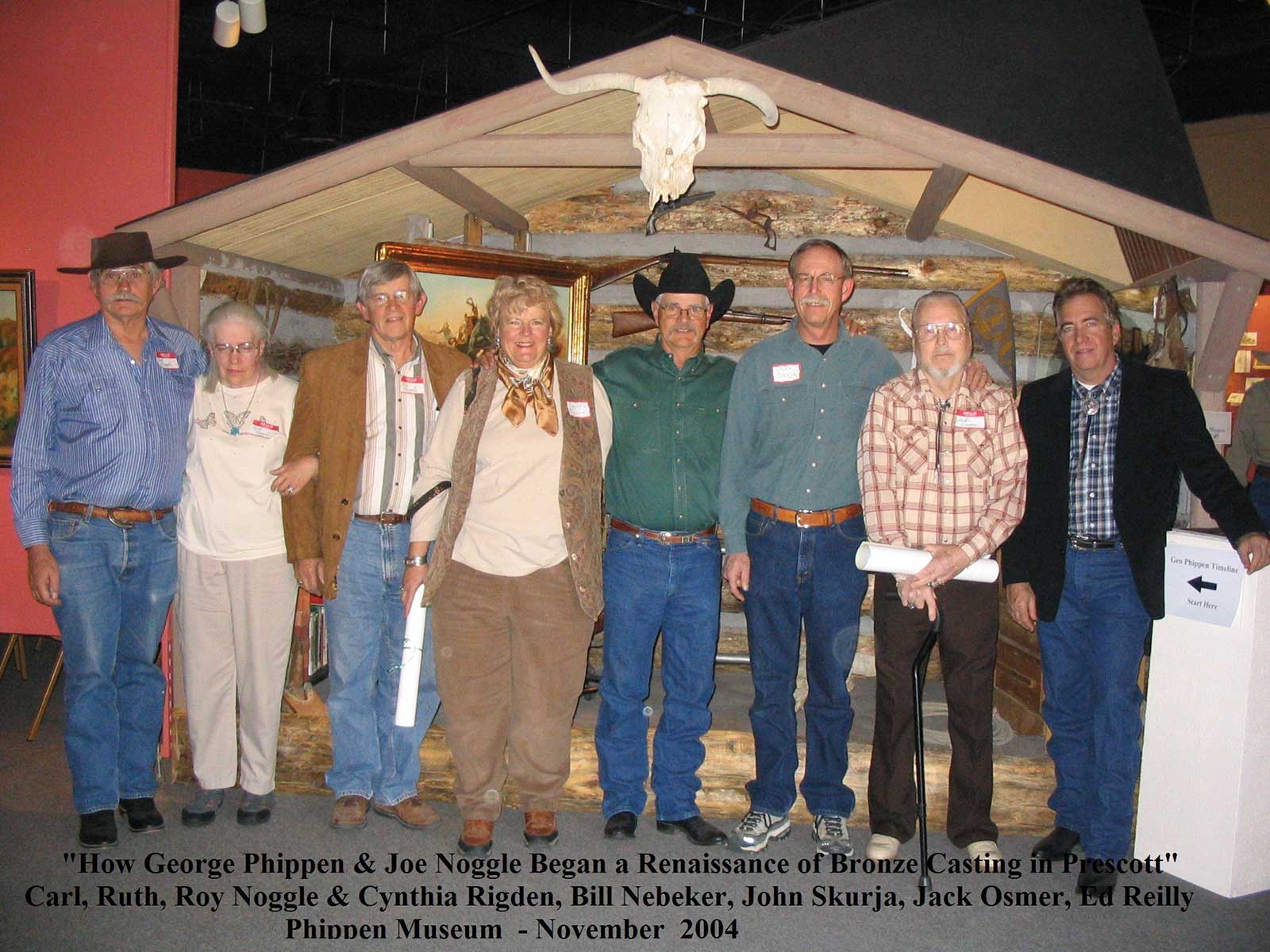
A 2004 conference at the Phippen Museum with, left to right, Carl, Ruth and Roy Noggle; Cynthia Rigden; Bill Nebeker; John Skurja; Jack Osmer; and Ed Reilly. They are standing in front of a replica of George Phippen’s log-cabin studio.
In 2021, Reilly completed an 18-foot-tall sculpture, the Jenkins Obelisk, celebrating the Prescott Valley area, the Yavapai Tribe, mining, ranching and the natural beauty of central Arizona. He said at the time, “I want those who see the obelisk to understand what an aesthetically, historically and environmentally rich area this is.”
Three 12-foot bronze panels were carved and cast in bas-relief, echoing Phippen’s sculpture of Teddy Roosevelt created more than 60 years earlier. The fourth panel is translucent and lit from inside, its surface composed of angular shapes aimed at the sky, symbolizing the future of Prescott and its people. Several of the panels are highlighted by soft pastel patinas done by Carl Wolf of Bronzesmith.
Reilly notes that Bronzesmith pioneered and specializes in subtle patinas. “We develop a signature look for each artist,” he explains. The same chemicals used for subtle color can be used to produce more vibrant color if the artist requests it.
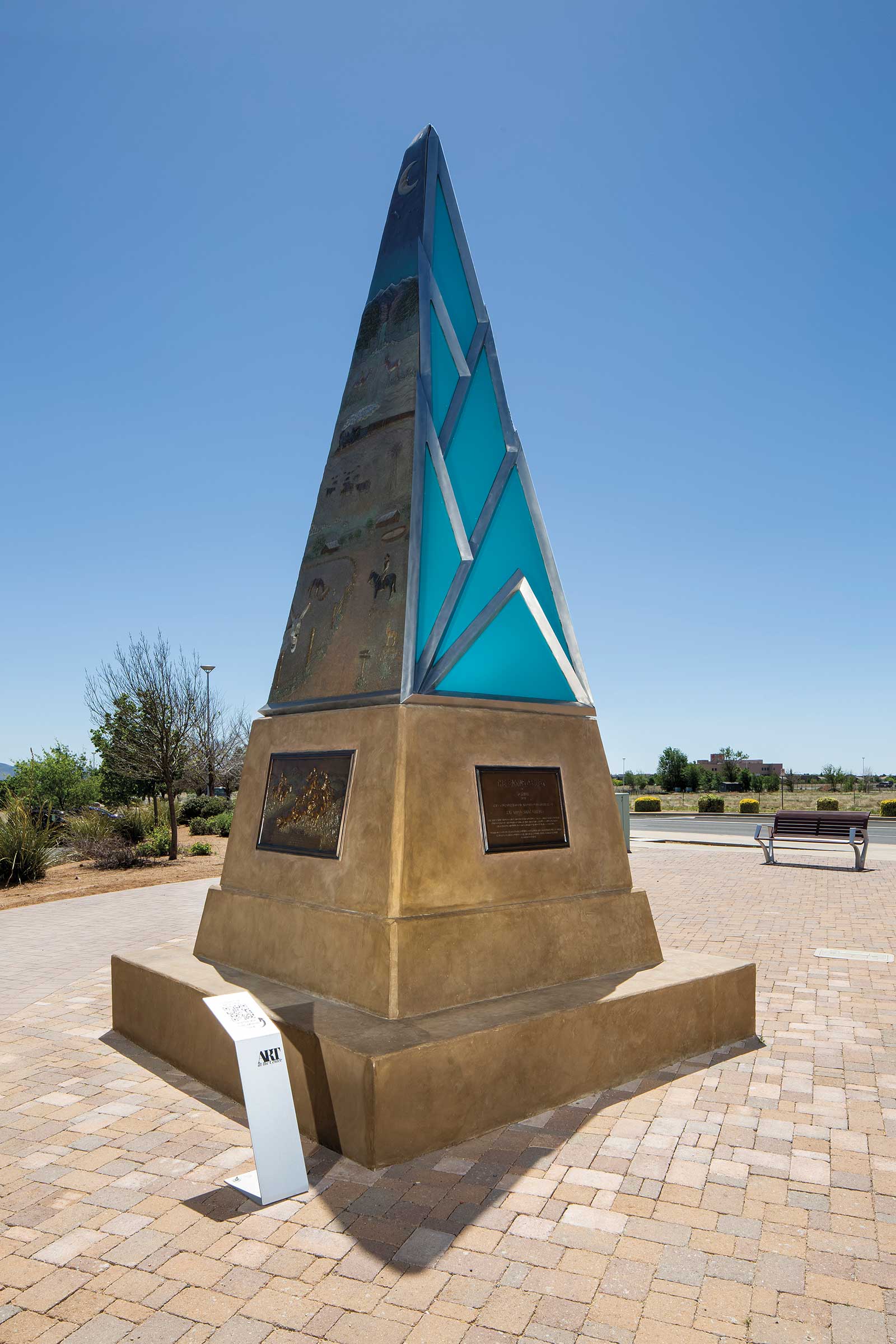
Ed Reilly, Jenkins Obelisk, bronze, 18 ft.
One panel honors the Yavapai who “thrived in Central Arizona, and their blankets, weaving, tribal artwork—all these reveal their intense relationship with nature and the environment,” Reilly explains. Another panel depicts the miners of the 19th-century gold rush who brought big changes to Yavapai County. The third panel depicts cattle ranching, the arrival of the railroad and the development of commercial and residential communities. Also appearing in the panel is the silent movie star Tom Mix, who built a ranch nearby and a laughing jackass as a reminder that the area was once named Jackass Flats.
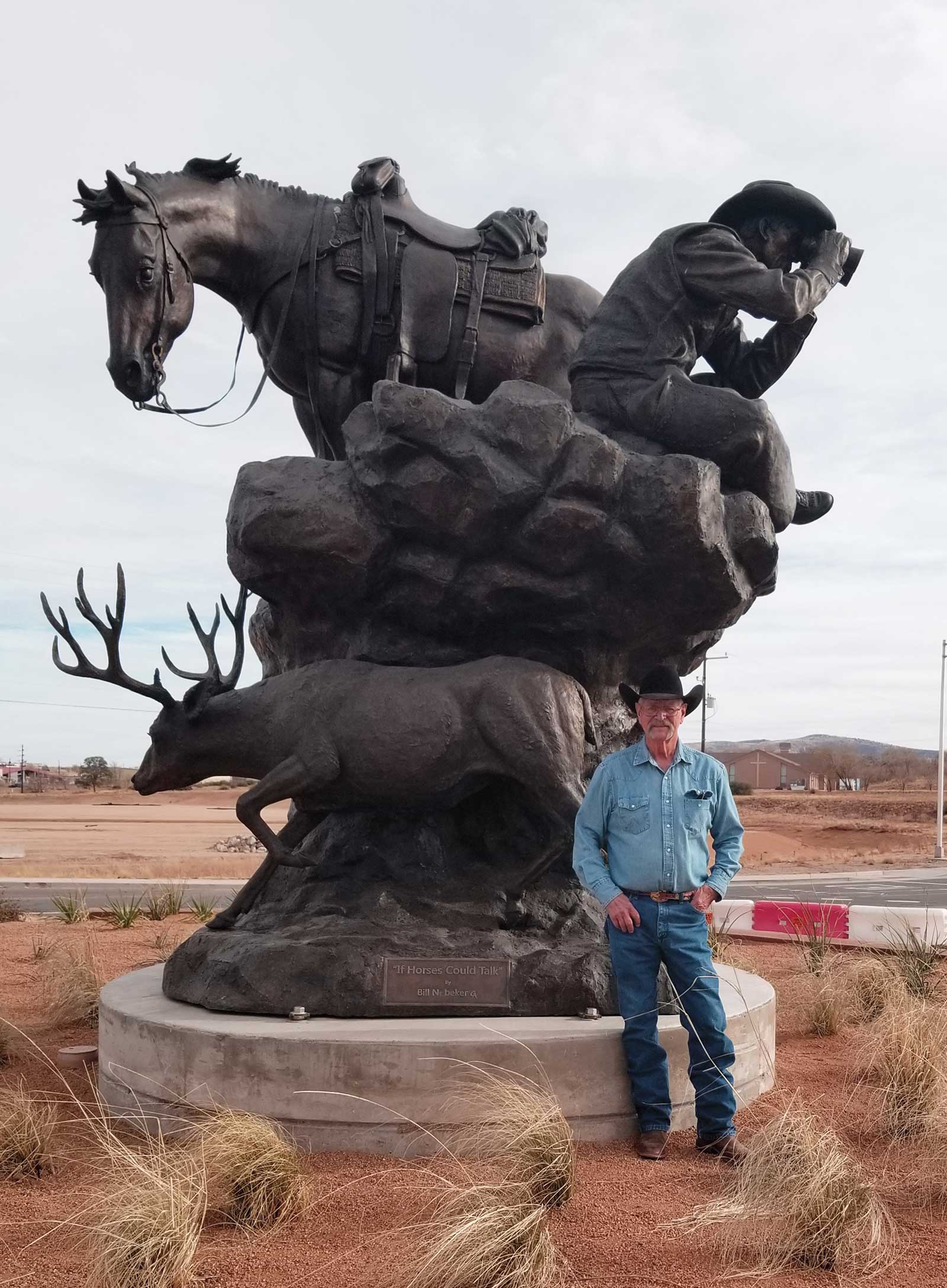
Bill Nebeker and his monument If Horses Could Talk in Prescott, Arizona. Courtesy the artist.
Another Prescott foundry, the Bronze Age, is still one of the busiest and is completing bronzes for many renowned sculptors. It is owned and operated by Eric Petersen, with Bill Nebeker’s son, Travis Nebeker, as one of his associates. Eric Petersen began as a foundryman at Ed Reilly’s Bronzesmith in 1996. In 2005, John Coleman offered Petersen a space in his personal art studio for the young metalworker to finish Coleman’s bronze patinas. The Bronze Age now completes all the sculptures for Coleman, and many of the works by Kim Obrzut, Susan Kliewer, Deborah Copenhaver Fellows, Kim Kori and Bill Nebeker.
A “family tree” of foundries descended from Noggle Bronze Works was created many years back. It was assembled by Joe Noggle’s son Roy with the help of George Phippen’s son Loren and John Skurja. It indicates the expansion of art bronze casting in Arizona from its humble beginnings to it being a worldwide leader casting pieces by other artists such as Joe Beeler, Oreland Joe, Bill Owen, John Soderberg, Cynthia Rigden, Susan Kliewer, Ken Rowe, Art Norby, Pat Mathiesen, Deborah Copenhaver Fellows, Veryl Goodnight, Dave McGary, Richard Greeves, Frank Polk, Don Polland and Willy Rubottom. —
Powered by Froala Editor


