In his book The Genius of Nicolai Fechin, the late Forrest Fenn wrote, “Fechin was primarily a painter of portraits, and his oil studies reveal the very deep-down character of his subjects…Even his floral paintings held me in awe and disbelief of their beauty and their seemingly complex simplicity. Many of his backgrounds could be described as a rainbow symphony of splotches, lines, forms and smears that enveloped the overall composition to make a very pleasing picture. It was marvelous.”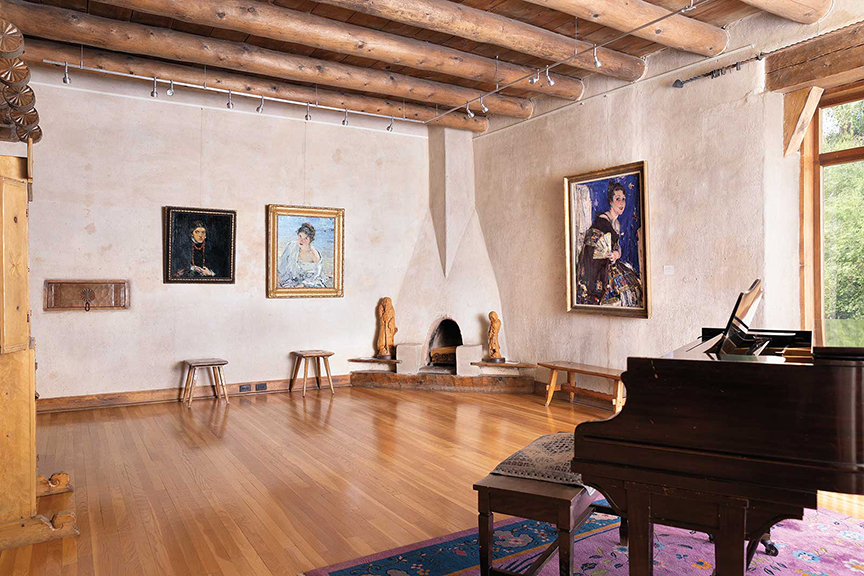 Fechin’s oil on canvas paintings in the living room are, left to right, Alexandra with Coral Beads, 1910; Alexandra on the Volga, 1912; and Russian Singer with Fan.Fechin (1881-1955) was one of the most important portrait painters of the 20th century. Born in Russia, by the age of 6 he was doing drawings for his father’s woodworking shop where he also learned woodcarving. He enrolled in the Kazan School of Art at the age of 13 and was accepted into the Imperial Academy of Petrograd in 1900. Architecture was a required part of the academy curriculum and would serve him well when the family moved to Taos. In 1909 he won the prestigious Prix de Rome and traveled to the art capitals of Europe. The award brought him invitations to exhibitions at the Munich Glaspalast and, in 1911, Pittsburgh’s Carnegie Institute. He returned to his hometown of Kazan to teach at the School of Art and later married Alexandra Belkovich (1893-1983), the daughter of the founder.
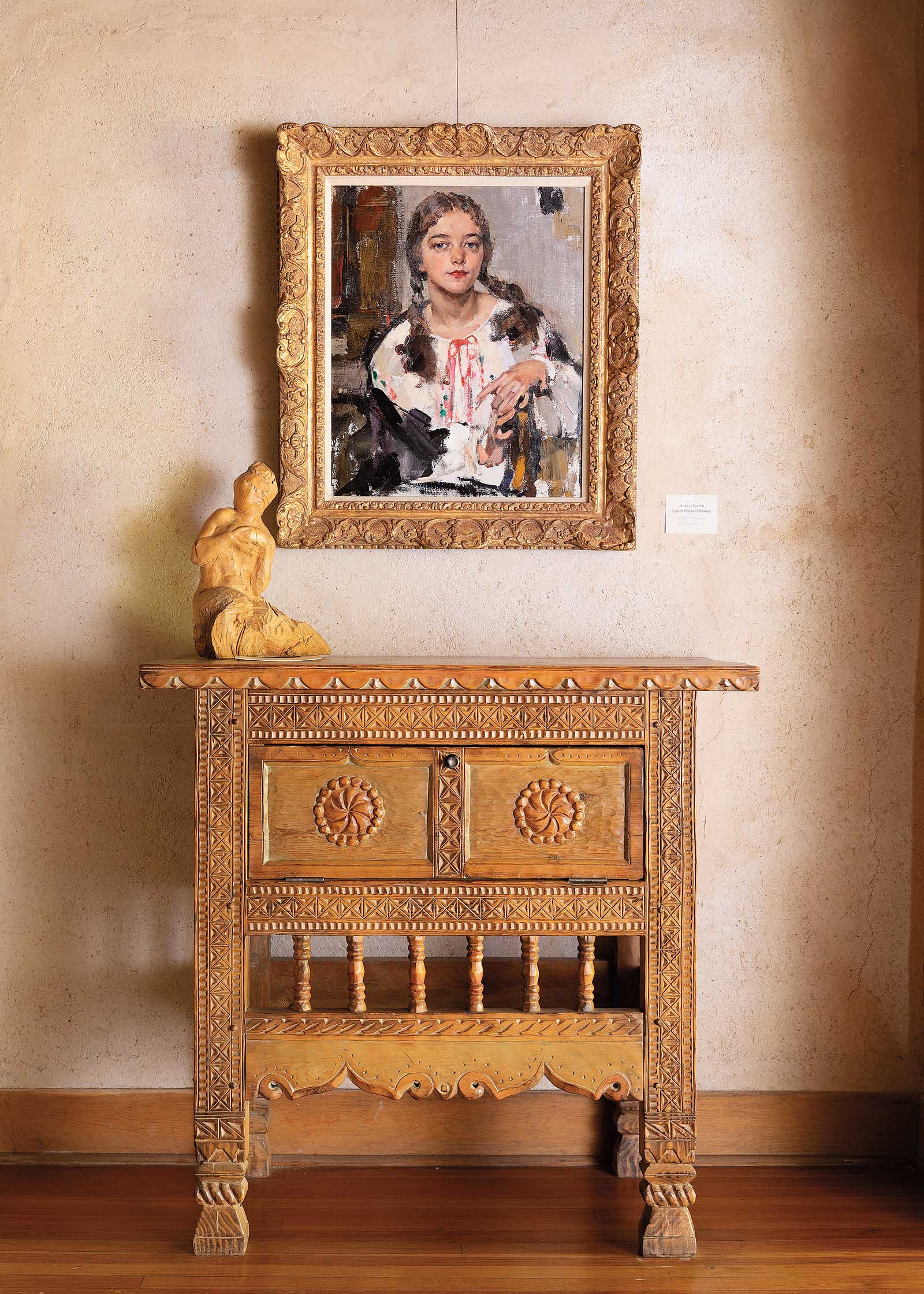 In the hall is Fechin’s Eya in a Peasant Blouse, circa 1927-1933, oil on canvas, from a private collection.He, his wife and daughter Eya (1914-2002), emigrated to the United States from Russia in 1923 and moved to Taos in 1927, staying briefly at the home of Mabel Dodge Luhan. The following year he acquired an adobe house with an outbuilding that he used for his studio. He expanded the house, enlarging window openings, carving columns, stair rails, vigas, doors, furniture and, with the local metal smith, creating light fixtures, door pulls and hinges. The result is an extraordinary “Russian house evolved out of New Mexico mud,” Eya recalled.
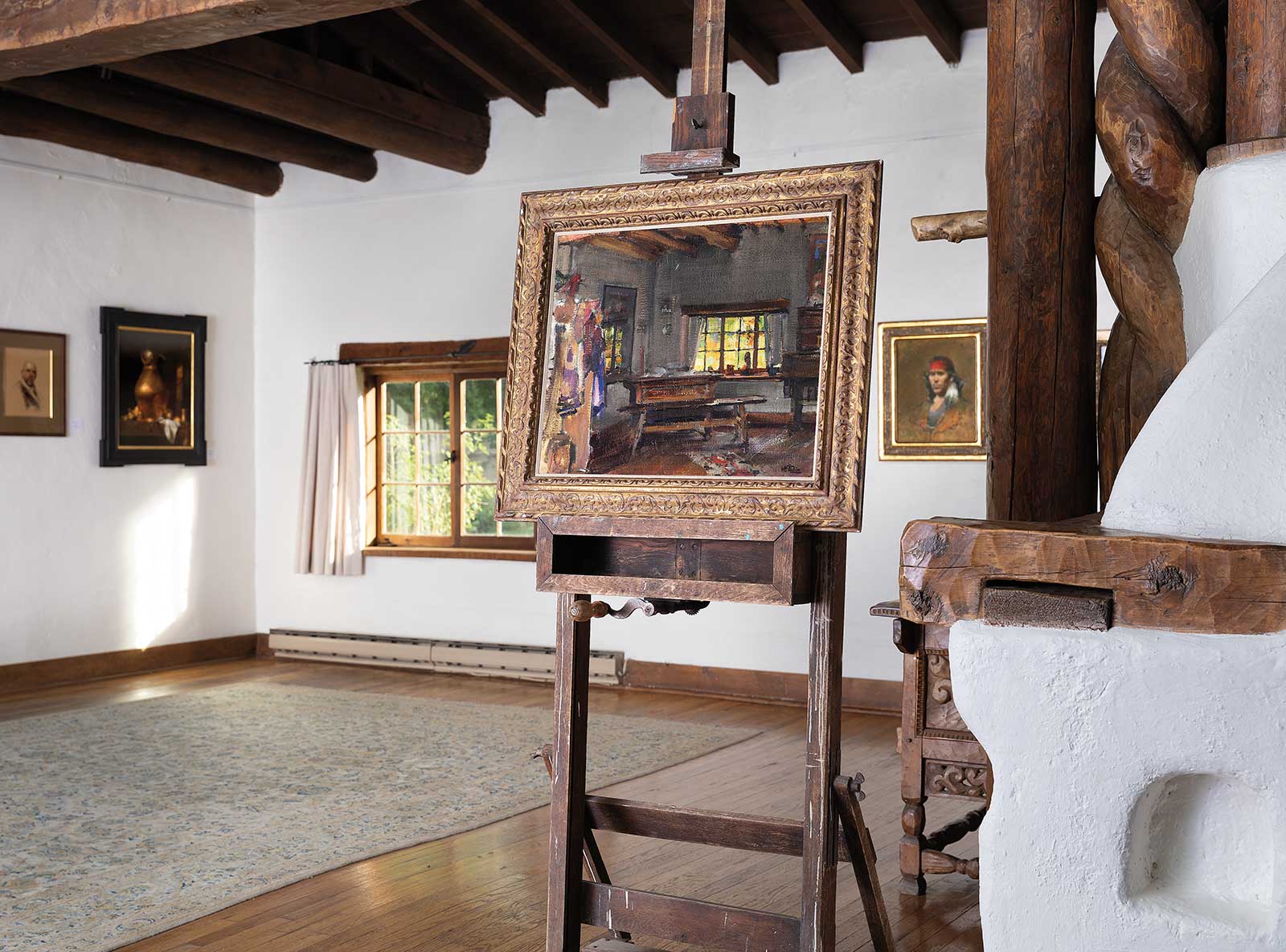 In the foreground in the studio is Fechin’s Taos Studio Interior, circa 1927-1933, private collection, courtesy of the Owings Gallery, Santa Fe. On the walls are, left to right, David A. Leffel’s Rocky, 2019, charcoal and conté on paper; Sherrie McGraw’s St. Bernard Copper, 2012, oil on canvas; and Leffel’s Pueblo Man with Eagle Feather, 2012, oil on canvas.
Fechin and Alexandra divorced in 1933, and he and Eya moved west. Alexandra maintained the house, moving into the studio in 1946 when the house became too much for her to manage. It remained untouched for 30 years until Eya returned in 1977 and was appointed conservator, overseeing its restoration. In 1979 it was added to the National Register of Historic Places. Nikki Donner, Fechin’s grand-daughter is secretary of the museum’s board of directors.
Today, Christy Schoedinger Coleman, its executive director, oversees exhibition programs in the house and studio, as well as plans for an expansion that will result in secure, climate-controlled exhibition and art storage spaces. The new facility will be an addition to a building built behind the studio in the 1990s for administrative offices.
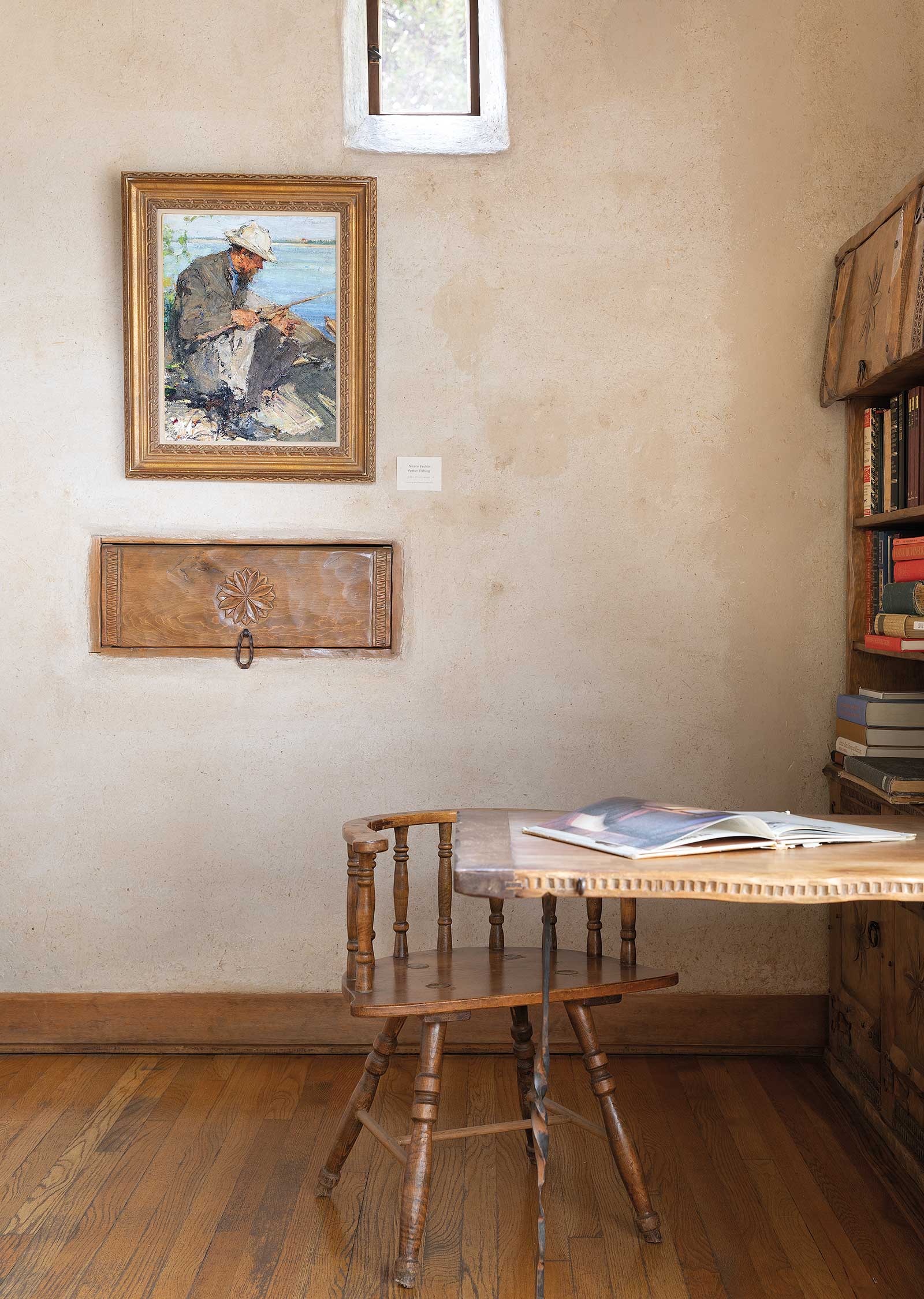
Fechin’s Father Fishing, oil on canvas, from a private collection, hangs in the library.
For the curator of a historic house, making discoveries is a recurring pleasure. I lived in Frank Lloyd Wright’s Darwin D. Martin House in Buffalo, New York, for six years and had “ah ha” moments until the day I left.
Coleman notes that there is a column in the studio—where the family lived while the house was being rebuilt—that is carved from pine and full of knots. There are no knots in the wood of the main house, since Fechin ordered sugar pine, as well as poplar, from the Pacific Northwest.
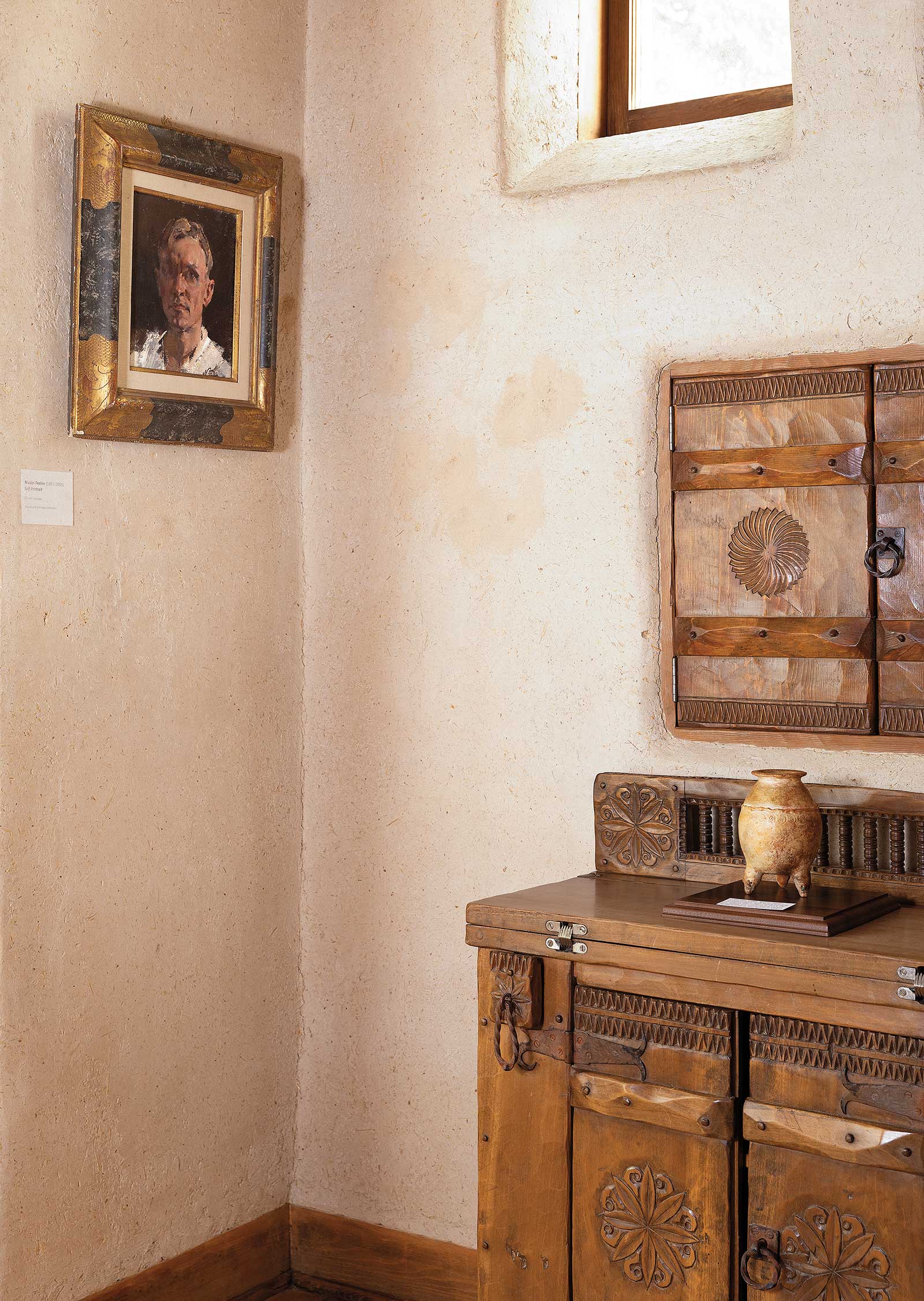
Fechin’s Self-Portrait, oil on canvas, from a private collection, hangs in the library.
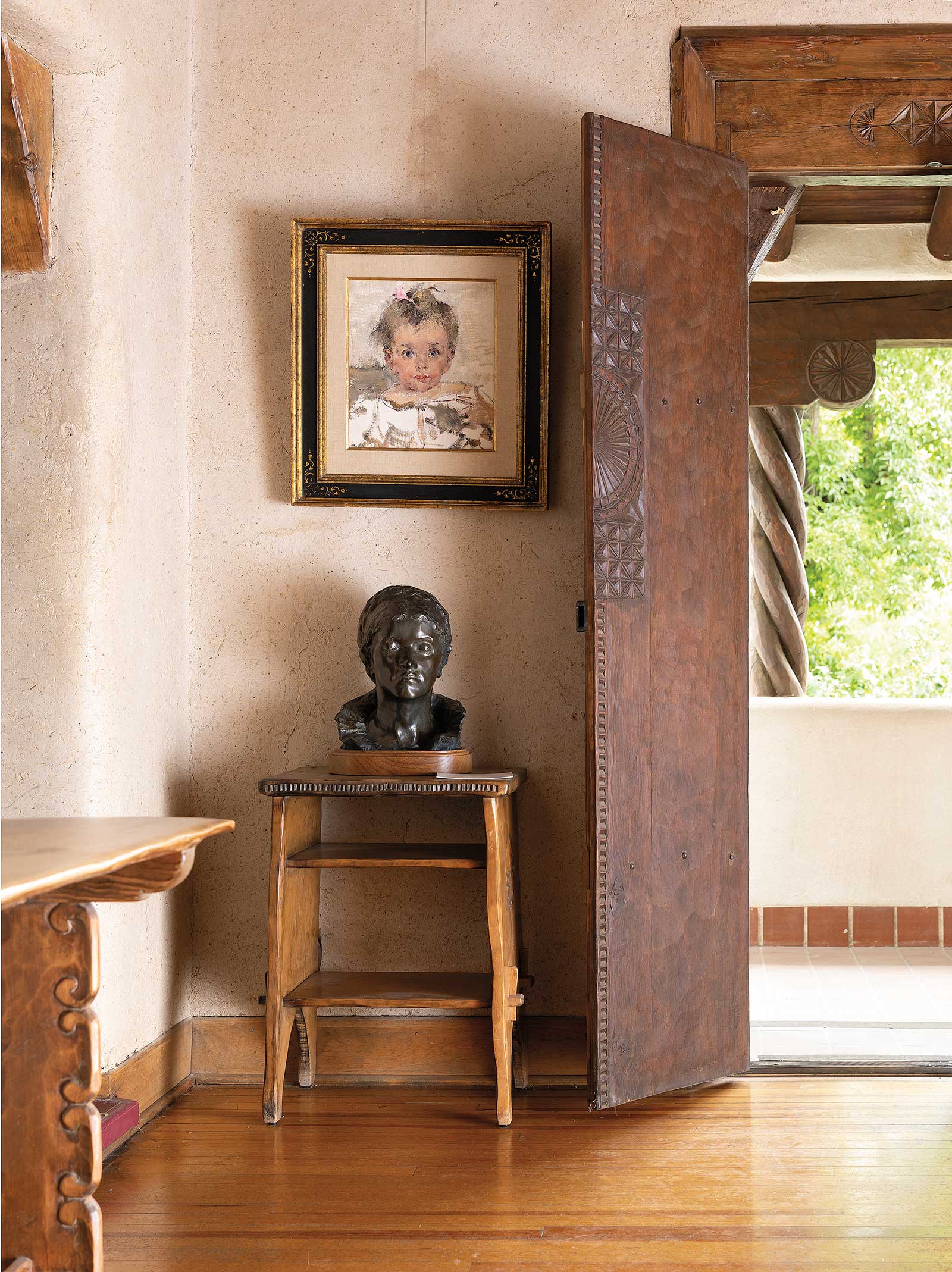
Fechin’s, Baby Eya, oil on canvas, hangs above his bronze sculpture, Alexandra, in the entry. Both are from a private collection. The motif on the door is derived from a Navajo design of lightning.
“I’ve been learning about his carving techniques,” Coleman says. “He didn’t care for radiators and carved coverings for them. There is one at the top of the stairs that he made into a bench. I recently noticed that the spindles on the bench are cut in half and carved only on the front, saving him time. He carved in the evenings after a day of painting. It was a quicker process than painting. I wonder if carving was a meditative process for him. There are lots of repetitive patterns with many notches in a row. It’s a quiet, contemplative process. All the carving is done by hand. He tried machine tools once but didn’t like being disconnected from the wood.”
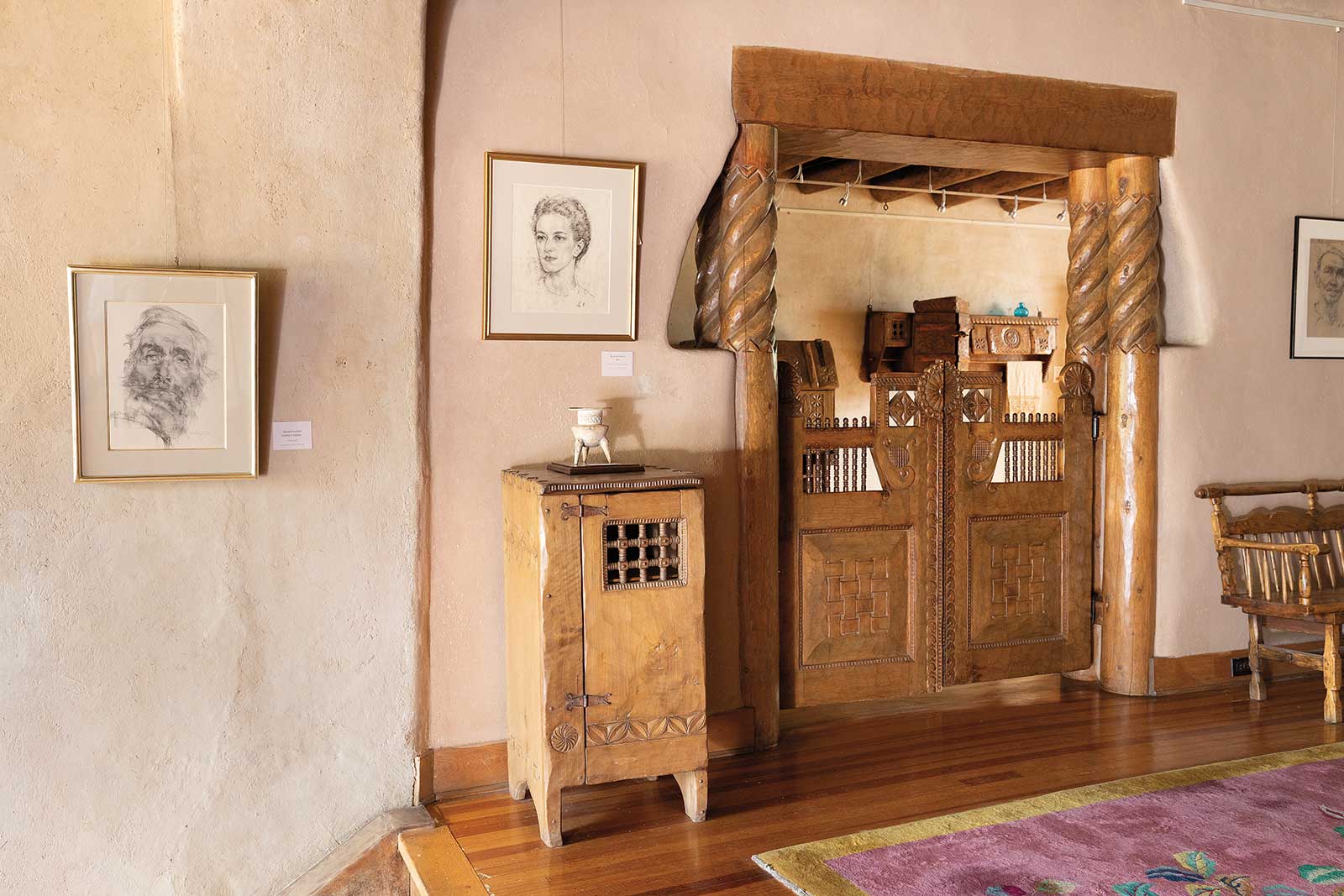 In the hall are, left to right, Fechin’s Man with Beard, lithograph, and his Eya, charcoal on paper, each from private collections. The door panels bear the motifs of the sunflower to honor Russia and the acorn to honor Taos. The hinges on the cabinet were designed by Fechin and crafted by Taos blacksmith Bill Hinde.
Fechin formed the wood with an adze, creating an undulating surface and then carved columns, stair rails, vigas and doors, and constructed furniture carved with intricate designs. He lightly stained the wood to obtain a uniform color, allowing the grain to show. He then waxed the pieces to a soft sheen, often putting ash in the crevices to reveal the carved patterns. One of the treasures of the collection is a sketchbook of designs for doors and furniture.
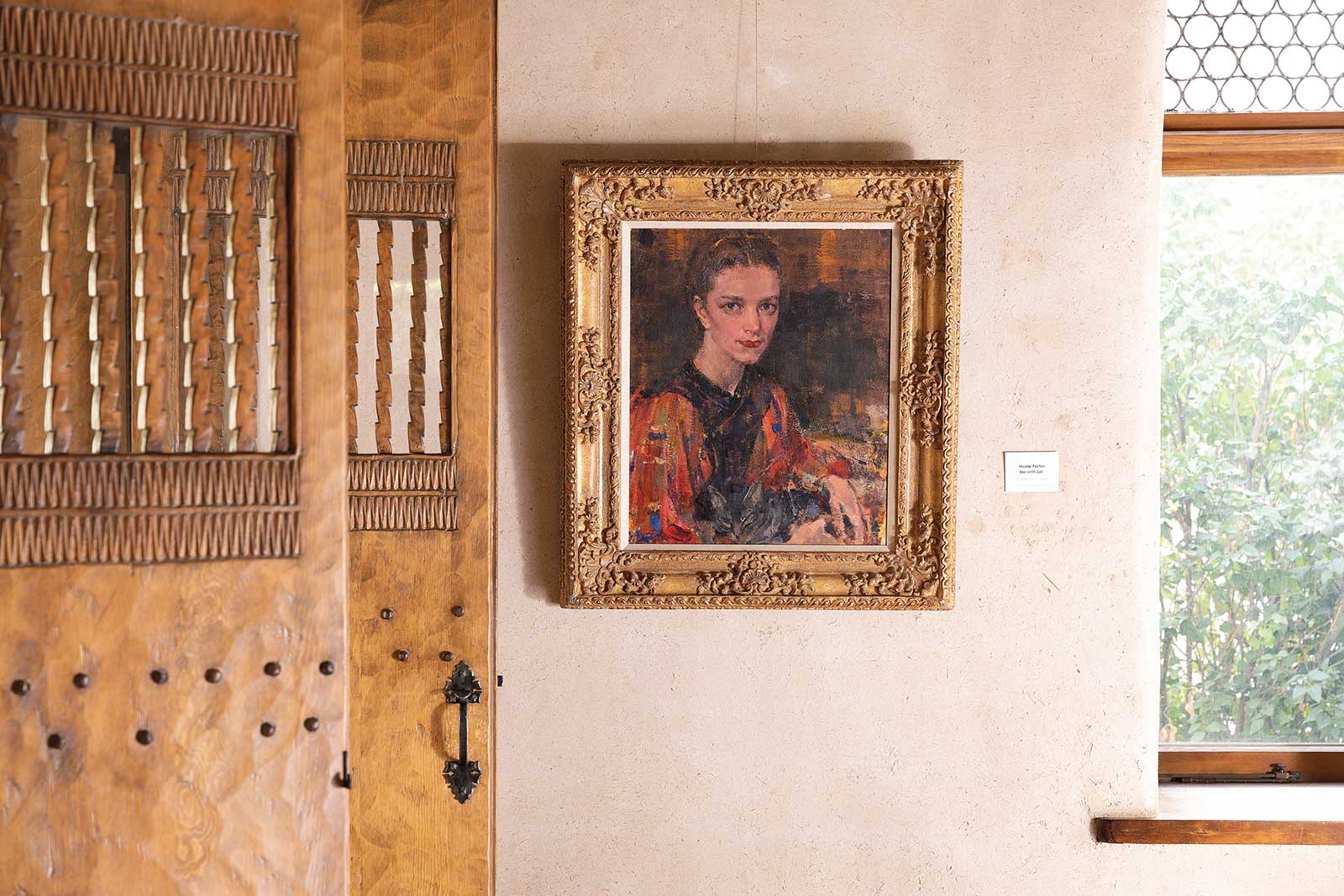
Fechin’s Eya with Cat, oil on canvas, hangs in the dining room.
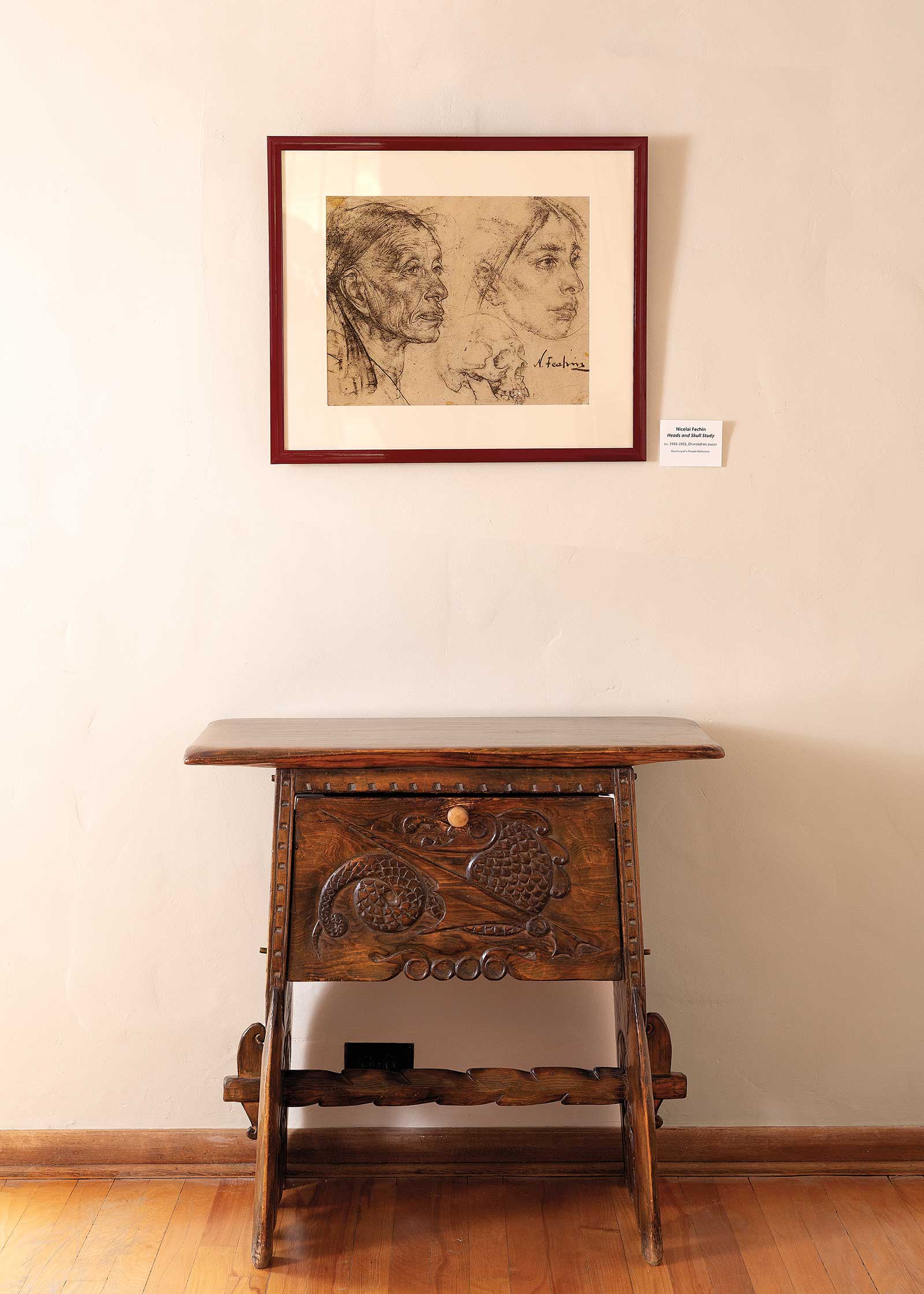
In a bedroom is Fechin’s Head and Skull Study, charcoal on paper.
Coleman pointed out hinges and other metalwork in the house that was made in a collaboration between Fechin and the Taos blacksmith Bill Hinde. Fechin had employed Miguel and Pedro Mirabal, masons from the Taos Pueblo, as well as Joe Martinez, to essentially gut the house and rebuild it to his design. The result is 3,545-square-foot work of art to house works of art.A basement full of ephemera and the family’s personal effects is also on Coleman’s research agenda. “Alexandra kept a lot of stuff,” she comments. The photographing process has already begun. She notes that Fechin’s lithographic press is there. Alexandra made cherry wine and the bottles are there as well.
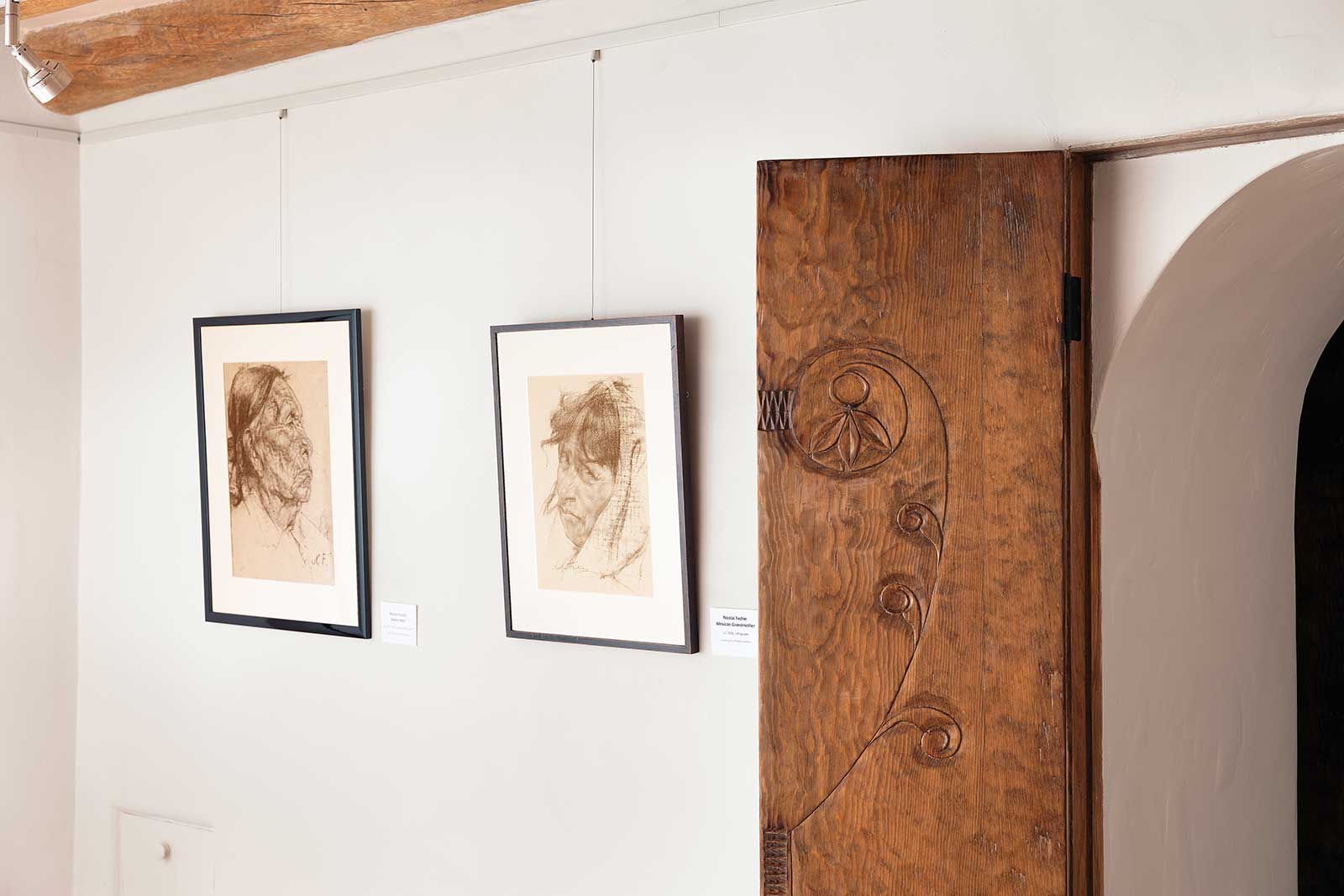
On the left in a bedroom is Fechin’s Indian Profile, charcoal on paper and his Pueblo Woman, ca. 1927-1933, charcoal on paper, from a private collection. When the door is shut, the pattern on this panel joins another to form the shape of a heart.
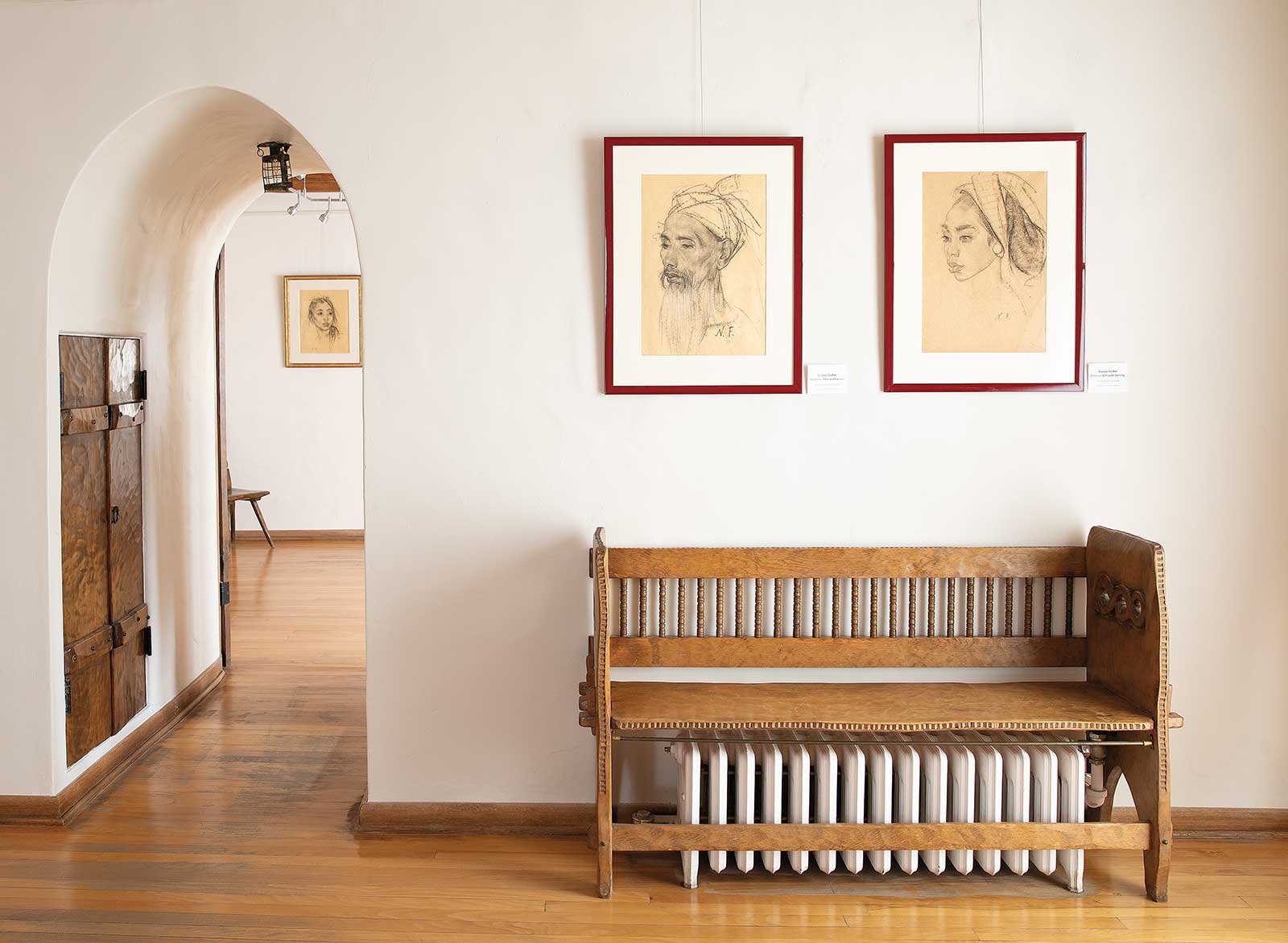
In the far room is Fechin’s Balinese Girl with Long Hair, circa 1938, from a private collection. In the foreground are, left to right, his Balinese Man with Beard, circa 1938, charcoal on paper, and Balinese Girl with Earrings, circa 1938, charcoal on paper, both from a private collection. Fechin built and carved the bench to hide the unsightly radiator.
Fechin was a quiet, almost solitary man, but his home and art resonate in even those with little exposure or knowledge of art.
He was once asked, “which of the arts I consider most important. For me, no one particular art is greater than another. I can only say this: when you find yourself in the presence of creativeness…take off your hat.”
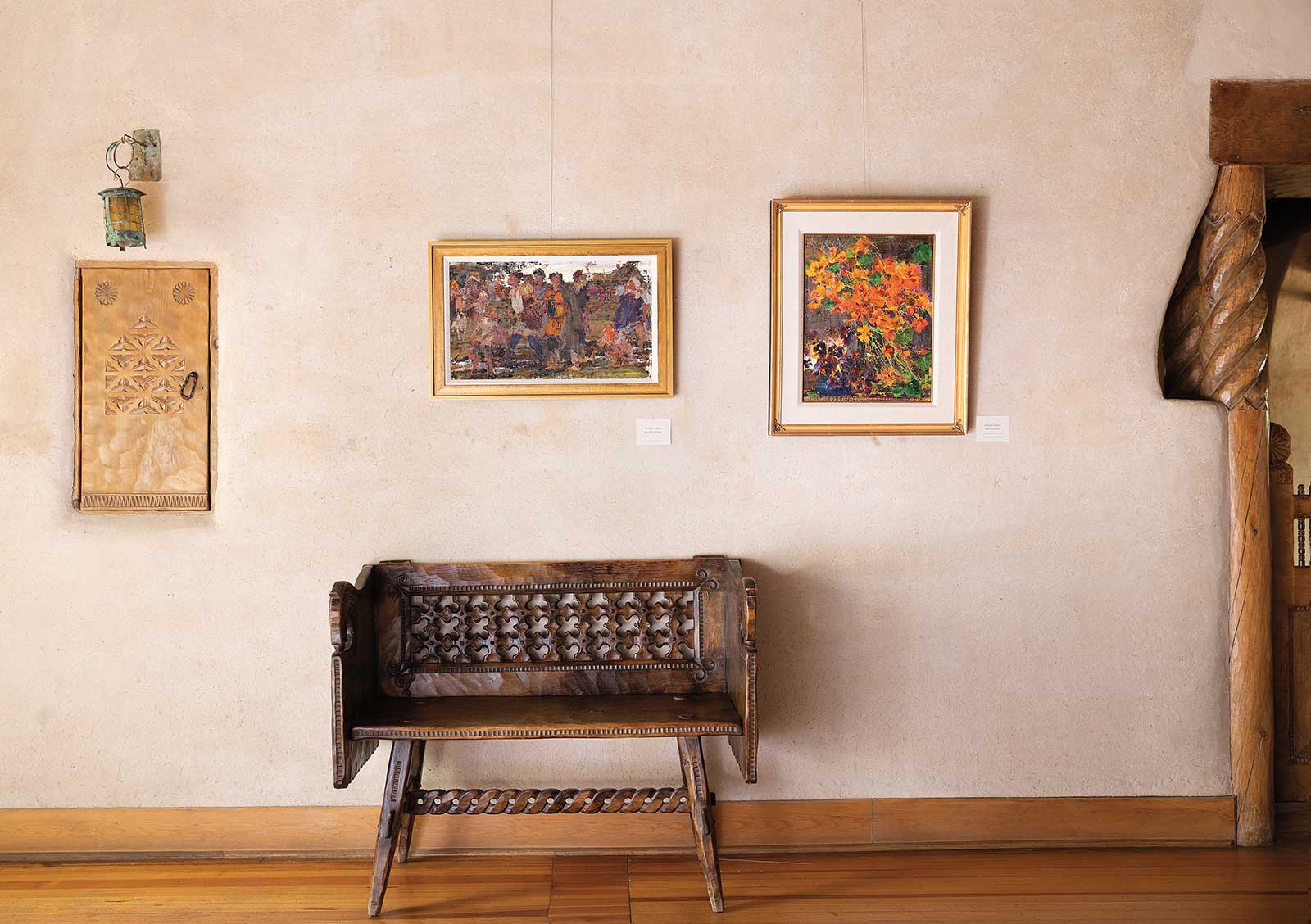
Fechin designed the lantern on the upper left in the dining room. His Russian Sketch, circa 1910, oil on canvas, is from a private collection. On the right is his Nasturtiums, oil on canvas, from a private collection.
About technique he wrote, “The subject, in itself, has value only according to the mode of the day. Tomorrow it will be superseded by a new fashion or fad. With the passing of time, the subject loses much of its meaning. But the fine execution of that subject retains its value.” —
Powered by Froala Editor