Painter Gary Ernest Smith grew up in a farming community about 20 miles northeast of Baker City, Oregon. After high school, he worked with his father outdoors for a year and then put two years of college under his belt before packing up and moving away to start his own life. As those familiar fields with grazing bay horses and Hereford cattle, the grand mountains of eastern Oregon and dusty country roads faded in his rearview, the hope for the future swelled within him. The year was 1964 and it was the last time he would live in Baker City.
What happened next? Well, life happened.
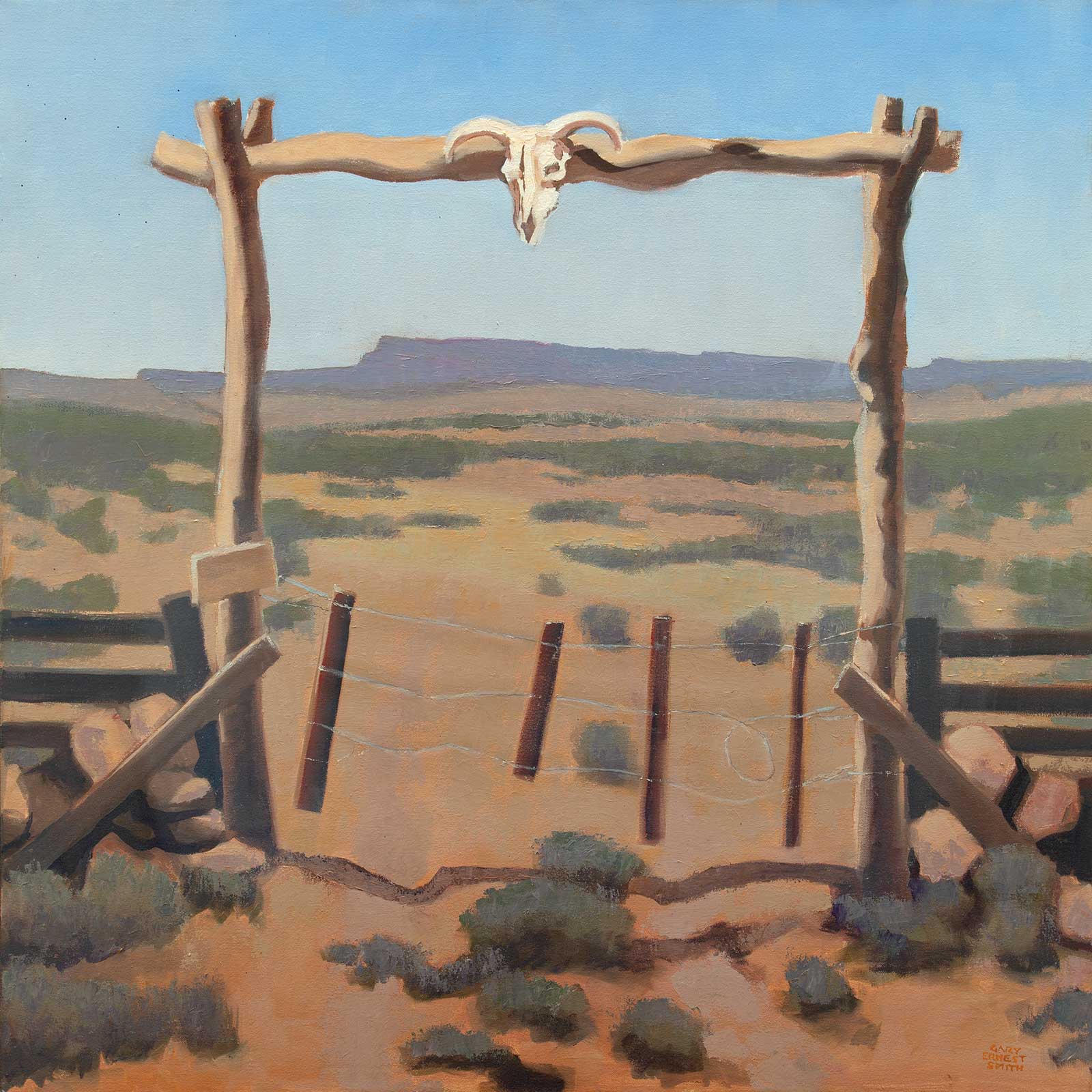 Gateway, 2015, oil on linen, 32 x 32 in.Two years at Brigham Young University in Utah. He marries his wife, Judy, a music student. His first solo show. Drafted into the U.S. Army at the height of the Vietnam War. Serves in Alabama and Korea for 18 months. Expands his family with four children. Moves to Highland, Utah. Art commissions. Murals. Solo shows. Exhibitions.
An artist could travel to the ends of the universe, but their starting point will always remain the same. It’s an inescapable truth that, for better or worse, where a person was born and raised will remain a part of who they are forever. For Smith, that starting point is in and around Baker City, which will host an exhibition titled Towards Home: The Artwork of Gary Ernest Smithstarting on May 24. The retrospective will take place at the Crossroads Carnegie Art Center.
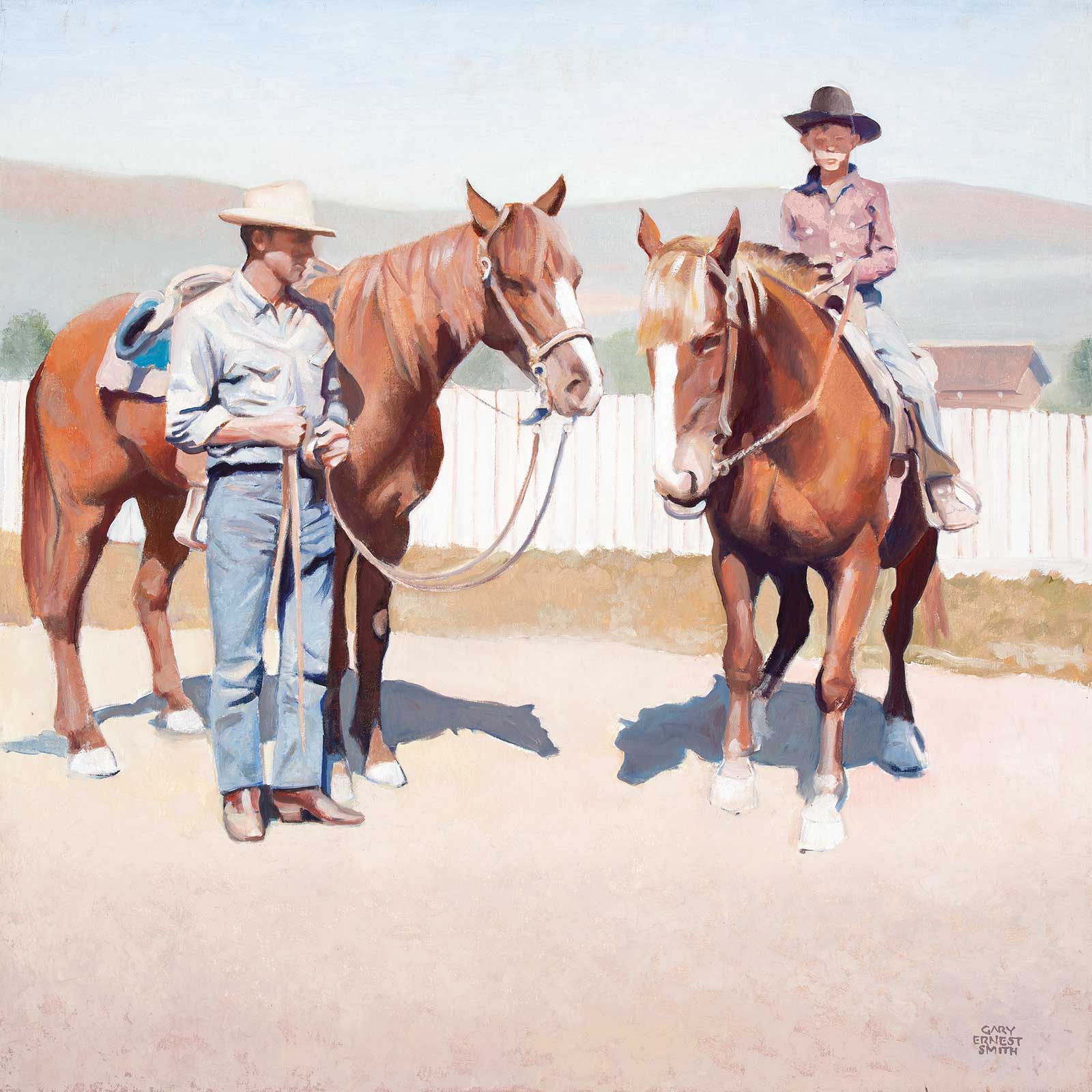 Headed for Fruit Springs, 1997, oil on linen, 36 x 36 in.“It’s definitely a full-circle kind of thing,” the artist says with a laugh. “That place means a lot to me. At one point in my career, I didn’t know what I wanted to really do. I went back to my roots and just walked through the country there for a week. I remember looking through old photo albums and things like that. I needed to find a connection to something. It was there that I realized where I wanted to go as an artist. My parents eventually left, but I have so many connections to those places.”
The exhibition will feature more than 60 works, many of them inspired by eastern Oregon, including many of his father and the family ranch in Medical Springs, Oregon. In one of the works, Ernie, his father poses with a piercing gaze, as if the subject of a Richard Avedon photograph, except Avedon used white backgrounds and Smith uses golden orange that makes the blue of his father’s shirt pop off the canvas. There is kindness and maybe a little concern in his eyes. “He sat for that portrait for me. He was probably 90 years old and he just calmly sat there, although he kept wondering why on earth I wanted to do this,” Smith remembers of the 24-year-old painting. “I talked him through the whole thing and got him to settle down so I could paint him.”
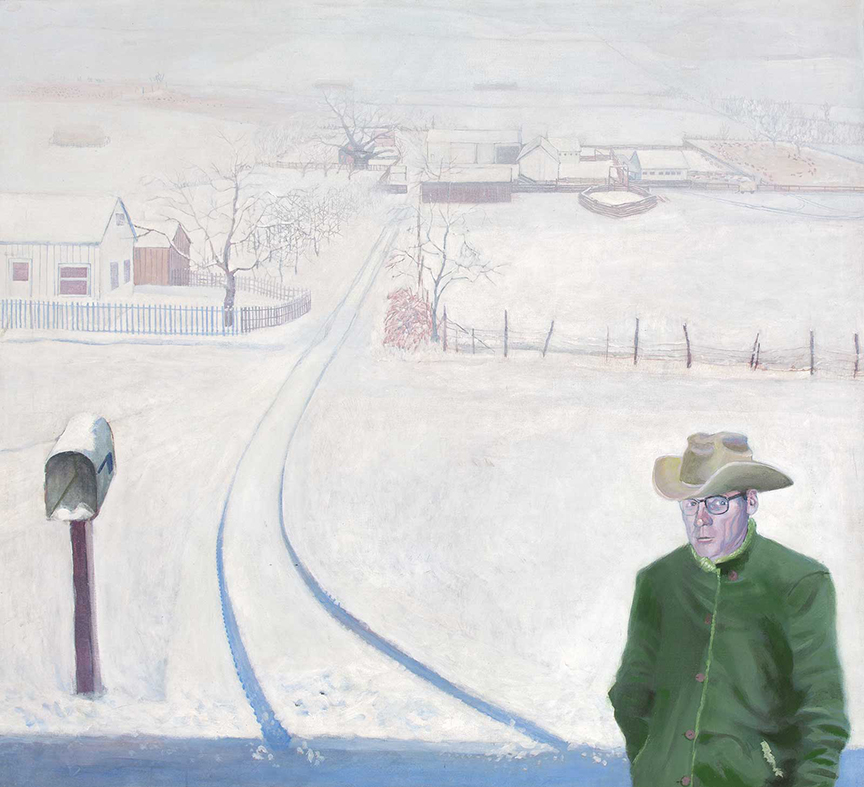 Ernest Smith Ranch, 1965, acrylic on canvas, 44 x 48 in.It was in the 1980s when Smith’s father, and people like him, inspired the artist to turn his attention to the fields and the workers who toiled away on farms and ranches. The resulting works, painted over several decades, are some of the most iconic pictures by the painter. They are also the works that led to Smith being referred to as a regionalist due to the rural qualities of the subjects and the hardship in their labors.
“Smith’s art is grounded by a deep sense of tradition, based on his memories of an agrarian childhood, shaped by experience and the presence of places. Most of his subjects—cultivated fields, rural men and women—are about the processes of agriculture,” writes Donald Hagerty in Smith’s 1999 book Holding Ground: The Art of Gary Ernest Smith.“But agriculture, for Smith, is much more about ideas than it is about the implications of food production and the technology used to produce it. The virtues of the landscape worked in harmony with nature, and people who respectfully create that environment, are the concepts that drive his work. A strong dose of nostalgia is embedded in Smith’s art, prompted by looking back at his own history. No doubt there is regret for what has been lost through changes in the rural traditions of America as played out in the West or the Midwest. Without much romantic sentiment, Smith’s paintings are evocations of both the unsung aspects of rural culture and the realities that confront it.”
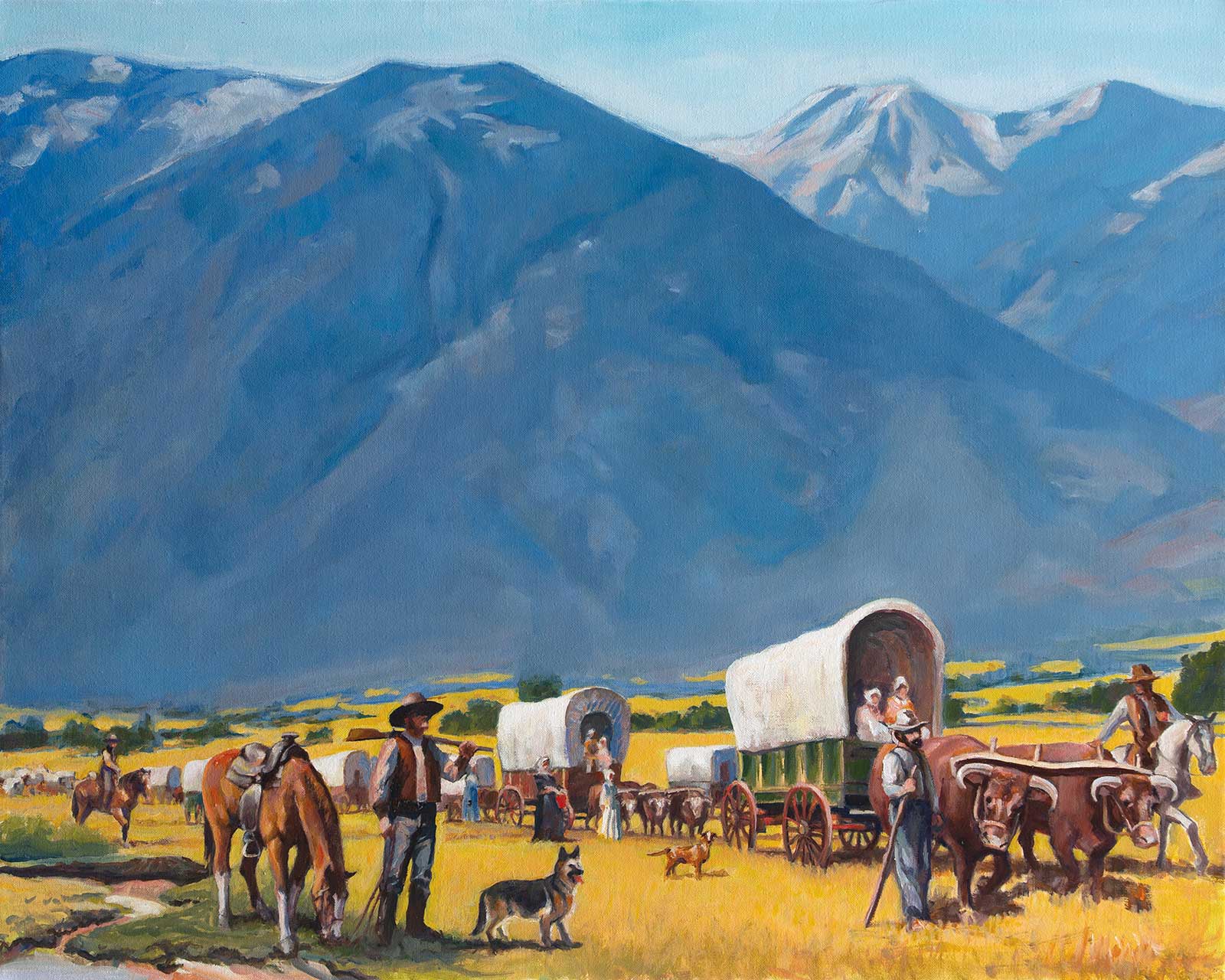
Pioneers Pass Through Baker Valley, 2023, oil on linen, 48 x 72 in. Courtesy the National Historic Oregon Trail Interpretive Center.
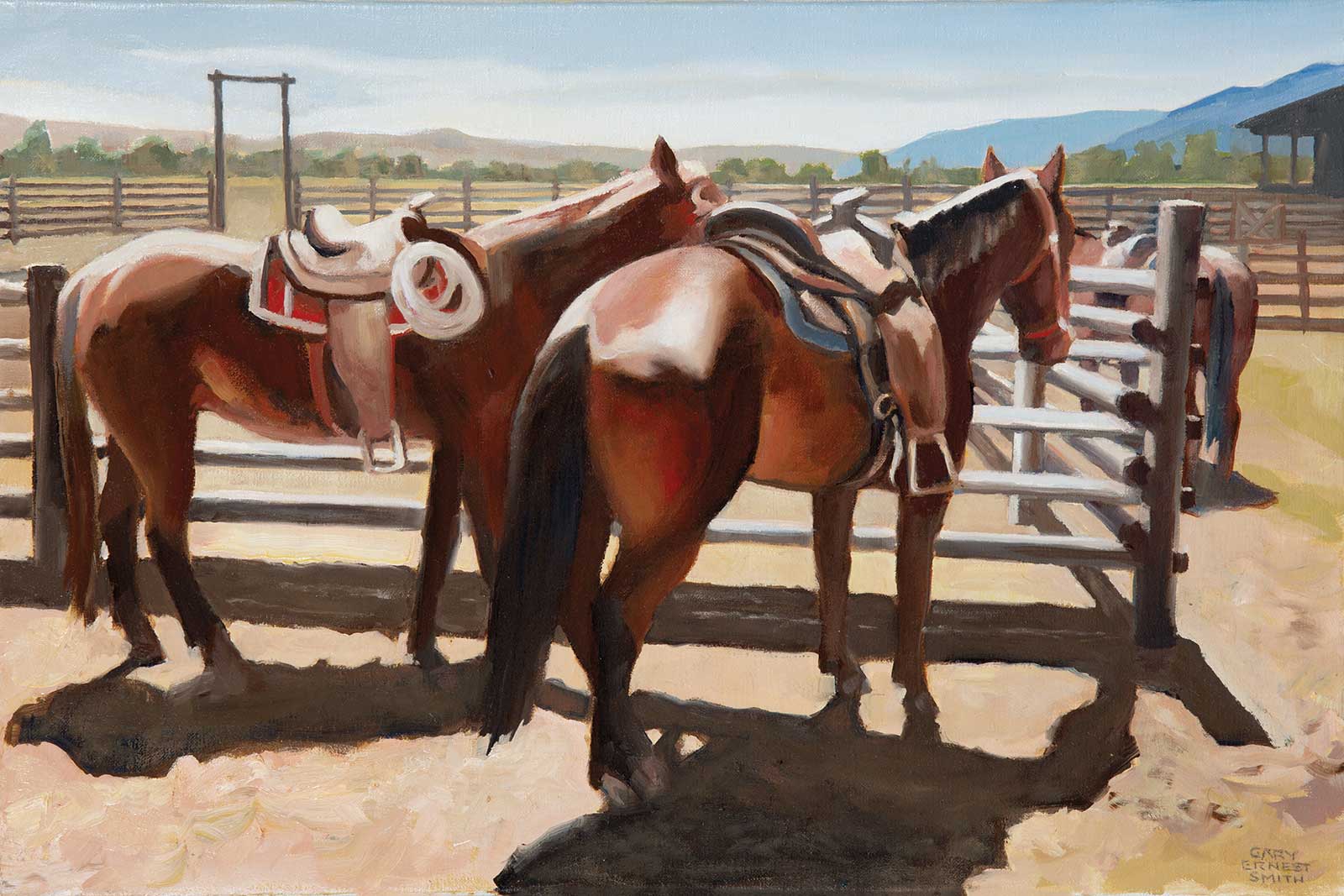
Rest at Noon, 2023, oil on linen, 16 x 24 in.
Seth Hopkins, the executive director of the Booth Western Art Museum in Georgia, contributes to the retrospective’s catalog, in which he notes that Smith’s work resonates with collectors because it’s about the fundamental building block of the West itself. “Many outside of Western art (and even some inside) think it is all about cowboys and Indians. However, the most Western of subjects is the land itself—but not the pure and unspoiled vistas of our national parks, although those are the images that first come to mind,” Hopkins writes. “It is, in fact, the cultivated land that drew settlers west along the Oregon Trail.
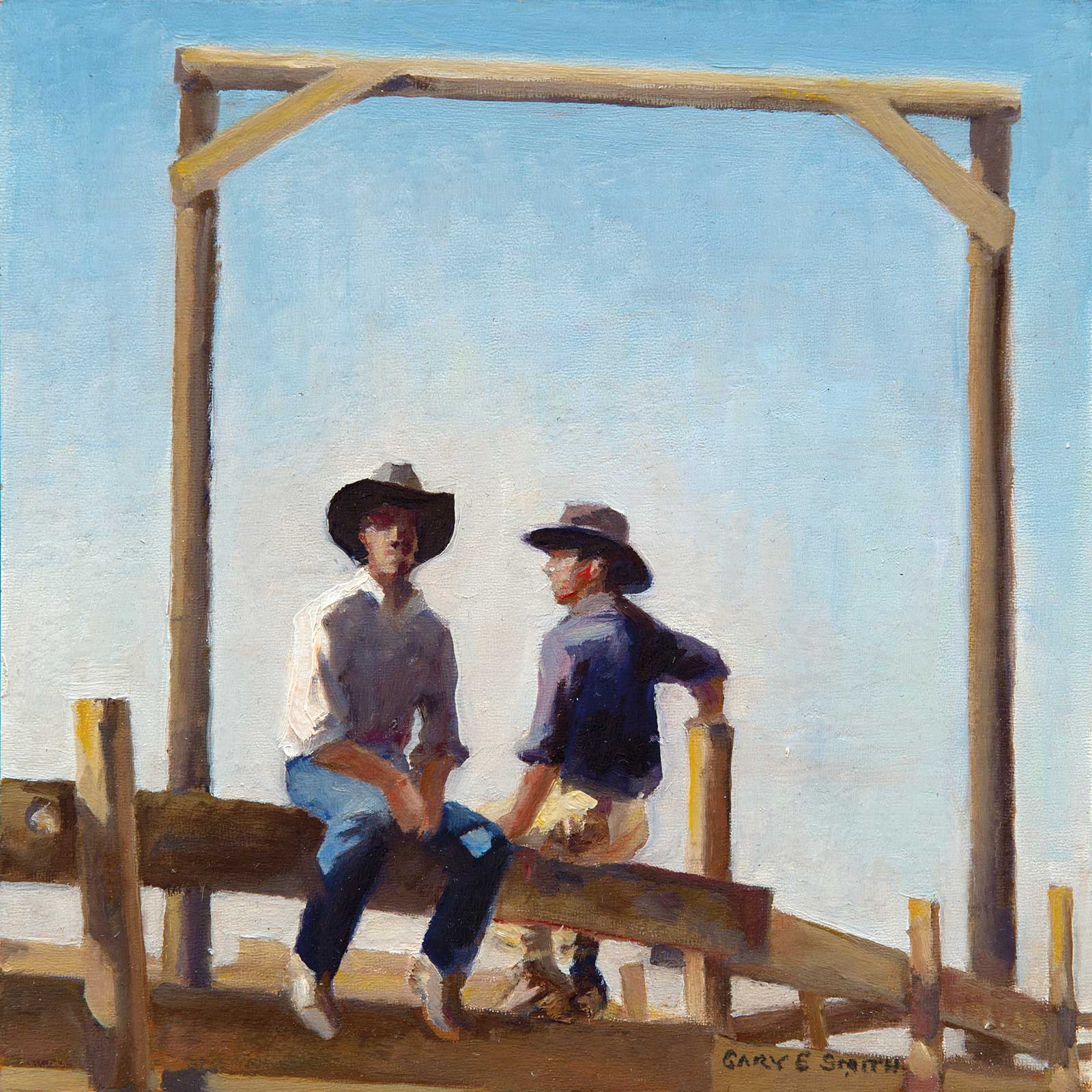
Time Out, 2023, oil on panel, 8 x 8 in.
Thus, Gary Ernest Smith might be the most Western artist standing in front of an easel today. One of his main subjects, throughout a long and storied career, has been agriculture. In his scenes the land is clearly the star, although the people provide a strong supporting cast, even with their faces often obscured. These anonymous individuals could be anyone from our great-grandparents to ourselves, allowing each of us to create our own narrative.”
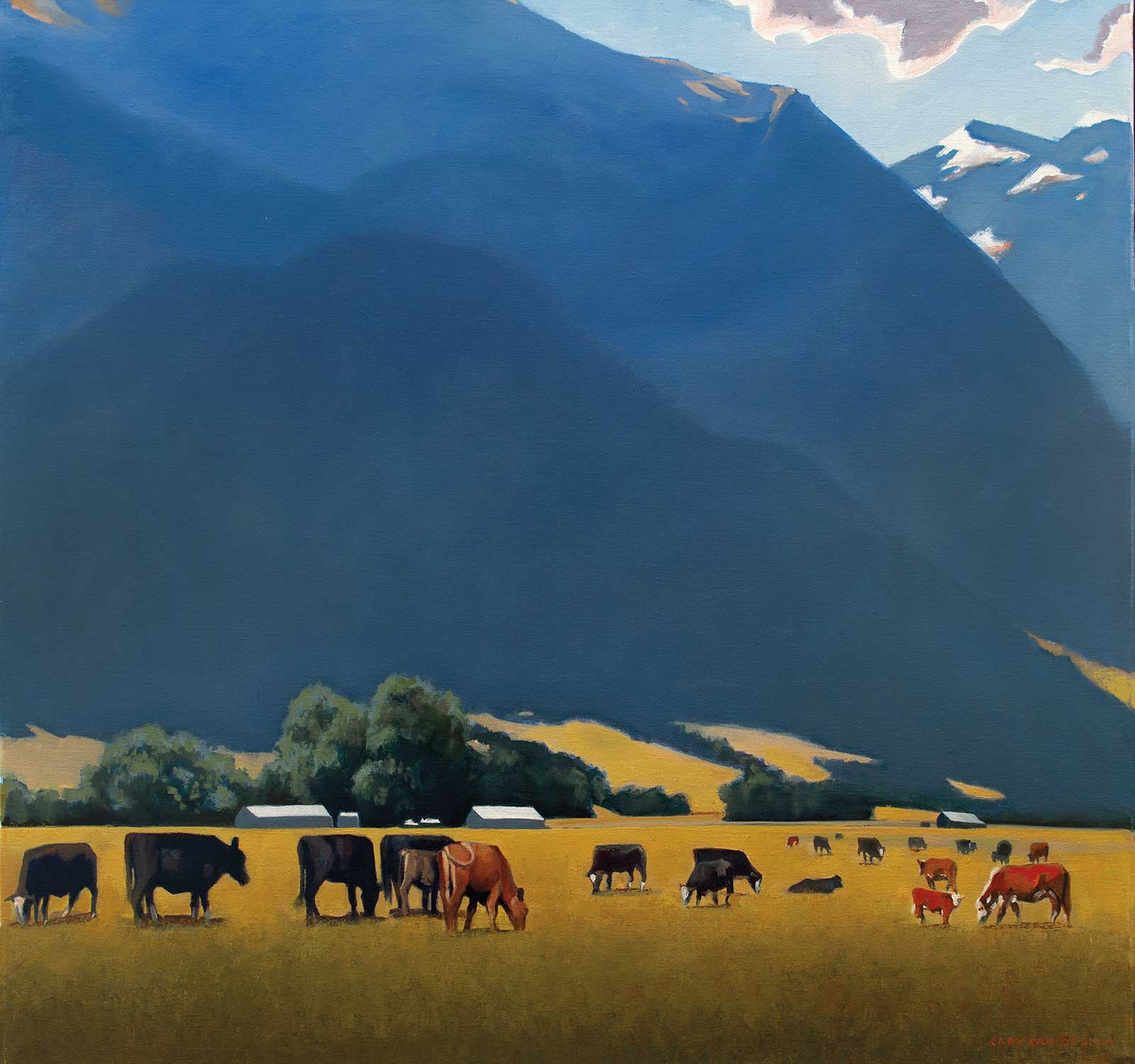 Summer in the Valley, 2023, oil on linen, 30 x 32 in.
Other images in the show include pioneer scenes, working cowboys and Smith’s more recent gateway paintings, showing the wood, stone and bone entryways that mark many ranches in the West. Smith calls the show his “final retrospective,” but says he’s far from throwing in the towel. “I’ll keep painting until they find my skeleton at the easel,” he says.
One thing that is clear with these works, and the hundreds that could not be included in the retrospective, is that Smith is one of the great contemporary Western artists. Coming up alongside Howard Post and the late Ed Mell, Smith has always been in good company in the West, even as he was name-dropping Fauvists like André Derain or Maurice de Vlaminck, or completing works that could be close cousins to Monet’s haystack paintings.
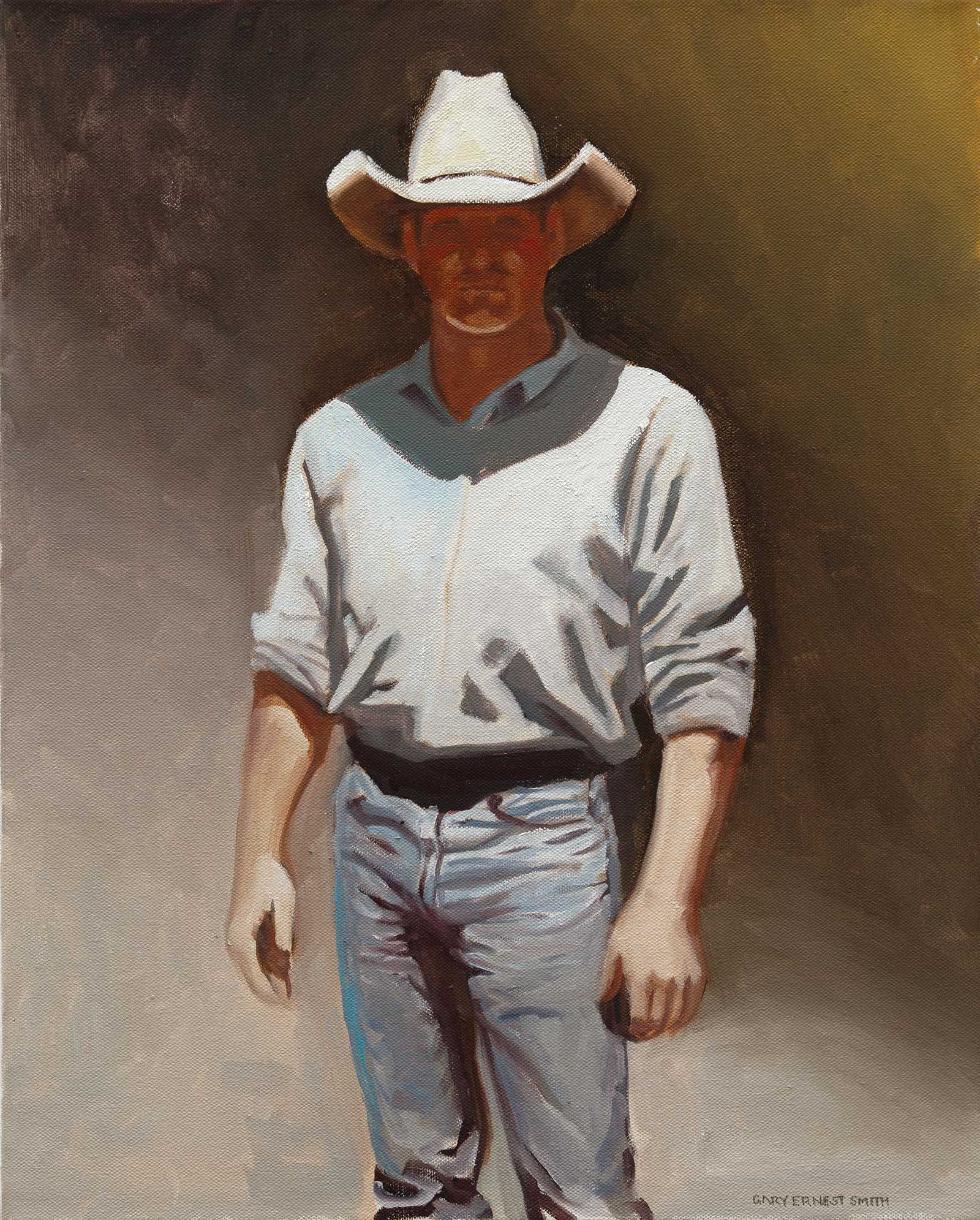
Oregon Rancher, 2022, oil on canvas, 20 x 16 in.
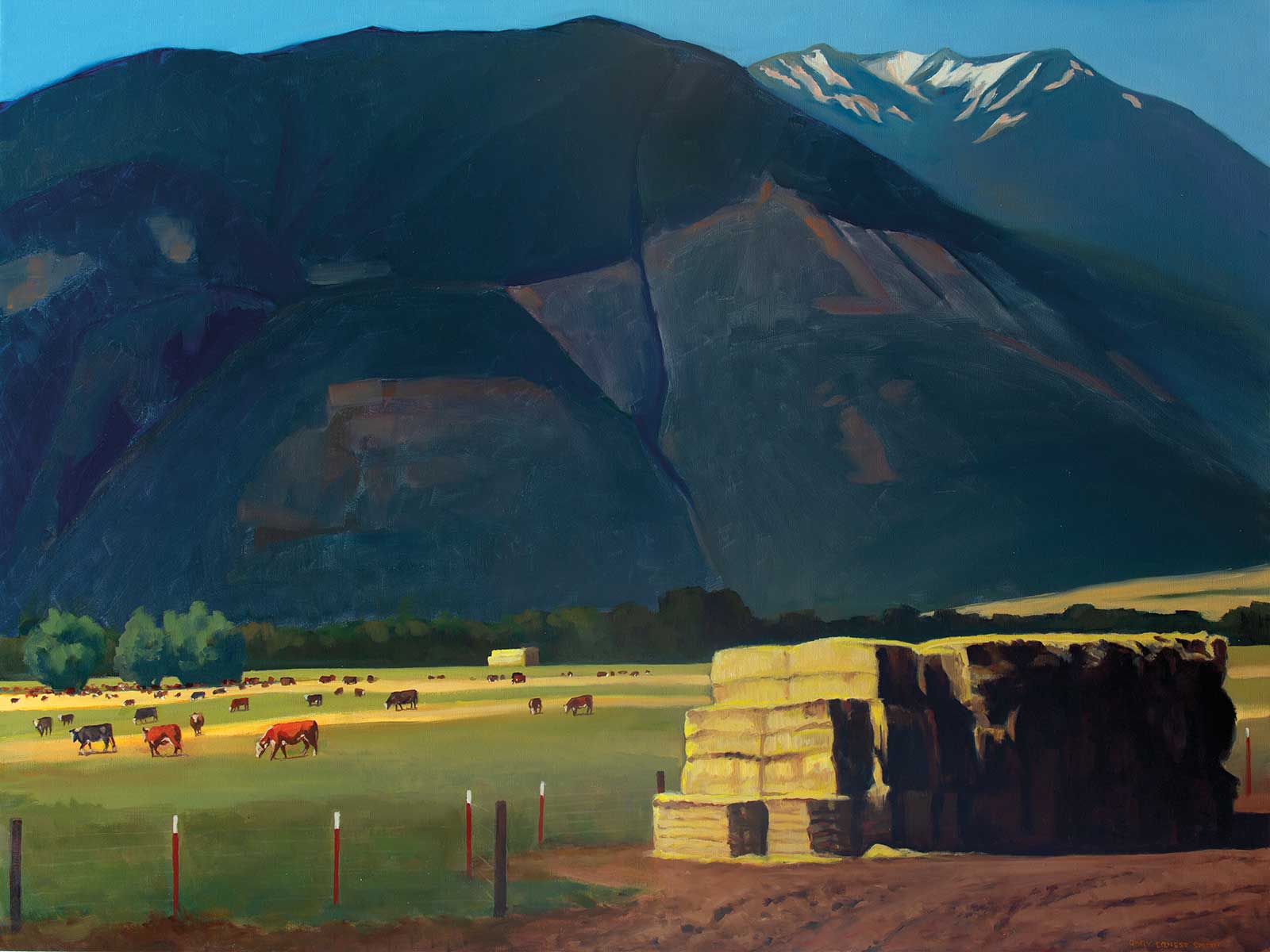
Iconic Baker Valley, 2023, oil on linen, 36 x 48 in.
“I’ve always enjoyed where my work takes me. When I was painting these abstracted figures in fields, it all just slowly evolved into something else over and over again,” Smith says. “I think I could pick out probably five or six different categories of my work, from fields to gateways to all the others. But that’s the fun, when you get to develop your own voice and style as an artist. An artist’s work should always be evolving. Always.”
Towards Home: The Artwork of Gary Ernest Smith will feature many of Smith’s evolutions. The retrospective continues through July 21 in Baker City. —
Towards Home: The Artwork of Gary Ernest Smith
May 24-July 21, 2024
Crossroads Carnegie Art Center
2020 Auburn Avenue, Baker City, OR 97814
(541) 523-5369, www.crossroads-arts.org
Powered by Froala Editor