Thomas Moran (1837-1926) painted his majestic Green Cliffs, Wyoming in 1881, a decade after he first visited the area. He depicts the colorful strata of the eroded peaks rising above the river and struck by bright sunlight. In the foreground, leading off diagonally across the canvas to an encampment in the distance, are Native Americans on horseback. The area was a popular meeting place for Crow, Blackfoot, Shoshone and other peoples.
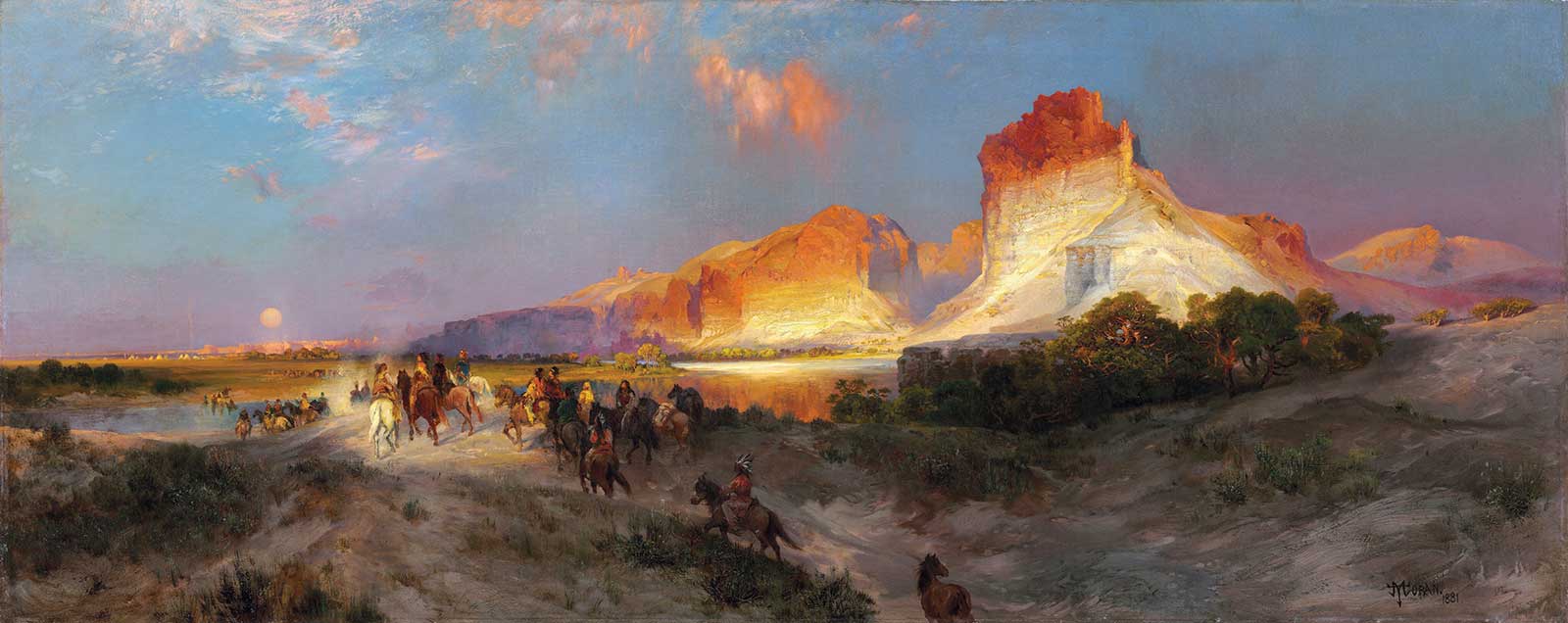
Thomas Moran (1837-1926), Green River Cliffs, Wyoming, 1881, oil on canvas, 63½ x 157½ in. National Gallery of Art, Washington, D.C. Gift of the Milligan and Thomson Families.
He made a small watercolor sketch at the time, which he titled First Sketch Made in the West at Green River, Wyoming 1871—the first of 40 paintings of Green River. Moran was on his way to meet F. V. Hayden’s survey expedition to explore Yellowstone. His paintings of Yellowstone were instrumental in the area’s being designated the country’s first National Park in 1872.
Moran famously wrote, “I place no value upon literal transcriptions of Nature. My general scope is not realistic; all my tendencies are towards idealization.” In his painting there is no hint that the Union Pacific Railroad had arrived in Green River from the east three years before. Moran, in fact, had arrived by train in the dusty depot town.
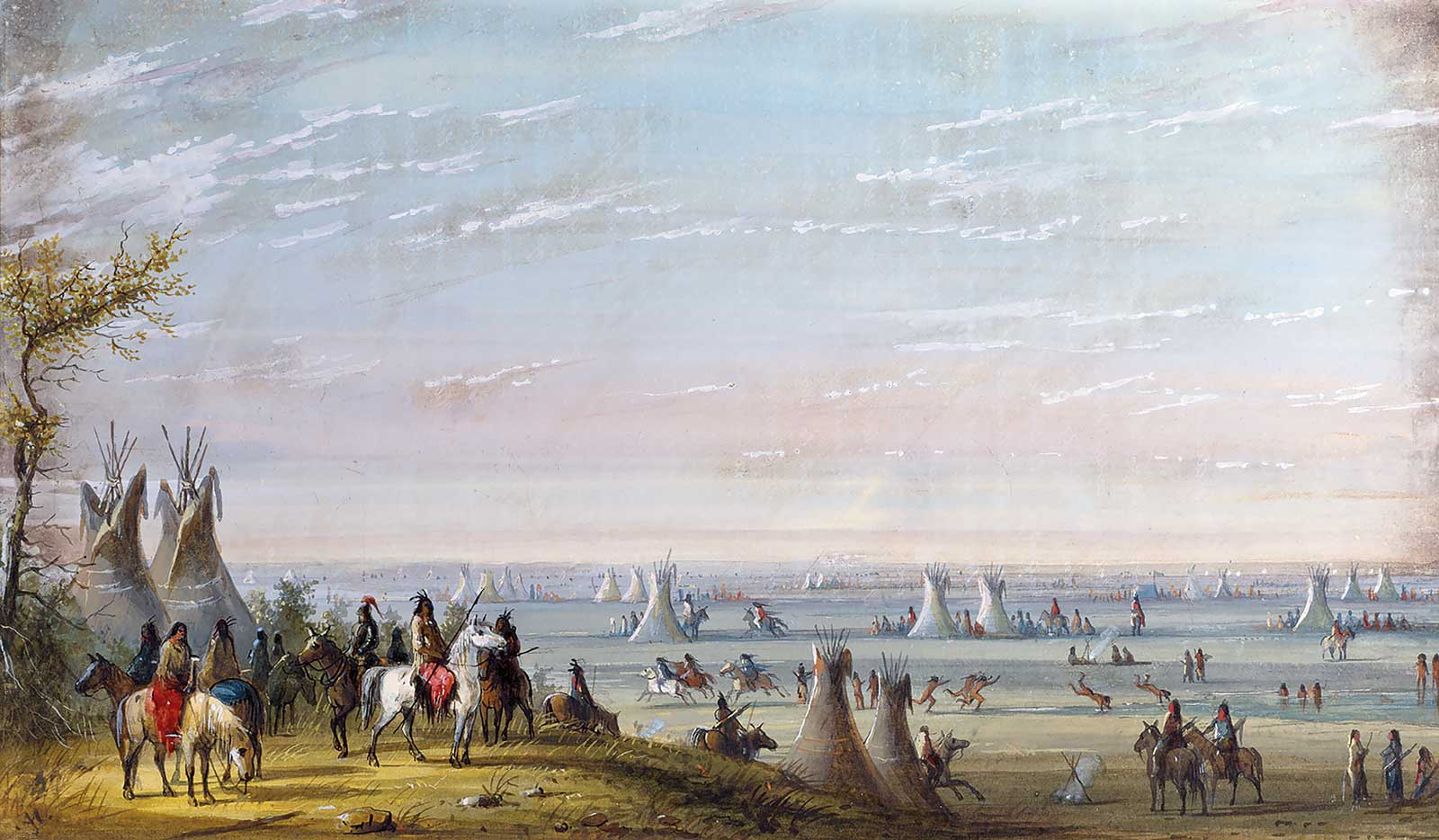
Alfred Jacob Miller (1810-1874), Rendezvous, 1858-1860, watercolor on paper, 8½ x 14³⁄8 in. The Walters Art Museum, Baltimore, MD. Commissioned by William T. Walters.
A lithograph drawn by E.S. Glover (1844-1920) in 1875, four years after Moran’s visit, shows the town within its spectacular landscape. Part of the description on the lithograph reads, “Green River City has a population of 500 inhabitants; it has a School House and Church, several stores, a First-Class Hotel, and a Brewery.” A grittier representation of the town can be seen in a photograph of the construction of the railroad bridge in 1869.
Alfred Jacob Miller (1810-1874), a Baltimore native, moved to New Orleans after studying portraiture in Paris. He had studio space on the second floor of a dry goods store and placed several of his portraits in the ground floor window. He was visited by retired British army captain, William Drummond Stewart (1795-1871), who was looking for an artist to accompany him and to document the annual fur trappers’ rendezvous on a tributary to the Green River.
The rendezvous that Miller attended in 1837 was one of 16 held between 1824 and 1840 at a site further up the river from the town of Green River. At the gathering, trappers supplied beaver pelts to the fashion industries of the East Coast and Europe; trappers and Native American people traded and bartered their animal pelts for guns, jewelry and supplies to get them through the next season’s grueling winter.
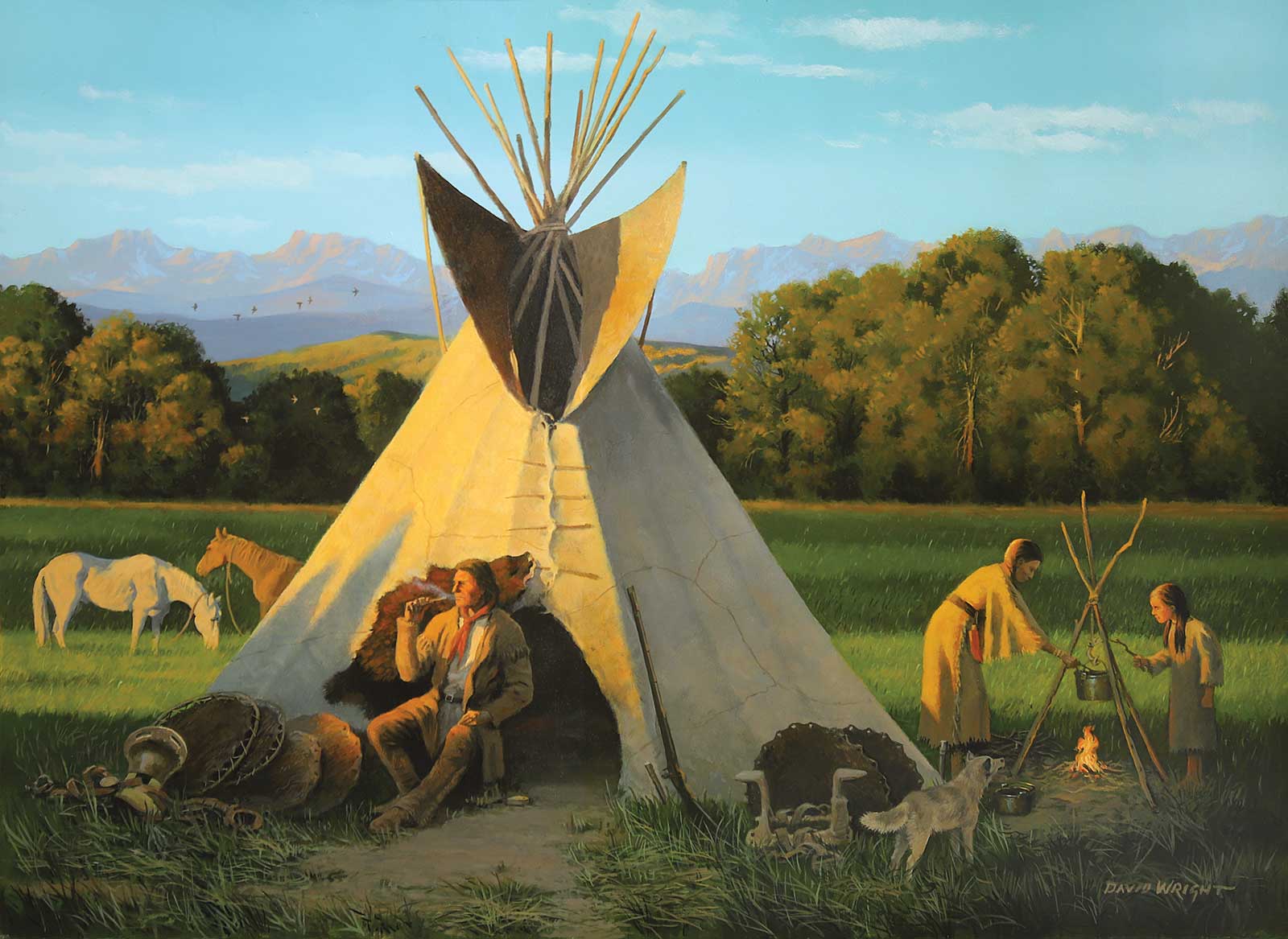
H. David Wright, Good Grass, Good Camp, oil on panel, 15 x 22 in. Courtesy the artist.
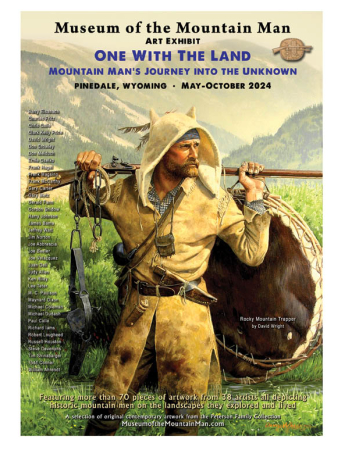
The Wyoming State Historic Preservation office explains that the rendezvous “was instituted during the early Rocky Mountain fur trade by General William Ashley, and it effectively revolutionized the trade. Instead of a system of fixed posts to which Indians and trappers came, the rendezvous was a previously established meeting place to which the great supply caravans from St. Louis brought trade goods which were exchanged for the furs. The rendezvous lasted for a few days or at most a few weeks. Grazing and hunting requirements forced the wide dispersal of trappers and traders during the annual get-togethers.” In nearby Pinedale, Wyoming, reenactments of the rendezvous have taken place since 1936. Pinedale is also the home of the Museum of the Mountain Man whose mission “is to preserve and interpret the history of the Rocky Mountain Fur Trade.” This year Green River Rendezvous Days will take place in Pinedale, July 11 to 14.
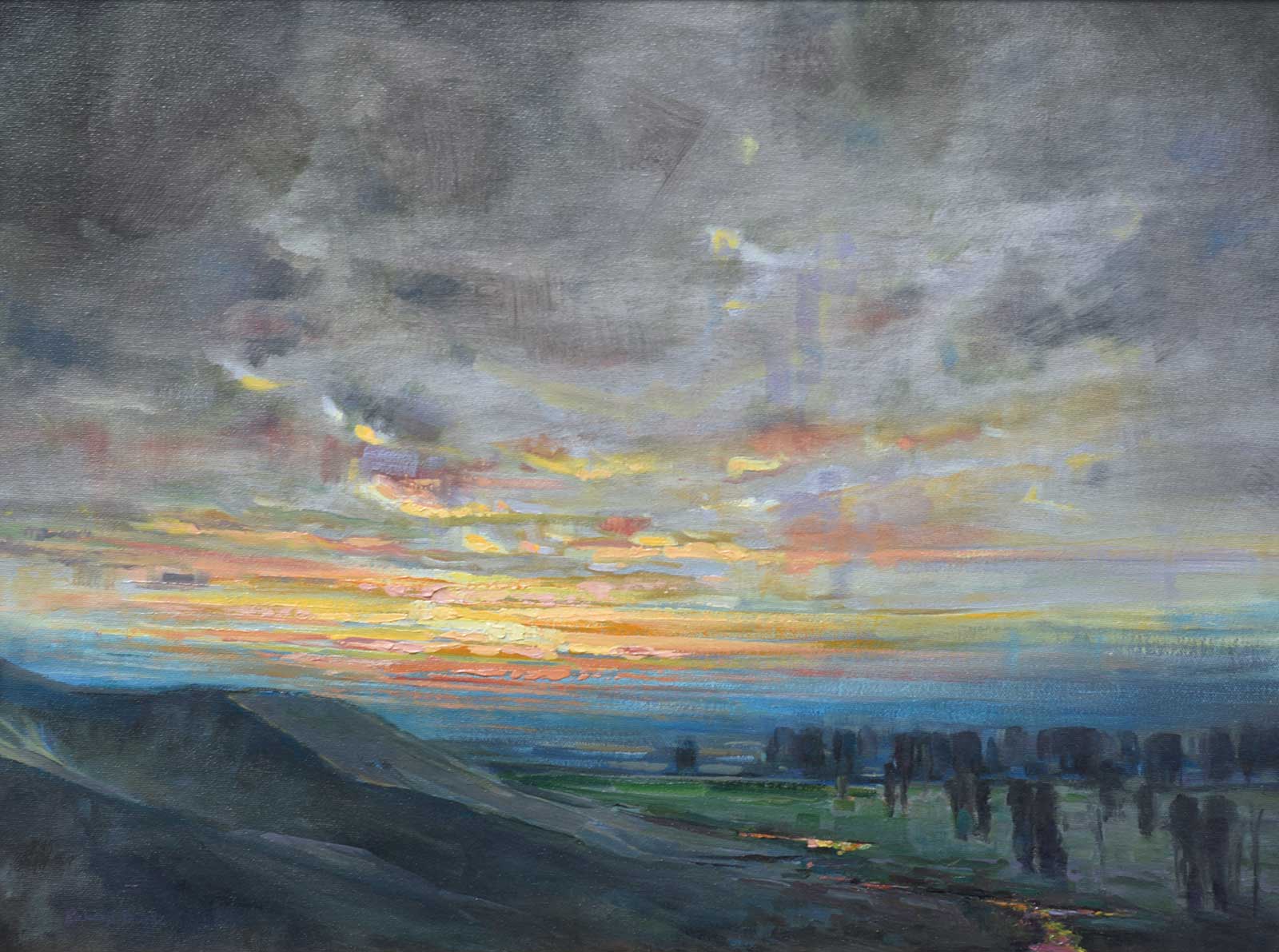
Richard Burke, Green River Mesa, Wyoming, oil, 18 x 24 in. Courtesy Angi D. Wildt Gallery, Astoria, OR.
In 1858, Miller, who had returned to Baltimore, was commissioned by William T. Walters (1819-1894), a local businessman and art collector, to produce 200 watercolors from his field sketches of the Rendezvous and paid $12 for each of them. Over his career, Miller created more than 1,000 paintings for patrons such as Walters and Captain Stewart based on his sketches. Walters’ collection formed the basis for the Walters Art Museum.
In his commentary on the painting Rendezvous, Miller writes, “The scene represented is the broad prairie; the whole plain is dotted with lodges and tents, with groups of Indians surrounding them; In the river near the foreground Indians are bathing; to the left rises a bluff overlooking the plain whereon are stationed some Braves and Indian women. In the midst of them is Capt. Bridger in a full suit of steel armour. This gentleman was a famous mountain man, and we venture to say that no one has travelled here within the last 30 years without seeing or hearing of him. The suit of armor was imported from England and presented to Capt. B. by our commander [William Stewart]. It was a facsimile of that worn by the English life-guards, and created a sensation when worn by him on stated occasions.”
The broad prairie is depicted in a contemporary painting, Green River Mesa, Wyomingby Richard Burke. Growing up in Oregon and Montana, he enjoyed drawing the natural world. Now living in Wyoming, he produces avian sculpture and landscape paintings, the latter inspired by the paintings of Thomas Moran.
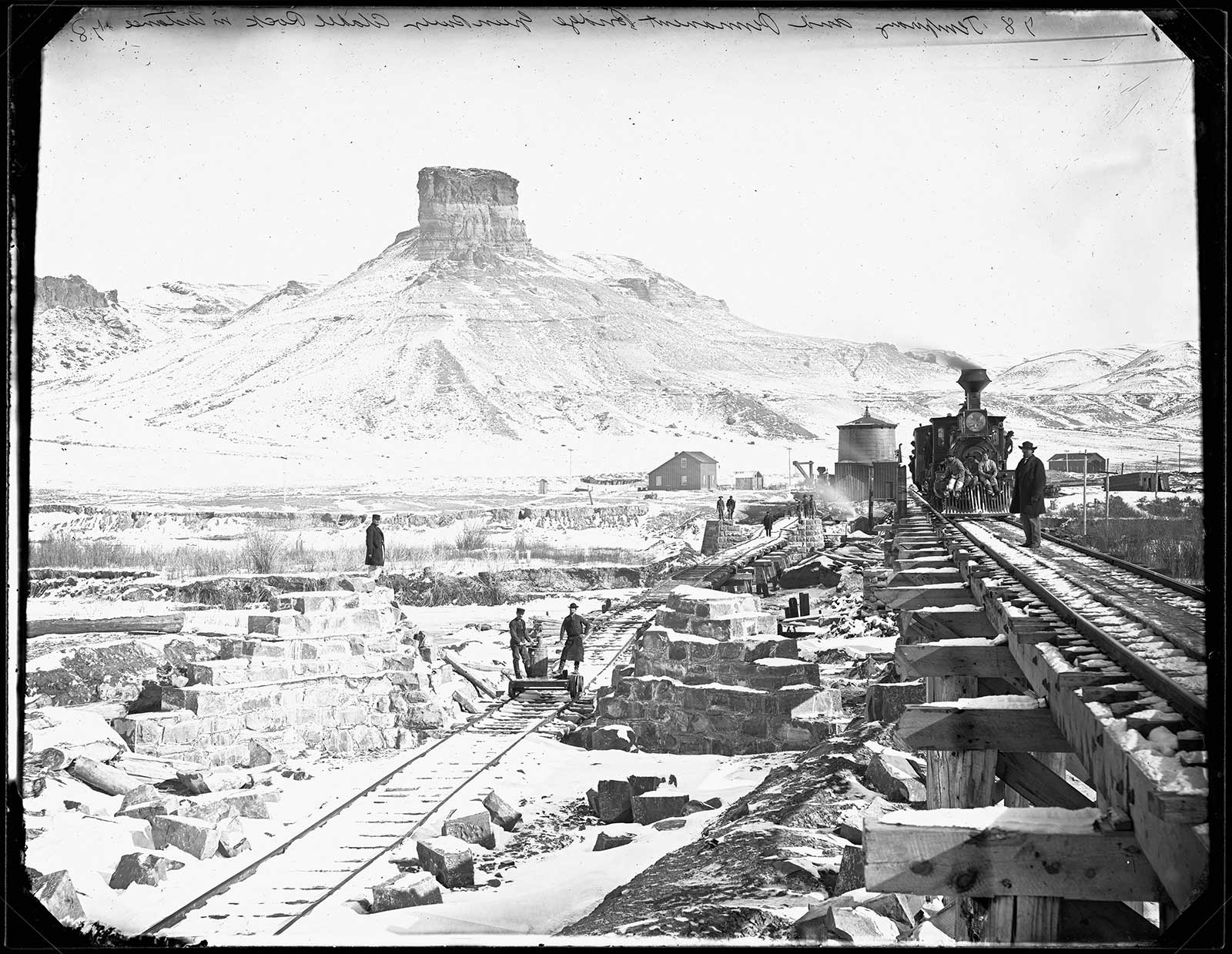
Andrew J. Russell (1829-1902), Temporary and Permanent Bridge, Green River, Citadel Rock in Distance,1869, photograph from Imperial collodion glass plate negative, 10 x 13 in. Oakland Museum of California, Oakland, CA.
H. David Wright is attracted to the site of the original rendezvous on the Green River and Horse Creek. His painting Good Grass, Good Camp is based on photos he took at Seven-Mile River Ranch “with the ‘Winds’ [the Wind River Range] in the background. I go out every year for the Museum of the Mountain Man fund raiser and visit that site quite often,” he says. “It has a special meaning to me and I’ve done several paintings located in the valley.”
In 2019, Wright had a retrospective show of his work at the Eiteljorg Museum in Indianapolis and in 2022 he was given the Booth Western Art Museum American Artist of Excellence award.
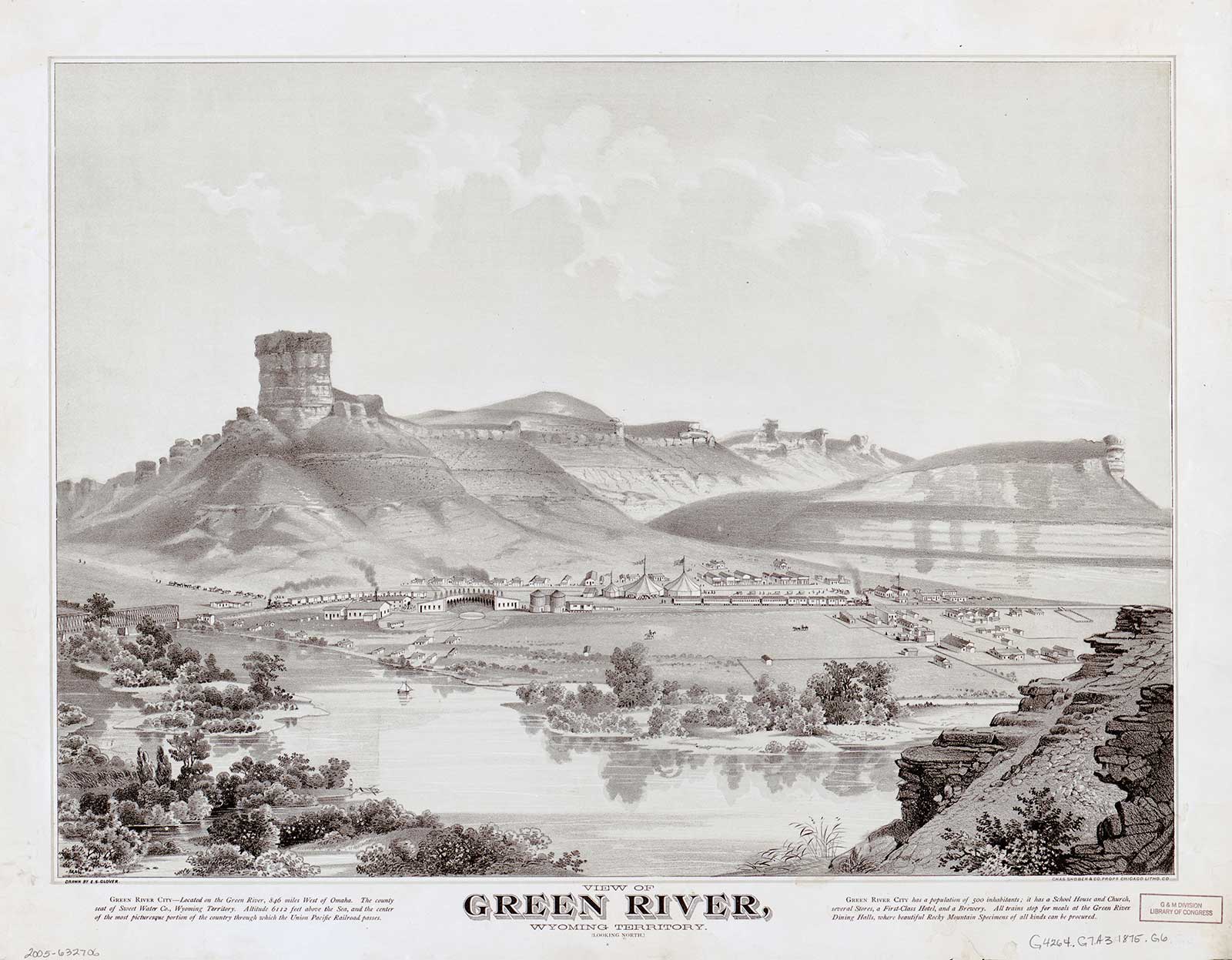
E.S. Glover (1844-1920), View of Green River, Wyoming Territory (looking north), 1875, lithograph, 15³⁄8 x 207⁄8 in. Library of Congress Geography and Map Division Washington, D.C.
The Eiteljorg notes, “Historical accuracy is extremely important to Wright. He researches his subjects through primary and secondary written sources, as well as through material culture that he personally collects or that he finds in museum collections. In addition to these more traditional research avenues, Wright also takes time to immerse himself in the ways of life of the frontiersmen he paints. He refers to his hands-on research as ‘reliving history,’ rather than reenacting it. His goal is to gain a deeper understanding of how frontiersmen lived in and negotiated the landscape by going out into it, and he uses the same kinds of tools and gear authentic to the period. These experiences inform his attention to detail when painting.” —
Powered by Froala Editor