Every page we put into Western Art Collector is a labor of love. The editorial team spends a great deal of time requesting materials, interviewing sources, choosing the best images, and then the production team ties it all together with page designs that complement the artwork and help tell a story. Every page matters.
But no pages are as important as our covers, which we hold near and dear to our hearts for every single issue. The cover is the first image you see when you pick up the magazine, whether you’re grabbing it from your mailbox, the newsstand or from a stack at the front of a gallery or museum. It’s also the image that represents the entire issue and what is happening that month in the world of Western art.
I wish I could tell you choosing these covers was easy, but it’s agony. For every cover you see, there are four or five that weren’t picked but were just as powerful. Cutting these choices hurts! But once we whittle our choices down to one ultimate cover, excitement rushes through our offices. It’s like that issue suddenly has a voice and identity. And since choosing the cover is usually one of the last things that happens in our development cycle, it’s also an opportunity for us to take a breath and admire where the market is headed that month.
I’m certainly biased, but I think our covers over the last year or so have been especially strong, from Shonto Begay’s snow-covered desert scene (Issue 185) and Scott Yeager’s spring painting of deer amid aspens (Issue 189) to Amy Brakeman Livezy’s bucking horse with cowgirl (Issue 196) and Kevin Chupik’s cowboy with airplane (Issue 186), which has been a fan favorite since it came out in February 2023. Although it’s still early, we already have some amazing ideas percolating for covers later in 2024.
As we mark our 200th issue, we want to celebrate 200 Western Art Collector covers by looking back at some exciting highlights in our history. Enjoy!
+++
 Martin Grelle, Cover King
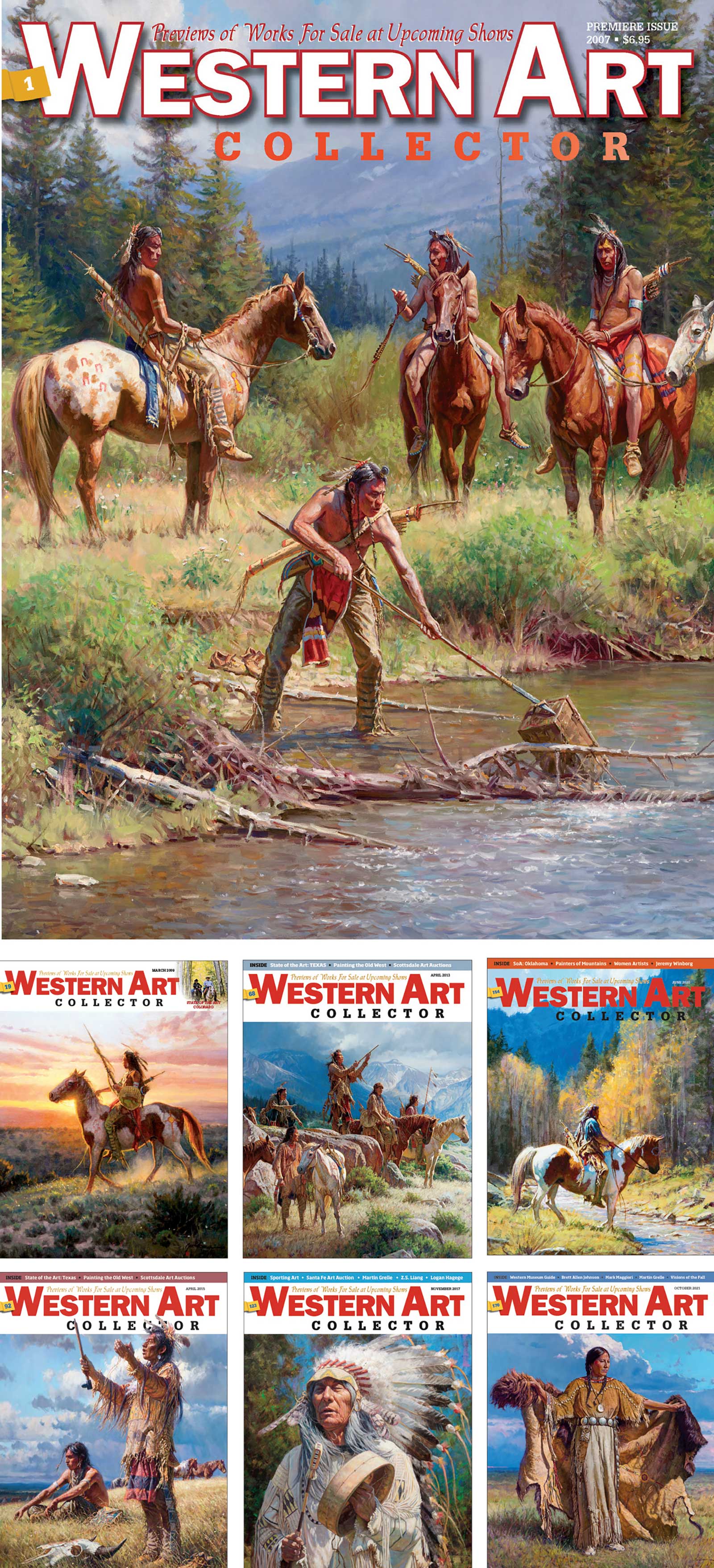
Not only was Martin Grelle on our first cover in September 2007, he was also on six additional covers over the next 17 years. No artist has had as many covers as the famous Texas painter known for his cowboy and Native American subject matter.
“There’s so much going on in The River’s Gift [Issue 1], with the figures and the horses, etc. There’s a lot to think through and get right anatomically. I get in these positions to make sure that they’re balanced right or that they feel right. If it doesn’t feel right, it probably isn’t right,” Grelle said in the article. “I painted a mountain man figure for a piece in the Prix de West show in June [2007]. He was holding a trade gun. I had a trade gun myself, and I went outside and held it, and where I had to hold it for it to be balanced in my hand wasn’t where I had originally planned to draw it. The barrel was really heavy, so I had to hold it further up on the barrel end of the gun than what I originally conceived. I changed the painting to reflect that. I also modeled for the figure lifting the trunk out of the river to make sure the positioning was correct.” Today, as he was back in 2007, Grelle is one of the top painters in Western art. “Life and painting have been really good for me and I’m just going to keep trying to do the best I can do and grow with each painting,” he added.
We caught up with Grelle to ask about our first issue, and he said he has it and several other Western Art Collector covers framed in his home. “I was blown away to get your first cover. It was a special deal for me. To get your work picked out for the cover when there are so many great images in the magazine, it’s truly an honor,” he says. “Looking back on all the covers the magazine has given me, they do represent milestones in my career, especially since I was doing annual shows down in Scottsdale—first for Overland Gallery and then for Legacy Gallery. Then there were also the museum shows, CA shows, auctions. They kind of helped me up the odds for those covers. Whenever I got on a cover, though, I always felt like I was in high cotton, as my dad would say.”
+++
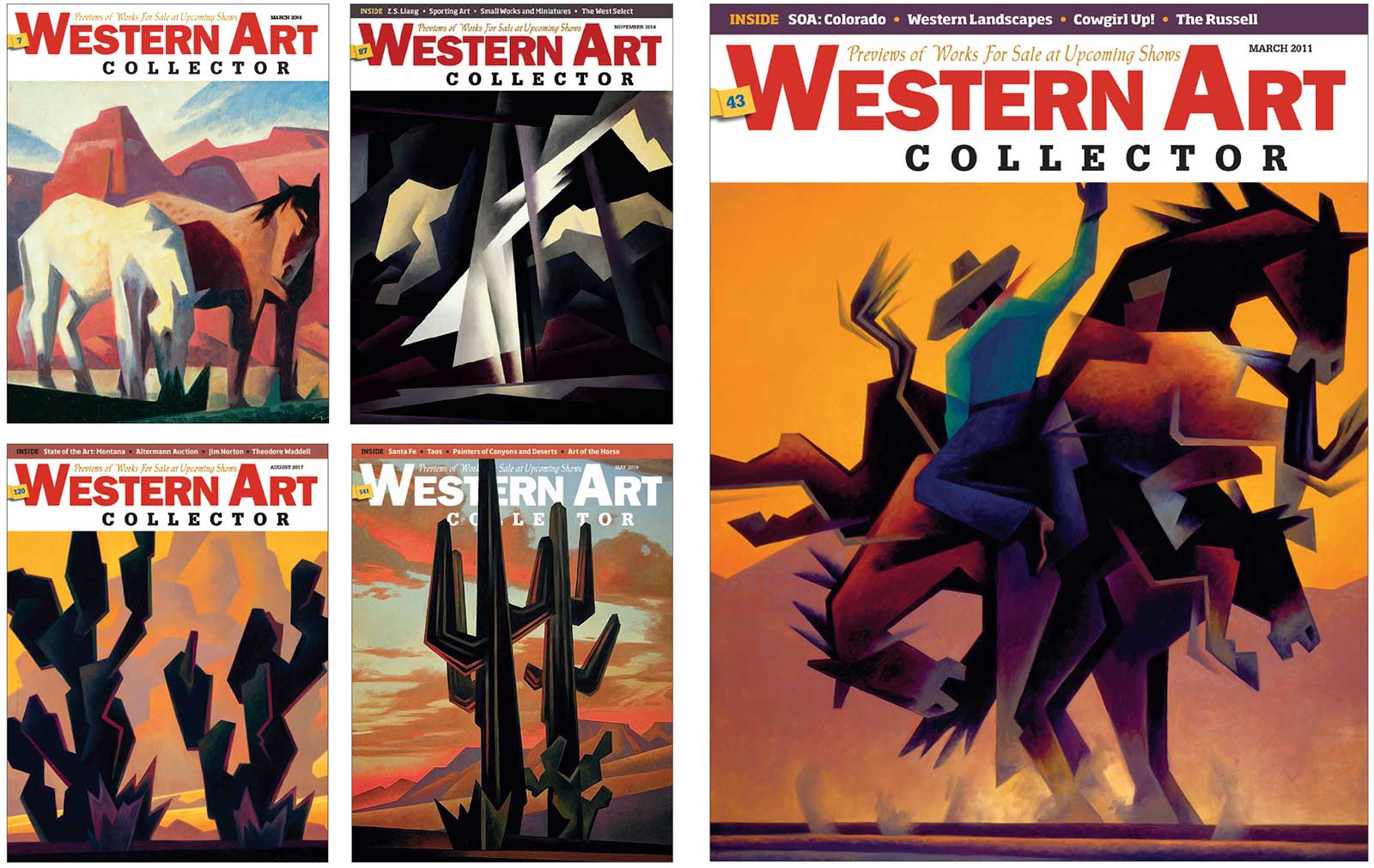
A Tribute to Ed Mell, Arizona’s Great Modernist
Phoenix painter Ed Mell was always intended to be on this list, but after his passing on February 21, it was twice as important to include him as an acknowledgment to all he has done for the Southwest. Mell is one of Western Art Collector’s six-timer cover artists, a title he shares with exceptional company: Charles M. Russell and two other Arizona artists, Howard Terpning and Bob Kuhn. First appearing on the front of Issue 7, Mell’s cover paintings included cacti (Issues 120 and 141), horses (Issue 7 and 164), an abstracted landscape (Issue 87) and the cubism-inspired bucking horse image titled Every Which Way But Loose (Issue 43), which has long been a reader favorite even 13 years after its publication date.
Mell didn’t just appear on our covers; he was also a regular fixture here in our offices, where he would visit with friends and talk shop with our different teams. He was quiet and soft-spoken, but he had a big personality and loved to connect with people in the art world. He would often come in to personally guide our designers on his ads or help with the color reproduction of his work in our editorial coverage. During interviews, Mell would openly admit he wasn’t good when it came to talking about his own work. He felt that art could speak for itself, and anything he had to say about it wouldn’t be adequate to what he painted. For many years, the joke was that if you wanted Mell to open up in an interview it was best to talk about anything but his own art. That worked well because he had lots of interests, including 20th-century illustration, odd bits of Arizona history and classic cars. He knew interesting people, had fascinating stories and he was thoroughly impressed with the work of younger artists, including rising Native American artists who were blazing their own trails.
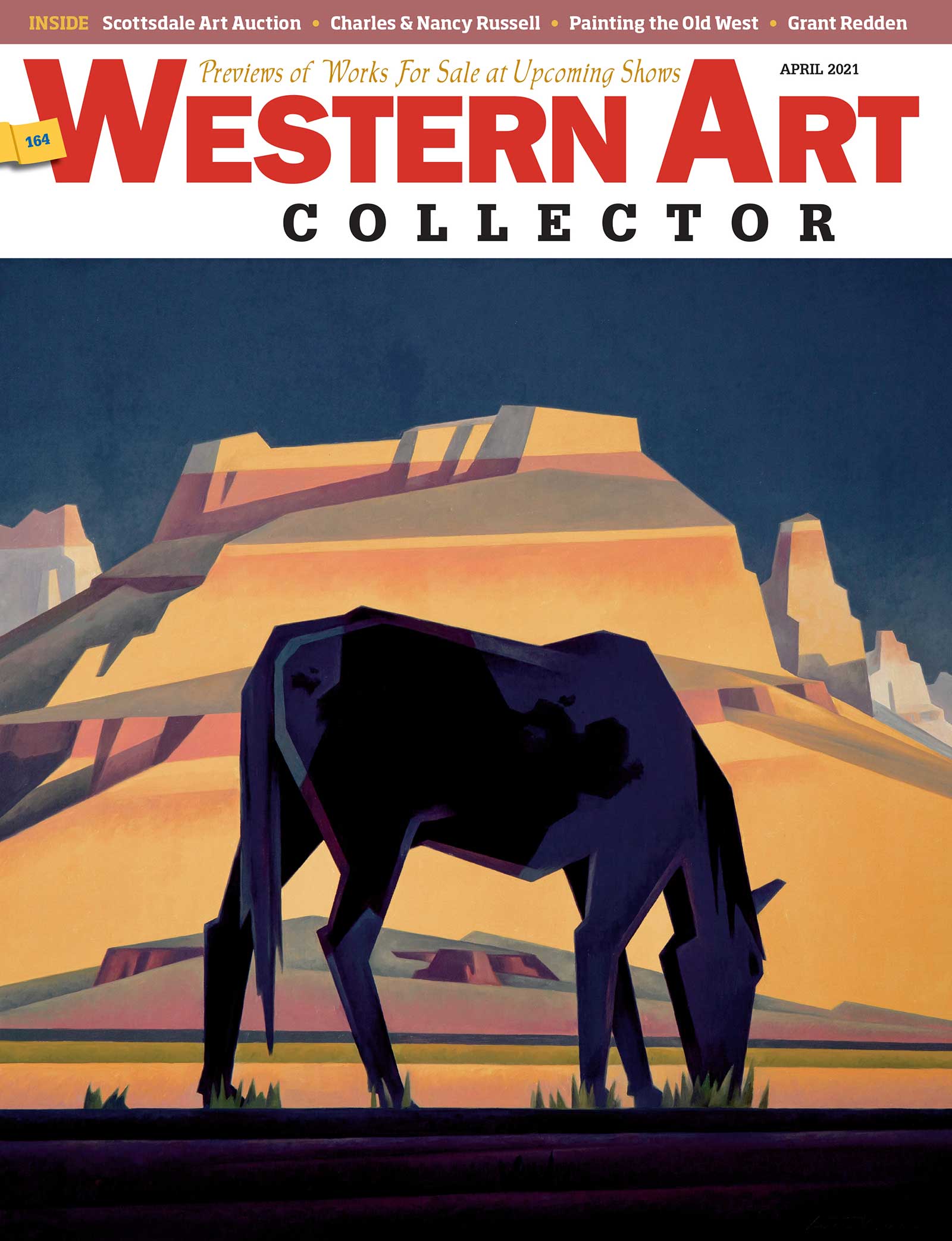
And, of course, Mell’s work was exceptional because it captured modern views of the Southwest. He was a trailblazer. This is reflected in all of his work, including the pieces that are featured on our covers. One piece that stands out now after his death is Sonoran Kings (Issue 141). The two saguaros standing tall in brilliant light were meant to represent him and his late son. The painting has all the hallmarks of a Mell painting: brilliant color, simplified forms with straight lines, glowing clouds hanging over the desert and a strong connection to Arizona, the home he loved.
+++
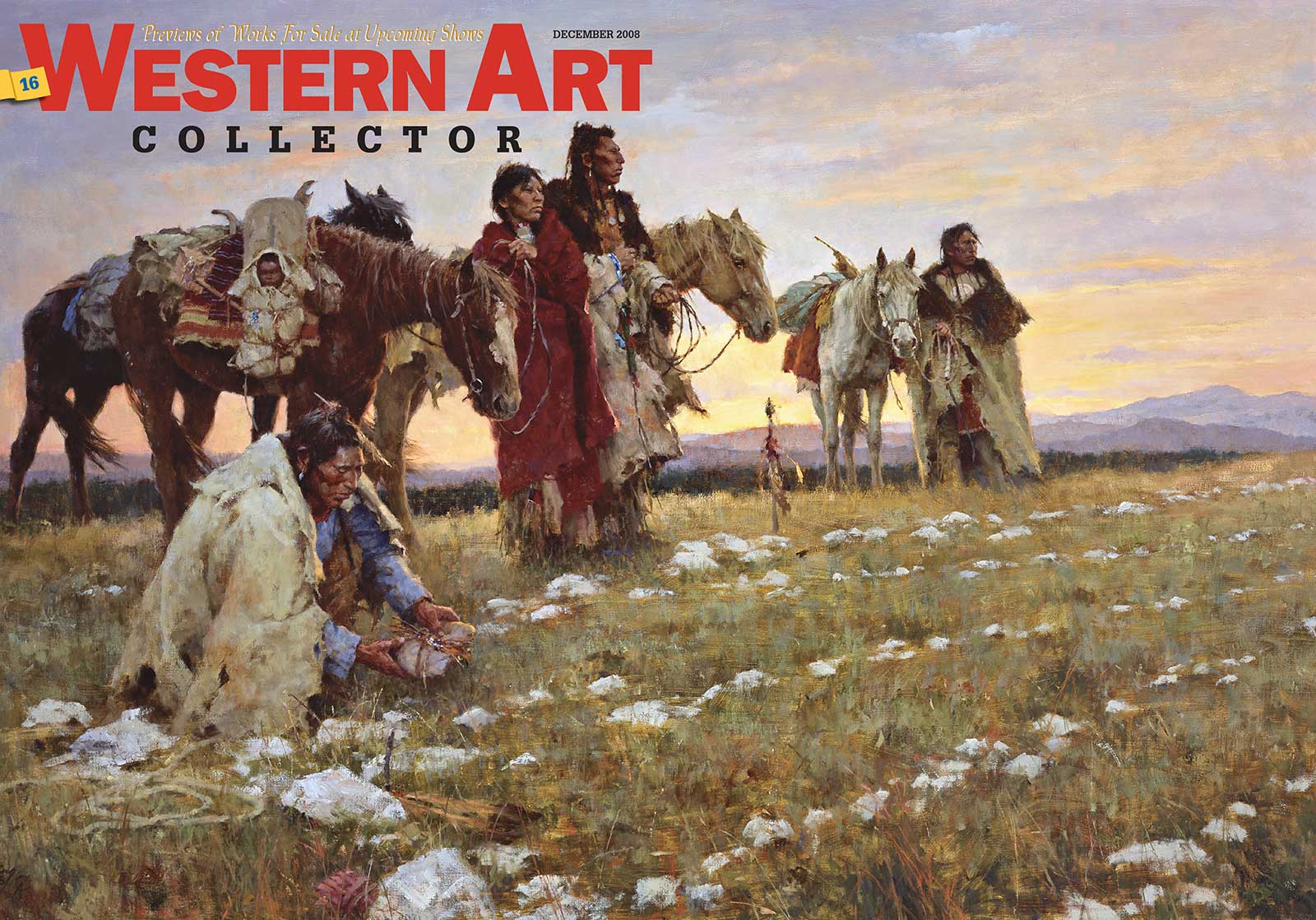
Bigger
and Better
Howard Terpning has appeared on six covers, but his first cover appearance was a noteworthy one. For Issue 16 in December of 2008, Terpning’s painting Journey to the Medicine Wheel graced the cover. Readers were given a surprise when the magazine arrived and they realized the cover folded out to reveal twice as much image. It was the first, and currently only, time Western Art Collector has used a fold-out cover, though our publishers are looking into it for future issues. Inside the issue, Masters of the American West organizer John Geraghty was given an in-depth look at the creation of the piece from the artist, who even supplied incredible oil studies and preliminary versions of the work. Geraghty, a long-time contributor and columnist to the magazine, was dear friends with Terpning, and their affection for each other was clear in the text. Geraghty writes: “Howard Terpning is unpretentious, sensitive, loyal, optimistic and impeccably courteous, and in cowboy phraselogoy, ‘He is a man to cross the river with.’”
+++
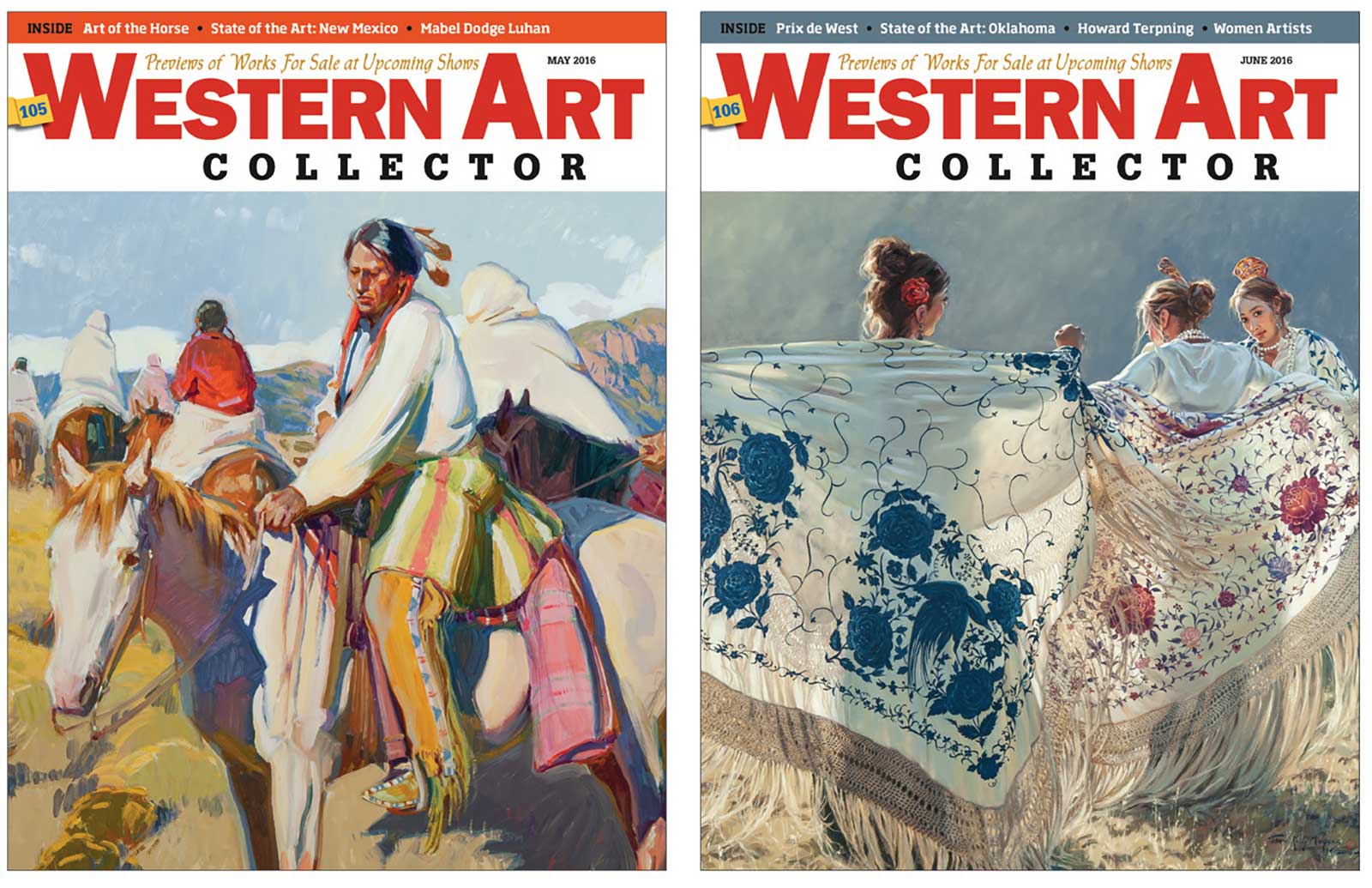
Partners in Paint
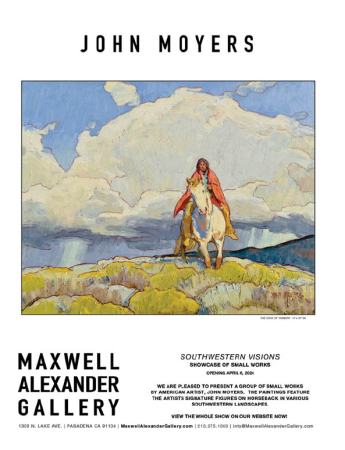
In a unique pairing of covers, husband-and-wife painters John Moyers and Terri Kelly Moyers were given back-to-back covers in the summer of 2016. John had Issue 105 with a work titled The Long Trail Home, and Terri had Issue 106 with her work Las Flores for the Prix de West. What’s so magnificent about the images is how they perfectly represent the strengths of each artist. John’s image has male figures painted with loose brushstrokes that convey so much with so little. Terri’s image, more detailed and with tighter brushstrokes, shows women holding up delicate shawls with floral designs. The Moyers have been regulars in the magazine since the very early days; John was even in Issue 1. Today they are both still very active.
+++
The American Outlaw
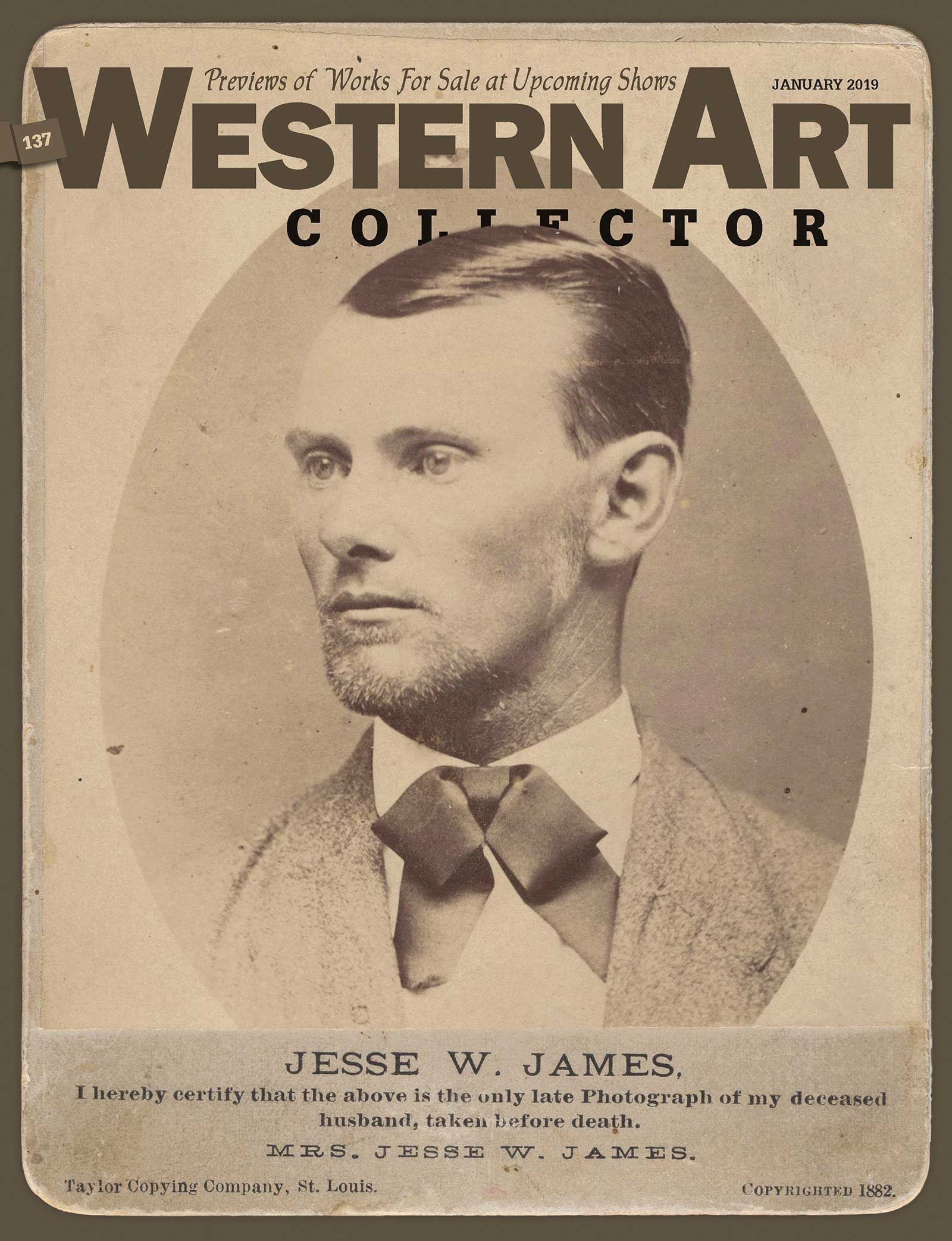
Even though photography was still in its infancy in the Old West, there are a handful of Western figures who are instantly identifiable by their photographs. These include Billy the Kid, Wyatt Earp, Buffalo Bill, Geronimo and, as seen here on the cover of Issue 137, Jesse James. All of these figures, and hundreds more, are common subjects at Brian Lebel’s Old West shows, which is where this James image was offered to auction bidders. Lebel has made the case—accurately, in our opinion—that these images and also objects such as parade saddles, silver spurs, historic Western rifles, Navajo blankets, pueblo pottery and much are, are fine art as much as paintings and bronzes. If you need proof, just look at any of our collector home features, where collectors around the country show these objects right alongside their paintings and sculptures. So when the James image came for auction, it instantly entered our pool of images for consideration. When it won the cover, it became the first of its kind in our history.
+++
A Historic Photo for a Historic Time
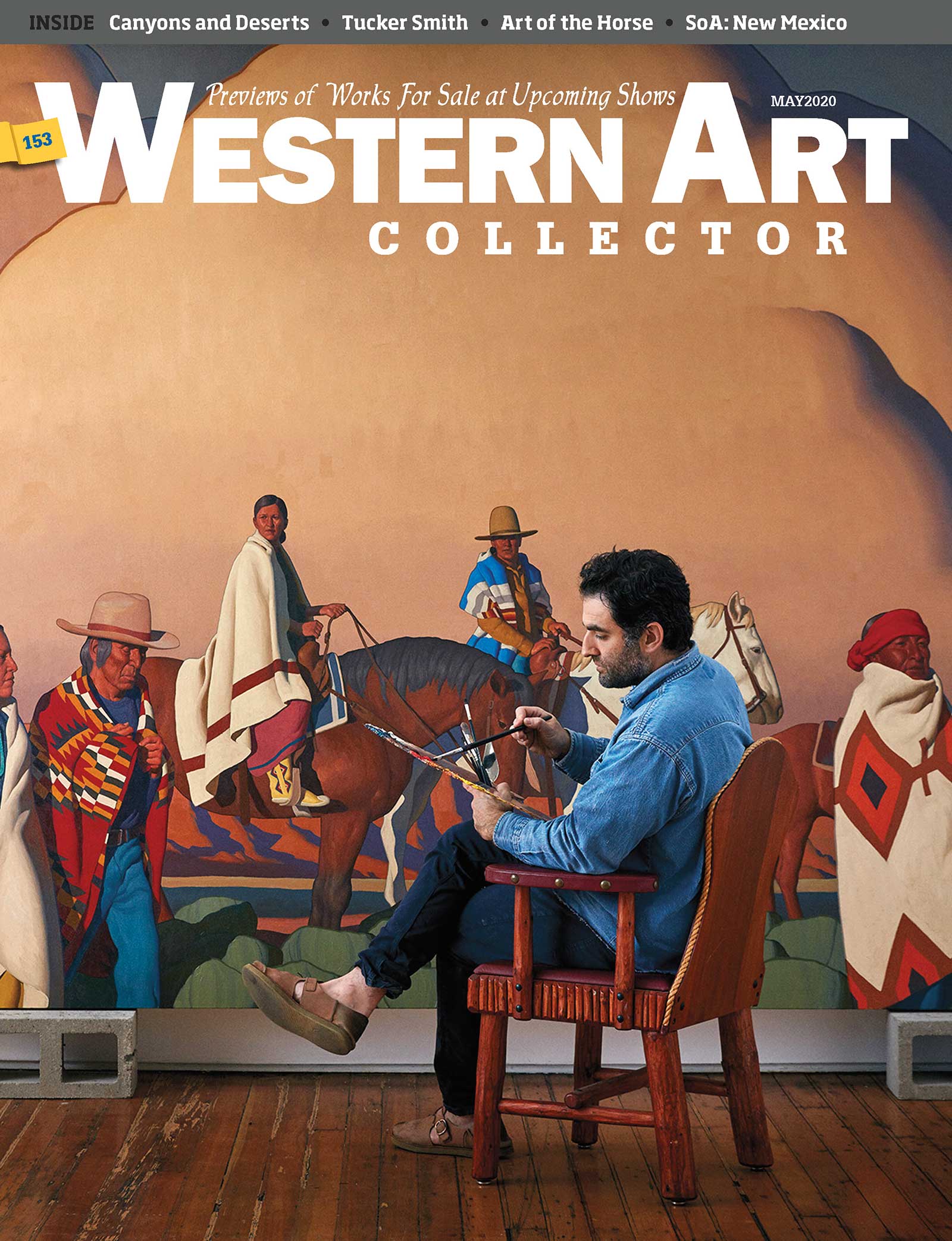
The May 2020 issue of Western Art Collector exists in a fog for many of us here on the editorial and production teams. We worked on May in March 2020, which is when Covid-19 slammed into the American economy. In addition to sports, music, movies and other huge segments of the country, the art market was suddenly incapacitated with canceled shows, shuttered public events and online-only openings that were hastily organized at the last minute.
Logan Maxwell Hagege made Western Art Collector history that month when he appeared on our cover with one of his paintings. It was the first and only time an artist would appear in a photograph on the cover, although Andy Thomas would paint Charlie Russell on Issue 67, and Joseph Henry Sharp would do a partial self-portrait on Issue 128. When the magazine made inquiries about the Hagege painting for the cover, it was the artist who pitched us on the photograph.
“I just liked the idea of a photograph because it showed the scale of the painting, which was 8 feet by 12 feet,” says Hagege, who’s had four total covers for Western Art Collector. “I was given some loose direction on the format of the cover, so I hired a photographer to come to Maxwell Alexander Gallery to shoot me painting. It was early in Covid so the photographer wasn’t wearing a mask, but he wouldn’t shake my hand because he had been reading about how Covid was spread. So we fistbumped. It was a strange time. That was my Covid show. We didn’t open the gallery, but we did do the show online. That image is special to me because not many people were able to see the actual painting because of what was happening in the world. But they did see it on the cover of the magazine.”
+++
The Roots of Our Redesign
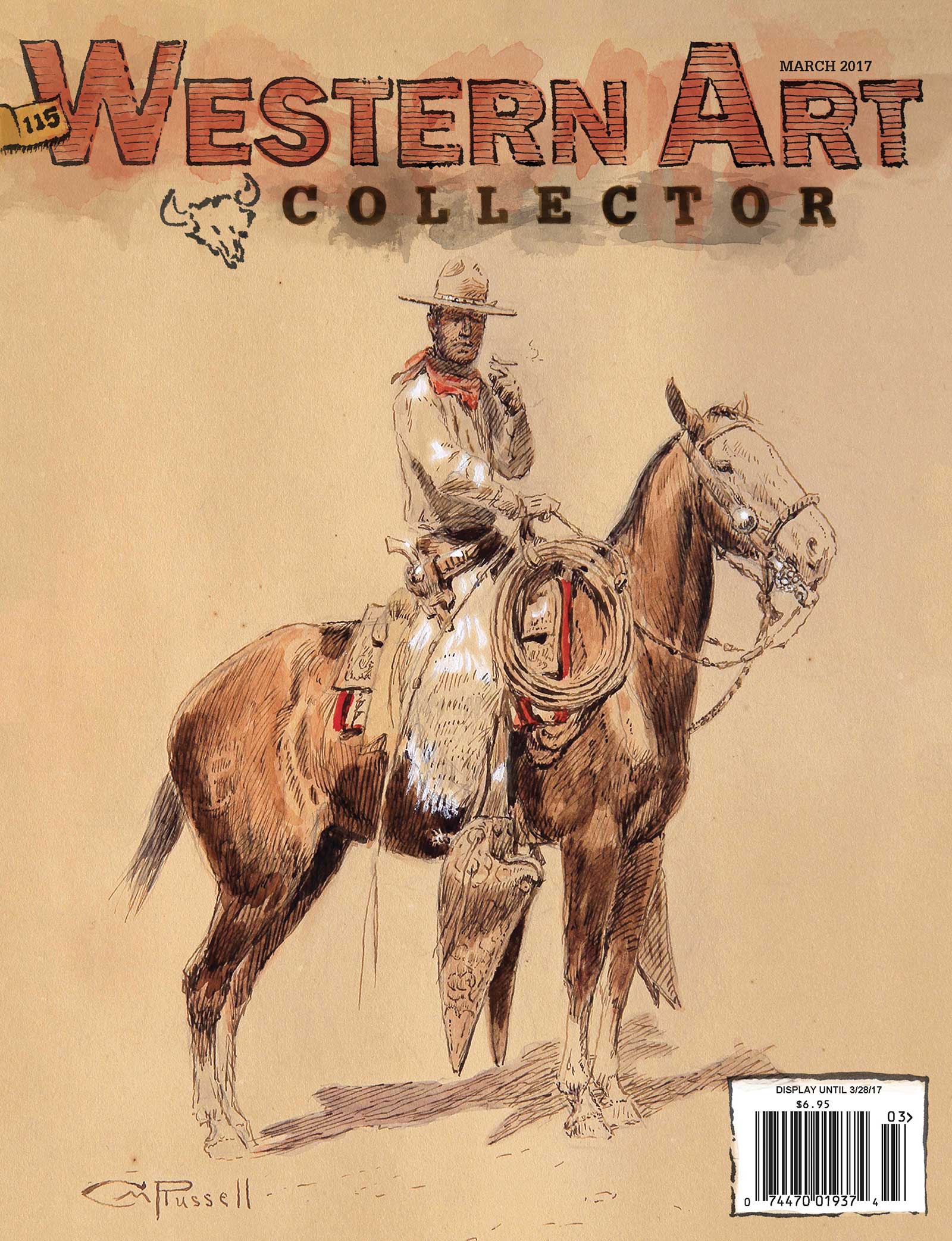
We have been talking about tweaking some of the magazine’s design elements for many years, but some of the earliest landmarks on this journey came way back in Issues 115 and 116. For Issue 115, art director Tony Nolan took a watercolor work by Charles M. Russell and let that inspire an ink and watercolor redesign of our logo. The idea was to make the cover look as if Russell had painted it into one of his famous illustrated letters to friends. The result was a huge success, with the magazine becoming a hot commodity at The Russell in Great Falls, Montana, where the Russell watercolor was being offered to bidders.
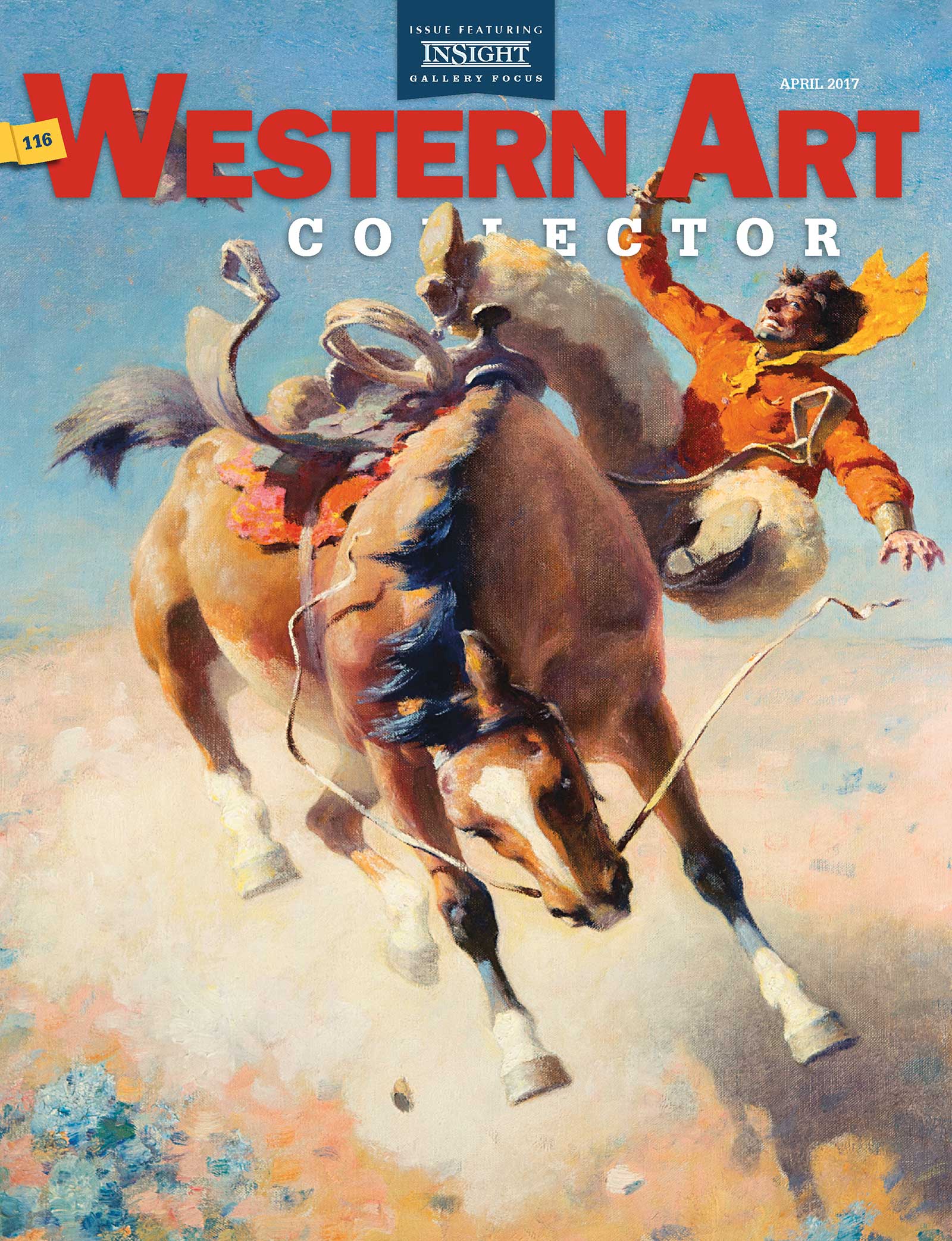
The very next issue featured William R. Leigh’s Hell Bound that was being offered at the Scottsdale Art Auction. For that one, Nolan removed the white background behind our logo and extended the image all the way to the top. This small tweak allowed some of the logo to appear behind the falling rider, which was the chef’s kiss on this exciting image. Those two back-to-back issues would tease us for years as further redesigns remained at arm’s length as we tirelessly covered the Western art market.
+++
Iconic Imagery
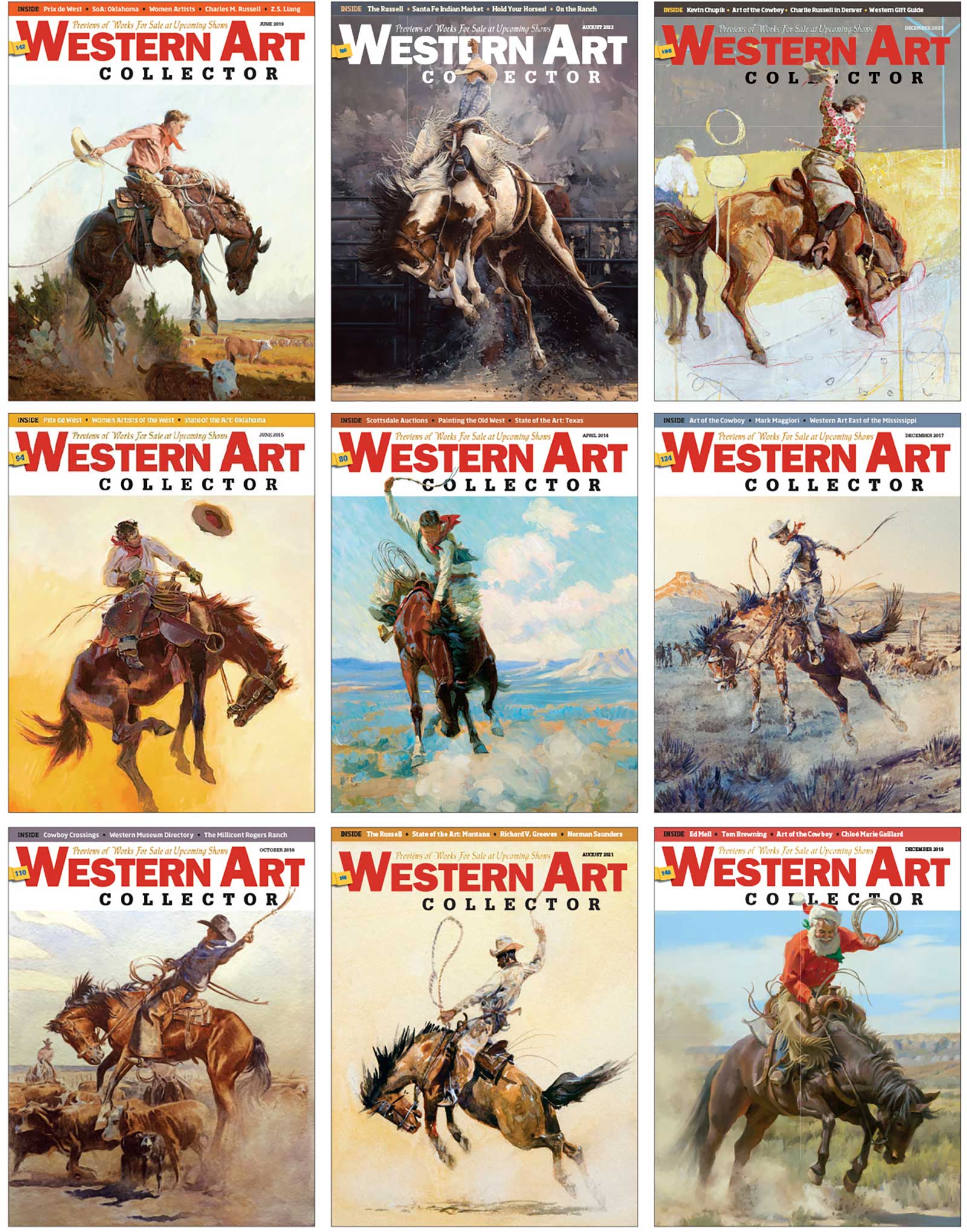
One of the most timeless images in Western art is the rider, often with hand raised high, clinging tightly against a bucking horse. It’s an image made famous by Frederic Remington and Charles M. Russell, and seen prominently in the logo of the city of Scottsdale, Arizona, and on license plates from Wyoming. It is shorthand for the West. It speaks volumes, even when it’s just in silhouette. Of course, it’s also appeared on many covers of Western Art Collector. These are some of the examples, from artists like John Moyers, William Gollings, Edward Borein, Teal Blake, Bruce Greene and many others. Some noteworthy covers in this series include Tom Browning’s Santa Claus riding a bucking horse on Issue 148, Bruce Cheever’s rodeo scene on Issue 180 and Amy Brakeman Livezy’s female rider on Issue 196.
+++
Representing Taos
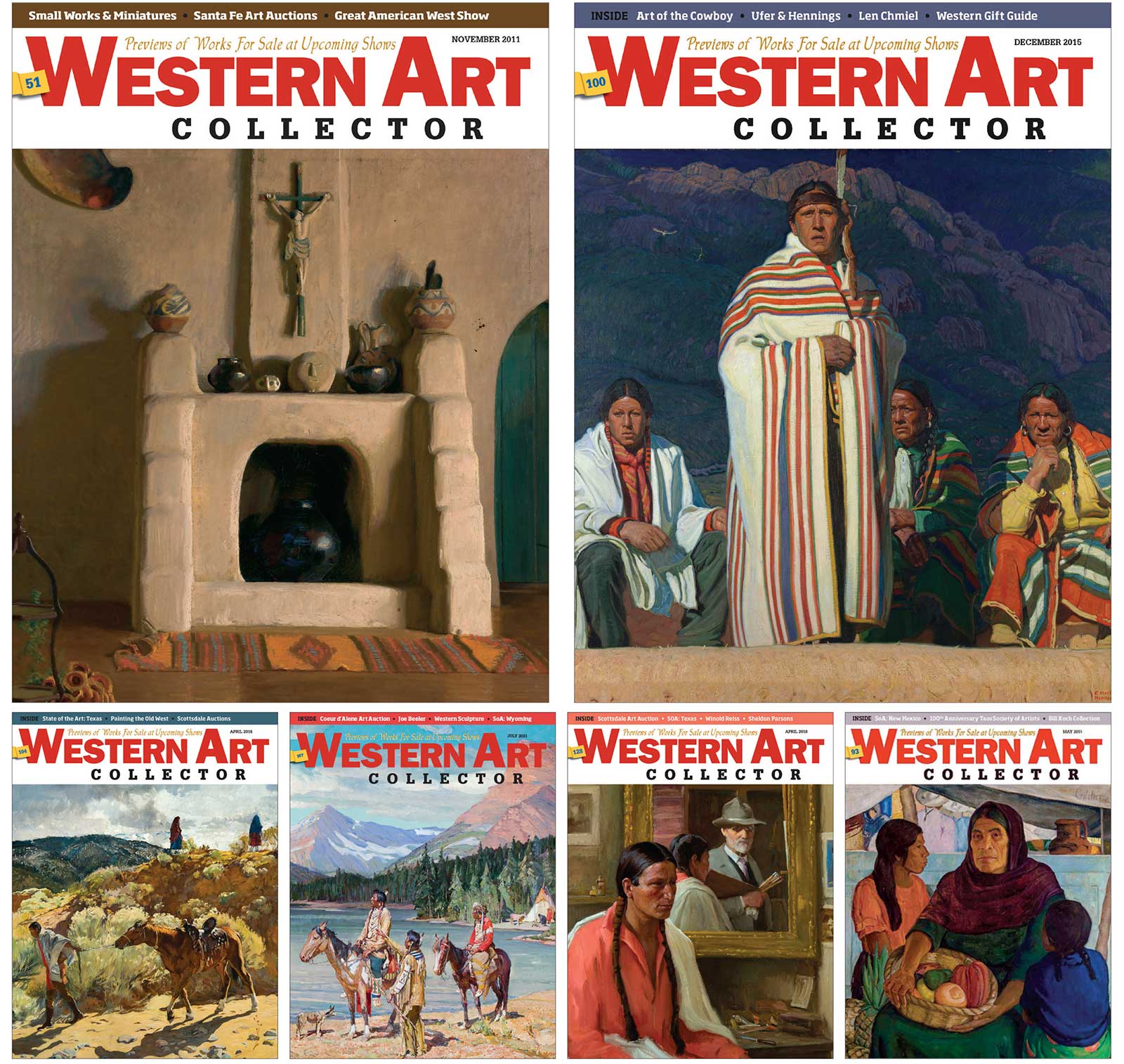
We have covered the Taos Society of Artists since the very beginning, but are still missing some of the Taos Founders on our cover. Of the founders, we have only run five covers from three artists: Joseph Henry Sharp (Issues 128 and 151), Ernest L. Blumenschein (Issues 51 and 55) and Oscar E. Berninghaus (Issue 167). Other TSA members that have had works on the cover include Walter Ufer, Catherine Carter Critcher and E. Martin Hennings. I would love to have all six founders represented before we hit Issue 250, which means we need covers for William Herbert “Buck” Dunton, Bert Geer Phillips and Eanger Irving Couse. Stay tuned! —
Powered by Froala Editor