Maynard Dixon (1875-1946) arrived in Nevada on horseback in 1901, on the first of many short and extended visits that would occur over 40 years. He had been encouraged by his friend and mentor, the journalist Charles Lummis, to “travel east to see the real West.” Lummis (1859-1928) had walked the 2,200 miles between Cincinnati and Los Angeles in 1884, falling in love with the Southwest, its landscapes and its people.
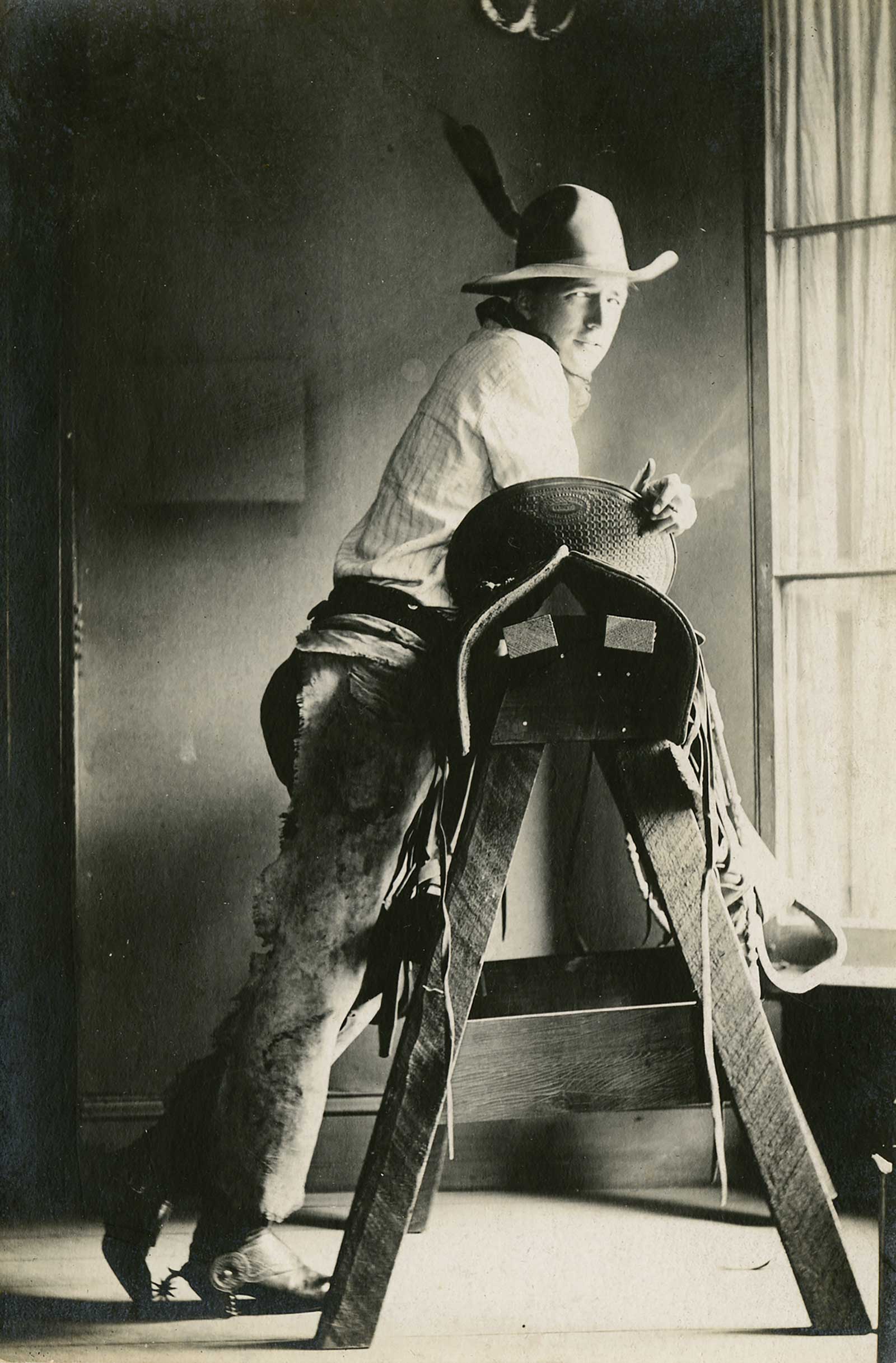 Isabel Porter Collins (1875-1954), Portrait of Maynard Dixon, ca. 1895. California Historical Society Photographs from the Isabel Porter Collins Collection, MSP 422.
Dixon and his friend, painter Edward Borein (1872-1945), set out from Oakland, California, on their way to Montana with six horses carrying living, camping and art supplies. Arriving in Carson City, Nevada, 11 days later, he wrote to a friend, “We have sumptuous lodging in a box stall, which is preferable to any hotel in sight. This kind of traveling is just to my liking. This is a hell of a country, judging by Ormsby County…gray sagebrush flats and ranges.”
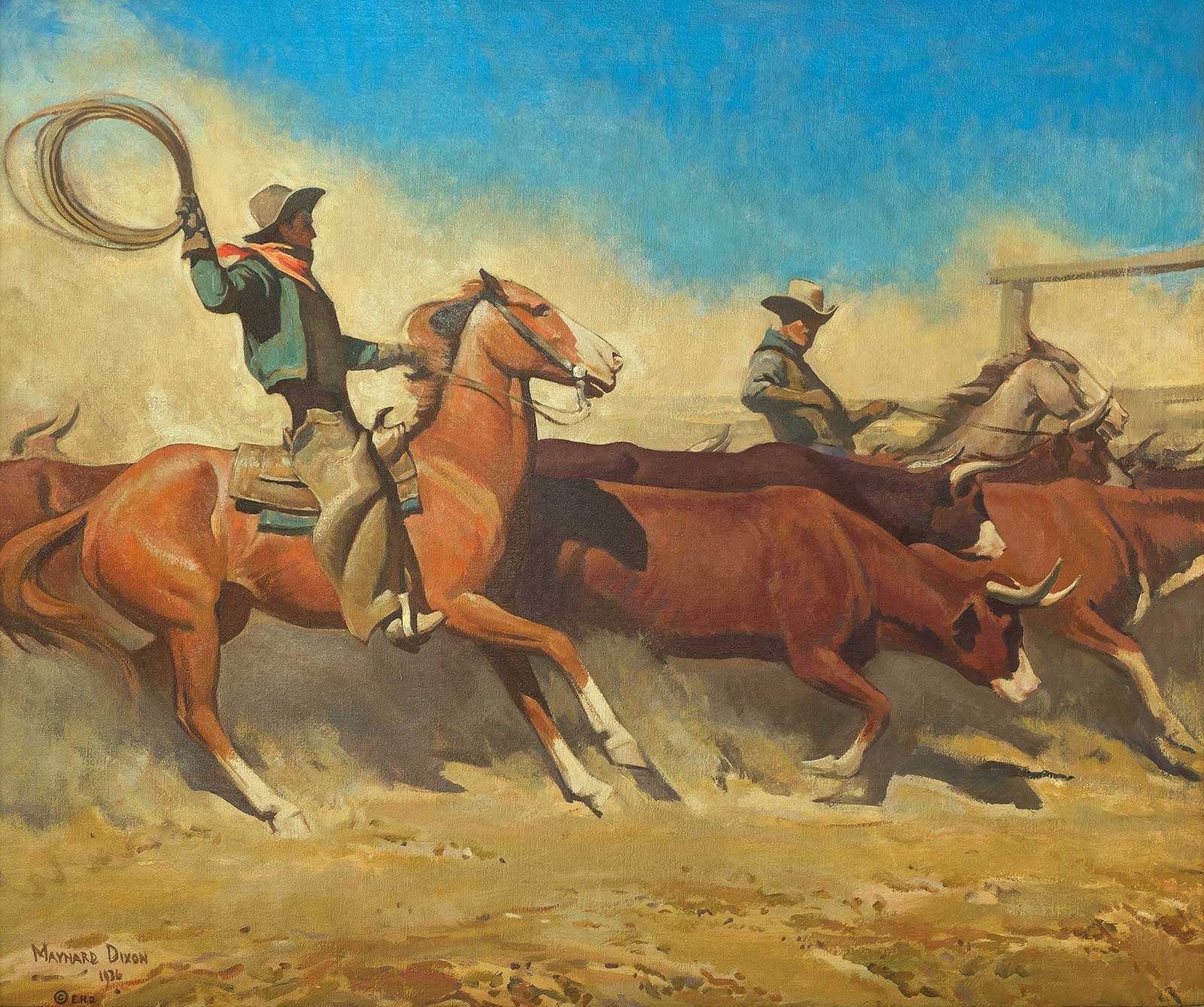
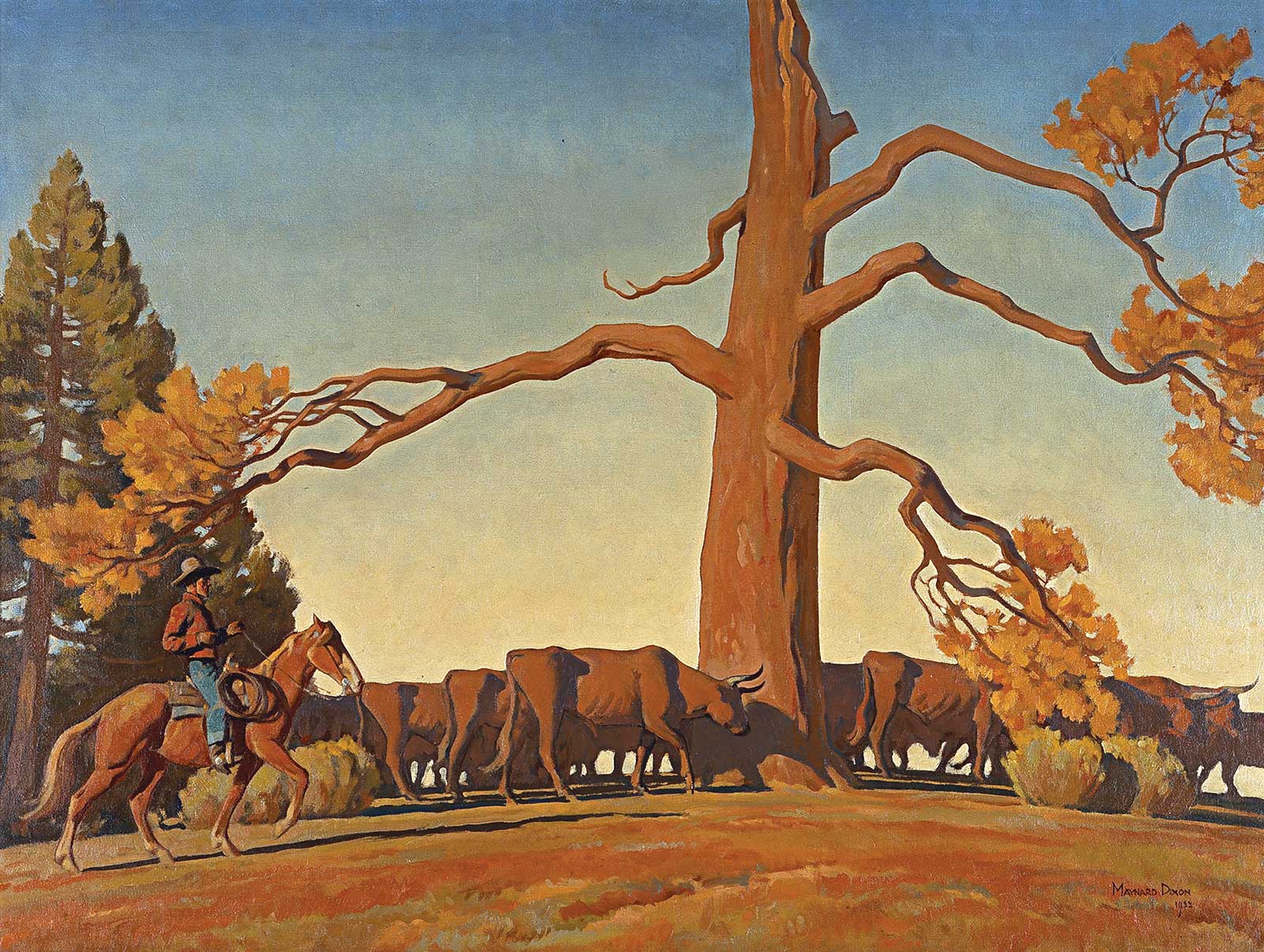
Maynard Dixon (1875-1946), Steers to Market, 1936, oil on canvas, 30 x 36”. Private Collection.
The Nevada Museum of Art in Reno has mounted the exhibition Sagebrush and Solitude: Maynard Dixon in Nevada, which opens March 2 and continues through July 28. It contains nearly 150 paintings and drawings of Nevada and the Eastern Sierra including his rarely seen series on the construction of Boulder Dam in 1934.
Writing in the book accompanying the exhibition, art historian John Ott notes that Dixon’s Boulder Dam paintings “…depart dramatically from the nostalgic frontier scenes with which he established his reputation. These two dozen artworks are a critical watershed in his career,” marking a stylistic departure that would continue to evolve.
Maynard Dixon (1875-1946), Top of the Ridge, 1933, oil on canvas, 36 x 48”. Blanton Museum of Art, The University of Texas at Austin, Gift of C.R. Smith, 1976.
In her essay, exhibition curator Ann M. Wolfe writes, “Dixon pushed stylistic boundaries and introduced modernism to the state of Nevada. His exposure to avant-garde European trends in post-impressionism, cubism and futurism at the 1915 Panama-Pacific International Exposition in San Francisco led to his experimentation with more structured geometric landscape compositions and increasingly vibrant coloration.” Wolfe is the museum’s chief curator and associate director.
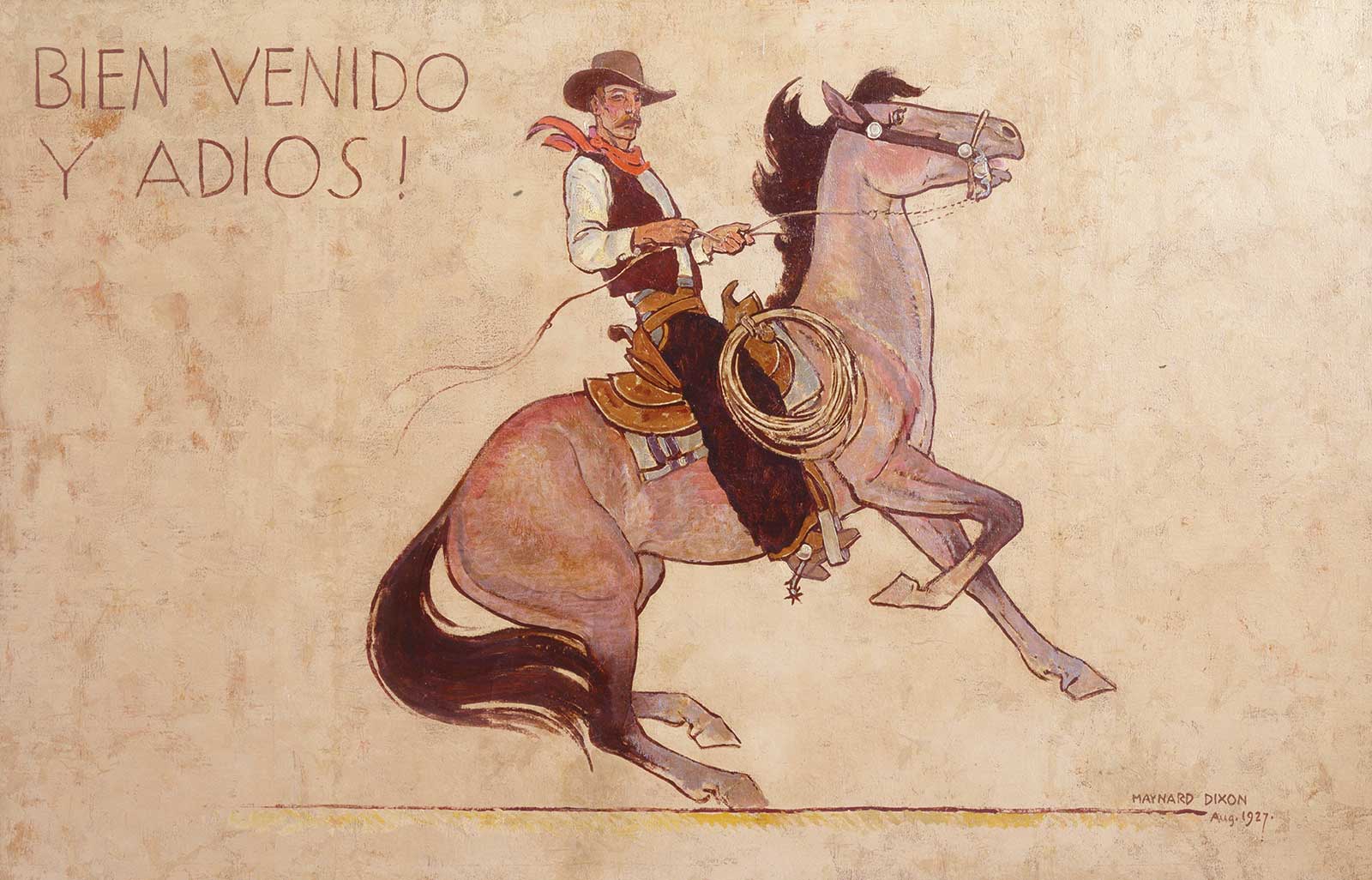
Maynard Dixon (1875-1946), Bien Venido y Adios, 1927, oil on canvas, 44 x 77”. Private Collection.
Dixon was enraptured by what he called “sagebrushland” and often escaped San Francisco for sketching trips in the open spaces of Nevada.
Writing about Dixon’s artistic practice in his essay, Dixon scholar and biographer Donald J. Hagerty explains, “When traveling he always carried small pads of special drawing paper of different colors and sizes in the pockets of his shirts. Dorothea Lange praised Dixon’s drawings, extolling his extraordinary visual memory and a facility beyond anything she had ever encountered: ‘He could capture anything, anything. That very narrow, flexible hand of his could put anything he wanted it to on a piece of paper.’ On any trip, Dixon might make dozens of small drawings with pencil, pen and ink, charcoal and sometimes pastel annotated with year, location and written color notations if needed. If sketch paper ran out, he utilized envelopes, the backs of letters or whatever was at hand.”
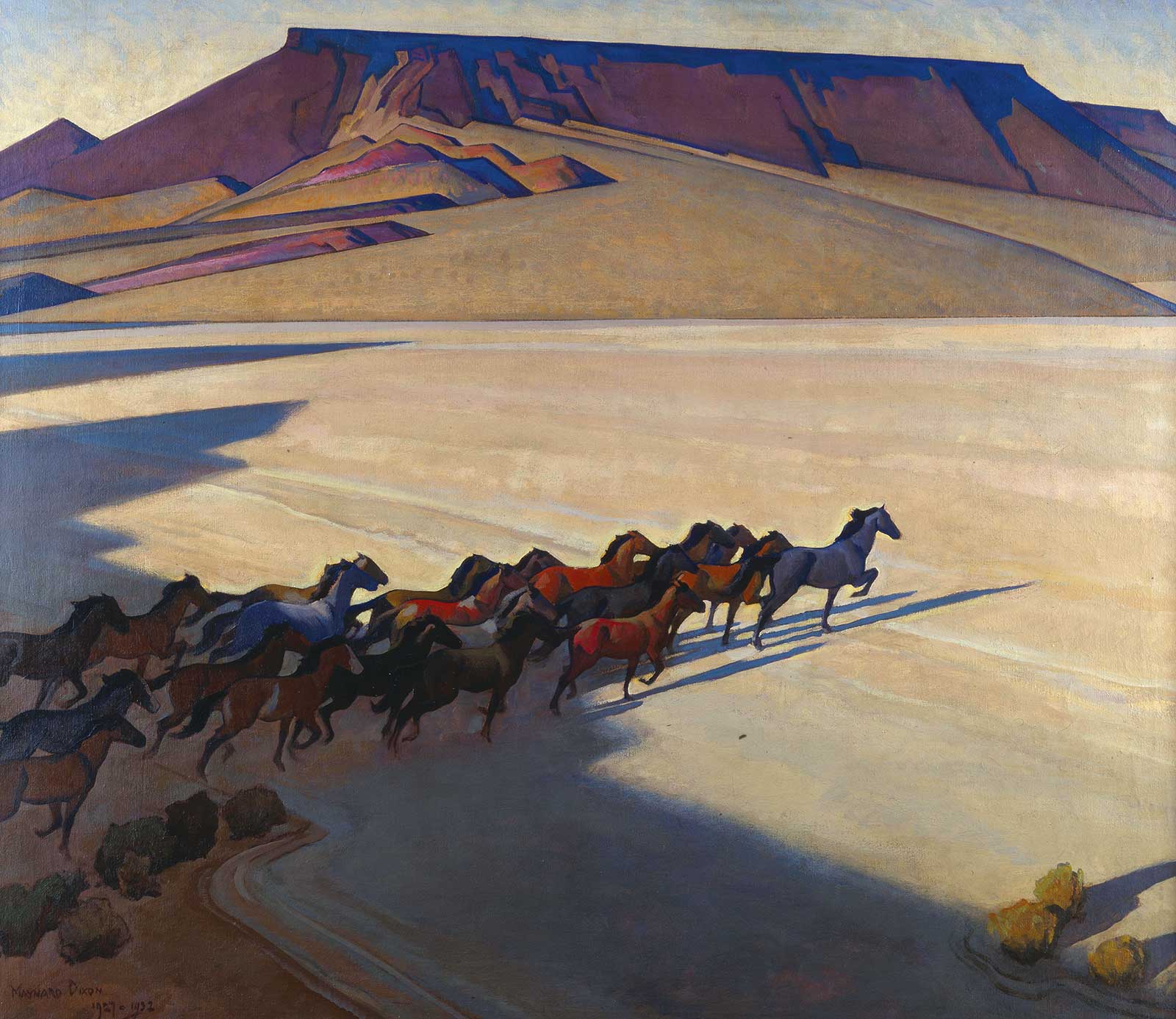
Maynard Dixon (1875-1946), Wild Horses of Nevada, 1927, oil. Collection of the William A. Karges Family Trust.
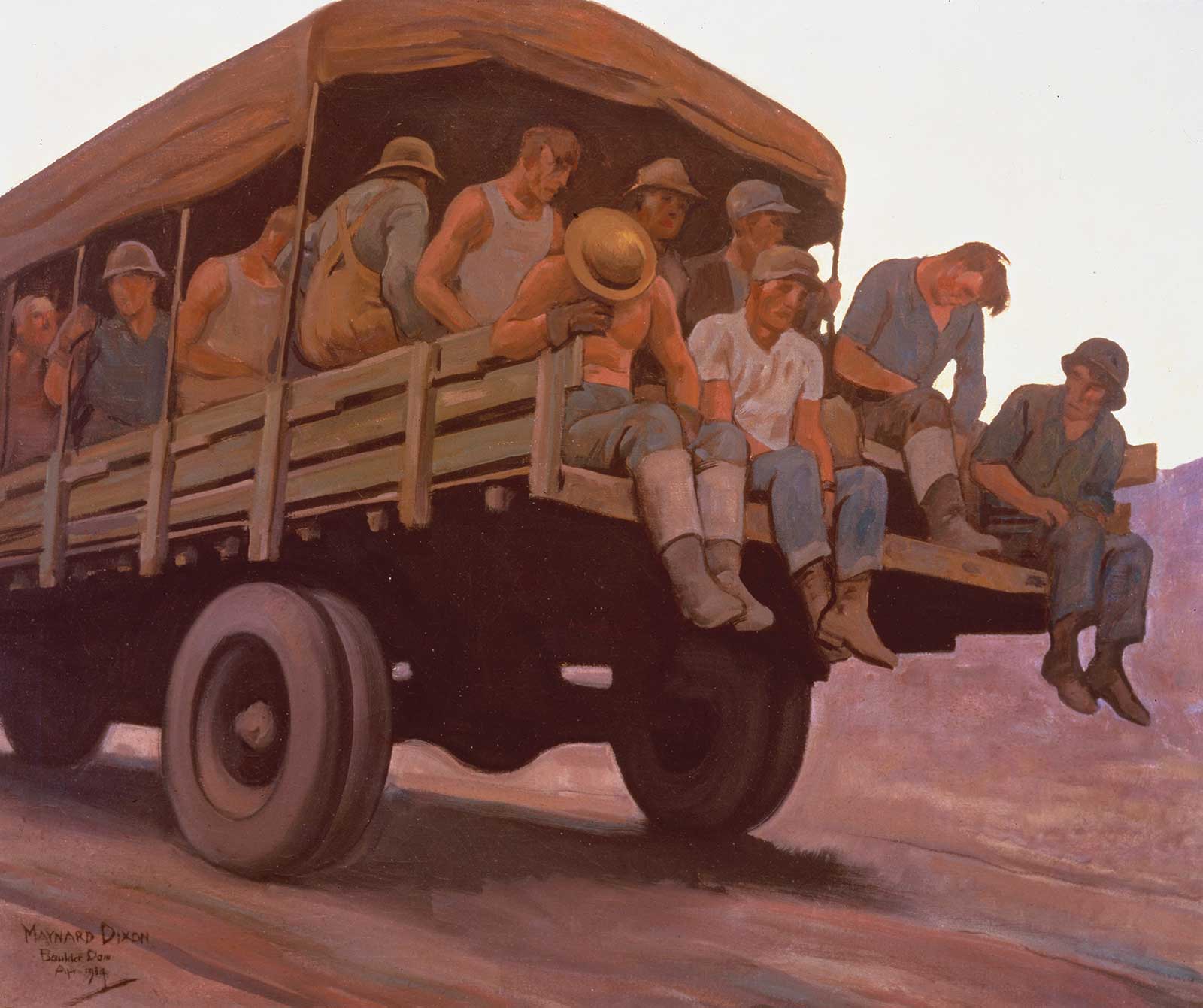
Maynard Dixon (1875-1946), Tired Men, 1923, oil on canvas, 25 x 30”. Private Collection.
Lange (1895-1965), Dixon’s second wife, is noted for her photographic documentation of the Great Depression in California, the Southwest and the South.
Hagerty remarks, “Some of the most notable Nevada paintings were done at the Montgomery Street studio [in San Francisco] upon his return, including the startling Wild Horses of Nevada with its unusual vision—a bird’s-eye view showing a group of wild horses surging across an alkaline flat. Dixon composed the painting with modified cubist realism principles using bold patterns, a modest distortion of form, the elimination of unnecessary detail and a limited color scale massed in large areas.”
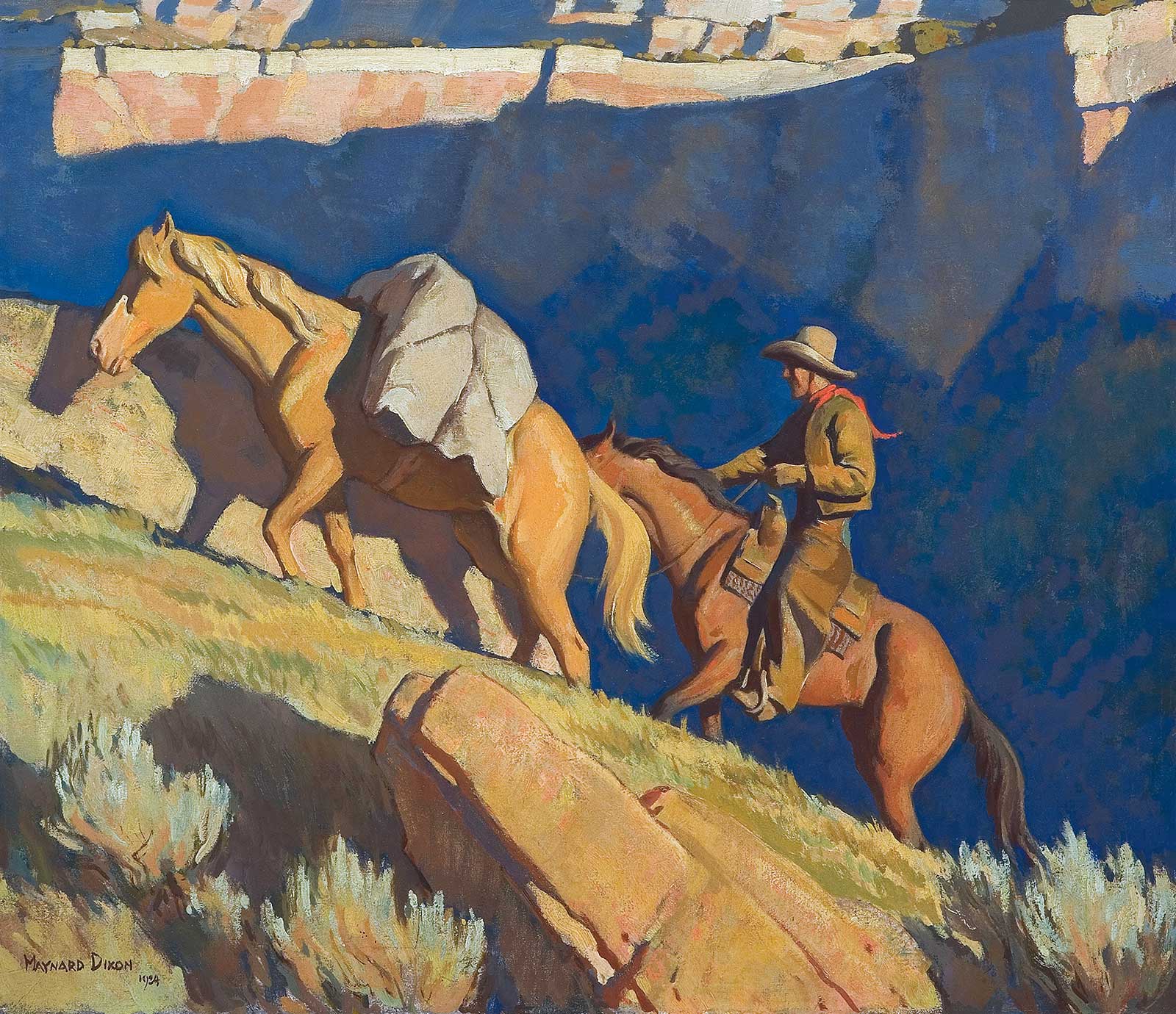
Maynard Dixon (1875-1946), Cowboy and Packhorse, 1934, oil on canvas, 25 x 30”. Ray and Kay Harvey Collection.
Writing of his experience at Boulder Dam, Dixon reflected his concern for the people of the Great Depression as Lange did in her work. He wrote, “The men seemed like robots to me. I didn’t get near enough to know them. But there they worked in the blazing sun at 140 degrees. The water boys—important persons there: high-scalers working on the faces of stupendous cliffs; men riding huge cement buckets in the middle of space, over canyons a thousand feet deep; flesh and blood men opposed to immutable rock.” Tired Men depicts his impression of the human “robots.”
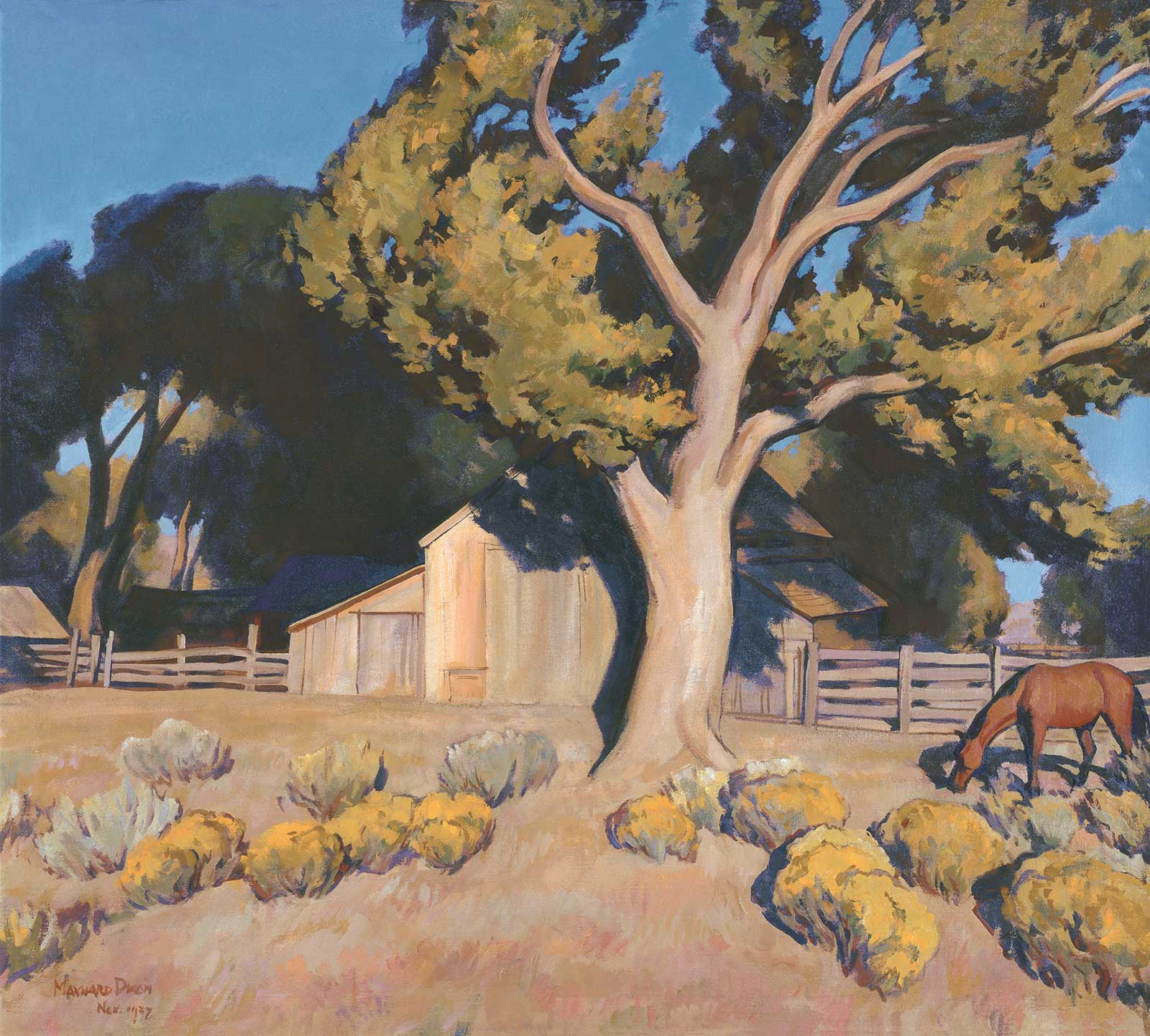
Maynard Dixon (1875-1946), Old Homesite, 1937, oil on canvas, 36¼ x 401/8”. Brigham Young University Museum of Art, gift of B. Darrel and R. Reed Call, 1977.
The book accompanying the exhibition features not only his paintings and drawings but also examples of his poetry. Flight evokes his feeling of oneness with nature:
There humble hills in the descending twilight,
And a vast plain, dim and receding,
And a great dark bird sailing outward—
As he glides, the long slant of the earth sinks away from beneath him.
It seems that my own soul is that bird,
And as I glide outward into the twilight,
The small hills of the days disappear,
And the sombre plain of the world drops away from beneath me. —
Sagebrush and Solitude: Maynard Dixon in Nevada
March 2-July 28, 2024
Nevada Museum of Art, 160 W. Liberty Street, Reno, NV 89501
(775) 329-3333, www.nevadaart.org
Powered by Froala Editor