“My God, finally something different,” thought Booth Museum director Seth Hopkins as he rounded a corner and saw Maeve Eichelberger’s floating plexiglass collages for the first time. “It literally was one of those knock-your-socks-off, epiphany moments,” says Hopkins, who acquired a piece for the Cartersville, Georgia, museum on the spot. He was at Coors Western Art Exhibit & Salein 2016, the artist’s second year in the show.
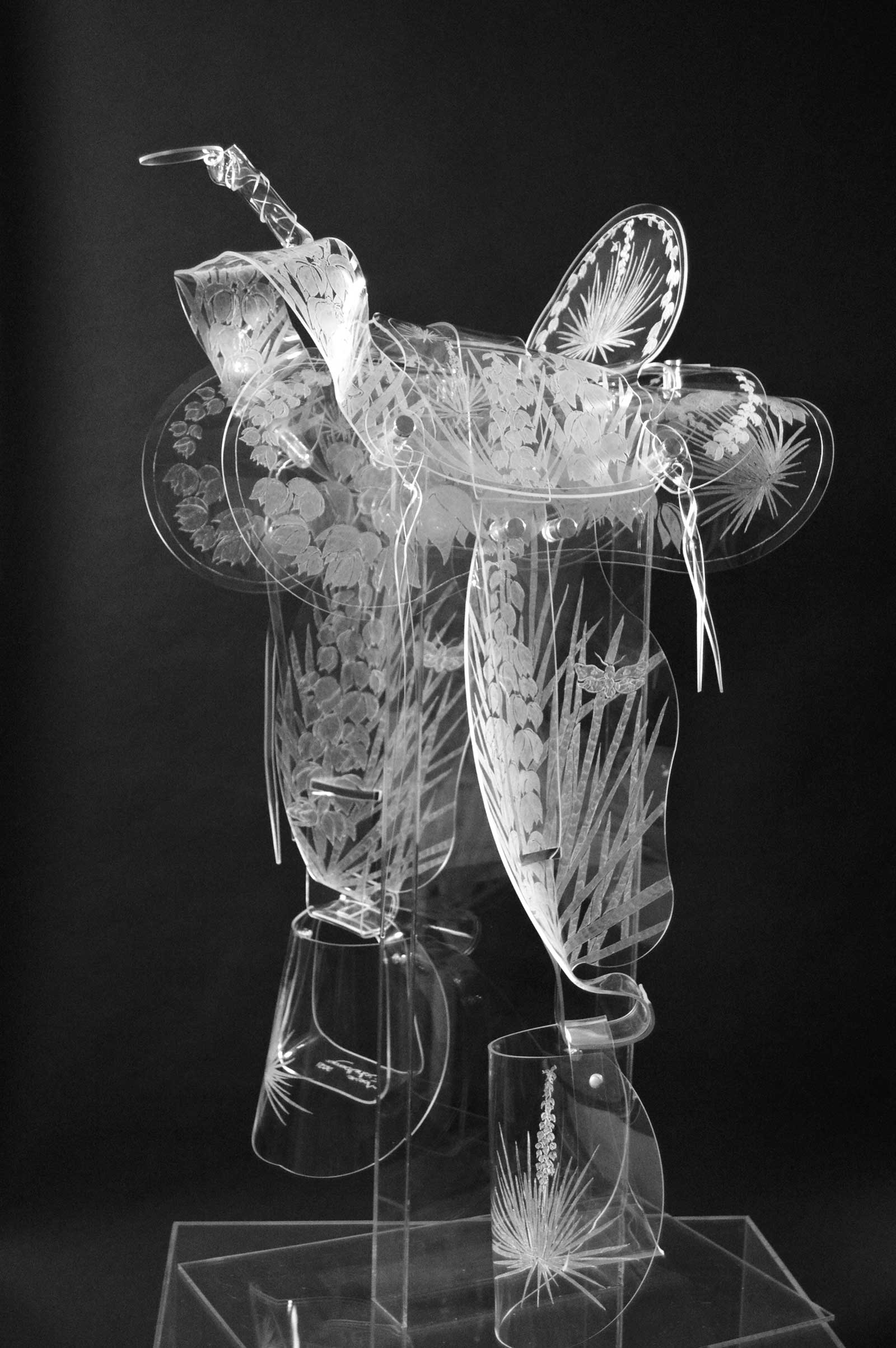 Yucca and The Moth, hand-etched and hand-formed acrylic, 42 x 26 x 16”
Fast forward to 2022 and you’d find Hopkins curating an exhibition at the Steamboat Art Museum. It traced the evolution of contemporary Western art from Allan Houser and Fritz Scholder at the Institute of American Indian Arts in the 1960s, to artists like Donna Howell-Sickles and Kim Wiggins. The show, aptly named The New West, placed Eichelberger and fellow Colorado artist Duke Beardsley in the next vanguard.
“I think the people who are at least somewhat open-minded feel the same way I do, which is that it’s cool, there’s something new and different under the sun, that people are innovating within Western art and it’s not the same old, same old,” Hopkins says of Eichelberger’s genre-pushing work.
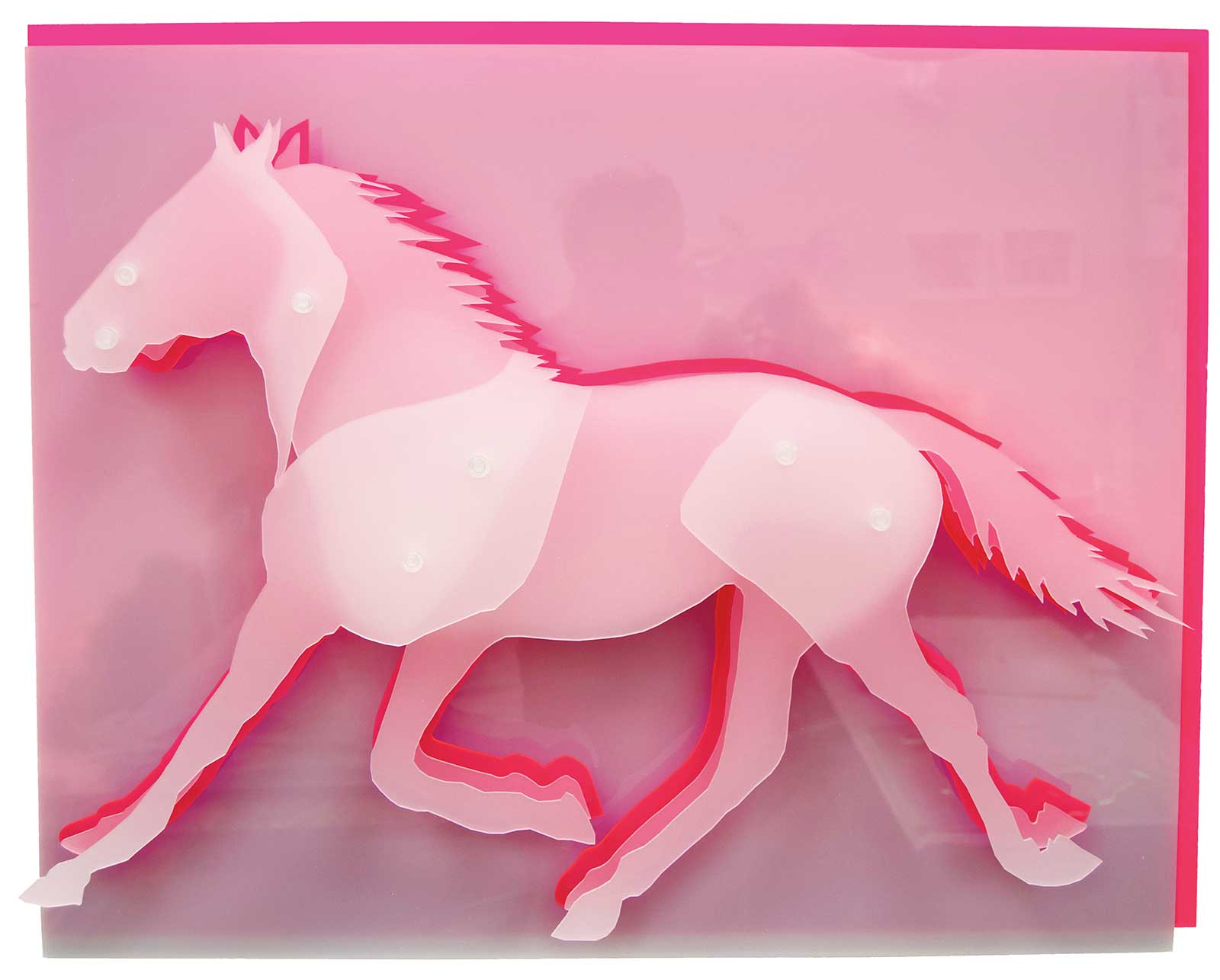
Electric Pony II, frosted and fluorescent acrylic, 24 x 30 x 6”
Perhaps best known today for her luminous plexiglass saddles, Eichelberger considers herself a three-dimensional collage artist more than a sculptor. From horses, to wildflowers, to abstracted aerial landscapes, many of her works begin with her photography printed onto plexiglass, which is then layered in unexpected ways. Sometimes they’re reminiscent of theater sets or dioramas—a series of flats on separate, parallel planes. Freestanding works like the saddles are more akin to Larry Bell than Frederic Remington, more about light passing through the material than landing on the form itself.
Discovering how to heat and shape flat sheets of acrylic into anatomically correct, often life-size saddles took some research and development, the artist tells us. Armed with heat guns, drills, rasps, razor cutters and a serious amount of finesse, Eichelberger gradually breathes life into static components. Sometimes they bend to her will. Sometimes they break.
“I think if I were to throw a word out for Maeve it would be fearless,” says art advisor and former Coors curator Rose Fredrick, who praises not only her technical tenacity but conceptual prowess as well. “I love artists who are using new materials, unusual materials, who have a really unique thing to say,” Fredrick continues. “And that’s just Maeve in a nutshell. I mean she’s coming out of the gate with plexiglass as a medium, and when I was curating the Coors show, the thing that I really looked for was people who could show us our world in a completely different way.”
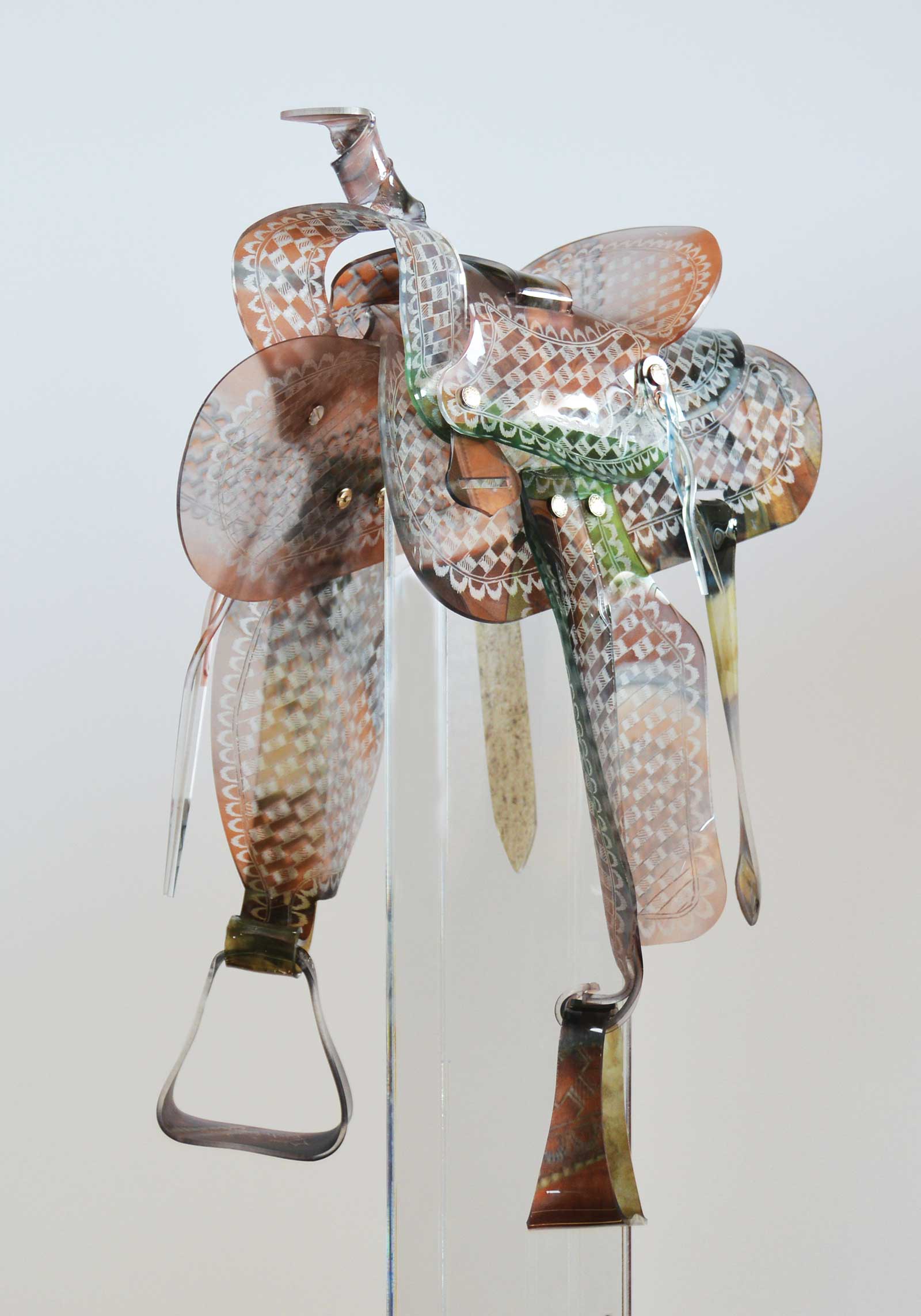 Tallgrass, UV inks on plexi and etched, 20 x 12 x 9”
Eichelberger’s world consists of a live-work loft in a rapidly changing Denver, a childhood with horses and ranchland outside of the city, and family in Taos, New Mexico, where she does much of her social media posting (because it’s more interesting than her day-to-day grind in the city). She picked up an MFA in Miami, teaches part-time at Regis University and has galleries in Jackson, Wyoming; Vail, Colorado; Tucson, Arizona; and the world wide web.
“She really sees the West,” says Medicine Man Gallery owner Mark Sublette. “She sees her art in a different way than other people. And she’s working in a medium, this acrylic, that no one else is doing.” Sublette first invited Eichelberger to take part in a rodeo-themed show, and as he got to know her background, he appreciated her “authentic sensibility to what she was doing and why,” he tells us. “I pretty much fell in love with her work right off the bat. And in fact, I have one of her saddles in my house,” says Sublette, noting how people are “blown away” when they see her pieces in person.
Eichelberger’s work was especially popular among the Coors Young Guns, a social group for young professionals who collect art in Denver, Fredrick tells us. “When we started the Young Guns, they specifically said they did not want the stuff their parents collected,” she remembers. “I loved that she sold to our younger audience, who were just coming on. And now that audience has become kind of more established collectors. I’ve always looked at that as part of my job as a curator—to educate the younger audience and to bring them in and to answer questions. And part of that is to validate their thinking [that] what they want is art and what intrigues them is actually art.”
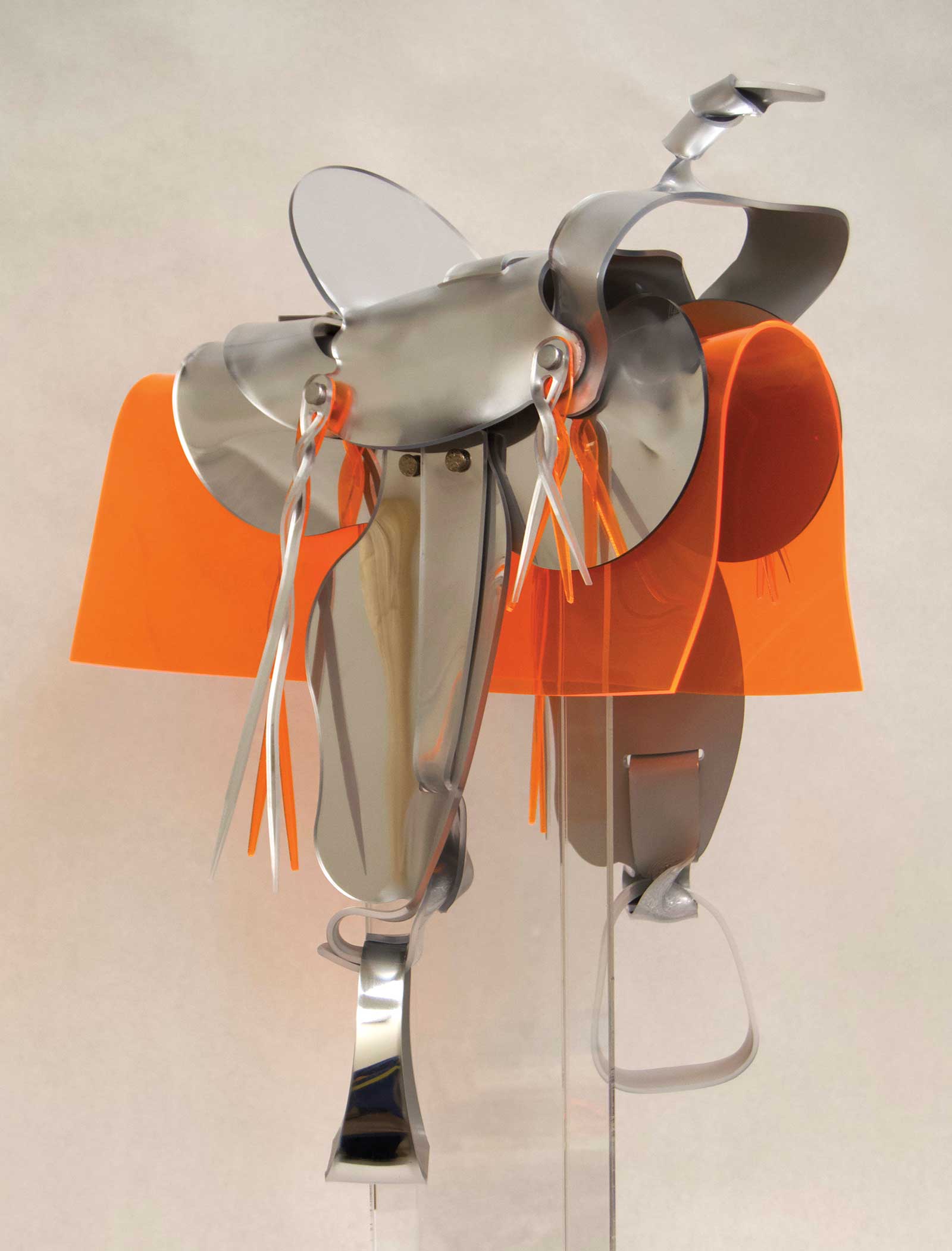 Reflections of a Sunset, hand-formed mirror and neon plexi, 27 x 11 x 15”
This year Eichelberger will join the usual suspects and a handful of fresh faces at the Autry Museum’s Masters of the American West, perhaps a sign the Los Angeles museum is courting new audiences as well. While they have a strong foothold in the traditional Western art genre, Los Angeles is different from other markets, Masters co-chair Jim Rea tells us, citing the contemporary taste of Angelenos. “Maeve is perhaps the most unique artist we’ve ever had in the show,” he says.
A crystal-clear, life-size saddle headed to Masters, The Yucca and the Moth, is Eichelberger at her most elegant. Its hand-etched floral motif gracefully flexes the artist’s drafting skills and interplays between transparency and opacity, a quality also found in Preston Singletary’s Autry-bound glass work.
“They’re so airy and light looking, but so solid at the same time,” Hopkins says of Eichelberger’s saddles. “I particularly like the clear ones though, where you can see through them and they’re transparent and they look almost lighter than the air—very ethereal,” he adds, recounting how one of her saddles looks slung over a second-story railing in a collector’s lodge-style home. “I can’t take my eyes off it when I’m in their house.
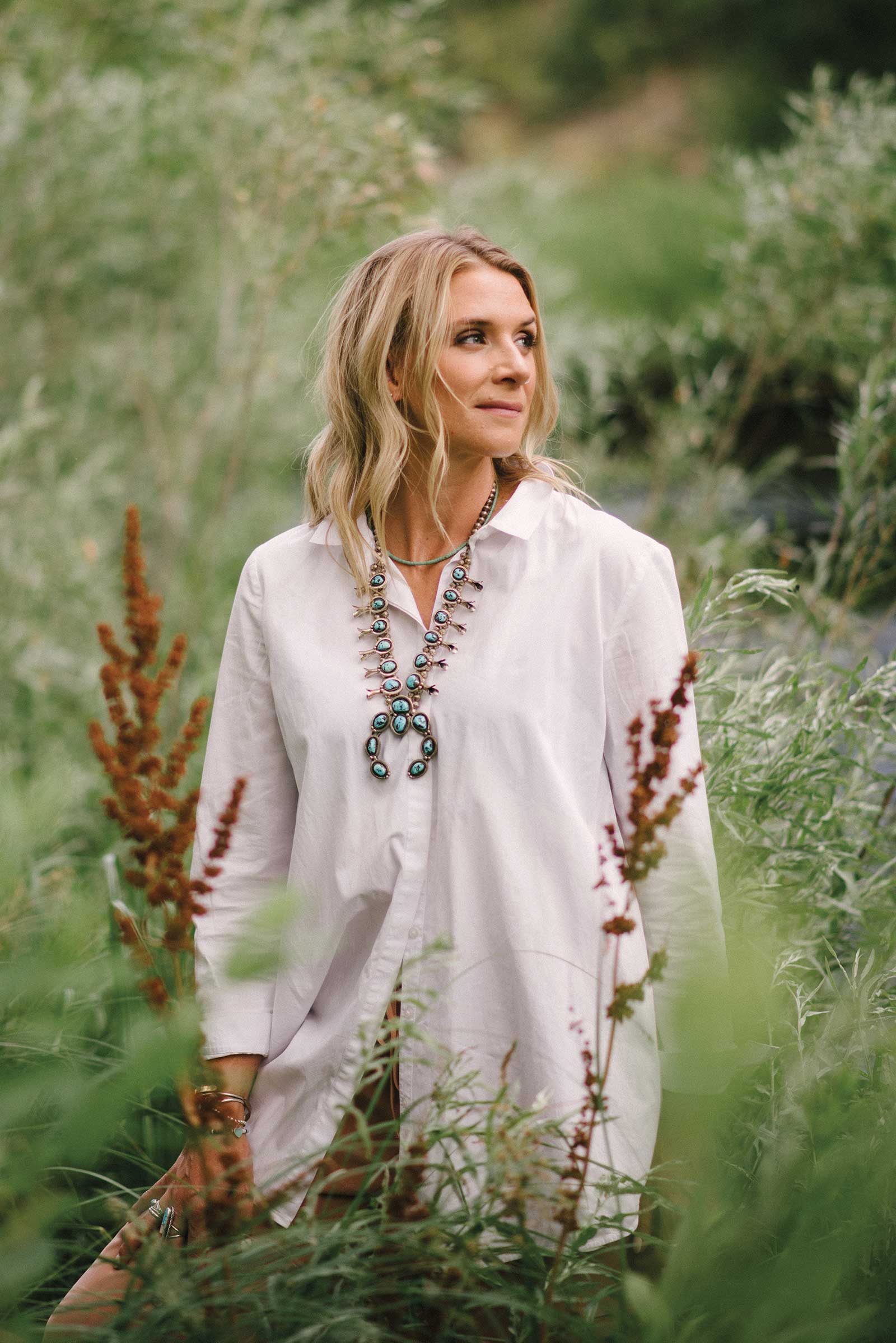
Artist Maeve Eichelberger
Also headed to Los Angeles are California Dreamin’, a mini saddle with photos of palms, planes, poppies and the Golden Gate Bridge; and Electric Pony, a lime green horse in silhouette that echoes of childhood playthings and reminds us why every kid, at one point or another, wanted a pony of their own. Many of us still do.
With pop culture once again smiling upon Western fashion and cowboy iconography, maybe Los Angeles and Eichelberger are a match made in Barbie heaven. Her work is quite literally plastic. And occasionally hot pink. Though the artist chose the medium for its transparency and durability, she tells us, we can’t help but find narrative potential in a material that will, for better or worse, define the Anthropocene era. Acrylic is the medium of fake nails, dancing shoes, hair accessories, and display cases where we put precious objects with the sole purpose of being gazed upon.
If you believe that Hollywood was built by men and cinema reflects their gaze, then bringing innately feminine art (made with the macho power of industrial chemistry) to a museum named after a movie cowboy (in a city that’s synonymous with plastic) might summon the spirit of the true cowboy by rendering his most essential tool a giant toy. Or maybe Eichelberger’s saddles simply look cool.
If the Autry doesn’t snap one up for its own collection, her saddles will be just as happy riding off down Sunset Boulevard to an airy loft with floor-to-ceiling fenestrations, Roche Bobois sofas and panoramic views of the city that made cowboy culture a commodity in the first place.
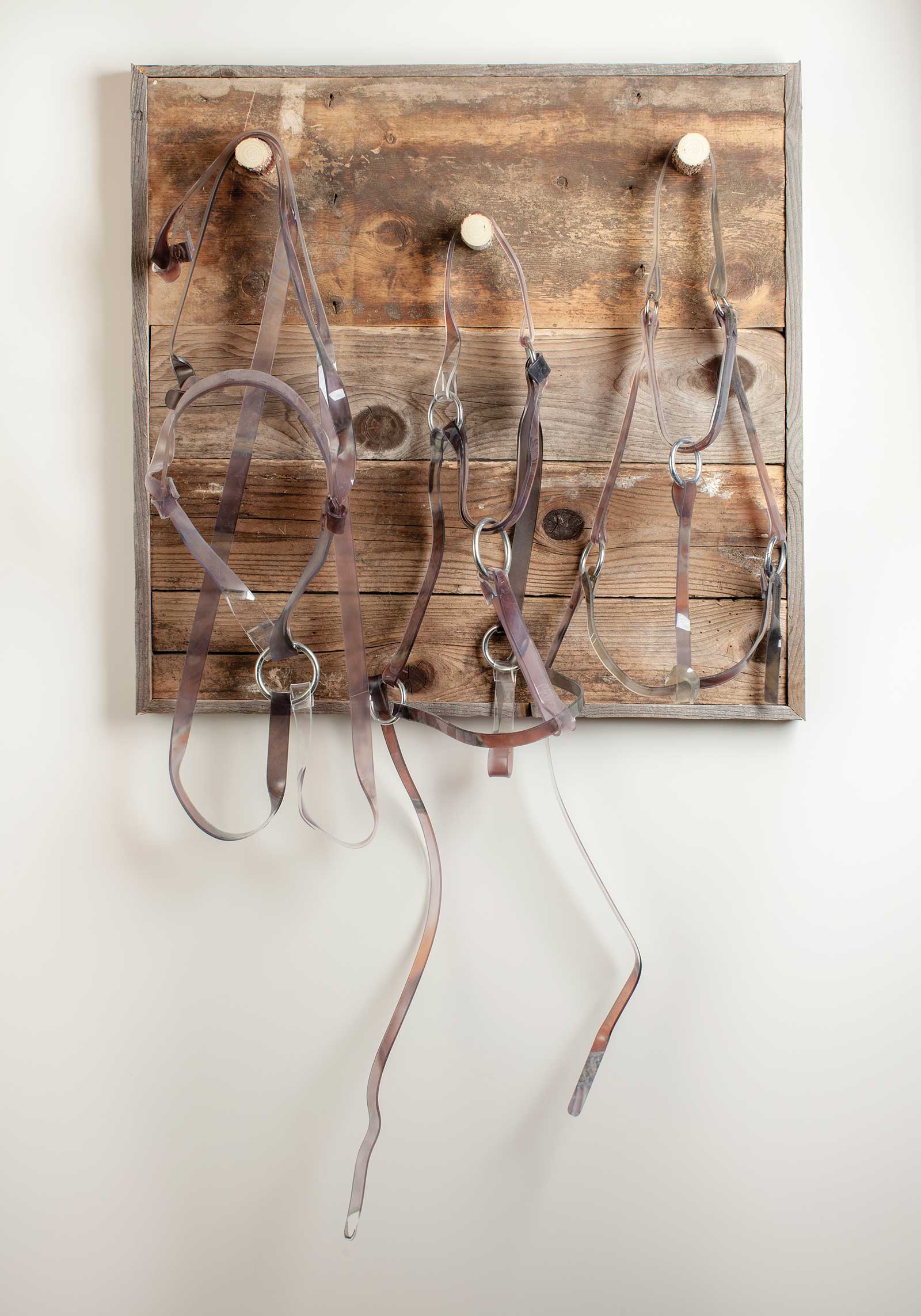
Tack Room Wall, UV inks on hand-formed plexi, 44 x 26 x 8
“You know she’s not just trying to create wall decoration. She’s really thoughtfully having conversations about her slice of this world, and what can she put in front of people to get them to stop and say, I hadn’t thought of it that way,” Fredrick continues, noting the artist’s latest work around water and the West.
In line with those newer themes of ecology and land use, Eichelberger is exploring native plants of the West. She’ll be an artist in residence at the Denver Botanic Gardens this year, which also offers access to the archives and the ability to partner with botanists and researchers. It’s an experience she hopes will rekindle her first love, drawing, and enable a body of botanical work that informs future etchings like the Yucca and The Moth saddle or anything else she decides to make her mark on.
Public art and installation are also on Eichelberger’s radar as she explores avenues for making larger-scale work, possibly inspired by rivers and her new hobby, fly fishing. She’s “testing the waters,” so to speak, with work Fredrick is showing at The ArtSol, a new artist dinner and pop-up exhibition series in Denver.
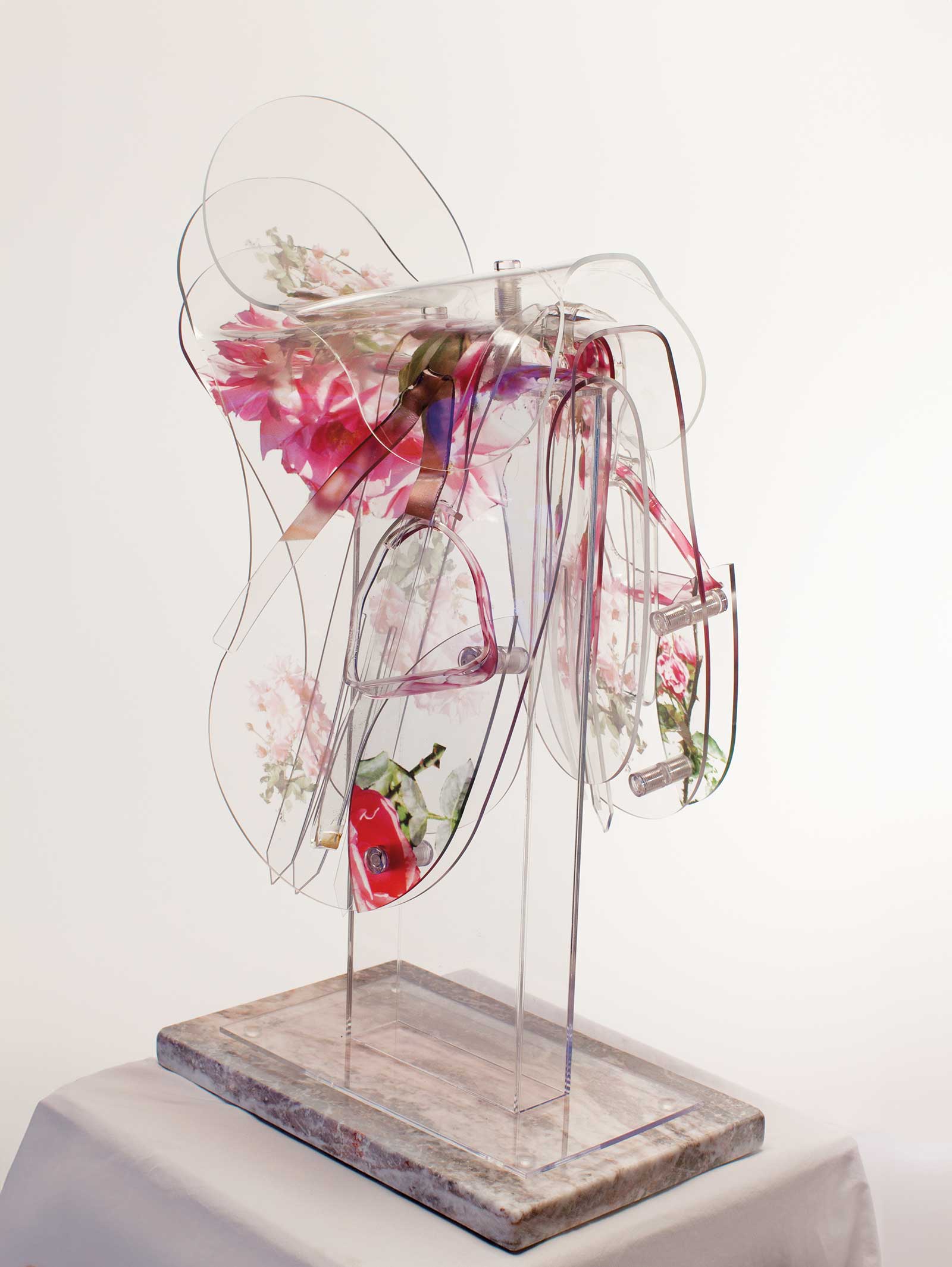
Half Seat, UV inks on hand-formed plexi, 18 x 10 x 11”
“It’s just wonderful to have her making waves out there. You have to have people like Maeve pushing boundaries because it’s a little scary to be an artist,” says Fredrick. “I don’t think she’s oblivious to the fear of being an artist today, but I think she doesn’t let it dictate what her art is and what it’s going to be, which I think is such a beautiful thing.”
When we chatted, Sublette also had wave-making on the mind. “People often miss the wave as it’s coming. And the wave is coming,” he forecasts. The dealer’s hot tip for collectors interested in Eichelberger: “If you’re going to buy, don’t wait.”
You can find Maeve Eichelberger’s work at Medicine Man Gallery in Tucson, A Rare Gallery in Jackson, Vail International Gallery in Vail, and The ArtSol online. Work will be available by draw in person and by proxy on February 24 at the Masters of the American West. The show will be on view through March 24. —
See More: www.maeveeichelberger.com
Mark Sublette Medicine Man Gallery www.medicinemangallery.com
A Rare Gallery www.raregalleryjacksonhole.com
Vail International Gallery www.vailgallery.com
The ArtSol www.theartsol.com
Masters of the American West masters.theautry.org
Powered by Froala Editor