Every school of art needs its Monet or, to keep things American, its Martin Johnson Heade. By this I mean the artist who sees and seeks to convey the essential geometry of the art of their time. Art always knows the scaffolding and the armature: artists like Monet, Heade and R. Tom Gilleon paint the scaffolding and armature. Monet’s haystacks might as easily be his water lilies—or the figures that people his sun-dappled impressionism. Heade’s Hudson River School haystacks might as easily be mountains.
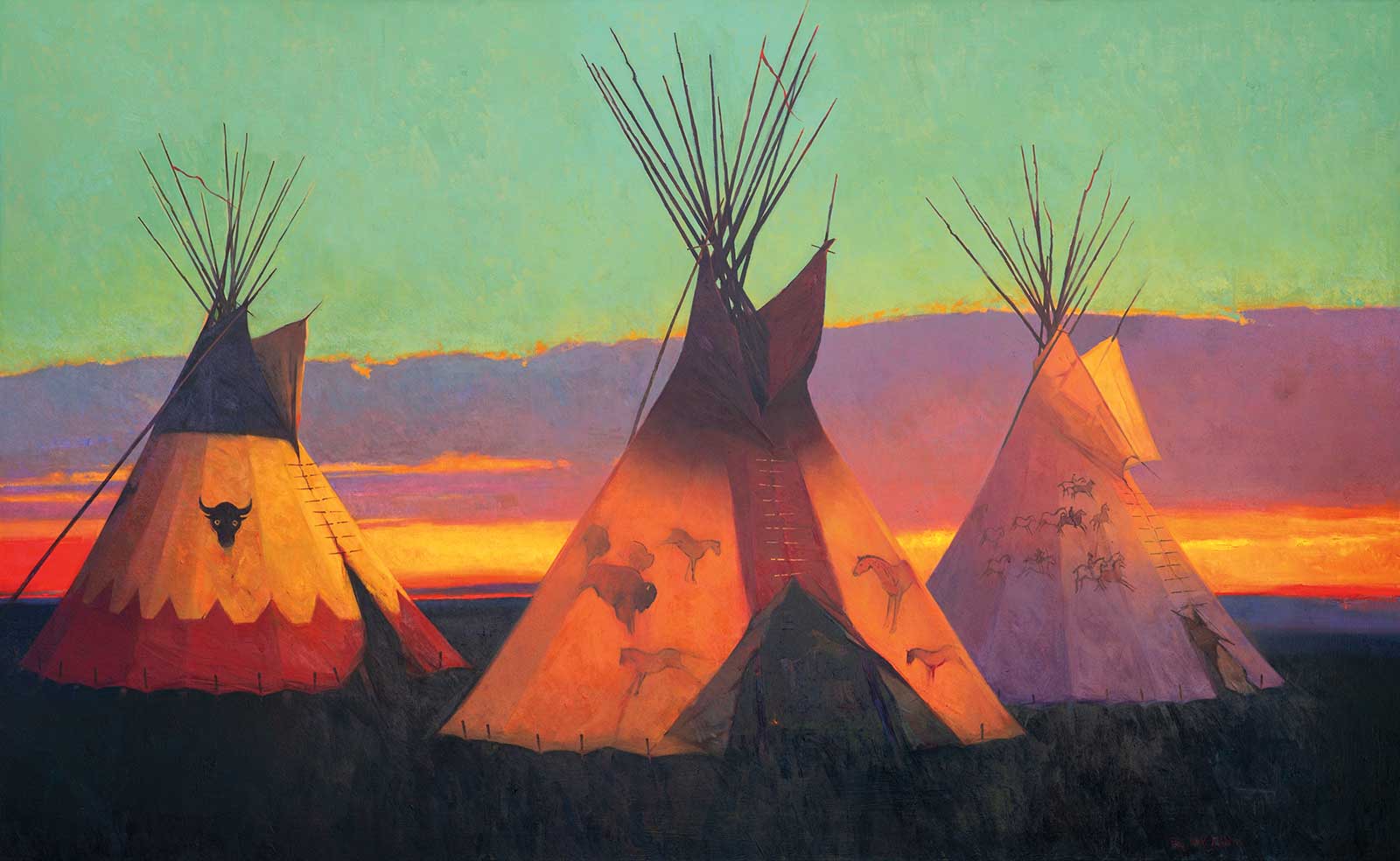
Tres Buhos, 2014, oil on canvas, 52 x 84”
For yet another point of comparison—perhaps a clearer one—consider Giorgio Morandi’s still life paintings of white ceramics. Just as Monet and Heade tapped into the wellspring of their times and emerged with the shape of the haystack, and just as Morandi tapped into modernism and emerged with the tray of porcelain shapes, so Tom Gilleon tapped into his life and his experience of the American West and emerged with the triangle—the strongest shape in nature—a shape that repeats itself in the West in the highest mountain peaks, in the mounds and pyramids of Indigenous Americans, in the crowns of conifers, in tipis on the plains—singly and arrayed in camps—and in the portraits of Native Americans that protrude in triangular power from the bases of canvases.
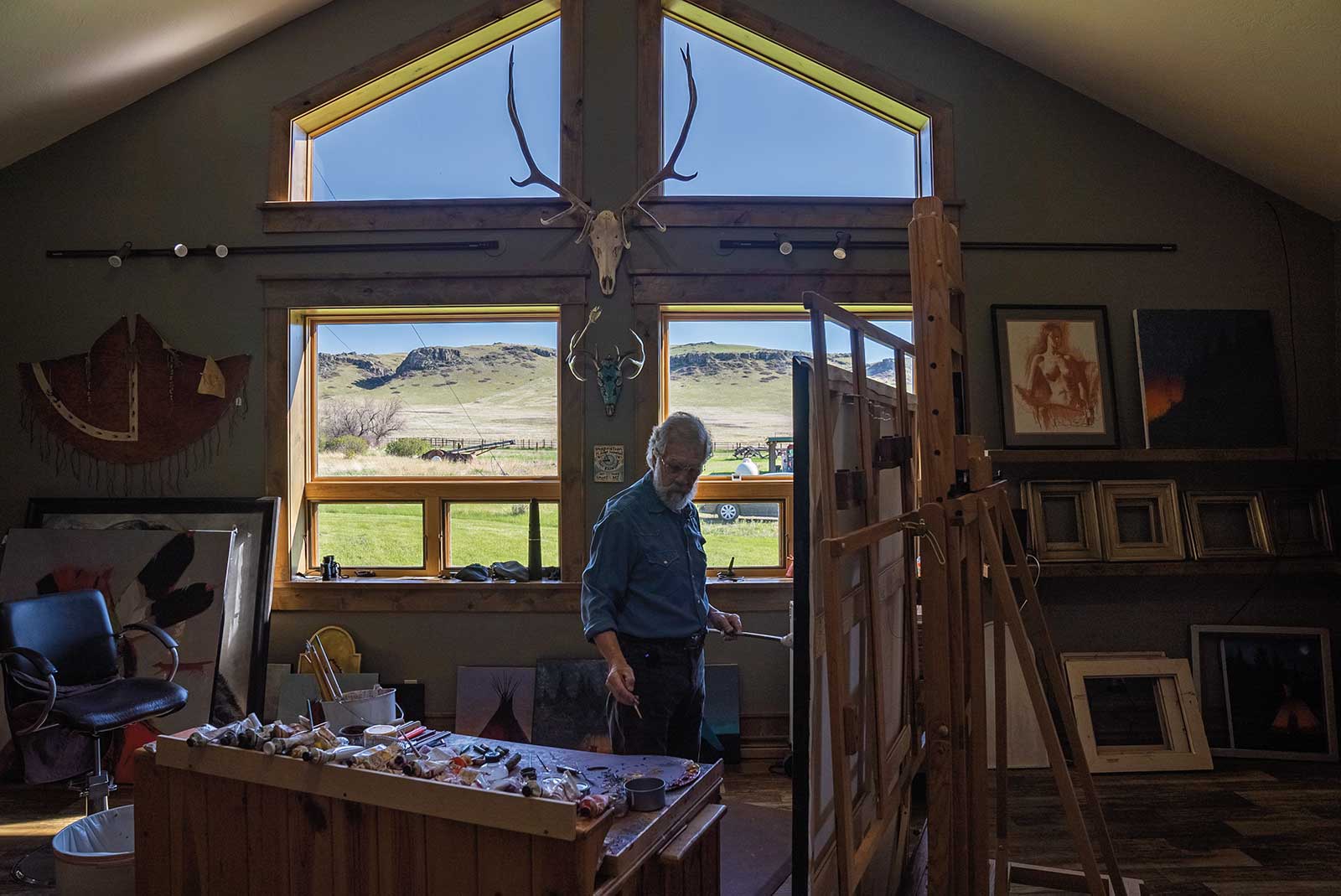
R. Tom Gilleon at work in his studio. Courtesy KingArts.
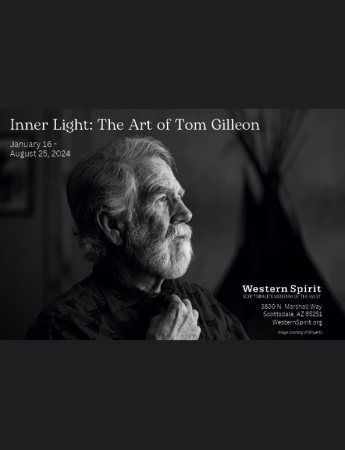
If understanding were simply a matter of repetition, we’d have a couple of haystacks each from Monet and Heade, a handful of personified still lifes from Morandi—and a few Gilleon tipis. Fortunately, as Inner Light: The Art of Tom Gilleon, the major new retrospective exhibition at Western Spirit: Scottsdale’s Museum of the West demonstrates, the artist’s trenchant observation, which leads to repetition, quickly contends with variation. The shape that captured the artist’s attention begins, as it were, to shift shape, and the artist sets about depicting how the shape fills space, how space contains the shape, and, crucially, how light falls on and shines through the shape, imparting ever-changing color and the illusion of ephemerality or solidity.
Co-curated by Western Spirit trustee Tim Peterson and Richard King of KingArts, in conjunction with Western Spirit’s assistant museum director and chief curator, Tricia Loscher, the exhibition features 70 paintings, including 12 works on loan from Walt Disney Imagineering, where Gilleon once worked and honed his craft. The exhibition will also mark the premier of Spirit Catcher, Gilleon’s 22-minute digital painting triptych created with Magic Media Labs concept designer and former Walt Disney Imagineer, Marshall Monroe.
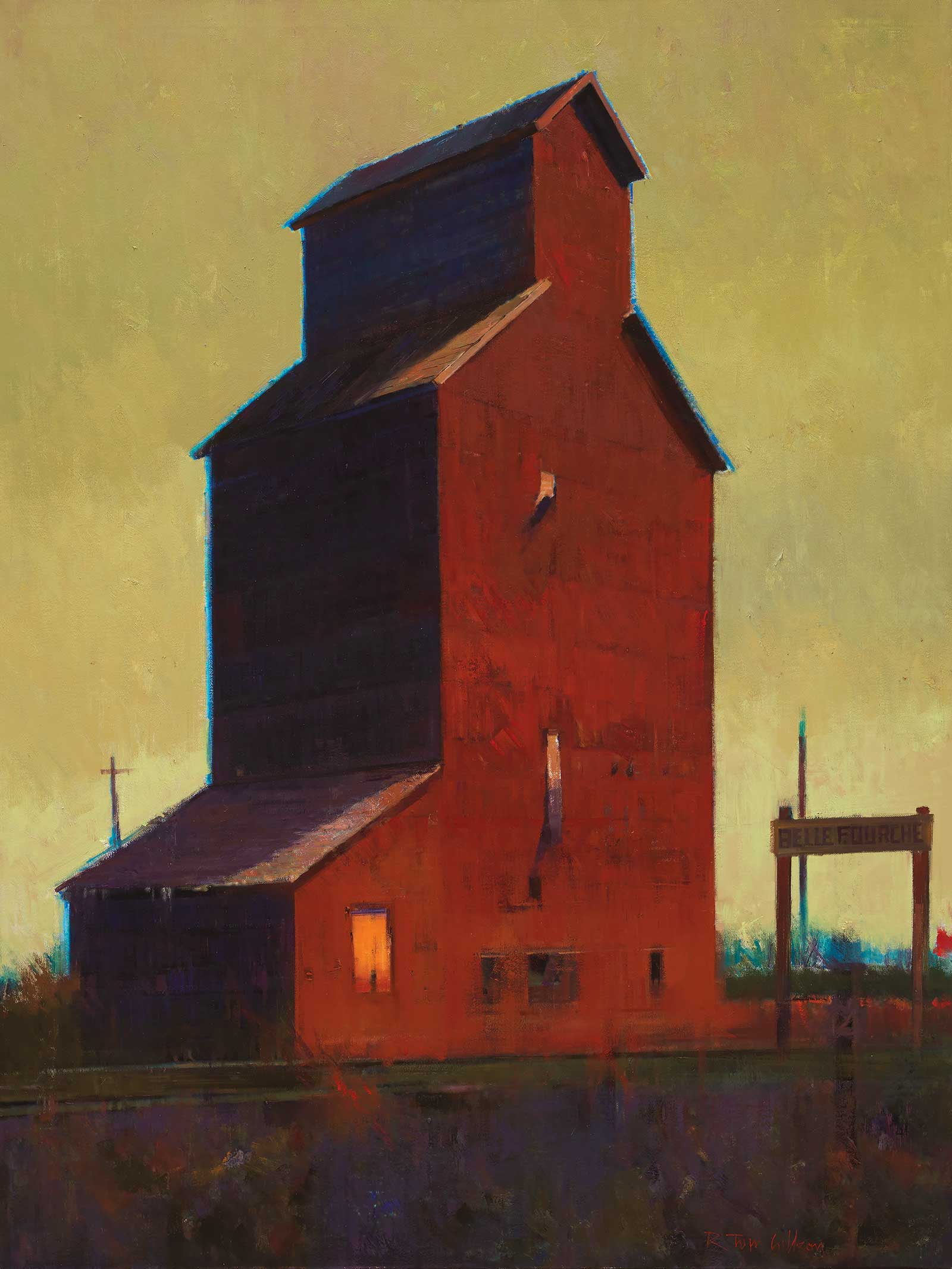
Muckle Flugga to Belle Fourche, 2010, oil on canvas, 48 x 36”
Born in Florida in 1942, Gilleon learned to draw by the light of a kerosene lamp while listening to his grandparents’ stories when his parents sent him to live with them. His grandmother, a full-blood Cherokee, insisted that he learn the ways of the wilderness and self-sufficiency. After serving in the Navy, Gilleon studied at Florida’s Art Students Guild of Brevard and found work at Pan Am, where he would interpret NASA’s Saturn and Apollo programs for the public. Later, in 1974, Walt Disney World hired Gilleon to conceptualize designs for what would become the EPCOT Center. Eventually, he joined Walt Disney Imagineering, where his concepts helped propel Disney attractions in Paris, Shanghai, Tokyo and Hong Kong. In the 1980s, Gilleon and his family visited and fell in love with Montana. They built a home there and the inspiration of the landscape and people around them encouraged Gilleon to embark on what has become a remarkable career as a painter and visual artist.
If it seems as though “painter and visual artist” are redundant, Inner Light: The Art of Tom Gilleon also highlights and sheds light on the artist’s digital painting practice. In Spirit Catcher,tipis in a camp in three large frames change over time, through day and night. Light and clouds morph and superimpose, one atop another. Eventually, portraits of Native figures appear and fill the three frames. Gilleon breaks boundaries between painting and film here as well as the boundary between painting and painting, as the triptych often merges into a single image before separating again into two or three individual images. Fluidity is the idea here, the flow between people, the land that makes us, and the things we make from the land that makes us.
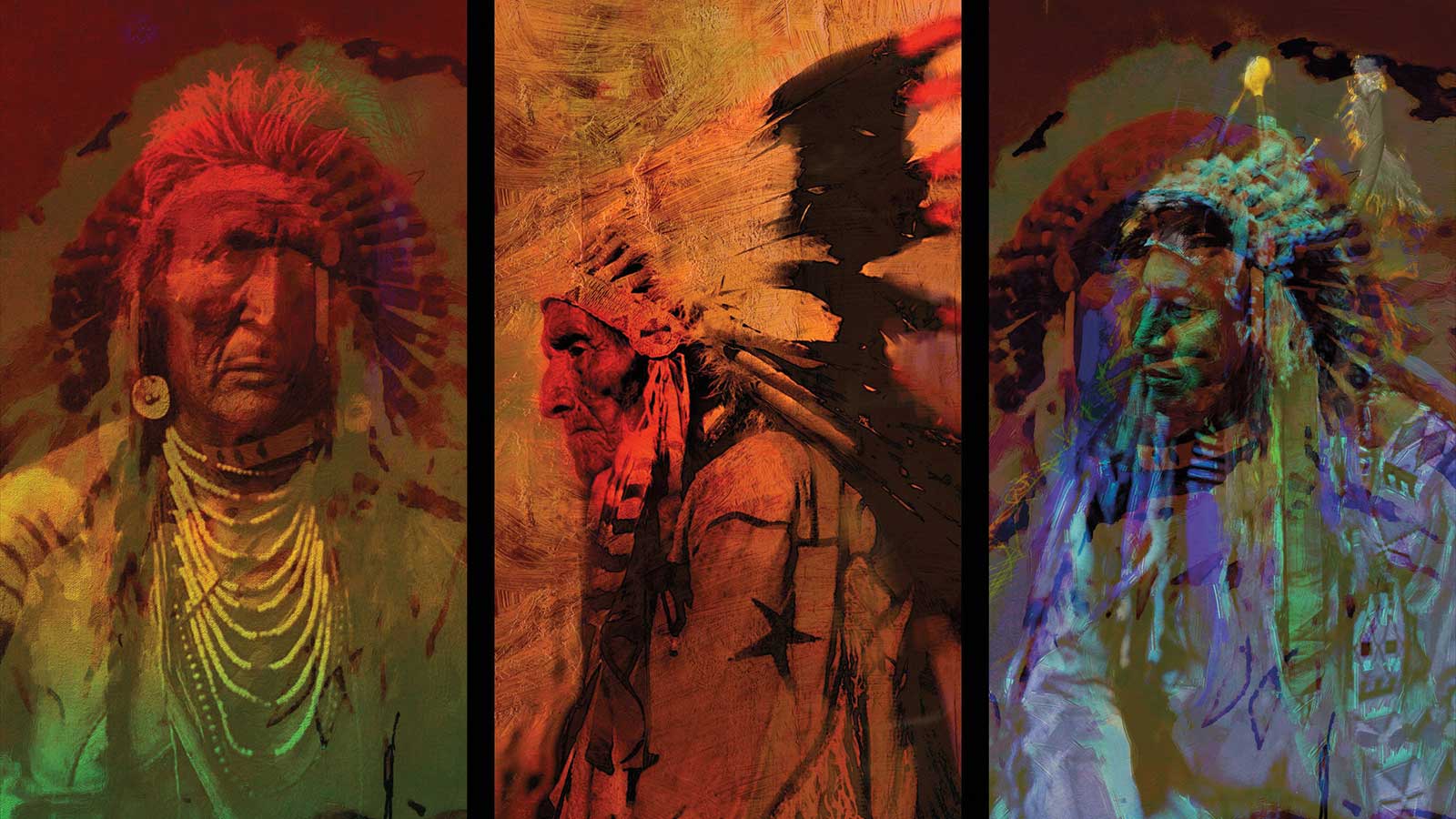
Spirit Catcher (triptych), 2022, digital painting, 66 x 38”
In Richard King’s article, “The Art of Tom Gilleon,” the artist describes his passion for the essential geometry of the West, stating, “Philosophically, I feel the square denotes fairness and justice. The triangle introduces mystery and intrigue or romance. The flat horizon in many of my paintings is intended to give a feel of stability.” Gilleon goes on to say, “The tipi paintings connect to our primal understanding of simple shapes. We all relate to the circle, triangle and square. Using basic shapes might seem a simple formula, but ‘simple’ does not equate with ‘easy’ in the visual arts.”
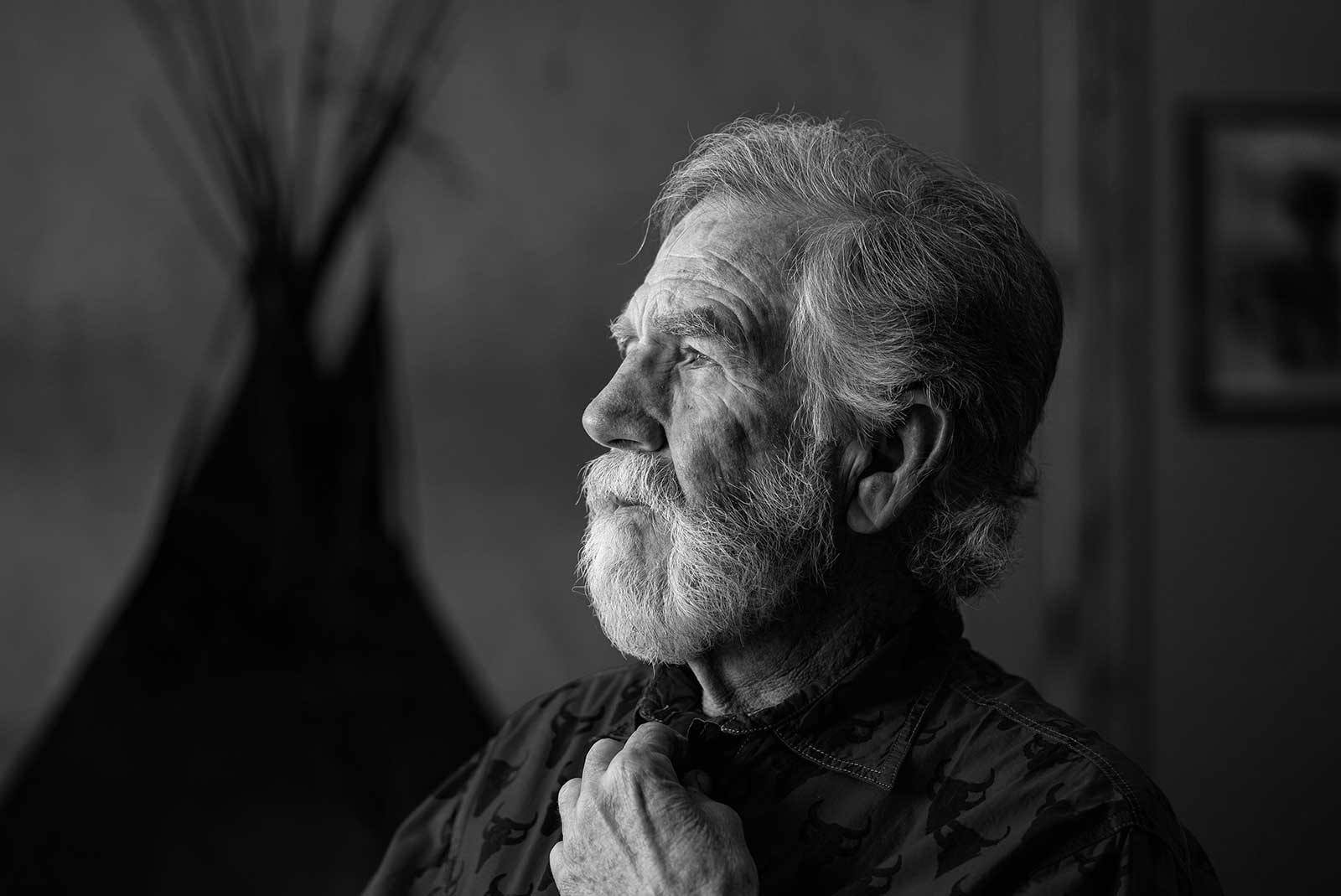
R. Tom Gilleon in his Montana studio. Courtesy KingArts.
Comparisons between Gilleon and Mark Rothko, especially in their approaches to light, seem apt; however, Rothko’s interest in the “band,” as in “band of light,” is wholly natural, as opposed to Gilleon’s flat horizons, squares and triangles, which straddle the natural and the human-made. Taos artist Victor Higgins observed, “The difference between the modernistic and the romantic form of art, as I see it, is the architectural basis.” Rothko, for all his minimalism, is more romantic than modern. The architecture—the architectonics, if you will—in Gilleon’s work is more modern than romantic despite keeping a foot in realism and conveying aspects of the story of the American West—a story, as everyone knows, that is replete with romance.
Gilleon’s digital art, perhaps an offshoot of his time among Disney’s technological wizardry, is his solution to time, which is always the question and the quest, the problem of architectonics, as Higgins might have put it, that his art seeks to solve.
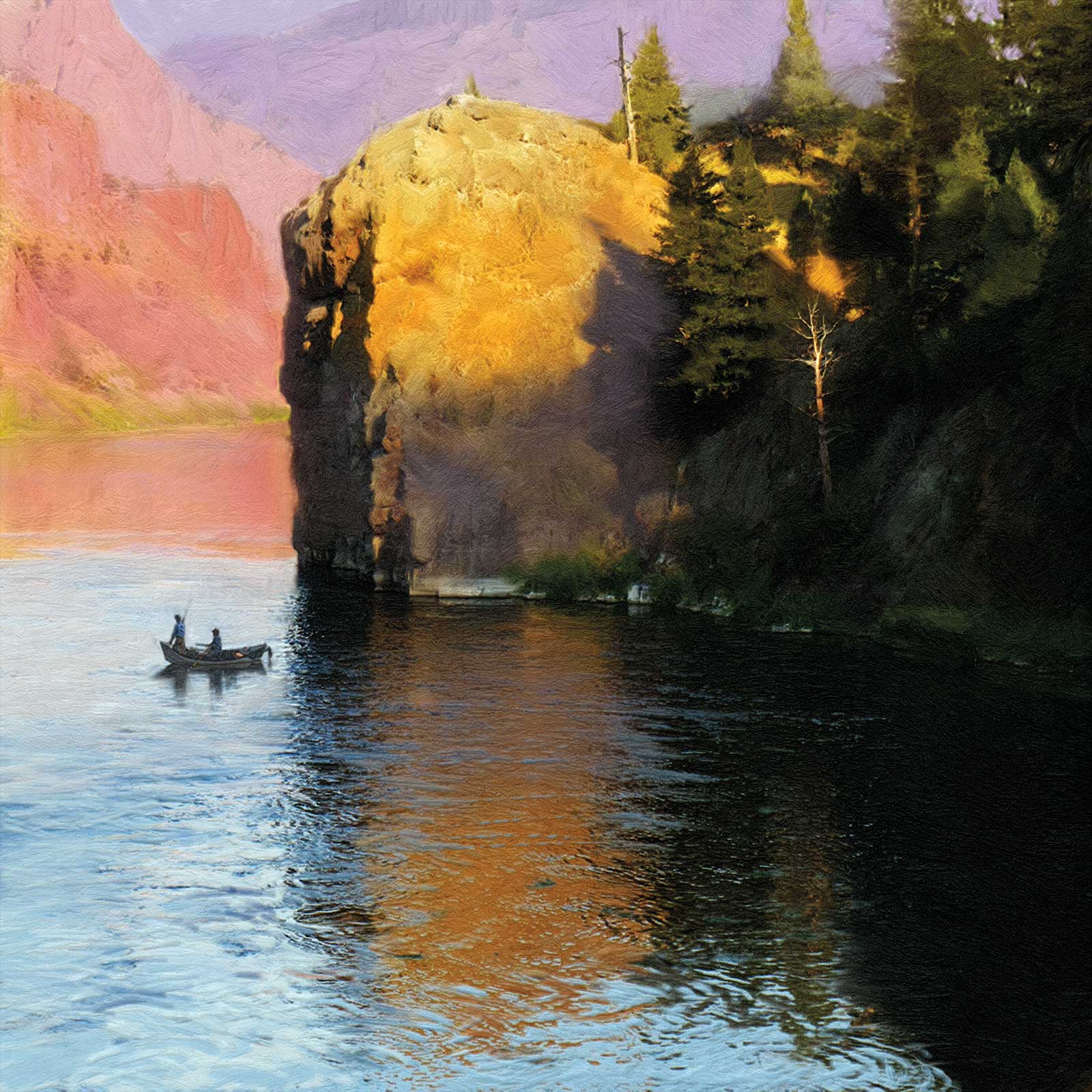
Over the Rainbows, 2013, oil on canvas, 50 x 50”
Consider two tipi paintings, a work depicting a single tipi, Indian Sunset, and another depicting three tipis, Tres Buhos. In each, while the evening sky is painted in Rothko bands of light, the bands of color, light, patterns, and animals on the tipi hides themselves rival and, in many ways, surpass the sky itself. On the skin of the tipi in Indian Sunset, night is also falling in the form of the shadow at the top, below the spiky lodge pole armatures on which a universe hangs. A thin band of red shows beneath the dark, like the last light of day. Horses race on a plain, and if you let the sides of the tipi fall away, you can imagine them riding through the dusk-hued air. Beneath them, abstract peaks take on the red of the setting sun and the opening into the tipi seems like a portal to another domain entirely. Many of the same mythical qualities—something you might see in Marc Chagall’s flying horses—obtain in Tres Buhos. Here, however, to extend the mystery, the tipis seem lit from within, like lanterns or beacons on a dark, flat, barren plain. We’re in the realm of petroglyphs from long ago—I just typed the word as “pteroglyphs,” which would mean “winged glyphs,” which isn’t a bad word for the concept—only the rock walls are translucent, invitations to an initiation into a new and ancient world. Huddled together, the Tres Buhos seem almost anthropomorphized, a trio of old people with an inner fire who have little need for words. The parallel with Morandi’s still lifes seems ever less strange and even more likely.
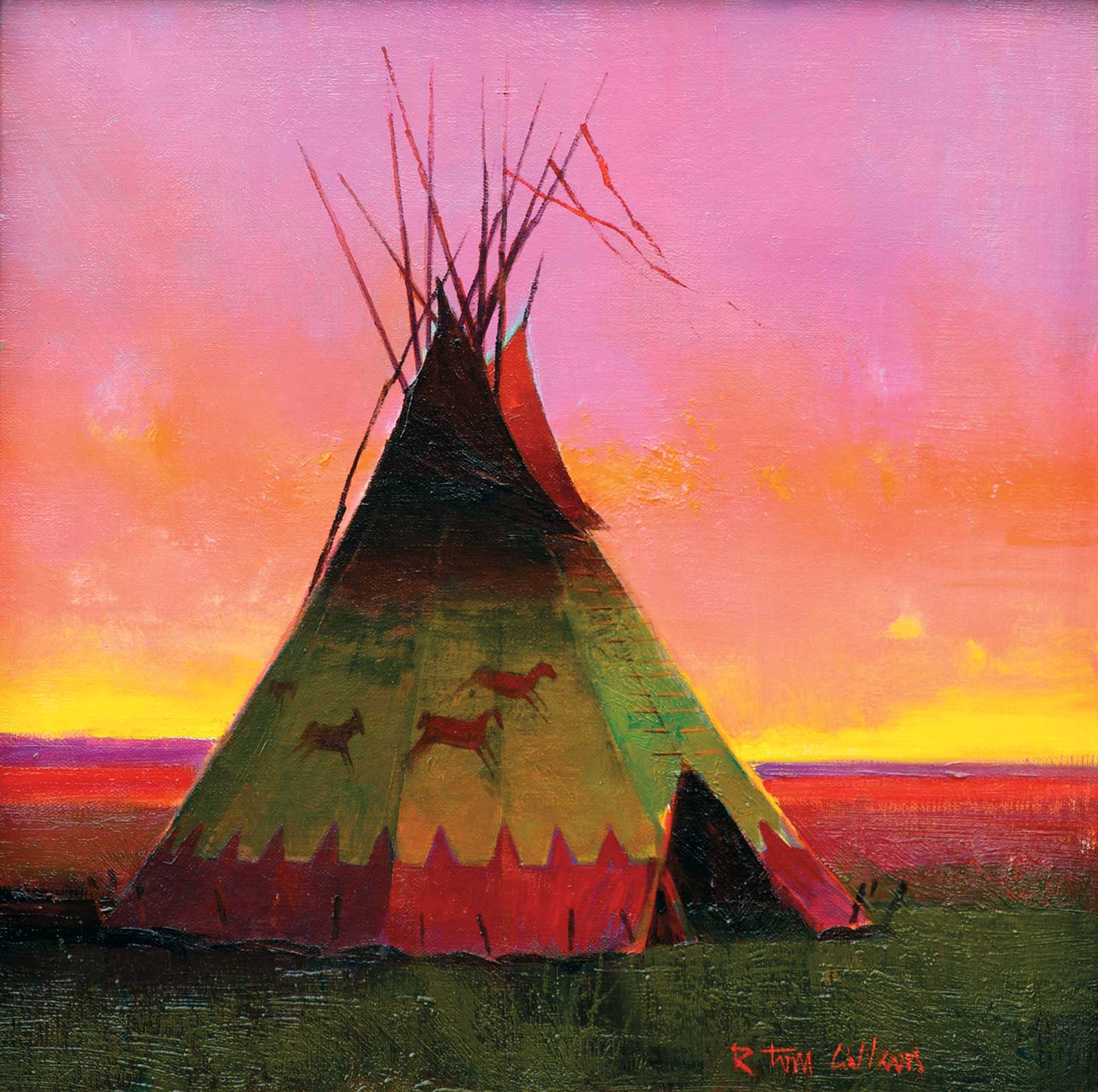
Indian Sunset, 2023, oil on canvas, 12 x 12”
In the figures that enter the frames in Spirit Catcher, or in paintings such as Slow Bull’s Eye, the mystery of the triangle takes human form and the portrait bust, an artistic trope so old and so prevalent in painting and sculpture that we take its form for granted, is brought to vivid new life. Taking Gilleon’s own quote, the mystery of the triangular figure rises from the stability of the horizon and fills the just, fair square frame. The faces face us, look back and out at us, square in the eye, seeing us and demanding that we see them. And yet the colors Gilleon uses to paint them, lurid and faded colors like those in old photographs that have seen too much light or become damp with age, distance us from these people even as their gaze connects us. I imagine them coming into view, into actuality, from vanishing points in the landscape, visions striding down, out of sight in the foreground, only to rise up into their present positions.
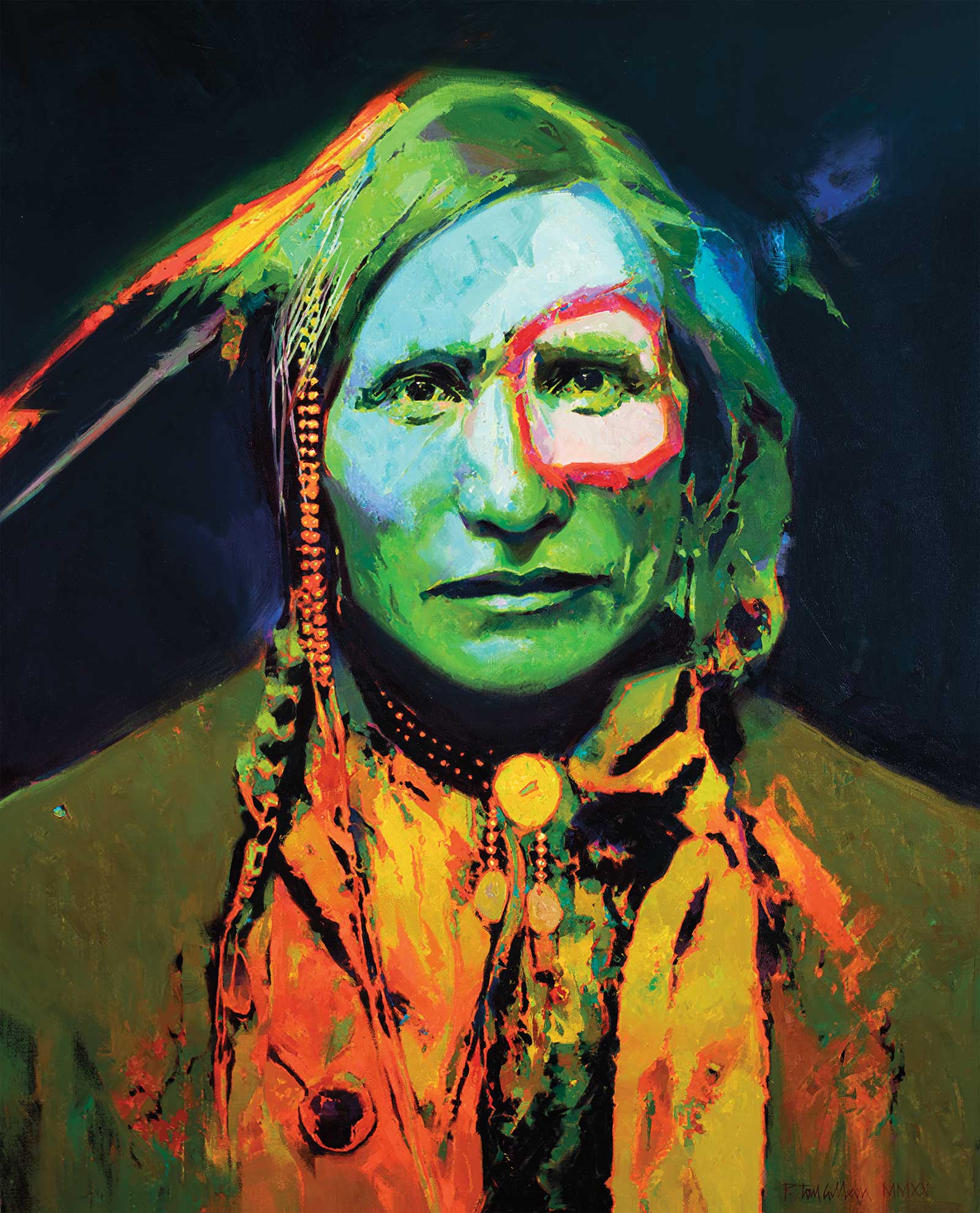
Slow Bull’s Eye, 2020, oil on canvas, 50 x 40”
Looking at a painting like Muckle Flugga to Belle Fourche, a painting having nothing at all to do with tipis, the interest in the triangular form rising from a strong horizon is evident. It is as if light and color have conspired to inflate the tall granary and that the building itself will defy gravity and rise into the sky if we are patient and keep watch.
Even in these, his more traditional paintings, Gilleon seems to be offering solutions to the problem of time—of sequence and duration—seeking to capture and convey the subtleties of change over time through repetition and variation.
Inner Light: The Art of Tom Gilleon might as easily be titled Inner Music: The Art of Tom Gilleon. See it—and hear it—for yourself. —
Inner Light: The Art of Tom Gilleon
January 16, 2024-August 2024
Western Spirit: Scottsdale’s Museum of the West
3830 N. Marshall Way, Scottsdale, AZ 85251
(480) 686-9539, www.scottsdalemuseumwest.org
Powered by Froala Editor