William Haskell grew up in Wisconsin where he developed his love of the Southwest. His family home was in Lac du Flambeau, a large part of which is the land of the Ojibwe. Lac du Flambeau, or Lake of the Torches, was given its name by French trappers who saw the tribe fishing at night by the light of torches.
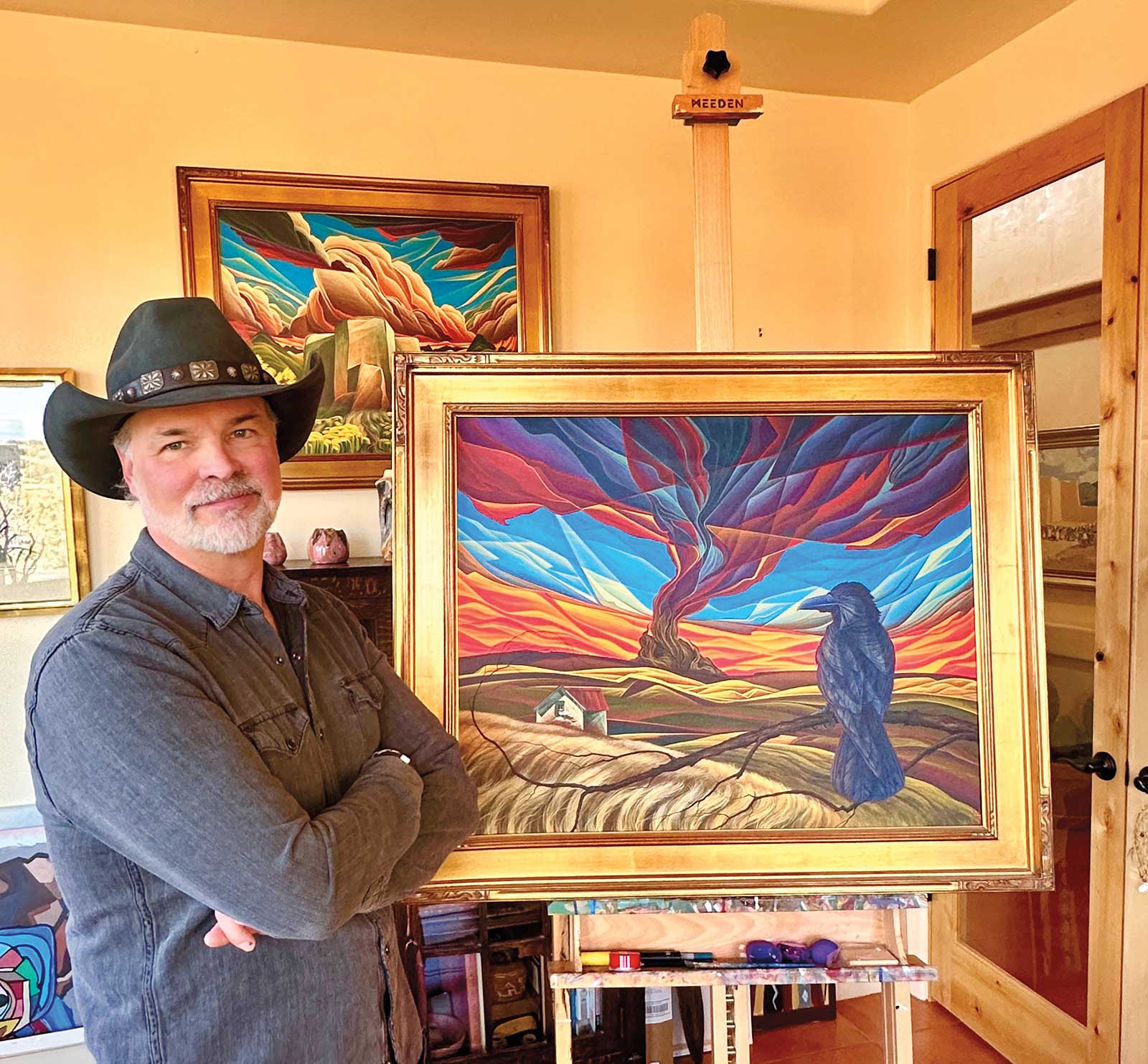 William Haskell in his Santa Fe studio.
His mother “thought anything from Wisconsin is fantastic,” he recalls. Recognizing her son’s interest in art at an early age and his penchant for drawing, she introduced him to the work of Georgia O’Keeffe who had been born in Sun Prairie, Wisconsin, just outside Madison, where he was born. “My mother thought it would be kind of a natural connection and she was right. I looked at O’Keeffe’s paintings of New Mexico and the Southwest and they always stuck with me. Even as a kid I always loved cactus and the shapes of them.”
He had initially thought he wanted to be a wildlife painter and apprenticed with Terrill Knaack, a Wisconsin painter of the flora, fauna and landscapes of the region. “He’s an extraordinary painter, highly realistic,” Haskell says of his former teacher, whose philosophy goes beyond the representation of nature.
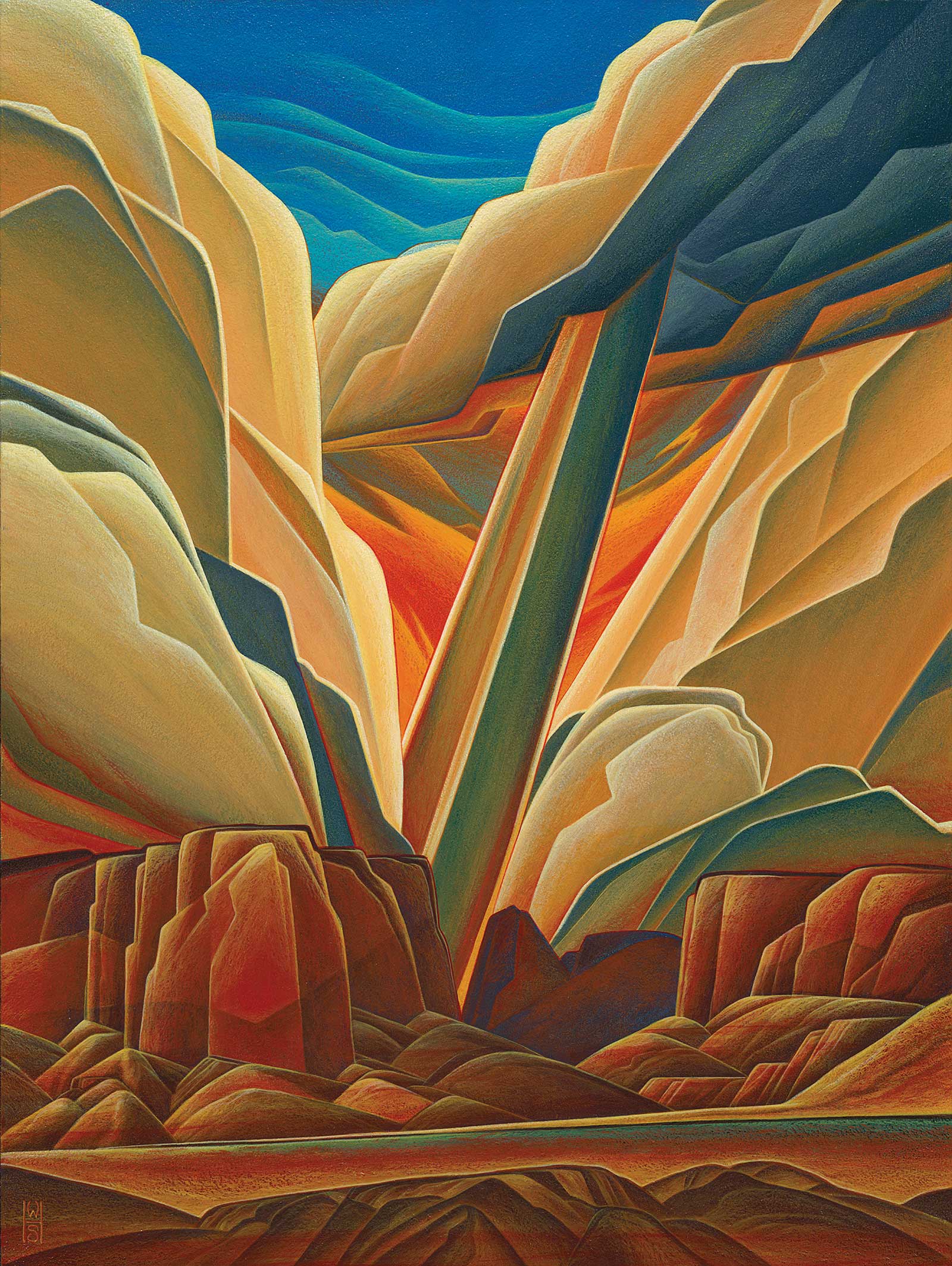
Desert Dynamics, acrylic on panel, 24 x 18”
“Art for me is a process of organizing materials and elements to awaken the senses and emotions in a way that inspires contemplation, healing and wholeness,” Knaack writes. “Much as a poet arranges word symbols and sound to suggest a meaning, forms in space and relationships of color similarly reach beyond that of simply revealing an impression of the subject itself.”
Haskell continues, “My parents always encouraged my creativity, but they didn’t say ‘Oh, you should be an artist as a profession.’ They thought I needed to get a degree in something where I could find a job.”
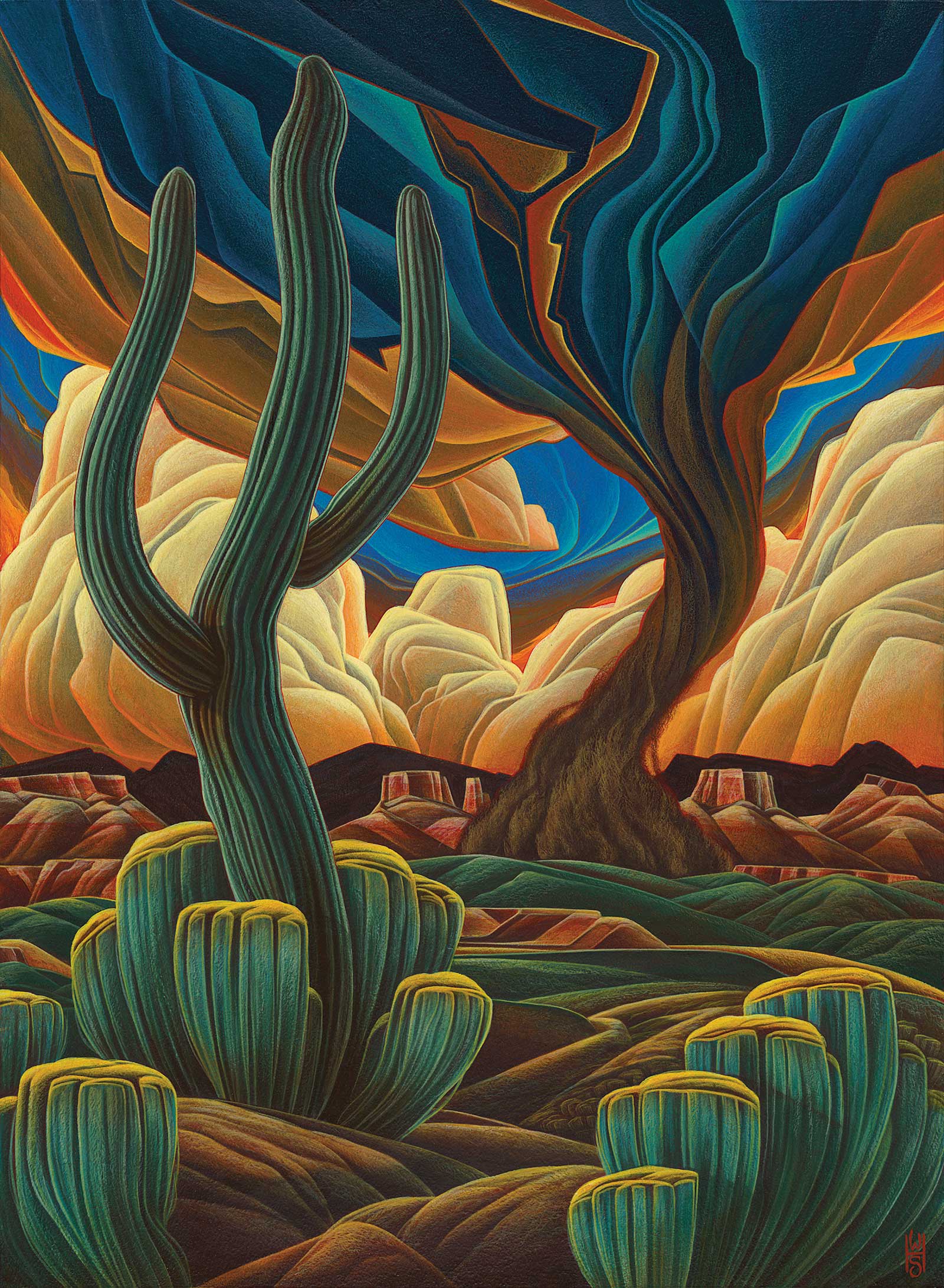
Desert Vortex, acrylic, 30 x 22”
He went on to get a degree in graphic design and began a career in design and advertising. “I had become a sales director for a company and it turned out to be a good fit,” Haskell shares. “It was a good job and lucrative, but not what I wanted to do for the rest of my life. I was painting part time and I was showing in a gallery in Minneapolis. I was making paintings of the Southwest even though I’d never been there. I was just looking at books. My paintings then were more tonalist with a much more limited palette.”
He now lives in Santa Fe, New Mexico, not far where O’Keeffe had her home in Abiquiu. He came here in the early 1990s for the first time and moved here in 2001. “I realized you can actually make a living being an artist out here,” says Haskell. “I was instantly drawn to it. I think it’s the kind of place where you either feel a spiritual connection to it, or you don’t get it. Also, the Native American presence is more of a force here than I experienced in Wisconsin. My mother came here and she thought it looked like Afghanistan...I think part of it frightened her. It’s so big and so wide open.”
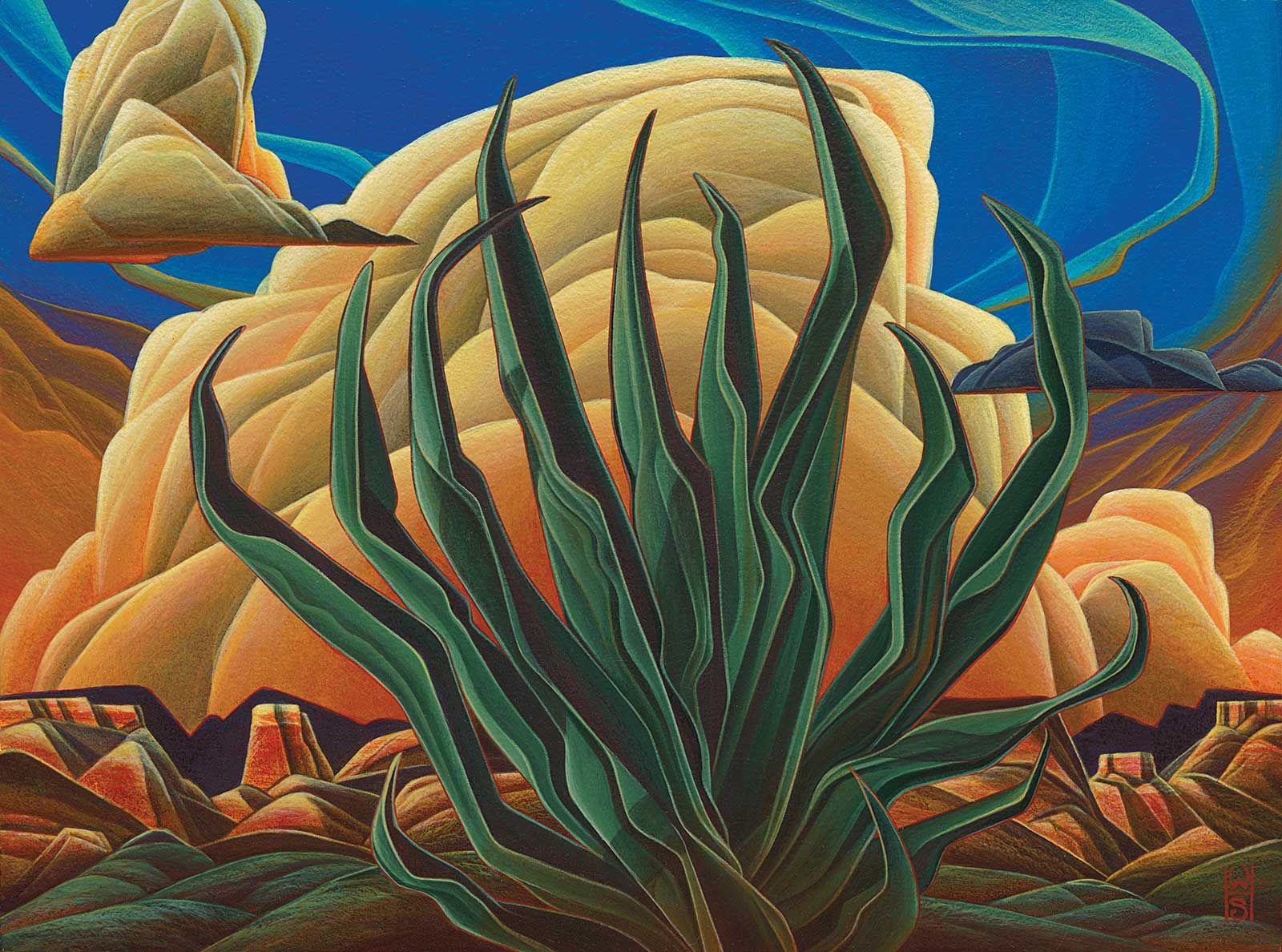
Centurion, acrylic on panel, 12 x 16”
He had been working primarily from photographs, but in 2012 he did a residency at Brush Creek Ranch in Saratoga, Wyoming. There he began working with acrylics, his medium today. “I used to be focused on having a painting look like a particular place,” he says. “At the residency I decided I’m going to approach the landscape differently than I’ve ever approached it before. I always felt very confined by using a photograph. It was always like, does the painting look like the photograph? Did I hit it?”
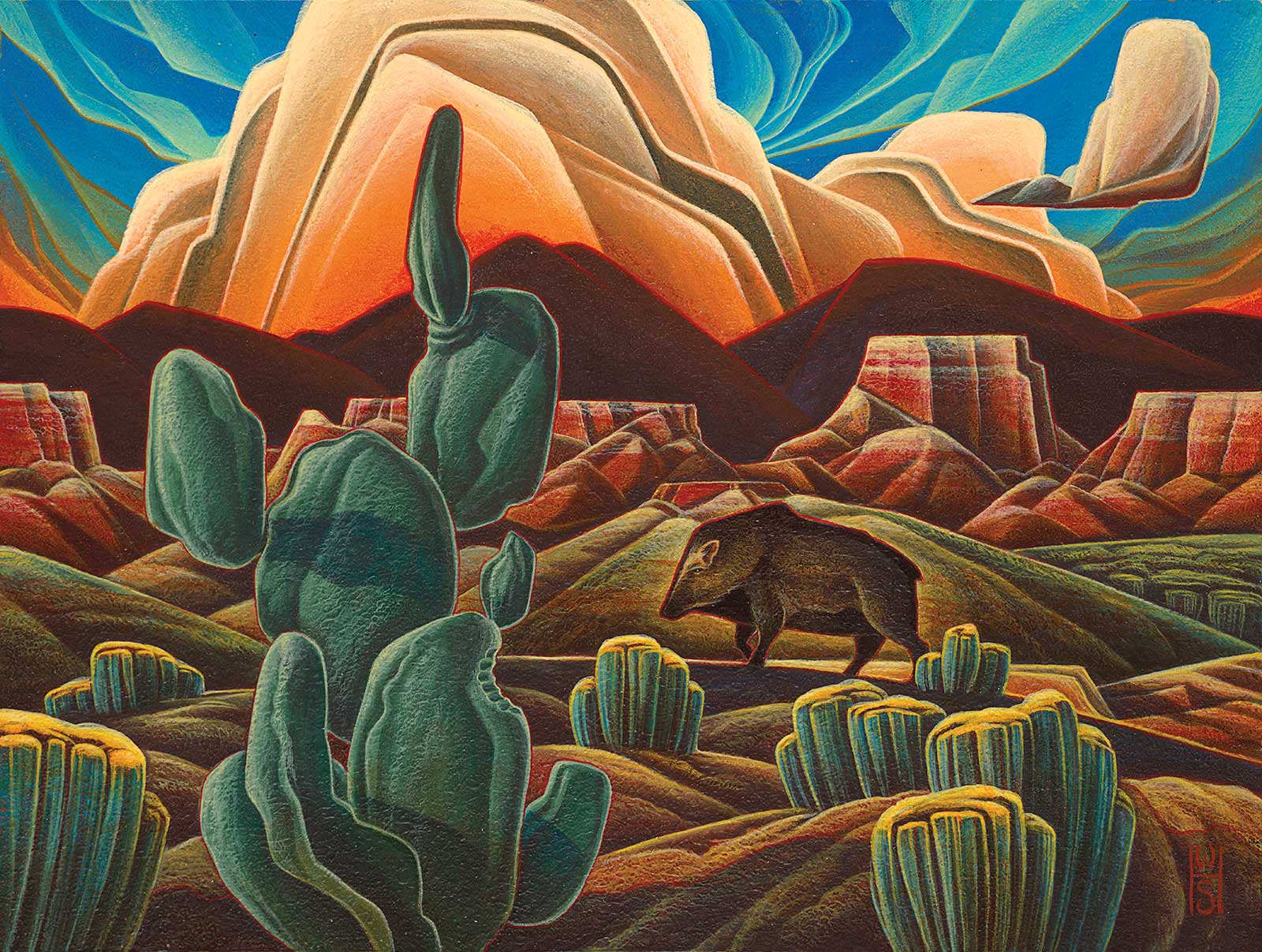
Wild Thing, acrylic, 9 x 12”
Today, Haskell’s paintings are distinctly his own. His palette expresses the energy and vitality of the landscape of the Southwest as do the forms of the flora, landscape and skies. “Artists are drawn to particular subjects more than others,” he explains. “I’ve always been attracted to chamisa, rabbitbrush. It takes on all these cool shapes and its very sculptural. When I look at it, I feel it just needs to be painted. I like art deco and I stylize the chamisa in the paintings.
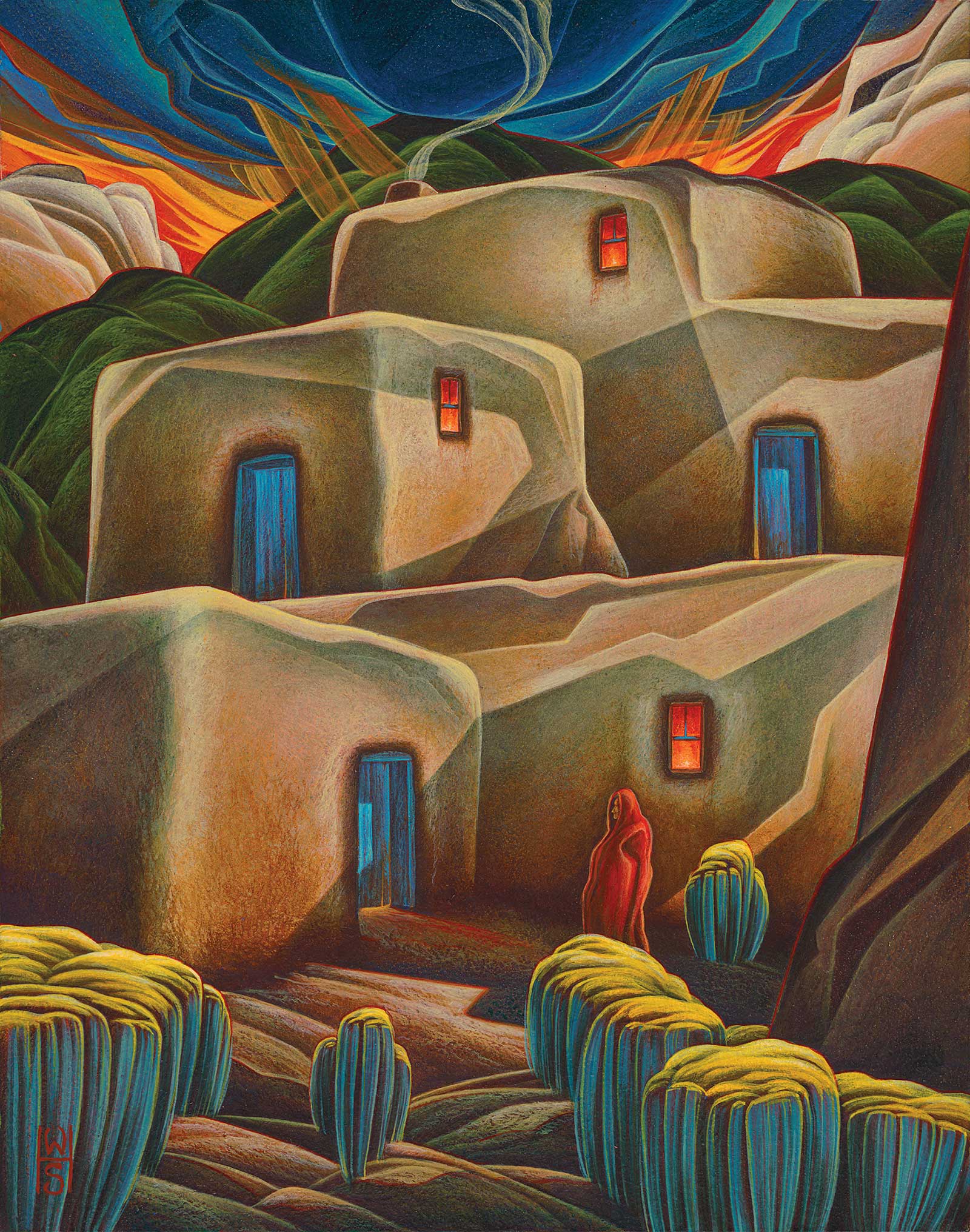
Introspection, acrylic on panel, 14 x 11”
“I’m trying to emphasize the energy that the landscape has,” he says. “The main thing I want is for every painting to have an emotional energy—a subliminal energy and motion in it. There is the landscape that we see and the spiritual feeling you get when you’re in it. I want the paintings to be universal without a specific narrative. I want the viewer to enter the paintings and tell their own stories. I want to keep the viewer in the paintings. I don’t want them to be static. I want people to enjoy looking at a painting for years and I want them to always find something new to explore within it.”
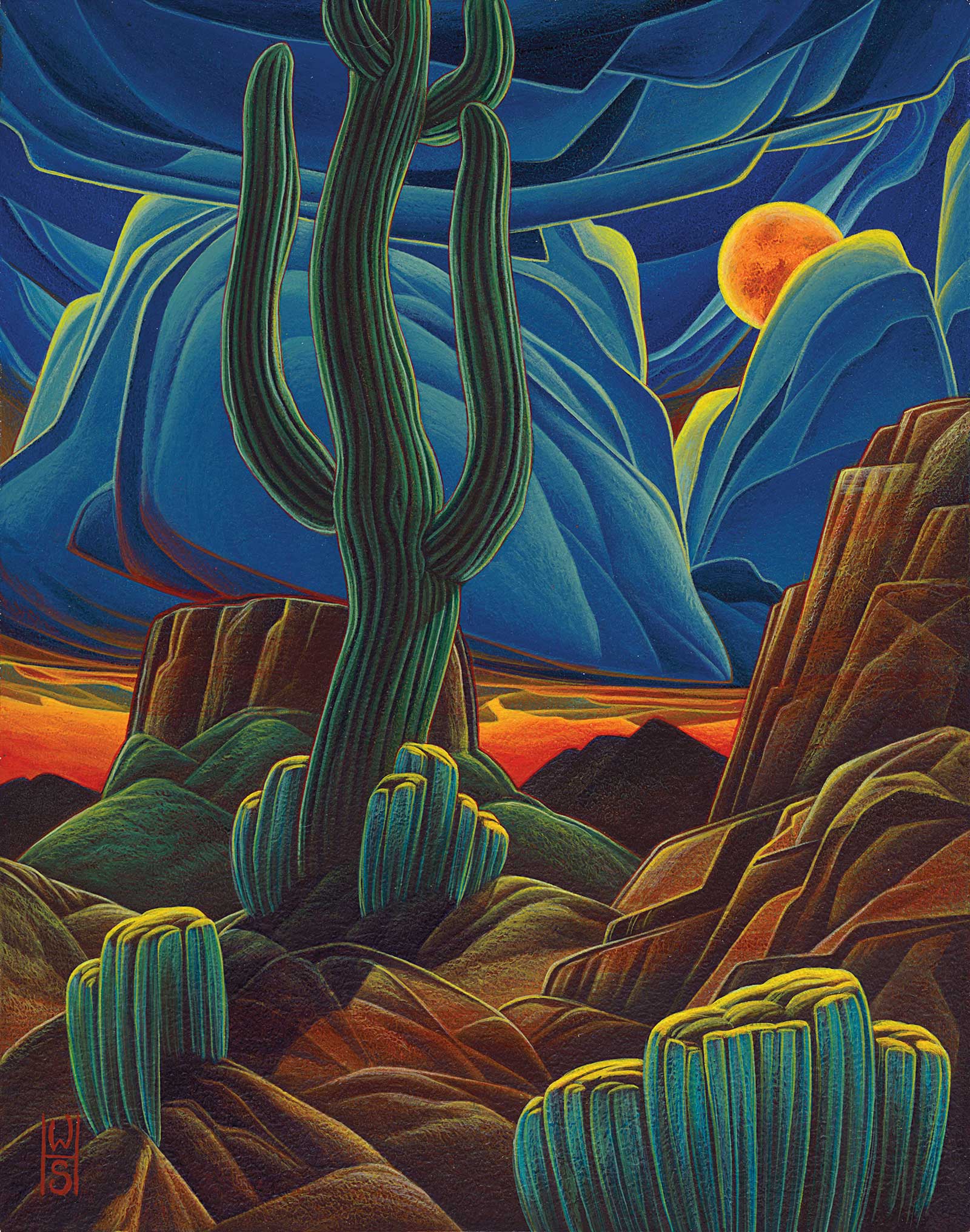
Wolf Moon, acrylic on panel, 14 x 11”
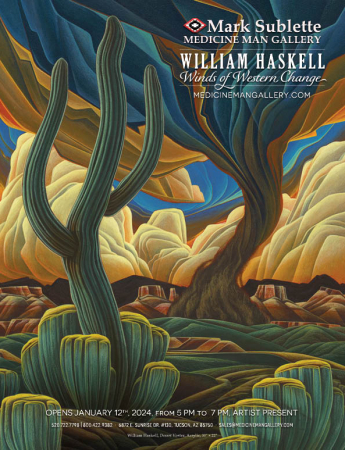
William Haskell: Winds of Western Change, an exhibition of his latest work, opens January 12 at Medicine Man Gallery in Tucson, Arizona.
Among the paintings is Desert Bloom, a chamisa monumentally central on the panel, as present as the mountains and the clouds. Intrigued by the shape of the javelina, he painted Wild Thing, in which the animal claims its place among the other living and inert things of the desert.
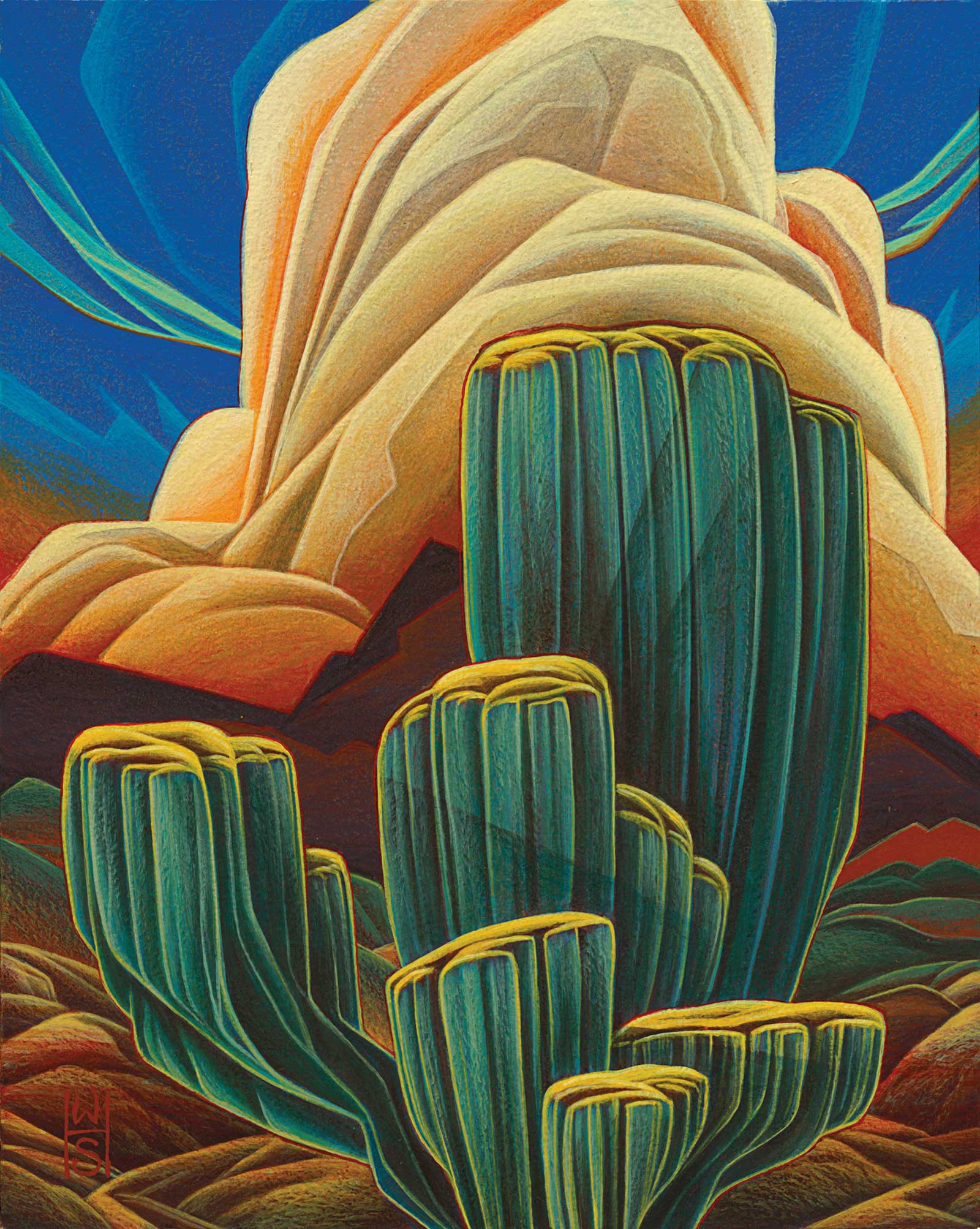
Desert Bloom, acrylic on panel, 10 x 8”
The wolf moon is the full moon of January. In his painting with that title, Haskell depicts the moon reflecting orange from behind the blue of the evening clouds that rise above the orange sunset. The warm hue of the distant moon is complemented in the foreground by the yellow blossoms of the chamisa. The relationships of colors and forms on his painted panel embody the impression of living energy in the landscape and the oneness of creation. —
William Haskell: Winds of Western Change
Opens January 12, 2024
Reception: January 12, 5-7 p.m.
Mark Sublette Medicine Man Gallery 6872 E. Sunrise Drive, Suite #130, Tucson, AZ 85750
(520) 722-7798, www.medicinemangallery.com
Powered by Froala Editor