During a two-week period that straddled late November and early December of 1921, Charles M. Russell visited Denver to exhibit artwork at the Brown Palace Hotel. It was during a critical time for the artist, who was creating some of his most masterful work and showing it around the country amid significant praise. That Denver visit serves as the backdrop for a new Russell exhibition now open at the Denver Art Museum.
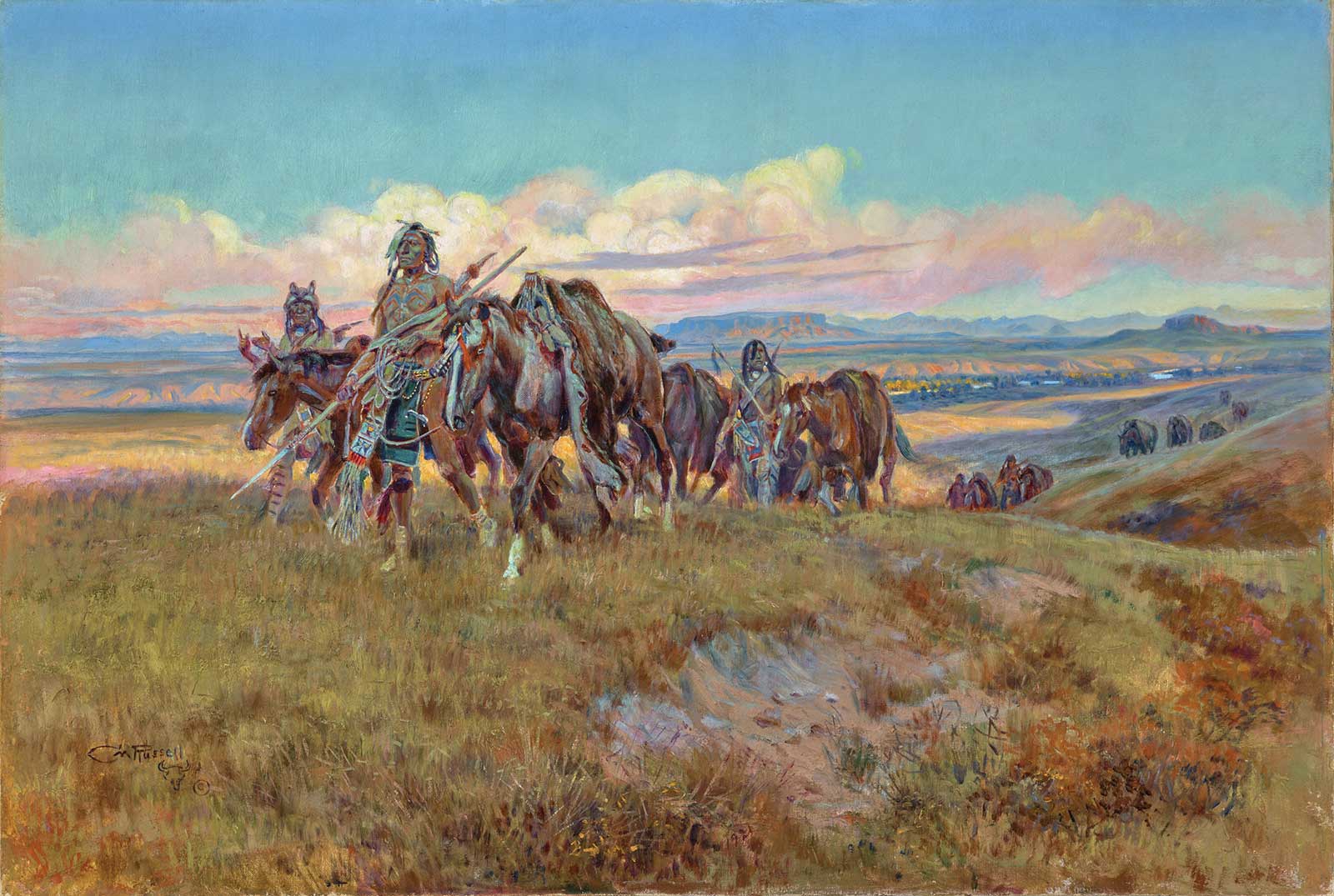 In the Enemy’s Country, 1921, oil paint on canvas, 24 x 36”. Denver Art Museum: Gift of the Magness Family in memory of Betsy Magness. Photo by Christina Jackson, Denver Art Museum.
The exhibition, The Russells in Denver,1921, is not a recreation of the show, although it will have a number of works that were known to have been displayed at the Brown Palace more than a century ago. “It is a celebration of Charlie and Nancy’s two-week stay in the Mile High City that highlights many of the works we know were on display, tells the story of Denver in the 1920s and acknowledges Nancy’s critical role,” notes JR Henneman, the show’s curator and director of the Petrie Institute of Western American Art at the museum.
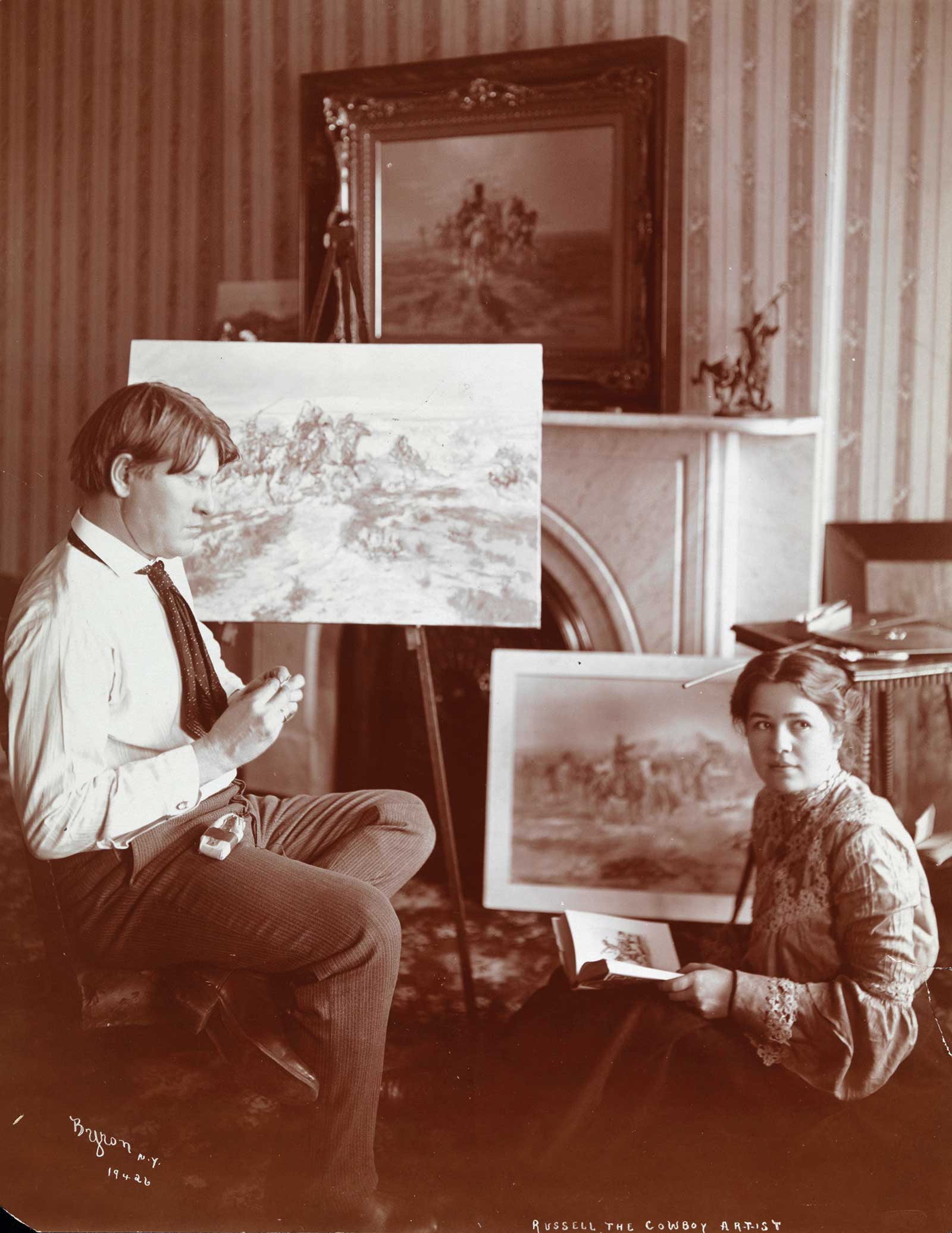
Charlie and Nancy posing in front of some of their art in New York, Byron Company photograph, February 1905. Museum of the City of New York Collection, New York.
On view will be 18 works by Russell—including seven oils, seven bronzes and a watercolor—that come from the museum’s collection and important lenders such as Tom Petrie, the Gilcrease Museum, Amon Carter Museum of American Art and the National Cowboy & Western Heritage Museum. Adding another layer to the exhibition is the Brown Palace, which still exists and is located a mile from the museum. Russell scholar Brian W. Dippie has indicated that the original exhibition may have been held on the hotel’s eighth floor, which today has guest rooms, but in 1921 would have been a convention hall. It was there where Russell would have shown paintings he had created between 1918 and 1921.
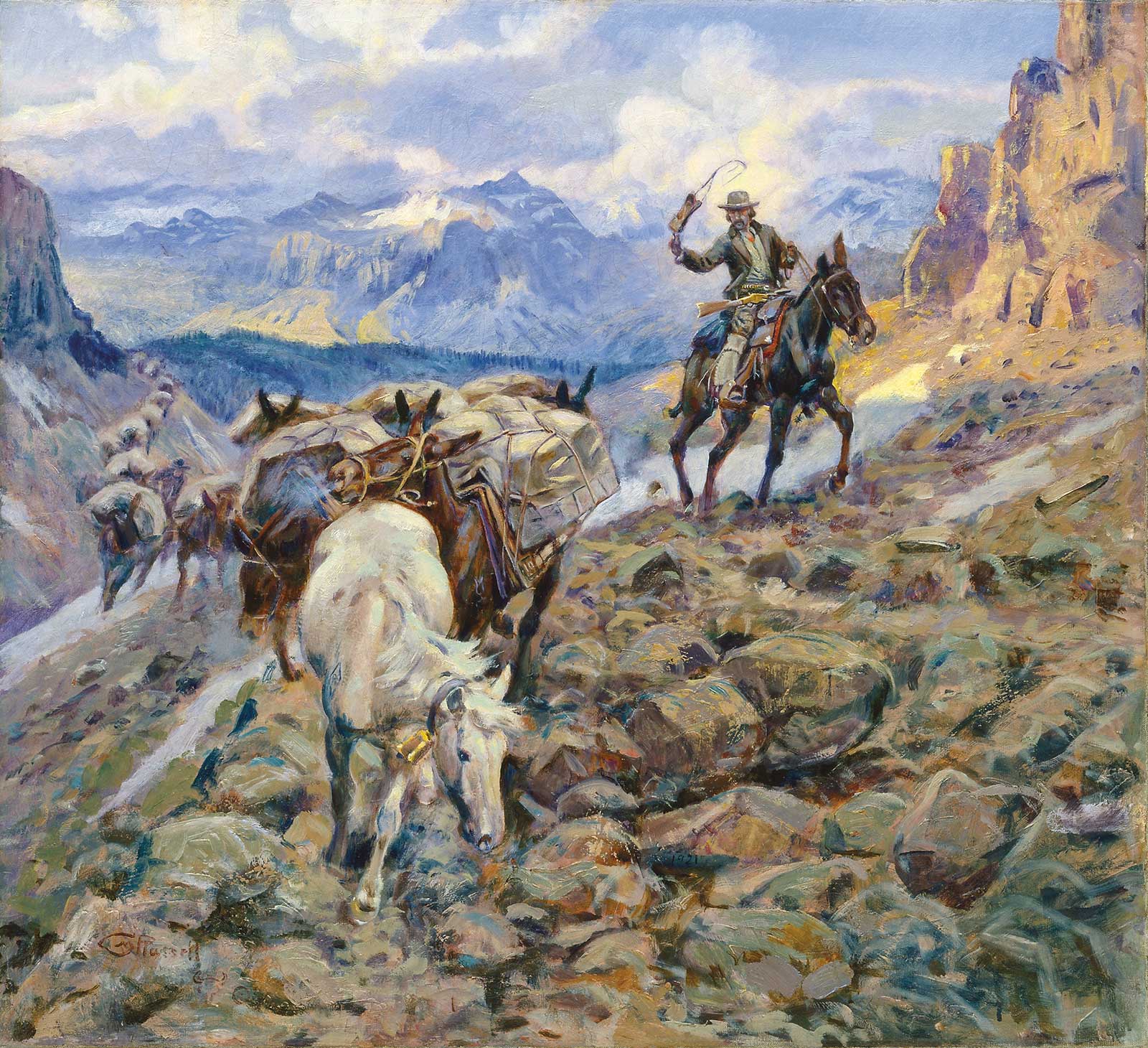
When Mules Wear Diamonds, 1921, oil paint on canvas, 30 x 33”. National Cowboy & Western Heritage Museum: Museum Purchase.
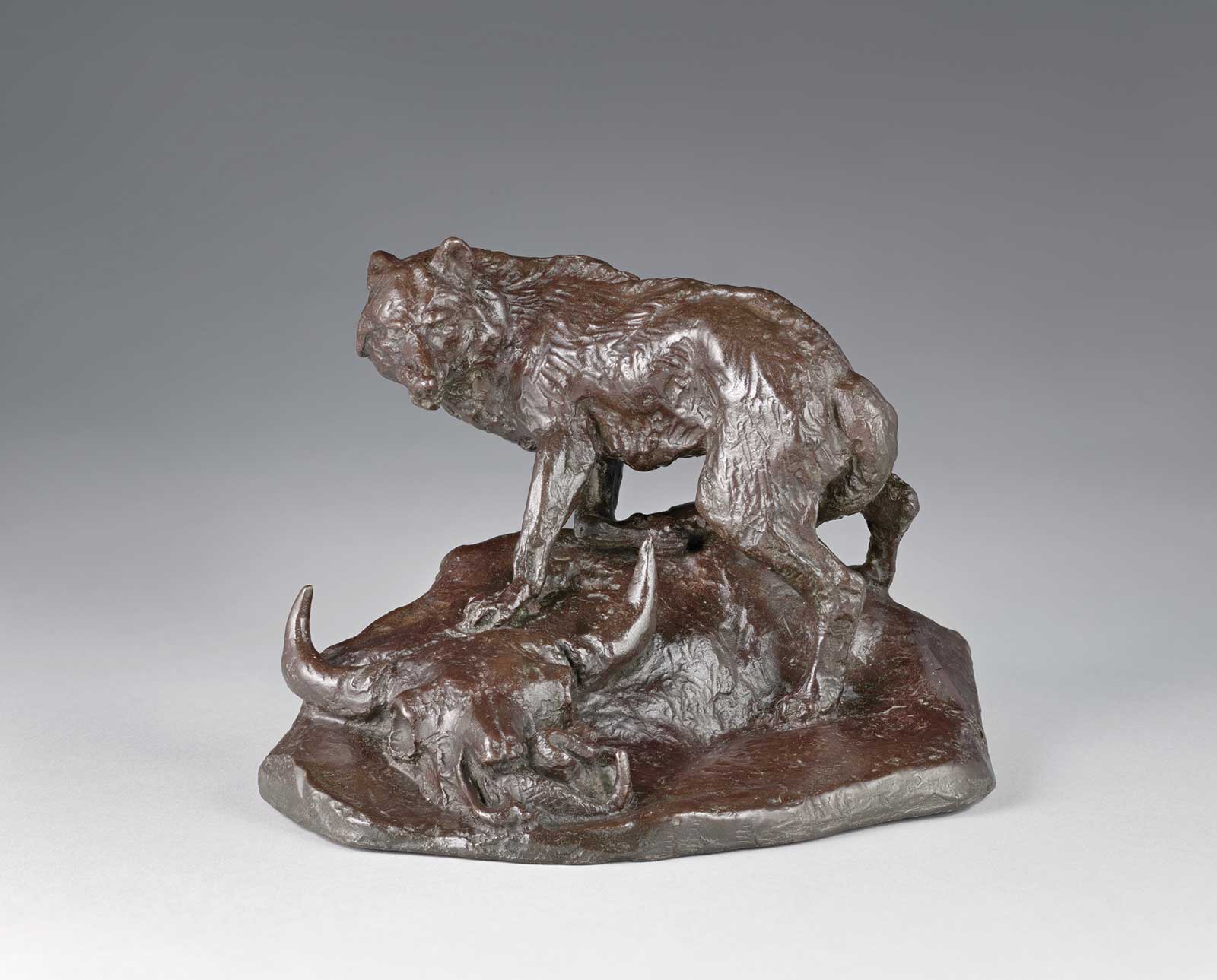
An Enemy That Warns, modeled 1921, bronze, 51/8 x 8 x 6”. Bob and Betsy Magness Collection. Photo by Eric Stephenson, courtesy Denver Art Museum.
Visitors to the museum will see work from that period, but also earlier work to contrast how far Russell had come creatively by 1921. “The paintings and sculptures are among some of his most accomplished. To highlight how much Russell had matured over the course of his career, we added two earlier works to the exhibit: the DAM’s Buffalo Hunt (oil) from 1898 is paired with Buffalo Hunt No. 40 from 1919 (Tom Petrie’s collection). Buffalo Hunt No. 40 was on display in Denver,” Henneman says. “The second pairing is a watercolor from the DAM’s collection, That Night in Blackfoot was a Terror from 1910, alongside the Gilcrease’s When Guns Speak Death Settles Dispute from 1921. When Guns Speak Death Settles Dispute was on display in Denver. These comparisons underscore how much Russell had matured in his technique and understanding of color and composition while revisiting similar themes over time.”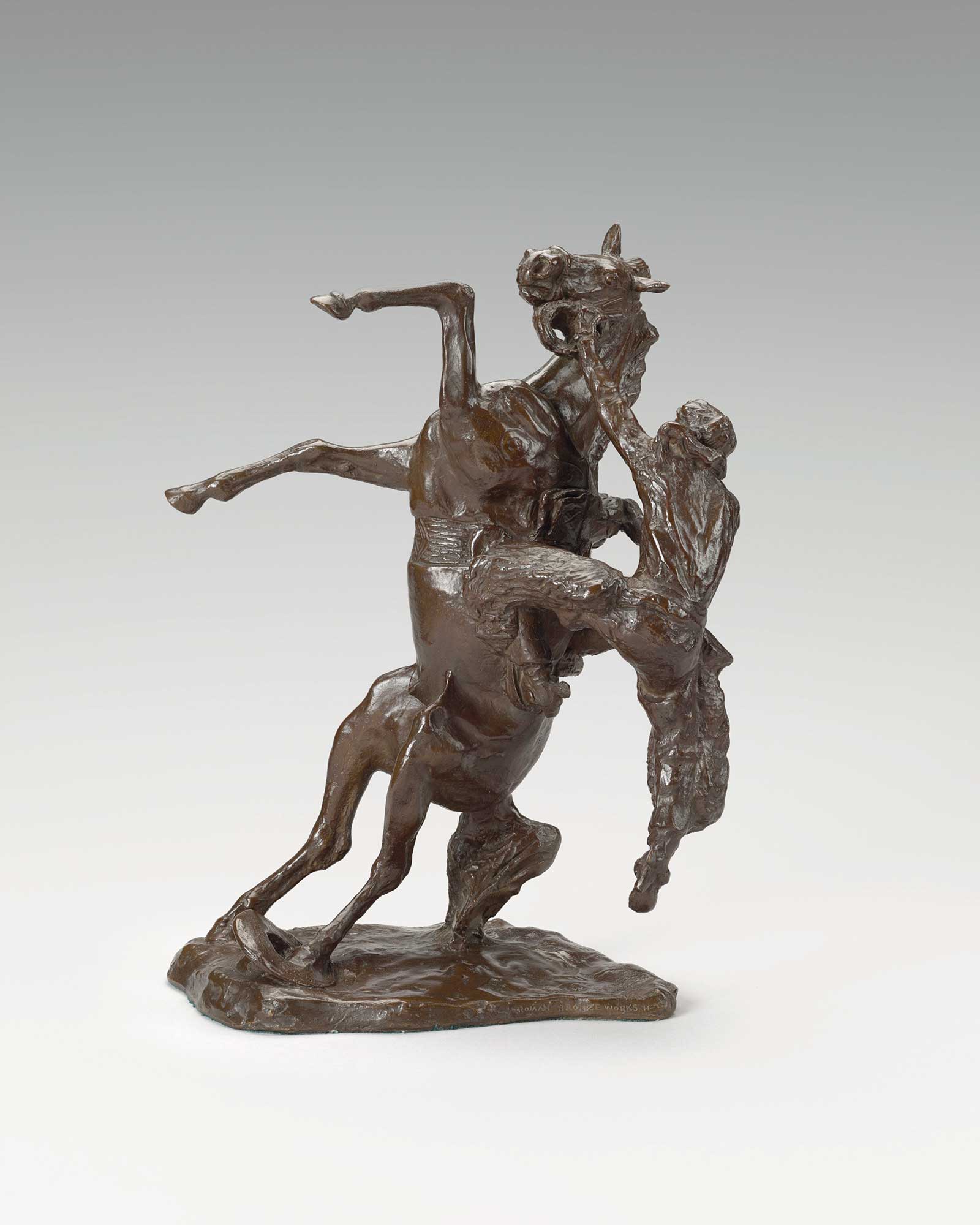
Where the Best of Riders Quit, modeled 1921-22, bronze. Petrie Collection, Denver, Colorado. Photo by Bruce Fernandez, courtesy Denver Art Museum.
Henneman adds that the show has some key works that should thrill visitors. “Piegans is stunningly beautiful and a testament to Russell’s use of color. A Tight Dally and a Loose Latigo is an exceptional ‘problem picture’ that requires close looking and a little familiarity with cowboy lingo. It’s a wonderful demonstration of Russell’s knowledge of range life and his humor,” she says. “We see Russell’s humor and knowledge of cowboy life in his sculptures as well. Consider the humorous Weapons of the Weak, in which a porcupine has treed a family of bears, and the dramatic When the Best of Riders Quit, where a rider appears ready to bail off his backwards-falling steed.”
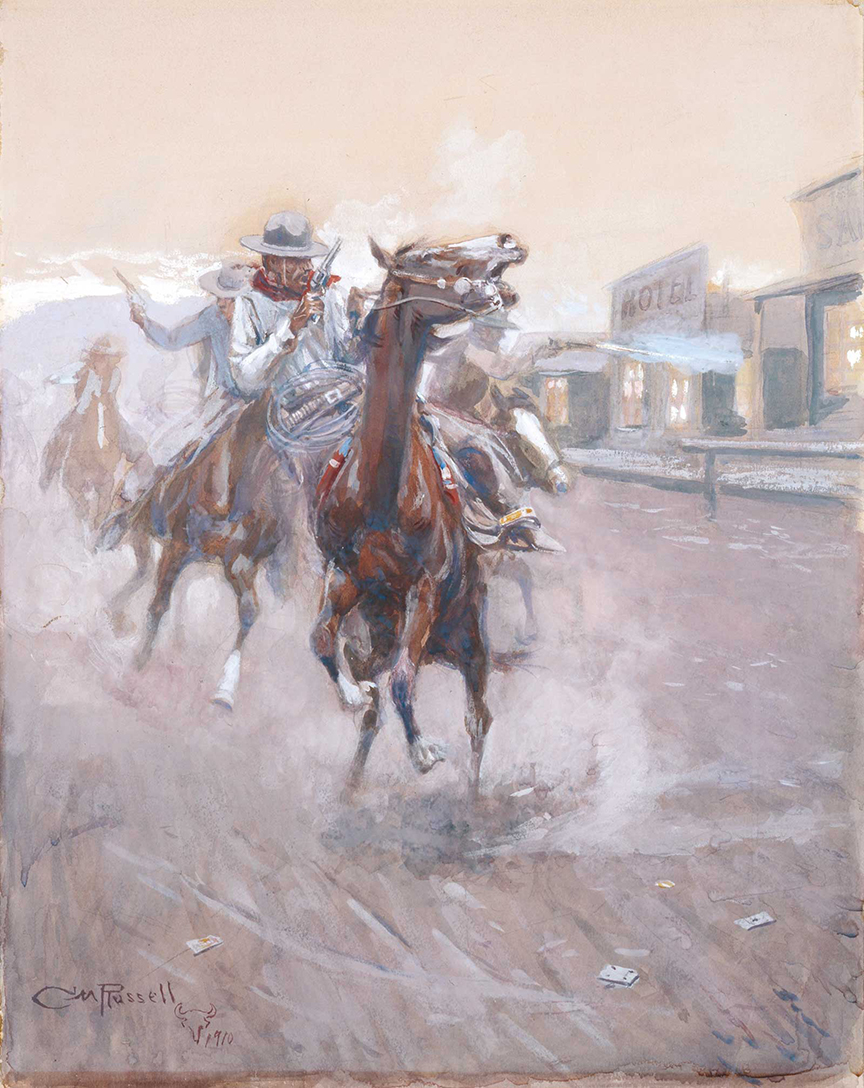
That Night in Blackfoot Was a Terror, 1910, watercolor on paper, 16 x 13”. Denver Art Museum: In memory of Dr. John Cunningham, a gift of his granddaughter, 1991.609. Photo by Jeff Wells, courtesy Denver Art Museum.
One other important role of the exhibition is to drive home how important Nancy Russell was to her husband. “Without Nancy, it’s doubtful Charlie would have become the internationally known artist he was during his lifetime and still is. Nancy served as his business and marketing manager. She negotiated commissions, unflinchingly sold his paintings for ever-higher prices, organized exhibitions (including the one in Denver in 1921), and kept his work and memory alive after his death in 1926,” the curator says. “To fully appreciate and understand Charlie, we need to acknowledge Nancy’s critical role.”
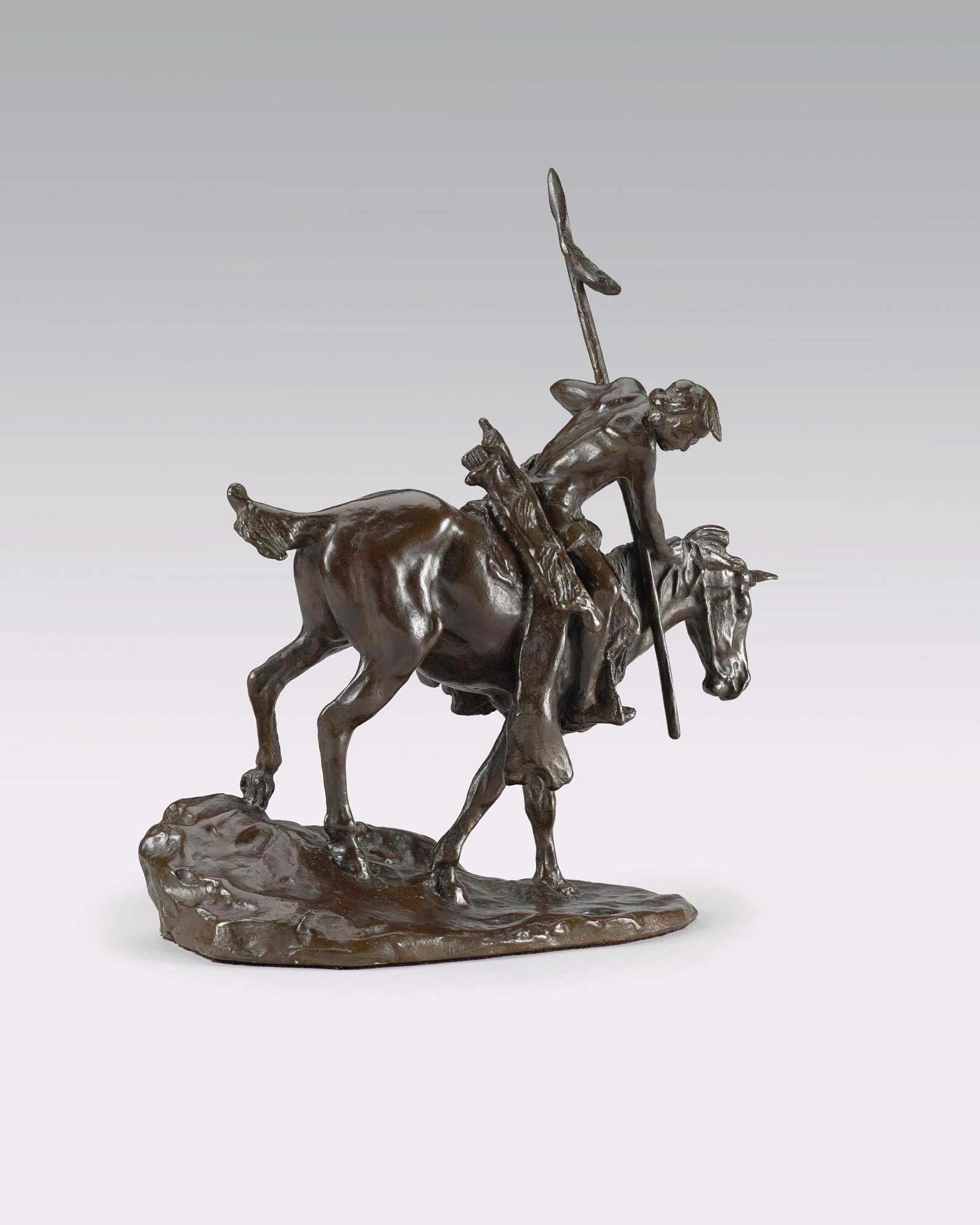
The Enemy’s Tracks, modeled 1920, bronze, 127/8 x 10½ x 5¾”. Petrie Collection, Denver, Colorado. Photo by Bruce Fernandez, courtesy Denver Art Museum.
In an essay in the exhibition’s catalog, lender and Russell collector Tom Petrie quotes Nancy directly: “[My husband] was not a business man. He knew absolutely nothing about the methods used in the business world, nor did he want to buy the food, pay the rent or order coal. If we were going East…he would not purchase the tickets or check the trunks. Room reservations and all the detail connected with exhibitions of or contracts for work disturbed and worried him. All those things were my job. It was a joy to supply his needs and do the things he could not do without disturbing his creative genius. It was much more important for him to record the history of the Great Northwest which was his work.”
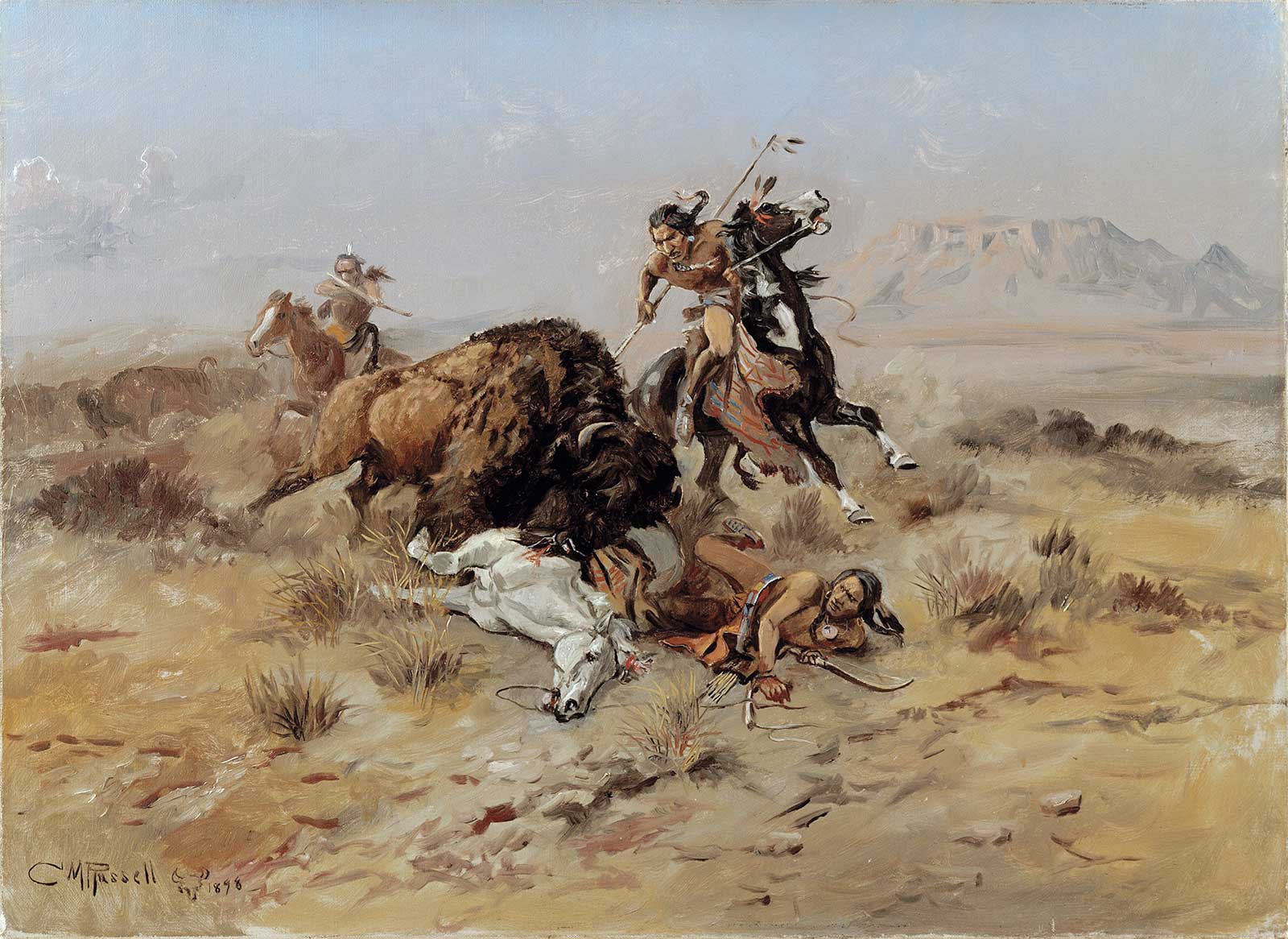
Buffalo Hunt, 1898, oil paint on canvas, 181/8 x 253/8”. Denver Art Museum: Gift of Sharon Magness. Photo by Jeff Wells, courtesy Denver Art Museum.
Petrie’s essay also includes a brief story on Denver-based newspaperman Olney Newell, who saw Russell’s work and predicted it would reach worldwide acclaim. Petrie continues: “While this exhibition highlights Charlie’s artwork, it is important to acknowledge Nancy’s crucial role in his success. Newell’s ‘prophecy’ could not have come true were it not for her savvy business skills and deep-rooted belief in her husband’s talents. In the late 1890s, shortly after the newly married couple moved to Great Falls, Montana, Nancy started to take the reins of selling Charlie’s work, moving his art prices from $25 to $100 or so during the first three years of their marriage and, during their 1904 trip to New York, to $400,” Petrie writes. “In a few years, Nancy was able to generate much of the funding needed to help build Bull Head Lodge, their log cabin and studio on Lake McDonald, now part of Glacier National Park in Montana.
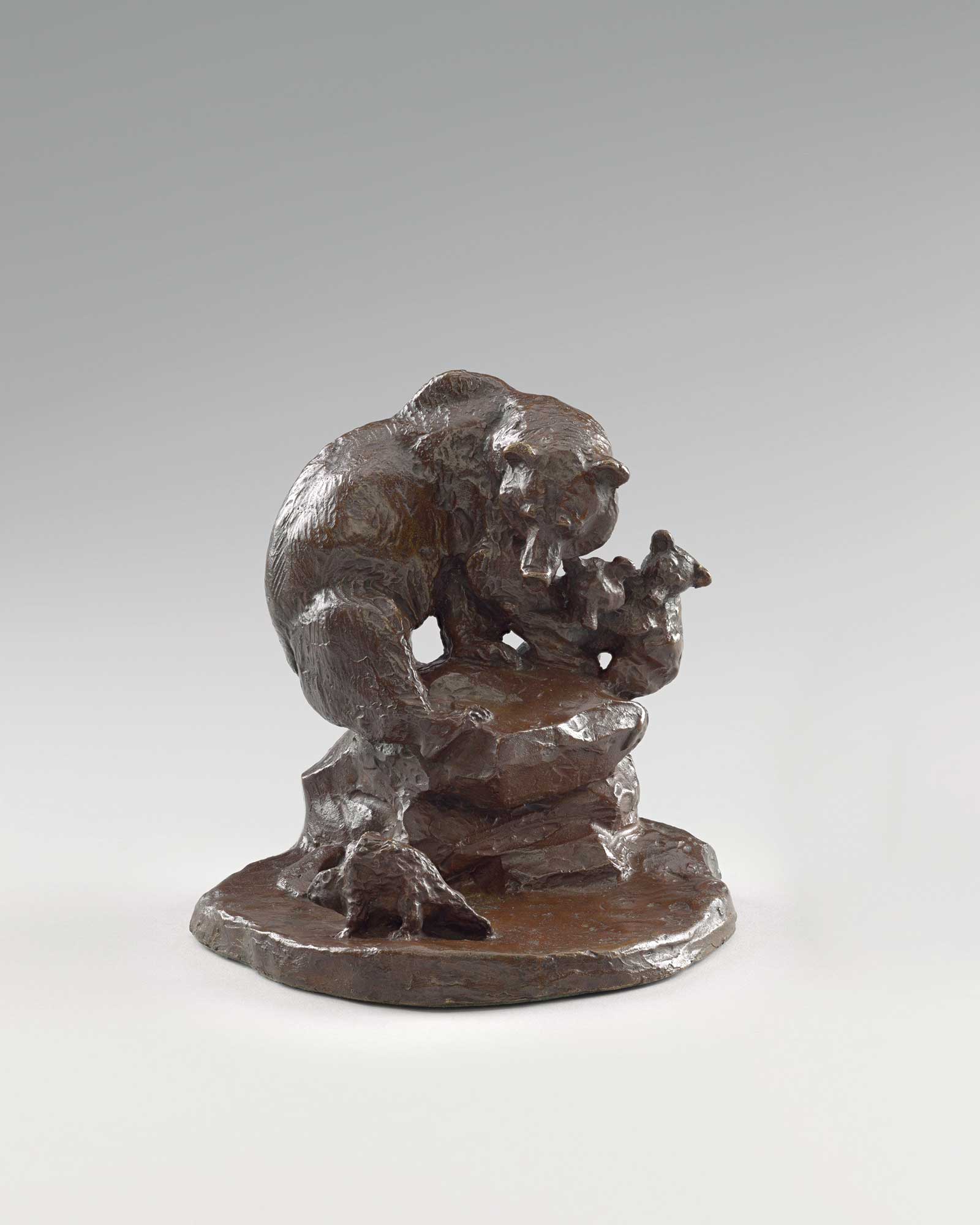
Weapons of the Weak, modeled 1921, bronze, 5¾ x 57/8 x 5½”. Petrie Collection, Denver, Colorado. Photo by Bruce Fernandez, courtesy Denver Art Museum.
By the 1920s, Charlie’s paintings commanded prices up to $10,000. Beyond negotiating the sale of Charlie’s work, Nancy often functioned as his promotional mouthpiece, as a 1921 newspaper interview with reporter Roger Batchelder makes clear. After a few short responses from Charlie, Nancy steps in to confide, ‘He’s a terrible man to interview…Maybe I can help.’ She then succinctly summarized key events in Charlie’s life story, taking control of the narrative as his de facto art marketer in chief.”
The Russells in Denver, 1921 continues through June 30, 2024. —
The Russells in Denver, 1921
Through June 30, 2024
Denver Art Museum, 100 W. 14th Avenue Parkway, Denver, CO 80204
(720) 865-5000, www.denverartmuseum.org
Powered by Froala Editor