“I started out in folk art,” Henry Bauer explains. “In the South, we call them self-taught artists. A friend got me into it, but it’s not really me. I got bored with it. Today when people come to our home and see the collection of Western and Native art, they say, ‘This is a house where the art reflects the people who live here.’
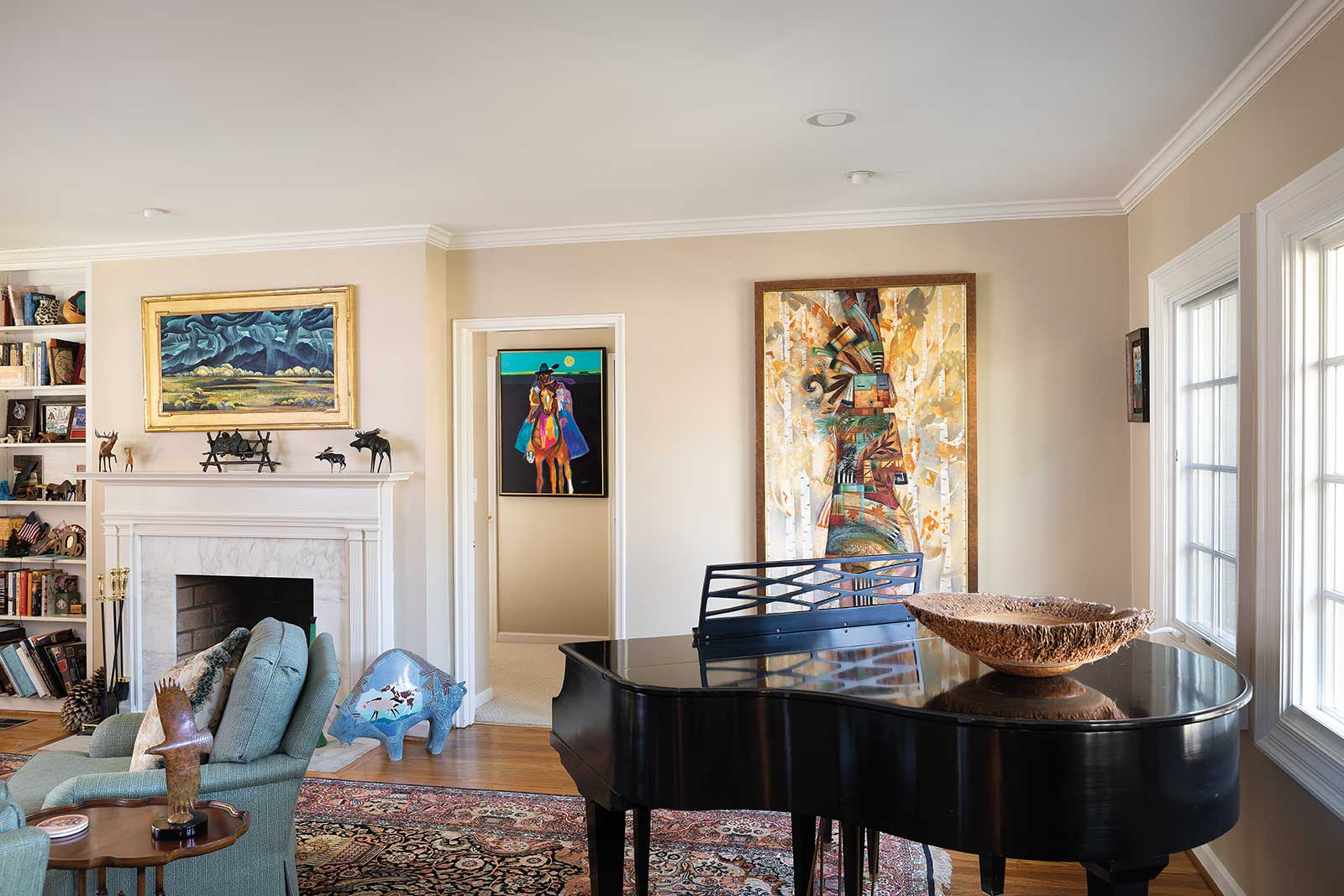 Above the fireplace in the living room is Trueno Rodante, oil on canvas, by Tony Abeyta (Diné). Beneath it are Saddle on Fence, bronze, by John Mortensen, in the middle, and his Moose and Elk on the right. A ceramic buffalo by the hearth is by Rebecca Tobey. Her bronze Eagle sculpture is in the foreground. Through the doorway is Comanchero, acrylic on canvas, by John Nieto (1936-2018). To the right of the doorway is Aspen Wind Chant, oil and sand on canvas, by Tony Abeyta (Diné). The bowl on the piano is Washingtonian palm with surrounding roots—white melee burl from Australia.
 “My wife, Mary Carole Cooney, brought back a Western serigraph from a business trip to Santa Fe. I liked the colors. I had the idea that I could start collecting this kind of art and not be satisfied only with serigraphs. As I became more successful, I was able to buy more expensive pieces. I’ve done it because I enjoy it, and it reminds me of places that I’ve enjoyed. Mary Carole enjoys the art and gives me the freedom to do what makes me happy.
“I had been out west many times. When I was a boy, my family stayed at the R Lazy S Ranch in Jackson Hole, Wyoming. Mary Carole and I have taken our children and grandchildren there for years. This was my 38th year at the ranch.”
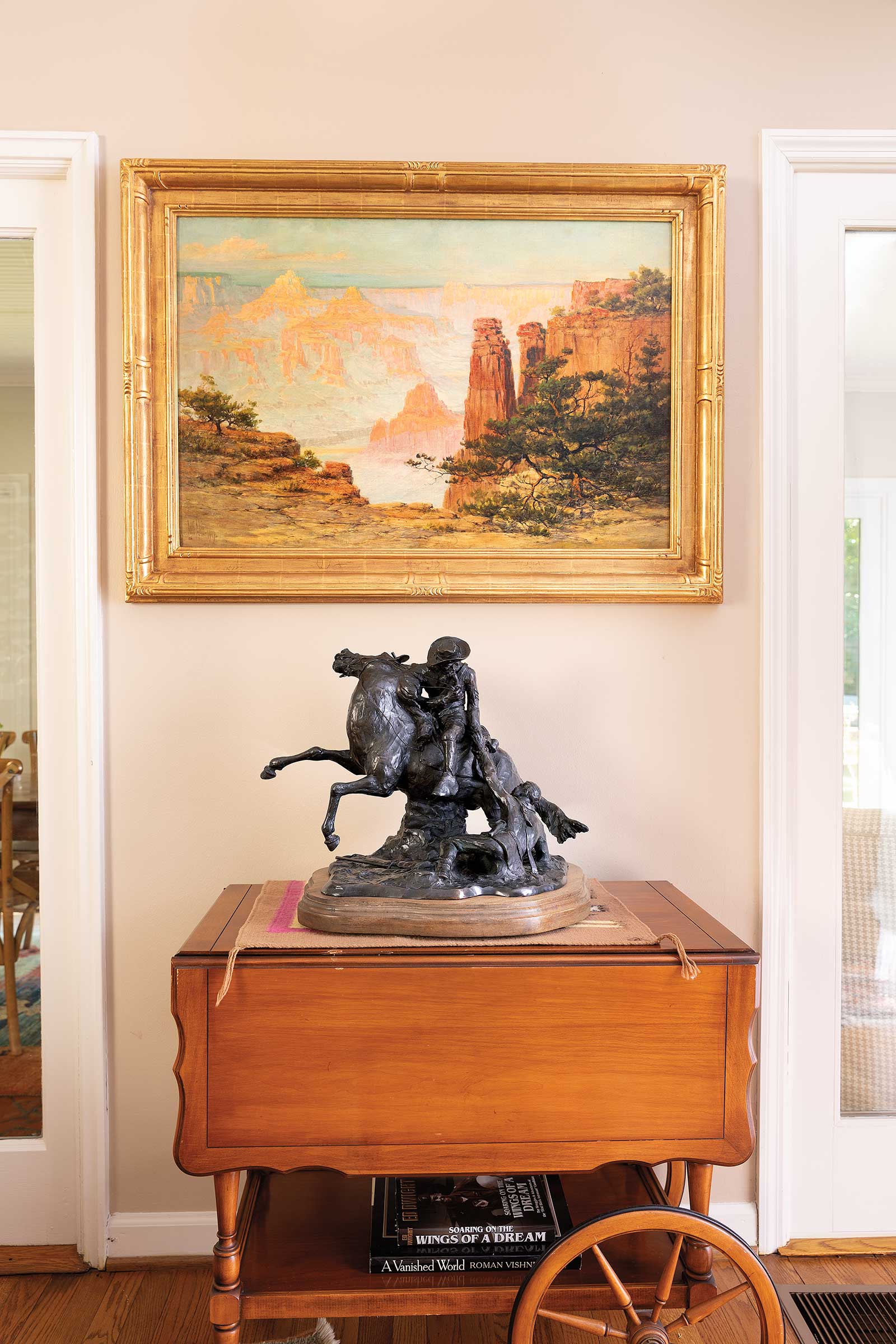
In the dining room is Grand Canyon—1909, oil on canvas on panel, by Louis Benton Akin (1868–1913). On the tea cart is Rescue by Sgt Denny, bronze, by Ed Dwight.
The R Lazy S also had a role in the growth of his collection. Painter Amy Ringholz had graduated from college and moved to Jackson Hole where she was a waitress at the ranch. The management gave her the opportunity to show her paintings to the guests. Henry recalls, “We bought the very first piece.” She has had her own gallery in Jackson Hole since 2014.
Henry bought Grand Canyon—1909 by Louis Benton Akin at Medicine Man Gallery in Tucson, Arizona, where it was on consignment. “I later decided I like more modern pieces,” he explains.
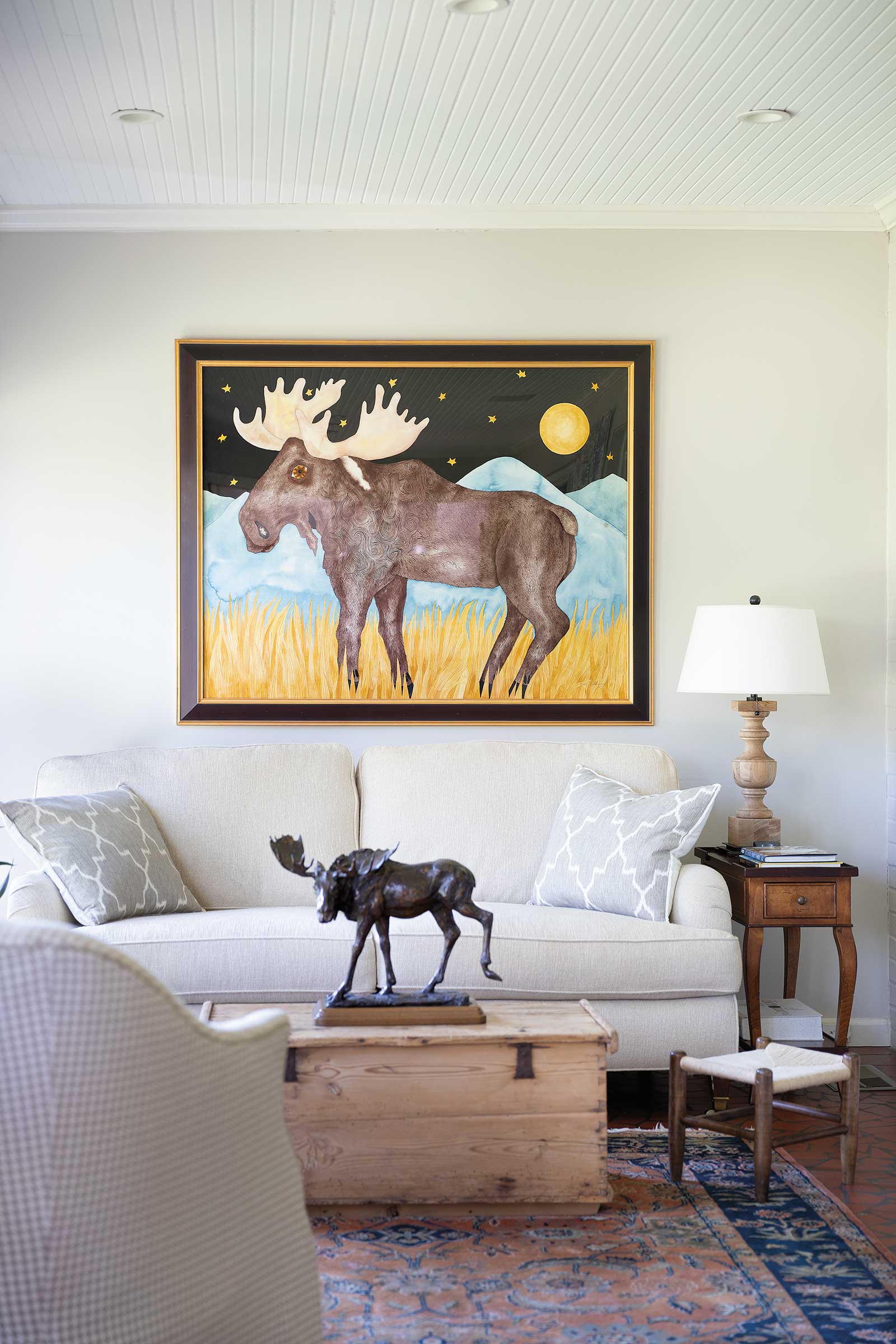
In the sunroom, the watercolor of a moose is by Anne Hathaway. The bronze, Moose Flats, is by Sandy Scott.
Today, the collection is a rich eclectic blending of paintings and sculpture that mean something to him. “I like the scenes and the colors in the paintings, and I never consider whether the artist is famous or if the work will appreciate.”
Henry is a lawyer with deep roots in Atlanta. His collection includes a neon Budweiser sign from the 1996 Atlanta Olympics and works on civil rights themes from an original photograph of the Memphis sanitation workers’ strike in 1968 by Ernest C. Withers (1922–2007) to paintings by Charly Palmer who documents the African American experience.
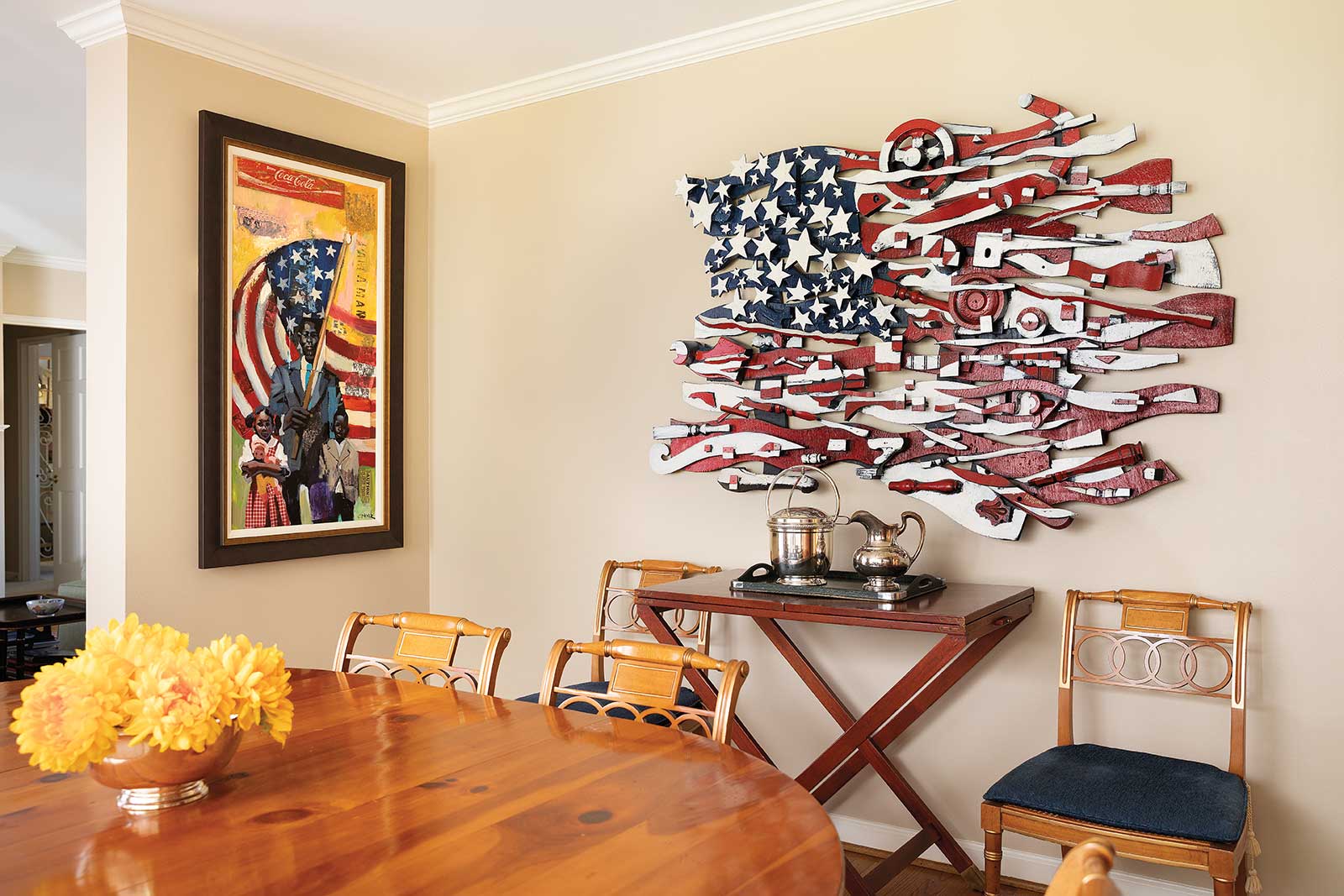
In the dining room are, left to right, Medgar Evers, acrylic by Atlanta painter Charly Palmer, and American Flag, painted wood, by Roger Lee Ivens (1964-2022), also known as Ab the Flagman.
Martin Luther King Jr. had gone to Memphis to support the sanitation workers and was assassinated the day after addressing them. The Withers photo shows a large group of workers holding “I Am a Man” signs. “I was in in Mississippi taking a deposition and saw the photo at a gallery in Oxford,” Henry recounts.
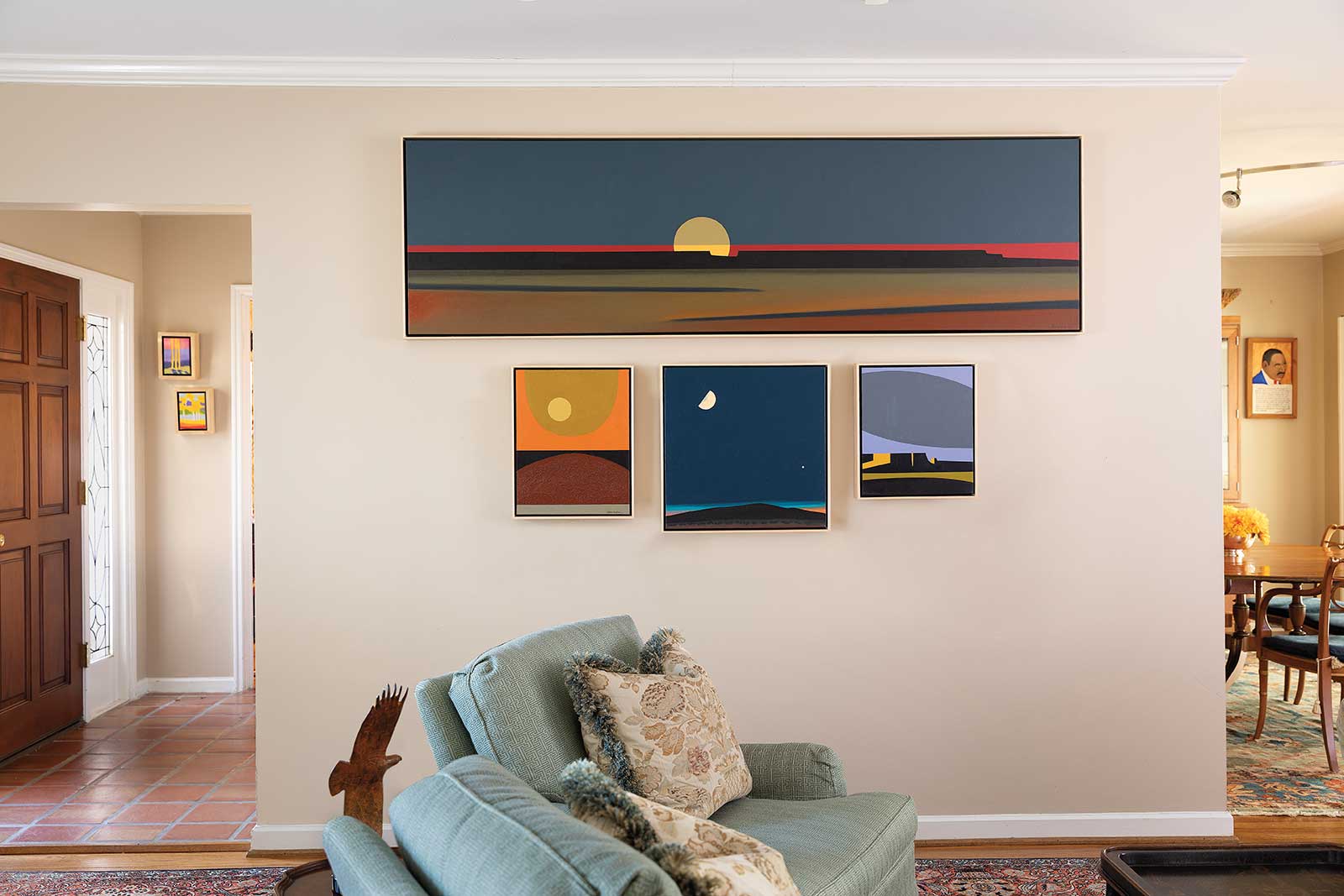
In the living room are paintings by Dan Naminga (Hopi-Tewa). The horizontal painting is Polacca Moon #1, acrylic on canvas. Beneath it are, left to right, Sun and Clouds Over Horizon, acrylic on canvas; New Mexico Night #6; and Receding Rain Cloud, acrylic on canvas. On the far wall in the dining room on the right is Martin Luther King Jr., oil on carved wood, by Ned Cartledge.
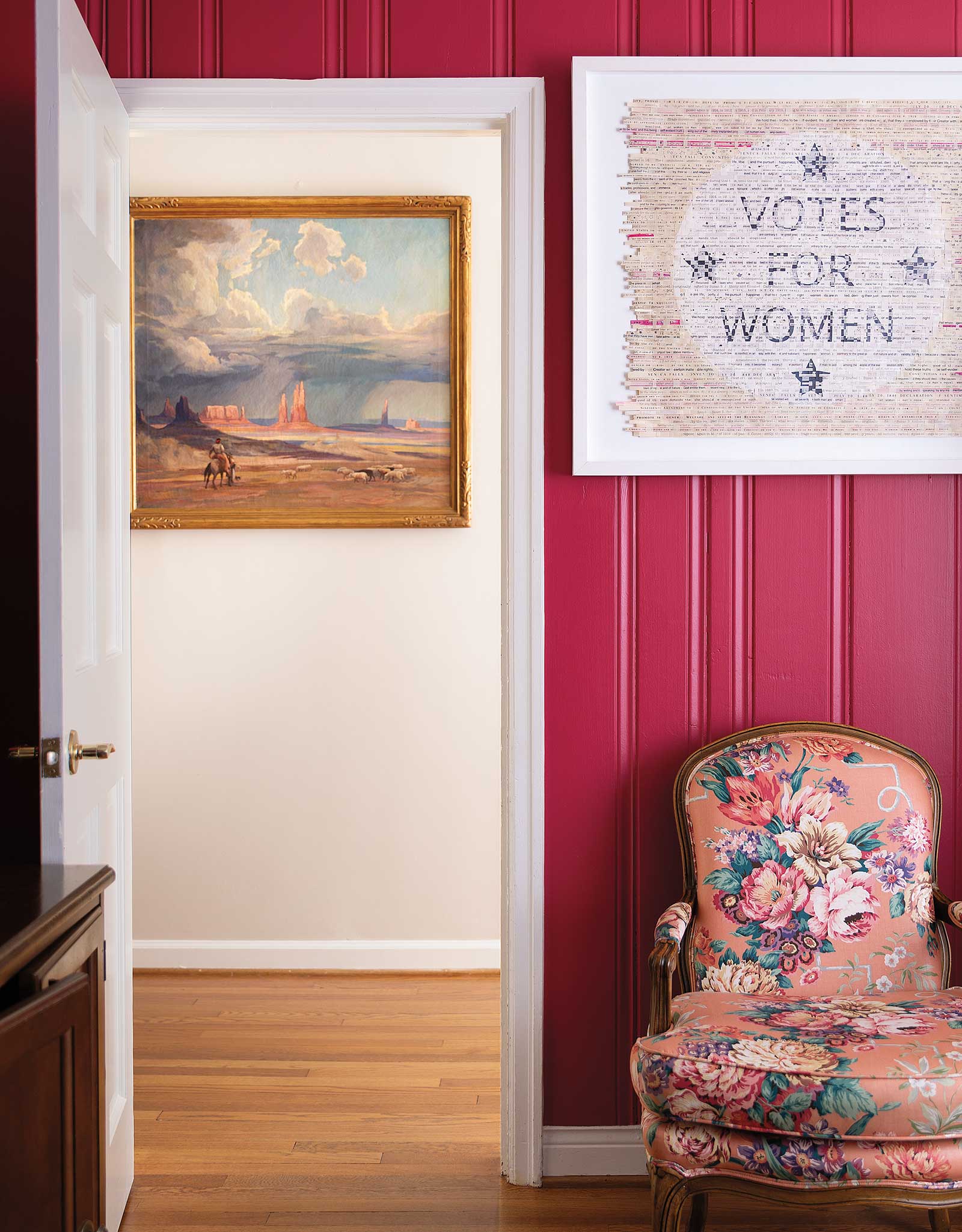
In the hall outside the office is Corals of Earth and Sky, Monument Valley, oil on canvas by Carl Hoerman (1885-1955). In the office is Nineteen: Votes for Women, 2017, woven screenprint, by Julie Torres. The piece was a gift to Mary Carole from her husband for her service as chairperson of the Fulton County (Georgia) Board of Elections during both the 2016 and 2020 presidential elections.
He recalls riding the Atlanta Rapid Transit bus to school every day. “All the maids coming into the city to work at homes in the wealthy neighborhoods were standing in the back of the bus. I felt, ‘There’s something wrong with this.’”
An unusual series of events surrounded his acquiring the Budweiser sign. “We had done some pro bono legal work for an elderly neighbor, and after she died her children found the files where we had helped her,” Henry recounts. “They called and said they were having a house sale and, in gratitude, asked me to go over to pick something out. The moment I saw the Olympics sign, I was thrilled. We were very proud to have the Olympics in Atlanta. We went to everything.”
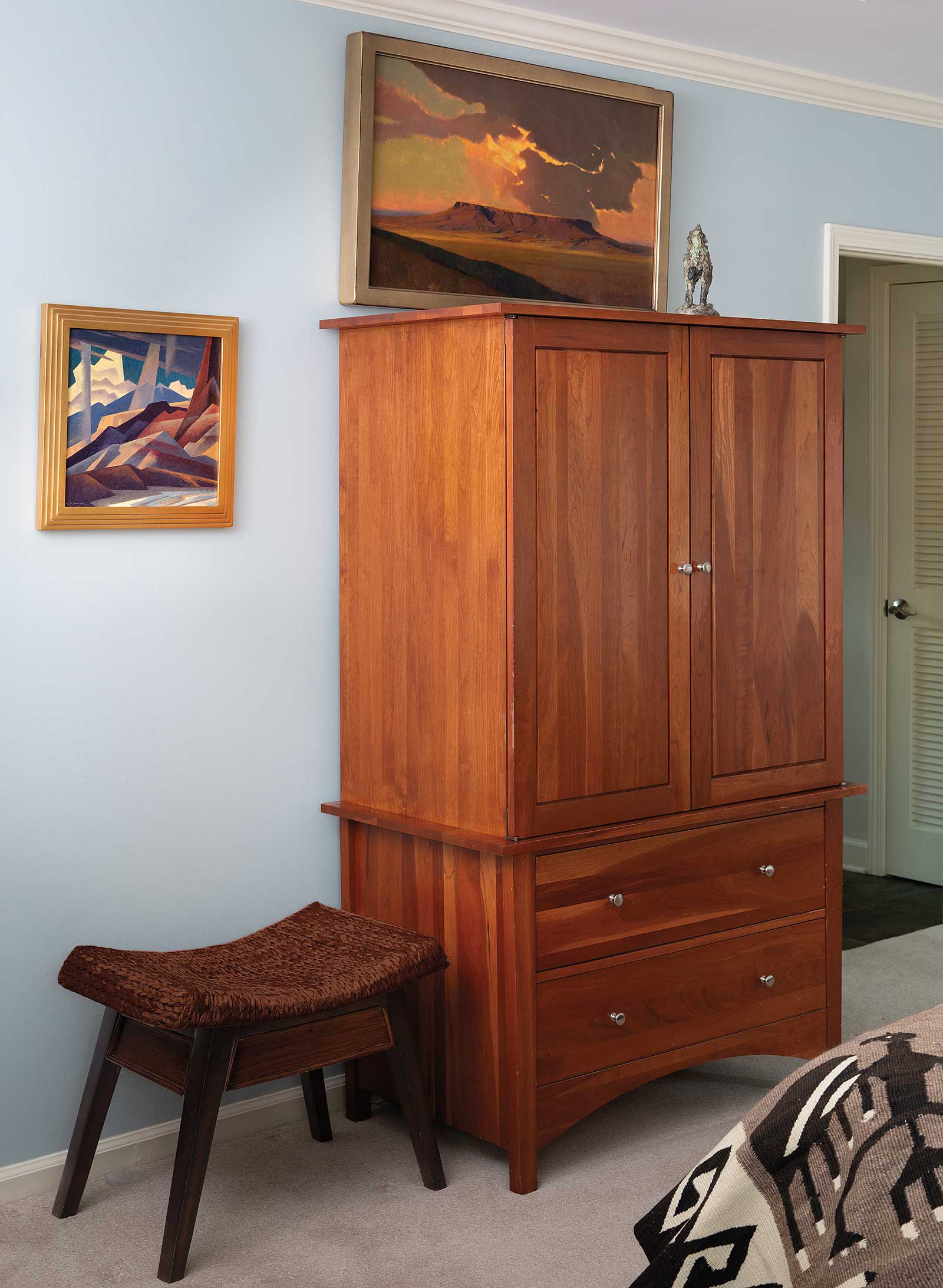
To the left of the cabinet in the principal bedroom is R. Tom Gilleon’s Fort Mountain, August Heat, oil. Above the cabinet is Ed Mell’s Levels of Land 1, oil.
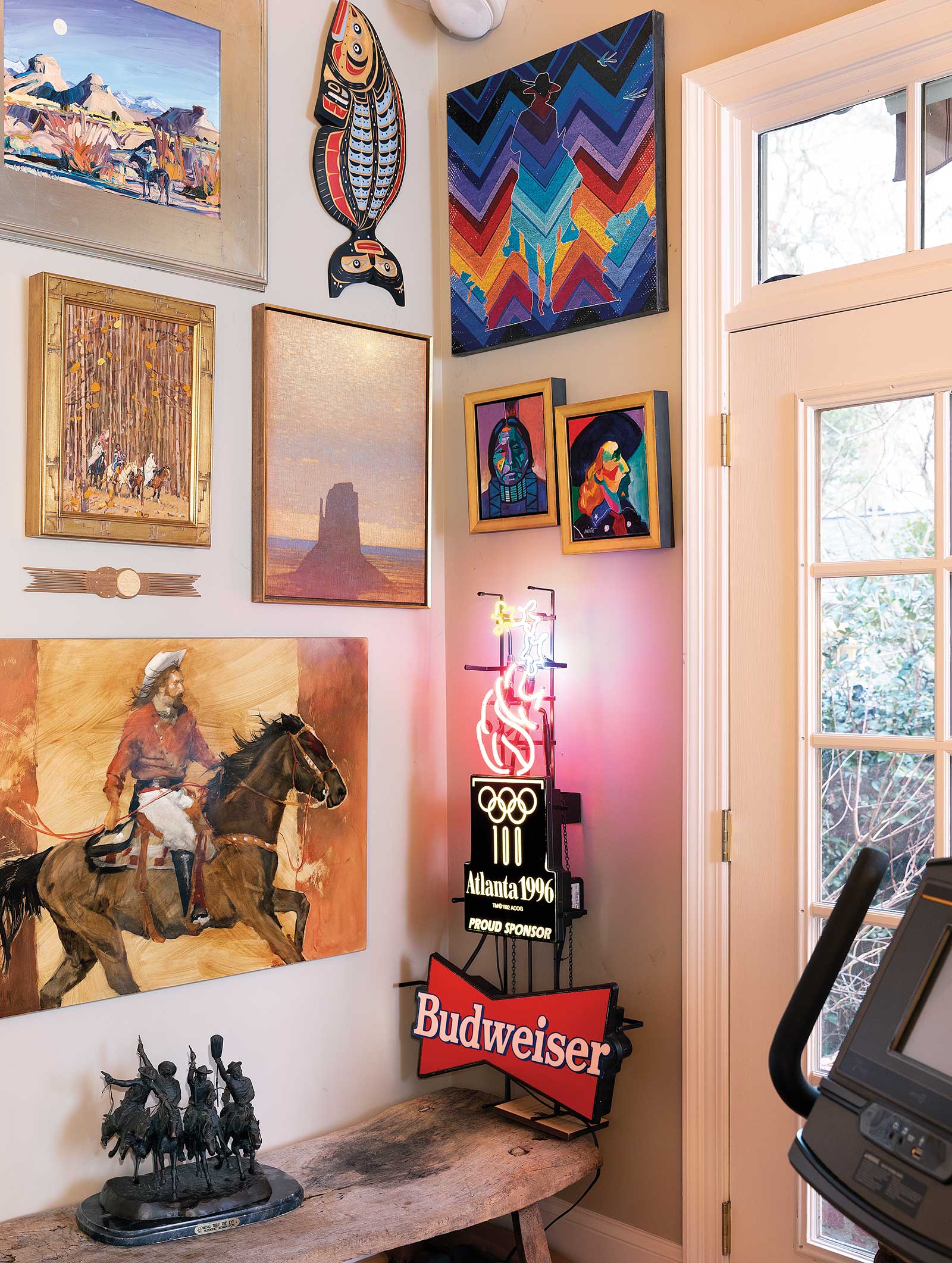
The painting on the top right in the family room is Drifter Mirage pt. 2, acrylic on canvas, by Starr Hardridge. Beneath it are Custer and Crazy Horse, acrylics by John Nieto (1936-2018). Beneath them is a neon Budweiser 1996 Olympics sign from the Atlanta Olympics. On the upper left is Badlands Moonrise, oil on canvas, by Louisa McElwain (1953-2013). Next to it is Grouper, which Henry acquired in Ketchikan, Alaska. Beneath are, left to right, Through the Quaking Aspens, oil, by John Moyers, and Stone and Cloud Patterns, oil on linen panel, by David Grossmann. Below the Moyers is Comb Depicting an Eclipse, red and yellow cedar, by Greg A. Robinson (Chinook). Beneath it is Haste, acrylic on board, by J.E. Knauf. The sculpture is a reproduction of Coming Through the Rye, bronze, by Frederic Remington (1861-1909).
Throughout his collecting career, Henry has relied not only on his own insights but on the input of friends and dealers, not the least of which is Seth Hopkins, executive director of the Booth Western Art Museum in Cartersville, Georgia. “If I’m not sure about something I usually call Seth who I know will be honest with me. He’s done an incredible job with the Booth.
“Dean Munn was director of Altamira Fine Art in Jackson Hole and helped me locate about a third of the collection,” Henry notes. “We became friends and he has visited us here in Atlanta. Mark Karelson is the owner of Mason Murer Fine Art in Atlanta. He got me interested in self-taught artists.”
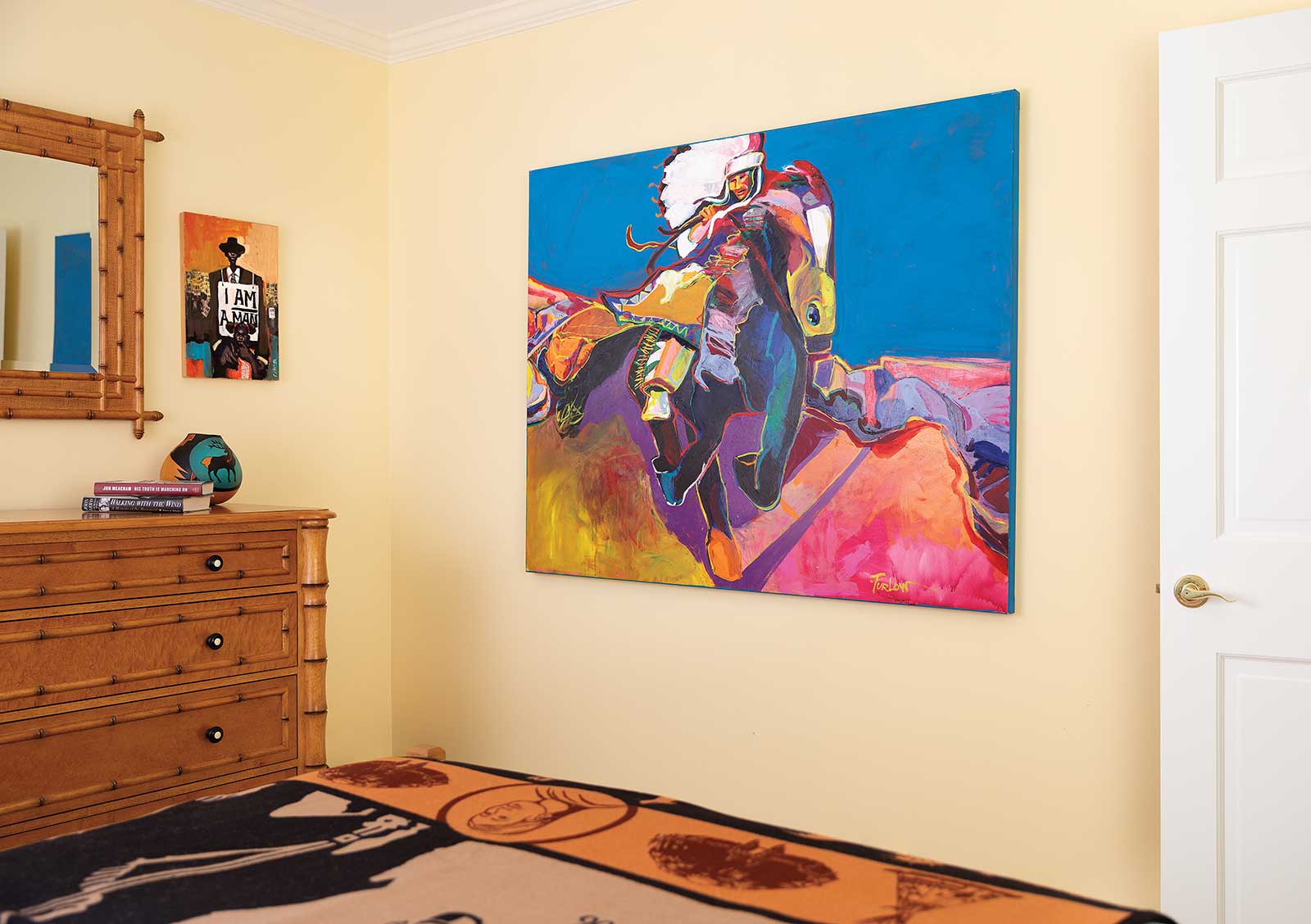
The large painting in the guestroom is Indian at Rio Grande, oil, by Malcolm Furlow. The painting on the adjoining wall is I Am a Man, oil on wood, by Atlanta artist, Charly Palmer, part of a collection of civil rights art.
Sometimes his purchases are spontaneous. “We saw Tony Abeyta’s Trueno Rodante that’s now over the fireplace when we were at Altamira Fine Art and bought it on the spot. I trusted myself and bought his large Aspen Wind Chant after only seeing a photograph from Blue Rain Gallery in Santa Fe.
“I’ve been on three medical mission trips and have brought back knickknacks from all over. I took the family on an Alaskan cruise and came down with Covid. The company put me in Ketchikan, Alaska, for 10 days. When I got better, I took some walks and found a little shop where I bought an Inuit sculpture of a grouper.”
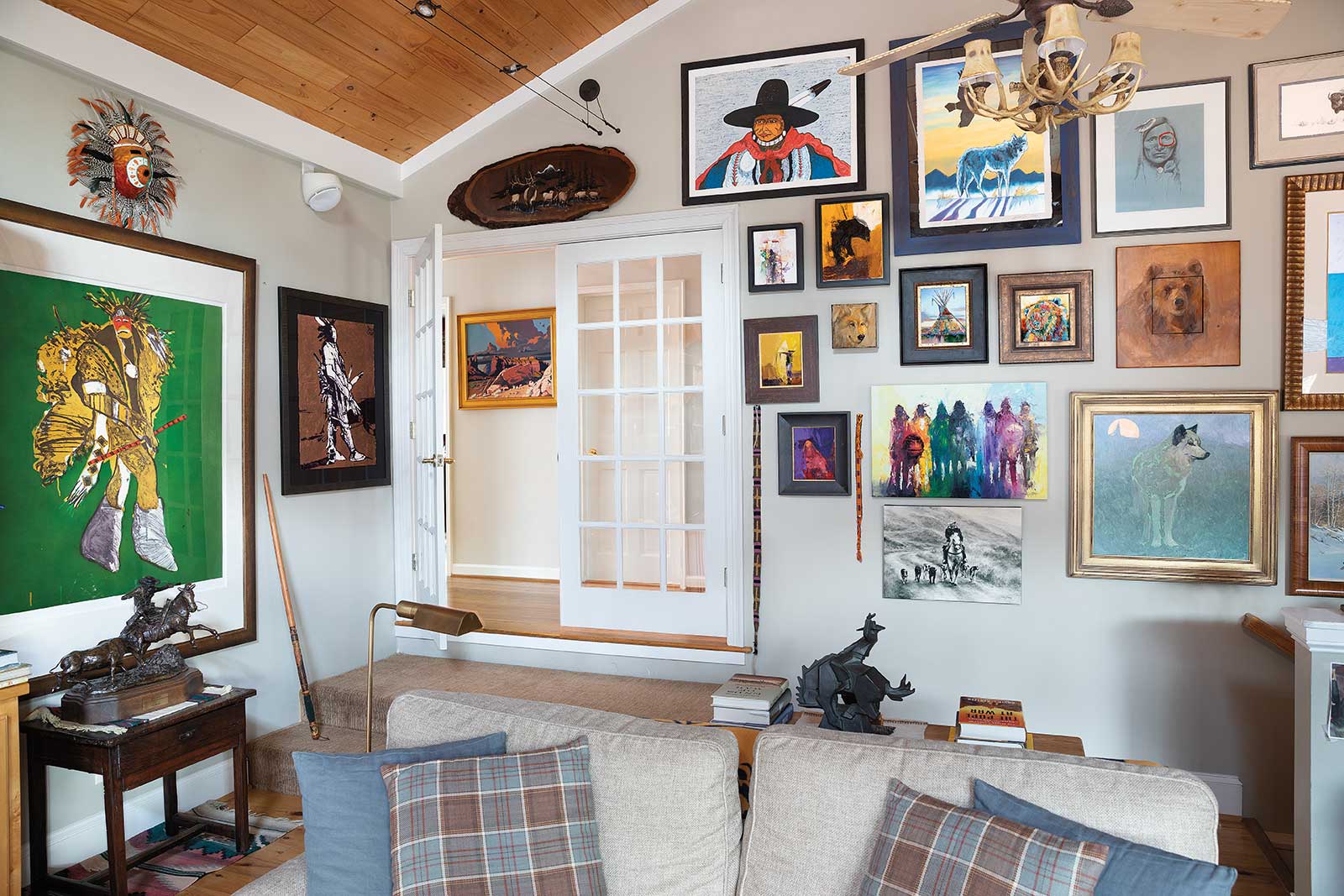
On the left in the family room is Fancy Dancer in Roma, etching and aquatint, by Fritz Scholder (Luisueño, 1937-2005). Beneath it is Isom Dart, Cattle Rustler, Thief, Rodeo Clown, 1978, bronze, by Ed Dwight. Above the Scholder is Sun Worshiper, a mask by Kelly Cedeño. To the right is Scholder’s Sioux Chief, lithograph. Through the doorway is Black Canyons, oil on canvas, by Billy Schenck. On the upper wall is a work by Kevin Red Star (Crow). Next to it is Blues Traveler by Jennifer Lowe. Below the Lowe are two paintings by Carol Hagan: Five Star Lodge, left, and Pink Cheeks. To the left of them is Wolf by Mary Roberson and a selection of paintings by Rocky Hawkins. To the right of the Hagans is Life Offers Beauty by Mary Roberson. Below it is The Enemy to My Enemy is My Brother by R. Tom Gilleon. To the left of the Gilleon are Color Changers, 2008, on the left, by Rocky Hawkins, and Magnificent Seven by Julie Grieg. Beneath the Grieg is Jack Knife, bronze, by Ed Mell.
“People love the art, but I think they are afraid to buy it themselves,” Henry says. “Some think no one should have so much art on one wall. I don’t care. I can’t explain why it gives me pleasure in words. It just does.” —
Powered by Froala Editor