Wildlife artists are built a little differently. While they still undoubtedly focus on all of the major, technical principles of art, there’s another element to their work entirely. On the one hand, there’s that pure love of art and visual expression that all artists can connect with. And on the other hand, there’s a deep-rooted devotion to animals, to nature and to the wild. You’ll often find many of the greats, both past and present, weren’t just painters or sculptors, but avid explorers, photographers, naturalists and conservationists. It’s not a requirement for painting this subject matter, and yet, a connection to nature seems to come with the territory.
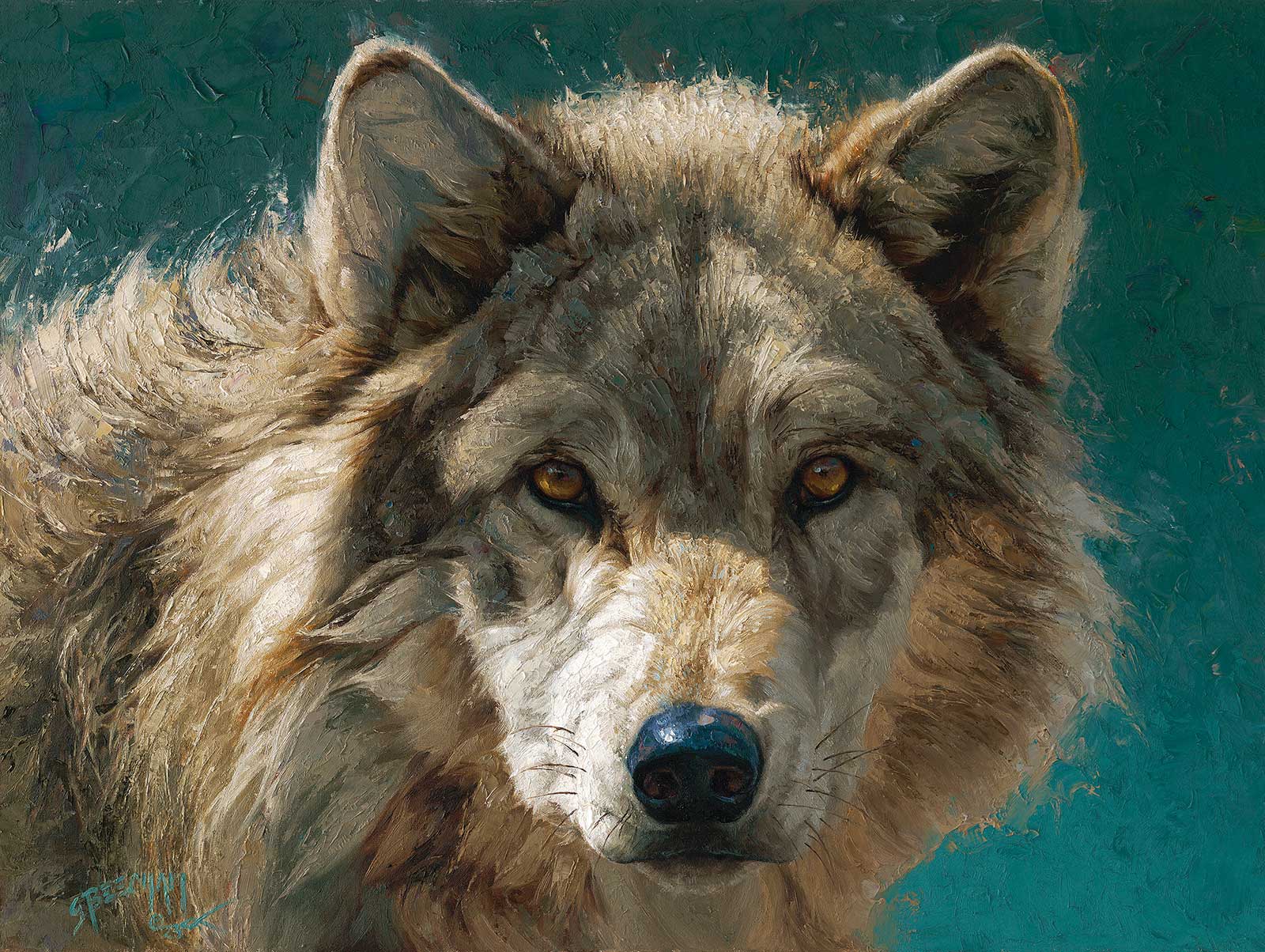
Greg Beecham, Beware the Stranger, oil on linen, 18 x 24”
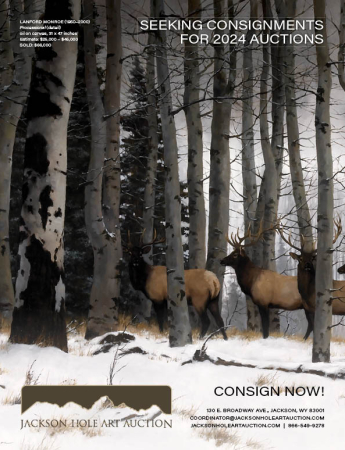
Beginning this winter, the Steamboat Art Museum in Steamboat Springs, Colorado, celebrates the untamed spirit of the American West in the exhibition Wild West: Wildlife Masters, Past and Present. A story of past and present, the show features a phenomenal collection of wildlife art from historic legends within the genre including Carl Rungius, Lanford Monroe, William Herbert “Buck” Dunton and Bob Kuhn, alongside 35 of the nation’s top living artists. Guest curated by Tim Newton, the exhibition is pieced together from private and museum collections, with several works available for purchase.
“When Tim Newton called me several months ago to tell me about the show and invite me to be a part of it, I got excited. I realized, from how he described it, that this show would be the most important wildlife art exhibition in a very long time,” says contemporary wildlife master Greg Beecham. “To have my work included in what will be the best of the best contemporary wildlife art—alongside the historic masters—is a high honor, which I don’t take lightly. This is going to be a goodn’.”
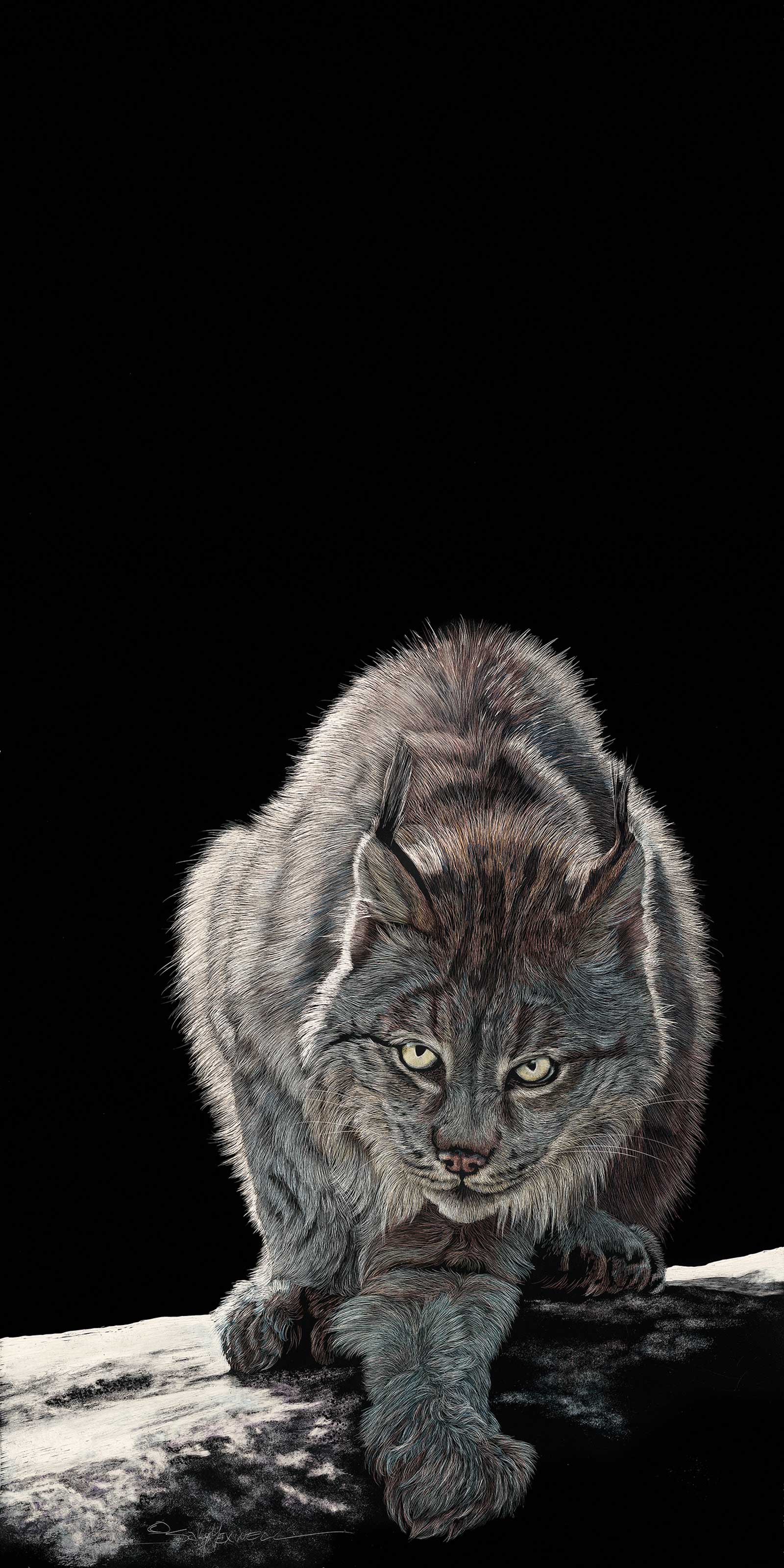
Sally Maxwell, Cautious Reentry, scratchboard, 36 x 18”
Beecham’s oil on linen Beware the Stranger is a stunning portrait of a timber wolf rendered with raw intensity, texture and expressive brushwork. With a closely cropped composition, Beecham creates an intimate moment between viewer and subject, where the wolf’s amber eyes seem to peer directly into the viewer’s. It’s a charged moment—electrifying and utterly still all at once—as though the viewer and the wolf are connecting for the briefest of encounters. “One interesting thing is that the wolf itself had one eye way smaller than the other. I don’t believe it was camera distortion, but the right eye was small enough that I had to enlarge it considerably in order to make the image work,” Beecham reflects on painting the piece. “It is kind of ironic, as so many who have expressed being blessed by the piece mention the eyes as speaking to them on an emotional level. I am not a formula painter, so I never really know where a painting is going to go until I dig in and get a direction as I see things happening. I am thankful that this one has something to say.”
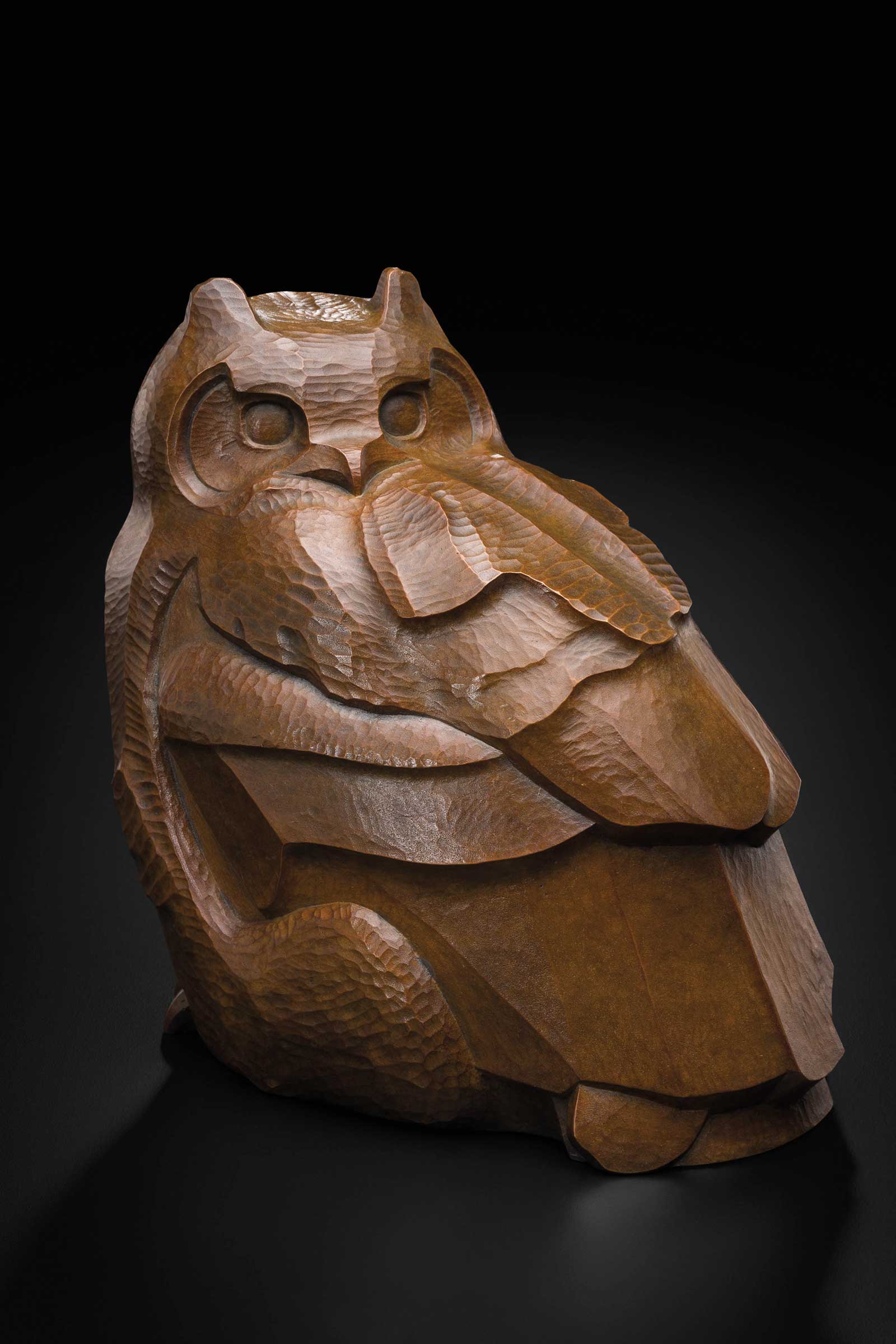
Tony Hochstetler, Rough Skinned Newt, bronze, 8 x 10½ x 9½”
Scratchboard artist Sally Maxwell created Cautious Reentrybased on a photo she took in Michigan years ago. “Back when I first built my own studio in the woods, it was only a few weeks after I moved in and was sitting at my drawing board that I spotted a bobcat out my window,” she says. “Fortunately, I had my camera on a tripod just in case and took many photos of him, climbing up a dead tree that was only 20 feet away from me…Cats are terrifically important to me…I have observed them up close and personal, and found that the larger species of cat are not that different than the common house cat…This cat spoke to me just as we were trying to get back to what we considered normal after the Covid shutdown. The look in his eyes and the body carriage was [exactly] the way I felt. We animals telegraph our inner feelings unconsciously.”
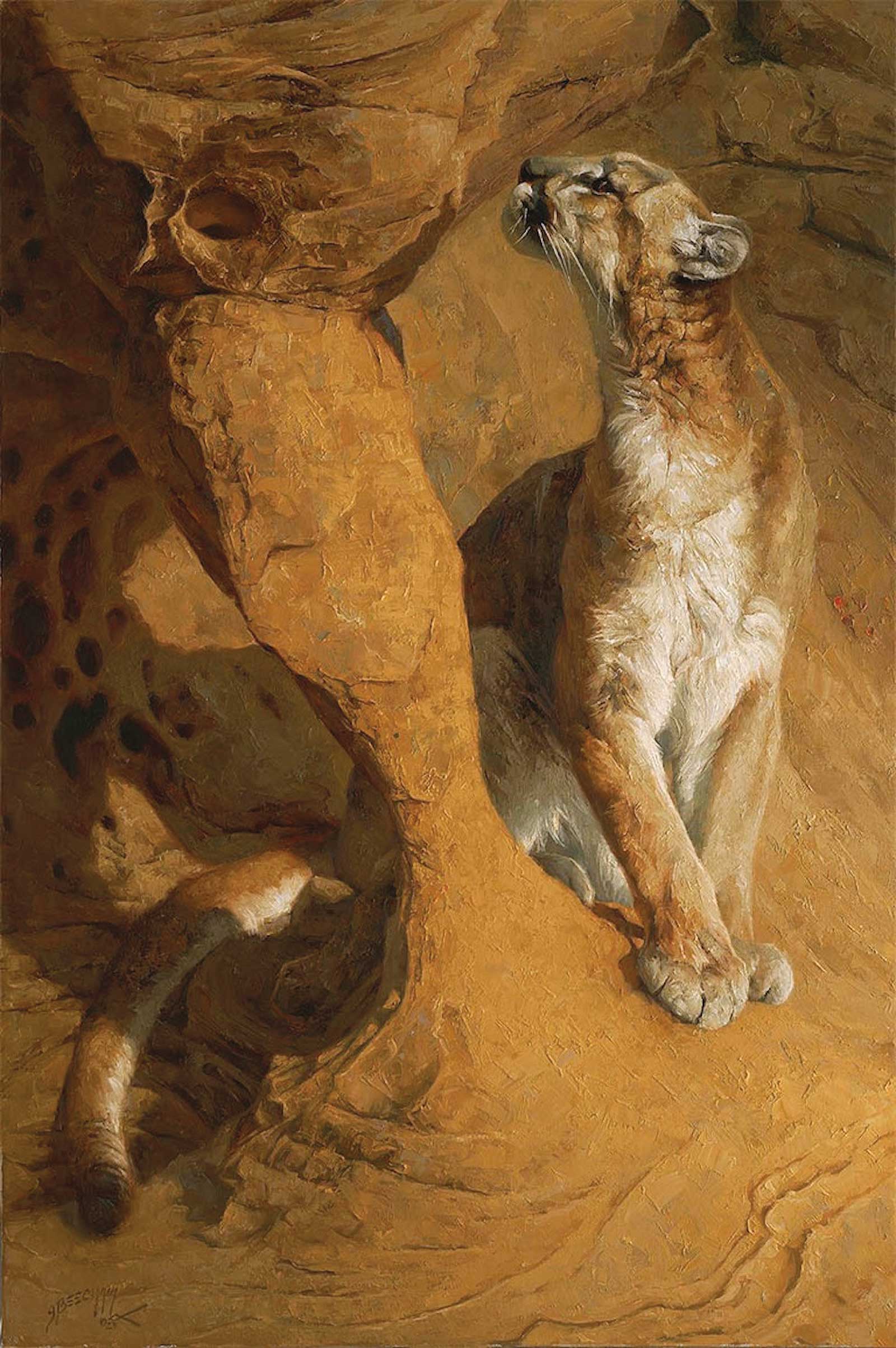
Greg Beecham, Checkin’ the Mail, oil on linen, 36 x 24”
Beecham agrees, adding that the best part of painting beasts is actually being right there with them in their own habitats. “I often go out in the field with wildlife artist friends, and we will literally start laughing. Here we are, with a grizzly right in front of us, and we look at each other and say, ‘this is our job!’ How can it get any better than that?”
Joshua Tobey sculpts North American beasts like bears, rabbits, wolves, deer and owls, to name just a few. While his bronzes are decidedly accurate in anatomy and form, Tobey instills a style in his work that’s entirely his own. Each sculpture seems to capture that particular animal’s personality, with anthropomorphic traits coming through in body language and expression. “Making wildlife the emphasis of my art career allows me to spend time studying wildlife. I think in today’s world, anyone that is able to observe the natural world on a regular basis is very fortunate,” says Tobey. “I think there is a growing disconnect with wildlife and wild places for the majority of people. I hope that my work reveals the subject in an artistic and beautiful way. But most importantly I hope that people connect and relate to the subject, recognizing part of themselves in my work.”
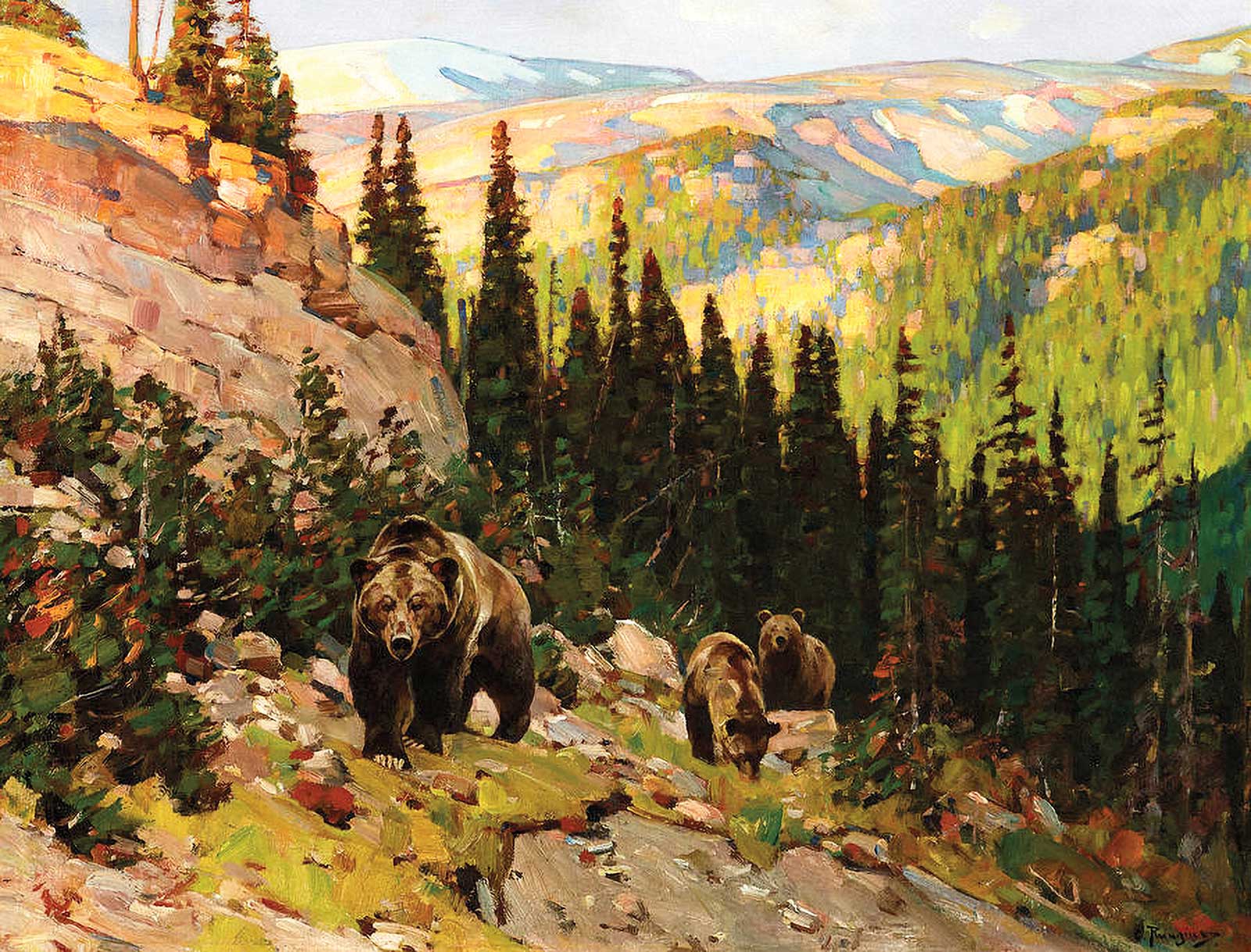
Carl Rungius (1869-1959), Out of the Canyon, oil on canvas, 28 x 36”
His piece Mothership was inspired by time spent observing sea otters. “[Watching an otter] floating on the ocean surface raising her pup in what I think of as the most unforgiving environment. There is no comparison in nature to the lifeboat that the mother otter is. Her body being a natural boat shape and a refuge for her pup,” says Tobey.
Another sculptor in the upcoming exhibition is Pati Stajcar, who dwells in the Golden, Colorado, area. “To have my work stand next to some of the historic masters of wildlife and my well-known contemporaries is exciting and humbling,” she says. “Tim Newton has brought together an eclectic group of art and artists to showcase the wonderful world of wildlife art, and I am proud to be part of this stable.”
One of her bronzes in the show, titled Riff Raff, depicts two ravens on rectangular perches. “The raven is an iconic figure in the images of Western culture,” says Stajcar. Just as birds have complete freedom in their ability to fly in all directions, this sculpture is versatile as well. Each raven is a separate piece, so collectors can arrange them in any way—touching, facing toward or away, even across the room from one another. “Their interaction can be anything from bluster and submission to mating behavior, [and] that’s for the viewer to discern,” says the artist.
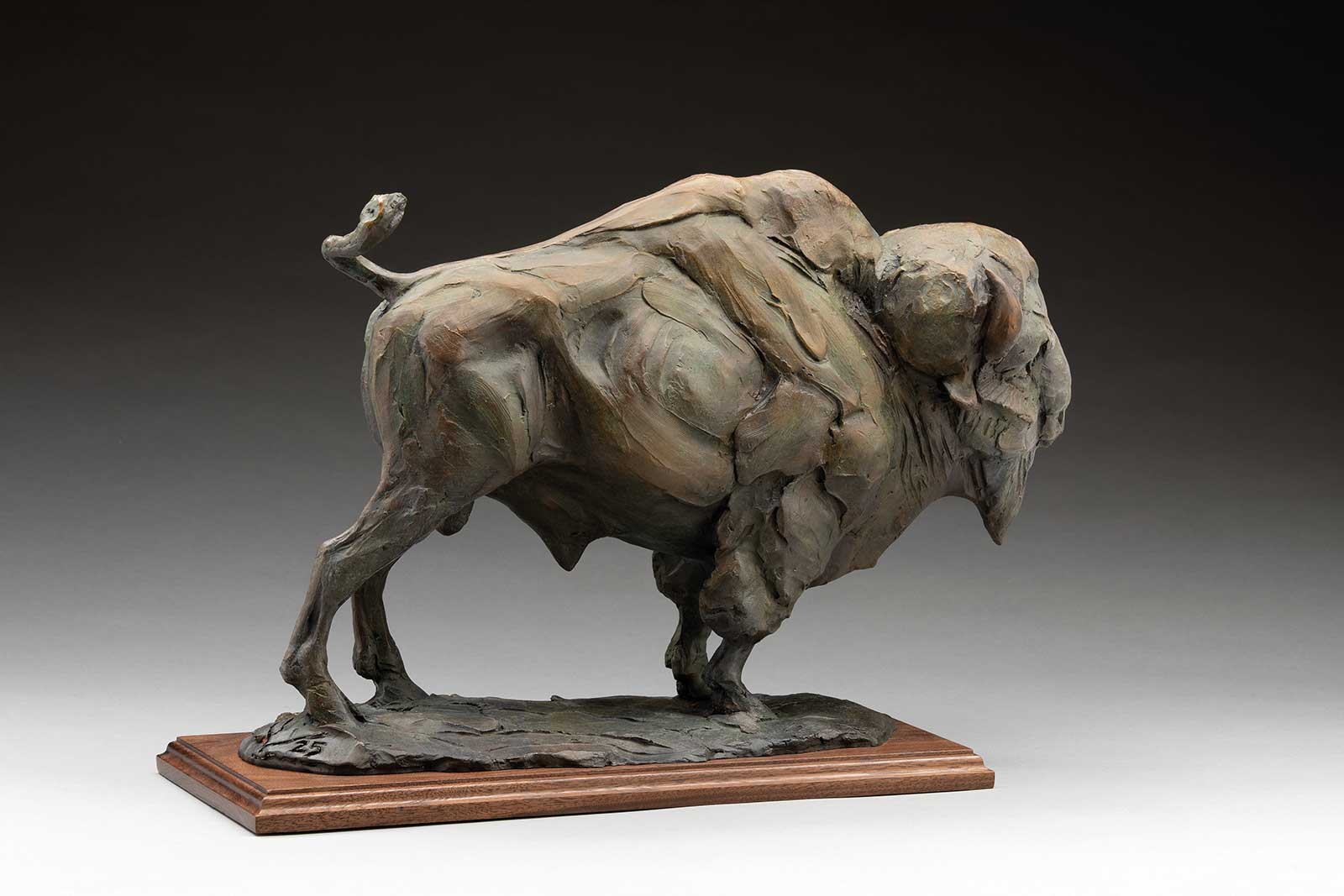
Sandy Scott, Herd Bull, bronze, ed. of 25, 13 x 21 x 7”
She continues, “I started sculpting birds early in my career as they are welcome in any setting. Looking out your window or walking a trail, they’re always close.” Stajcar volunteered for more than 16 years at the Raptor Education Foundation, then five years at Nature’s Educators, a non-profit wildlife organization in Colorado. Both organizations provide educational outreach programs using injured and non-releasable raptors as ambassadors to teach the public about the importance of biodiversity and conservation. “There is nothing like having an owl, hawk or falcon, vulture or eagle on your glove,” says Stajcar. “It is both wild and fierce, and powerful yet centering.”
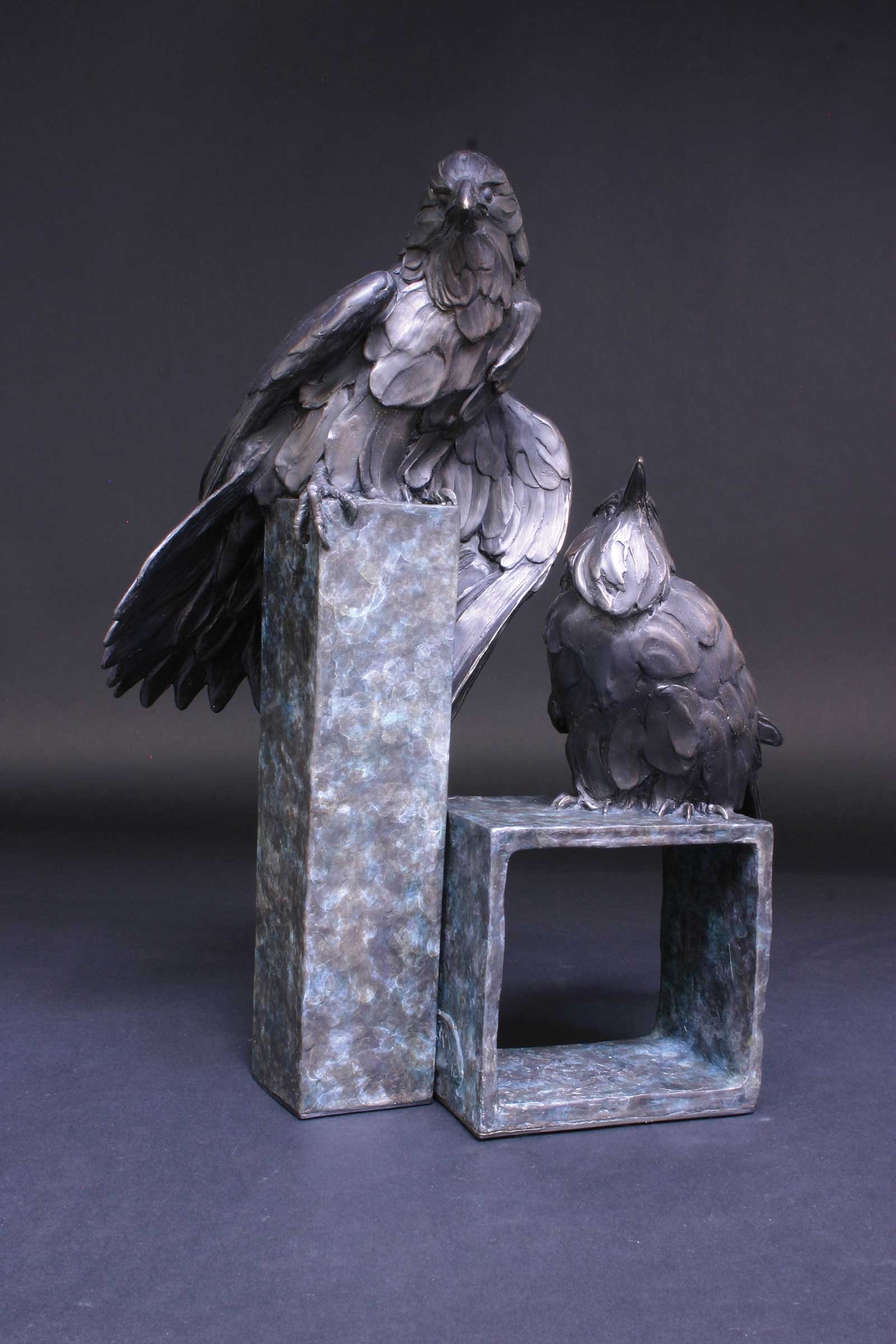
Pati Stajcar, Riff Raff, bronze, ed. of 12, 19½ x 14 x 14”
Wild West: Wildlife Masters, Past and Present will also feature the artwork of Jim Bortz, Jim Morgan, Mark Kelso, Dustin VanWechel, Tucker Smith, Amy Ringholz, Mark Eberhard, Bill Alther, Kyle Simms, Nancy Howe, Ezra Tucker, Dan Smith, Douglas Allen, Jill Soukup, Bonnie Marris, Walter Matia, Sandy Scott, Paul Rhymer, Tim Shinabarger, Rich Loffler, Steve Kestrel, Sandy Graves, T.D. Kelsey, Peregrine O’Gormley, Tony Hochstetler, Tim Cherry, Curtis Zabel, Lindsay Scott, Tom Quinn and Ray Brown.
The exhibition opens December 1 and hangs through April 13, 2024. A ticketed celebration with the artists is set for December 2, with a variety of educational programs scheduled throughout the duration of the show. —
Wild West: Wildlife Masters, Past and Present
December 1, 2023-April 13, 2024
Steamboat Art Museum 807 Lincoln Avenue, Steamboat Springs, CO 80487
(970) 870-1755, www.steamboatartmuseum.org
Powered by Froala Editor