In 1845, George Catlin presented his paintings of Native Americans in Paris. The great French animal painter Rosa Bonheur acquired a set of prints of his paintings. Her interest in Indigenous people and the American West led her to attend William F. Cody’s Buffalo Bill’s Wild West Show at the 1889 Paris Exposition Universelle.She had become friends with Buffalo Bill who gave her free rein to roam the encampment to paint and to draw.
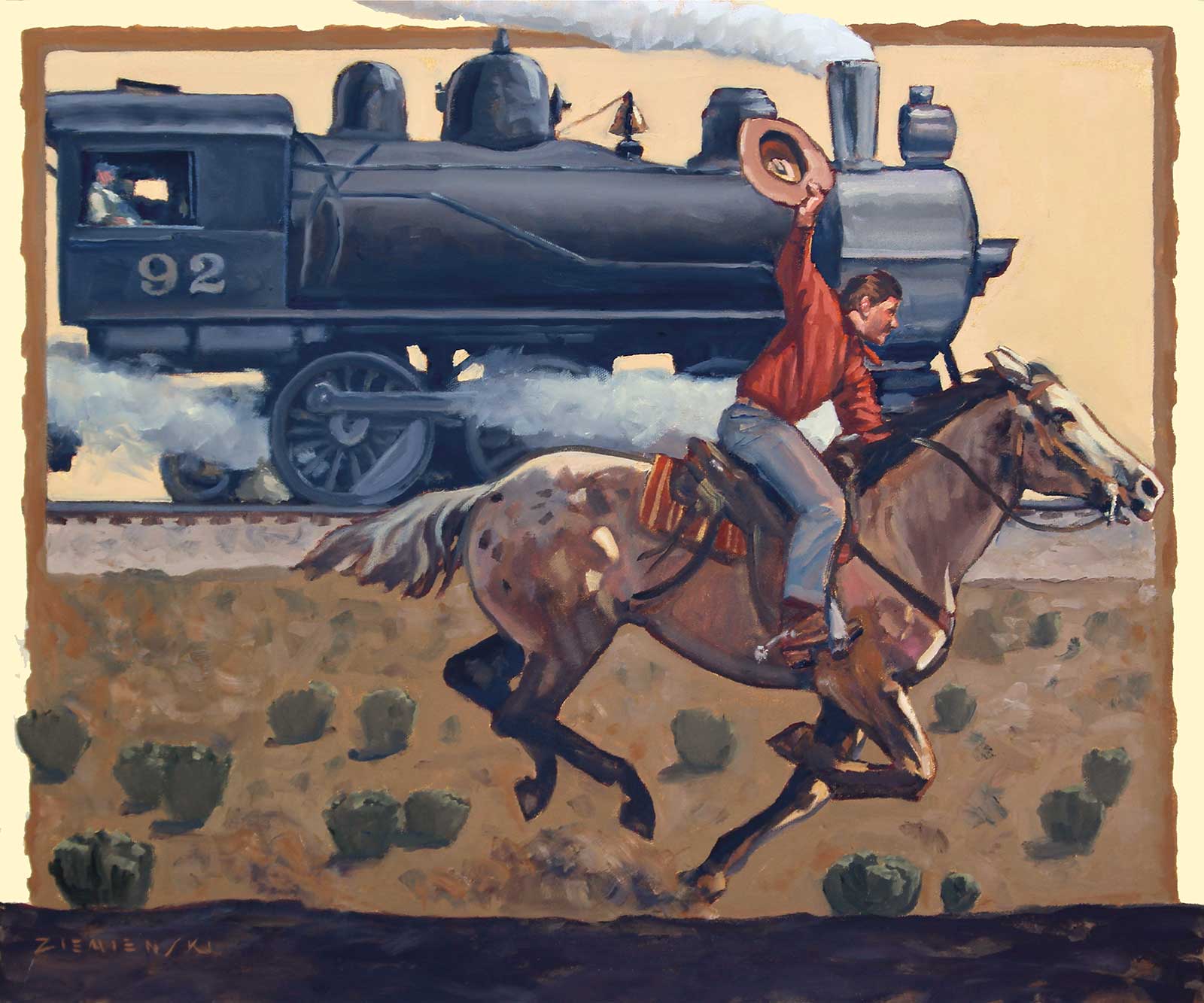 Mark Sublette Medicine Man Gallery, Iron Horse Race, oil on canvas, 20 x 24”, by Dennis Ziemienski.
She later invited Cody to her estate where she painted a portrait of him on horseback and presented the painting to him as a gift. It later appeared on posters for the Wild West Show’s European tour. Cody employed real cowboys and cowgirls to perform in his spectacle. He had earned the sobriquet “Buffalo Bill” for his skill at slaughtering buffalo to feed railroad workers in the West. His travelling show popularized the romantic myth of the cowboy and the American West.
The romance and reality of cowboys combined in competitions they held among themselves to test their skills. The competitions evolved into rodeos that continue today throughout the West.
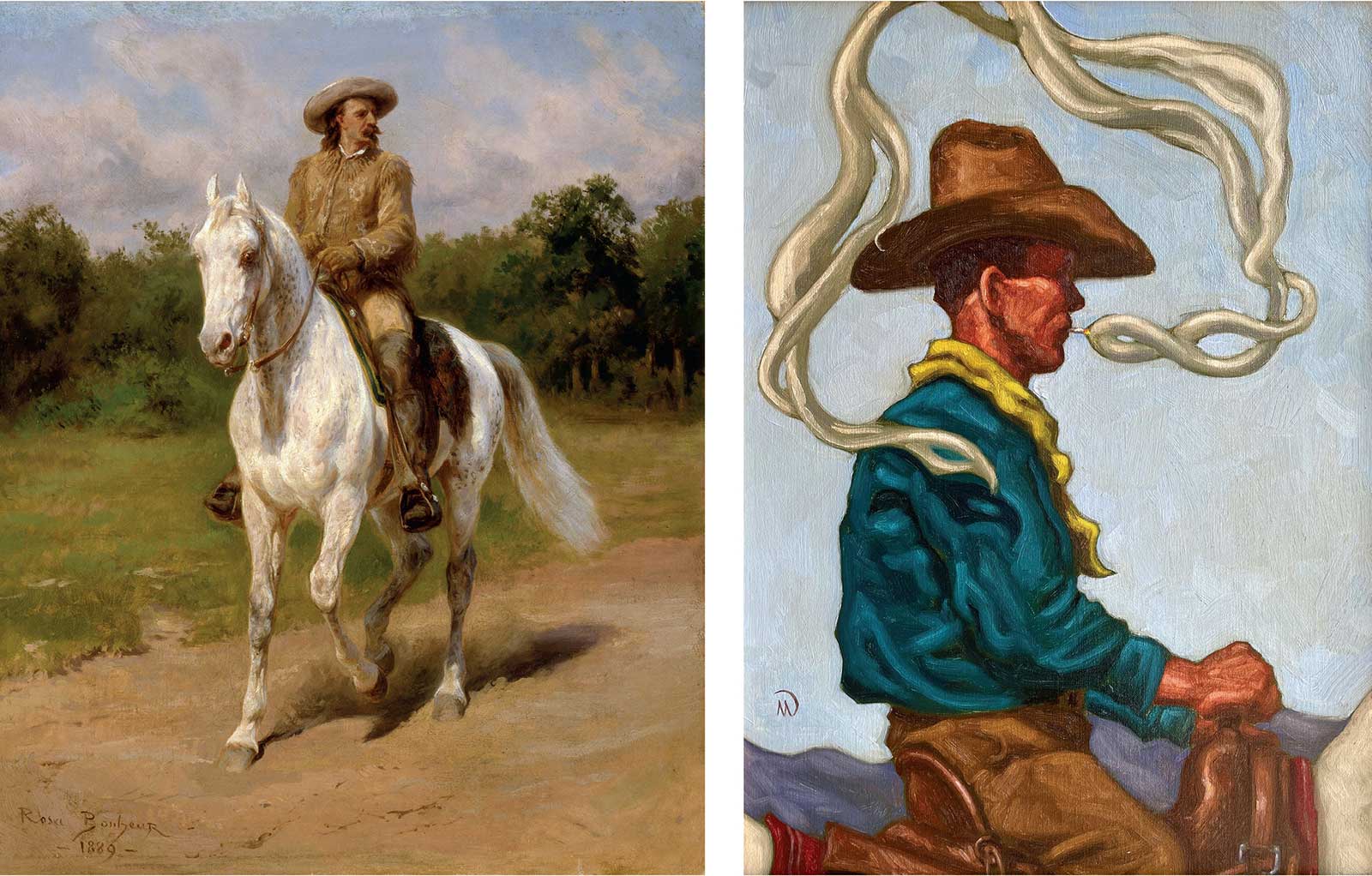
Whitney Western Art Museum, Col. William F. Cody (Buffalo Bill), 1889, oil on canvas, 18¼ x 15¼”, by Rosa Bonheur (1822-1899), given in memory of William R. Coe and Mai Rogers Coe; Parsons Gallery of the West, Hold Tight, oil on panel, 24 x 18”, by Drew Macias.
Dennis Ziemienski painted a competition between a horse and rider and a locomotive in the powerful composition of his painting Iron Horse Race. Traveling throughout the West as a young man he saw cowboys driving Model T’s and Native Americans driving pickup trucks—juxtapositions of unexpected elements. He enjoys “conjuring up imagery” such as Iron Horse Race. In this painting, he has included a border, a device from his advertising days, and breaks it (as with the horse’s muzzle) to give a sense of three dimensions. In his career as an illustrator, he admired the work of Maynard Dixon and Edward Hopper, artists he considers “fine illustrators…I think it was their use of geometry and their composition that influenced me the most. Even back in college I knew I wanted to make dramatic compositions like theirs.”
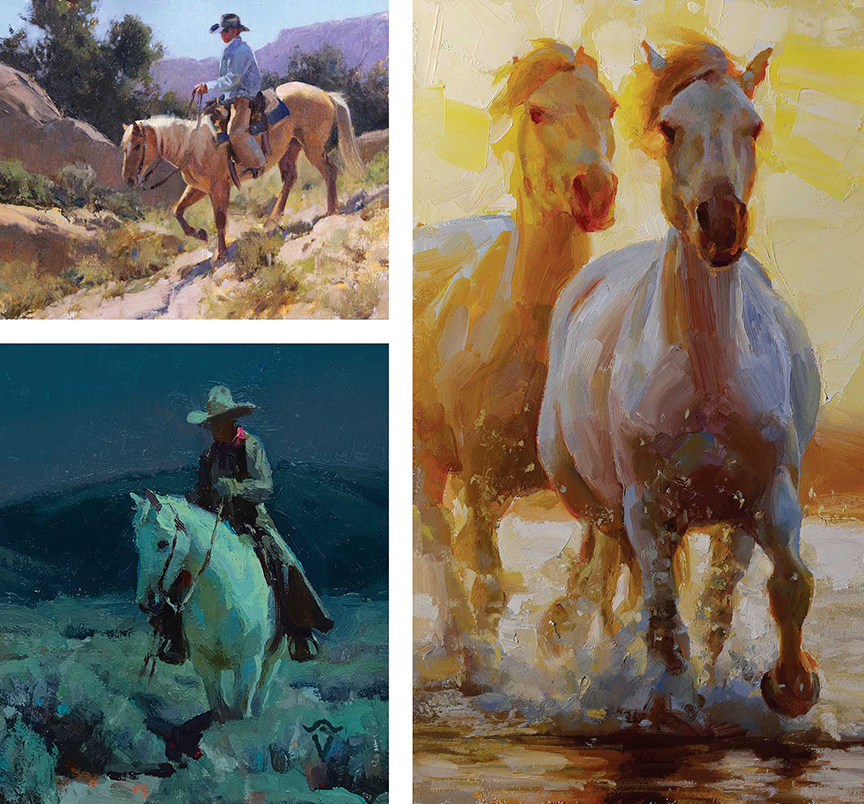
Clockwise from top left: Legacy Gallery, Sure Footed, oil, 10 x 12”, by Bill Anton; Legacy Gallery, Golden Hour, oil, 16 x 9”, by Jason Rich; Legacy Gallery, Sage Nocturne, oil, 8 x 7”, by Albin Veselka.
Drew Macias’ early career was in professional baseball in which he was an outfielder for the San Diego Padres. A stint as an actor also preceded his dedication to fine art. The hard work of baseball and the awareness of expression in acting combine in his portraits of weathered cowboys, a subject he has focused on since he was a boy. He says, “Every face has a story to tell. I just hope to capture it.” He often combines the veracity of his portraiture with his magical depiction of cigarette smoke. “The smoke is always on a whim,” he explains, “so it always comes out so different. I just go wherever it takes me.”
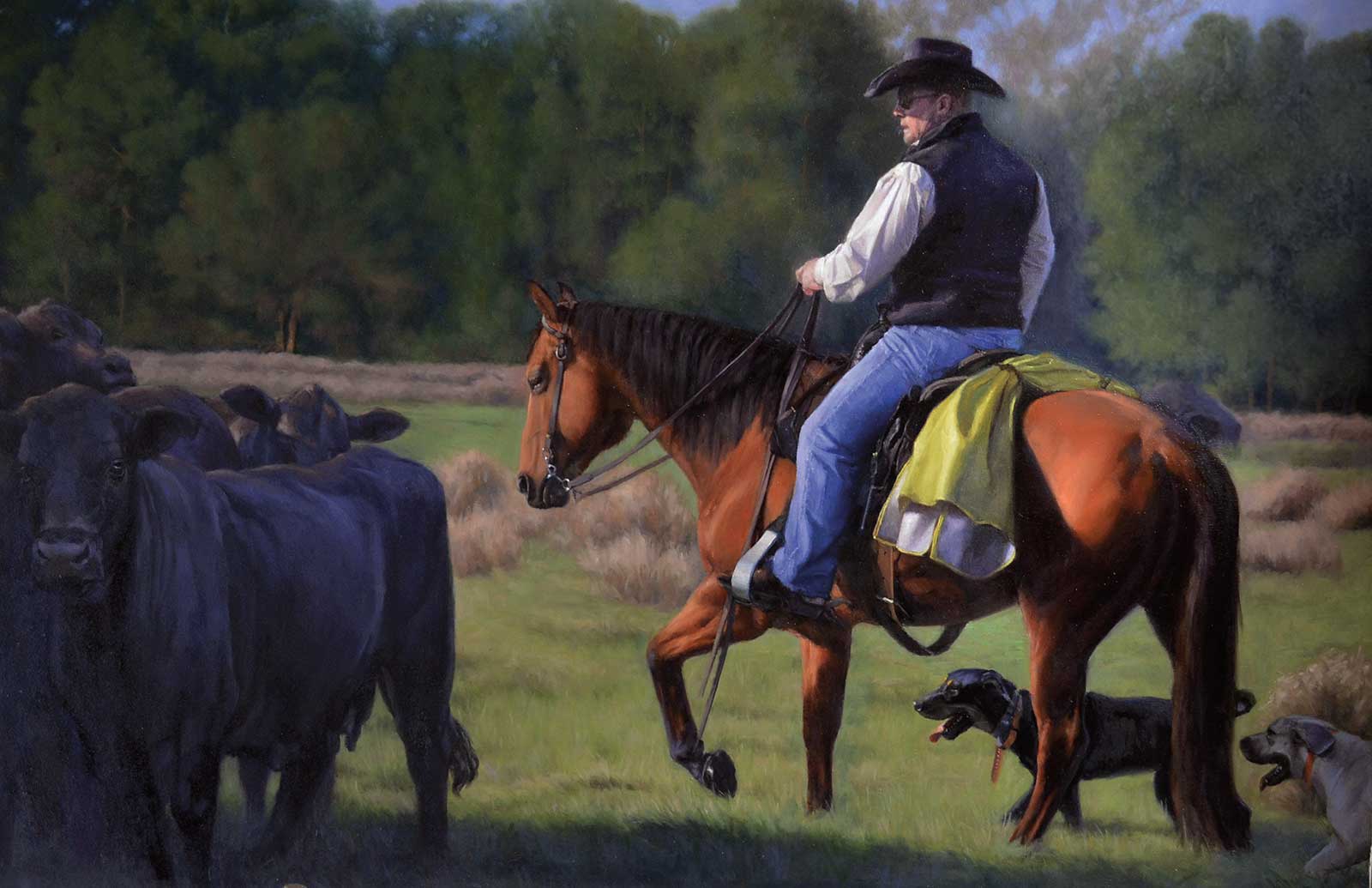
Kenneth Spirduso, Morning Roundup, oil on linen, 24 x 36”
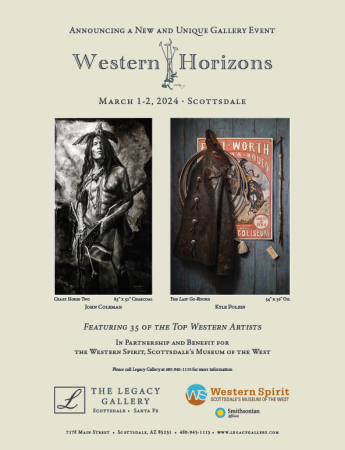
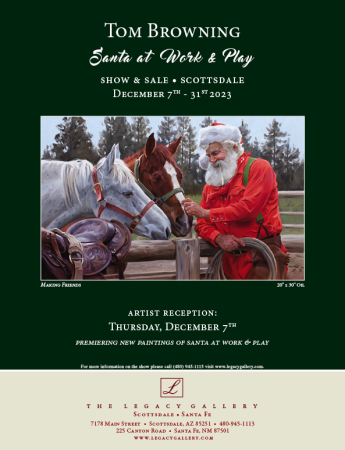
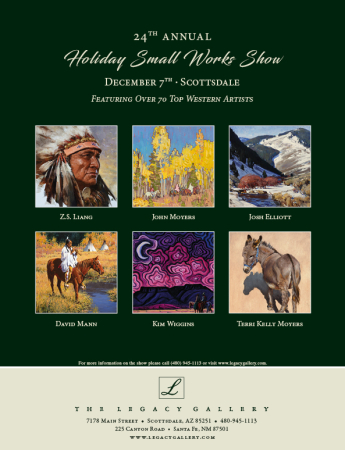
The American Cowboy takes on many forms by many different artists. Numerous examples will be on view at the annual Holiday Small Works Show at Legacy Gallery in Scottsdale, Arizona. Cowboy highlights from the December 7 show include Bill Anton’s Sure Footed, showing a horse and rider during bright afternoon light; Jason Rich’s stunning horse painting Golden Hour; and Albin Veselka’s Sage Nocturne, which shows a cowboy from an older era riding slowly under a moonlit sky. Legacy Gallery has long shown work that features and celebrates cowboys in many mediums and styles.
Shirley Quaid, Tracking Before the Storm, oil, 24 x 30”
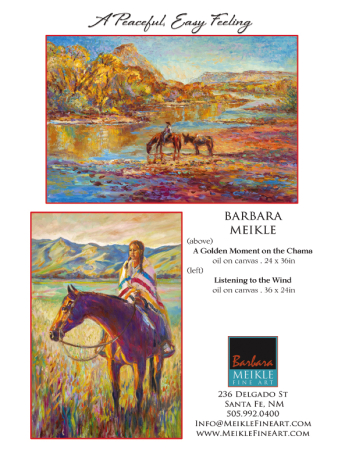
In Santa Fe, New Mexico, artist Barbara Meikle has appreciated cowboys for decades, both in her studio and her gallery, Barbara Meikle Fine Art, which is located several dozen feet off the famous Canyon Road. “Painting horses, cattle, working cowboys and cowgirls is a favorite of mine—I love to portray the energy they create, and the beautiful landscapes that they live in,” Meikle says. “There is something special and monumental about a figure in a cowboy hat, atop a magnificent steed, striding through the desert, or the prairie, or the corral…it’s that kind of romance I think that keeps the traditions of Western art alive. I’m not a traditional painter, but I think us modernists can use color and texture to portray what we love about the West…Collecting artwork is all in the eye of the beholder, and I find that some people gravitate towards the horses and riders, while others like the solitary animal in the landscape. The most important thing is to love the piece you collect, that way it will always have a space on your walls.”
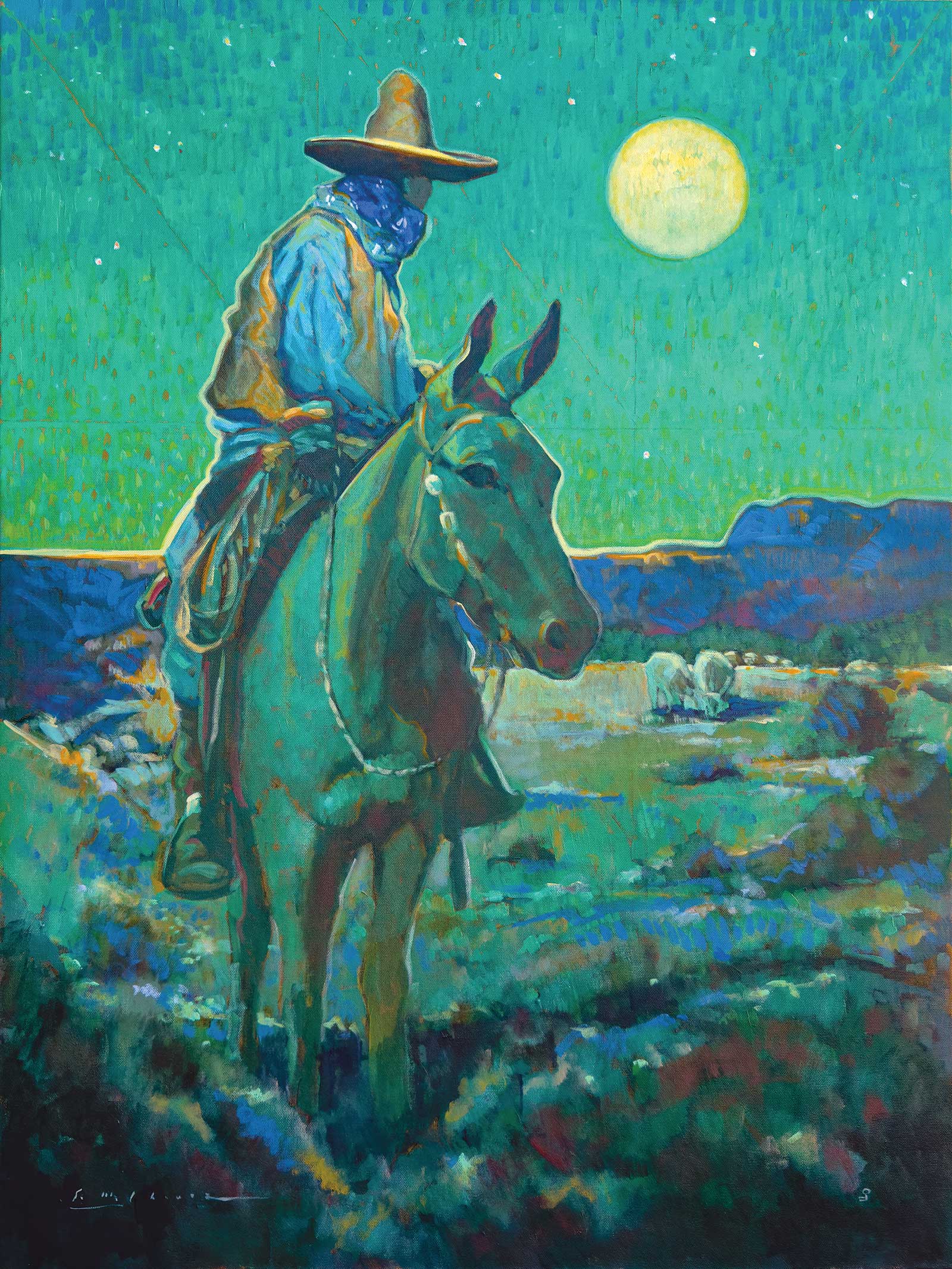
Sean Michael Chavez, Moonlighters, oil on canvas, 48 x 36”
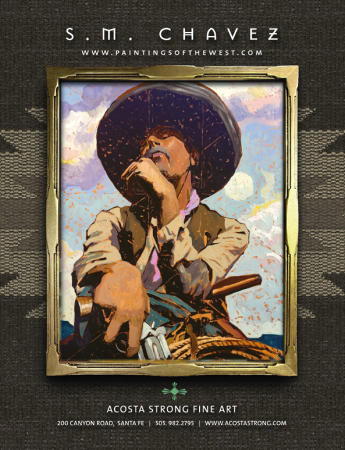
One of the rising stars of Western art is Sean Michael Chavez, who not only paints cowboys, but their Mexican counterparts—vaqueros. This subject matter has served as the theme for some of his most recent shows. “Without the vaquero, the West and the cowboy as we know it doesn’t exist. Neither does Western art. The genre of the cowboy would look very different without the lasso, the wide-brimmed hats, the chaps, the husbandry and riding style, or even the moral code of the ‘originales,’” Chavez says. “‘Dar a luz’ is an expression than can be translated from Spanish as ‘to give light.’ I find that fitting in the work I do in many, many ways. It is an honor to be given the opportunity to paint and give light where I can within this invaluable heritage and catalyst, that of the American West, and the art it continues to inspire.”
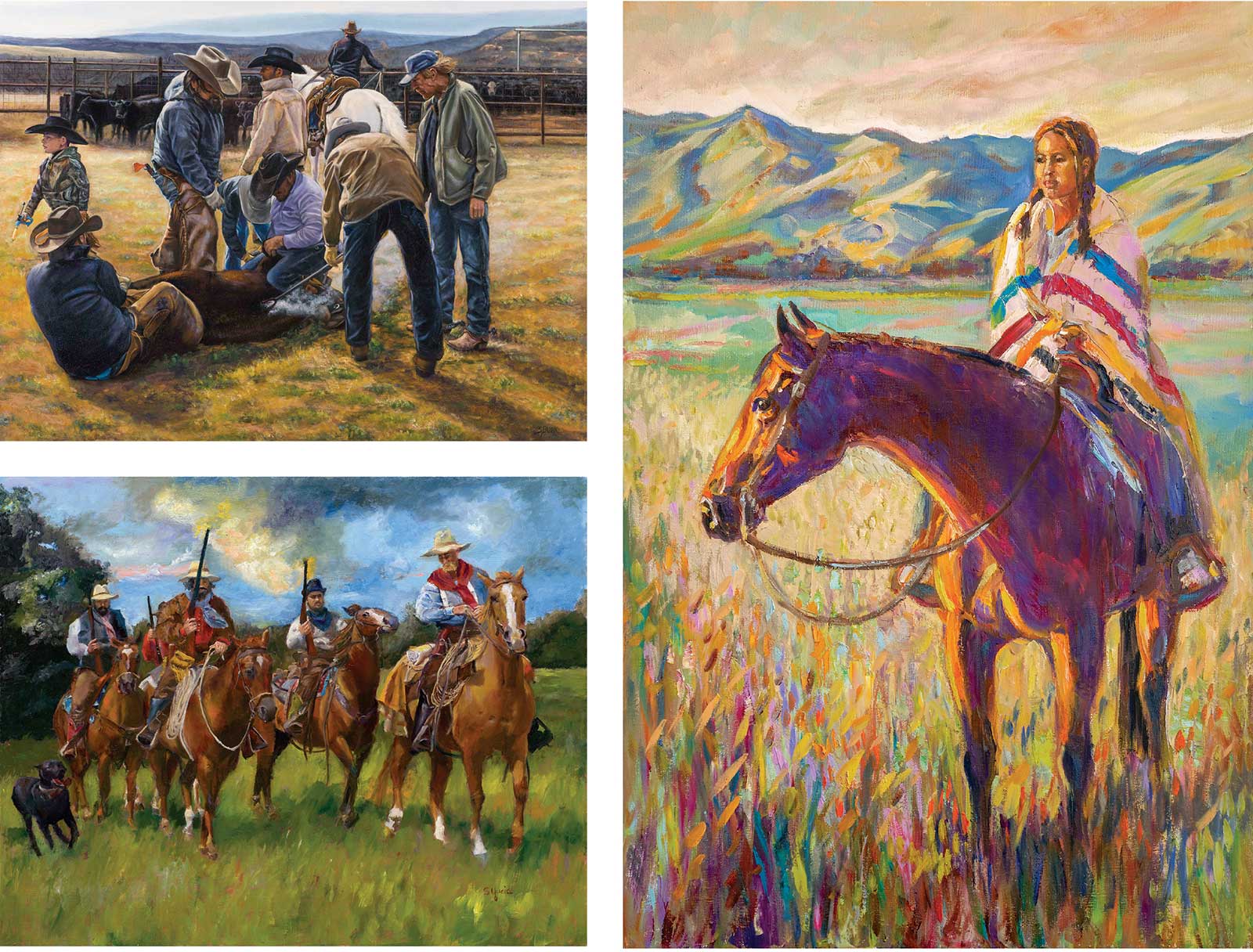
Clockwise from top left: Stephanie Burk, Lambshead, oil on canvas, 30 x 40”; Barbara Meikle, Listening to the Evening Wind, oil on canvas, 36 x 24”; Shirley Quaid, Tracking Before the Storm, oil, 24 x 30”
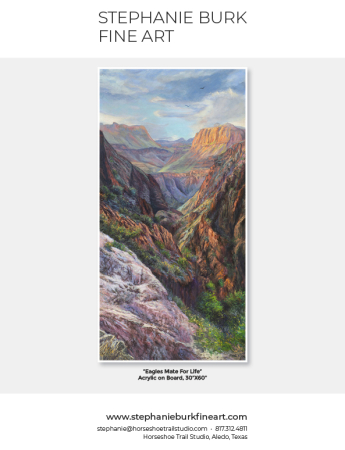
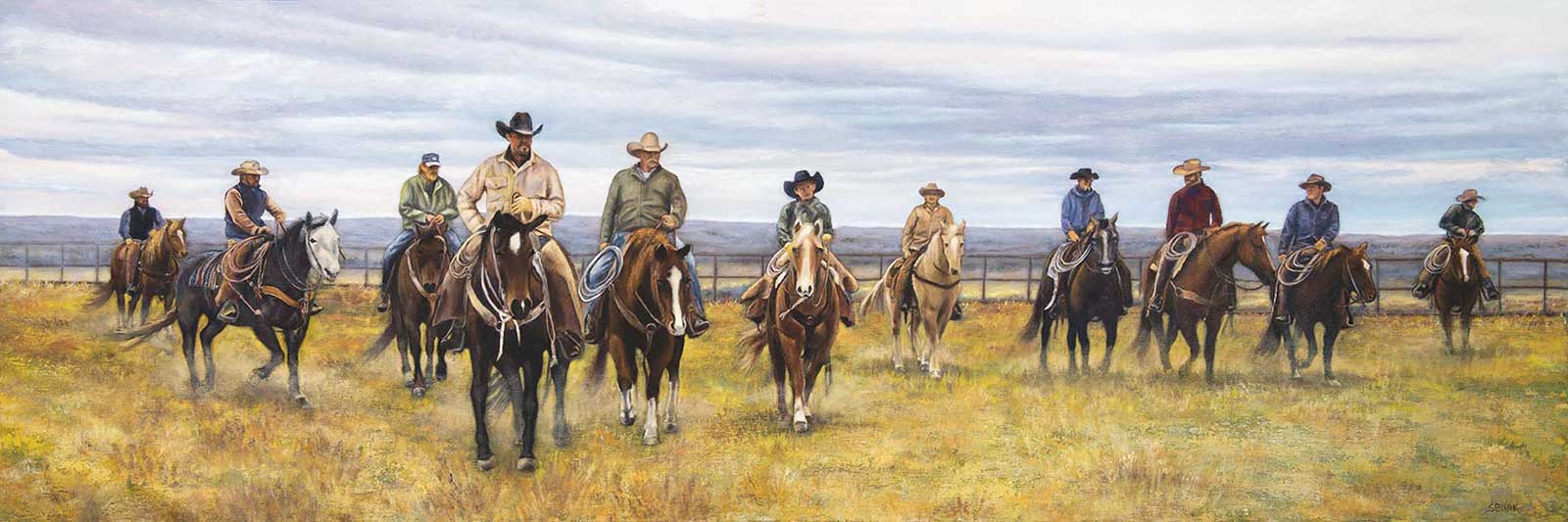
Painter Stephanie Burk is also inspired beautiful lands and fascinating people, and aspects of the West she can witness firsthand. “I adore living in the American West. My husband and I had the incredible opportunity to join fellow artist Susie Gregg and her husband, Clarke, both retired physicians, at their family ranch Lambshead, in Albany, Texas, founded in 1897. Branding the 400 calves took all day, sunup until sundown, with a short break for mesquite-grilled steaks early afternoon. The cowboys had taken their sons out of school to help, as shown in the paintings. The opportunity to be on the historic ranch in the middle of the annual event was a trip I’ll always cherish. I tried to capture not only the spirit of the West, but also the bond between all those participating, from the ranch managers and owners, to a second grader in charge of vaccinating each calf, a job he took seriously,” Burk says, adding that she loves to paint these subjects for those who want to celebrate the West. “Collectors are an integral partner in an artist’s career. As an artist, there is no greater thrill than seeing a patron connect with one of my paintings and make the decision to have it hang in their home.”
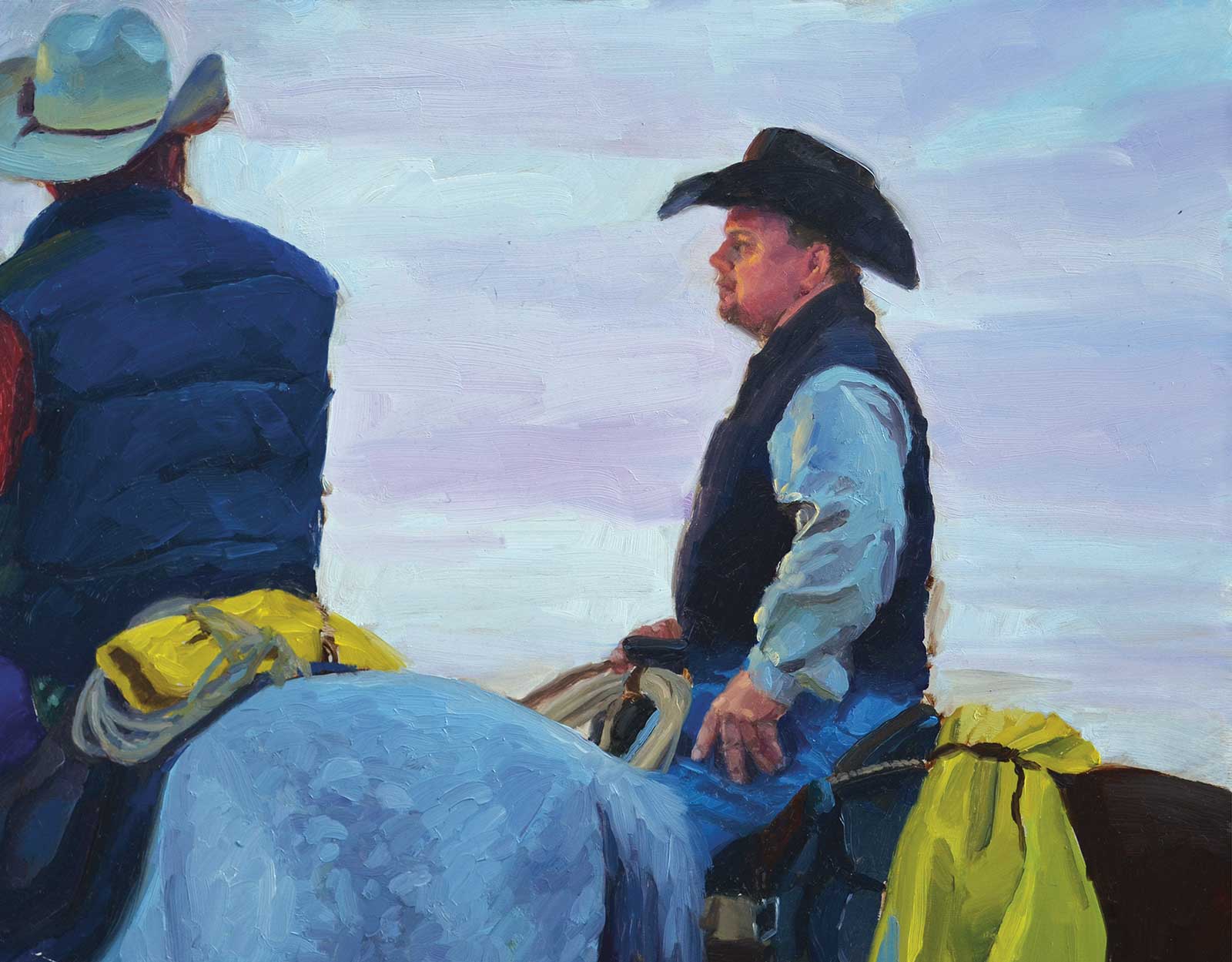
Kenneth Spirduso, Preparing for Work, oil on linen board, 11 x 14”
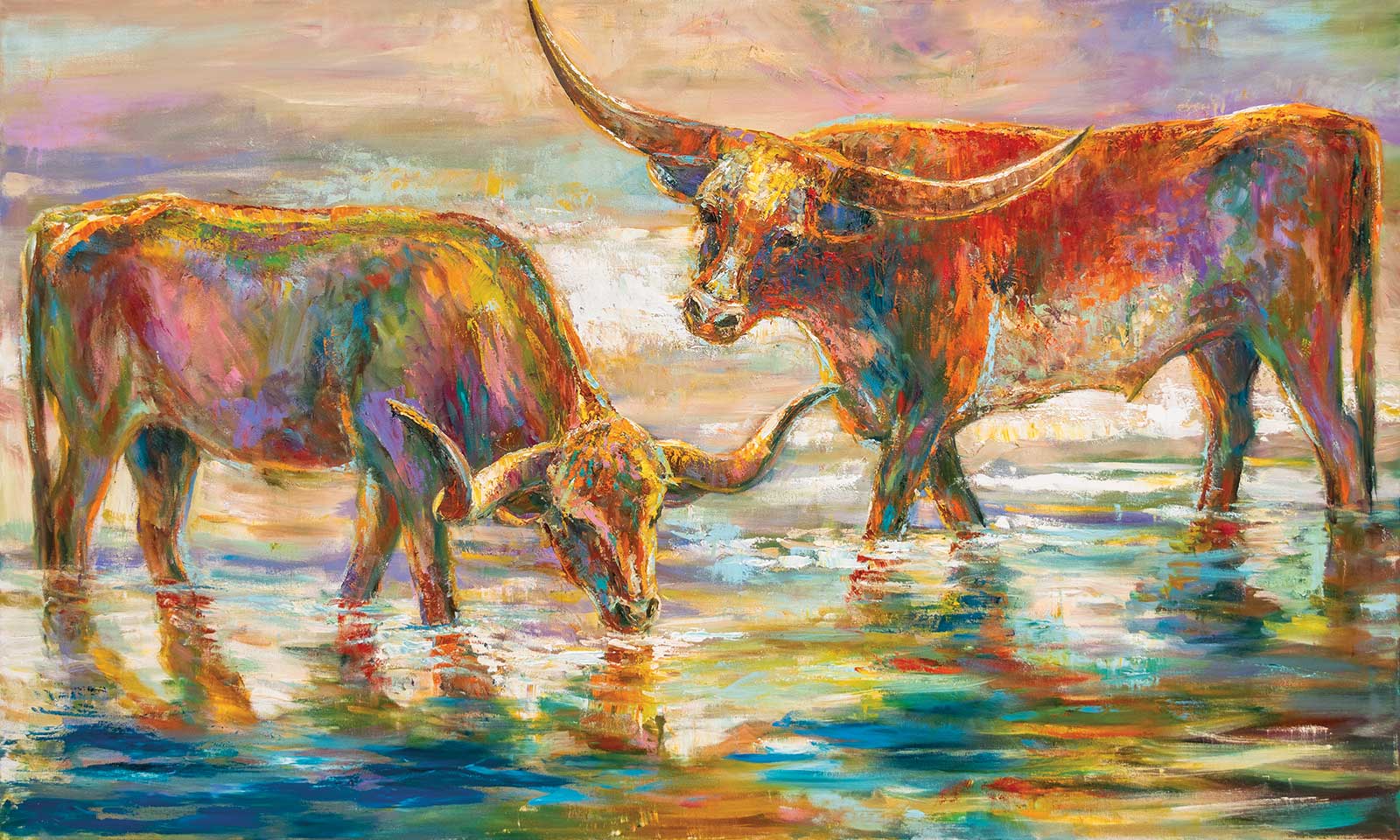
Barbara Meikle, Solace in the River, oil on canvas, 36 x 60”
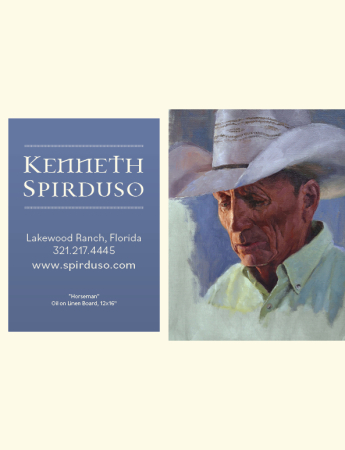
Horses play a major role for Kenneth Spirduso, as does firsthand experience. “In order to get reference for my paintings, I spent an early morning with my friend, Jason, as he and his fellow cowboys worked cattle. Studying the herd from their saddles, they planned their work as the sun rose over the trees. With quiet confidence, they moved through the herd looking for a sick cow that needed medication. Once spotted, she was quickly lassoed and attended to. Their well-trained horses were agile and quick and darted in and around the cattle with ease,” the artist says. “And then there were the cattle dogs, who loudly assisted in the morning roundup. Tongues hanging out, eyes bright with excitement, they raced and barked, coaxing the big beasts to move, while always listening for Jason’s instructions. The teamwork of cowboys, horses and dogs, the warm sunlight and cool shadows, the herd of cattle moving through the wet, morning grass, combined to be an inspiration for these paintings.”
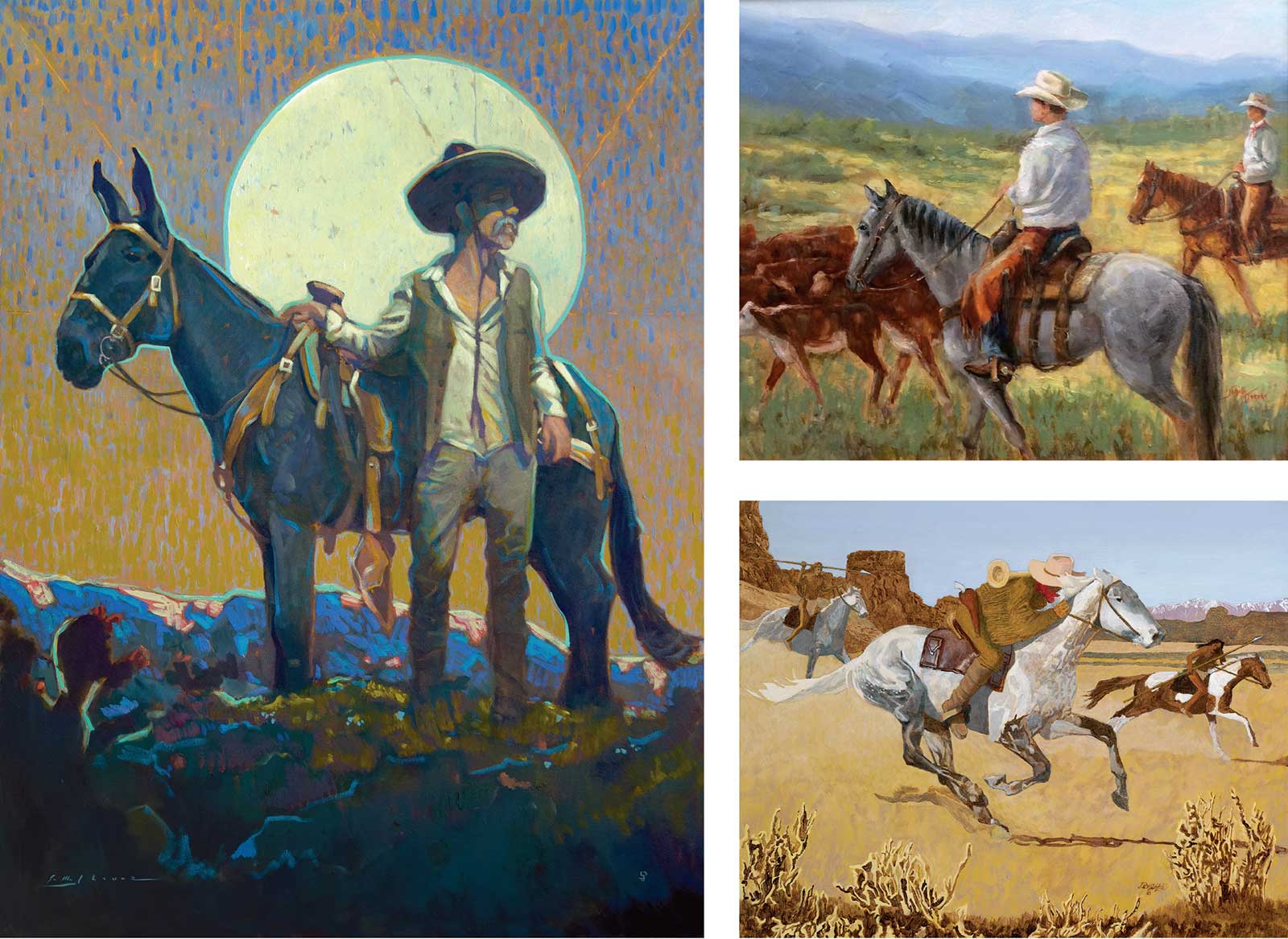
Clockwise from left: Sean Michael Chavez, From Here to…, oil on canvas, 48 x 36”; Judith Jordan, Head Them Out, oil, 20 x 24”; Den Schofield, The Pony Express, oil on canvas, 24 x 30”
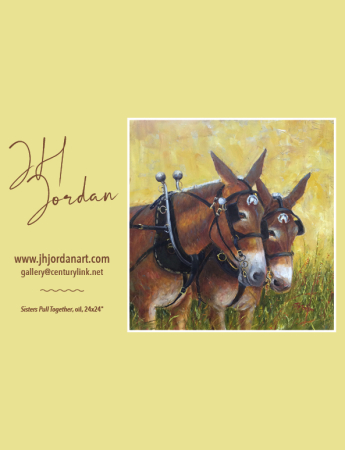
Judith Jordan graduated from Auburn University in Alabama. Later she began teaching before eventually switching to painting on a full-time basis. She also married and moved to Mellow Valley, Alabama. “My husband has a tremendous love for animals. At the time he was raising horses and mules, which gave me a great resource for painting,” Jordan says. “After being around animals, one can read their personalities and they are all different. Trying to capture their personalities and their movements on canvas, I enjoy painting the fields with the horses and mules dotting the landscape.”
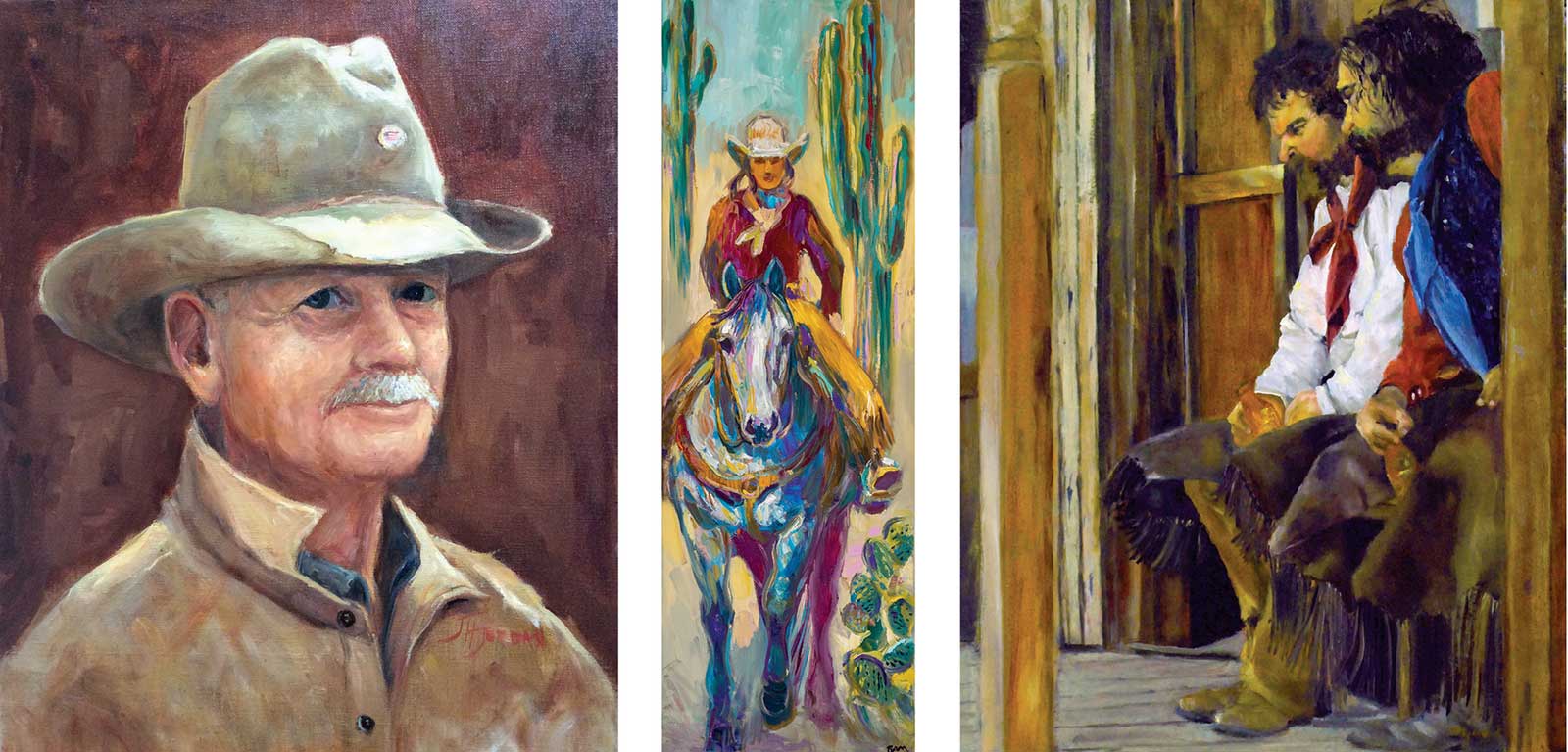
Judith Jordan, Portrait of a Cowboy, oil, 20 x 16”; Barbara Meikle, Welcome to Wickenburg, oil on canvas, 36 x 12”; Shirley Quaid, Hot and Tired, oil, 30 x 24”
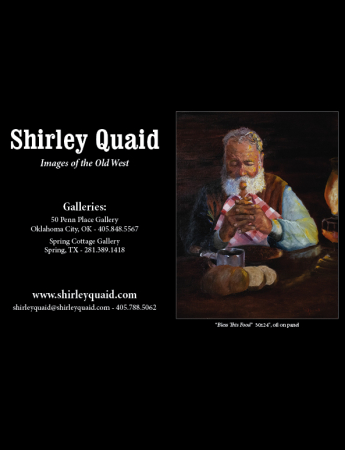
Award-winning painter Shirley Quaid has been painting for 25 years, but it wasn’t until she discovered Western photo shoots in Easton, Kansas, that she found her voice. She has loved Western subjects from childhood and delights in bringing the late 1880s to life with her paintbrush. “I have learned so much about the culture of various Native tribes and try to portray them with sensitivity,” she says. She does not produce traditional Western art but strives to tell the stories of the people of the era. “I am a people painter,” she adds.
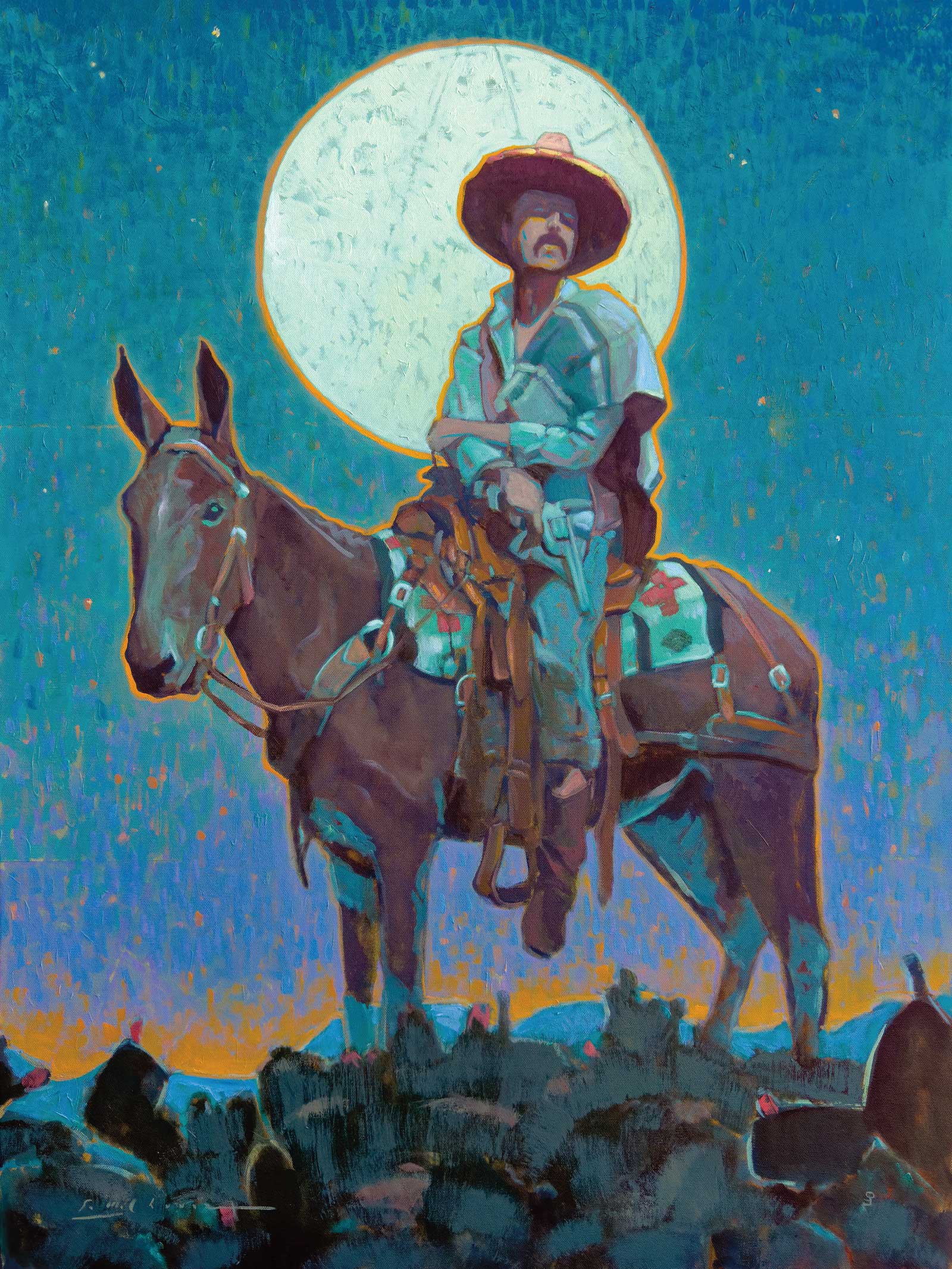
Sean Michael Chavez, Luna Azul, oil on canvas, 48 x 36”
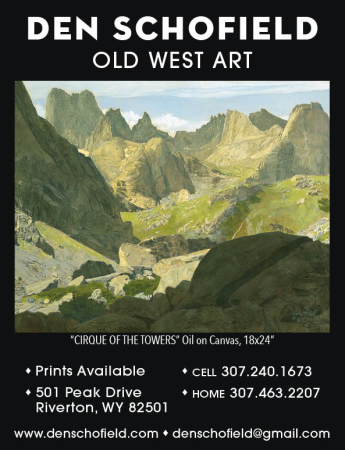
Den Schofield has painted the cowboy, and cowboy adjacent figures like the Pony Express riders, for many years. Prior to becoming a fine artist, Schofield worked in illustration for countless companies and publishers. Much of his work is about creating historical context within each painting to help better tell a story. So it makes sense that Schofield has a deep understanding of the Western frontier history and has traveled extensively through it. “Along the way, I attended various rendezvous and reenactment activities, perused all manner of museums and built my own respectable library on the subject of the Old West,” Schofield says, adding that the West has given him many reasons to create visually graphic and dynamic works of art. —
Featured Artists & Galleries
Barbara Meikle Fine Art
236 Delgado Street, Santa Fe, NM 87501
(505) 992-0400, www.meiklefineart.com
info@barbarameikle.com
Stephanie Burk
(817) 312-4811
www.stephanieburkfineart.com
stephanie@horseshoetrailstudio.com
Sean Michael Chavez
www.paintingsofthewest.com
Represented by Acosta Strong Fine Art
200 Canyon Road, Santa Fe, NM
(505) 982-2795, www.acostastrong.com
Judith Jordan
Cragford, AL
(256) 252-4492
www.jhjordanart.com
Kenneth J. Spirduso Equestrian Art
Lakewood Ranch, FL
(321) 217-4445, www.spirduso.com
Legacy Gallery
7178 Main Street, Scottsdale, AZ 85251
(480) 945-1113, www.legacygallery.com
Mark Sublette Medicine Man Gallery
6872 E. Sunrise Drive, Suite 130, Tucson, AZ 85750
(520) 722-7798
www.medicinemangallery.com
Parsons Gallery of the West
122 D Kit Carson Road, Taos, NM 87571
(575) 737-9200
www.parsonsart.com/parsonswest
Den Schofield
(307) 463-2207
www.denschofield.com
info@denschofield.comm
Shirly Quaid
(405) 788-5062
www.shirleyquaid.com
shirleyquaid@shirleyquaid.com
Whitney Western Art Museum
Buffalo Bill Center of the West
720 Sheridan Avenue, Cody, WY 82414
(307) 587-4771, www.centerofthewest.org
Powered by Froala Editor