Whitney Gardner paints a desert unknown to most, including visitors to Joshua Tree National Park. Dotted with odd-looking vegetation—ocotillo, jumping cholla, and the Dr. Seuss-looking trees that give the park its name, her boulder-strewn stretch of the Mojave quickly gives way to dry lakebeds and spare landscapes that double as training ground for U.S. Marines headed to Afghanistan and Iraq.
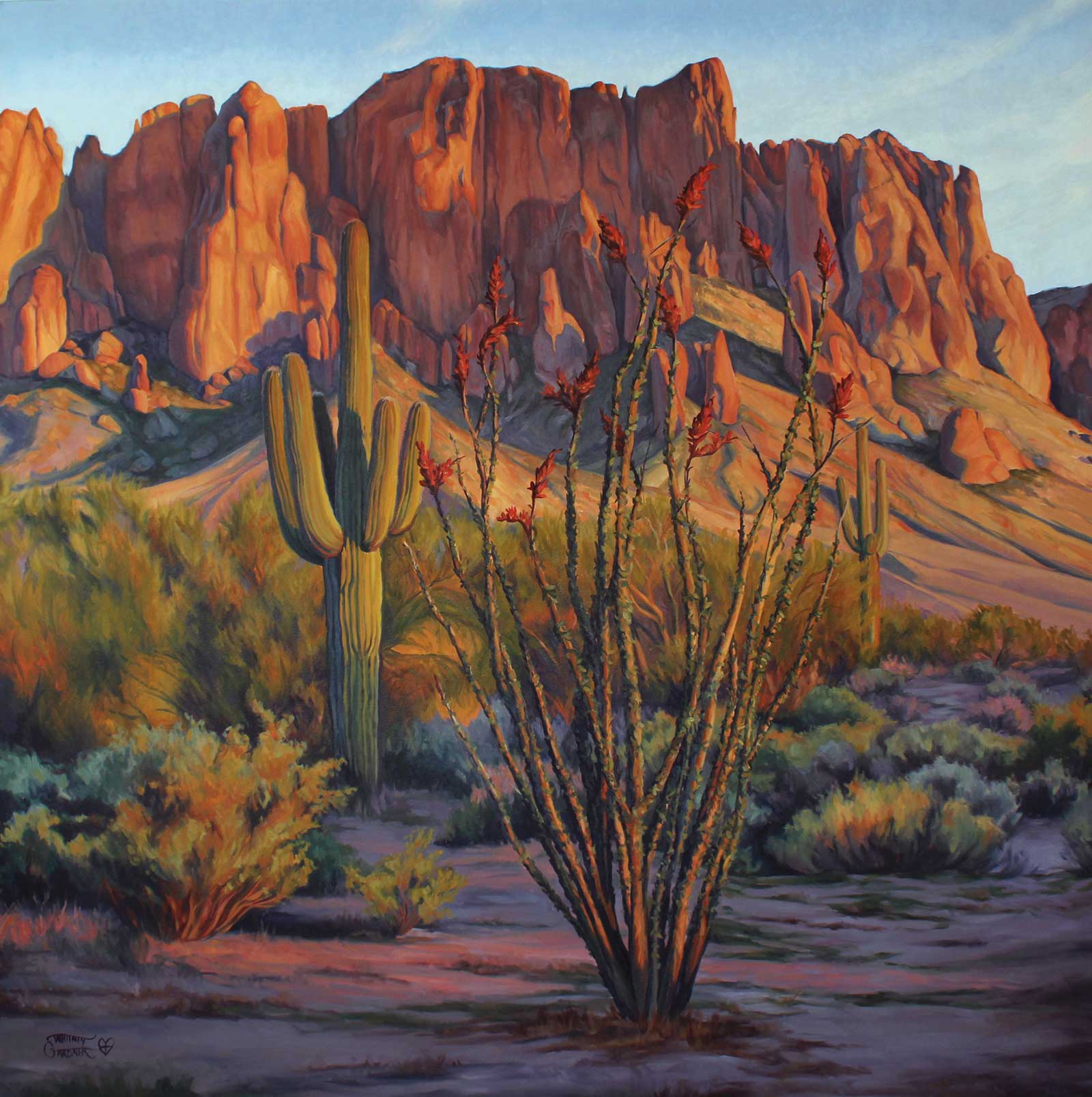
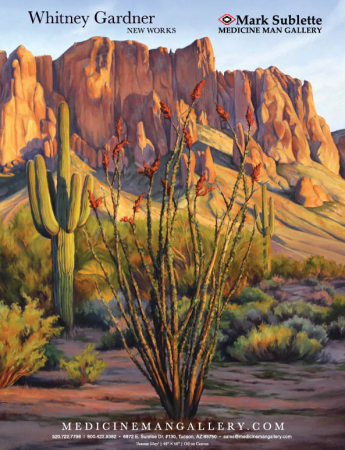
Sonoran Glory, oil on canvas, 48 x 48”. Available at Medicine Man Gallery.
Her nearest town is 29 Palms, the northeastern gateway to the national park. She lives in Wonder Valley, a small, unincorporated community of ranchettes and desert people doing desert things, another 20 minutes past town. Beyond there lies the kind of landscape that rattles the faint of heart, inspiring names like Skeleton Pass, Lost Horse Mine and Devil’s Playground. Keep diving east and you’re at the Colorado River. Cross it, and you’re in Arizona.
Closer to the park, these otherworldly hills are peppered with assemblage artists, junk collectors, bikers, van-living rock climbers, L.A. girls in Instagram outfits, pilgrims in search of spiritual vortices, alien enthusiasts, Airbnb superhosts and an annual onslaught of festival musicians (often with L.A. Instagram girls in tow). It’s an eclectic place to say the least.
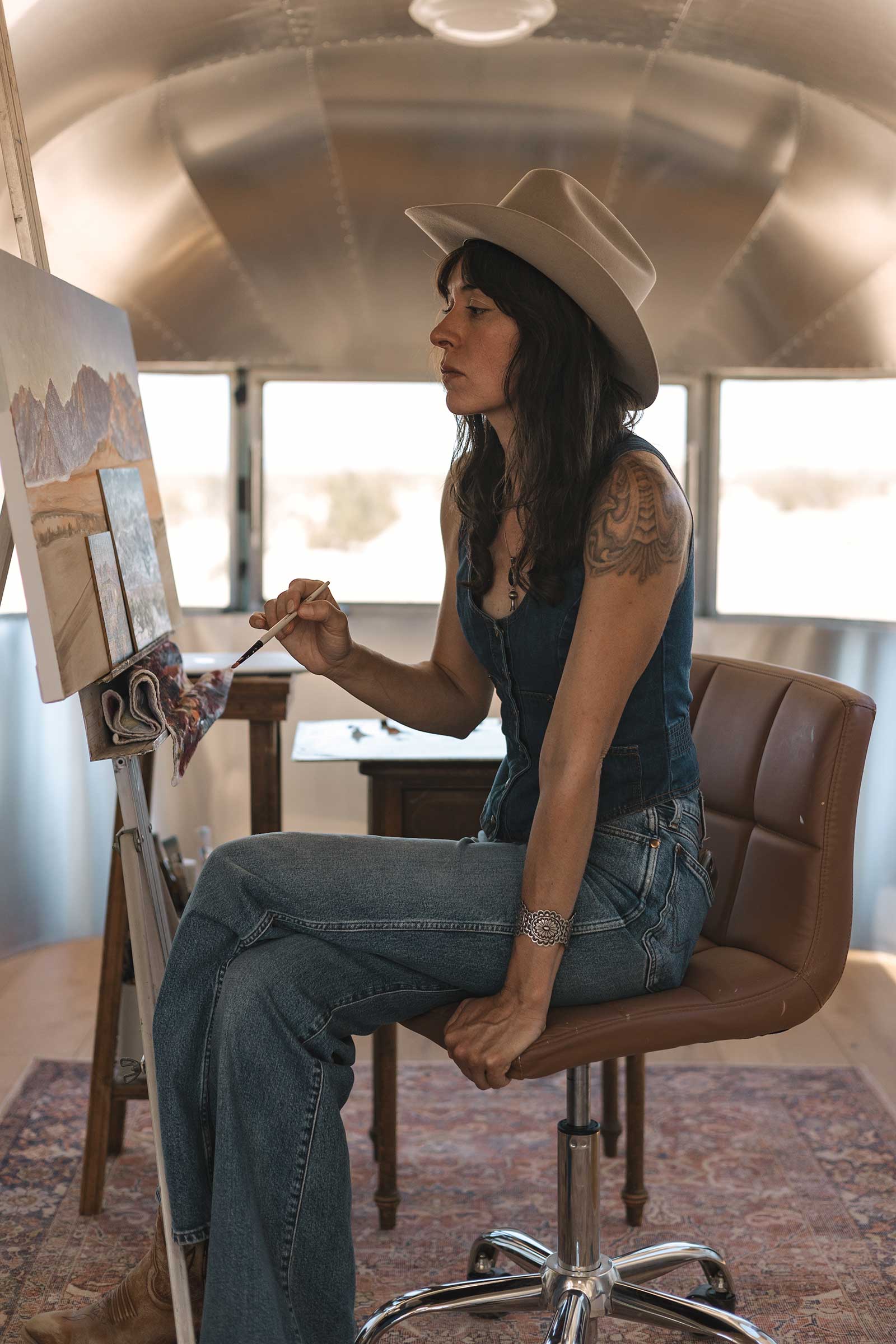
Whitney Gardner working in her Airstream studio at Wonder Lake Ranch.
Gardner made her way to Southern California’s high desert 13 years ago in search of somewhere to make a life as an artist with little overhead. “I moved there in 2010, fresh out of art school, had no money, just moved to where I could afford,” Gardner remembers. “My grandfather was a rock climber and a mountain man, and brought us out there, so it’s familiar to me. And I thought, wow, it would be really wild to go and move here.”
She had just finished school at California College of the Arts in the San Francisco Bay Area and was searching for a voice as a painter. “I was painting kind of dark imagery,” she says. “It didn’t really at all reflect where I was living. And little by little that landscape wanted to come through. I started taking these sort of dark still lifes I was doing, then placing them outside. And then I’m painting sand and creosote bush. And then pretty soon it was like, well, let me just take away all the subject here. And then it was like, oh…I’m supposed to be painting landscape.”
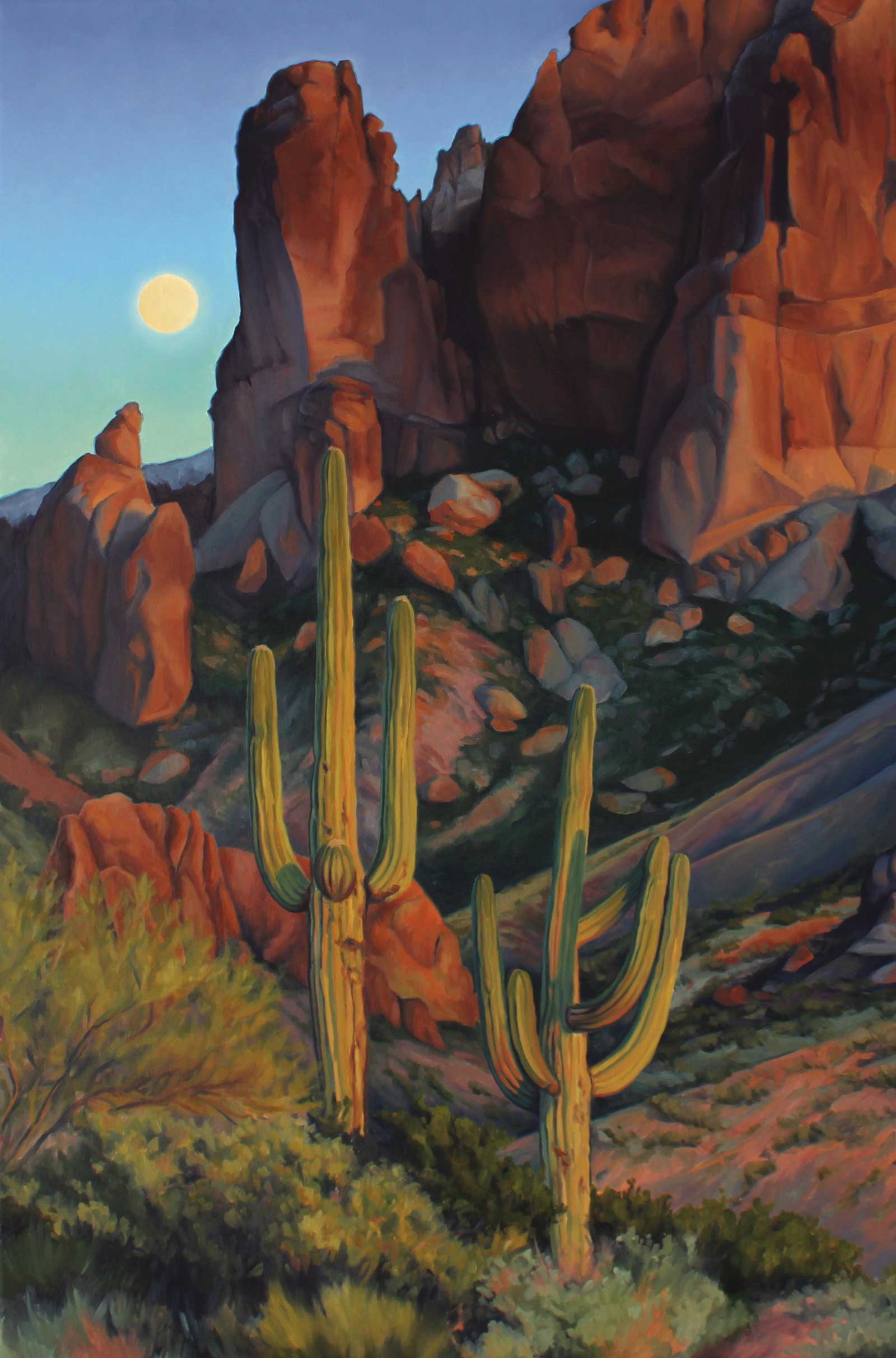
Fade to Night, oil on linen, 30 x 20”. Sold at Medicine Man Gallery.
While artists like Los Angeles-based Eric Merrell make it out to the Mojave—a place he calls “underpainted”—Gardner lives there yearround. Dust storms wail past her Airstream art studio and she paints on, giving wet pieces literal terroir, if you will.
Her world is expansive, bone dry, and yet, still liquid. For a place with very little water, the chiseled topography proves it has been there. Gardner plays with shadows and temperature in crevices carved by gully-washing monsoon storms. Maynard Dixon did this too. When Gardner paints mountains, they’re fleshy and corporal, evoking Alexandre Hogue’s Mother Earth Laid Bare, though what she paints has never seen a plow.
“It’s like a mix of where she lives—being in the desert out there and having all this really rough terrain—but then she has kind of a studied and modern style I think that she’s drawing on when she’s making her work,” says Western Gallery owner George Irwin, one of the first dealers to show Gardner’s work. “There’s sort of this almost feminine quality or something that has come through, whether or not she meant it to.” That feminine side is even more evident in her floral works, which include poppies, ocotillos, and Western art’s botanical of the moment, the hollyhock.
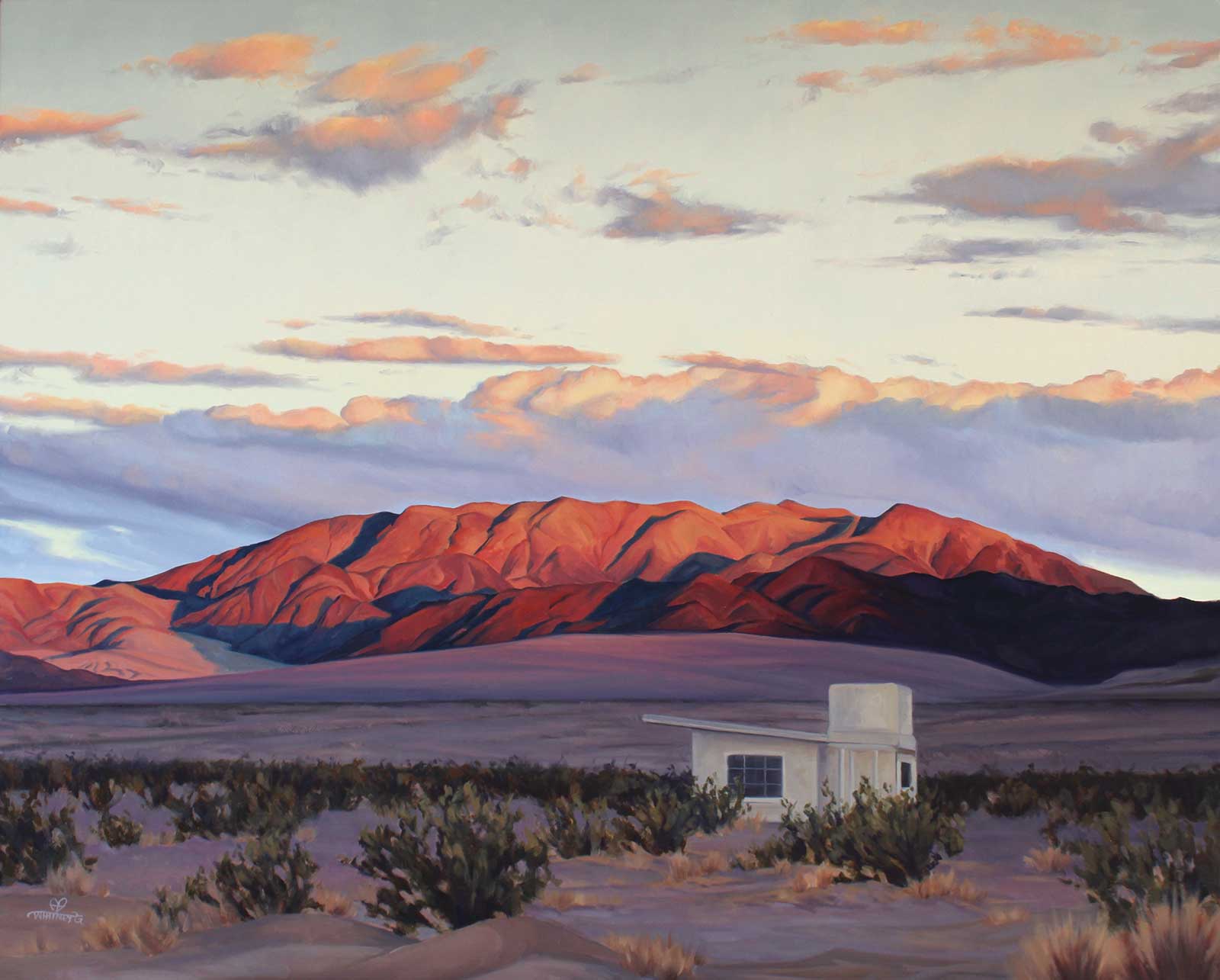
Wonder Valley Homestead, oil on linen, 24 x 30”. Available at Medicine Man Gallery.
As she travels to shows in other parts of the desert Southwest, Gardner paints and camps and incorporates their ecosystems into the mix too. She met Medicine Man Gallery owner Mark Sublette on one such trip. While dropping off work at the Mountain Oyster Club in Tucson, Gardner popped into Sublette’s gallery with respects to pay and time to kill.
“I wasn’t there to sell myself or anything, you know, I just really wanted to see Maynard Dixon’s work,” she says, “And so I kind of comb my hair with my hands—just did my best to look somewhat presentable after camping and whatever—that’s kind of how I roll.”
Her close inspection of a Josh Elliot painting exposed her as an artist to the gallery sitter, who happened to be Sublette’s son Charles. He struck up a conversation and asked to see her work. Gardner had returned to studying the paintings on view when a “Hey, Whitney” came from the other room.
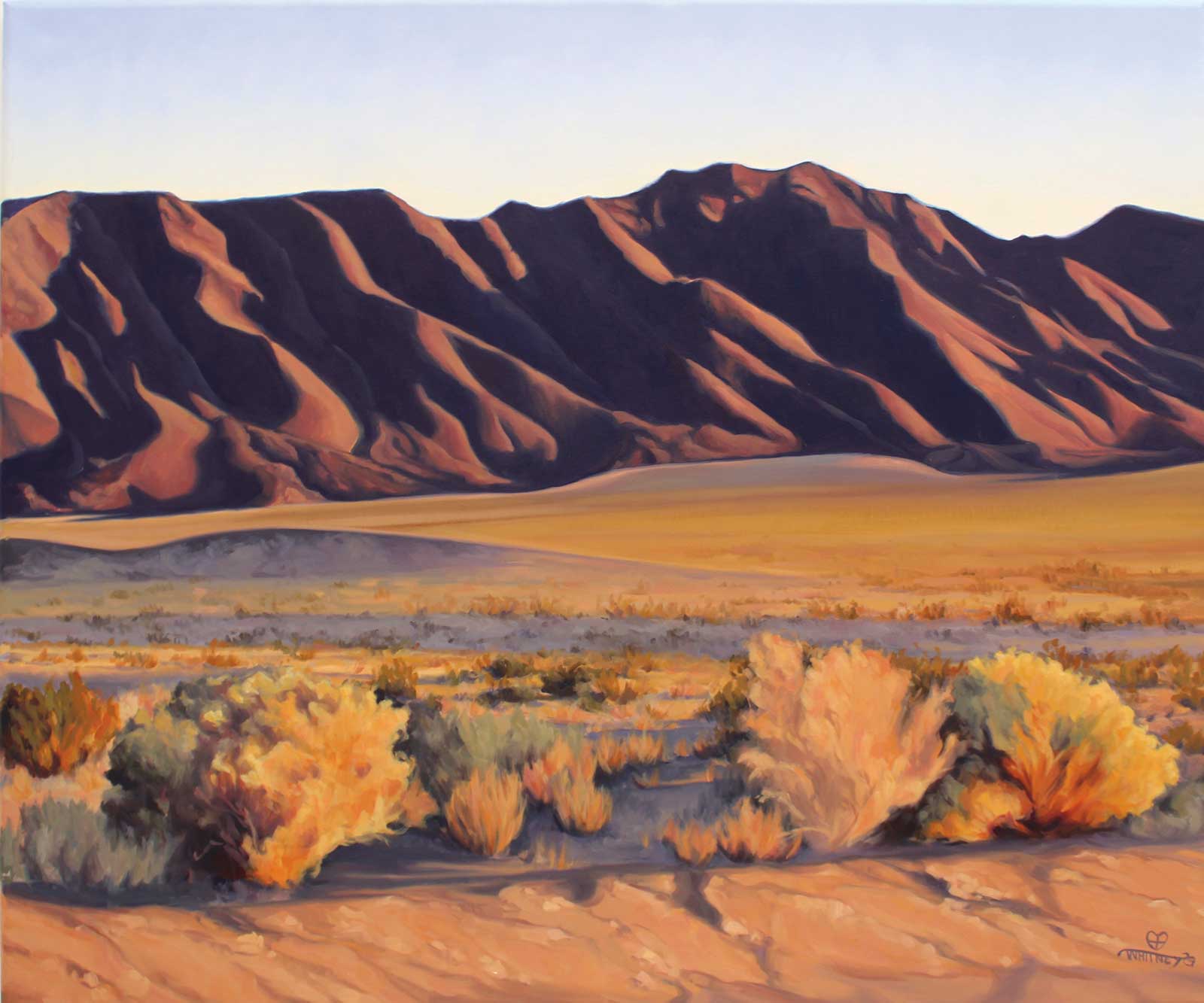
Golden Light, oil on linen, 20 x 24”. Available at Medicine Man Gallery.
“I really could have just passed out right then,” Gardner says, detailing how minutes later the elder Sublette entered the room, checked out her work, and offered her representation on the spot. “I am, you know, trying to keep my cool. He’s like, ‘Oh, great. Yeah, let’s do it. Are you available to do a podcast right now?’” She remembers saying yes and looking on in amazement as they readied the recording studio. “I’m not gonna say no to anything at this point,” she recounts. So, Gardner and her new art dealer got to know each other in real time…on the air.
Chris McLarry of McLarry Fine Art also saw something special in Gardner’s work. “As any gallery, we’re always on the lookout for young talent, up and coming, you know, the new star in the future,” says McLarry. “It just struck me as something powerful and yet soft, and just really appealing to me, to my eye. It crosses the line between realism and surrealism that I really like in a painting. And her use of light was just absolutely wonderful. So I reached out and contacted her and we started working together.” McLarry has been showing her work for about a year now, and he’s excited to really dig in as she wraps up juried show obligations and creates new paintings for the Santa Fe gallery. His advice to would-be collectors, “Get her work sooner than later.”
Appearances in Small Works, Great Wondersat the National Cowboy & Western Heritage Museum and a couple of wildly successful virtual shows helped Gardner gain momentum in the Western genre. Born out of the pandemic, Irwin’s online gallery was Gardner’s Western art debut. She had a few pieces in his inaugural New Western Talent show in 2020, and as he built up his own business as an art dealer, Irwin and Gardner teamed up to present an online-only solo exhibition. “When I started to put together the Impermanent Collection, she was the first artist that I showed,” Irwin says of his stable of “loosely represented artists.”
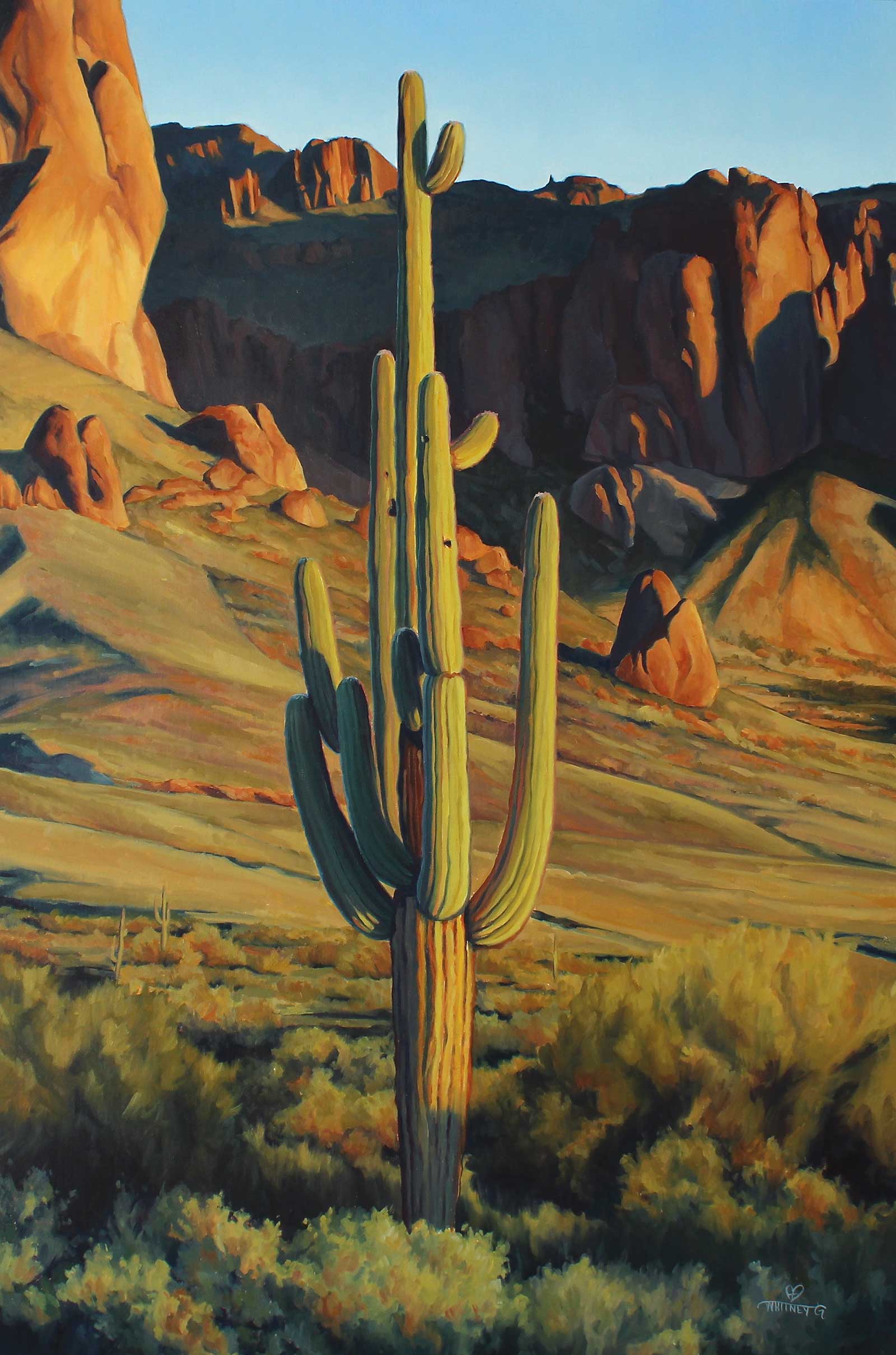
Between Jojoba and Heaven, oil on linen, 30 x 20”. Sold at Medicine Man Gallery.
The work was gone within a month, Gardner says, and all but one piece was nabbed within the first 24 hours. “So that was also my first sell-out show. George and I were a little floored. We’re like, what just happened, you know?” Gardner remembers. “And it was really exciting because I really felt proud of that work. I felt very attached to it. And for it to be so well received, felt like, okay, I think I’m doing something right.”
“I think that it helped to see a larger body of her work together for people to start to take her more seriously as an artist,” says Irwin. “And so that was really cool, I think, to have had some kind of participatory role in helping her to put together a body of work for the world,” he says.
“I’m so grateful for Western Gallery and George really has a great vision,” echoes Gardner. “I’m thankful for the relationship that we’ve been able to develop over the years,” she says. “He’s always so fun to work with.”
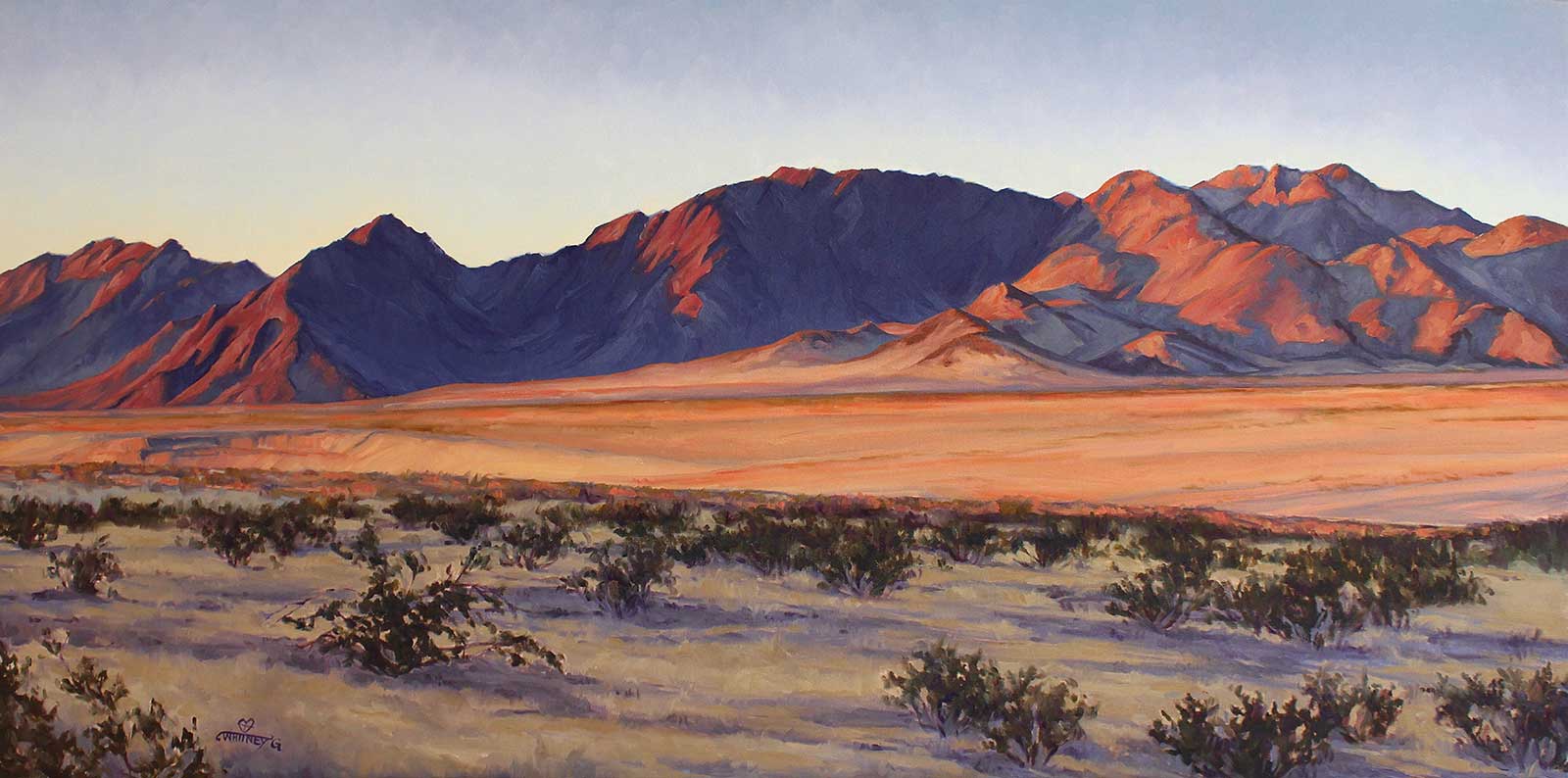
Deep Dusk, oil on canvas, 18 x 36”. Available at Medicine Man Gallery.
The two continue to show together today—just as Irwin has opened his first brick-and-mortar gallery in Austin, Texas—both members of the pandemic’s first graduating class, perhaps. “She’s been kind of hitting some of those milestones that are important earlier on in an artist’s career where they were showing at significant group shows and getting represented by bigger and more well-known galleries over time,” says Irwin of Gardner’s foray into the Western art world.
In addition to winning awards at the Joshua Tree National Park Art Exposition and SLOPOKE Western Art Show, Gardner is busy stacking up more milestones. November will mark her third appearance at Small Works, Great Wonders in Oklahoma City. In January 2024, she’ll be participating in Coors Western Art Exhibit & Salein Denver for the first time.
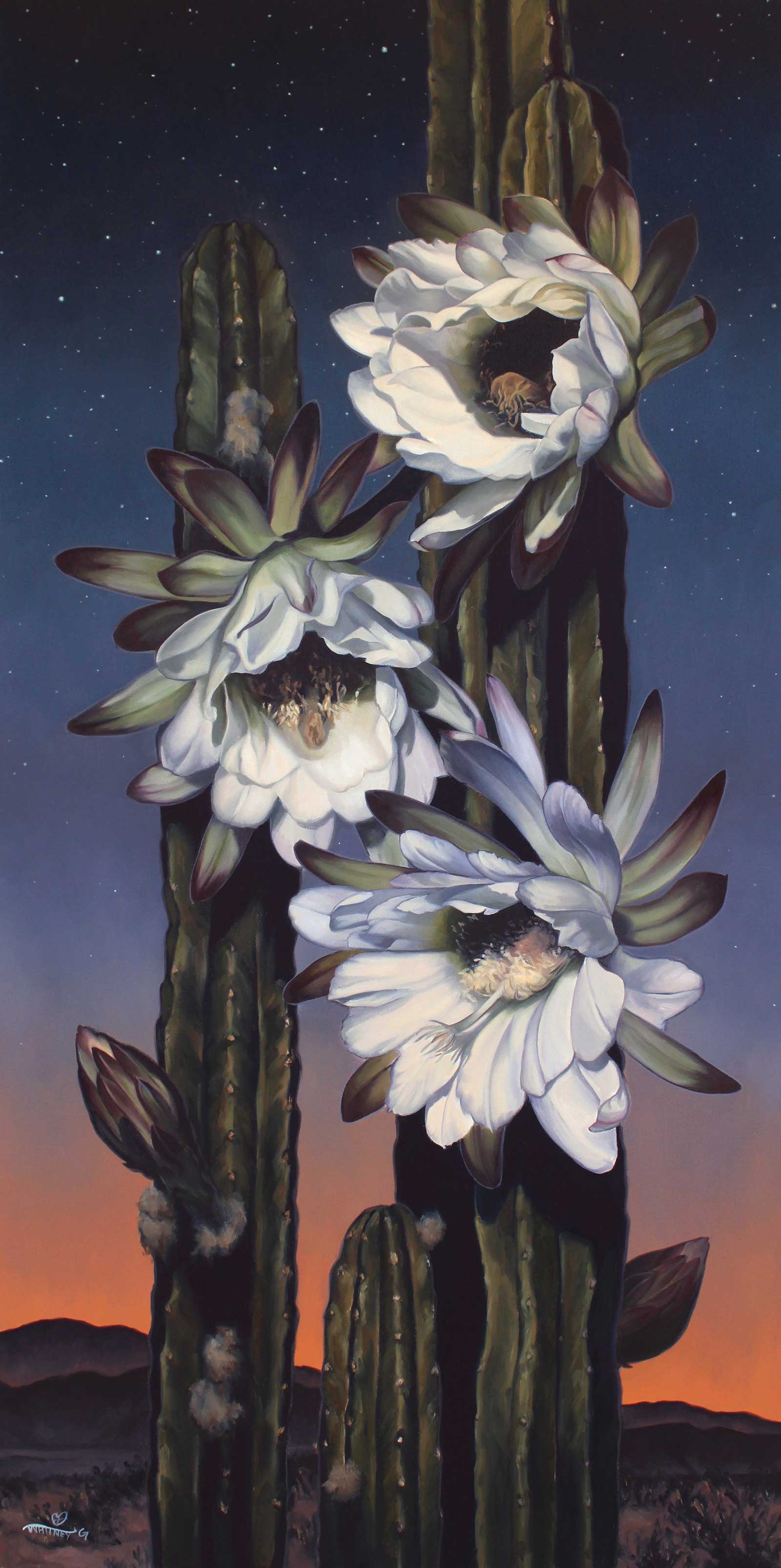
Born Under the Full Moon, oil on canvas, 36 x 18”. Available at the 2024 Coors Western Art Exhibit & Sale.
“I’m ultimately just happy where I am,” says Gardner. “And so grateful for all the readers and grateful for everyone who cares about what I’m doing, that they dig what I’m doing. That is such a huge thing and it still is just mind-blowing that the world works that way,” she says. The art world, like the desert, favors those who work hard and come prepared. Being in the right place at the right time never hurts either.
Collectors can find Gardner’s work at McLarry Fine Art in Santa Fe, Medicine Man Gallery in Tucson, and Western Gallery in Austin. —
Powered by Froala Editor