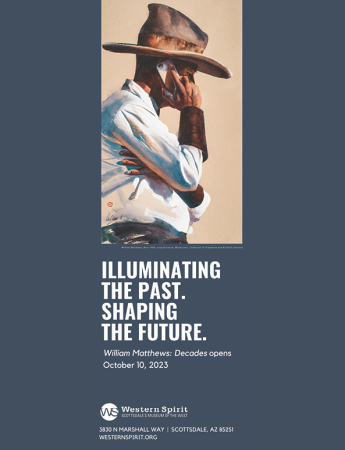
William Matthews is a man of many hats: his own, those worn by cowboys in his watercolors and those of the different aspects of his artistic life. In fact, one catalog of his paintings is titled Hats & Headwear.
The exhibition, Decades: William Matthews, chronicling five decades of his career, opens at Western Spirit: Scottsdale’s Museum of the West October 10 and continues through April 28, 2024.
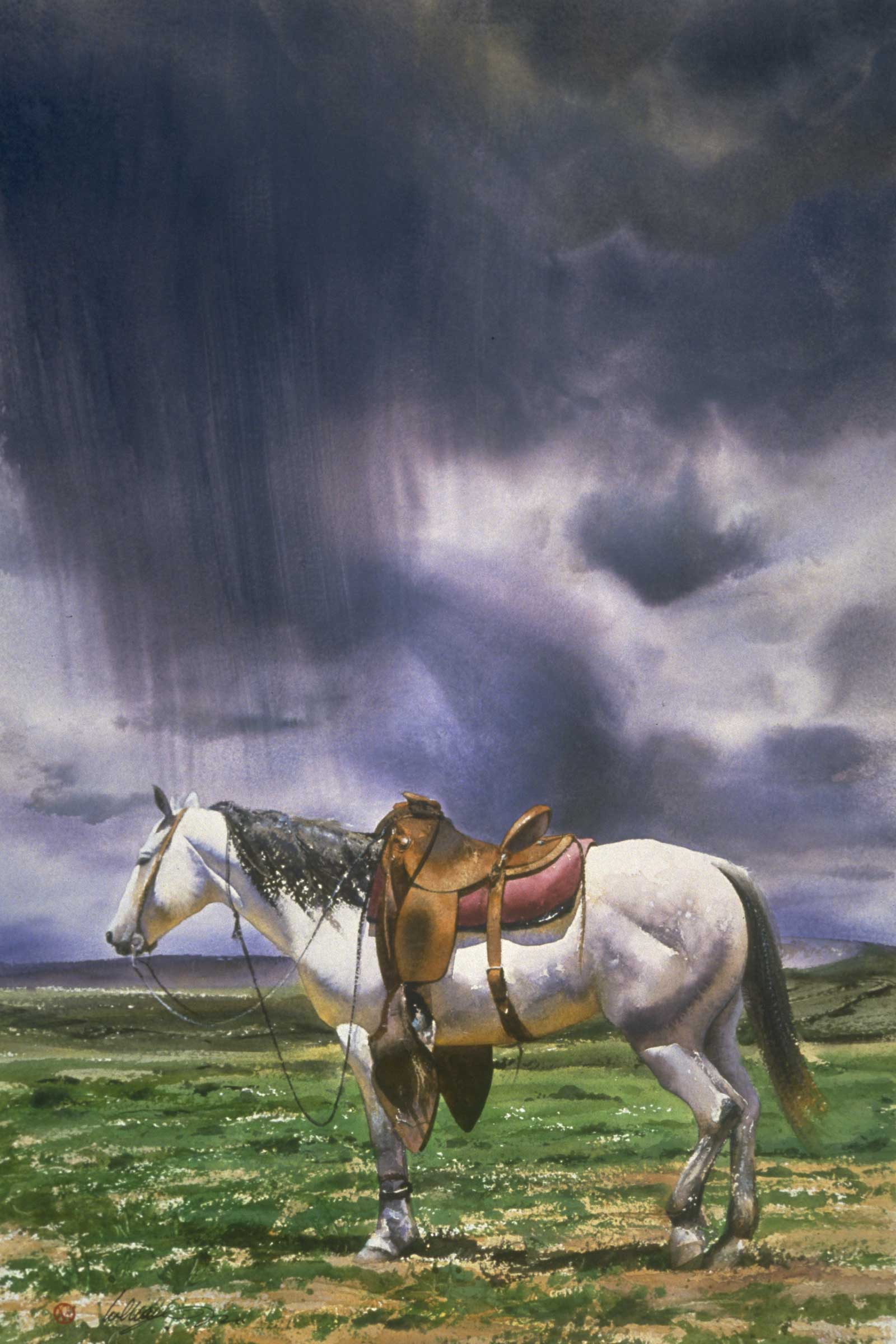
Hobbled, watercolor on paper, 32 x 21”
“My cowboy paintings are probably what people know the best and are possibly most interested in,” he explains. “This show is about a retrospective of my life. It’s going to be more than cowboys and will include 60 album covers and 25 posters, one mosaic and guitars I’ve designed and built.”
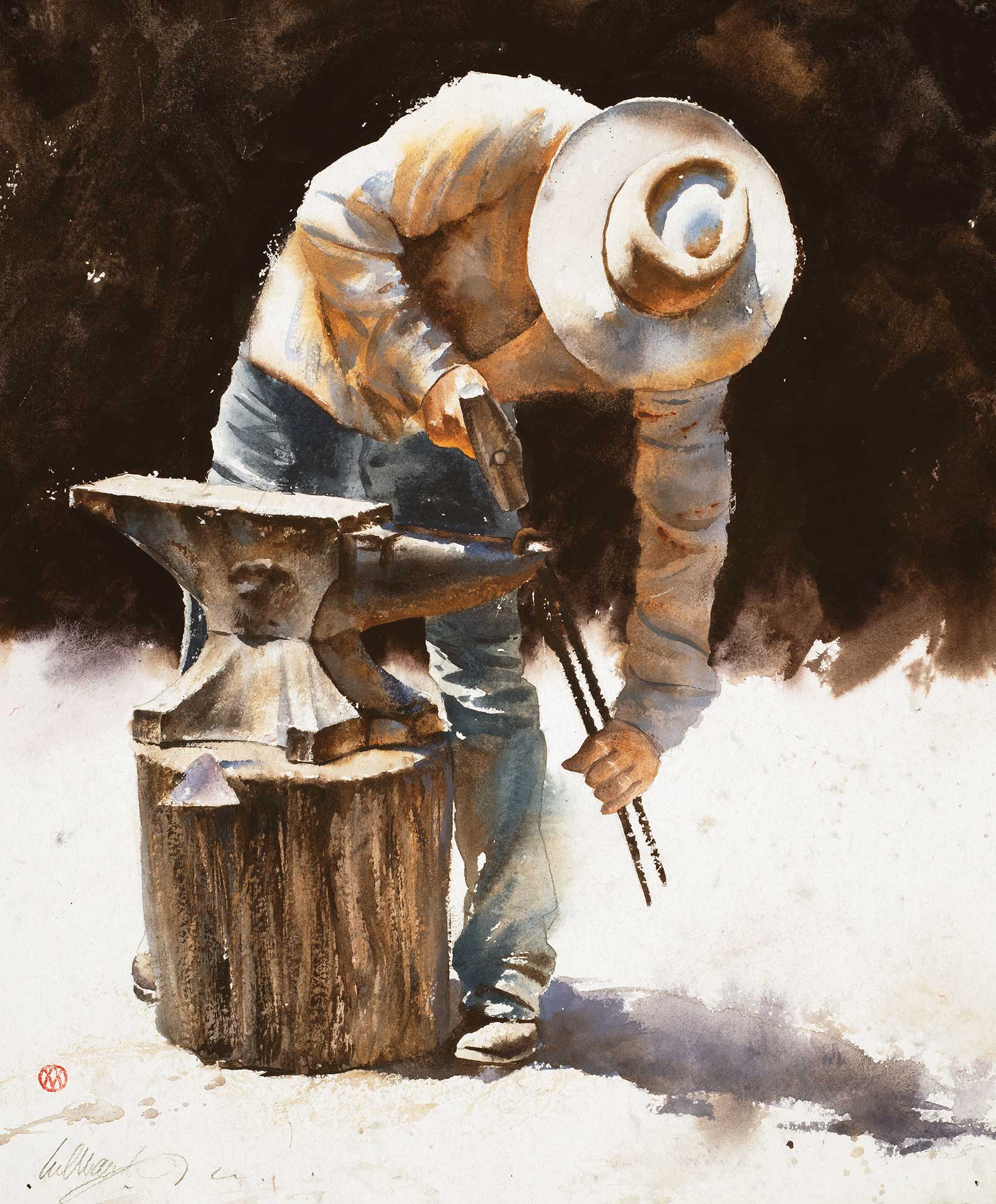
Randy Stowell, watercolor on paper, 22 x 18”
He has been designing album covers since the 1970s in Los Angeles and San Francisco. His commissions continue with, recently, the 2023 Telluride Bluegrass Festival poster. In 2019, the Dickies Arena in Fort Worth, Texas, opened with a 12-by-63-foot mosaic on its south façade fabricated in Mexico from his original watercolor. It is flanked by two bronze bas-relief sculptures of horses sculpted by Cherokee artist Buckeye Blake from Matthews’ drawings. In 2021, he produced the album cover for Bela Fleck’s My Bluegrass Heart.
It was at Telluride where he met the then-CEO of Martin Guitars, Chris Martin, who wanted him to produce an acoustic guitar with a Western scene painted on its surface like those used by the singing cowboy legends of the past. It was a step up for the young boy who would play his Martin guitar for guests at his parents’ dinner parties.
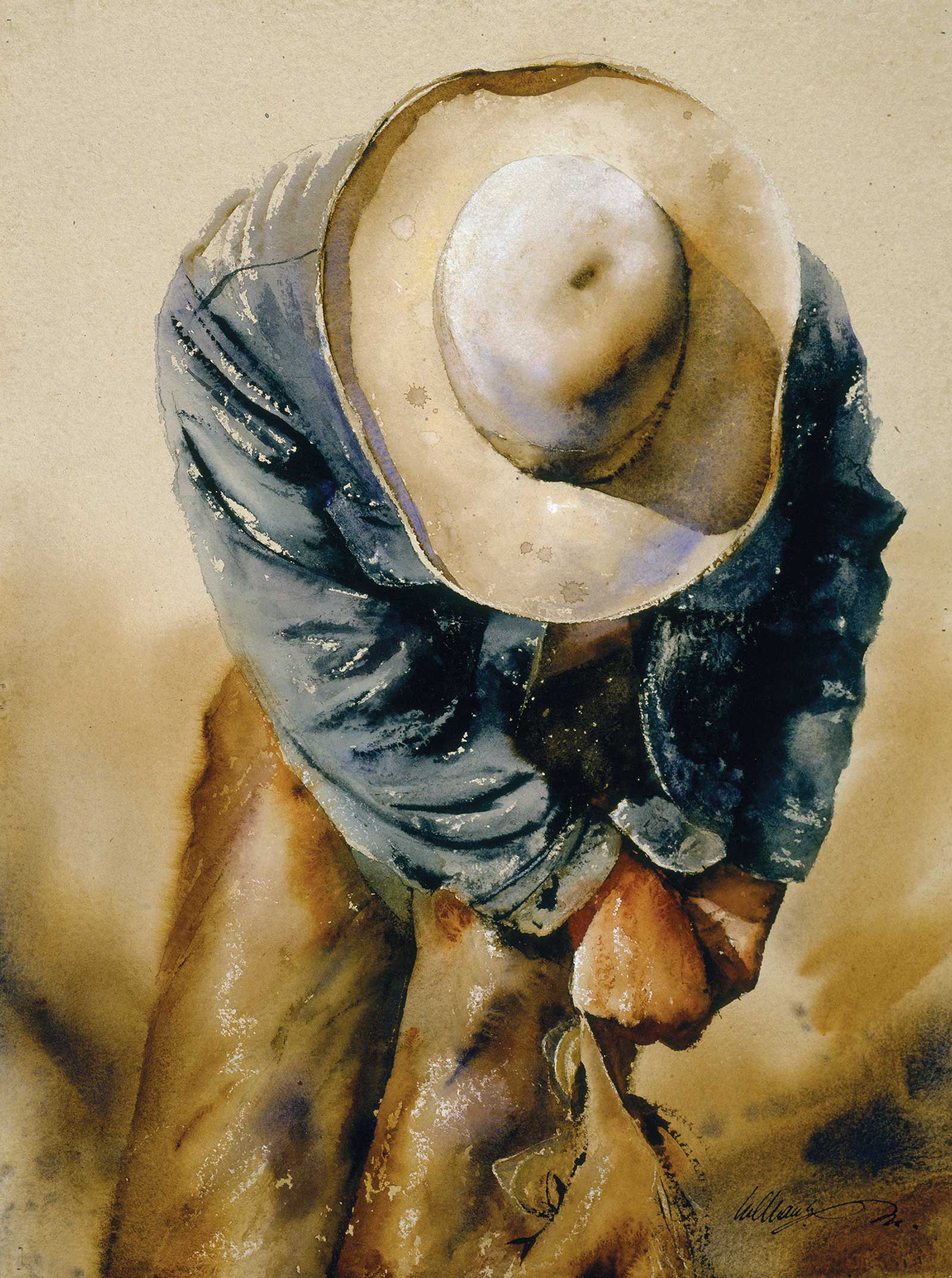
Chap Snap, watercolor on paper, 24¼ x 18¼”
Today, he has a large collection of guitars and, taking a break from painting, he will pick one up and play while he walks around the studio. “It’s not that the music will inspire the next brush strokes,” he comments. “Music and painting become complementary elements. They have some of the same language—rhythm, texture, color, nuance—but they’re different mediums, and you can achieve different things…A lot of cowboys play acoustic guitar. There is a direct correlation between them and acoustic instruments. I would often take out a banjo or a guitar when I was camping with the cowboys.”
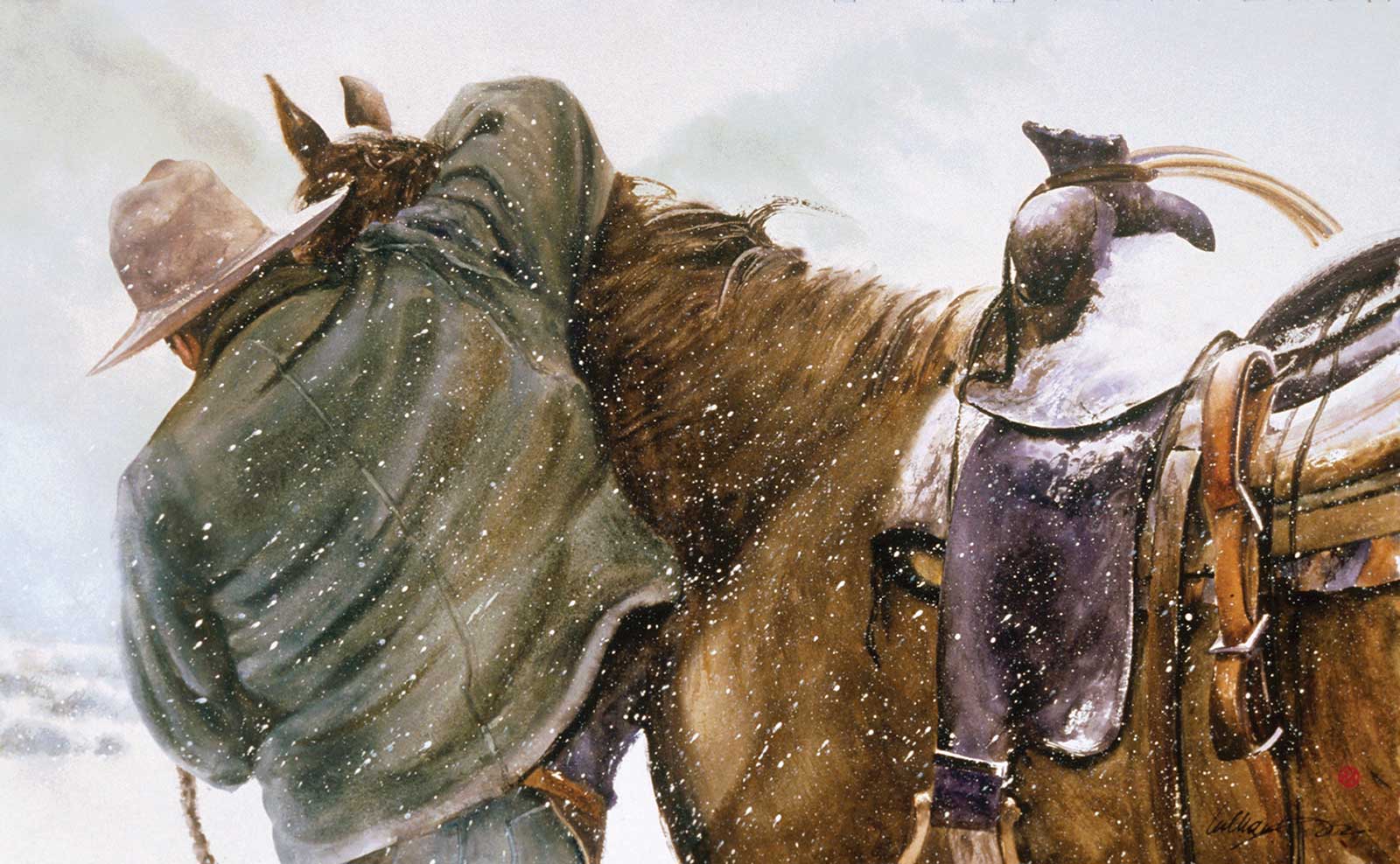
March Flurries, watercolor on paper, 20¾ x 33½”
Matthews grew up in San Francisco. “California in the ’50s was far more rural,” he explains. “It was glazed with a Western patina. I went to camp and rode horses. My mother was an artist and I was in her studio all the time. I focused on playing music and doing art. I wasn’t good enough at music but I loved art.”
He continues: “In 1985, I went to the National Cowboy Poetry Gathering in Elko, Nevada, where I met the buckaroos from the Great Basin and became friends with them. They invited me to their ranches. I found these guys fascinating. Living their way of life in such an isolated circumstance drew me in more than the romance of the West that attracted artists like Charlie Russell. I was never drawn to the classic Western art. I was more about the people I met and what they were doing.”
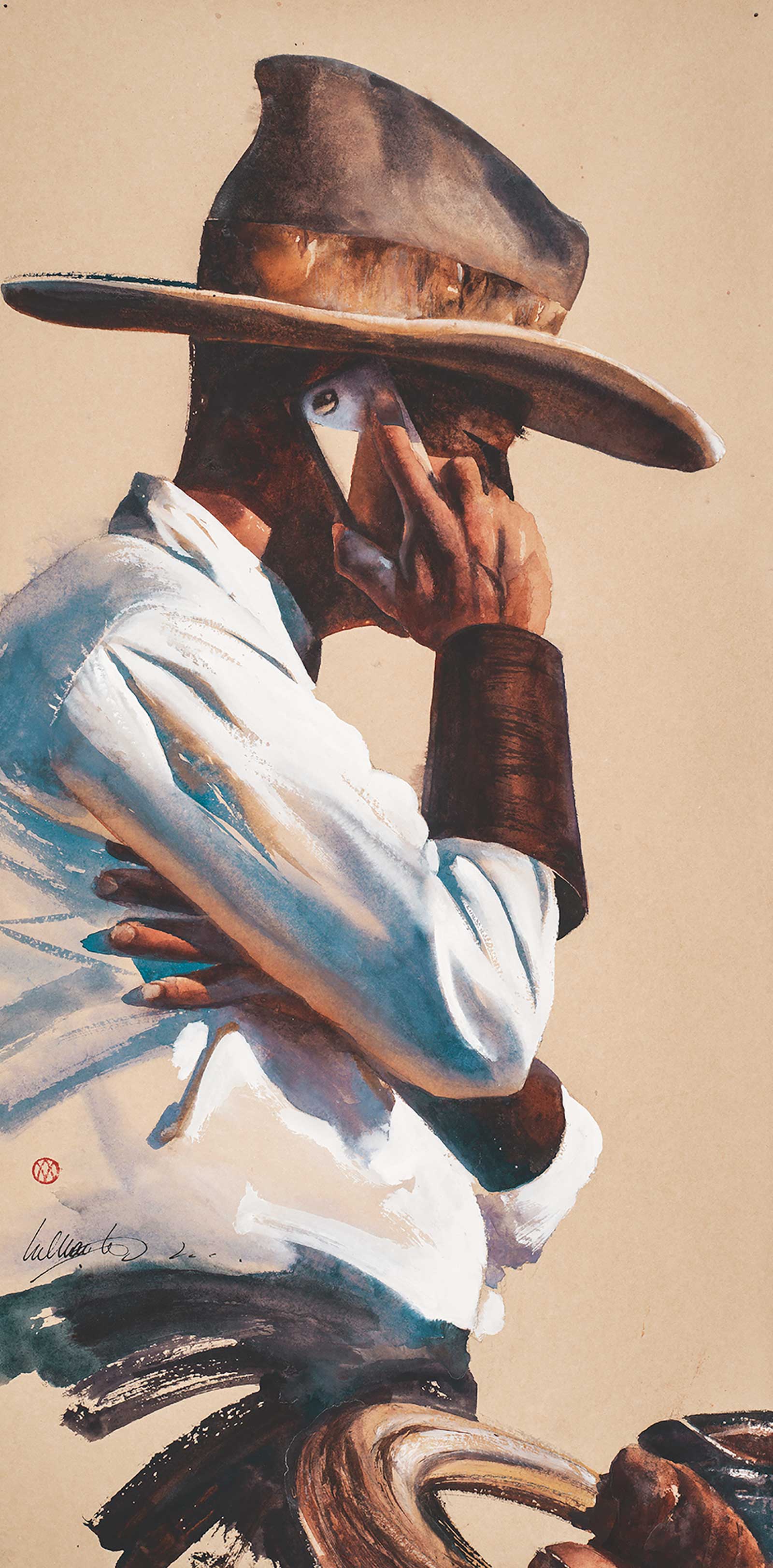
Long Distance, watercolor on paper, 30 x 15”
His closely cropped watercolors depict cowboys at work. “In general, what I find interesting is the gestures,” he says. “Everybody is active. By their doing something, their story gets told.” Although the identity of his subjects is often shielded by a hat or the circumstance of their action, people who know them recognize them through his depiction of their gestures…I’ve been plein air painting since I was in my single digits. I don’t think plein air is a separate category of painting. It’s painting in a different spot. I always have paints with me. I’m painting every day. It’s just what I do. Sometimes I’m out in the meadow, at other times I’m in the studios.
“My paintings come from my imagination and from sketches and other reference material. I always have a notebook in my back pocket and am always writing something down—conversational things, a song lyric I hear. I write down a lot of things I think are interesting at the time. Later I will pick it up and find something I can build on. There are always images and ideas or something I’ve written that I can turn into paintings.”
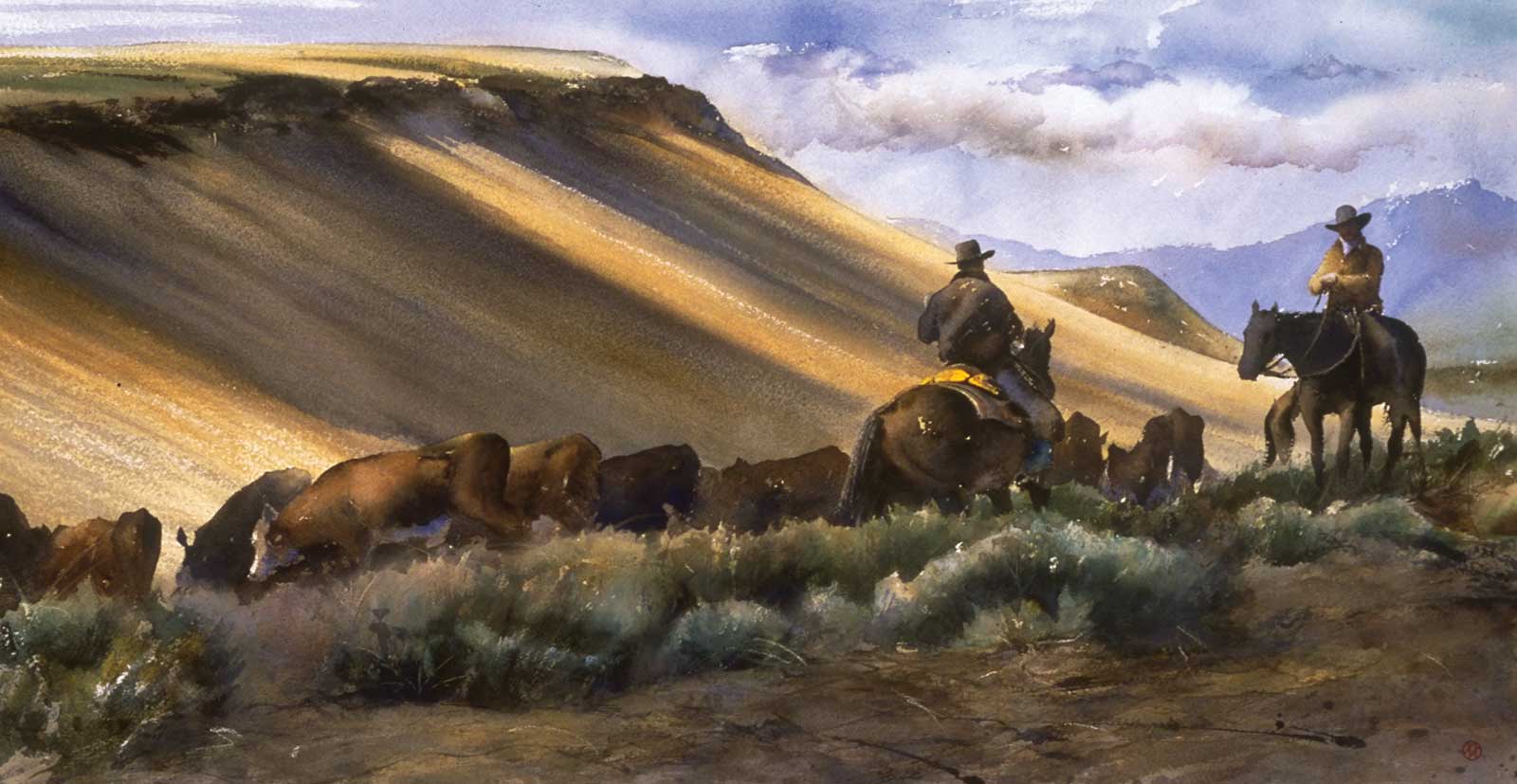
Oregon, watercolor on paper, 19½ x 38”
His painting Hobbled brings out a more philosophical side of the artist. The horse has a hobble just above its fetlocks to keep it from wandering away but giving it freedom to graze. “The way a horse gets restrained reminds me of anything else that restrains us as people,” he says. “It’s not just about a pony having a limited diameter to wander within, it’s also something I think about—restrictions I feel as well. The incoming weather sets up a certain tension I like.”
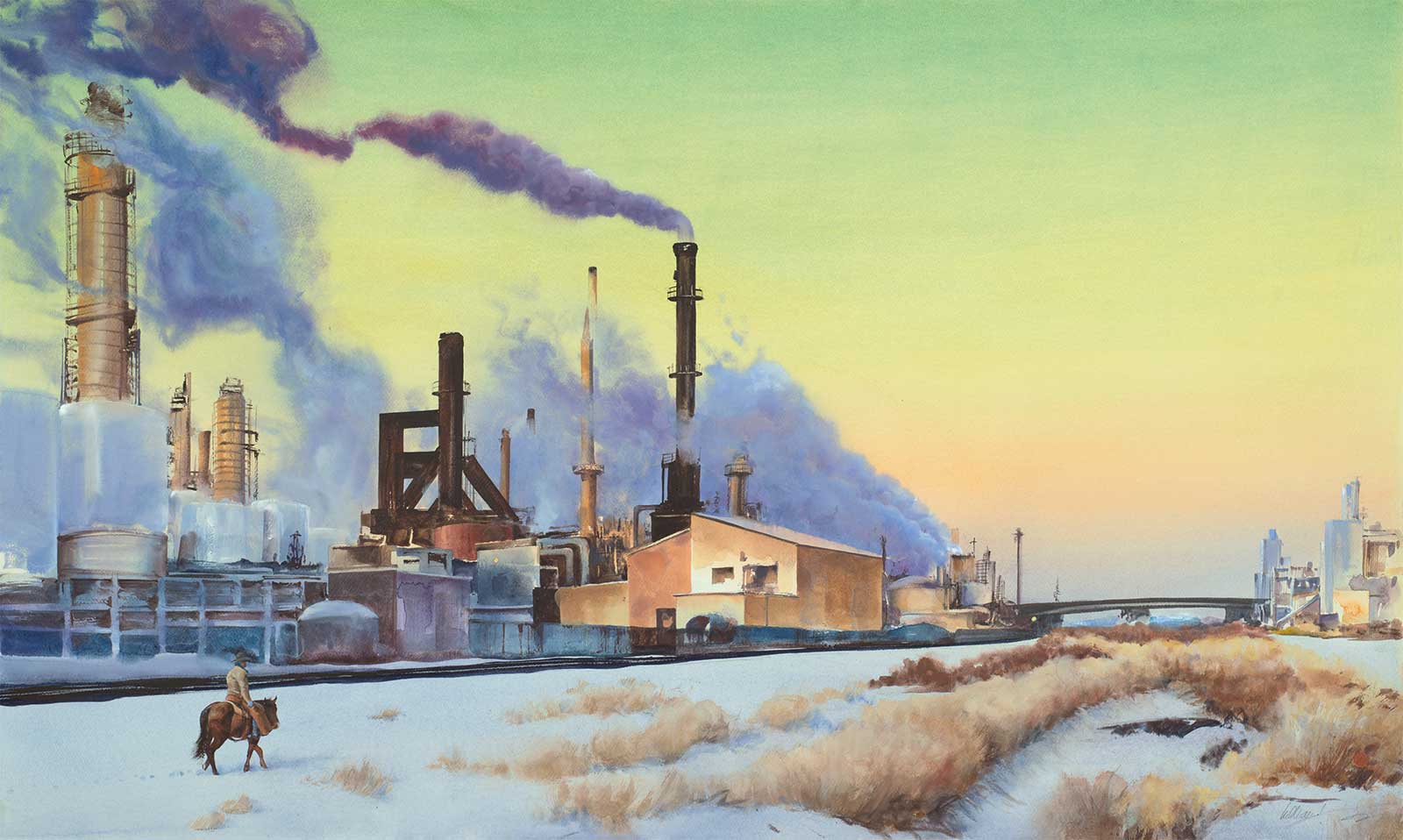
Western Changes, watercolor on paper, 30 x 50”
He comments, “There’s an abstract and continuous thread that links the elements of a creative life. My mind is always taking me into new and different areas.” —
Decades: William Matthew
October 10, 2023-April 28, 2024
Western Spirit: Scottsdale’s Museum of the West
3830 N. Marshall Way, Scottsdale, AZ 85251
(480) 686-9539
www.scottsdalemuseumwest.org
Powered by Froala Editor