Artists, by nature, are prone to introspection. It can be a product of working in isolation in a studio, or out in the quiet of nature. But more often than not, I would wager, artists are more likely to embark on deep periods of self-examination simply because art requires it. Art is more than just putting paint to canvas. It is doing that over and over again, so much so that a trajectory is established and patterns are revealed.
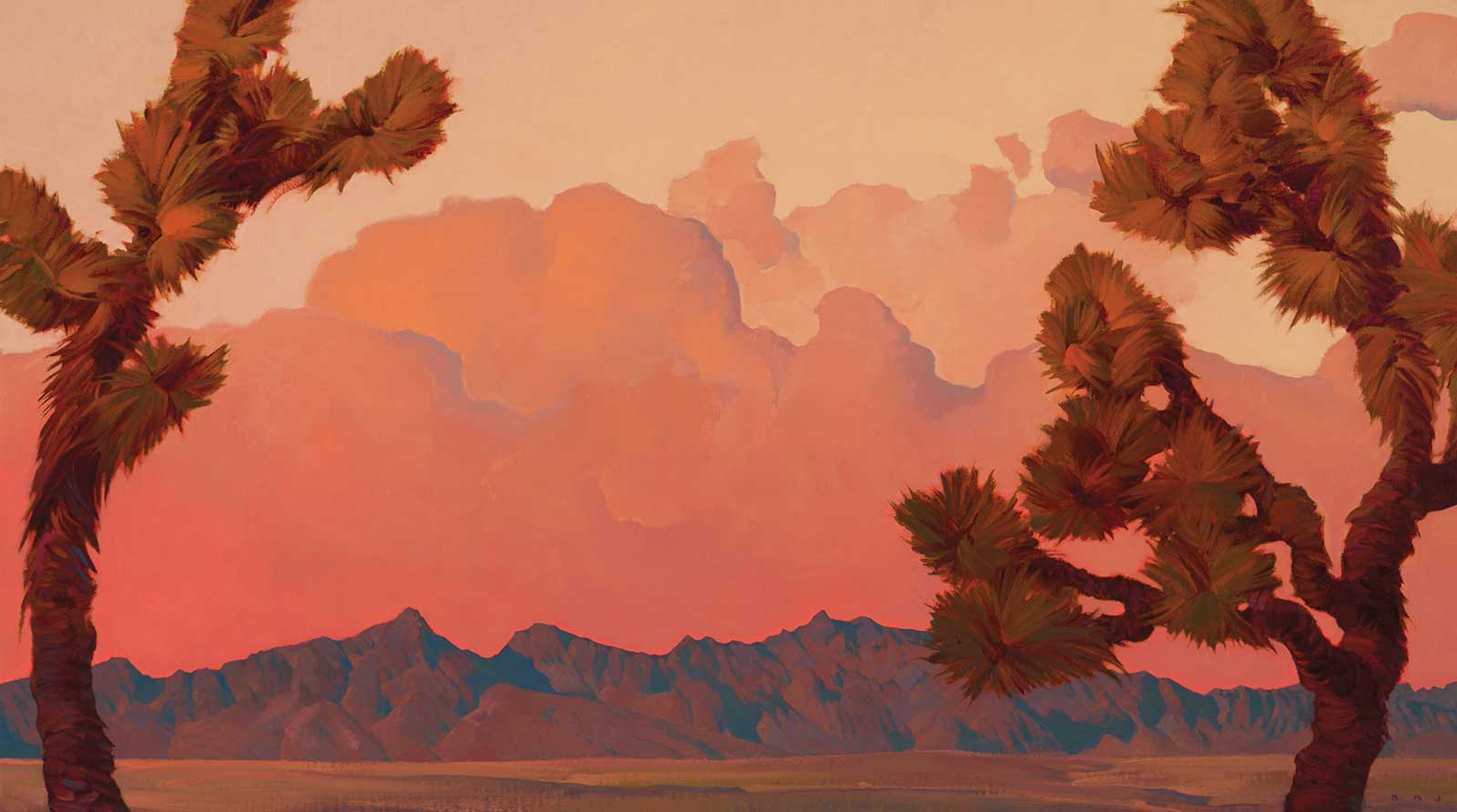
Trees of the Garden, oil, 18 x 32”
For Brett Allen Johnson, this is life. “It can be a continuous and frustrating process,” he says. “It’s so weird because you want everything to be great, but if you start trying too hard, or even make a formal or organized push, it can backfire. It has to happen all organically.”
He relates how he had no formal training as he was coming up, so there was never anyone there over his shoulder to tell him he was doing well or even to slap his hand and tell him to try harder—there was no one. “I’ve been talking to my wife a lot about switching techniques or maybe using a different set of colors. I worry that I’m too comfortable in the same place. But I’m also trying to get out of this mindframe of trying to escape out of my studio,” he says. “Because what this all comes down to is just developing neural pathways to solve problems, and hoping those pathways don’t lead to all the same solutions. When you can do that, then you can start developing your voice as an artist more.”
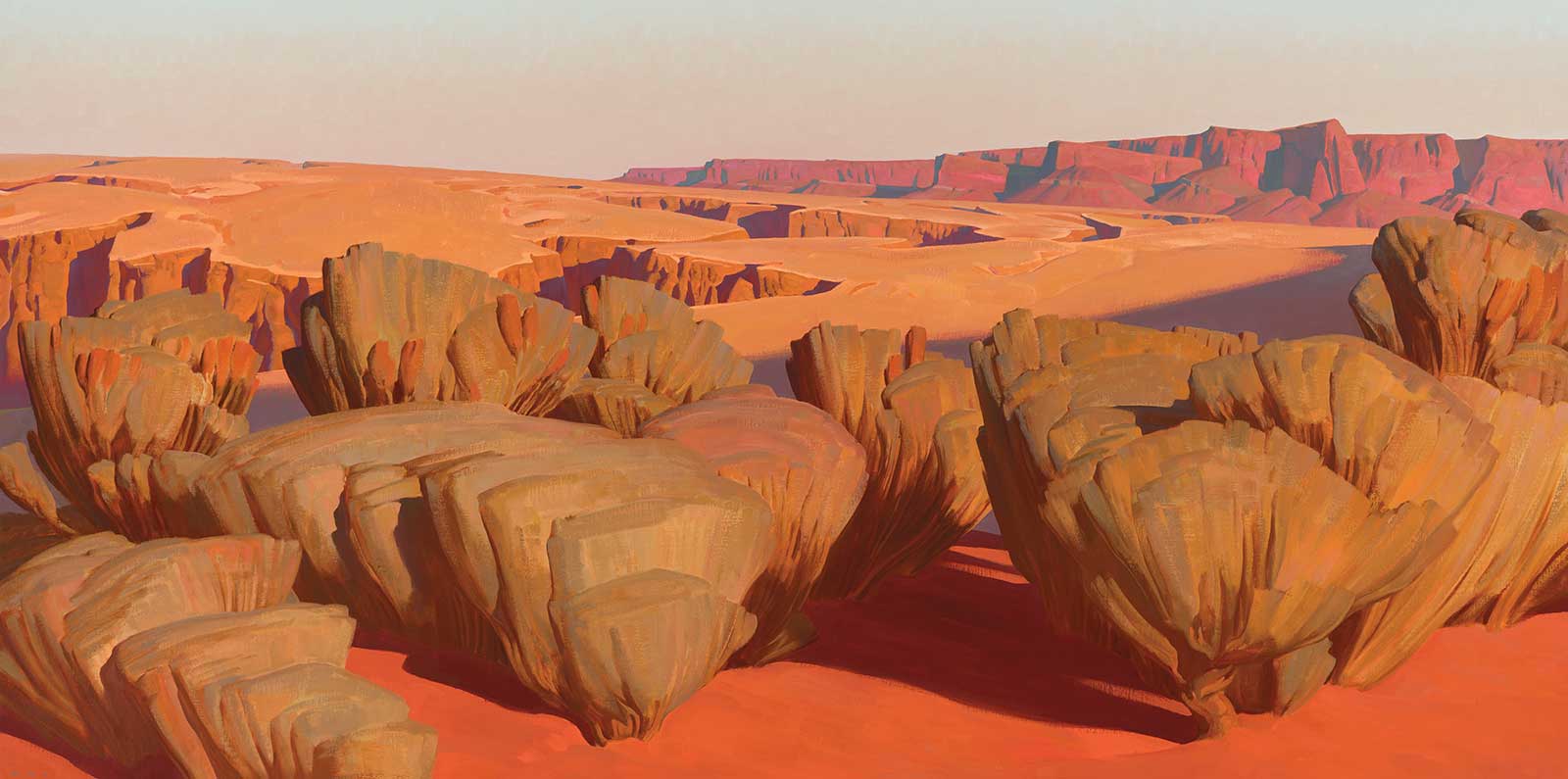
Two Valleys, oil, 30 x 60”
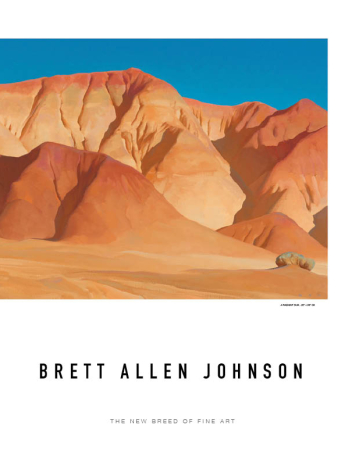
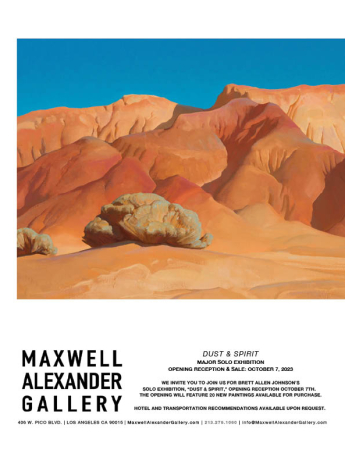
This is a lot to take in, especially at the beginning of an article, but it speaks to the exciting place Johnson is at right now. He is trying to make sense of what is next and where he should be going. He is likely to get answers at the conclusion of his newest show, which opens October 7 at Maxwell Alexander Gallery. The major solo presentation, which will feature as many as 20 pieces, shows an artist who is in supreme control of not only his brush and palette, but also his observational skills and his unique voice as an artist.
“I want to have a different style from other artists, but you don’t find that by forcing it. You find it by trying something you haven’t done yet. It’s repetition that solves that,” he says, adding that he has started to examine his own inspirations, including the great Maynard Dixon. “Dixon has cast a long shadow over my shoulder. You almost start to resent it sometimes, but his work is such a big influence on me that it’s hard to disregard.”
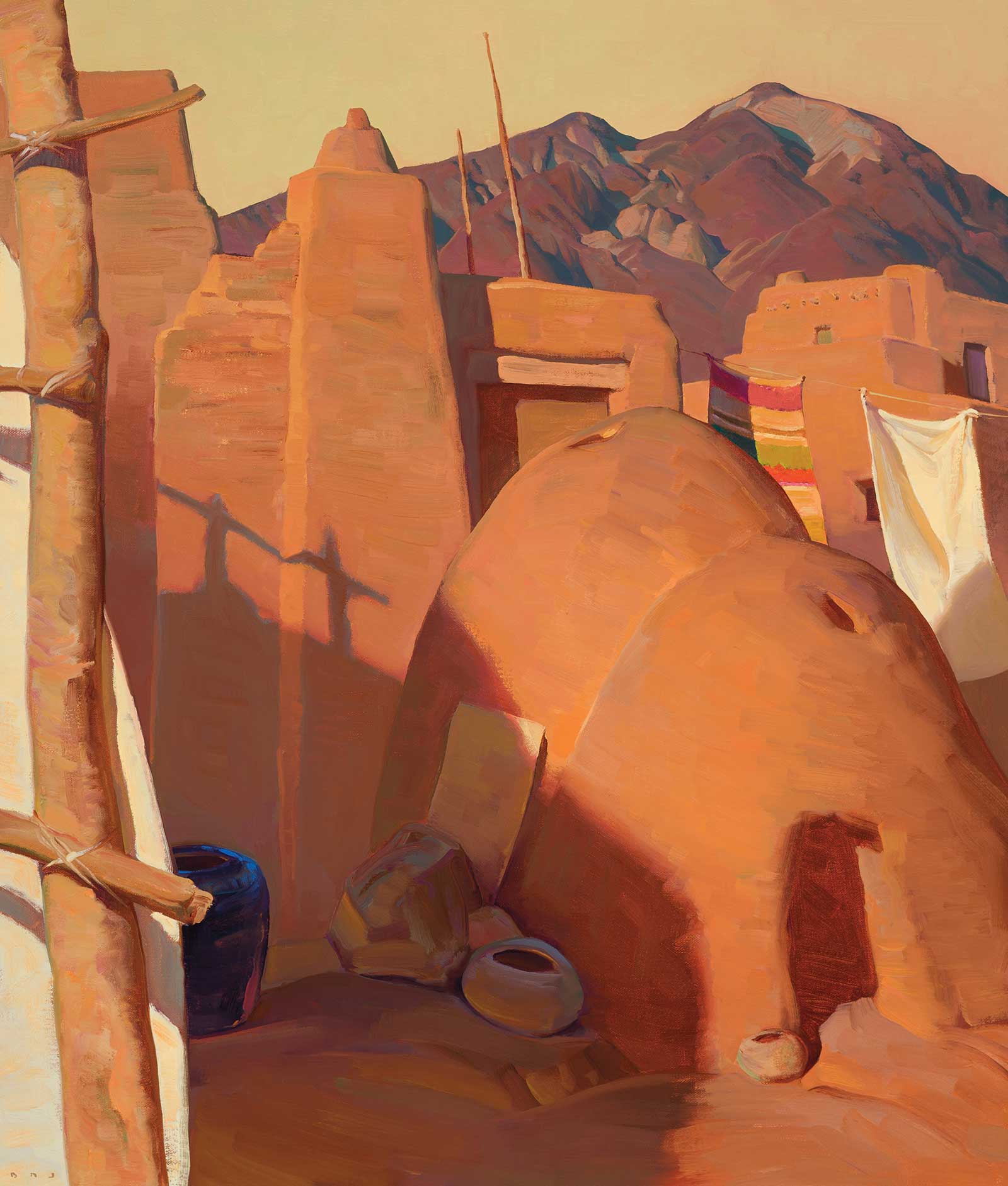
Pueblo Village, oil, 26 x 22”
Johnson has only been on the Western art scene since 2016—when Logan Maxwell Hagege and his brother, gallery director Beau Alexander, saw potential in an Instagram feed—which makes him a youngster in the genre. And yet, there is wisdom in his work, which does invoke Maynard Dixon and even Georgia O’Keeffe, but also is uniquely his own with color that leaps off the canvas, fascinating compositions and his ability to create dynamic scenes showing both epic and tiny qualities of the Southwest. Consider one of his new works, Half Circle, which shows two adobe ovens, or hornos, as they are framed against distant mountain peaks with mirrored forms. His deserts are both accessible and monumental in equal measure. “For Half Circle, I loved the interplay with the colors, and also the textures as well,” he says. “There are often surreal qualities about the desert that I enjoy painting.”
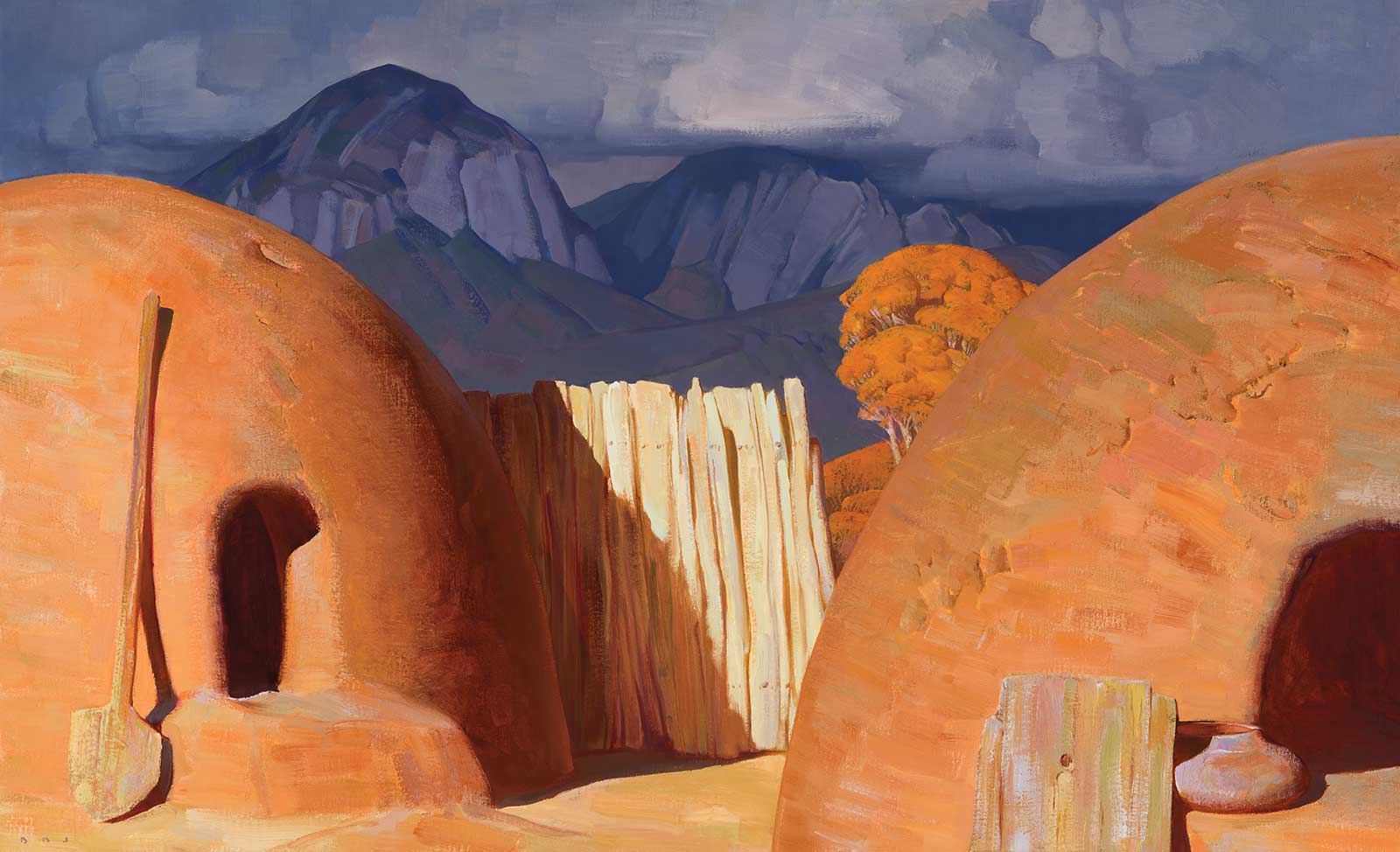
Half Circle, oil, 22 x 36”
Johnson does a similar trick in Gentle Earth, which combines sagebrush and mountains together, giving each one fair treatment as subjects. Even the color seems united in spirit, which is a key feature of the work. “For that one I actually used an open palette. I found myself gravitating toward this tonal sort of look with just two or three color families,” he says. “I’ve always enjoyed the work of Josef Albers and his color squares. His work is wonderful. He would choose a red and a brown and then a yellow family of colors and just build a whole painting with these very tiny variances. I love that look.”
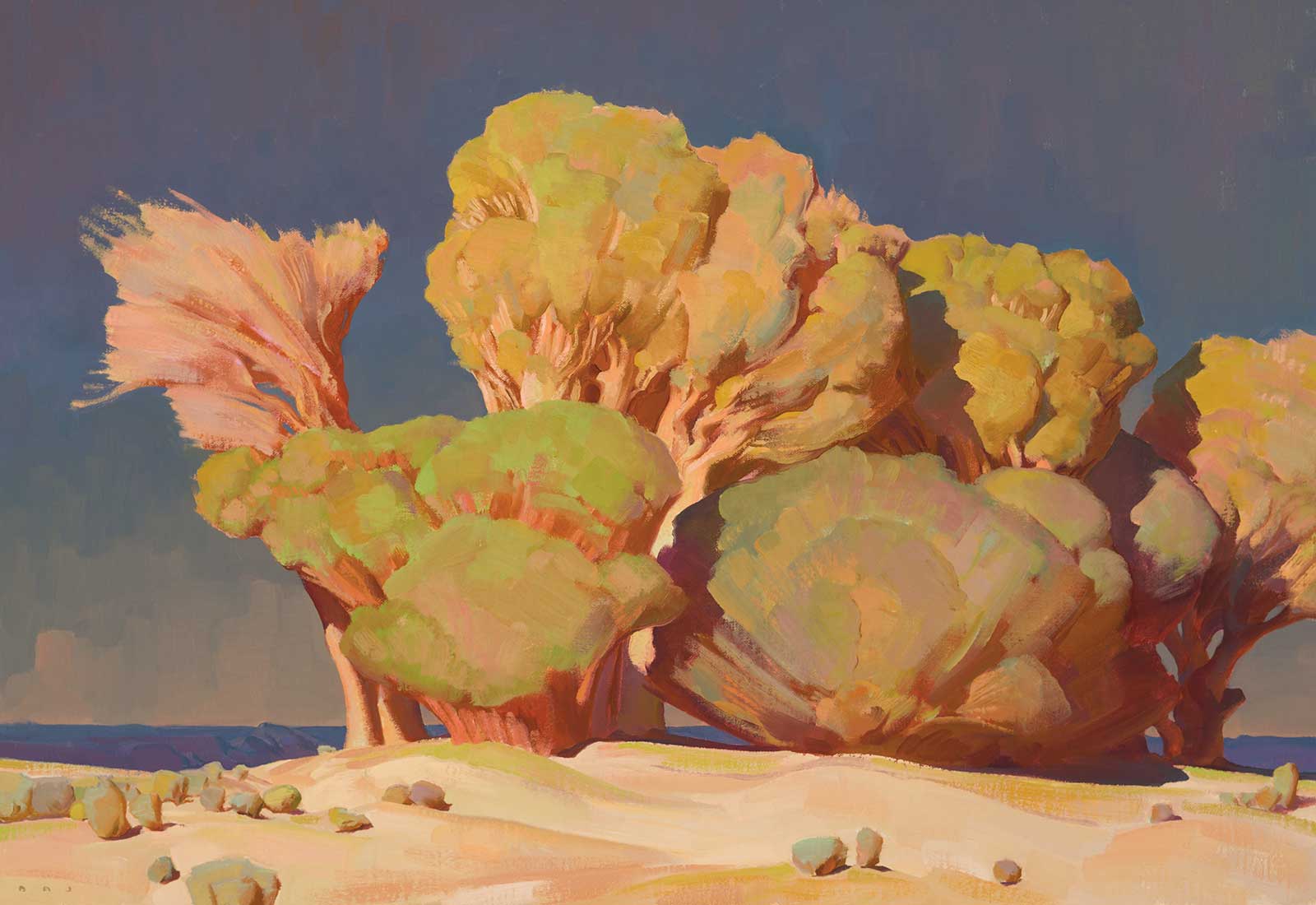
Cottonwood Stand with Distant Rain, oil, 18 x 26”
One of the standout pieces in the show, one that again shows the small and large aspects of the desert combined into one image, is Two Valleys, which depicts the Marble Canyon area of Northern Arizona. The painting is made up of three distinct regions: red-rock and wedge-shaped cliffs in the distance, golden canyons carved by the Colorado River in the middle of the painting, and light-green sagebrush in the foreground. All three sections unite in a gentle cluster of diagonals at the center of the painting.
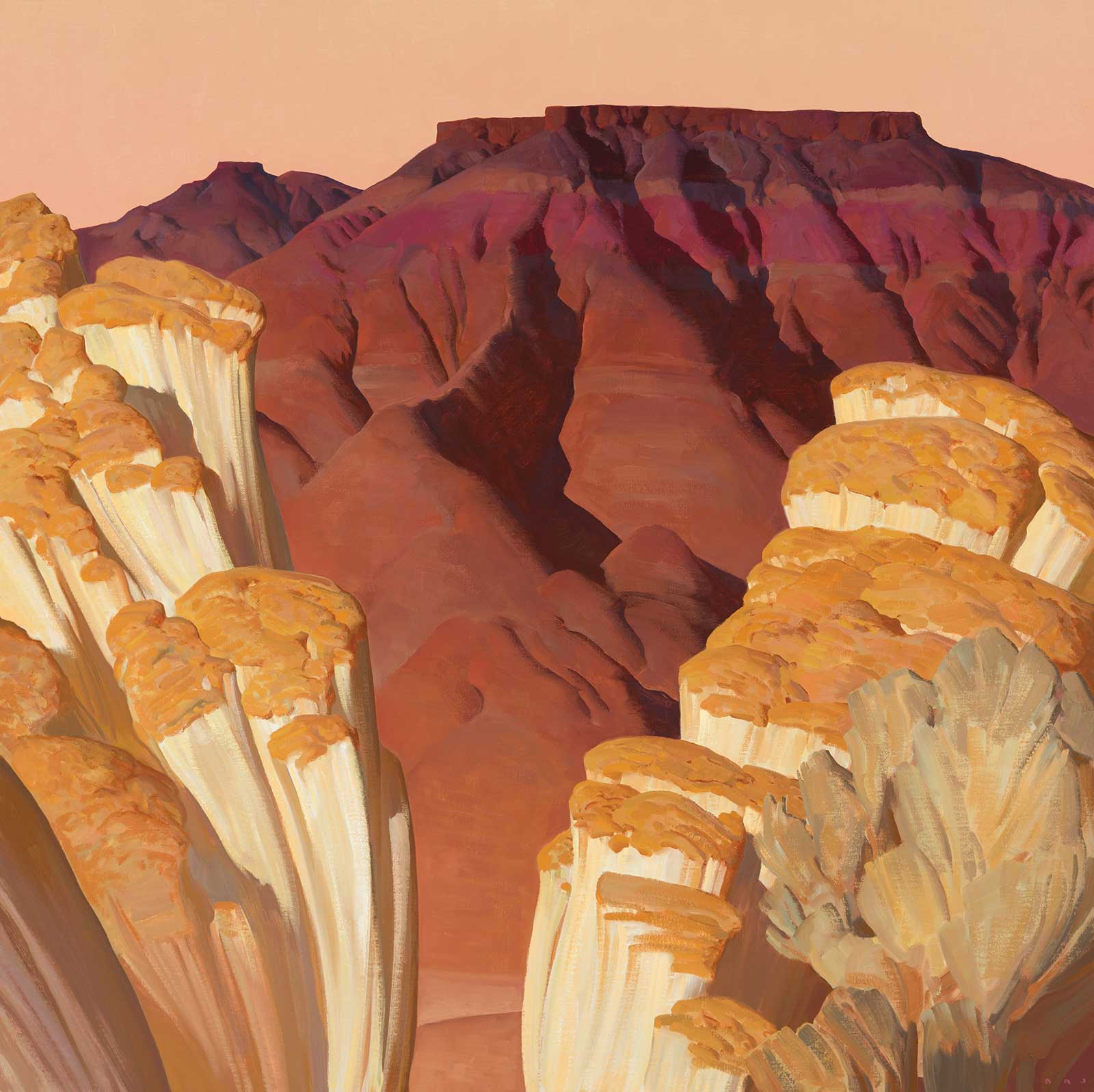
Gentle Earth, oil, 34 x 34”
“I basically did that one from memory of where the Colorado River comes out of the Glen Canyon area. I love seeing places like that, including Vermilion Cliffs and Death Valley—they’re gnarly places to paint,” he says. “For Two Valleys, though, after I had left I kept coming back to this idea that this big flat land was swelling in the valley, which is how I painted it. It’s a beautiful area.”
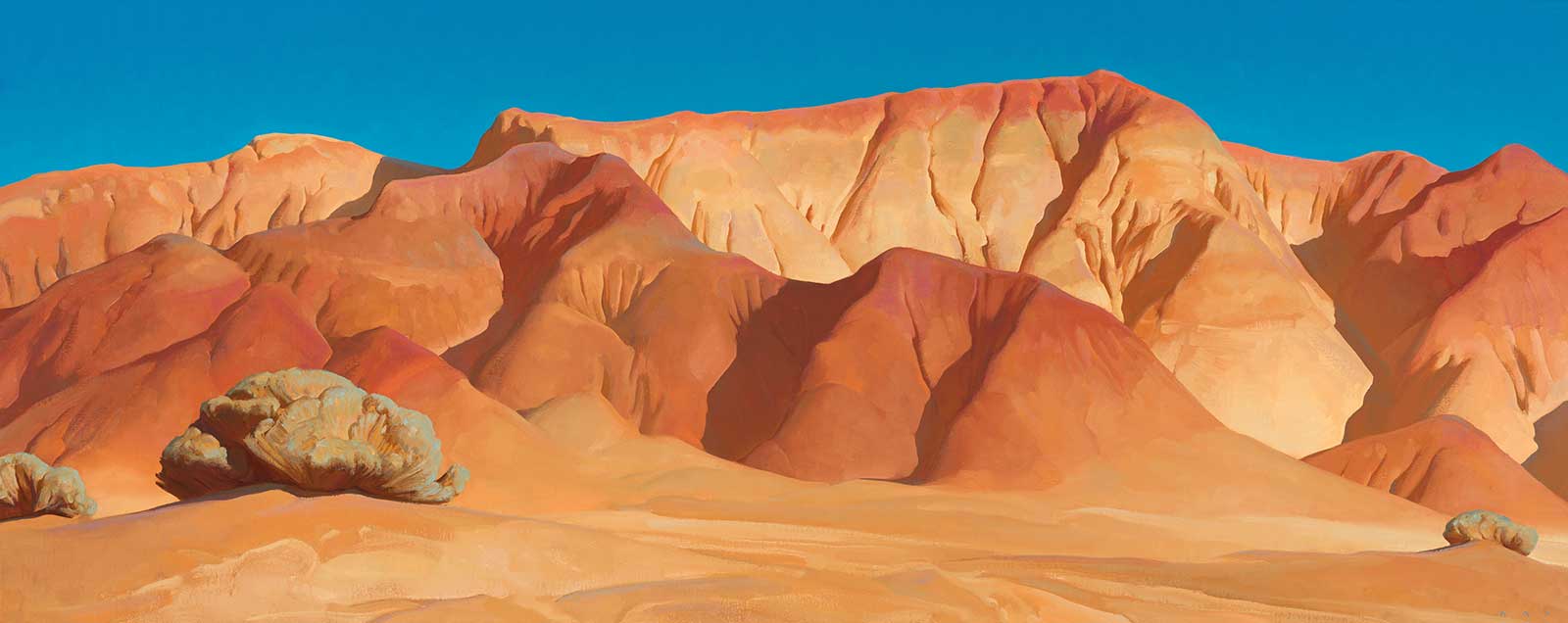
A Radiant Sun, oil, 20 x 50”
Johnson admits that when he plans a show, he doesn’t really strategize so all the works can be cohesive or tell a larger story. His interests, particularly in landscapes of the American West, is what guides his hand. He does concede that color is something he thinks about more than usual, and it’s changing his process every so slightly. “I start with a white canvas and just get a nice earth color and spread that around. Maybe sienna or umber. I’ll rub some on and then rub some back off, just push and pull it with a lot of flexibility. It helps that I’m not super literal with my subjects, which means I can draw everything in how I like it later,” he says. “For this show, I have been using more texture—in fact, a lot of it. I’ve used fairly thin paint in the past, but lately I have been letting the impasto stack up so I can drag a brush through it.”
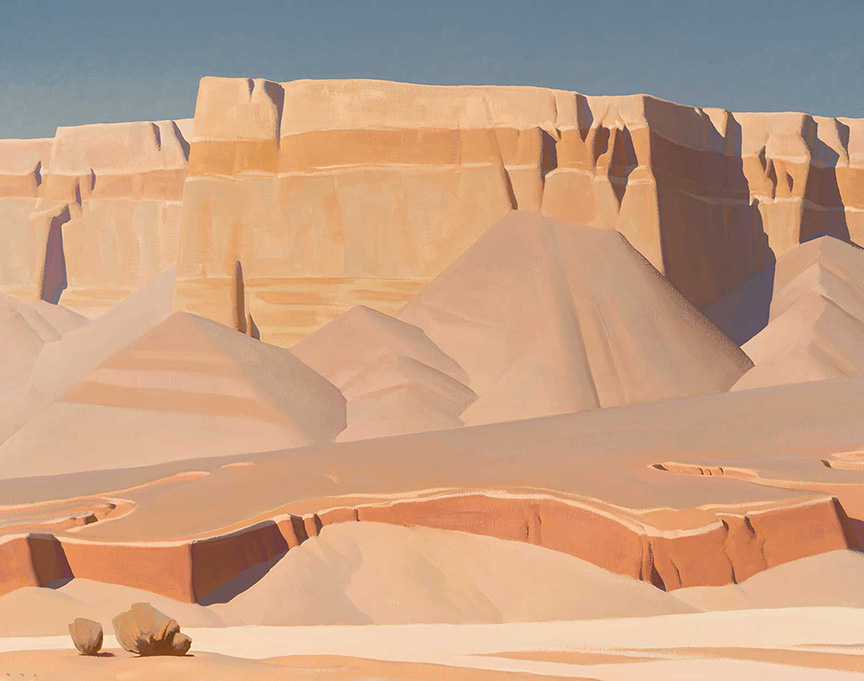
Stone Slabs, Glen Canyon, oil, 30 x 38”
Other works in the show include Pueblo Village, showing two hornos, several buildings and two blankets strung on a line; A Radiant Sun, a landscape painting that could easily be two nude figures lying next to each other; and Old Things and New, a still life merged convincingly with a half-hidden cloudscape that would make Maynard Dixon smile.
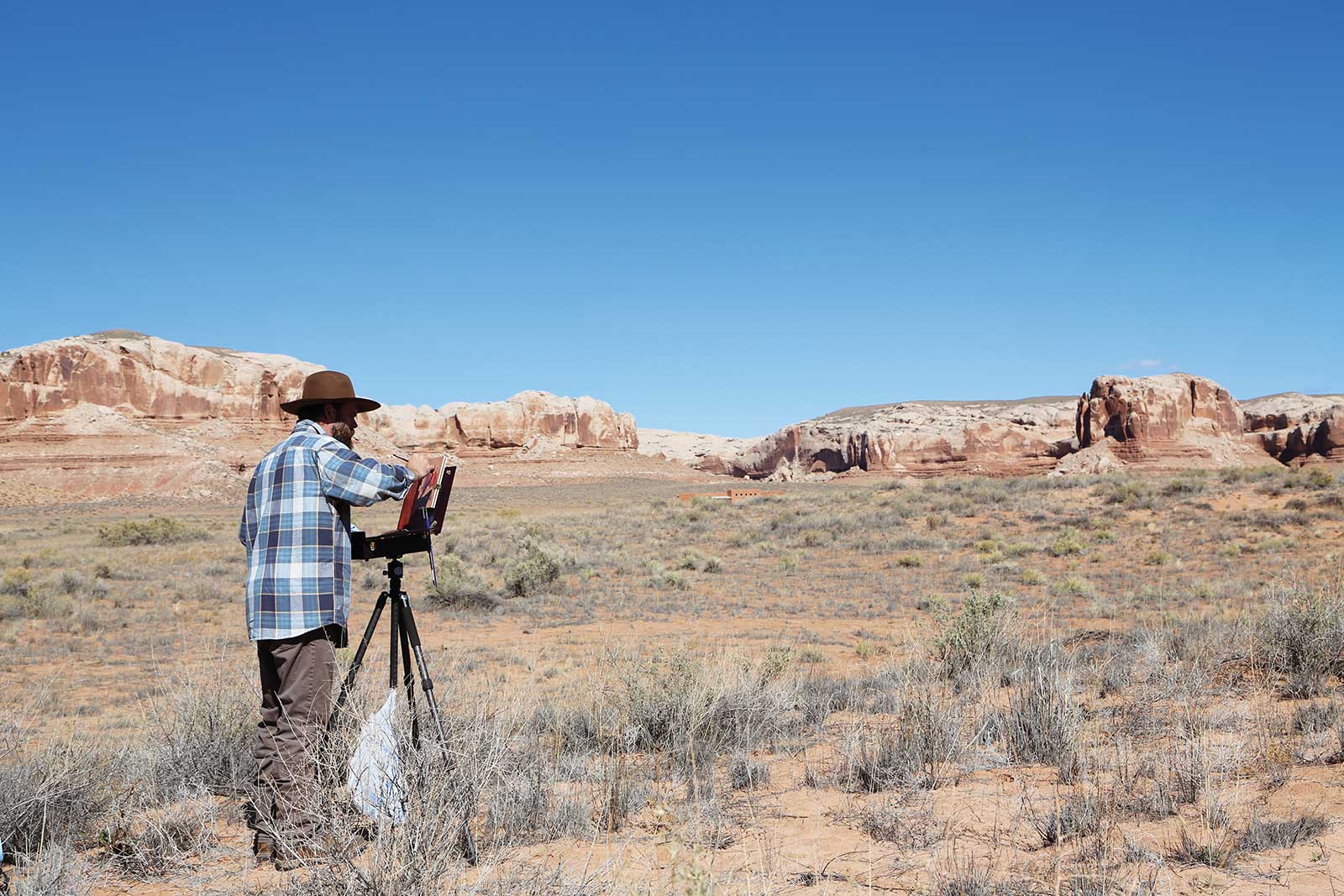
Brett Allen Johnson in Bluff, Utah, during a 2021 painting trip with Maxwell Alexander Gallery. Photo courtesy Beau Alexander.
The show will continue through October 28 in Los Angeles. —
Brett Allen Johnson: Dust and Spirit
October 7-28, 2023
Maxwell Alexander Gallery
406 W. Pico Boulevard, Los Angeles, CA 90015
(213) 275-1060, www.maxwellalexandergallery.com
Powered by Froala Editor
Powered by Froala Editor