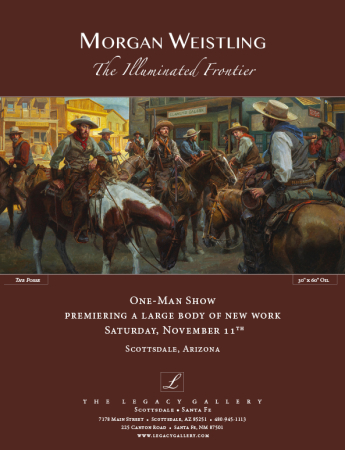
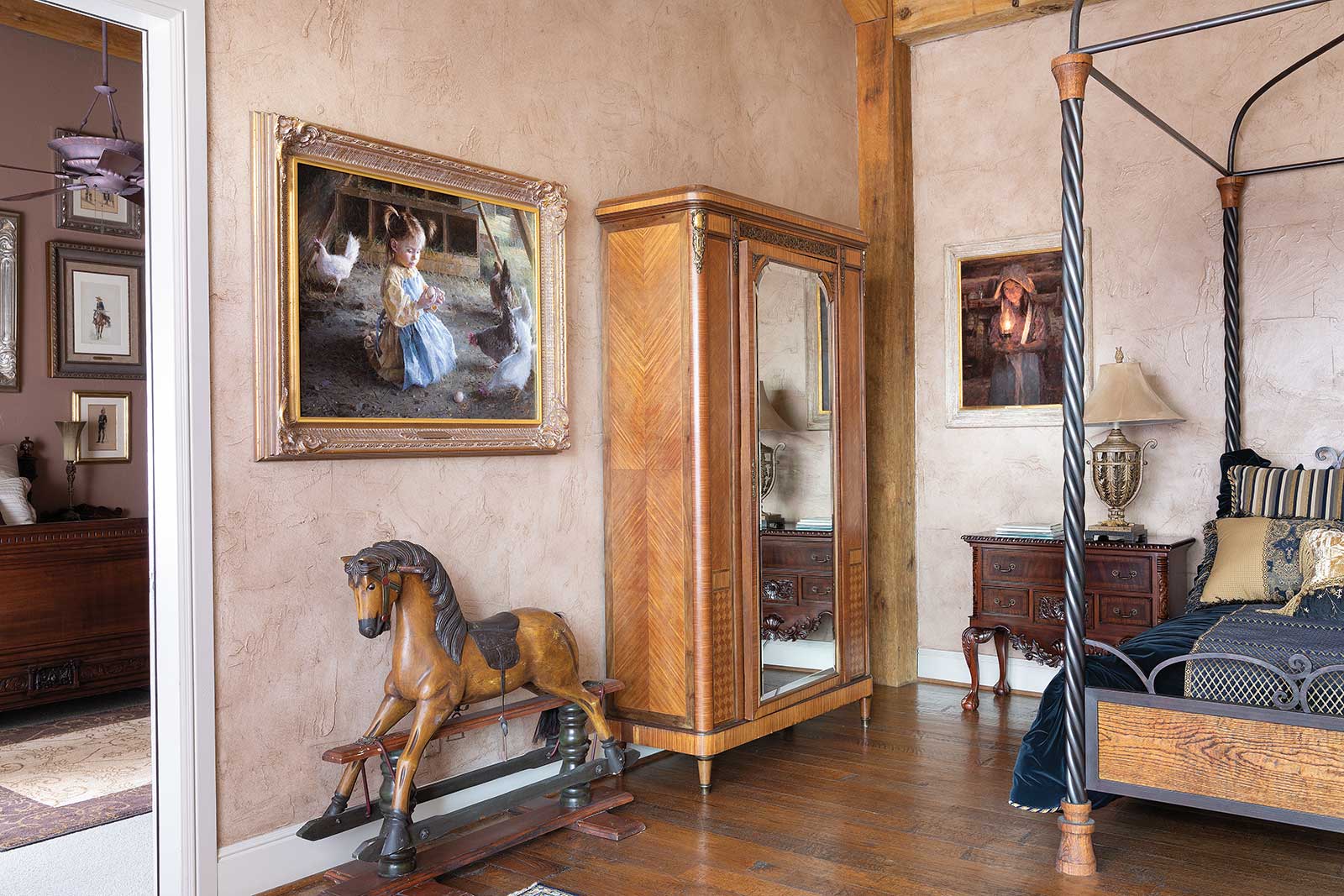
The Egg Inspector by Morgan Weistling hangs to the left of the armoire and his Lamp of Light is on the right.
Often, collectors will make a point of saying they never buy art for investment because they love the art. Duffy Oyster loves the art and loves investing in it. He and his wife, Tina, live in a 14,000-square-foot house in Dallas which they bought because it had “lots of great walls” to display their art. The collection of Western and American art is at one end and the French impressionist paintings are at the other. Sometimes they overlap.
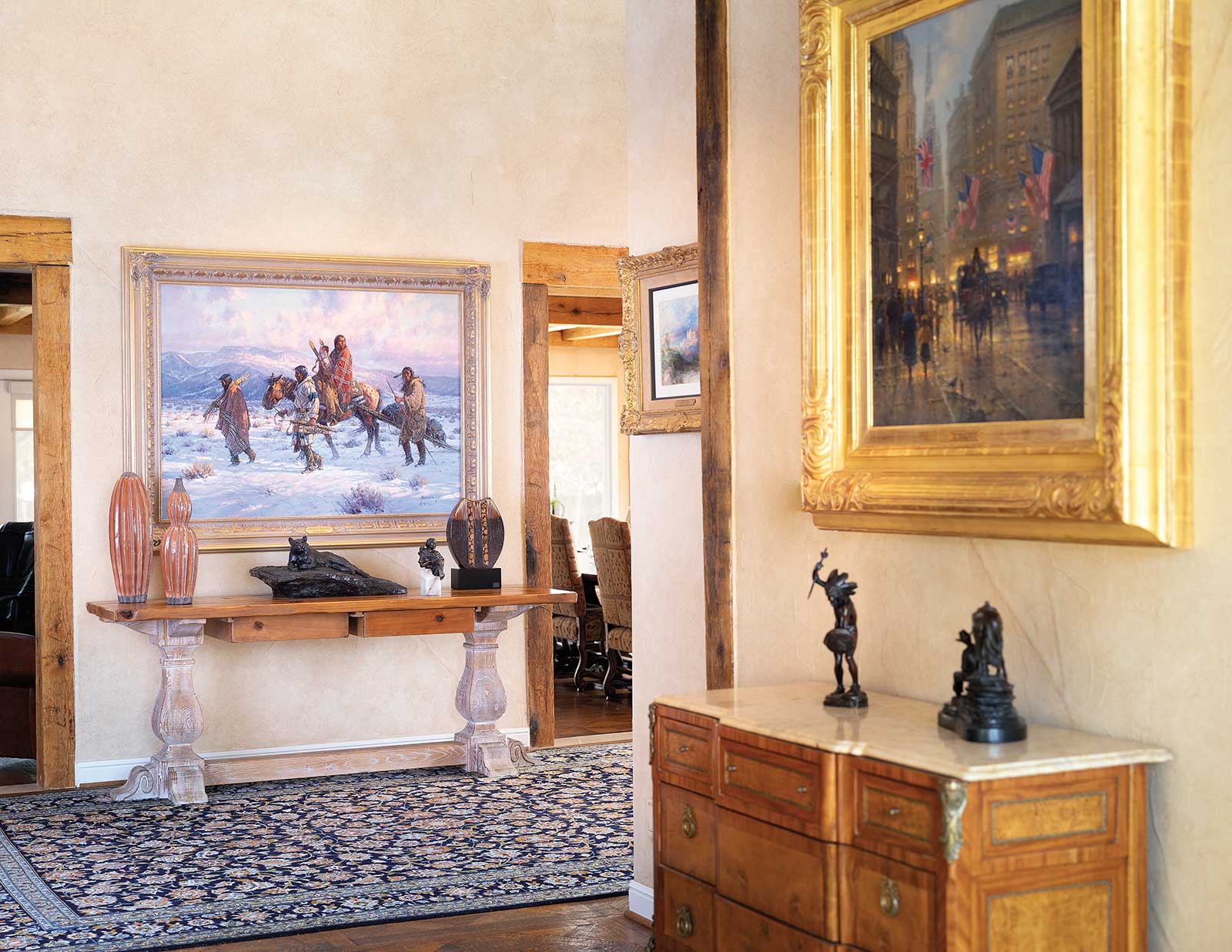
In the hallway is Martin Grelle’s Remnants. On the side wall is Sunset on the Moors by Thomas Moran (1837-1926). Above the chest is City of Dreams by G. Harvey (1933-2017). The sculptures in the foreground are, left to right, The Warrior and Indian’s Horse by Charles Humphriss (1867-1943).
“I have 250 paintings hanging in the house,” he says, “and 60 in our lake house.” Then the investor kicks in. “There are also 40 on consignment with dealers. I loan a lot of paintings out. Eventually, I’ll donate it all or open a private museum.”
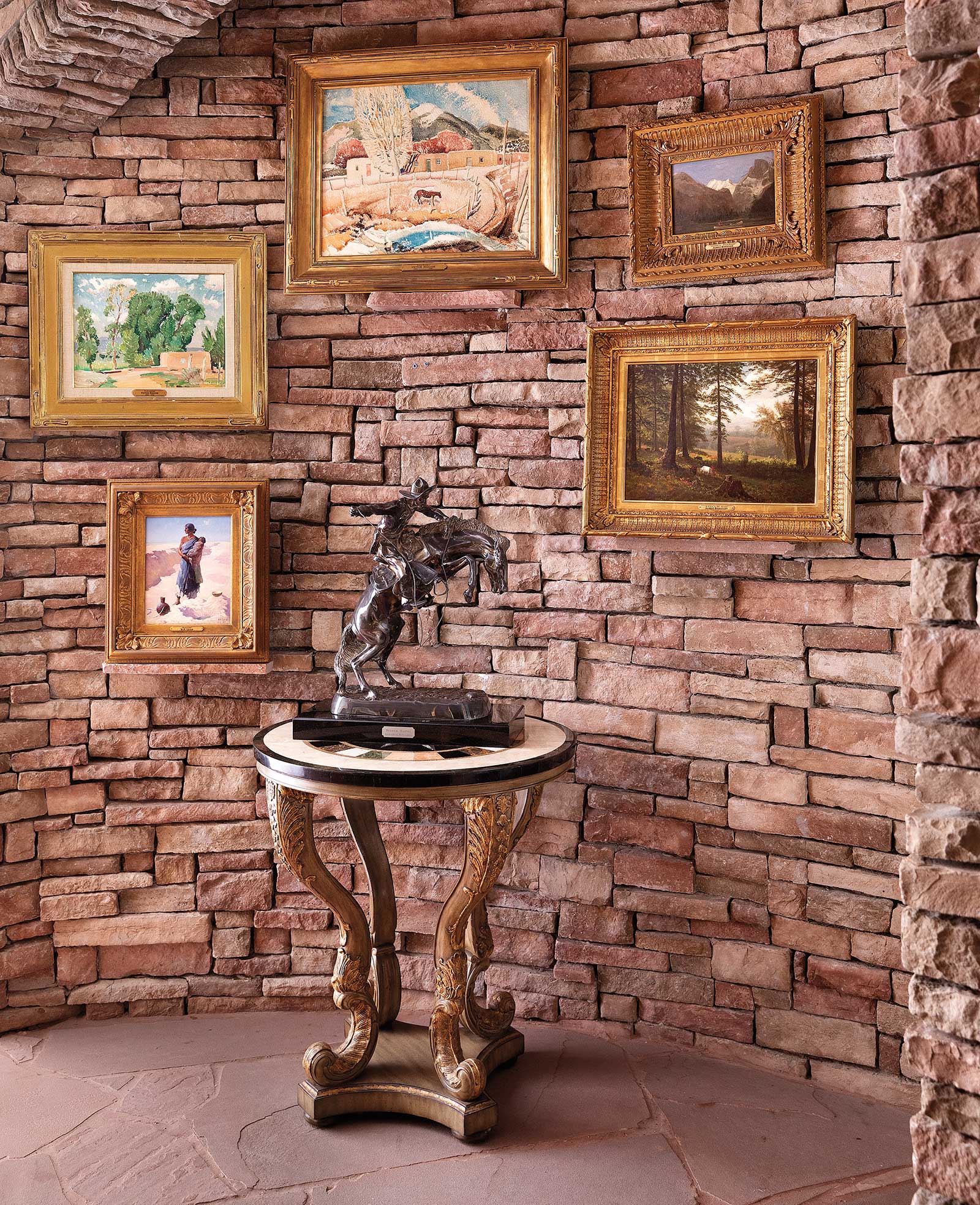
On the marble-topped table at one end of the “Little Gem Hallway” is Bronco Buster by Frederic Remington (1861-1909). Arranged on the wall behind it are, left to right, Indian with Papoose by William R. Leigh (1866-1955), Taos Retreat and Taos Mountain Ranch by Victor Higgins (1884-1949), and Canoe in Yosemite and View to Mt. Hood by Albert Bierstadt (1830-1902).
He bought his first painting for $800 and, six months later, sold it for twice as much. He was off. He researches the artists and chooses the best of the best and when he can find something even better, he trades up. He worked his way through college buying, restoring and selling classic cars and even won a few trophies for his work. Always interested in antiques and pieces with history, he even invested in historical real estate, restoring buildings.
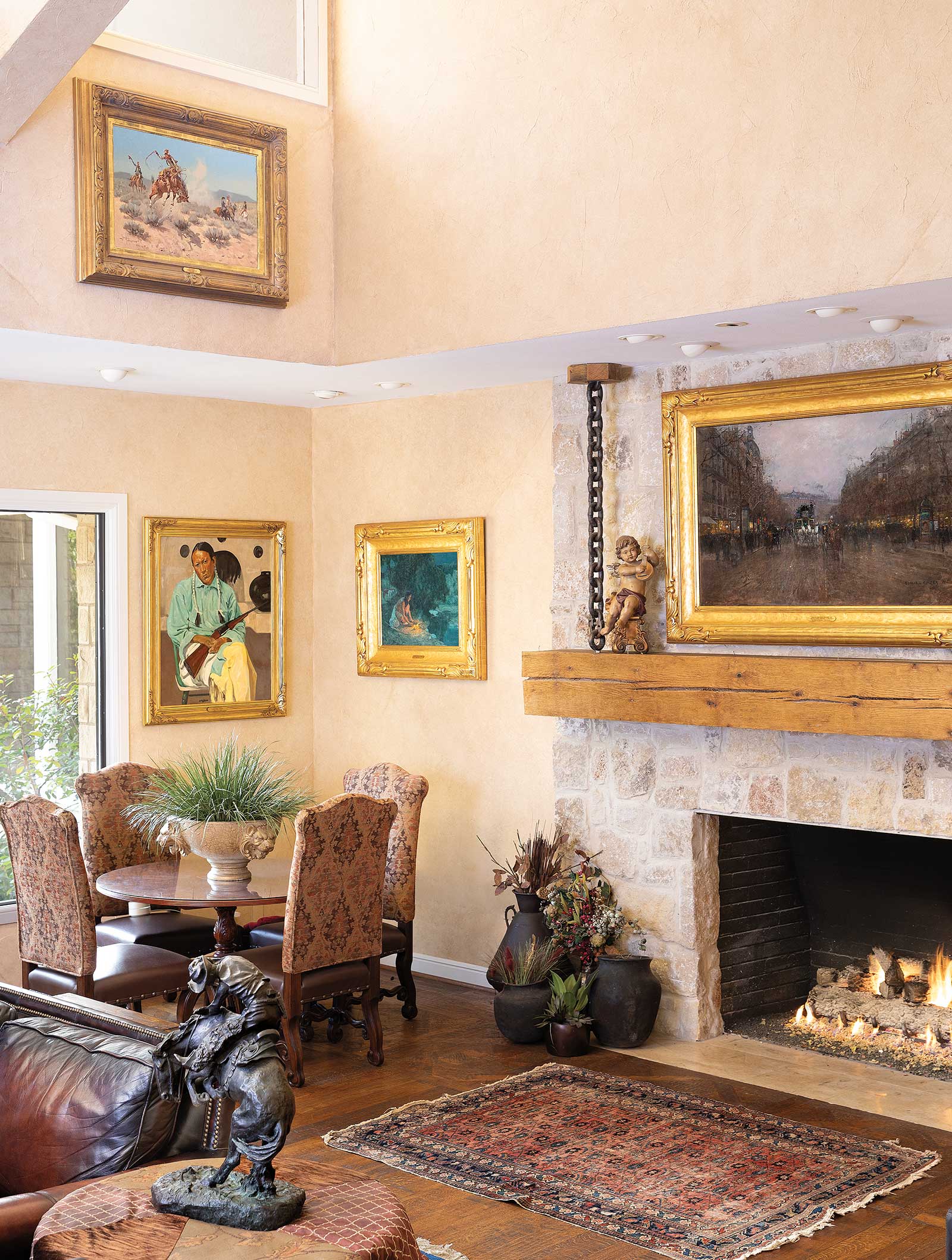
Beneath the upper window is Roping by John Hampton (1918-1999). To the right of the window is Indian Rifleman by Walter Ufer (1876-1936). On the adjoining wall is Moonlight Campfire by Eanger Irving Couse (1866-1936). Above the mantel is Paris Streets by Edouard Cortès (1882-1969) from the Oyster’s collection of French art.
Even paintings that need restoring attract him. He recalls a classic Thomas Moran painting of Venice that had been in the same family for 100 years. It was in a “horrible frame” and had a thick veneer of nicotine and residue from an oil-fired heating system coating the surface. “I bought it and took it to an art restorer in Dallas,” he explains, “and all the colors came through. I reframed it and it was worth three times what I paid for it. That often happens with paintings that people didn’t make the effort of cleaning or reframing.”
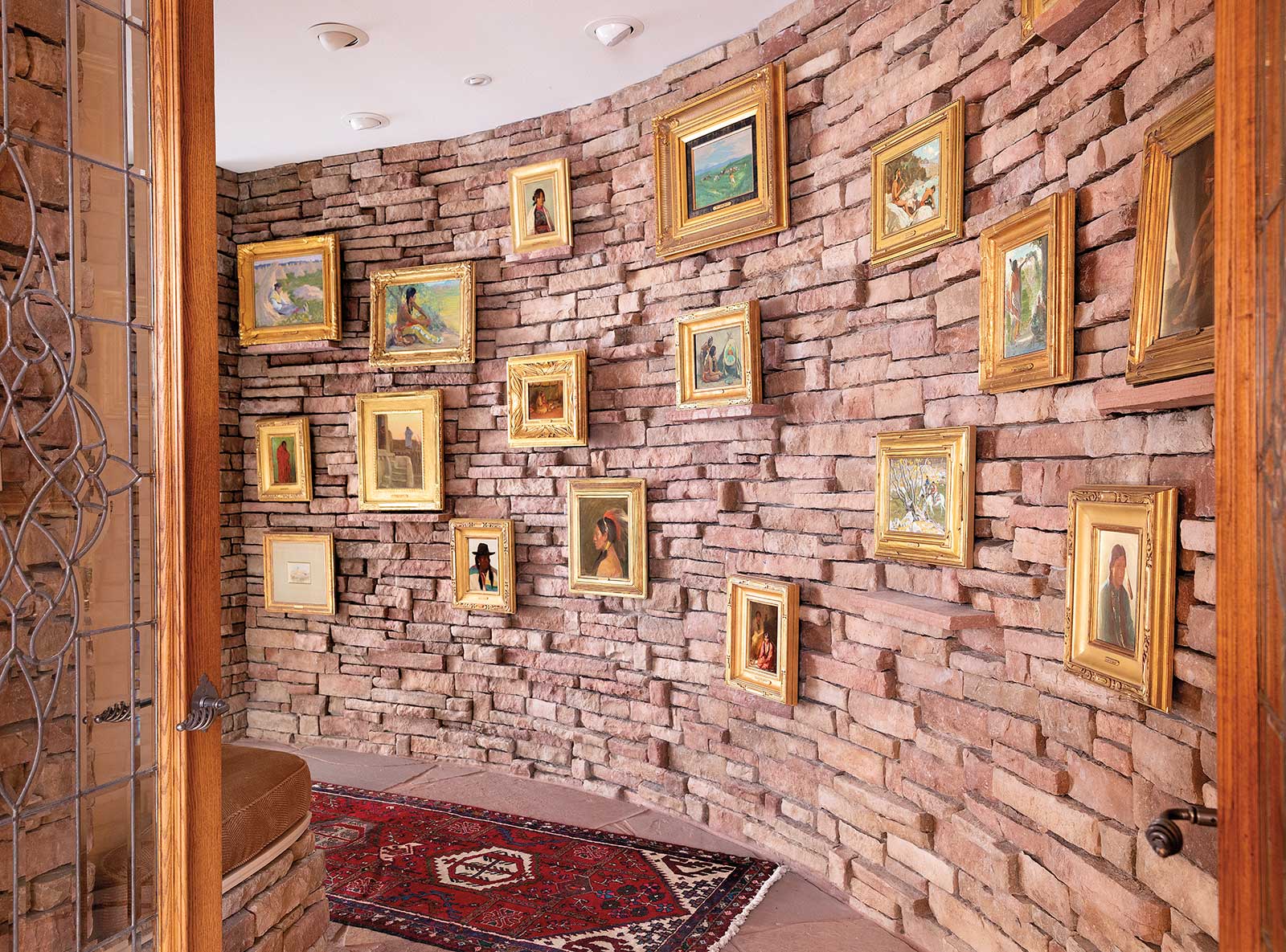
In the “Little Gem Hallway” are 50 small paintings representing all of the Taos Founders plus Charles M. Russell.
In his research, he often consults with Brad Richardson at Legacy Gallery in Scottsdale, Arizona. “He calls me if he thinks he has something that’s in my wheelhouse,” he explains. He also consults with Bob Malenfant at Southwest Gallery in Dallas, and Seth Hopkins at the Booth Western Art Museum in Cartersville, Georgia. “They know 10 times more than I do,” he admits.
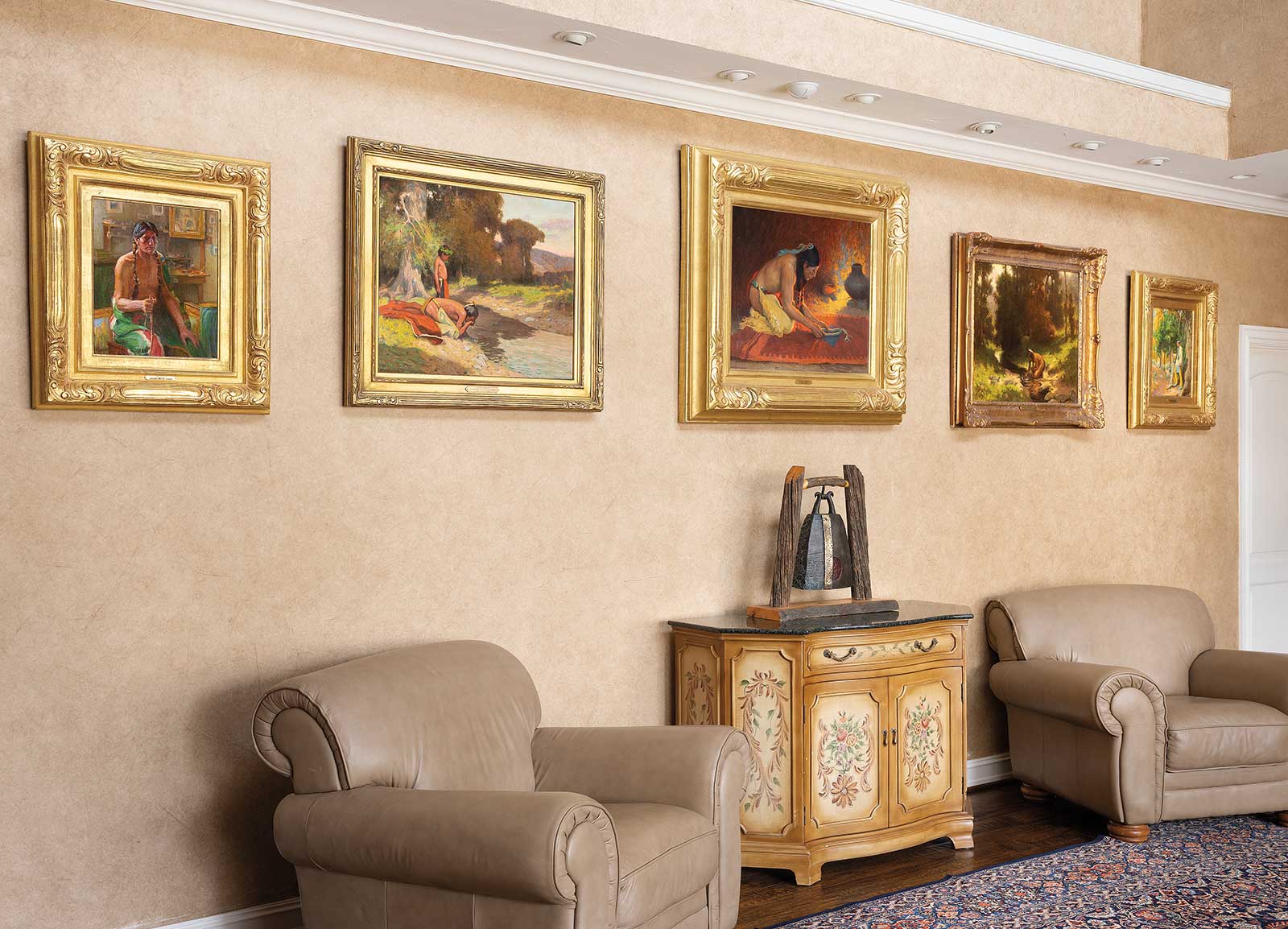
Along the wall are works by Taos Society of Artists founders Eanger Irving Couse (1866-1936) and Joseph Henry Sharp (1859-1953). They are, left to right, Sharp’s Elkfoot in the Studio; Couse’s Cooling Stream, Firelight and Water o’ Life; and Sharp’s Indian in Aspens. James G. Moore’s bronze and wood Four Seasons bell is on the chest.
Only about 15 percent of the artists he collects are living. The old saying about an artists’ market value going up after their death isn’t really true. Duffy recalls the wife of one artist flooding the market with his work after his death and the value of a $100,000 painting dropping to $25,000. Paintings by his late friend G. Harvey, one of the first artists he collected, are what he calls liquid assets and continue to go up in value.
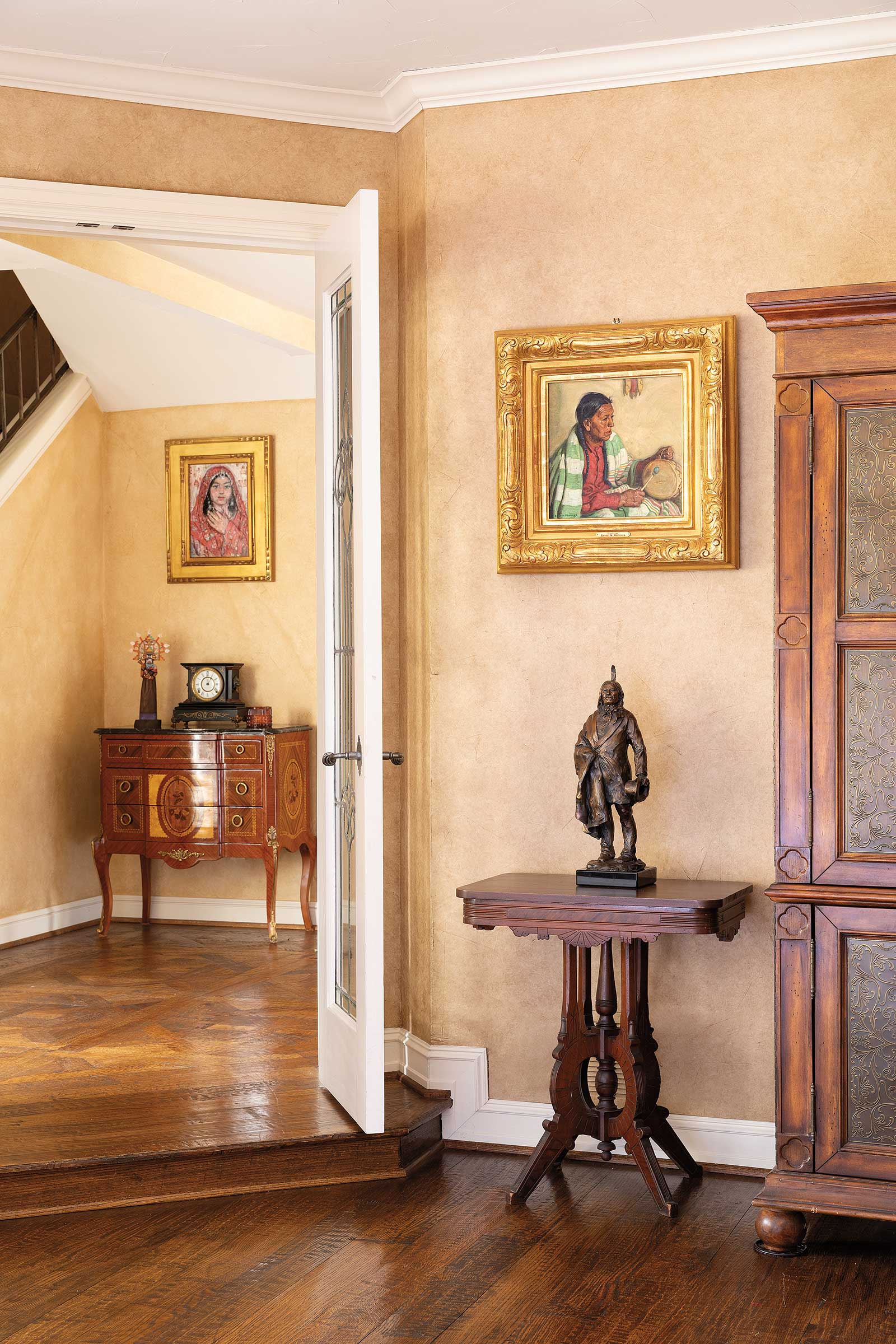
Above the bowfront chest is Russian Girl by Leon Gaspard (1882-1964). Indian Chant by E. Martin Hennings (1886-1956) hangs above the sculpture Spotted Tail Goes to Washington by Glenda Goodacre (1939-2020).
“Once I get to know an artist, I like to buy the full range of what the artist did. I have 100 paintings by the Taos Founders. I like the stories of how they got to Taos, coming from the East Coast, a lot of them had studied abroad. They all interacted in that one little town and became nationally famous. It intrigues me how they depicted the history of the Native Americans. The artists were so diverse and their styles were totally different.
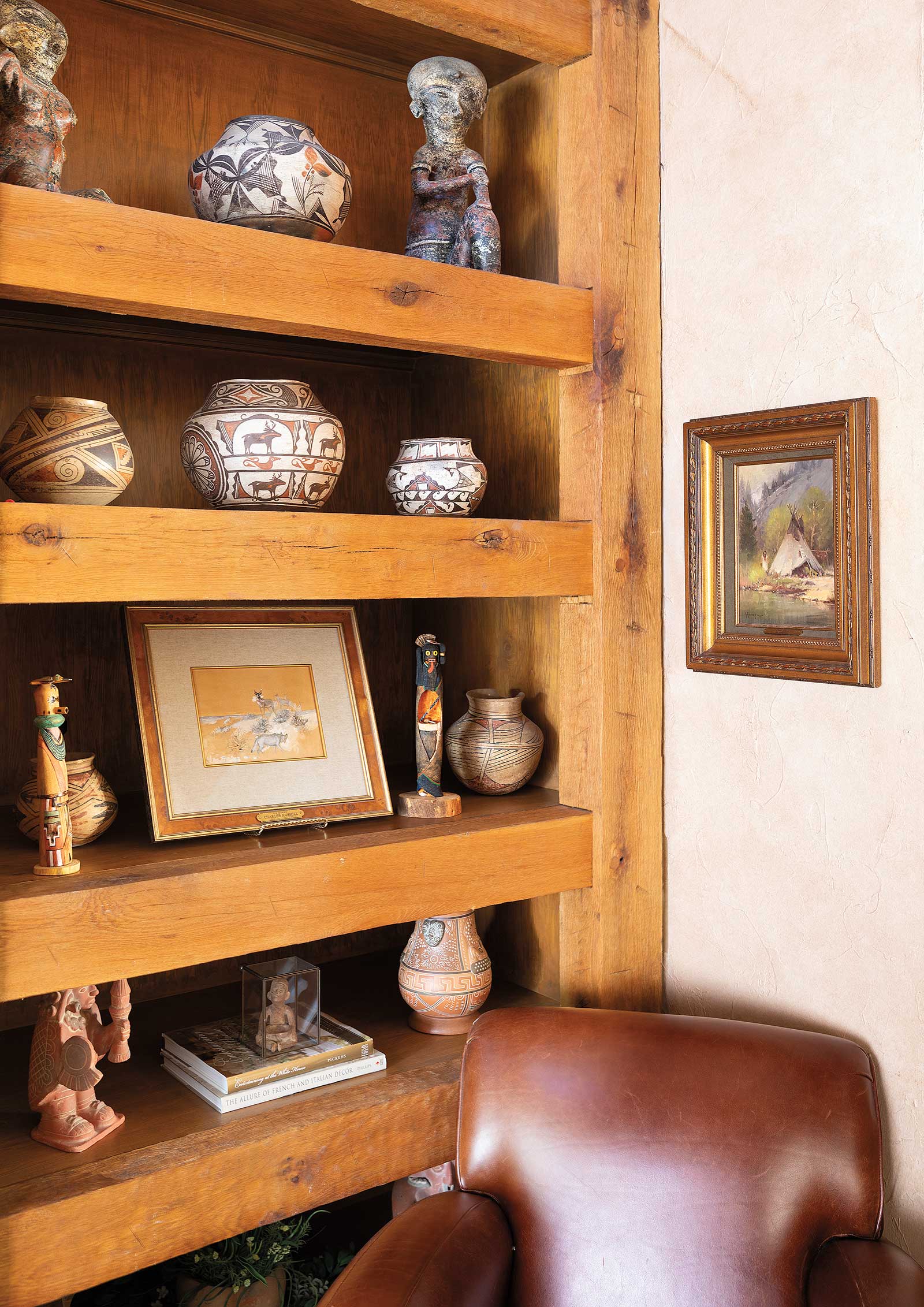
Sitting on an easel on the shelf with a variety of antique pots and katsinam is Indian Encampment by G. Harvey (1933-2017). On the wall is On Guard, by Charles M. Russell (1864-1926).
Some of the paintings are in his “permanent collection,” which he likes “from the standpoint of historic value and their value as rare paintings. I’m still buying Remingtons and Russells. Those are ones I need to keep together.”
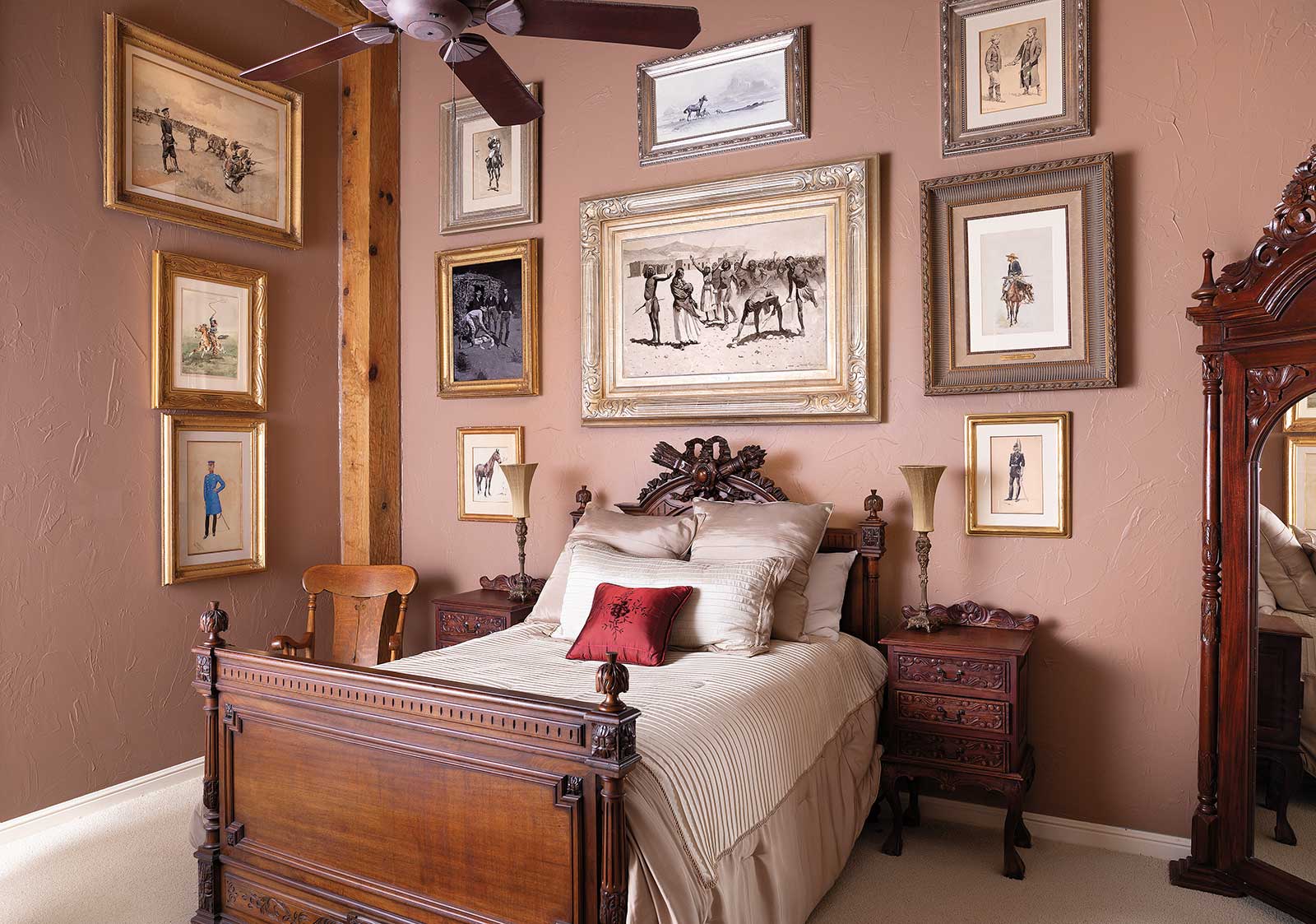
In “The Remington Room” are 11 of the 26 oil paintings, watercolors and drawings by Frederic Remington (1861-1909) in the collection.
The auction scene has changed over the years with collectors buying sight unseen on the internet. “The crowds aren’t as large as they used to be,” he says. “Auctions used to be a social thing where you’d see all your buddies and meet the younger collectors. Bill Burford, who owned Texas Art Gallery in Dallas, used to run charitable auctions. There was a sit-down dinner and the place was packed with paintings. The auctions were tremendously successful. If I buy something without seeing it first, I’ll get a condition report and have a friend who may be nearby check the painting out and look at it with a black light that can reveal if it’s been retouched or inpainted. “At auctions you have to be careful. I know the dollar amount I’m going to bid when I go in. If it’s a dollar over I won’t buy it. There’s also some competition among collectors, friendly stuff. We also sell among ourselves. We’ll call one another and say we have something we want to sell or we’ll call and say we have someone who wants to buy something the other guy has.”
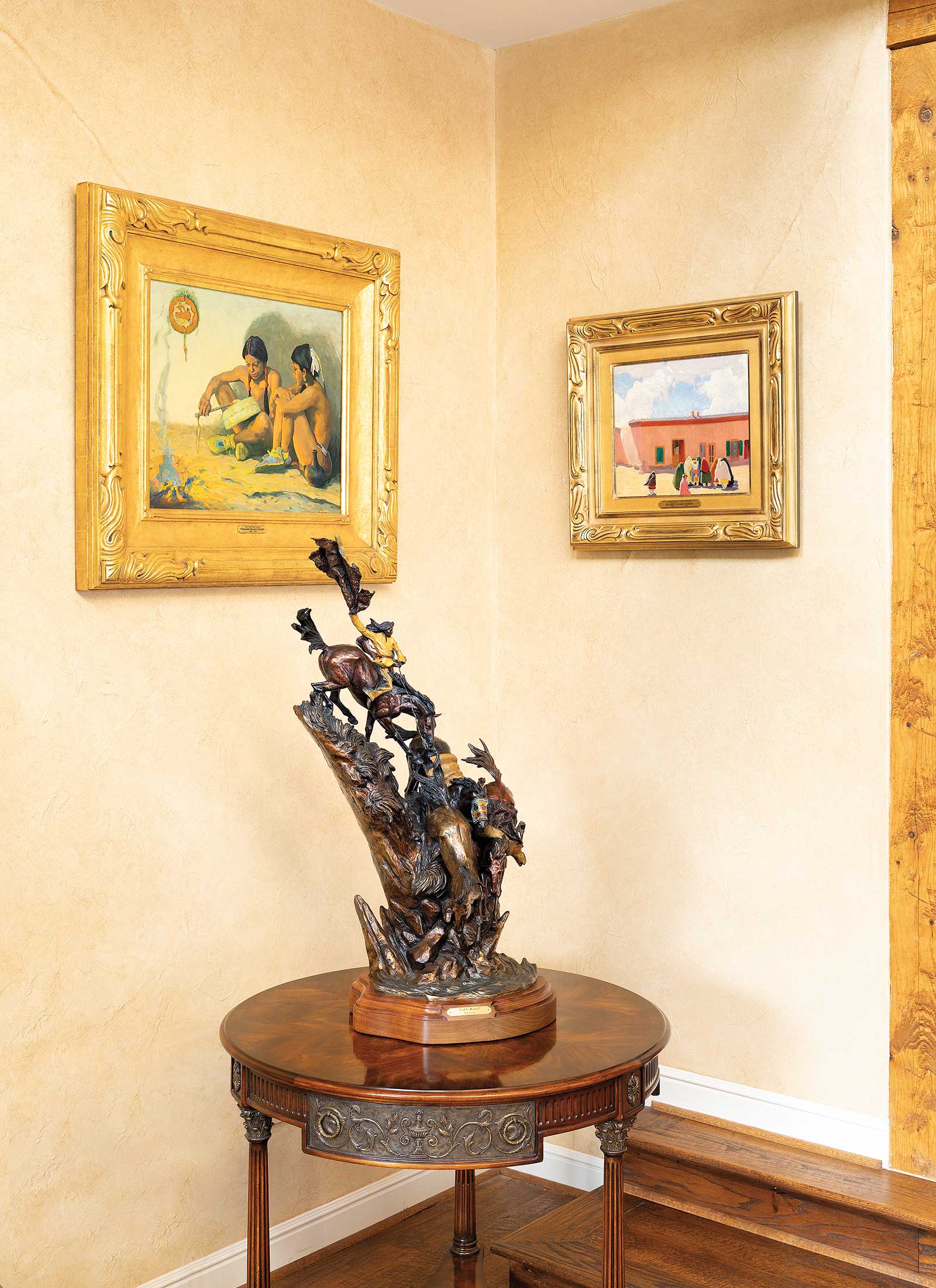
Above the sculpture Trail to Manhood, by Ken Payne (1938-2012), are, left to right, Tom Tom Lesson by Eanger Irving Couse (1866-1936) and Taos Gathering by Ernest L. Blumenschein (1874-1960).
I asked if he stores paintings in closets and he told me he has “leaners.” “In my office right now there are three leaners because I don’t have a place to put them. Tina isn’t involved in the business but she loves living with the art and she likes what I buy. She likes the Morgan Weistlings and won’t let me sell any of those.”
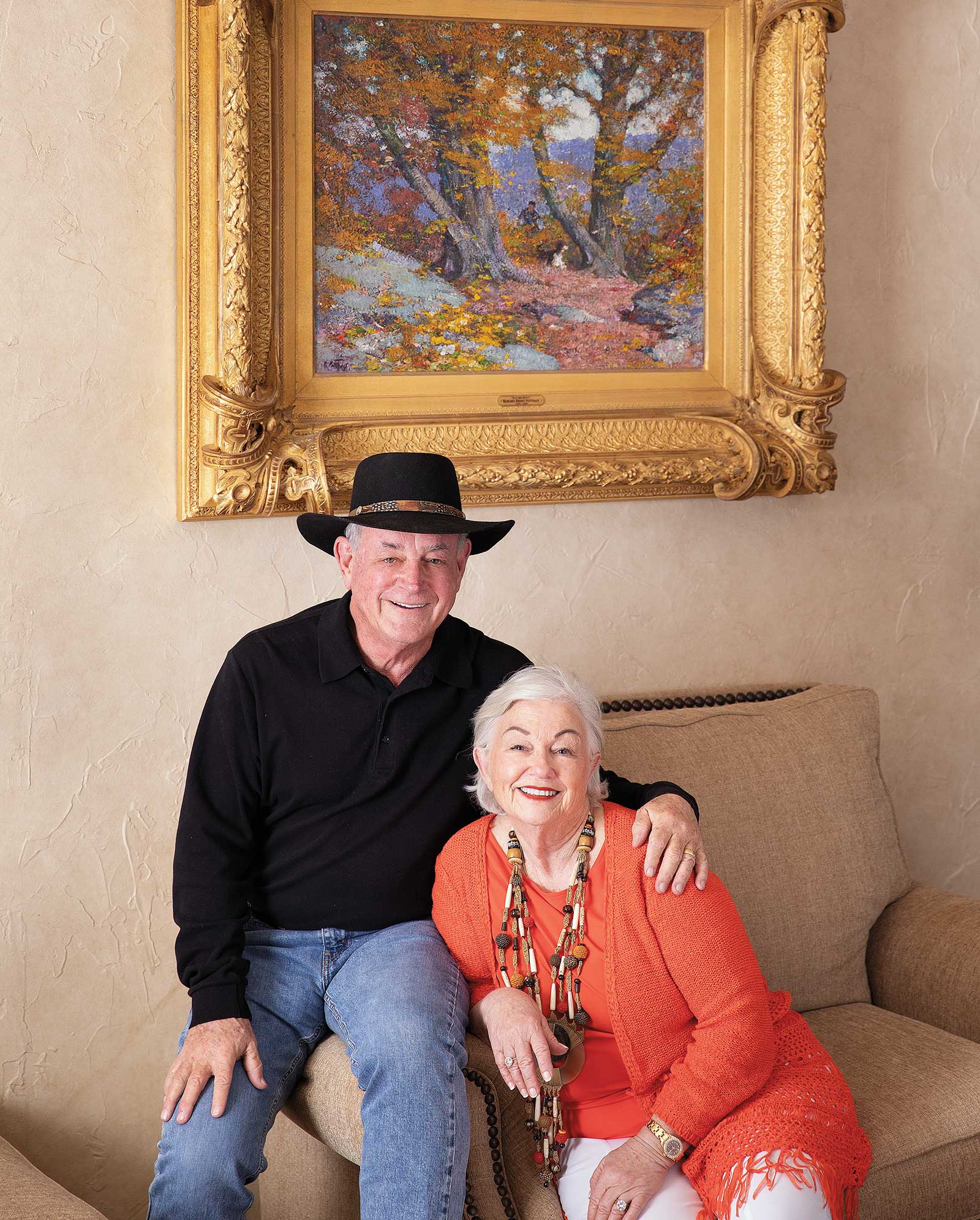
Duffy and Tina Oyster sit beneath Hunting Season by Edward Henry Potthast (1857-1927) from their collection of American art.
He continues: “The paintings really move me. I really enjoy them. I’ll have a glass of wine and walk around the house. I’ll enjoy them and sometimes think about what I want to move. The paintings are soothing and relaxing. It’s a great environment.” —
Powered by Froala Editor
Powered by Froala Editor