Chuckwagon racing at the Calgary Stampede is a staple in Canadian culture. It is something that is so uniquely and intimately theirs, and they are proud to have it. It’s a unifying legacy that artists have not hesitated to capture throughout these past 100 years, including this July as the Calgary Stampedecelebrates chuckwagon racing’s centennial at the event.
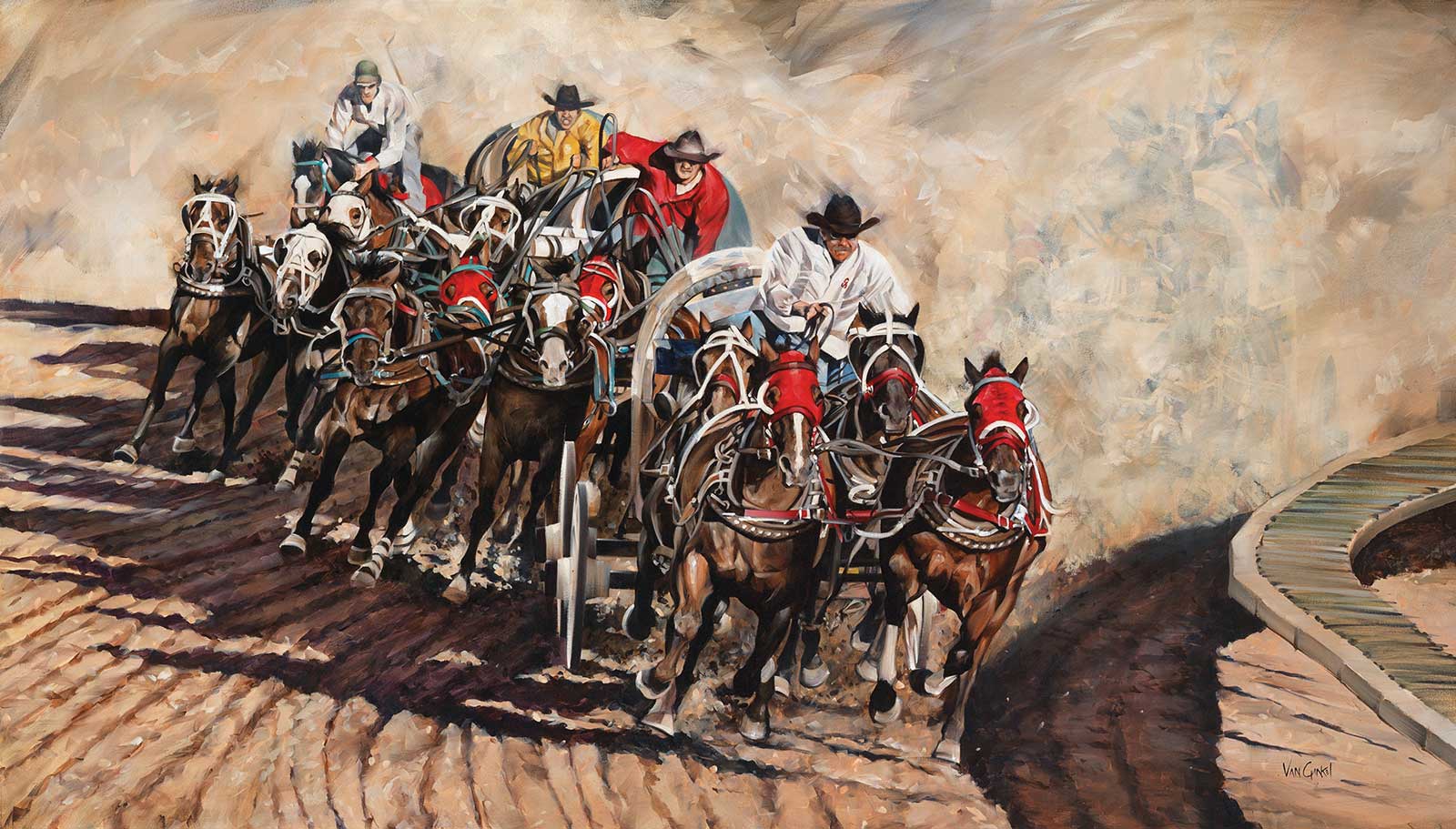
Paul Van Ginkel, History in the Dust, 2023, oil, 40 x 70”
Glen Mikkelsen, the author of The Rangeland Derby: 100 Years of Chuckwagon Racing at the Calgary Stampede, calls it Canada’s greatest race. “No other country in the world races chuckwagons and it was developed in Canada. Canadians excel at it and it’s something that emphasizes and symbolizes Canadians’ spirit of cooperation,” he says.
In his book, Mikkelsen chronicles the history of chuckwagons from their original purpose as providing hospitality to the cowboys moving cattle to the tantalizing sporting event it is today. Chuckwagons made their mark in Western history in the 1800s when cattleman Charles Goodnight found a way to repurpose a Civil War supply wagon and turned it into the original food truck. A kitchen on wheels with a pantry or “chuck-box,” a countertop and the signature canvas tarp for a roof—the wagons were brimming with all the essentials needed for the cowboys’ longest trails.
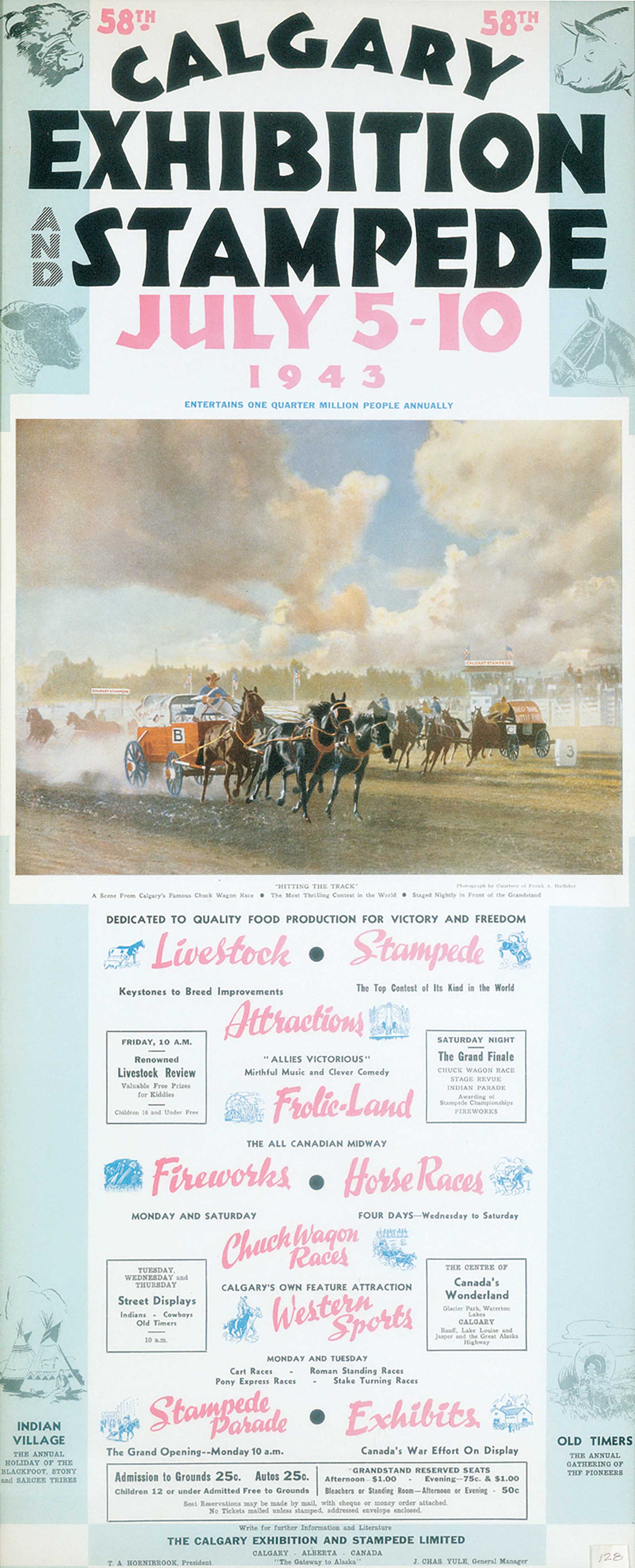
Poster from the 1943 Calgary Stampede.
In 1912, Guy Weadick, who Mikkelsen dubs the “P.T. Barnum or Walt Disney of rodeos,” wanted to honor the cowboy era by bringing to Calgary the “Stampede,” a rodeo show he advertised as “The Greatest Show of the Age!” It was an overwhelming success and continues to be the epicenter for wild rides and all things cowboy to this day. Chuckwagon racing was introduced to the show to help beef up the exhibition’s attendance and Weadick’s vision still thrives bringing ranchers, farmers and thousands of spectators to Alberta every summer in celebration of tradition, community and the hospitality for which chuckwagons were invented in the first place.
Though the rules are complex and have changed throughout the years for safety, the glory remains with a single rider controlling the wagon and four horses, and then two outriders on their own horses riding behind the wagon as support. There is a strategy to the races and many intricate moving parts that somehow come together seamlessly on the track, which may be why many artists find the sport so captivating to depict in paintings and bronzes.
Stew Cameron (1912-1970), Chuck Wagon Race, from the book What I Saw…at the Stampede.
The Calgary Stampede and Western art have always gone hand in hand. One of its most famous artists is none other than Western icon Charles M. Russell, who had a connection to Weadick and was invited to present artwork at the very first Stampede in 1912. Russell would return to Calgary in 1919 for the Victory Stampede, the first Calgary Stampede after the end of World War I, to show what many people believe to be the finest group of his work ever assembled during his lifetime. Later, in the 1950s, bronze sculptor Charlie Beil would create trophies for the Calgary Stampedeevents and then in 2012, the incomparable Harley Brown created the poster for the rodeo’s centennial. Other notable artists are, but not limited to, Western pencil artist Bernie Brown, photographers Paula and Carol Easton, and Canadian artist Paul Van Ginkel.
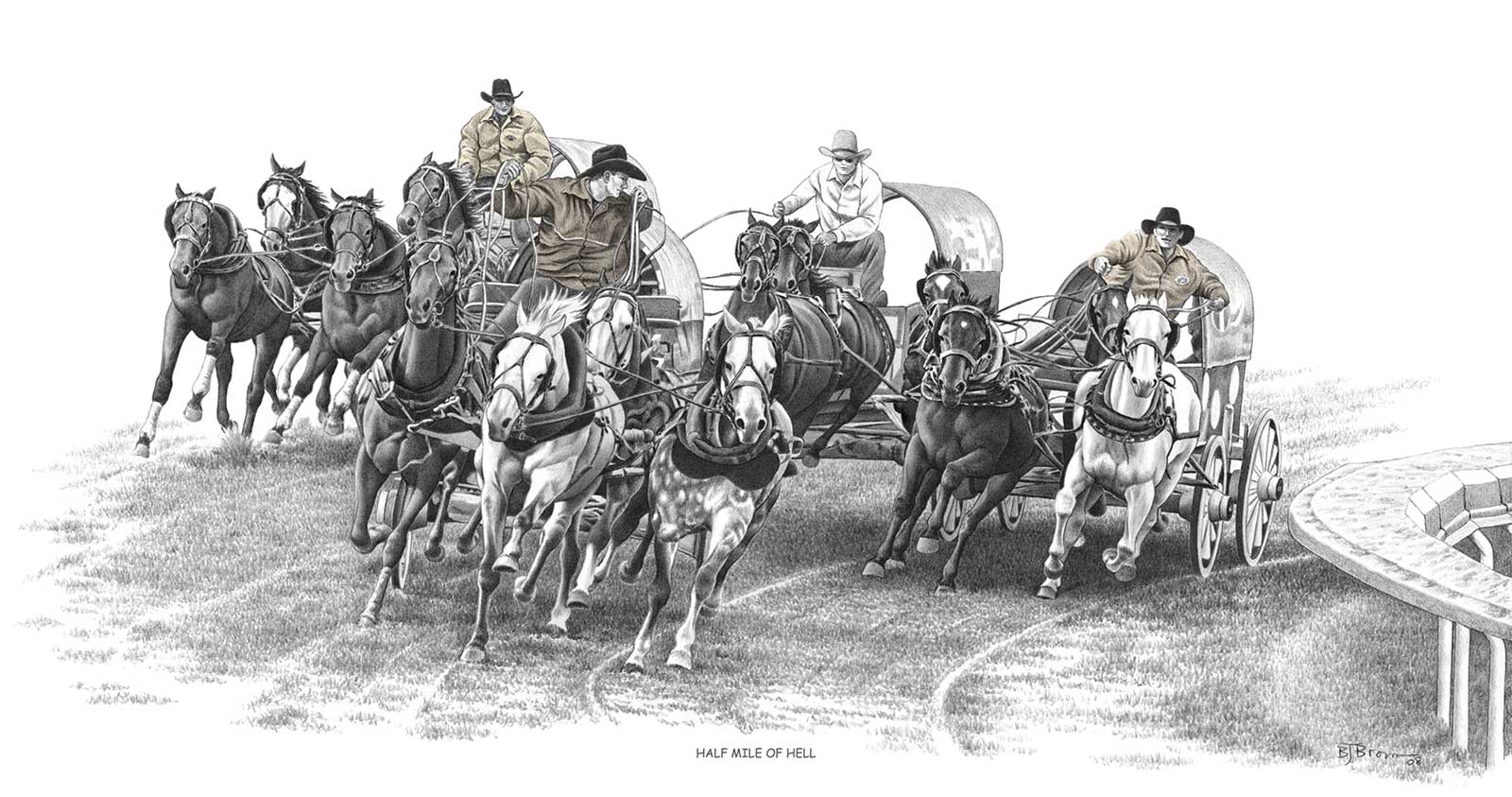
Bernie Brown, Half Mile of Hell, pencil on paper
Van Ginkel moved with his family to Calgary in 1973. He says that the Calgary Stampede has been instrumental in shaping his 40-year career, starting with the Stampede art auction in 1986 and participating in the Stampede Western Showcase since 1991. In 2006 he was proud to become the first fine artist to be chosen to paint the Stampede’s annual poster. Now he’s been called upon to commemorate chuckwagon racing’s 100-year anniversary in a very special way. The Stampede has commissioned his painting History in the Dust to be reproduced as a mural on the side of the Nutrien Western Event Centre in Stampede Park. The mural will be dedicated to the tradition and integrity of the sport. In the Calgary Stampede newsletter, the first vice-chair on the chuckwagon committee states, “With a powerful image from renowned artist Paul Van Ginkel, we’re poised to capture the spirit of the sport for generations to come.”
Another draw to the art of chuckwagon racing is the challenges it represents. Oil painter Ray Swirsky has been showing at the Stampede since 2019. “When I got accepted it was kind of a shocker for me because I had been visiting the Stampede[and] going to the art show…” he says, adding that he was not yet an artist when he first attended. “Wouldn’t it be amazing if I did painting and one day I could be here—and here I was!”
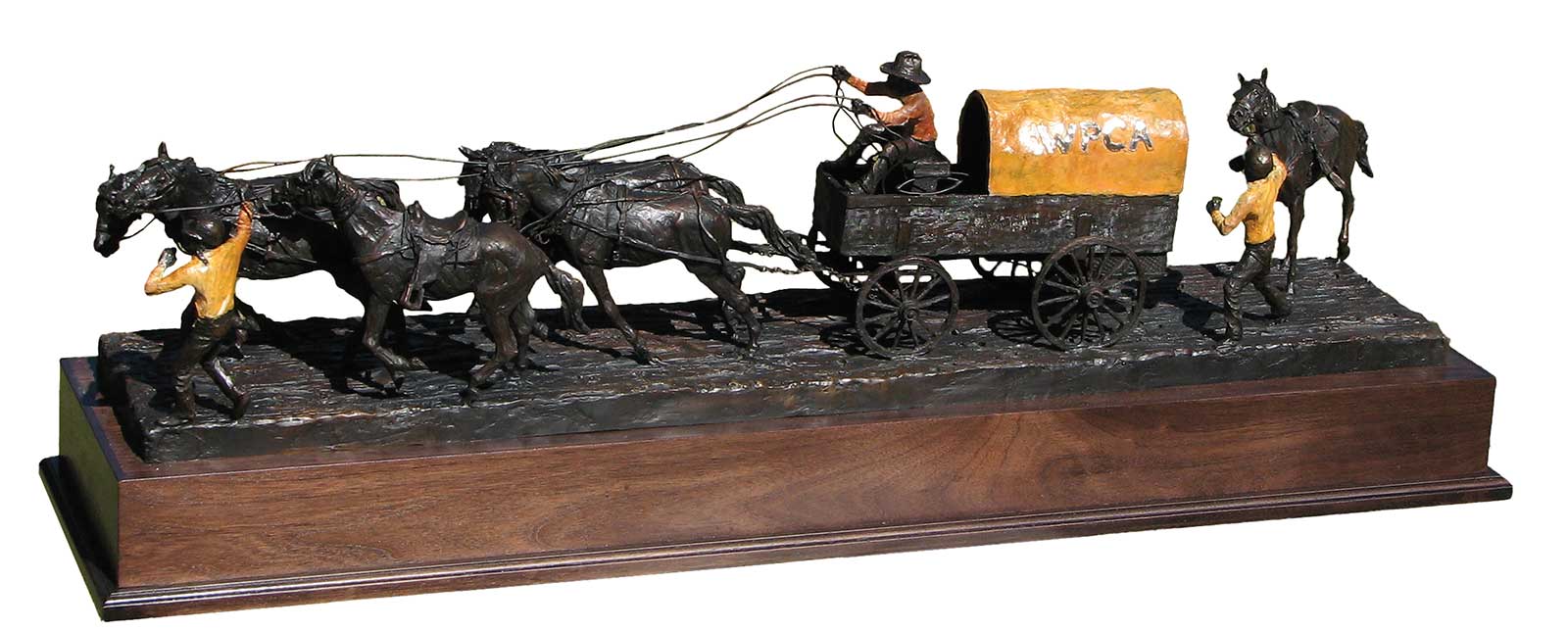
Rich Roenisch, At the Sound of the Horn, 2 Outriders, bronze
Swirsky describes the atmosphere of the art show as a fun time where artists support each other and have become like a family. The inspiration Swirsky paints from is the exhilirating rush of a chuckwagon race’s imagery on the track and the hurdles each element of the race represents. His piece Shaken, Not Stirred is a prime example of how ambitious it is to capture the scramble and the chaos of a wagon mid-race in motion—almost so much so that you feel like you’re actually there in the stands cheering the rider on.
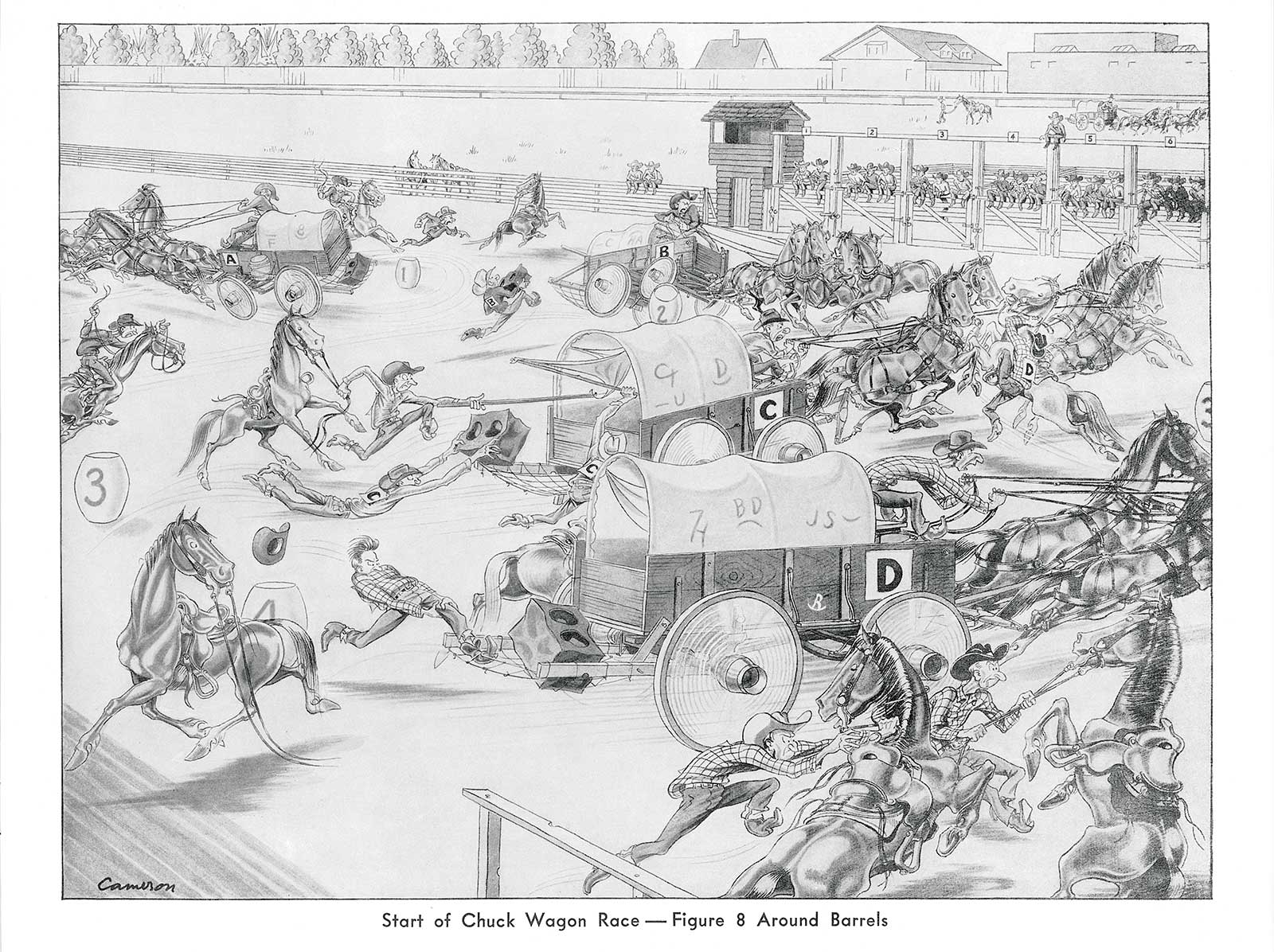
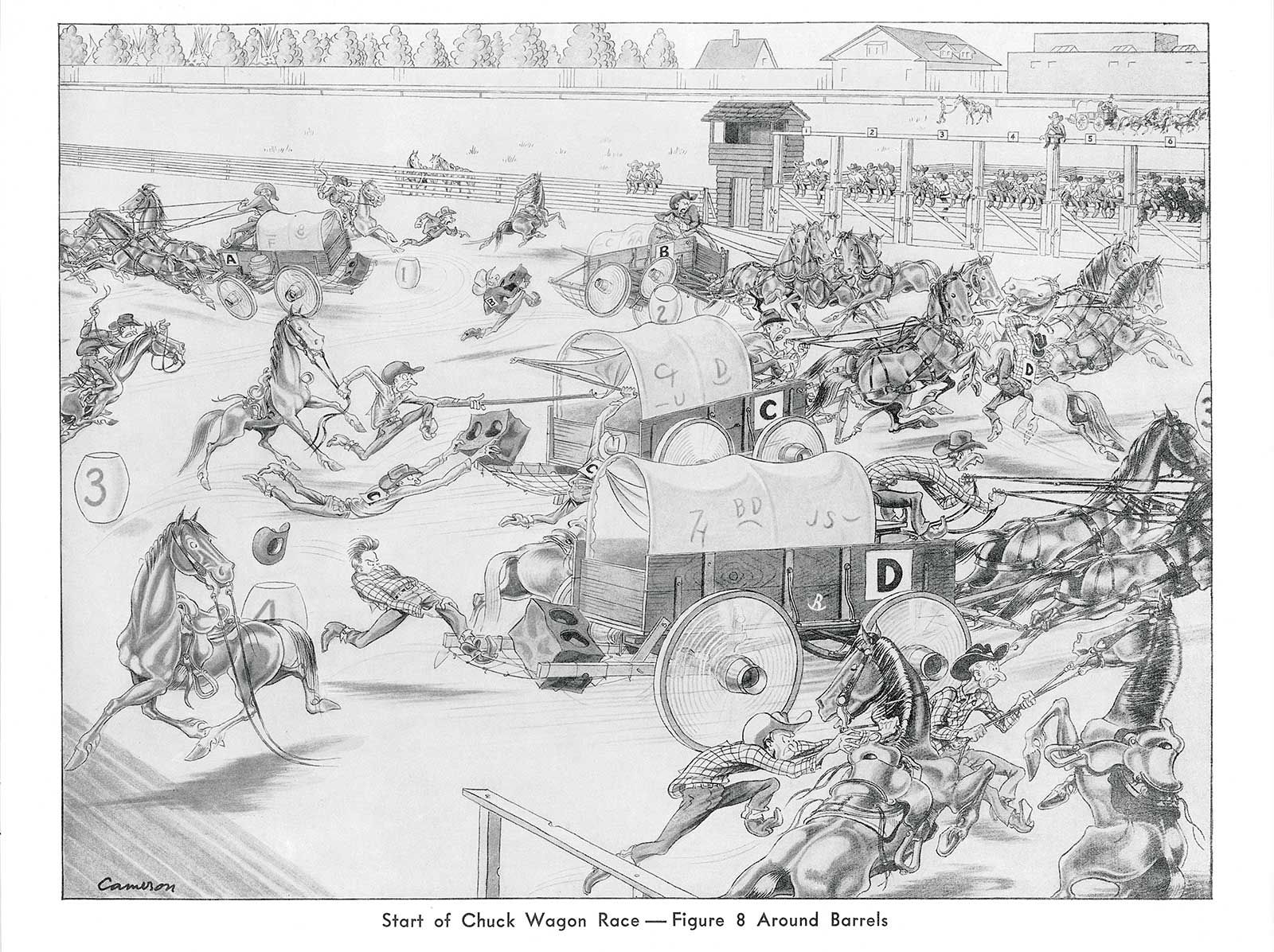
Stew Cameron (1912-1970), Start of Chuck Wagon Race – Figure 8 Around Barrels, from the book Let the Chaps Fall Where They May.
For other artists, it’s not so much about the challenge but more about reimagining the magic of being in the thick of the races, like with painter Carolyn Sinclair. Though she will not be showing at the Calgary Stampede this year, Sinclair’s admiration for the sport goes deeper than her canvas. She has spent years at the Stampede helping and supporting her husband who has won the event four times. With her husband’s racing days behind him, Sinclair still gets to bring her horses back every year through her artwork. Her piece Full Circle, from her Circle series, represents the authentic connection between horses and the people who care for them. “As an impactful piece of art, this one best represented my whole story. Because, you know, it’s a full circle moment, bringing the horses back,” she says. Sinclair has lived through the labor and dedication it takes to get to the track and can bring those memories back to the Stampede every year.
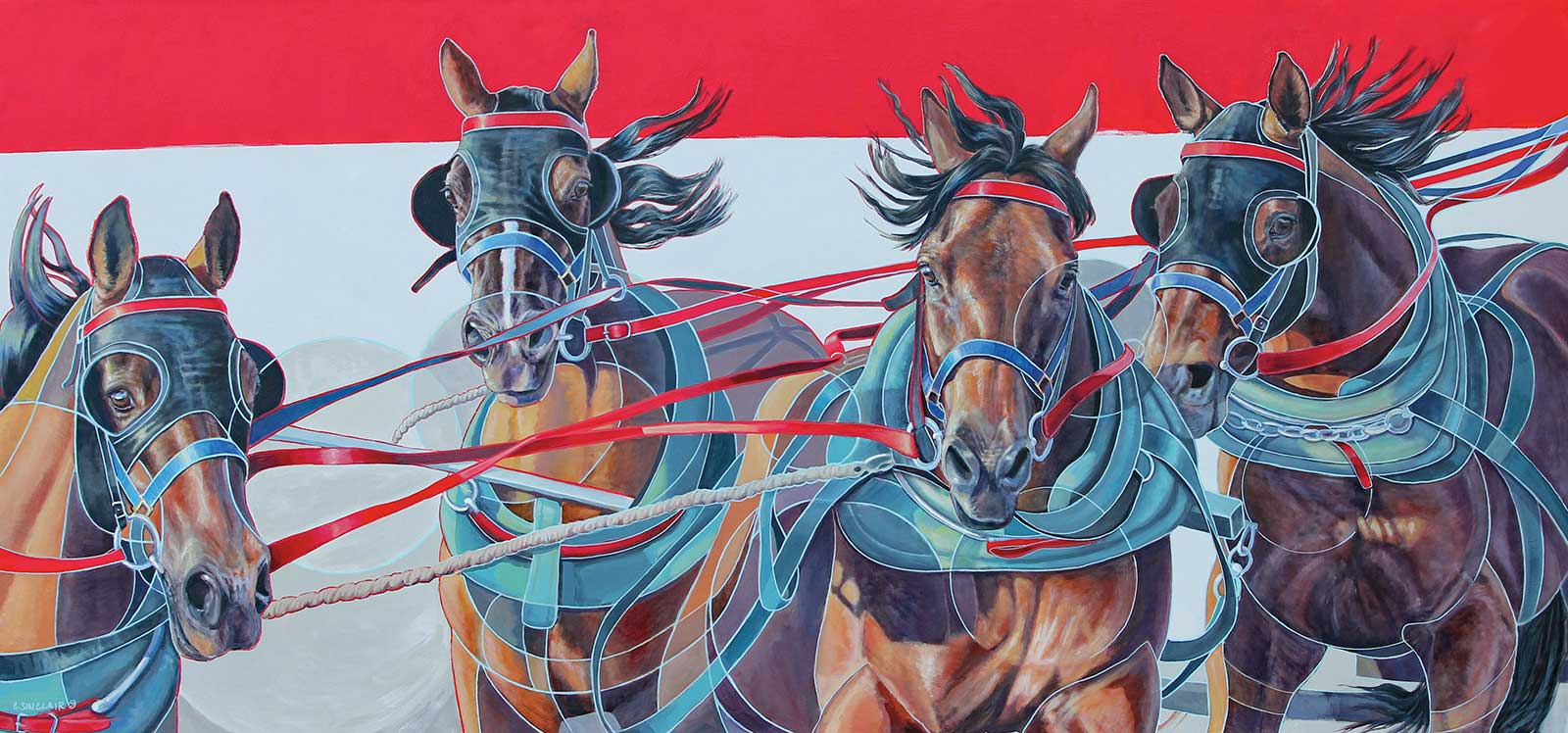
Carolyn Sinclair, Full Circle, acrylic on canvas, 37 x 77”. Private Collection.
No matter how fast the world moves with new generations surpassing their successors into a more modern era, nostalgia still lives like a heartbeat pumping into society. That is what the Calgary Stampede has been for the people of Alberta, Canada, for more than a century, breathing life into a proud Old West tradition of cowboys and rodeos. And though there are numerous festivities around the country for people to feast their eyes on, nothing is quite as exhilarating or as spectacular as the chuckwagon races. It’s an art form all on its own, and the artists who recognize that give it their all to recreate the imagery and the history of a truly treasured pastime.
The Calgary Stampede starts July 7 and runs through July 16. For more information, visit, www.calgarystampede.com. —
+++
Maggie Cibik is a freelance writer based in Cleveland, Ohio, and is a co-host of the American Art Collective podcast.
Powered by Froala Editor