Cowboys tended cattle on horseback and worked on ranches throughout the West. They sometimes participated in informal rodeos to demonstrate and test their riding and herding skills. Rodeos became more formalized and the first professional rodeo took place in Prescott, Arizona, in 1888.
The iconic bucking bronco is exercising an instinctual characteristic that protects it from predators. In early rodeos, horse and rider were together for as long as the cowboy could hold on. As rules came in, it was thought that eight seconds was a good period of time to test the cowboy’s mettle with the horse bucking perhaps 11 or 12 times.
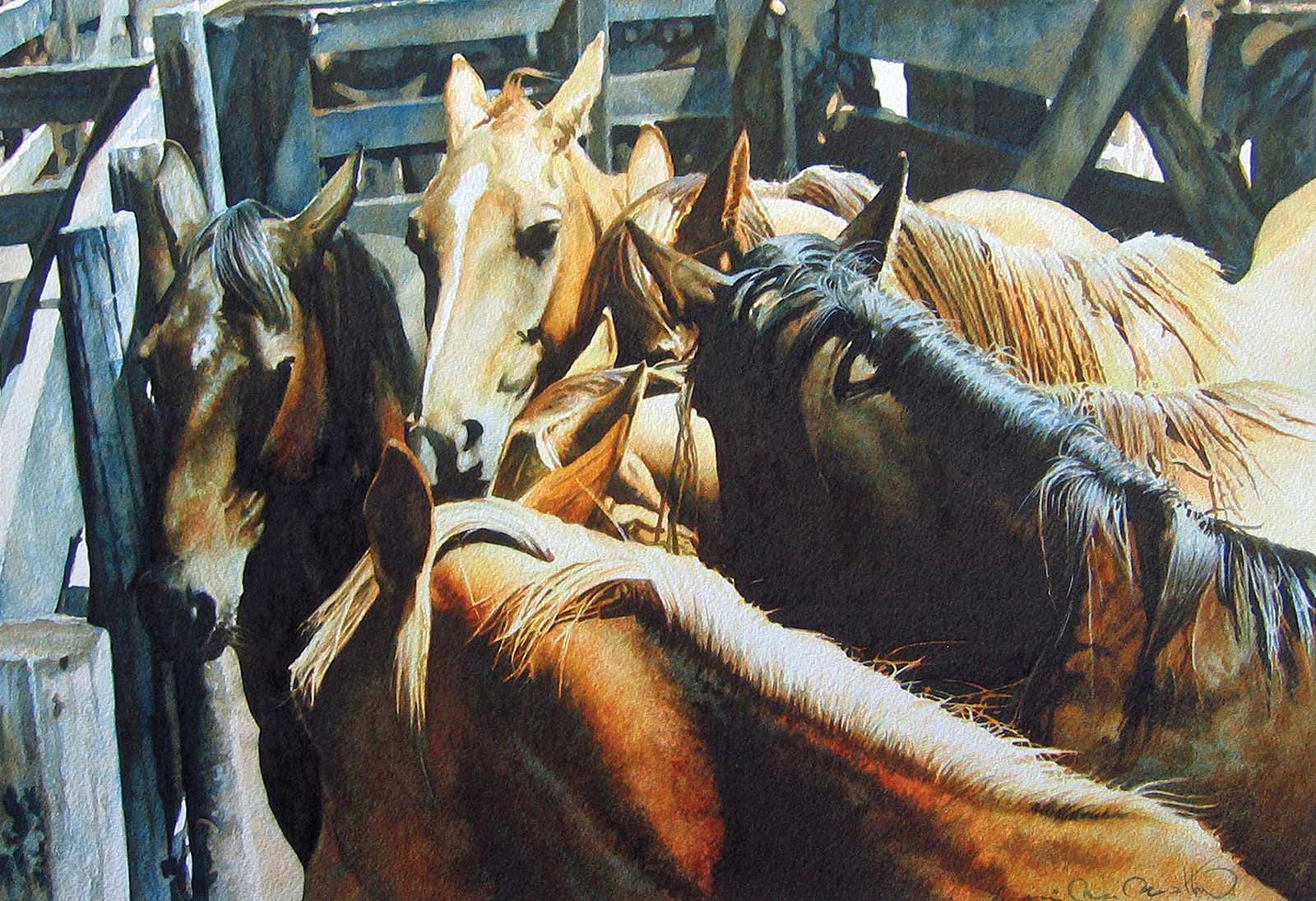
Leslie Levy Fine Art, Sunshine and Shadows of Bucking Stock, watercolor, 14½ x 21½”, by Suzi Mather.
Suzi Mather grew up in Southern California playing with horses and eventually having one of her own, which she rode across the countryside observing nature. She has also been an artist since she was a girl, having had a painting entered in the Laguna Festival of Art when she was in the first grade.
She comments on her watercolor Sunshine and Shadows of Bucking Stock: “One of the many groupings of consignment stock for the Lincoln County Rodeo (1980s). This group was separated out for bucking and put near the chutes and announcer’s stand. I always enjoy painting close-up headshots when there’s a variety of color. Lincoln County was the last of the fairgrounds to go to pipe corrals. The old wood, weathered to a wonderful salt-air patina in blues and rusts, allowed me to add a complementary color to the colors of the horses.”
Maura Allen searches for dynamic silhouettes for her rodeo art. “At a ranch or behind the chutes I literally start by squinting and looking for that moment,” she says. “By squinting you’re going to see the silhouette. By eliminating the details, you focus on bigger things like the way a person’s head is tilted, or their gesture, the exact moment when the rope is being released. Those are the moments that I look for. And that’s what gives the piece’s energy. Back in my studio, I’ll combine that image, that moment, with different color fields or other elements that help continue to tell that story. I use all different tools. I use screens, I use sanders, I use water, I use different materials to create this patina.”
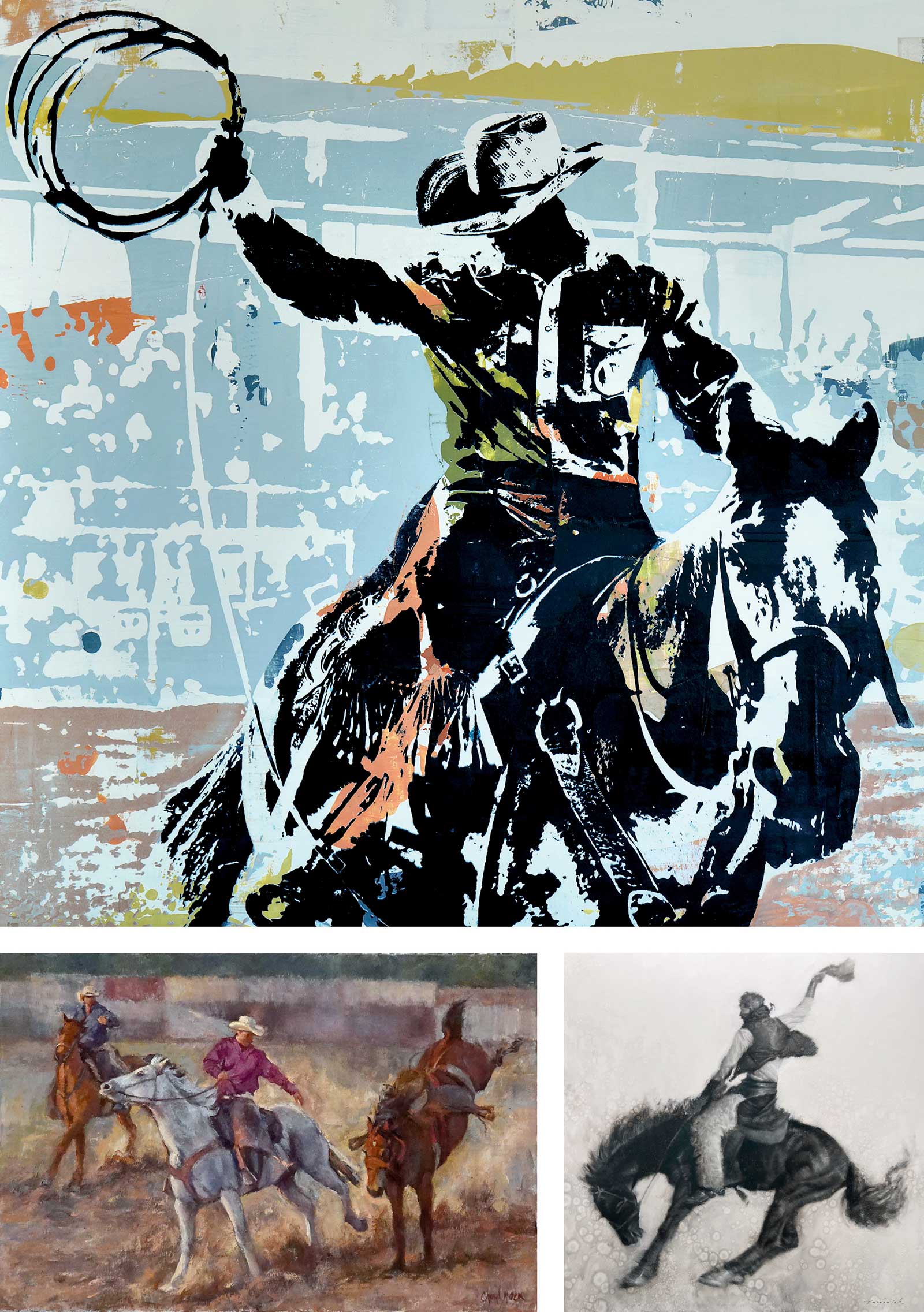
Top: Gallery MAR, The Pickup Man, mixed media, 40 x 40”, by Maura Allen. Bottom: Cheryl Koen, High Kick, oil on linen, 20 x 30”; Manitou Galleries, Hang Tight, oil, 60 x 60”, by David Frederick Riley.
Allen has 35 years of experience as a black-and-white photographer behind her, as well as two decades as a painter. The blending of techniques and images in her mixed media work echoes the multitude of sounds, smells and actions of events at the rodeo.
Sophy Brown describes rodeos as “the sporting show-biz remnants of a practical past. The bucking horse paintings show an adrenaline-born moment when both horse and rider are tapping into their primary resources. They are about hanging onto a rough ride and getting a threat off your back. They are about strength, balance and survival.”
In her painting Colorado Heat, horse and rider are caught in a brief moment of their six seconds together. “It is a painting that had a lot of allowance in the making of it,” she says, “meaning that it was out of control much of the time. I wanted velocity in the action and heat in the color. A sort of fiery chaos of that moment.”
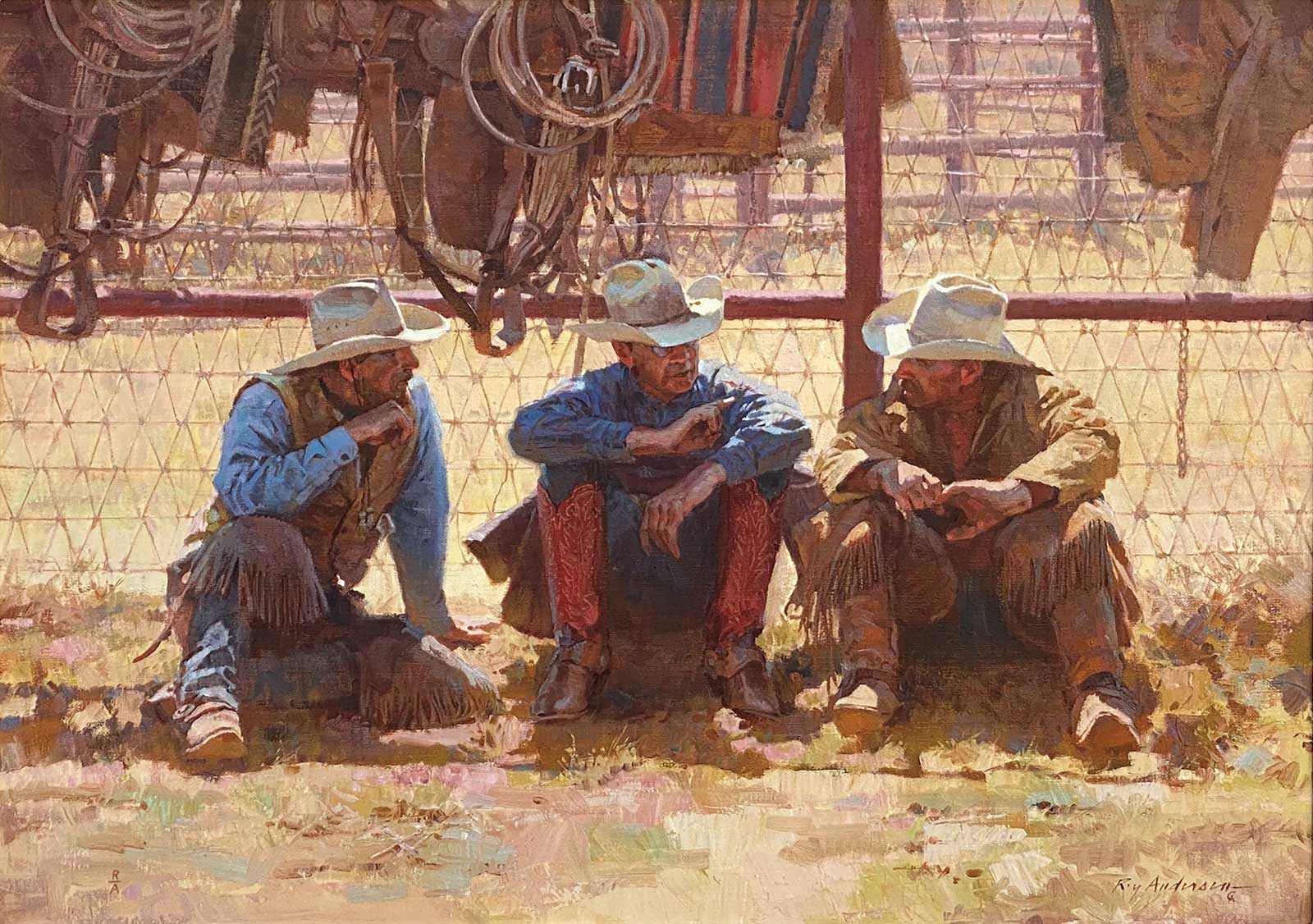
Claggett/Rey Gallery, Schooling the Boys, oil, 26 x 36”, Roy Andersen (1930-2019).
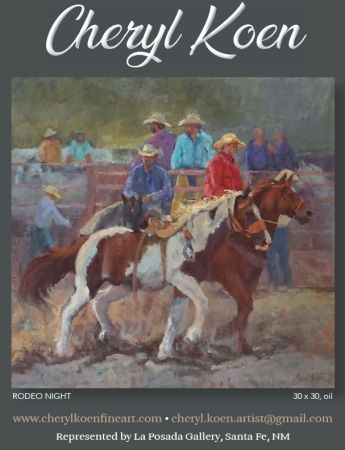
Cheryl Koen also paints the chaos of horses with her work High Kick, showing a horse that has lost its riders amid the frenzy of the action. “Working with rough stock and the raw energy they exude is a risky business. My painting High Kick is a tribute to the pick-up riders working an arena where they are part EMS to the contestants, and part wranglers for the loose, unpredictable animals,” Koen says. “The stock might include anything from a woolly sheep for the younger cowgirl or boy, to a 1,500-pound bull, and wily horses in between. With thrills and spills for two to three hours a night, these riders respond at lightning speed to anyone in need, keeping the rodeo moving along. Fearless, they’ve rescued many a cowboy or cowgirl from serious injury and ensured their safety to ride another day. A pick-rider’s job requires a great horse, roping, fast reflexes and a brave soul. Over the years, I have attended many rodeos, from the great ones like Cheyenne to small ranching community rodeos. The spirit of each rodeo is unique and palpable. Hats off to these heroes, the rodeo pickup riders.”
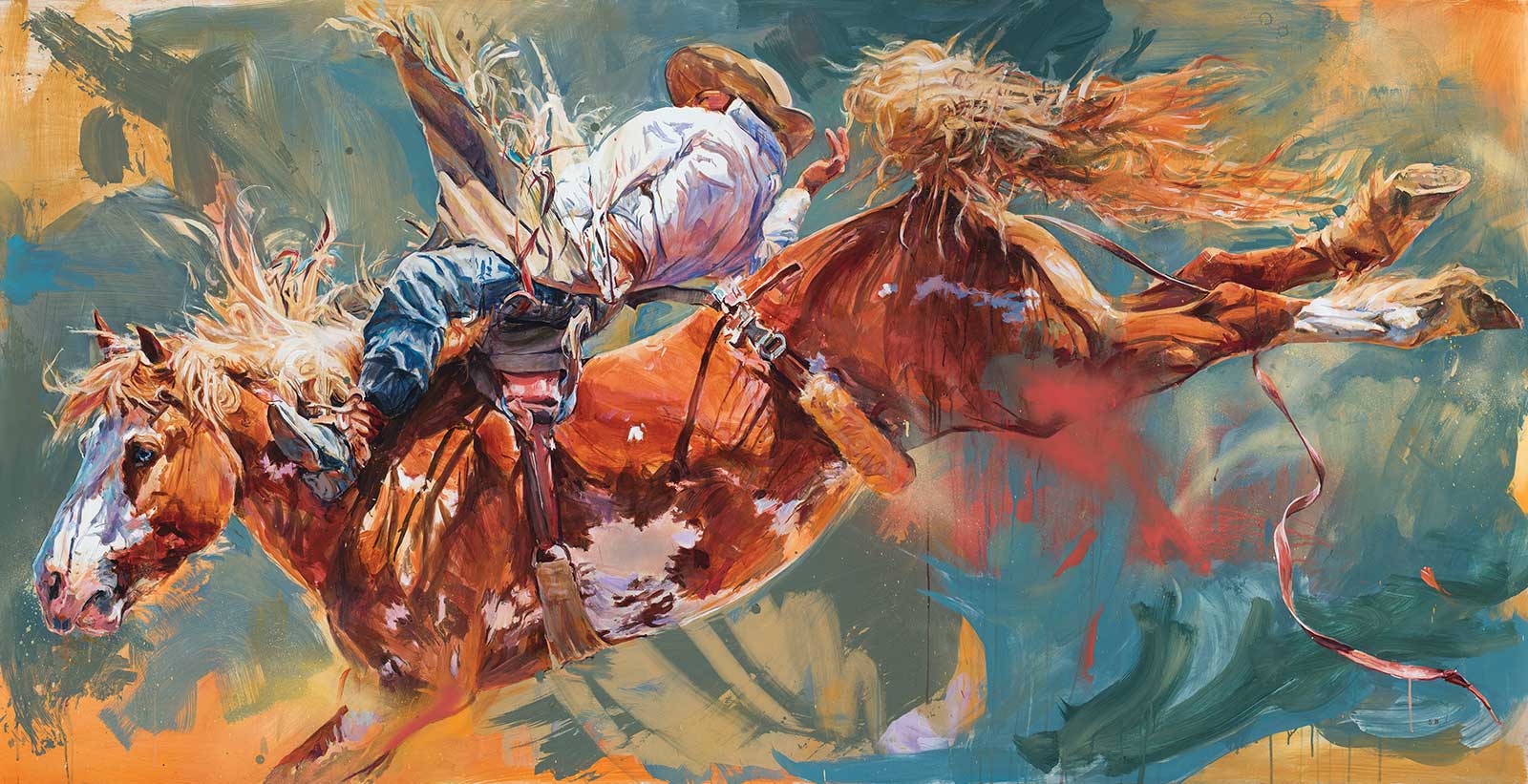
Sophy Brown, Colorado Heat, acrylic on board. Courtesy the artist.
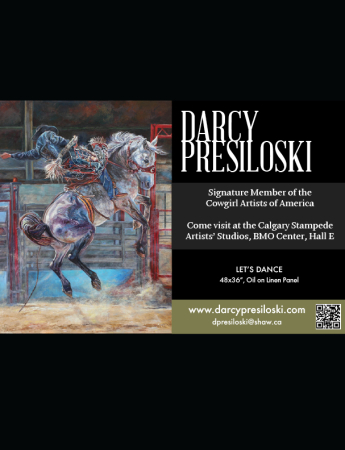
Canadian painter Darcy Presiloski grew up on a farm that was homesteaded by her grandfather, so her earliest memories are of horses, including drawing them. Today she is a signature member of the Cowgirl Artists of America and has also been involved with the Calgary Stampede Artists’ Studios for many years. “The people, animals and land are always changing, so creating a visual record of the Western lifestyle is very important to me,” she says. “I paint behind-the-scenes rodeo images, depicting things most people don’t see. My wish is that you enjoy Western art for the stories it tells, the feelings it evokes and to understand its roots.”
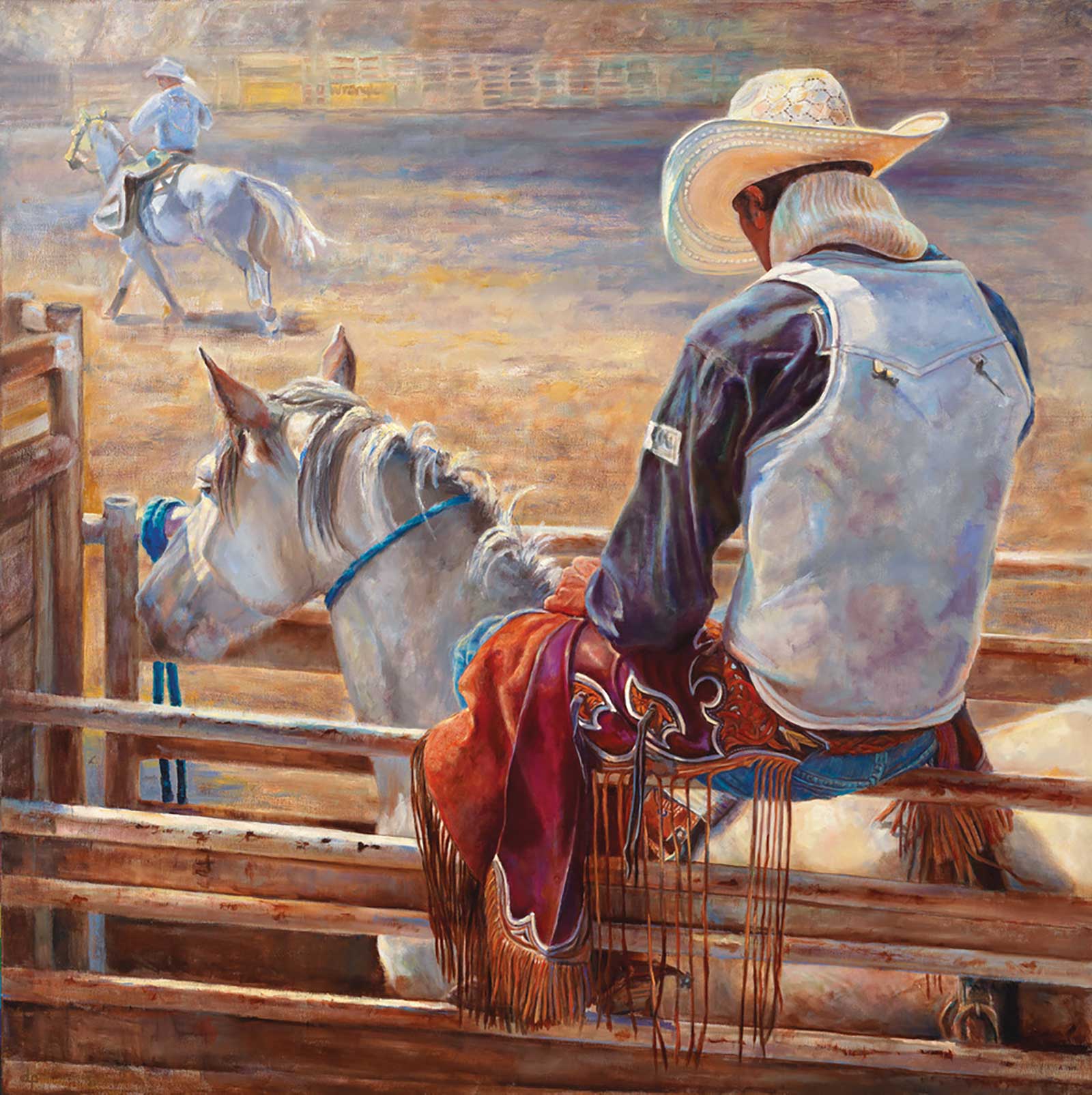
Darcy Presiloski, R.C., oil on linen panel, 48 x 48”
Colorado’s Claggett/Rey Gallery features rodeo works, including a stunning Roy Andersen work that captures the quiet moment before the action starts, or possibly after it’s ended. “Schooling the Boys is a painting that captures a behind-the-scenes moment of enlightenment being shared from a seasoned cowboy to his younger comrades in the saddle. Roy Andersen (1930-2019) caught the glint in the eye of an erudite cowboy, historian, poet, storyteller and our dear friend Don Hedgpeth (center) as he passed along his knowledge of being in the saddle and most likely a yarn flavored with some life lesson advice to his ‘pals’ before loading the chute,” says Bill Rey, the owner of the gallery. “Andersen caught a rare moment building up the courage and leveraging the risk these cavalier horsemen take into the ring. This painting has just become available, after years in a private collection, through the Claggett/Rey Gallery.” Koen has her work on display at the famous La Posada de Santa Fe.
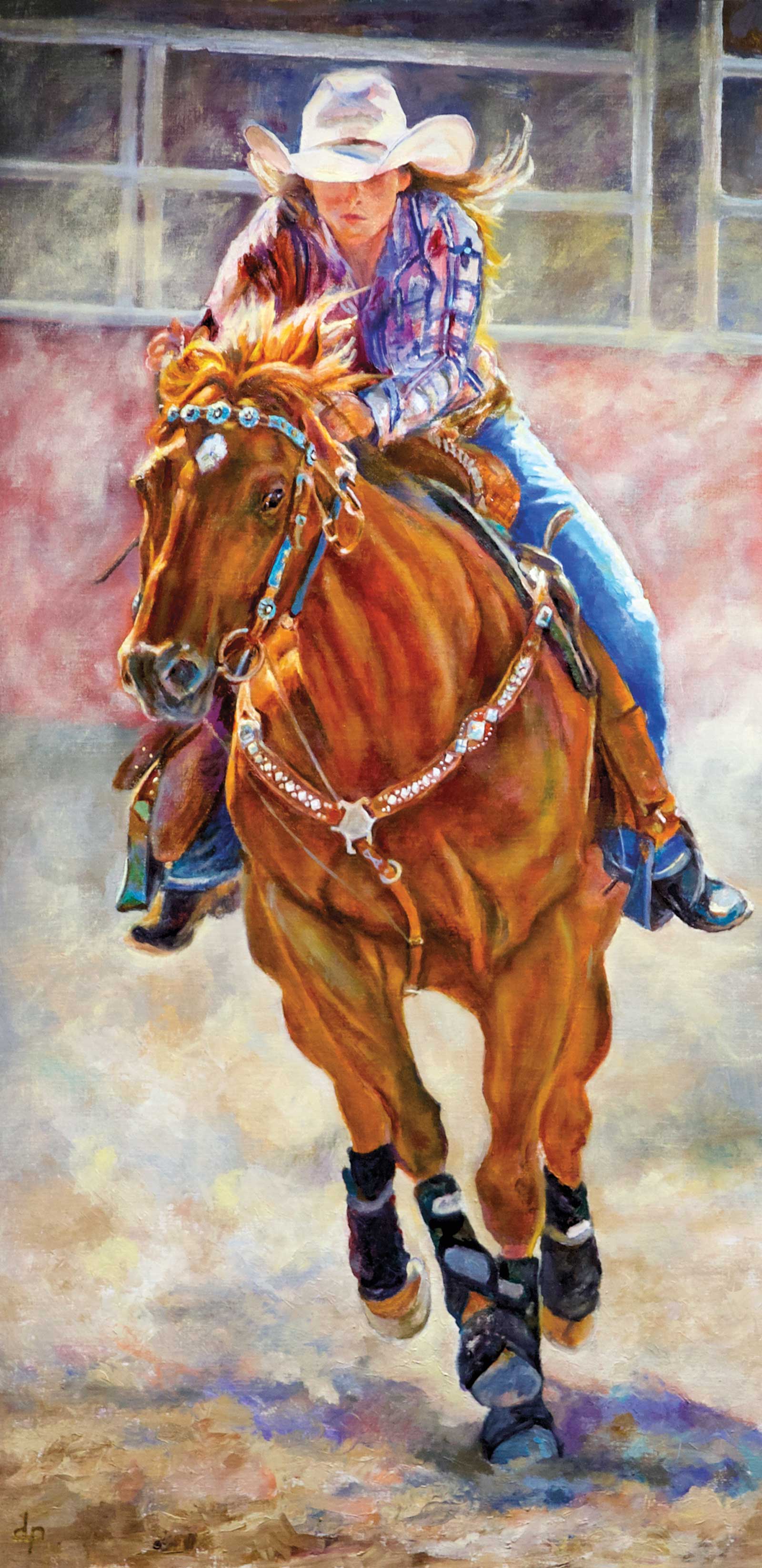
Darcy Presiloski, Fancy Like, oil, 36 x 18”
Santa Fe’s Manitou Galleries is offering work by David Frederick Riley, who occasionally breaks up his wildlife work with images of bucking horses and brave riders. “David Frederick Riley captures the turn-of-the-century cowboy in traditional wooly chaps and hat in hand while atop a bucking horse providing the viewer a glimpse into what would eventually turn into modern-day Saddle Bronc competitions,” notes Cyndi Hall, associate gallery director.
Riley says of the work: “After moving to the West over a decade ago, I have become captivated by the landscape, animals and history that abound here. My artwork is how I engage with this awe-inspiring land. My aim is to capture some of the West’s spirit, strength and grace to share with others.” —
Featured Artists & Galleries
Cheryl Koen
(505) 819-9956, www.cherylkoenfineart.com
Claggett/Rey Gallery
216 Main Street, Suite C-100
Edwards, CO 81632
www.claggettrey.com
Gallery MAR
436 Main Street
Park City, Utah 84060
(435) 649-3001, www.gallerymar.com
Leslie Levy Fine Art
Scottsdale, AZ
(602) 952-2925
www.leslielevy.com
Manitou Galleries
123 W. Palace Avenue
Santa Fe, NM 87501
(505) 986-0440, www.manitougalleries.com
Maura Allen
(415) 305-3149, www.mauraallen.com
art@mauraallen.com
Darcy Presiloski
http://www.darcypresiloski.com
dpresiloski@shaw.ca
Sophy Brown
www.sophybrown.com
Powered by Froala Editor