
At the bottom of his enormous 55-by-86-inch watercolor, De Na Zin, Place of the Cranes, Bisti Badlands, New Mexico, Scott Kelley has written the following description of the scene: “De Na Zin is a 45,000-acre tract of arid wasteland of the Bisti Badlands of New Mexico. Depending on who you ask, De Na Zin translates to either ‘Place of the Cranes’ or ‘Standing Crane’ although looking out upon it today, one would be hard-pressed to imagine a crane—or anything else—wanting to be there. It is an alien landscape of incredible beauty whose sole virtue is that it offers nothing else in return.”
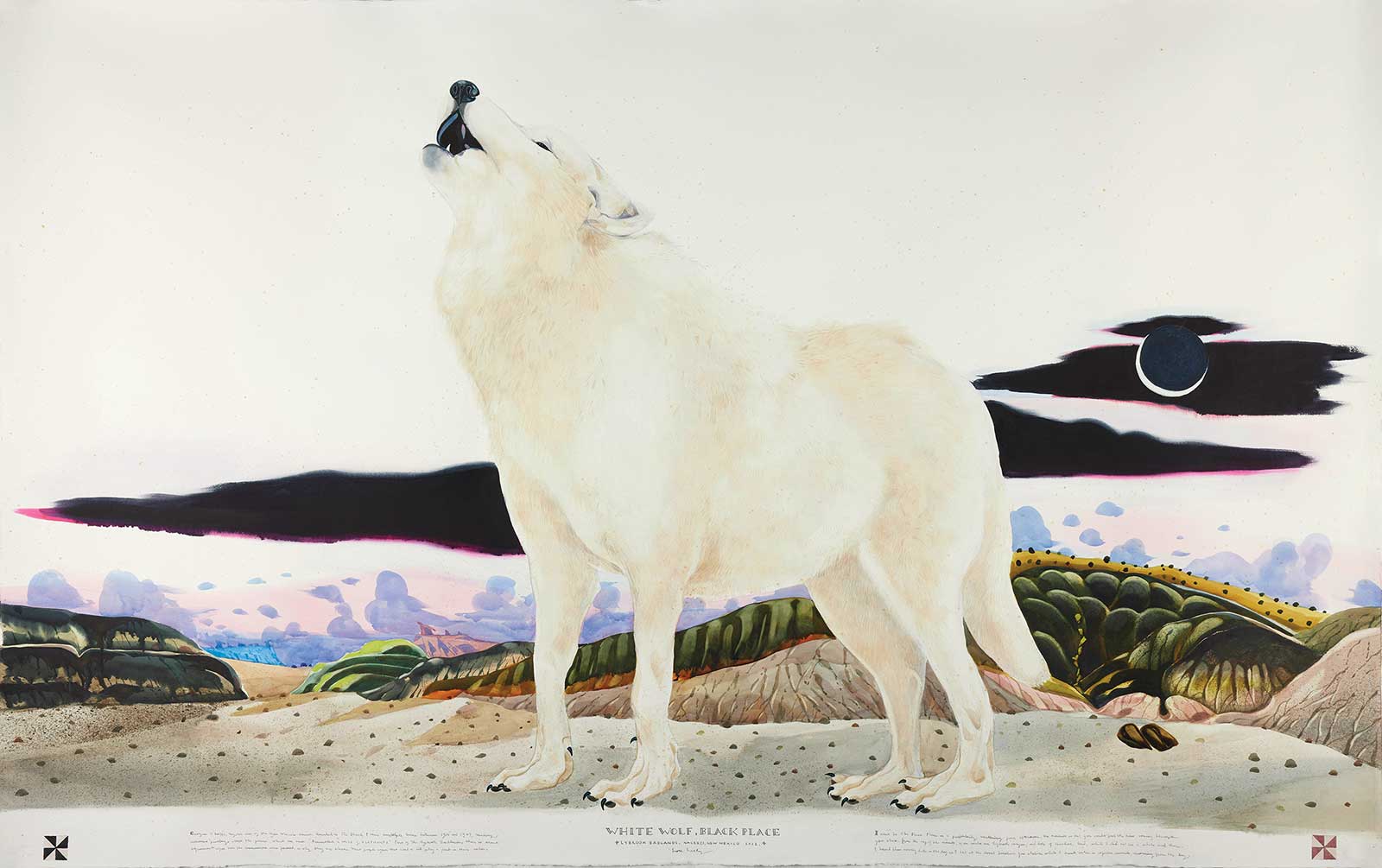
White Wolf, Black Place, Lybrook Badlands, New Mexico, watercolor, gouache and graphite on paper, 55 x 88”
His inscription goes on to describe the area as once having been a shallow inland sea that evolved to marshland and to the desert it is today. He also notes that it continues to evolve.
Kelley portrays the sandhill crane awkwardly landing in the landscape as if it still had water. Today there is nothing there for them. A hot, colorless sky vibrates above the odd and colorful landscape.
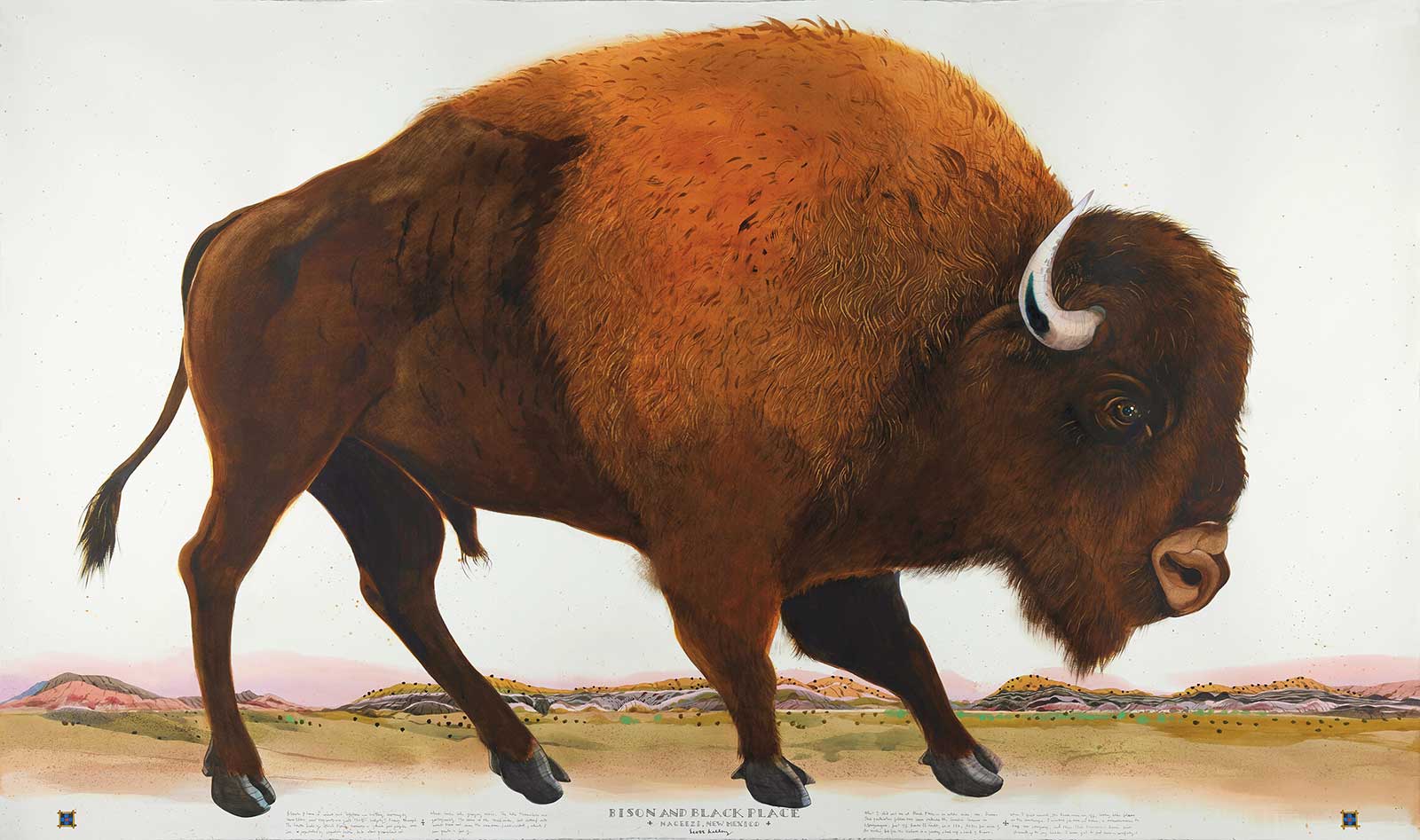
Bison and Black Place, Nageezi New Mexico, watercolor, gouache and ink on paper, 55 x 93”
He visited Northern New Mexico for the first time in 2019 at the invitation of Santa Fe businessman Gerald Peters. “Drawn to extreme places,” he says, “I had no idea that New Mexico would prove to be so very extreme. It was like an endless, looping reel of old Star Trek sets—everywhere I turned there were hoodoos and mesas and hillocks of primeval mud in acidic colors. And then there were the animals: the bison and jackrabbits, pronghorns and sandhill cranes. It was all—all of it—completely unexpected, beguiling and even, at times, seemingly very much divorced from reality. As if there is no there there, and yet—everything is, well…there.”
Hiking the Bisti Badlands and Black Place and the equally alien Lybrook Badlands about 50 miles away, Kelley contemplated the thousands of people who drive by having no idea how captivating the landscape can be. “I like painting things people don’t notice,” he says. “We’ve lost our ability to hear the landscape. Most people look at land and think about what you can do with it. This land offers you nothing.”
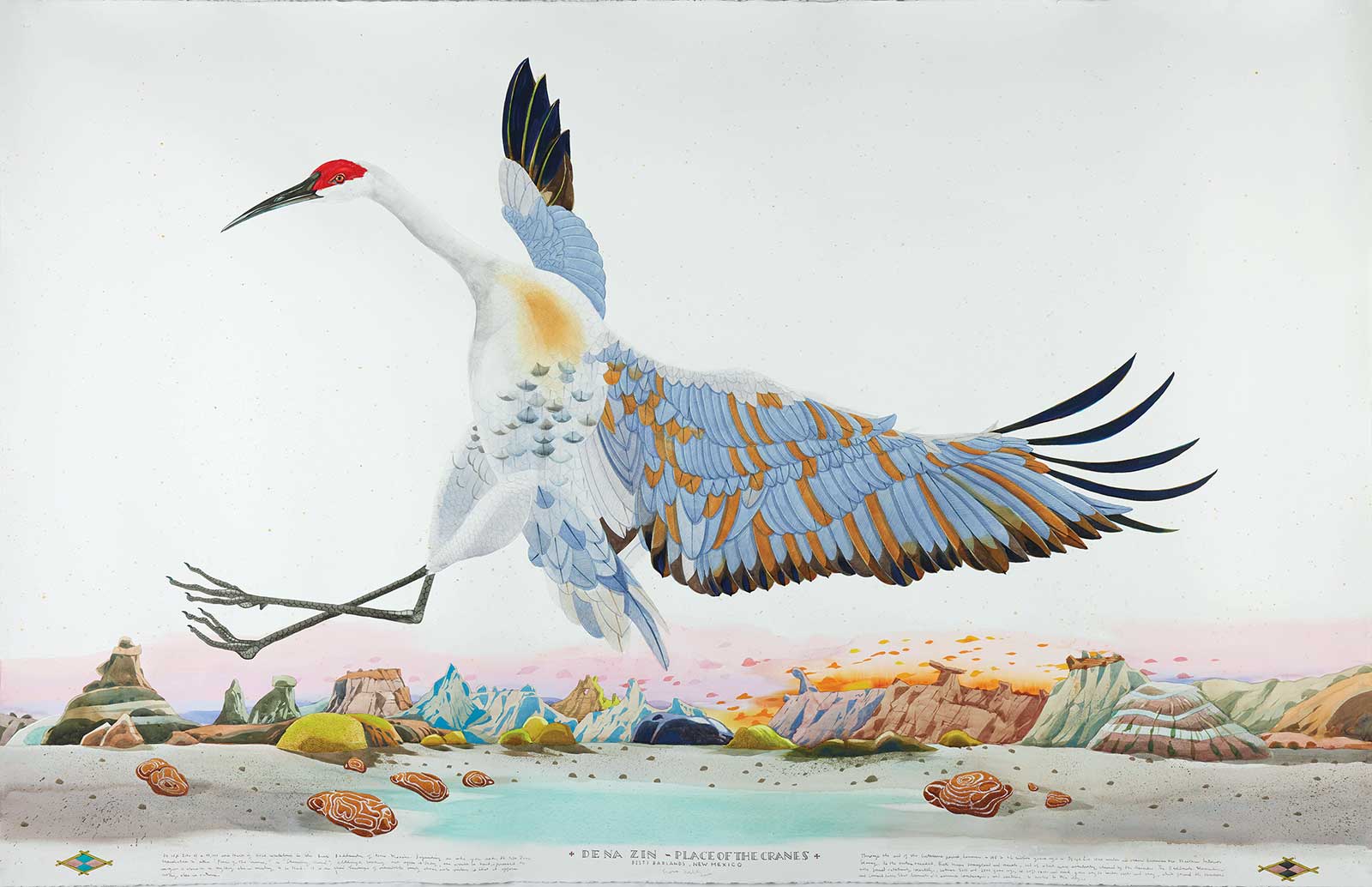
De Na Zin, Place of the Cranes, Bisti Badlands, New Mexico, watercolor, gouache and ink on paper, 55 x 86”
He recalls the environmental advocate John Muir who “had been convinced that nature exists to be put into our service. On a long hike through Florida, he got malaria. After he recovered, he had an epiphany. Nature does not care about us. It moves forward with or without us. The mosquito that gave him malaria was doing what a mosquito does.”
“We’re so rarely privileged to see wildlife,” he comments. “I’m attracted to animals in general and enjoy giving them a personality. They often have more humanity than humans.”
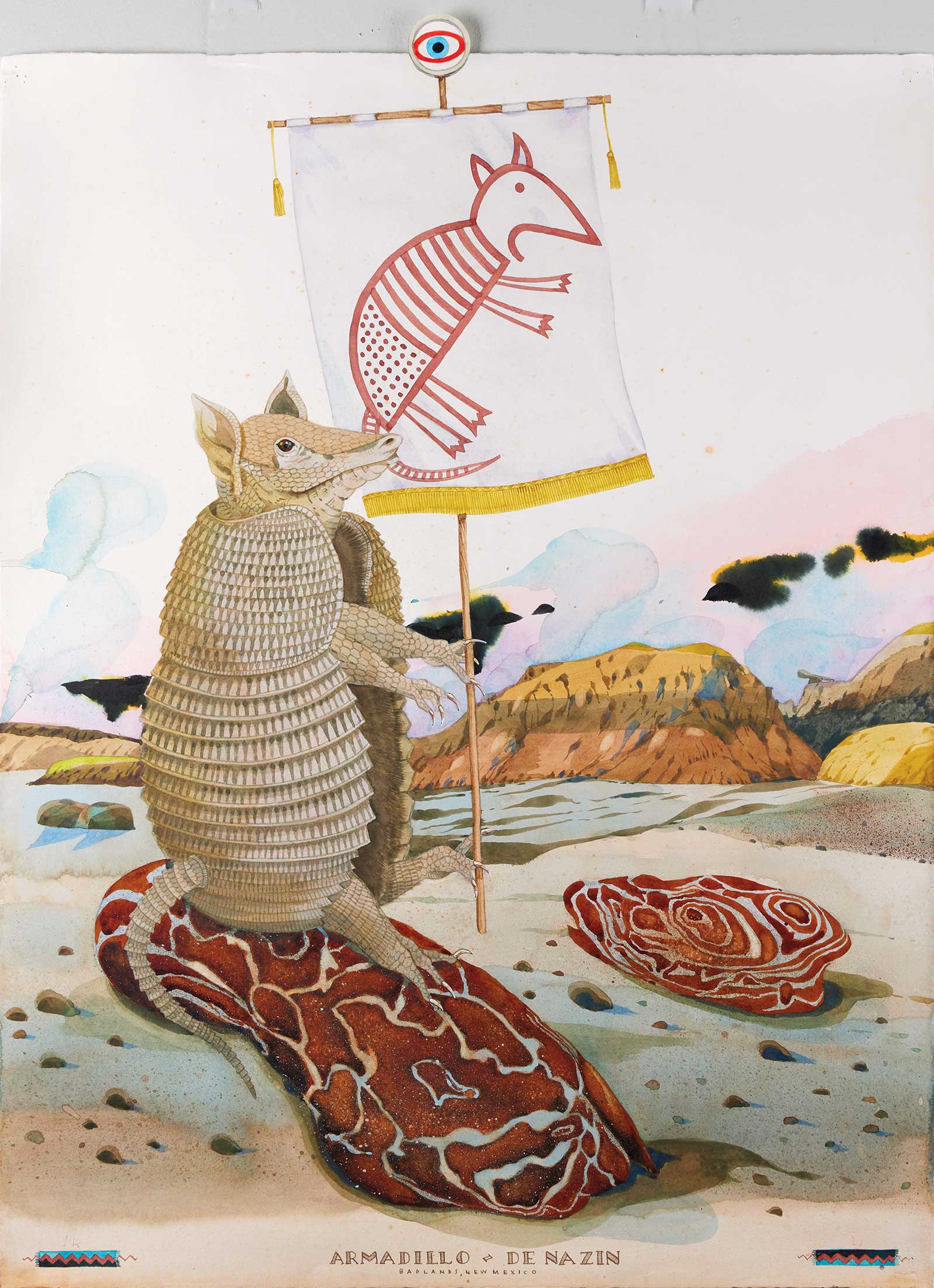
Armadillo – De Na Zin, Badlands, New Mexico, watercolor, gouache and ink on paper, 41 x 30”
Kelley takes great care in creating his scenes of impossible landscapes and the birds and other animals that inhabit the island in Maine where he lives. “I worked for artists and learned the craft of how to do things,” he says. “It’s something lost sight of by artists in what could be called the post-skill generation. The craft of painting is a great responsibility not to be taken lightly.”
The exhibition Scott Kelley: Badlands will be at Gerald Peters Gallery in Santa Fe, July 28 through September 23. —
Powered by Froala Editor