When Jinny and David Mullins went on their honeymoon to New Orleans nearly 59 years ago, they bought two paintings of the city from artists in Jackson Square. Their question at the time was whether to buy the paintings or to go to a fine restaurant. The paintings won out and art has been a passion for both retired medical professionals ever since. Living in Texas, they have always had a love for rodeos. Jinny shares that they took their wedding party to a rodeo the night before the ceremony.
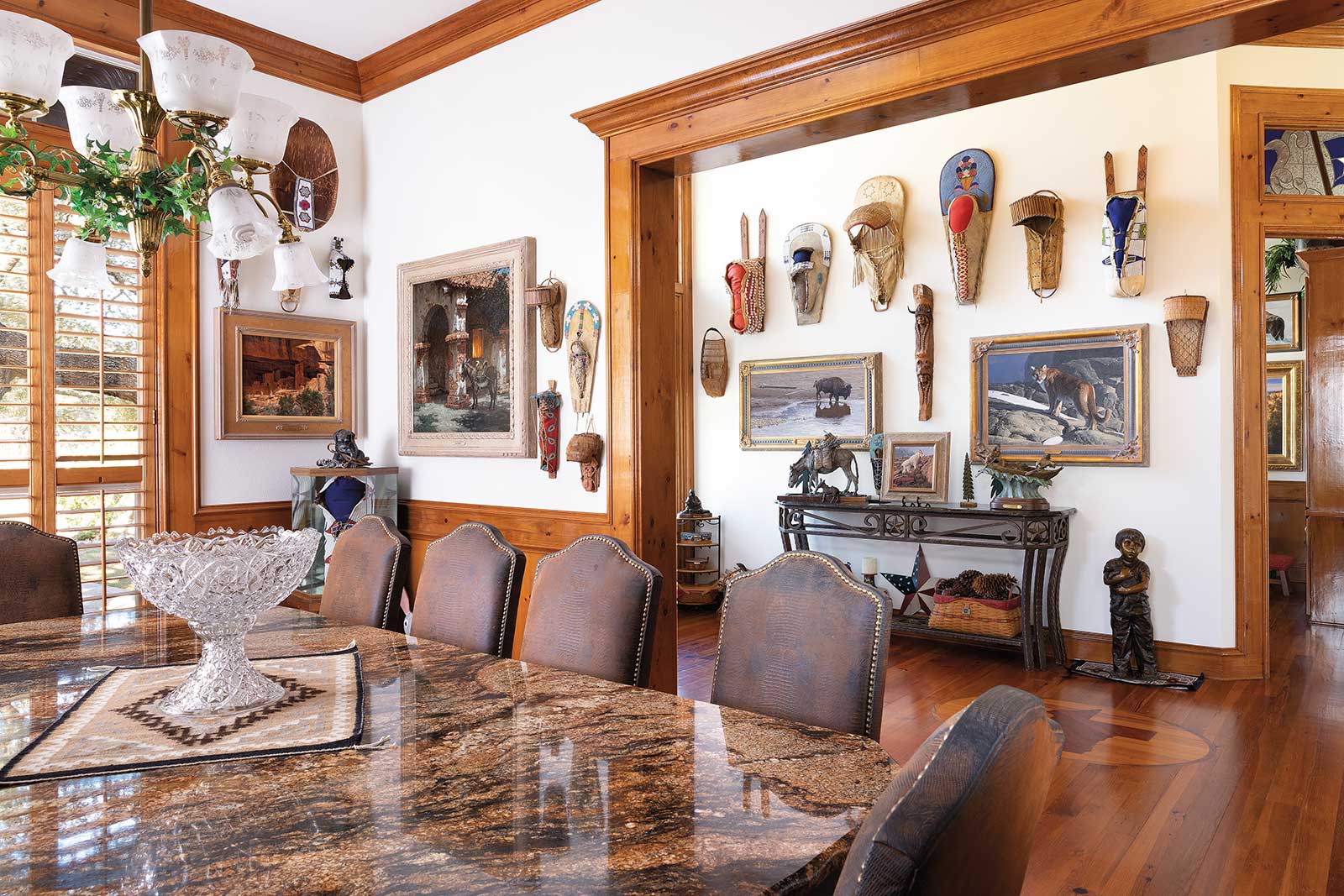
To the right of the dining room window is Ancient Pueblo, 2016, oil, by Robert Peters. On the adjacent wall is South of the Border, 2007, oil, by George Hallmark. In the entry hall are, left to right, Daniel Smith’s acrylics Summer Sanctuary (2015), Upwardly Mobile (2013) and Hard Rock Ascent (2008). On the hall table are, left to right, Spun from the Fibers of the Earth, circa 2018, bronze, by Deborah Copenhaven Fellows and Uncharted Waters, circa 2017, bronze, by Bill Nebeker. On the wall between the two large paintings is Two Indian Heads, circa 1977, carved wood, by Willard Morin. On the floor next to the table is Please, circa 2000, bronze, by Jo Saylors (1932-2018). The toy and full-size cradles from various tribes are from the 1880s to 1890s.
Western and Native scenes are the focus of their collection with an emphasis on those with a narrative. David relates that when training to be docent at the Briscoe Western Art Museum in San Antonio, he studied up on the paintings and learned the stories behind them. “I liked working with children,” he says, “and liked telling them the Western stories.” His favorite painting in the collection is The Gift from Grandpa’s Heart by Loren Entz. In it, a grandfather holds his grandson on his knee as they look at a mare and her newborn foal by lanternlight.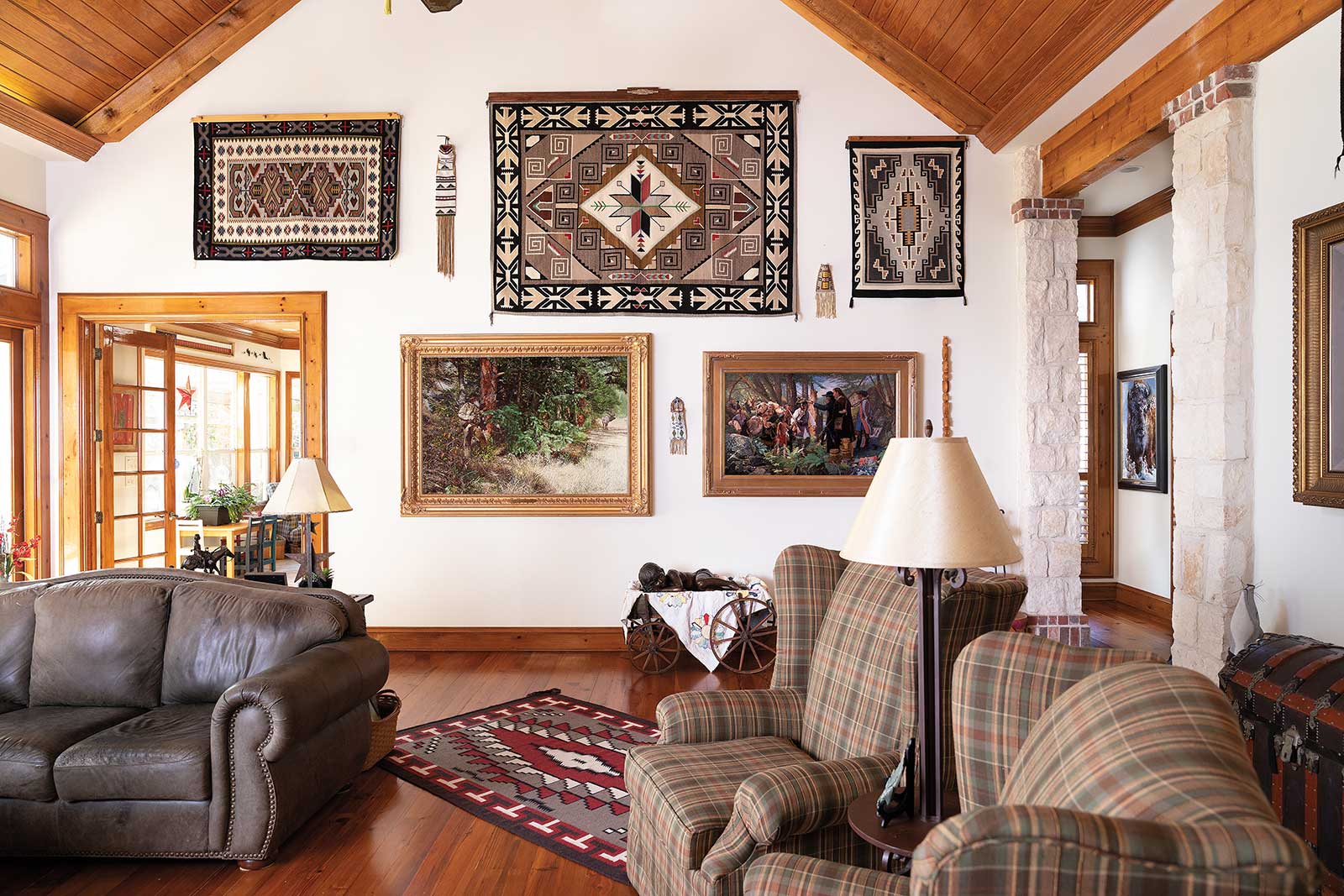
The paintings on the far wall are, left to right, Don’t Even Breathe, 2008, oil, by Craig Tennant and Coming to Trade, 2006, oil, by John Buxton. Selections from the couple’s collection of beaded bags, circa 1990s, also hang on the wall with pieces from their collection of Navajo rugs, from left to right: Ella May Jim (Navajo); Two Grey Hills, circa 1979; a Tec Nos Pos rug, circa 1950s; and a Tec Nos Pos rug by Bertha Tom Frank (Navajo). Beneath the paintings is The Dreamer, circa 1991, bronze, by Jo Saylors (1932-2018).
A theme of children runs through the collection, inspired in part by David’s career as a neonatologist. The couple has assembled a collection of Native American cradles as well as toy cradles that are interspersed among the paintings and sculpture. Jinny notes that she has “always been fascinated by some mom making the cradles or teaching a little girl how to make one. We also have a number of awl cases.”
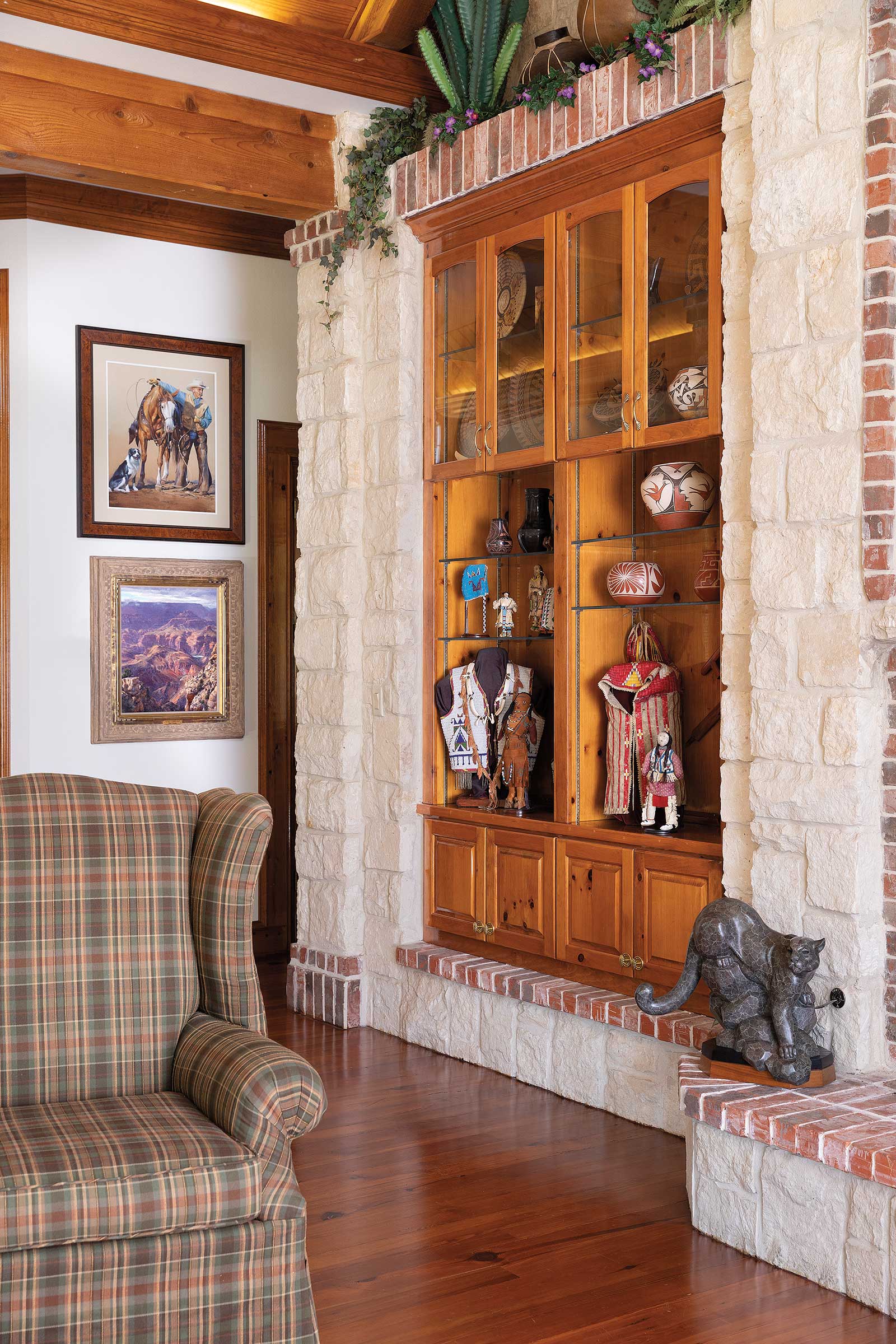
In the hallway are (top to bottom) Three to Get Ready, 2006, watercolor by John Fawcett and After a Summer Rain, 2009, oil, by Curt Walters. In the bookcase are beaded vests, dolls, baby bonnets and a quilled cradle cover, all circa 1880s-1890s. The pottery is from the early 1900s to mid 1990s. On the hearth is Silent Passage, 2014, bronze, by Gerald Balciar.
The cradle collection began on a chance rest stop when they took their children to Yellowstone in the late 1970s. Hanging above the counter in a trading post in Wyoming was a cradle made of birch bark with a beaded decoration. The proprietor told them it wasn’t old and had been made by a young girl at a reservation in Alaska. “After we brought it home, I began looking at it and it reminded us of the pumpkin seats we used to use when the children were little,” says Jinny. “I began to think we’d been taken and set it aside. Later, when we were in Washington, D.C., while David was at a medical conference, I went to the Smithsonian and in their Indian collection there was an identical Alaskan cradle. I later learned that the women who made them would incorporate older beadwork.”
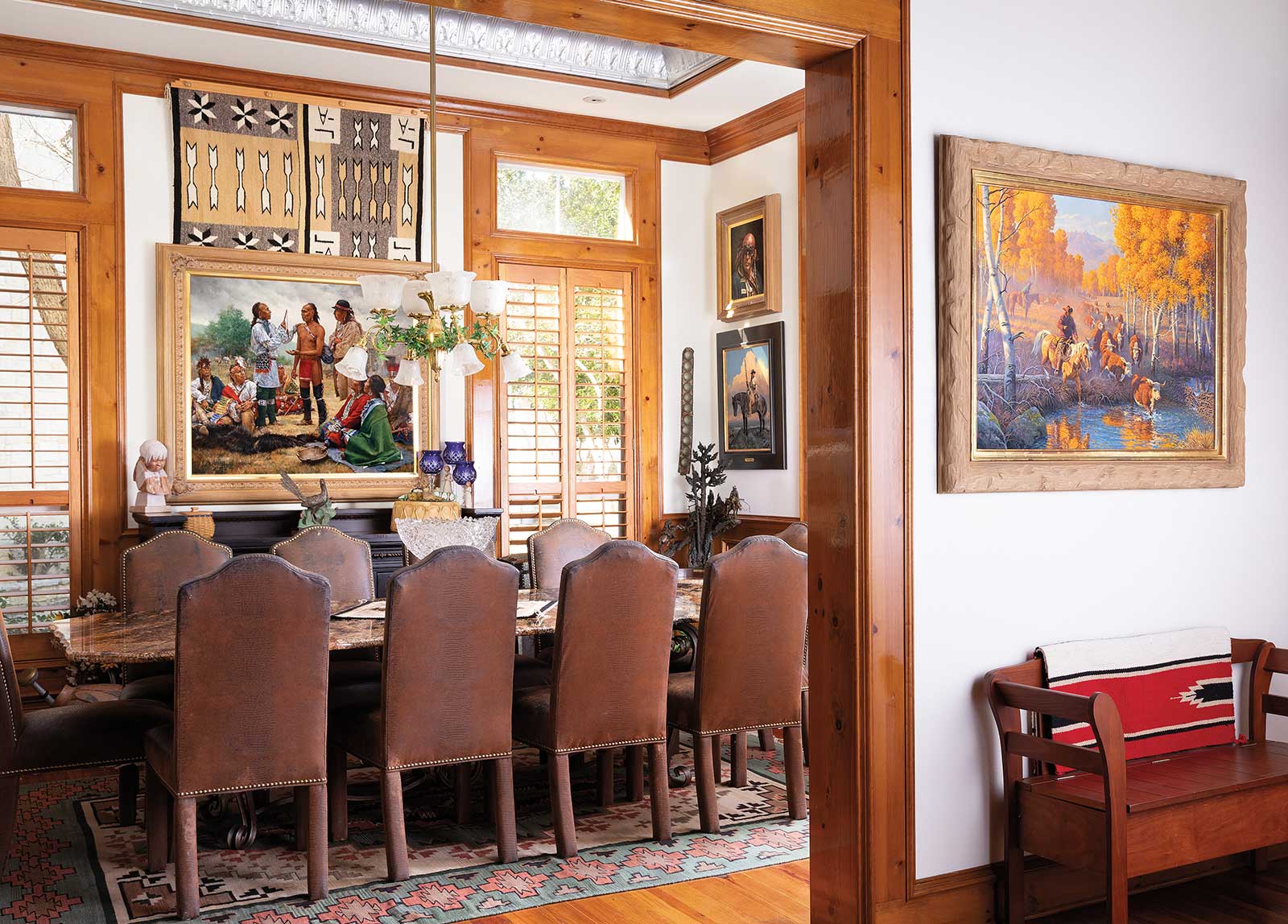
Hanging in the dining room is a 1950s pictorial saddle blanket. Beneath it is A Call to Council: Sending Runner with Invitation Wampum, 2010, oil, by Robert Griffing. To the right are, top to bottom, Griffing’s The Eyes of the Bear Clan, 2007, oil, and The Wagon Scout, 2022, oil, by H. David Wright. In the foreground is Autumn Gold, 2019, oil, by Clark Kelley Price. Beneath the Wright is Without a Blaze, 1980, bronze, by Bob Grieves (1922-2016).
Early on, they bought from shows like the Kiwanis Club Rodeo Art Show in San Antonio and then branched out to museum shows around the West, realizing their purchases benefit not only the artists but also the museum hosts.
While David was attending another medical meeting in Jackson, Wyoming, Jinny visited galleries. “I went over to Trailside and saw an exhibition by G. Harvey. We knew who he was,” she says. “He lived close by in San Antonio. I had never seen an original and was excited to see them. When I asked about a painting I liked, they told me it wasn’t for sale and was reserved for a draw sale. I wasn’t familiar with that but the gallery said, ‘Let us put your name in the draw.’ Not long after we got home, I got a call. We had won.”
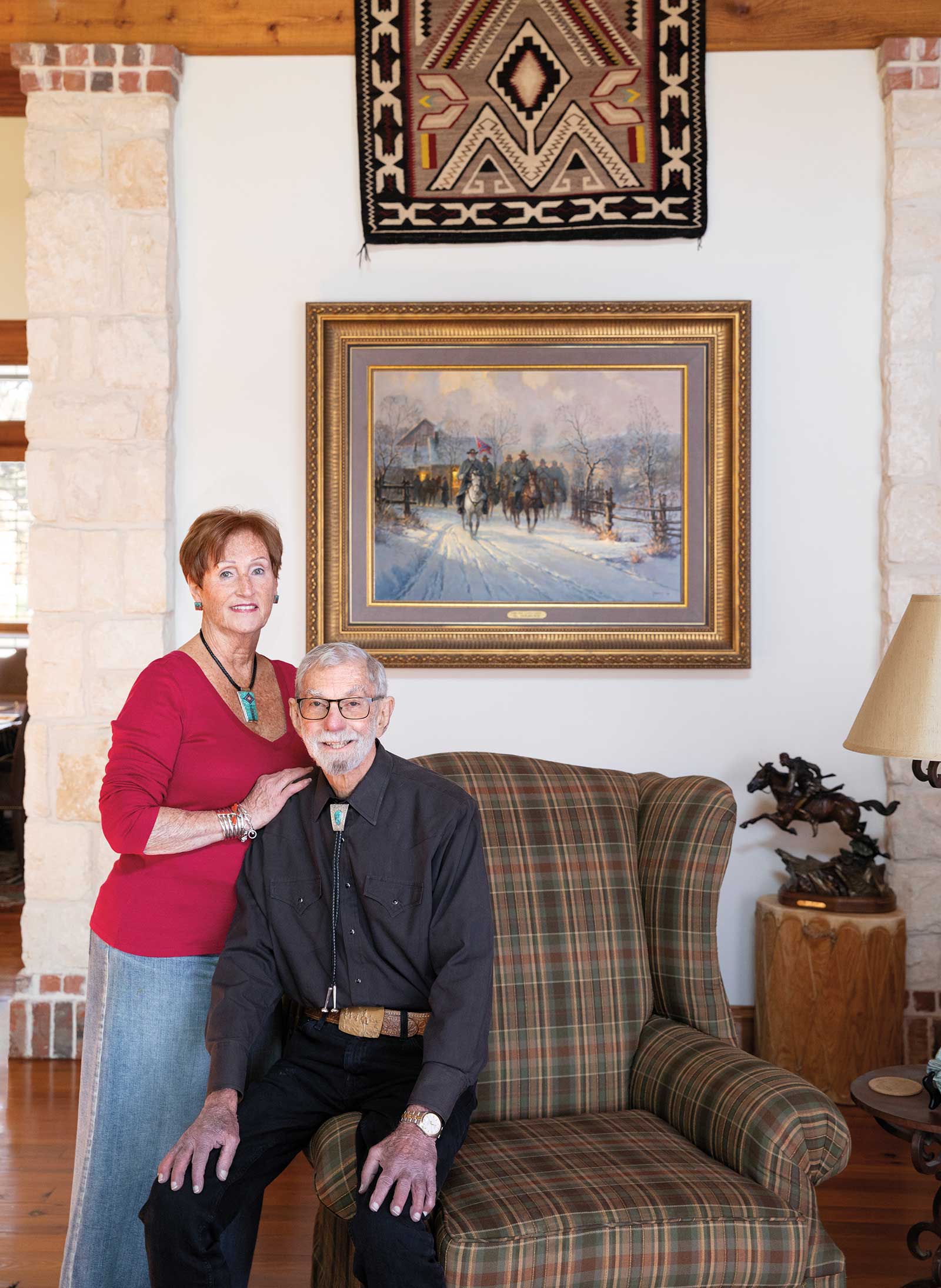
Virginia and David Mullins pose beneath a painting, Lee and Longstreet, 1996, oil by G. Harvey (1933-2017). Above it is a Tec Nos Pos weaving, circa 1920s to 1940s.
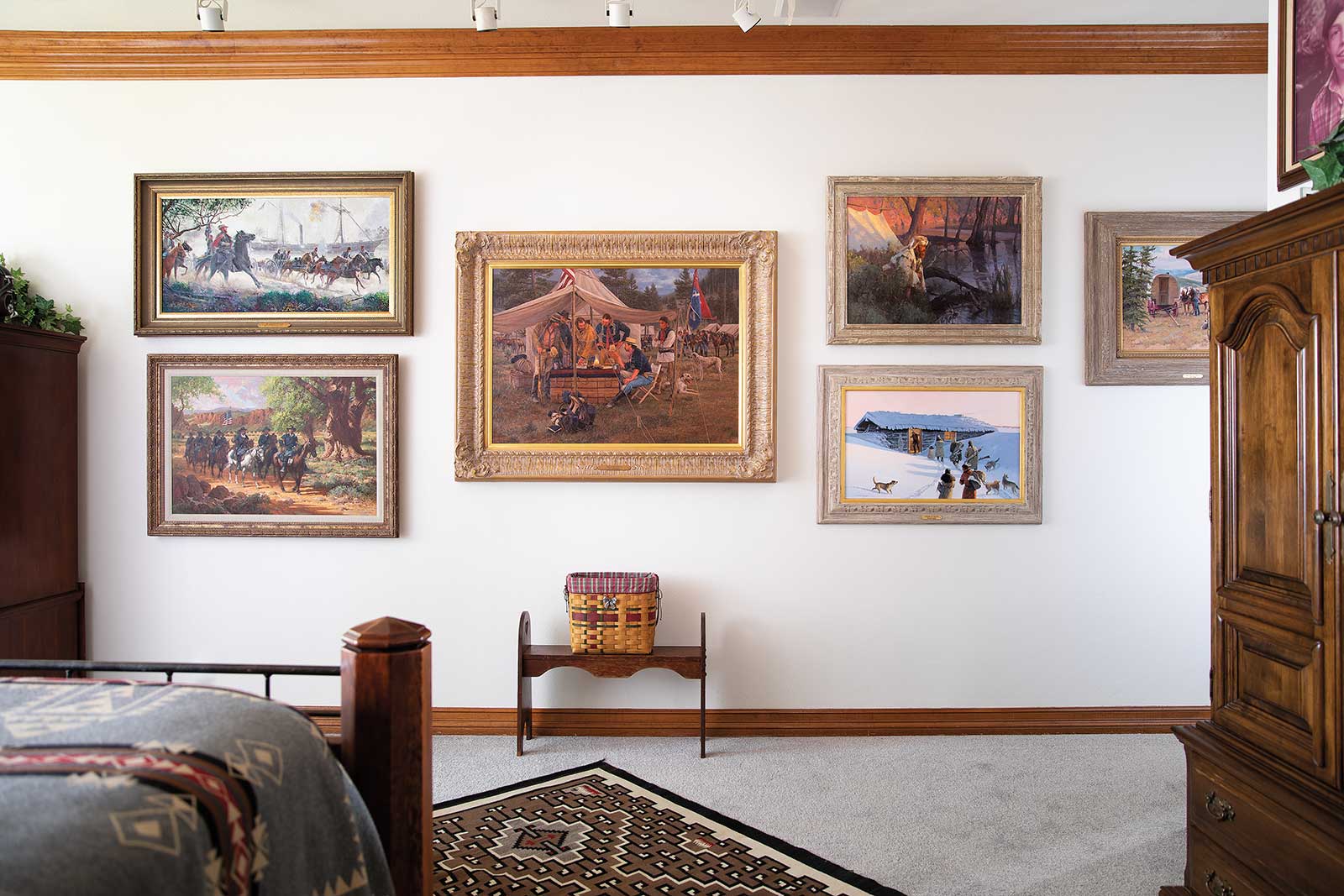
The paintings are—top to bottom, left to right—The Strangest Race, 2010, oil, by Mort Künstler; Fort Davis, 1997, oil, by Robert Summers; The Strategists, 2007, oil, by Karin Hollebeke; Reflecting on What is Ahead, 2017, oil, by Mian Situ; Coming to Trade, 2015, oil, by H. David Wright; and (partially visible) Sheep Camp on the Bighorns, 2013, oil, by Steve Devenyns. The Two Grey Hills rug, circa 1979, is by Irene Yazzie (Navajo).
Jinny admits to not being a fan of auctions, but on one notable occasion she did very well. “Back in the early ’80s after the savings and loan crashes, banks had to sell their collections. There was a big one in San Antonio for several banks that had collected Western art. We went to the auction preview and saw a bronze we liked, but we didn’t know about the artist and weren’t sure about it. At home, I began thumbing through an old book on Western sculpture and saw that sculpture being used as an example of the work of Bob Grieves. David had to go to a meeting and I went to the auction to bid on the sculpture. We had decided how much we would bid and wouldn’t go over it. I got it for $4,000! It took the two of us to pick it up and carry it home. I began to have buyer’s remorse, though. I decided to call the gallery in Sedona that had listed it in the sculpture book and asked them about the sculpture, Without a Blaze. They said ‘Oh yes, we have a cast of the sculpture. It’s available for $25,000!’”
Their oldest grandchildren are beginning to identify pieces they like. Jinny notes that they’re not very impressed with museums because they think their grandparents live in one. On one occasion, when they moved a painting, they learned what their grandchildren really thought.
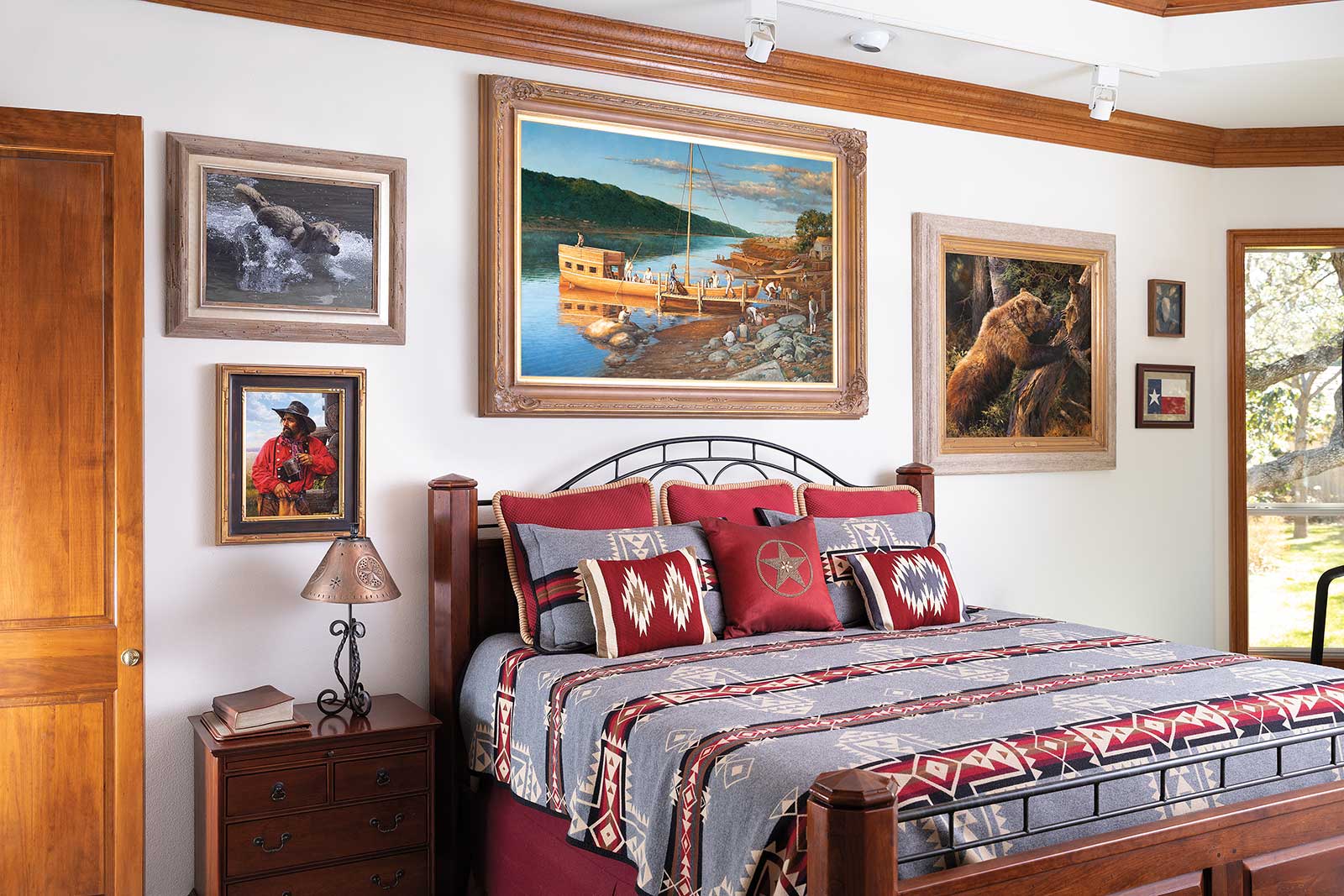
Hanging to the left of the bed are, top to bottom, Hot Pursuit, 2018, acrylic, by Adam Smith, and Calm but Cautious, 2018, oil, by Alfredo Rodriguez. Above the bed is The Voyage of Discovery is About to Begin, 2004, oil, by Robert Griffing. On the right is Sweet Tooth, 2013, oil, by Bonnie Marris.
“Robert Griffing’s The Eyes of the Bear Clan used to hang in the hall leading out of our kitchen. Everyone saw it as they would come and go. At one point we moved some things around and hung the painting in the dining room. Our grandchildren then told us the painting terrified them. It was so scary they would run past it if they had to go down the hall at night.”
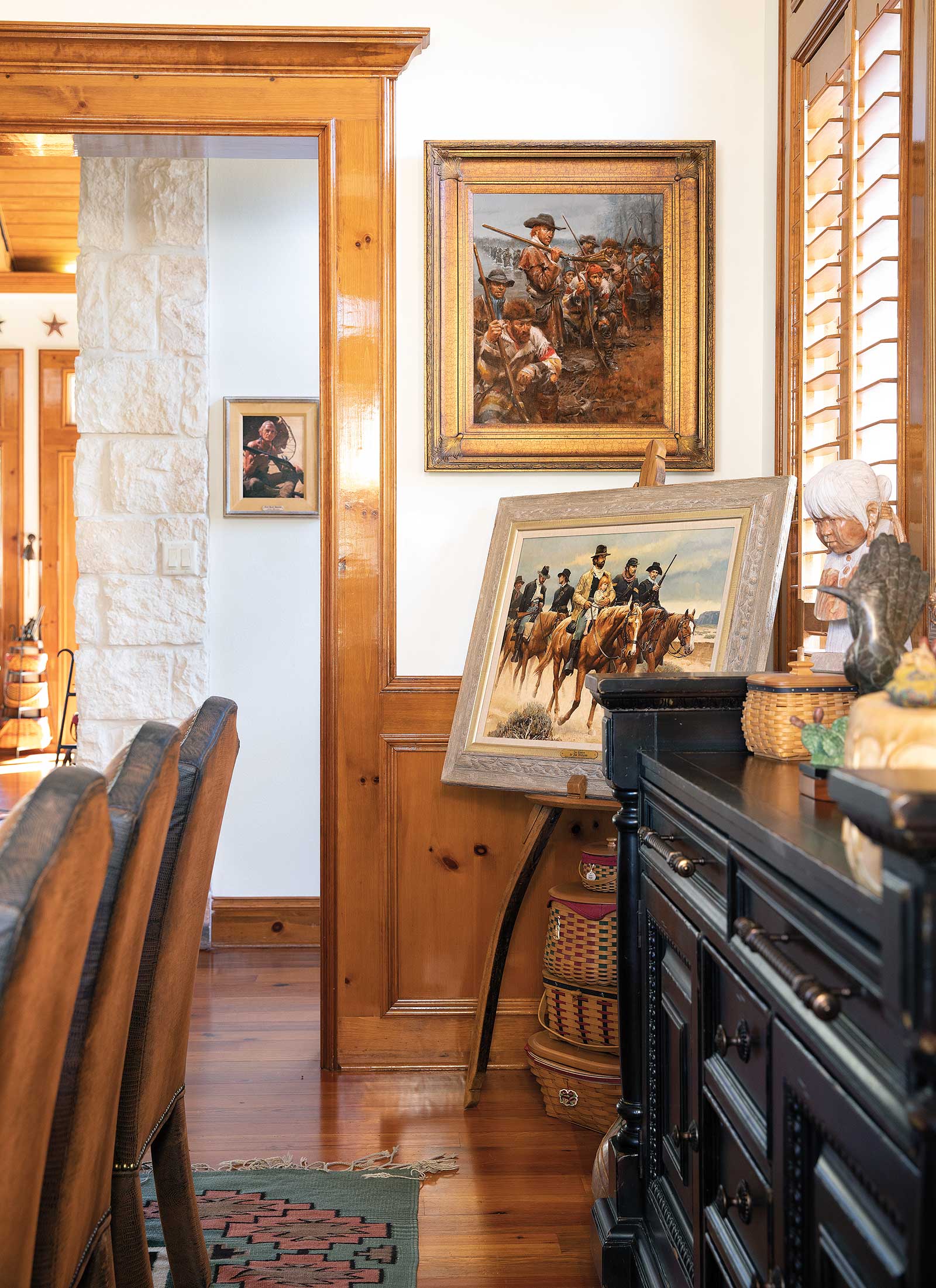
In the hall is How Many Beaver?, 2005, oil, by John Buxton. In the dining room are George Rogers Clark at Vincennes, 2010, oil, by Andy Thomas and, on the stand, The Rescue, 1988, oil, by Don Spaulding (1926-2021). On the sideboard is Grandpa’s Girl, 2005, alabaster, by Oreland Joe (Navajo/Southern Ute).
When they began collecting, Jinny says, “We were kind of afraid. We held the artists in awe. As we got to meet a few artists, we found they are personable and not distant. We got to know a lot more about them whether we collected their work or not. But, meeting them enhanced our buying their pieces. Heide Presse has wonderful stories. At shows, she will see people standing by one of her paintings and she’ll come up and tell them the story behind it. We have two of her paintings.”
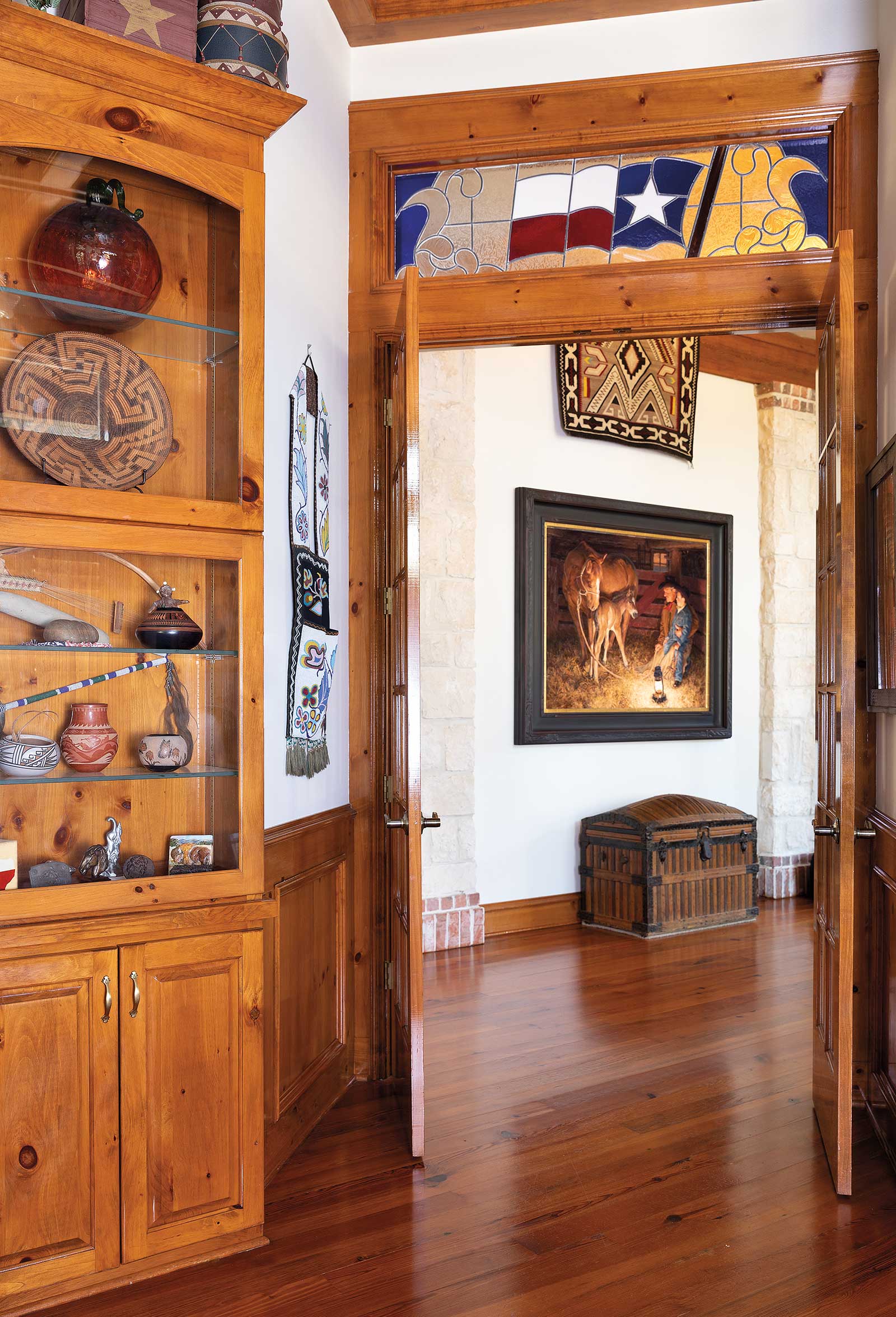
On the wall in the study is a Great Lakes/Ojibwa beaded bandolier bag, circa 1880s. In the hall are The Gift from Grandpa’s Heart, 2011, oil, by Loren Entz (1949-2022), and a Tec Nos Pos rug, circa 1920s to 1940s.
Jinny and David buy from their heart. The narratives in their paintings and sculpture and the craftsmanship of their Native beadwork bring it all alive. —
Powered by Froala Editor