There came a point during the beginning stages of her research for the body of work that would become We Set Our Faces Westwardwhen artist Heide Presse had to decide whether to fully commit to the massive project or abandon it. She was doubting that a series of paintings depicting one woman’s 19th-century covered-wagon journey from Ohio to Oregon would be of interest in the broader world of Western art.
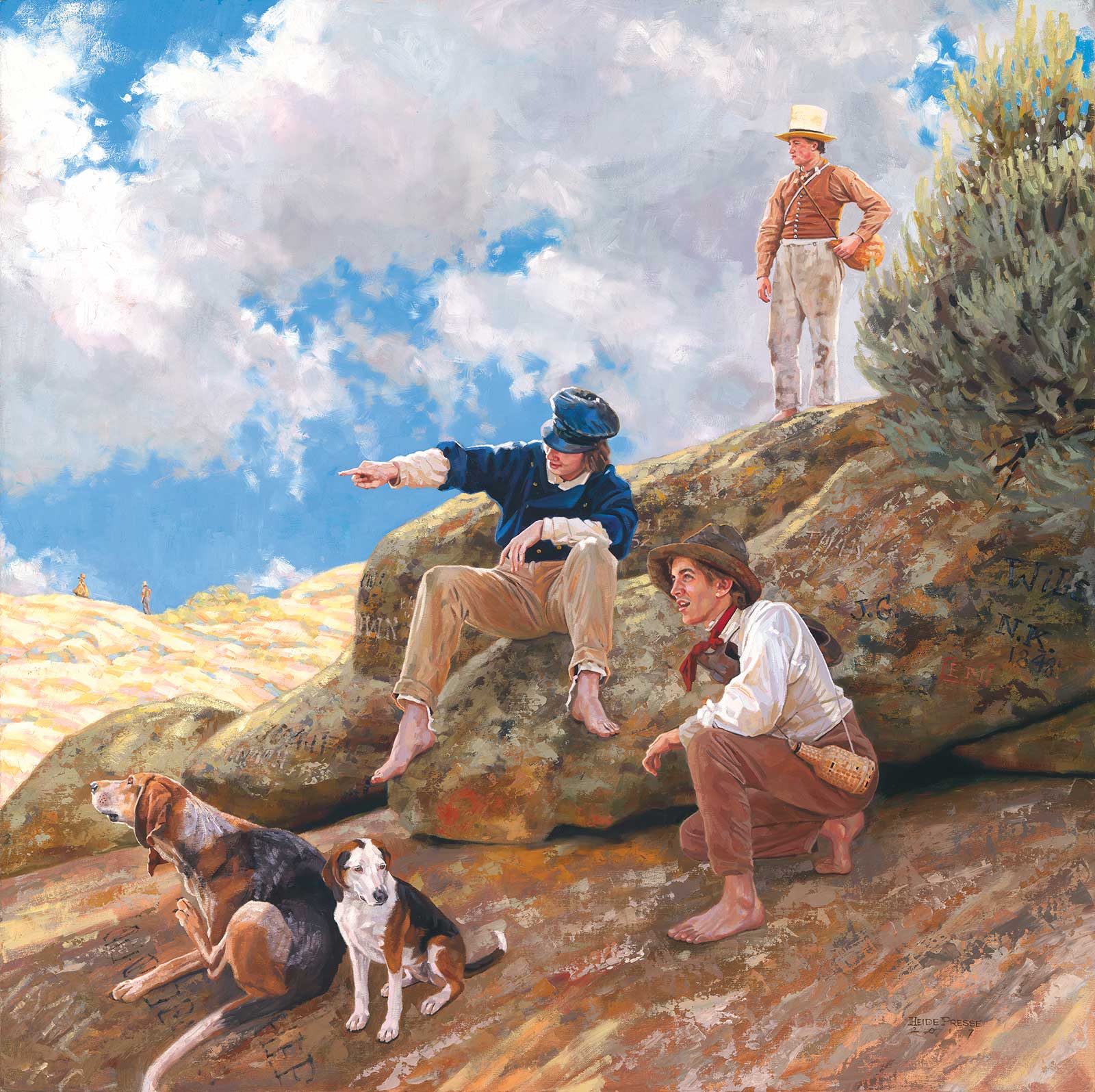
They Left Their Mark, 2017, oil on linen, 32 x 32”
While gathering reference material at central Wyoming’s Independence Rock, a historic landmark on the Oregon Trail, Presse got her answer.
“I was walking along the banks of the Sweetwater River looking for the right angle, when I looked down at my foot and an inch away was a porcelain doll leg,” recalls Presse. “It was obviously from the 1800s and I thought, ‘who else but me?’ I don’t find a button or bullet— I find a little piece of an antique doll just lying there waiting for me to pick it up. I took it as a sign that the women and children who passed through that spot wanted to me tell their stories.”
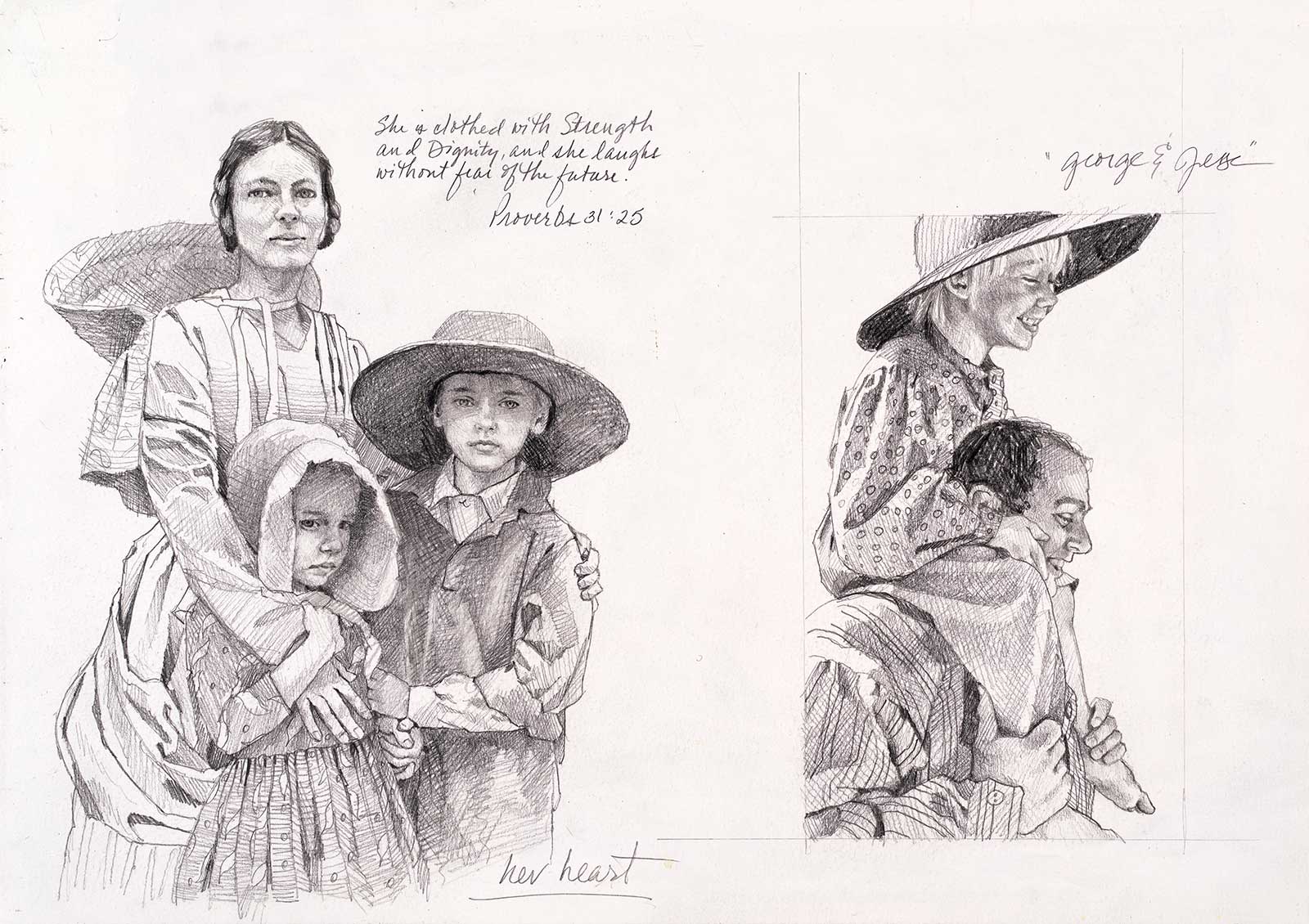
A sample from one of the many sketchbooks Heide Presse filled during the course of this project.
They Left Their Mark depicts several youth crouched on Independence Rock, where traces of names etched by those who stopped there during the great Western migration are still visible in the stone. It is only one piece in a series that has grown to include roughly 30 oil paintings and watercolors, and many sketches and drawings, since she embarked on the project in 2015. Adding another contextual layer and insight into Presse’s creative process, the exhibition also features period clothing, some of which she sewed herself, and other antiques and accurate reproductions. All of the objects were used as props for Presse’s paintings and many can be seen in the works. Together, the art and objects comprise We Set Our Faces Westward: One Woman’s Journey 1839-1848, which opens at the Booth Western Art Museum on July 1.
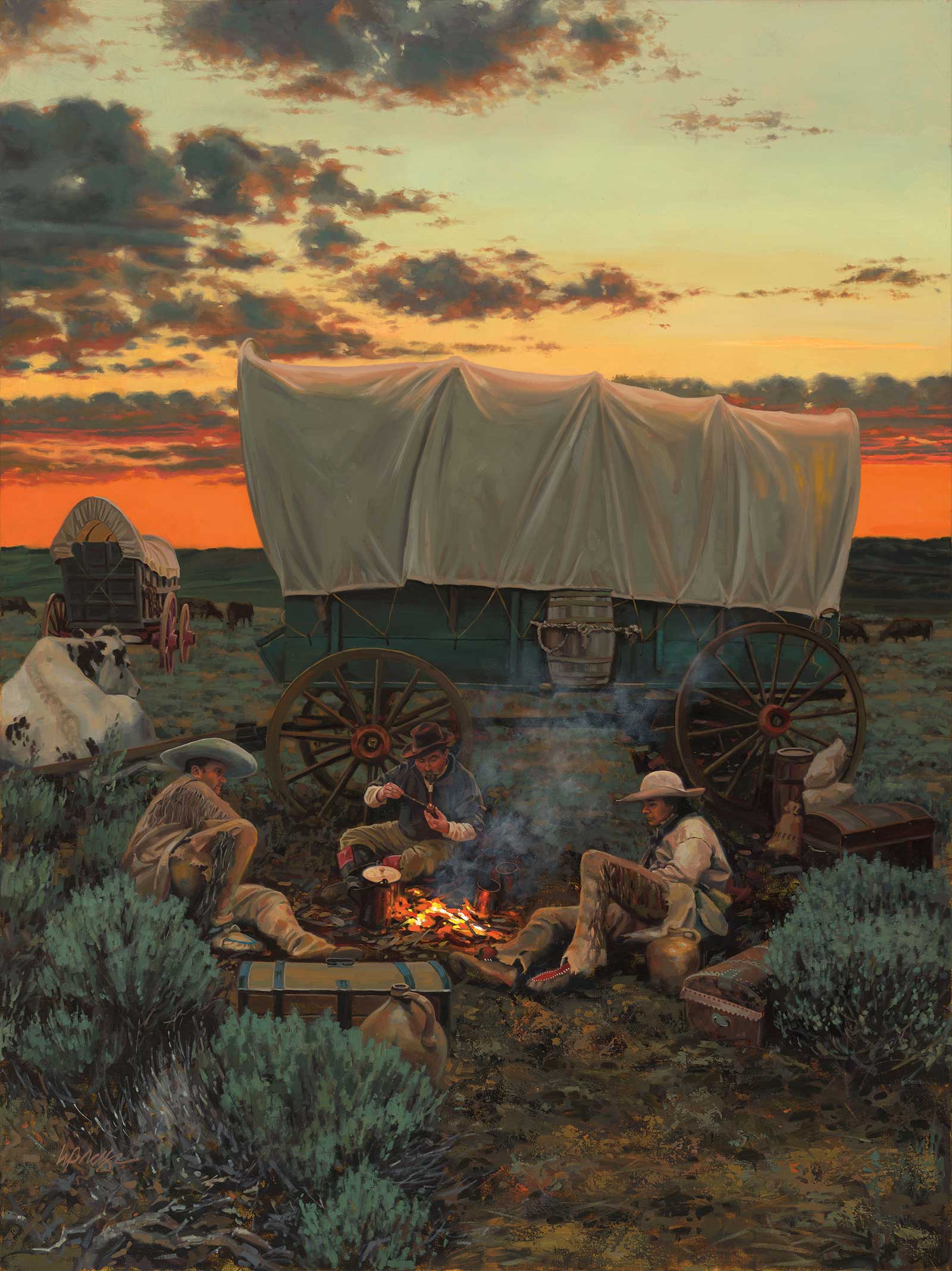
Twilight, 2023, oil on linen, 48 x 36”
Presse has always been curious about how people conducted their daily lives in bygone eras, so it was not unusual for her to pick up a copy of one of the Covered Wagon Women books in a museum gift shop. Intrigued by the first-person accounts of women who traveled the Oregon and California trails, she ended up reading the entire series.
“Before that I had never thought to do this subject,” says Presse. “I picked up that book because I liked to read journals—I’ve always felt like the best way to put your feet into a situation is through someone else’s experience.”
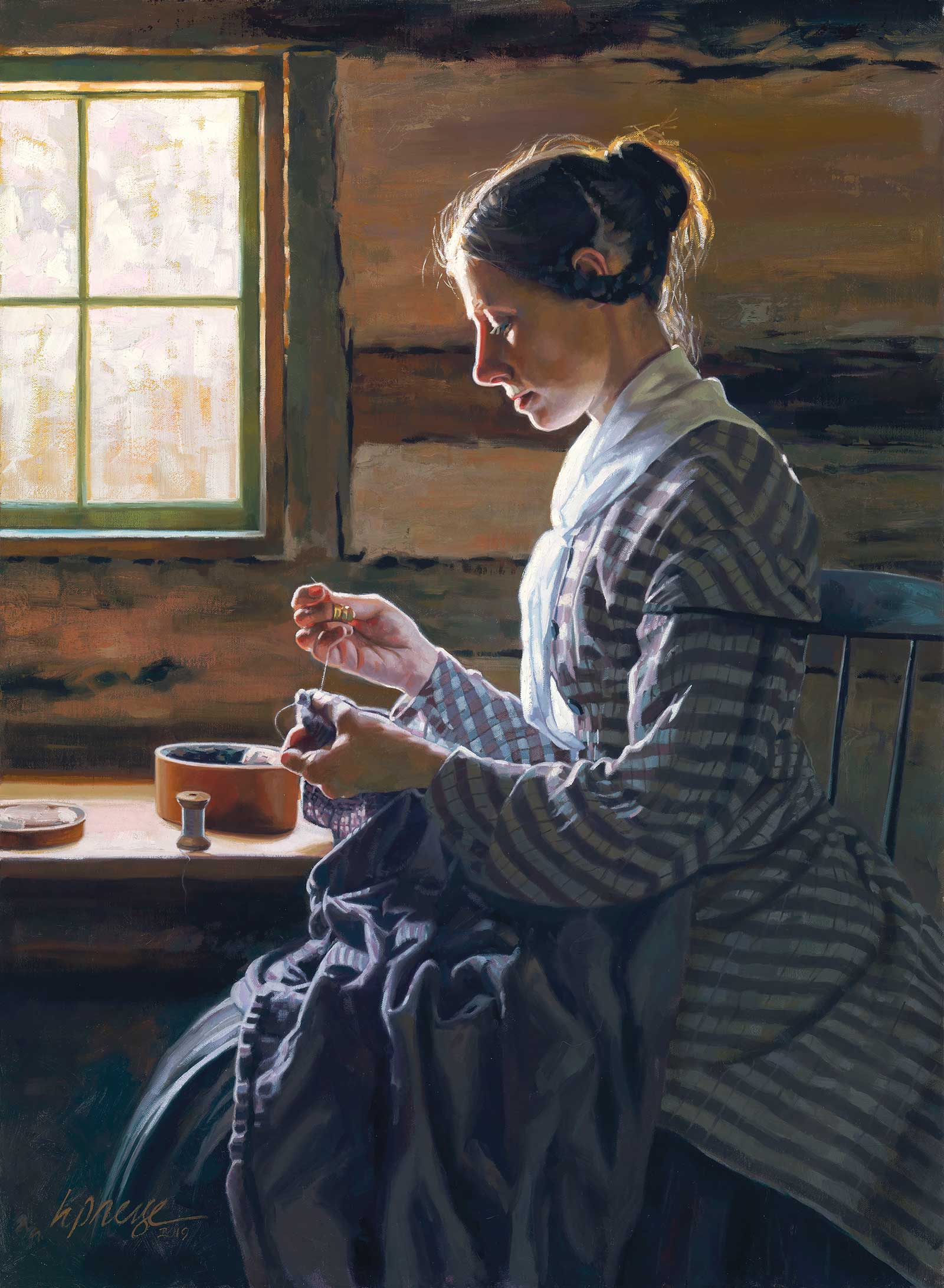
Not an Idle Minute, 2019, oil, 30 x 22”
Presse struck gold when she came across the journal of Keturah Penton Belknap, who left Ohio with her husband and in-laws in 1939 in search of prairie land to farm in Iowa. The pieces in We Set Our Faces Westward focus on their initial journey, the seven years they spent in Iowa and the family’s 1848 passage to Oregon, where they would carve out yet another new life.
Unlike many of the countless journals she read, Keturah was fastidious in chronicling the details of preparing for the journey and everyday tasks, like how she baked bread and made butter on the trail, wove cloth from home-grown flax and more personal accounts about her marriage.
“One of my favorite things to paint are scenes of everyday life,” says Presse. “That fleeting moment, when that everyday item just becomes transformed into something extraordinary. This was the perfect inspiration for that. She was incredibly descriptive—she has what might be the best, most complete description of how they packed their wagon. It was the perfect example of people living their everyday life and I wanted to tell those stories through paintings.
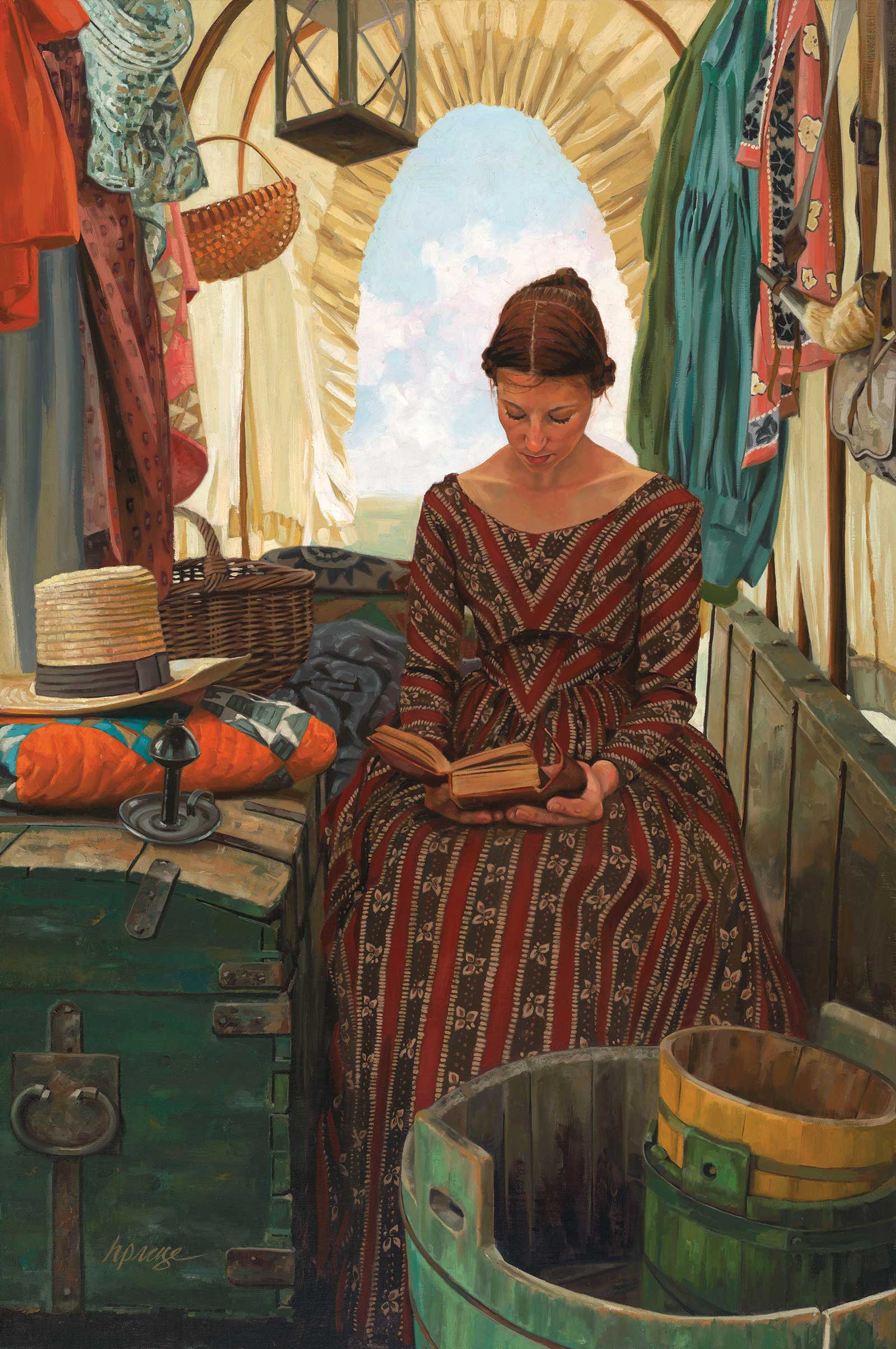
And I Shall Give You Rest, 2023, oil on linen, 36 x 24”
“It opened up this whole world that I didn’t even know existed,” Presse adds. “The experience of going westward in a wagon was a lot more varied than I thought. Other depictions I’ve seen focus so much on the negative. There were a lot of tragedies but maybe that affected 20 percent of those who went. What about the other 80 percent who were fine and didn’t get sick and didn’t die? They just lived their regular lives.”
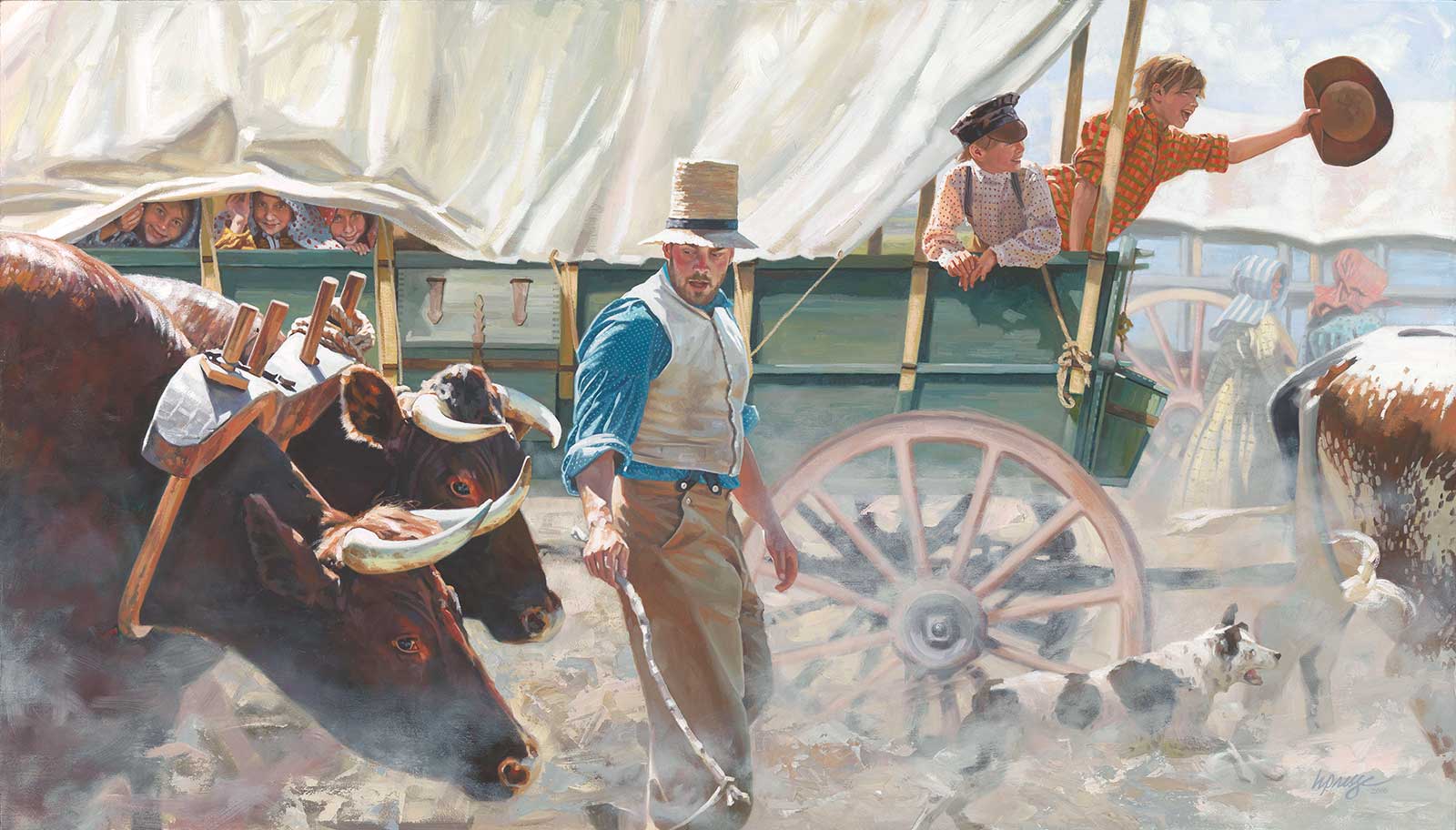
Westward Ho!, 2016, oil on linen, 24 x 42”
And I Shall Give you Rest shows Keturah reading a bible in the back of the wagon, her faith something she regularly referenced in her journal. Not an Idle Minute depicts Keturah sewing—a scene made all the more meaningful when Presse shares how Keturah grew her own flax, processed it, spun it into linen thread to be woven into cloth, which was then handsewn into their wagon cover. Twilight is an especially poignant piece for Presse because it depicts an actual moment she experienced on one of her reference trips. She, too, settled down on the ground at the end of the day with a group of people beside a wagon in Wyoming looking out at the same sunset.
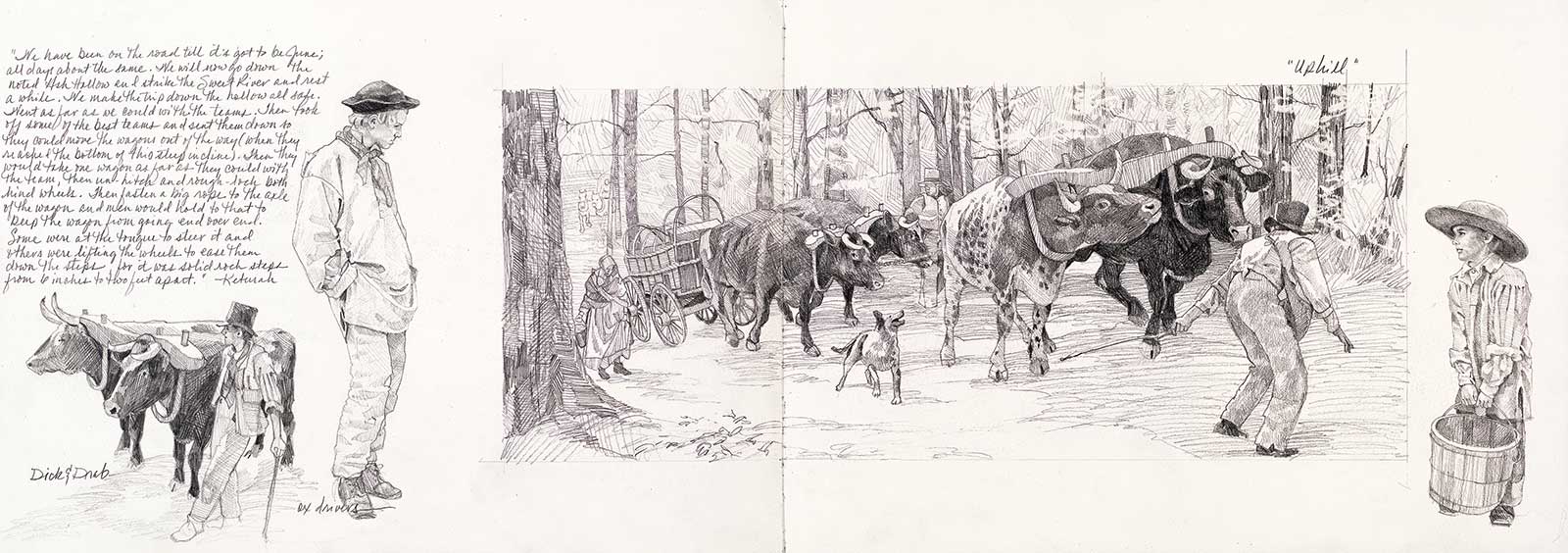
Graphite drawings from Presse’s sketchbooks will also be on display.
“Reading the recollections, the words, of all these various women made it more real,” says Presse, adding that she learned so much in the process, including that upwards of 30,000 people crossed the Missouri River on their way to California and Oregon during the peak of the migration between 1848 and 1852.
“They would join up with strangers to form a longer wagon chain. It could take them a week to cross the river and weeks waiting in line to do so,” she says, clearly still fascinated by the history. “The trail was so crowded—white-covered wagons stretched as far as the eye could see.”
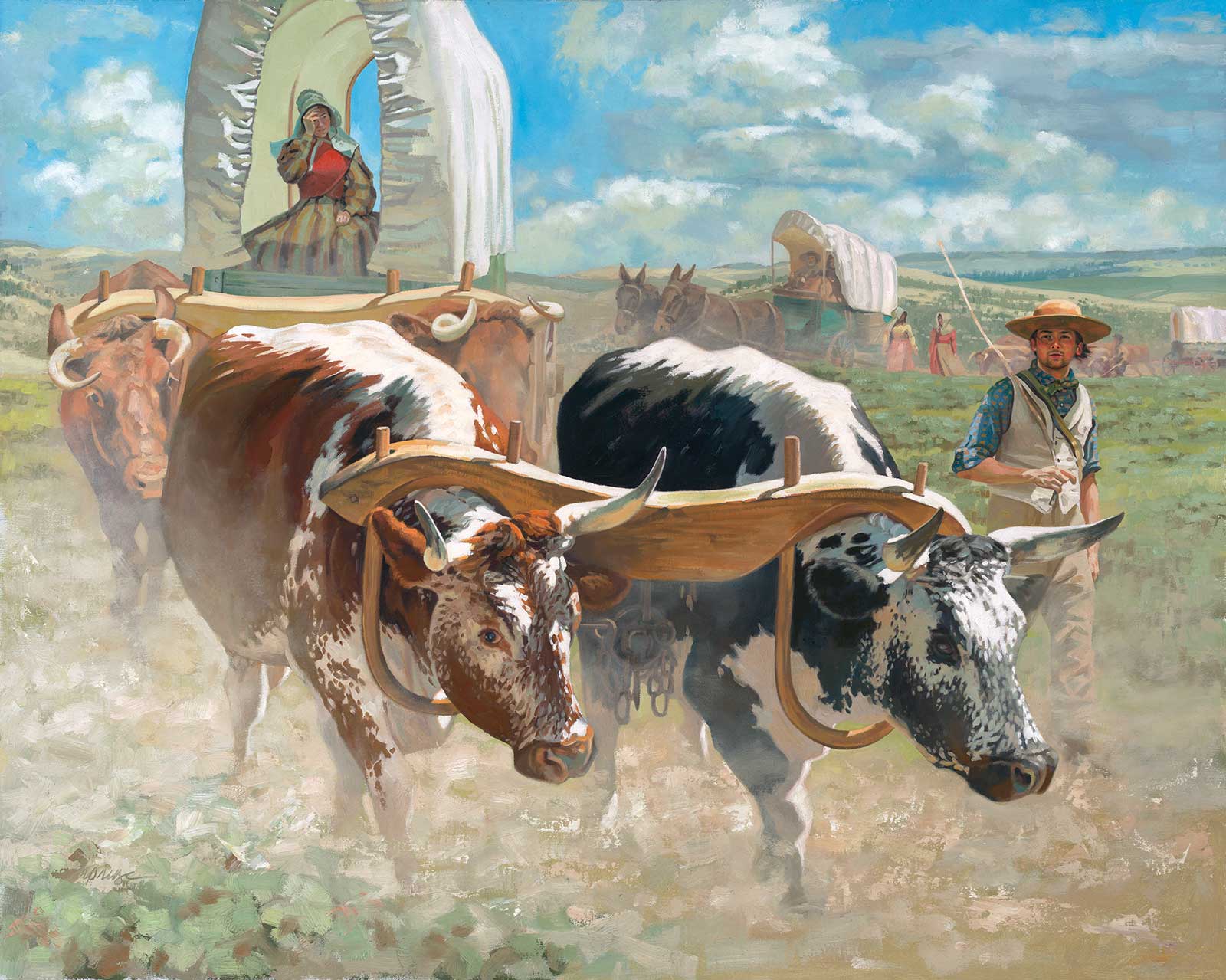
Pursuing Their Dream, 2023, oil on linen, 32 x 40”
Another revelation was that each family might be running 100 head of livestock. Some had sheep. “Of course people wanted to be at the front of the train. I never truly thought about the logistics of it,” she says. “I found the sheer numbers of people who were traveling just so surprising.”
The journals were only the starting point for the extensive amount of research—and travel—Presse conducted for a body of work that she has chipped away at between other creative commitments for nearly a decade.
She consulted and collaborated with living history interpreters who shared their expertise and even modeled for Presse, and visited living history museums to gather reference material on the architecture of the time period and historic animal breeds. She made a connection with an individual who gave her access to an authentic covered-wagon he had in his private collection. She found a source who had done historical reenactments of life on the Oregon Trail.
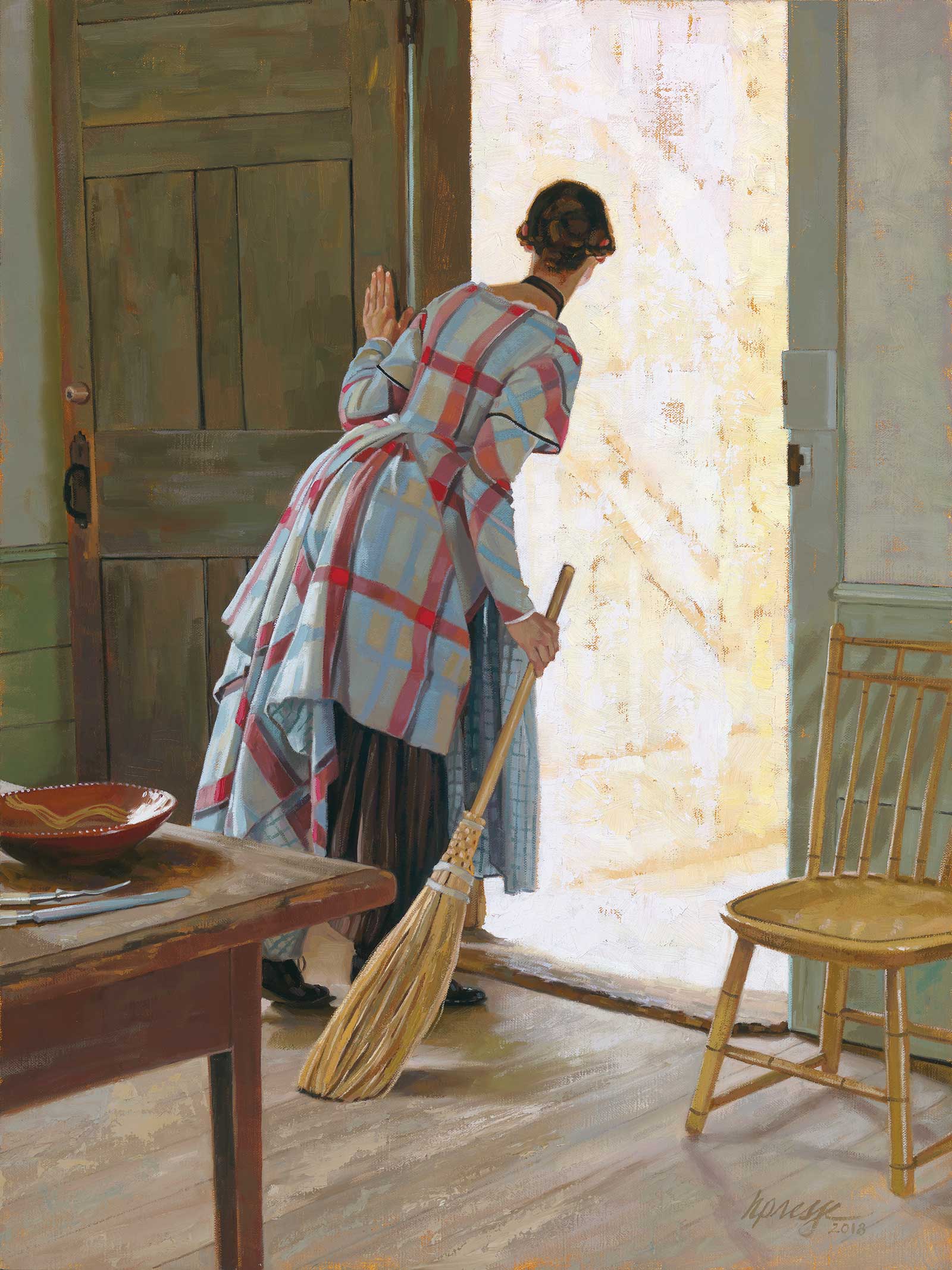
Unexpected Visitor, 2018, oil on linen, 24 x 18”
“I have spent a lot of time with oxen in historic places,” she says. “I would get the material wherever I could get it. I went wherever I had to go.”
That also meant traveling to nearly every stretch of the Oregon Trail, with the exception of Idaho and Utah. On site, she stood in the original wagon tracks, felt the heat and chill of the sagebrush desert, saw the rivers the emigrants crossed and the land formations described in the journals as “fine curiosities.”
All of her efforts resulted in scenes that are impressive aesthetically and for their uncompromising accuracy, but their real impact lies in knowing that they are a woman’s written account brought to life in pictures.
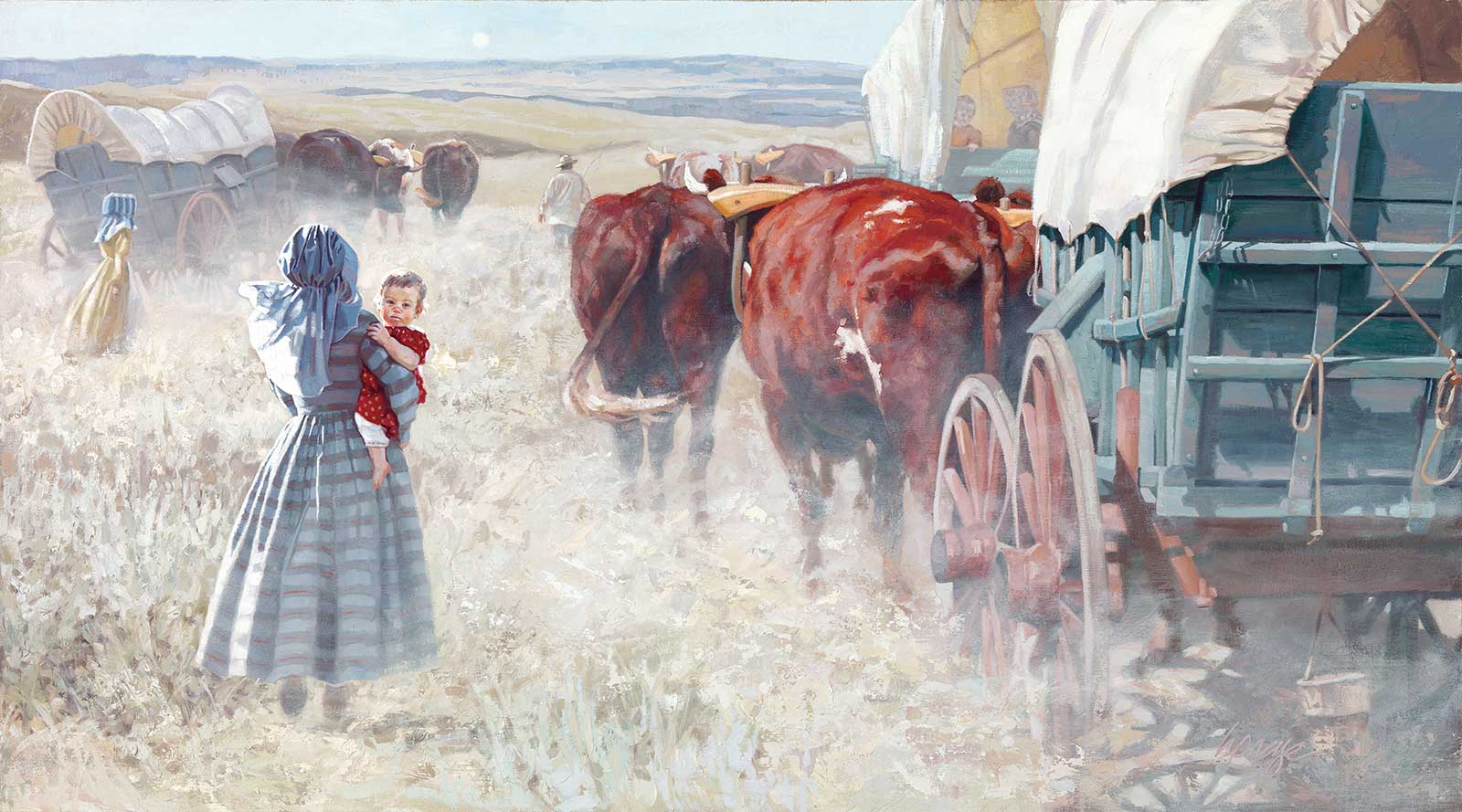
Destiny, 2018, oil on linen, 20 x 36”
When Presse began her own journey that has culminated in this exhibition, she didn’t know where it would lead. “I just felt compelled to create this body of work and see where it took me,” she says. “At first I thought it would be great to have a gallery show and hopefully people would be interested in the work. It ended up that I have two museum exhibitions and possibly a third. To have these opportunities is amazing, and I am immensely grateful and humbled.” —
We Set Our Faces Westward: One Woman’s Journey 1839-1848
July 1-December 31, 2023
Booth Western Art Museum
501 N. Museum Drive
Cartersville, GA 30120
(770) 387-1300
www.boothmuseum.org
Powered by Froala Editor