There was a studio in his parents’ garage, tucked into a corner amid boxes and with less-than-ideal overhead lighting. There was the studio in the 19th-century schoolhouse in the Northeast. In a textile mill in Massachusetts. In bedrooms and unused spaces in various houses and apartments. In rented warehouses with concrete floors. Logan Maxwell Hagege guesses he’s had more than a dozen places that he’s called studios. So when it came time to have his own built, he knew what he wanted.
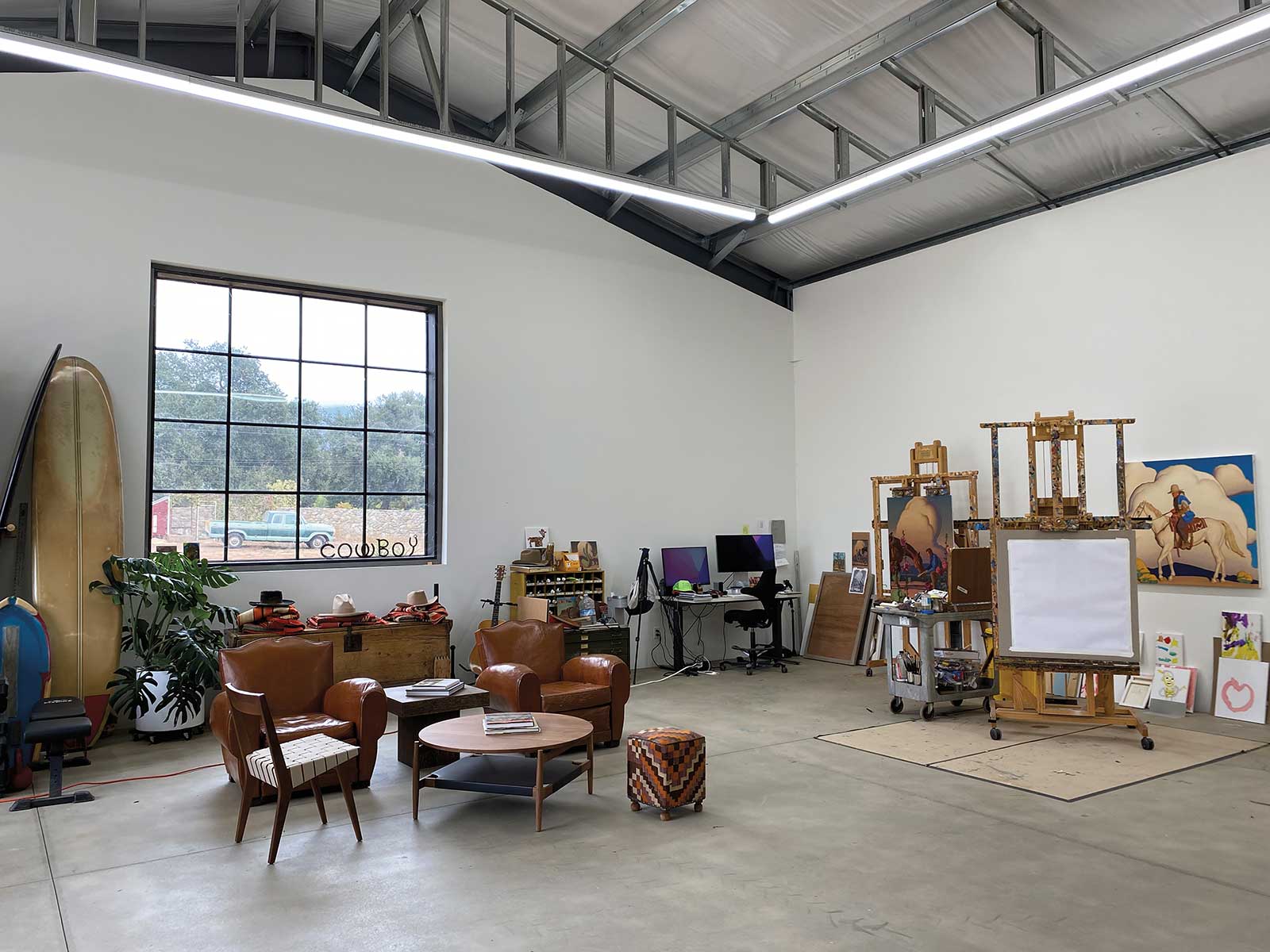 The studio of Logan Maxwell Hagege in Ojai, California.“I love that feeling of the open and industrious space. So I loosely based this studio on that model,” he says of his 2,000-square-foot studio in Ojai, California. “I knew I wanted big roll-up doors, 20-foot ceilings, a big 8-by-8-foot window on the north side of the studio. There was some stuff I knew was going to be in there. I had a lighting system designed in a complete rectangle in the ceiling so that the entire space could have daylight-balanced LED lights. I wanted to be able to put a painting anywhere in the studio and have consistent lighting on it so I could look at it from across the studio and know I was seeing the right colors.”
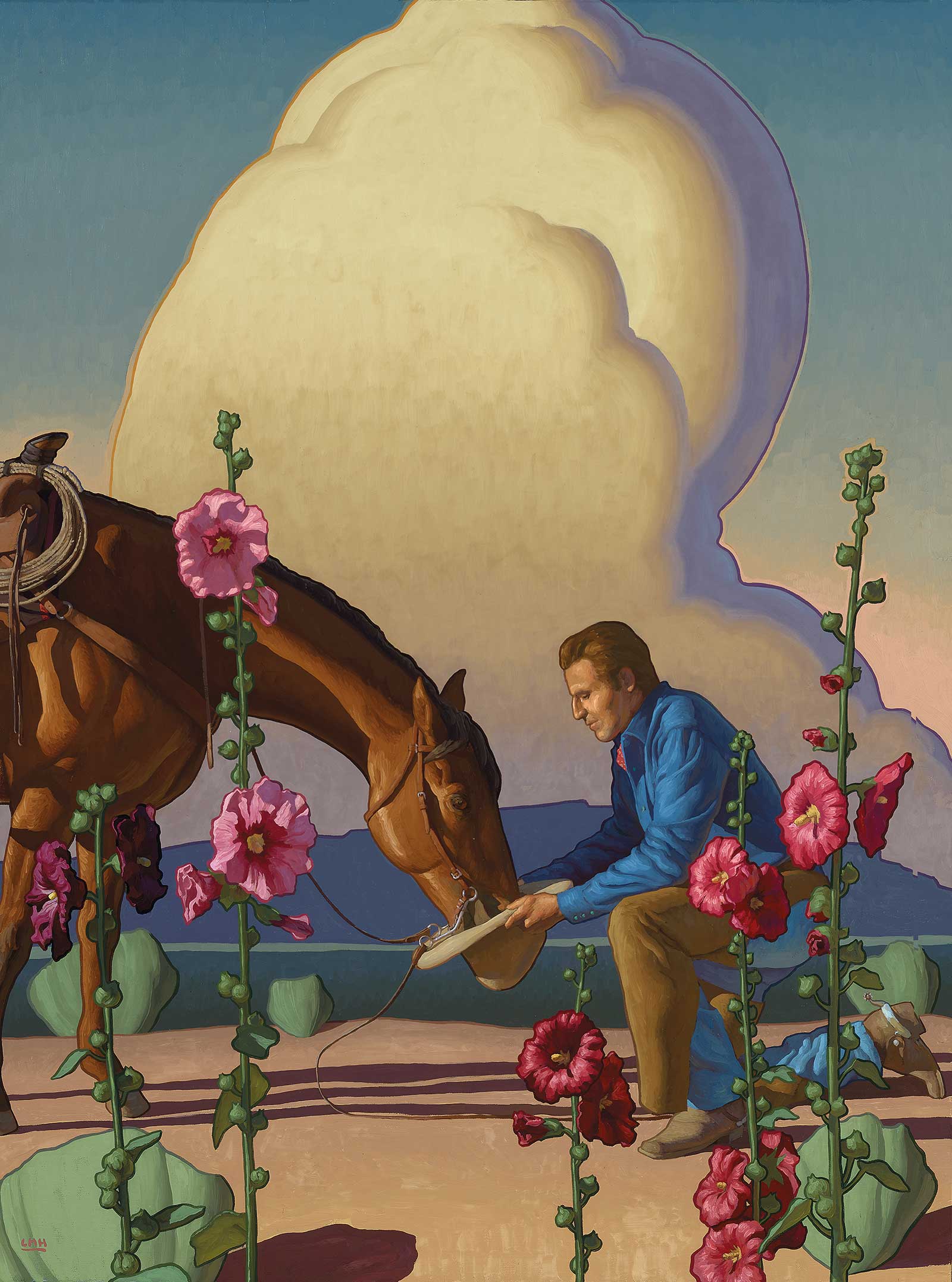 The Last Drop from His Stetson, oil, 40 x 30”Hagege hadn’t been in his Ojai house that long when work began on the studio, which would eventually be located across a driveway on the family’s property. “It was my Covid project. We basically broke ground as the pandemic was starting, and then it was completed later in 2020,” he says. Once it was complete, he was thrilled, but also admitted he could have gone bigger. “I’m kicking myself I didn’t add 1,000 square feet to it when it was designed.”
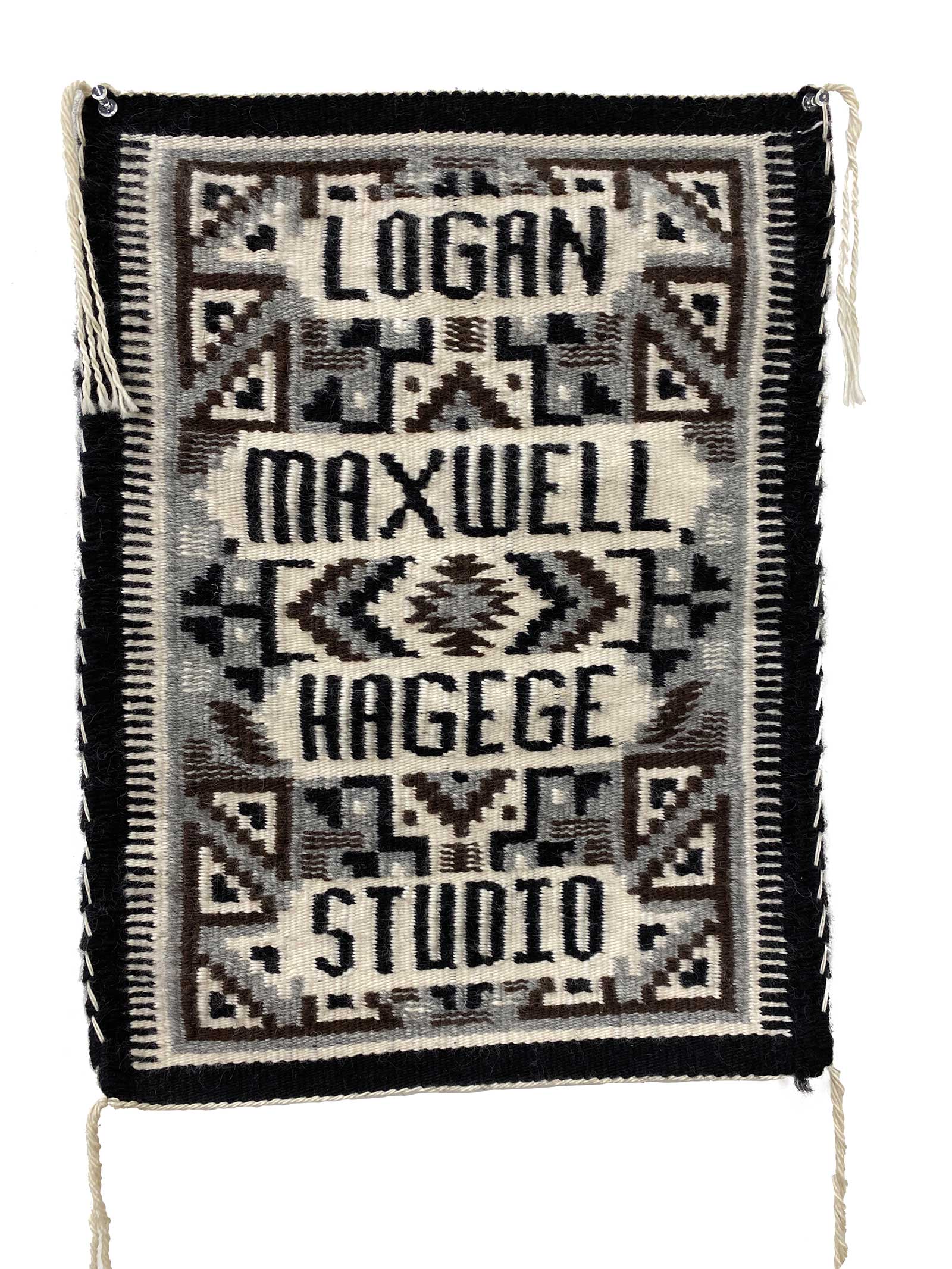 A commissioned weaving from Toadlena Trading Post
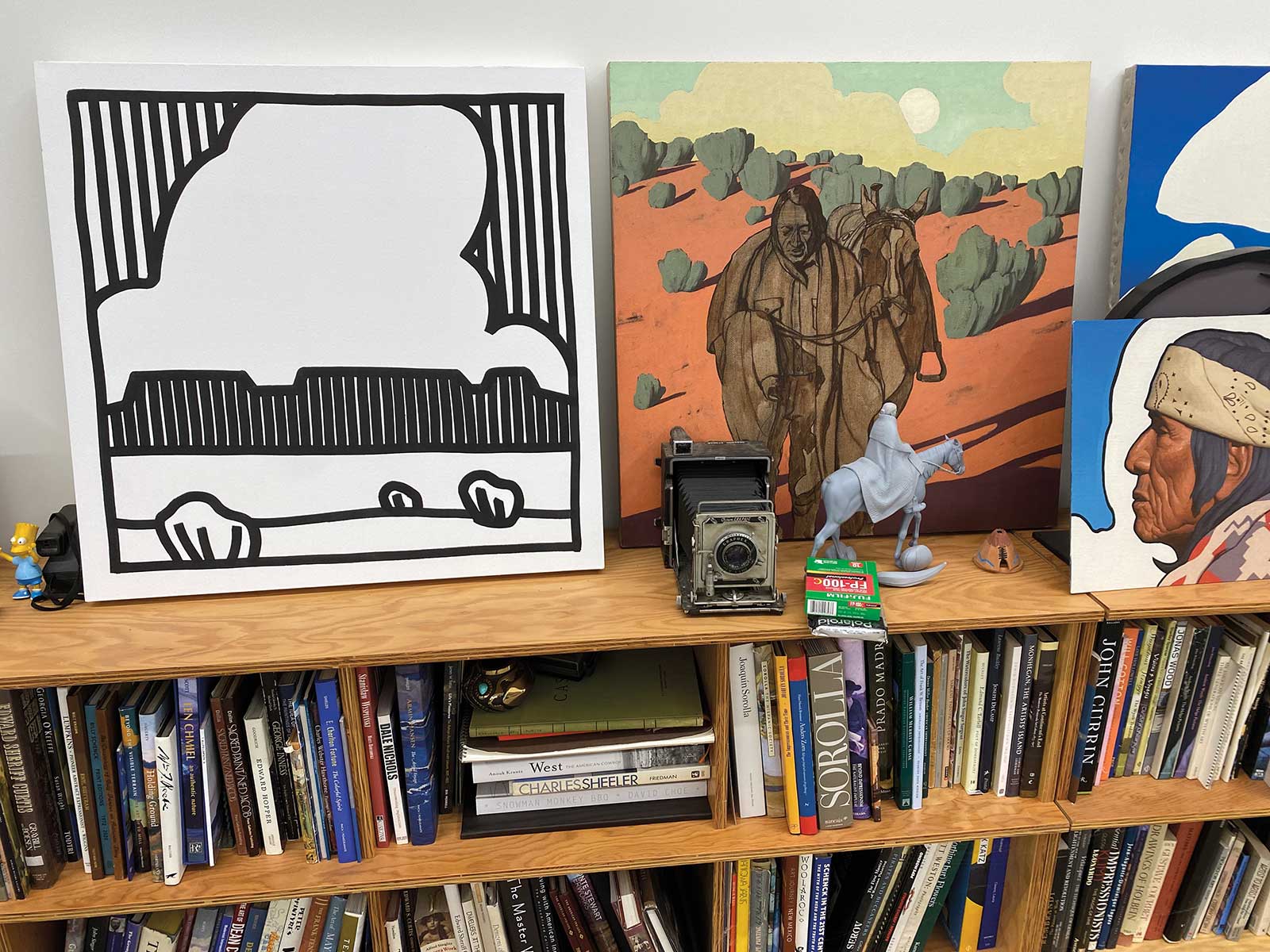 A small portion of Hagege’s art library, with several artworks on top.
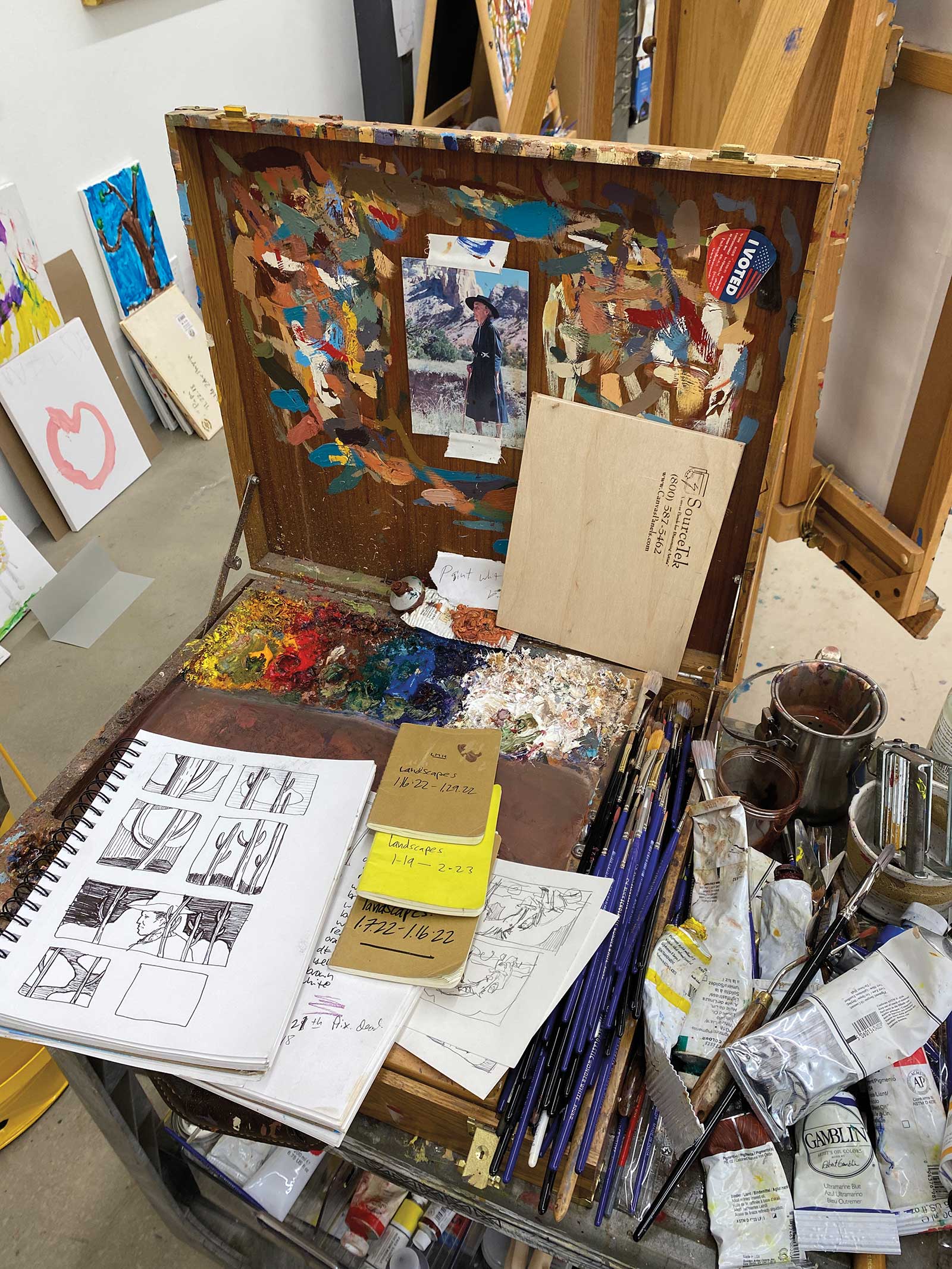
Paintbox, paints and various sketches near the easel
The first things guests might see are the objects that don’t appear in many art studios: numerous surfboards arranged in a rack. Ojai is only 15 miles inland from the Pacific Ocean, so surfing can offer a break from the studio when he has time. On the opposite end he has a custom bookshelf measuring 30 feet long filled with thousands of books. “Like most artists probably, I go through phases where I want to see certain kinds of things so I’ll start buying books,” he says. “Not long ago I sort of went crazy on Canada’s Group of Seven artists so I bought 15 books on them and their works. Just really immersed myself in it.”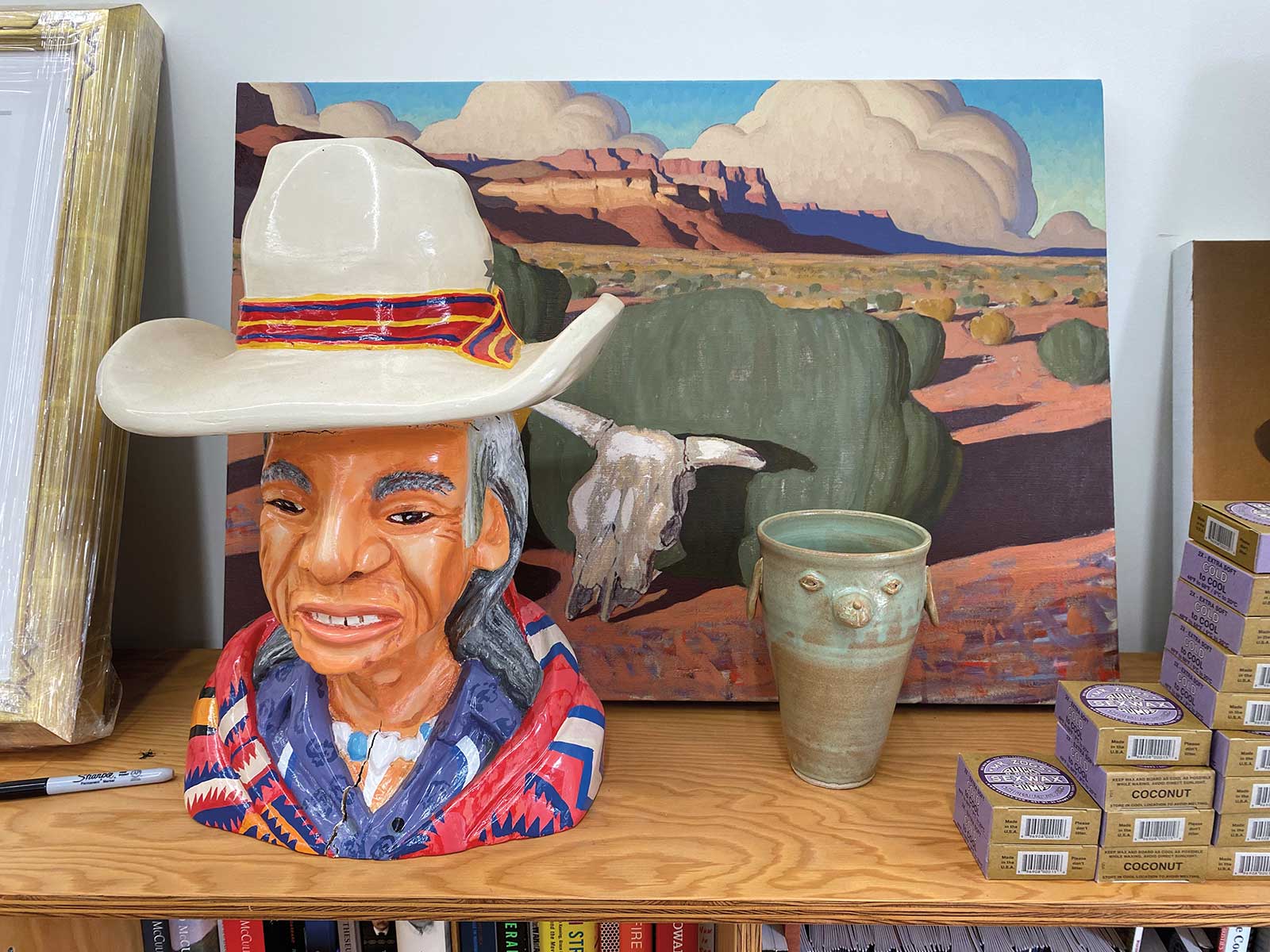
a woodcarving of the late Chesley Wilson, a frequent model for Hagege in his work. The carving is by Ghanaian artist Paa Joe.
The bookshelf is only waist high, so the top is filled with all kinds of art artifacts, antiques and paintings projects. Next to two large katsina dolls, there are two heads: one is a geometric gray bust with angular features, a work by John Asaro. The other is more recognizable: a life mask of Abraham Lincoln. They are relics from his days as a student artist.Not far from the heads is another bust, this one of a man wrapped in a Navajo blanket and wearing a cowboy hat. The figure is the late Chesley Wilson, a longtime model and friend of the artist who passed away in 2021. Hagege had the bust commissioned by Ghanaian woodcarver Paa Joe, who’s famous for his carved coffins. “It might look like ceramic, but it’s sculpted out of wood and then painted. Paa Joe is known for creating these really elaborate coffins. If someone is, for example, a fisherman, he might make them a coffin that looks like a fish. He’s done shoes and cars, all kinds of stuff. Chesley is such an important part of my work and life I wanted him to do a version of Chesley.”
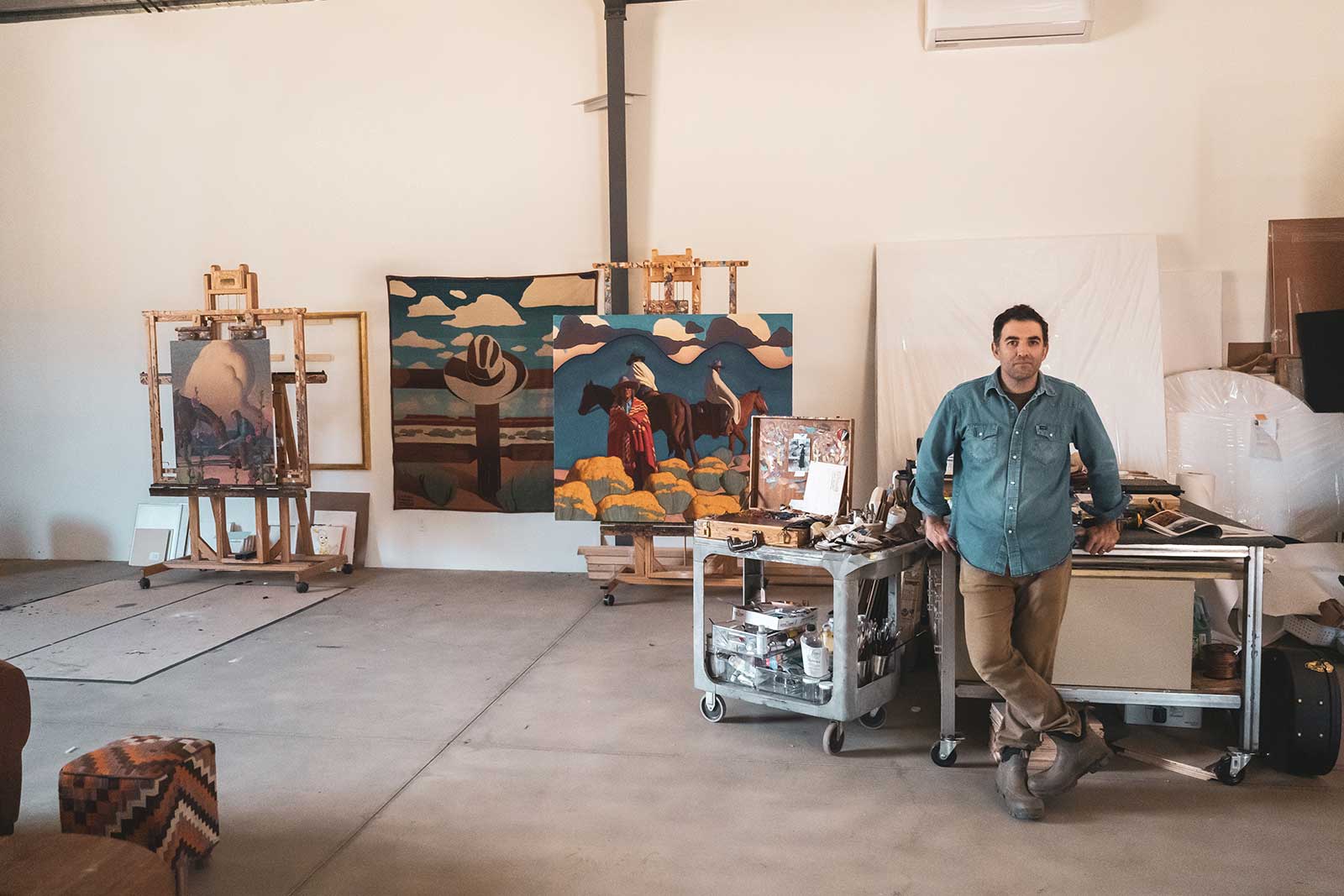
Logan Maxwell Hagege in his studio with The Last Drop from His Stetson on the far left. The Pendleton blanket is between the two paintings.
Wilson meant so much to the artist, it doesn’t stop at commissions: Hagege has set up a $10,000 scholarship in Wilson’s name at the Scottsdale Artists’ School. The scholarship will specifically benefit Native American artists.
While Hagege devotes much of the main studio space to his own work—with neat little stacks of artwork created by his two young children—he has made the bathroom a Murderers’ Row of his friends’ works: Brett Allen Johnson, Ed Mell, Billy Schenck, Phil Epp, Jeremy Lipking and others. Holding court in the middle is a large work from illustrator Daniel Content. “We’re kind of picky about what we put inside the house just because we have young kids, so a lot of stuff ends up out here with me,” he says.
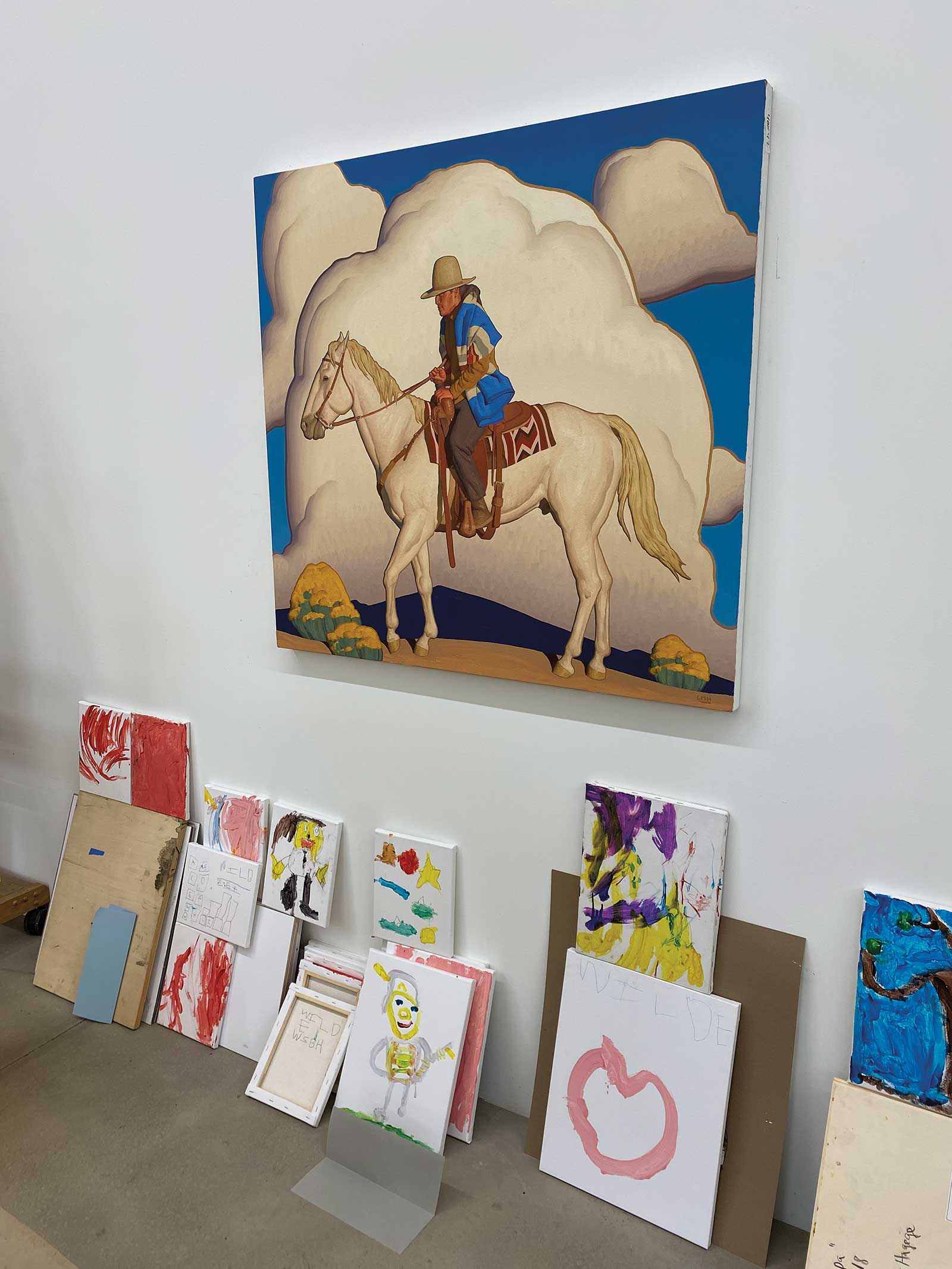
A piece by Hagege hangs over artworks done by his children.
Outside the bathroom is another commission, this one from the famous Toadlena Trading Post. “I was having dinner with Mark Winter, who owns the trading post, and he was showing me these custom weavings they can do with text on them,” he says. “I just thought it was really cool and told him I wanted one for the studio. He found an artist was able to do it. [He] and his artists are so supportive.”
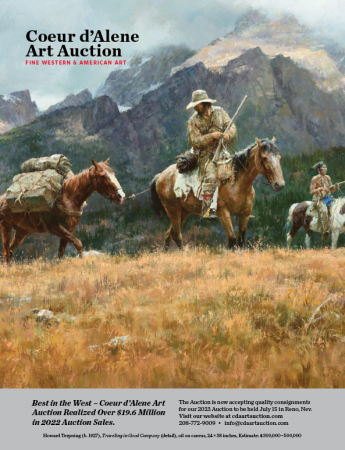
During our visit in late 2022, Hagege was prepping the release of two new projects. Both were collaborations with famous Western brands. One was Pendleton, which asked the artist to design a blanket, later titled Resting Place. The other was hatmaker Stetson, which had asked Hagege to paint his own interpretation of Lon Megargee’s The Last Drop from His Stetson, an image that appears inside many Stetson hats. The company asked three artists—Hagege, Thomas Blackshear II and Bella McGoldrick—to do new versions of the famous painting for an “ultra-limited edition” Stetson hat that would mark the 100th anniversary of Megargee’s paintings.
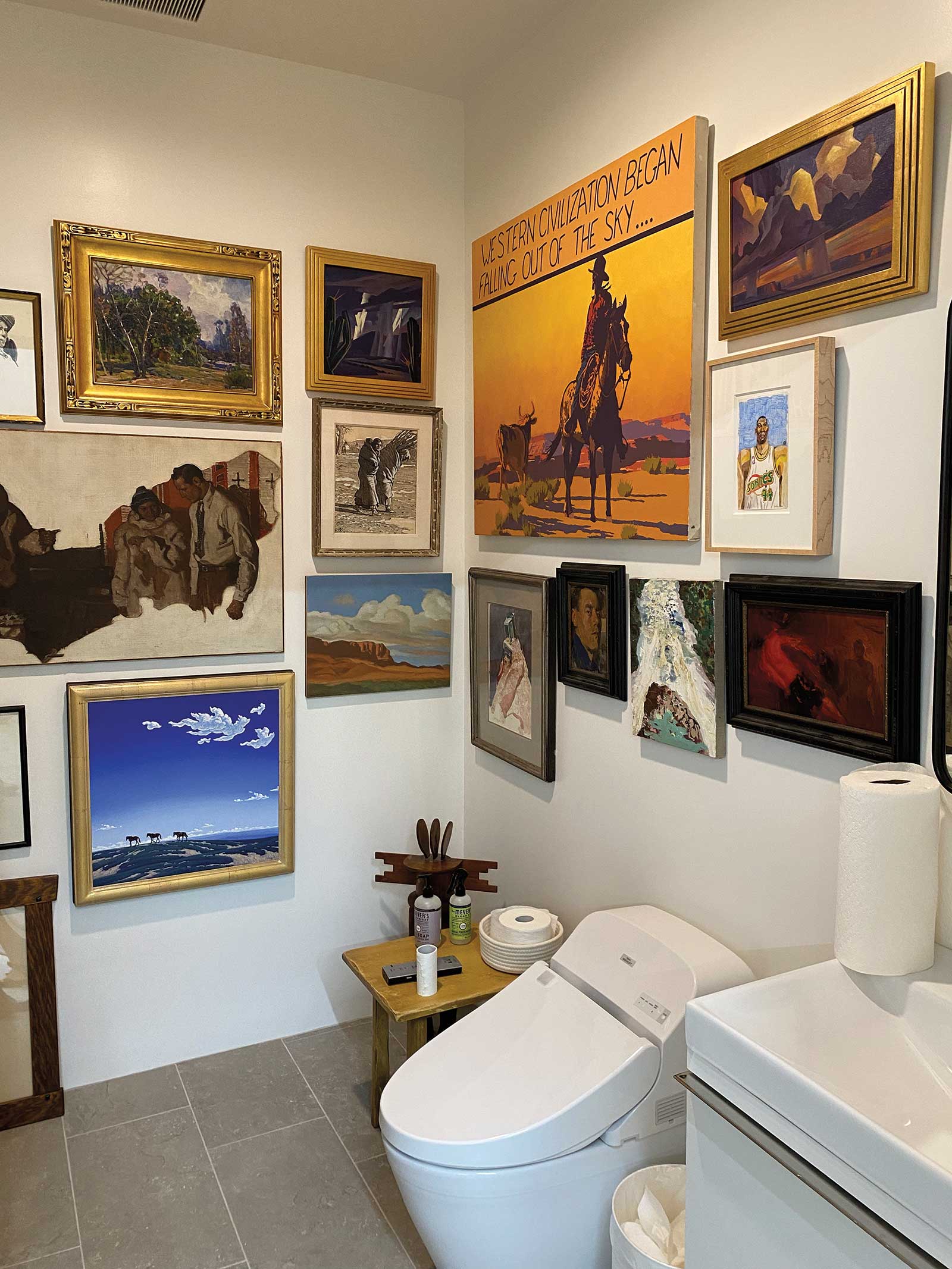
Works by Daniel Content, Billy Schenck, Ed Mell, Phil Epp and others fill a bathroom.
“I was just thrilled to be asked,” Hagege says. “I had visions of working with Stetson for some time, so I was excited when they reached out. They are such an iconic brand, one of those great heritage brands in the country. It’s so neat to think of all the history, all the artists and all the work that has gone into what they do. I’m happy to be part of it.”
His version of The Last Drop changes the composition significantly, putting the cowboy figure in front of the horse, and framing them both within Hagege’s own iconography: abstractly sculpted sagebrush, a large billowing cloud that erupts from the horizon and his delicate but still resilient hollyhocks that fill the foreground.
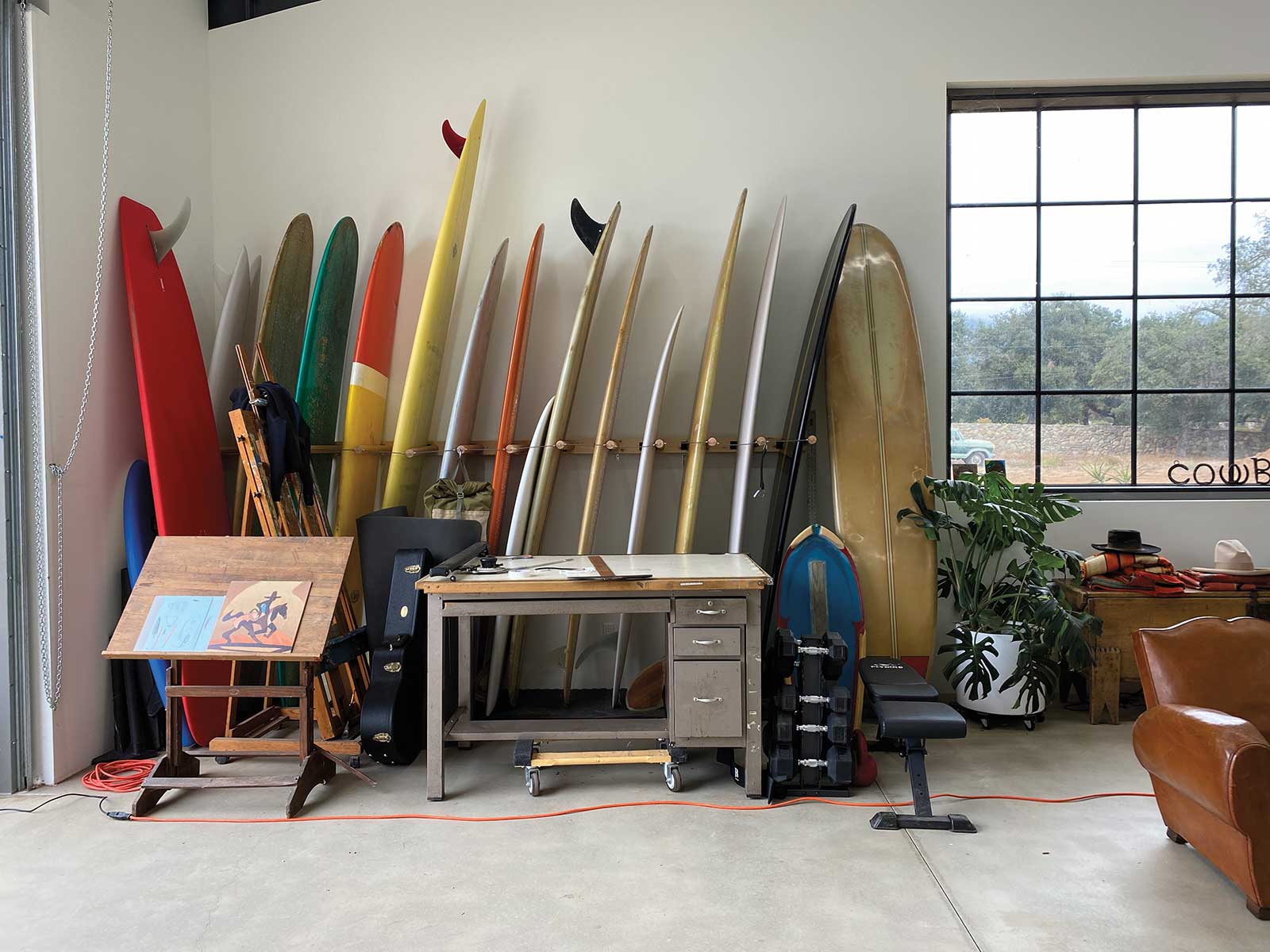
Surfboards in a rack not far from the easel.
“I came to this painting the way I come to a lot of paintings. I go to my sketchbook first and come up with concepts there. I loved the soft and gentle look of the hollyhocks, how they felt next to the rugged cowboy,” he says, adding that his version of the painting is now in the corporate offices at Stetson. Hagege also mentions the Pendleton blanket features a Tom Mix hat, a popular variety of Stetson.
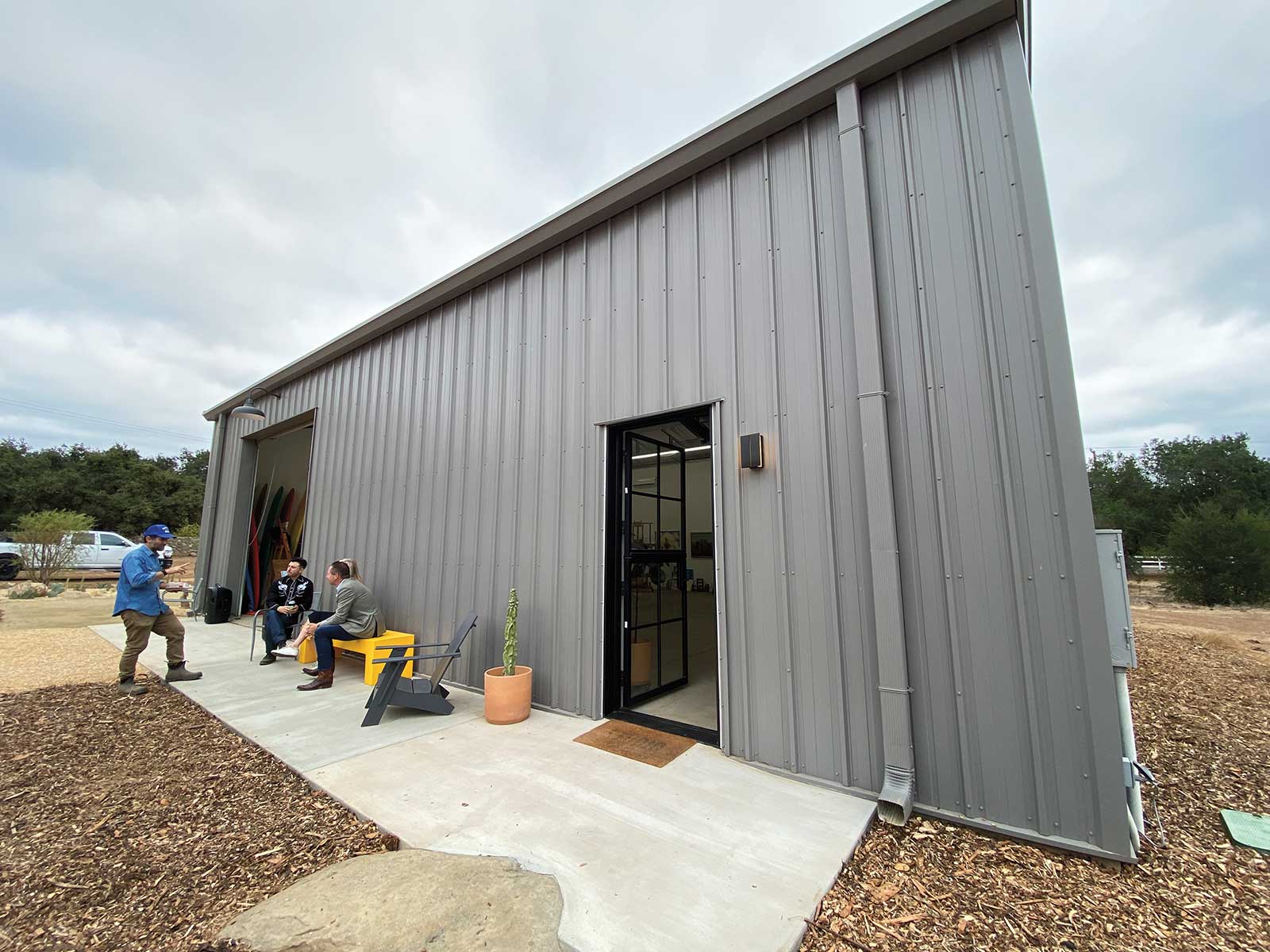
Exterior of Hagege studio in California.
Although The Last Drop has been shipped to Stetson, and one of the completed Pendleton blankets hangs over his desk, work continues uninterrupted in the Hagege studio. A new work goes up on the easel and finished works are moved to shelves so they can be pondered over while waiting for framing. “There is a kind of romance that exists in artist studios,” Hagege says. “It’s the inner sanctum of that artist’s world. I can say that because I get into an artist’s studio and that’s how I feel. It’s amazing.” —
Powered by Froala Editor