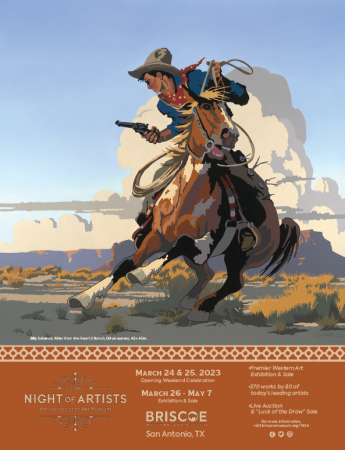
The Briscoe Western Art Museum hosts an annual Collectors Summit as part of its Night of Artists exhibition in San Antonio, Texas. In March 2019, the assembled panelists, including artists, dealers and museum directors, started talking about auctions and the inherent risks artists face when their work hits the open market—high sales could boost demand, but low auction prices can stall a career or slice into new sales. The panelists treaded carefully.
In the back of the audience, leaning against a column was painter Mark Maggiori. His arms were folded, and he had one foot pressed flat against the concrete column with his knee bent out in front of him and his cowboy hat pulled down over his eyes—James Dean meets the Marlboro Man. As talk switched to the risks of auctions, the artist pushed his hat up and raised his voice. He spoke in his heavily accented English: “I like the Western art auction because it is dangerous.”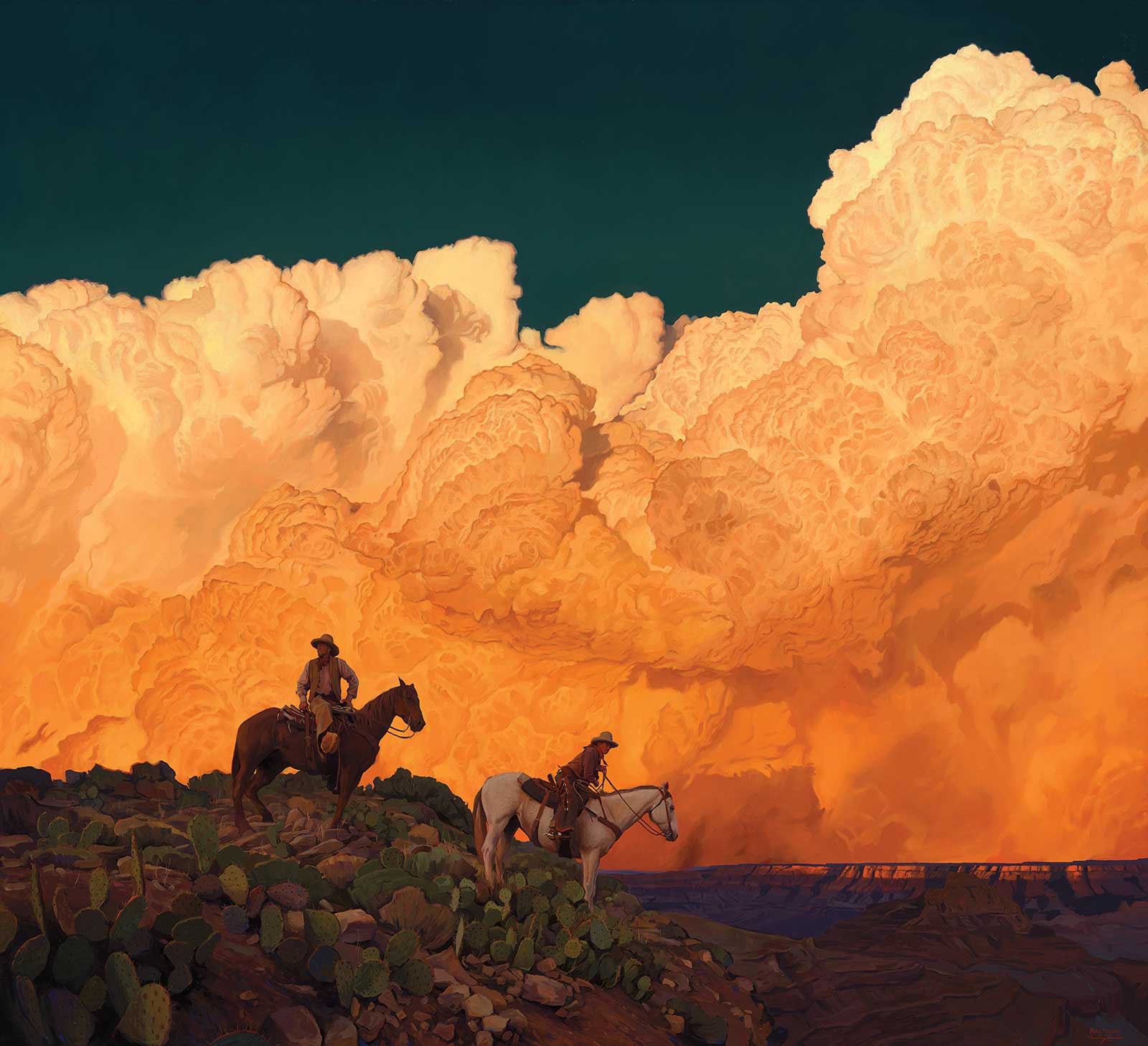 Sonoran Magnetism, oil, 48 x 53”
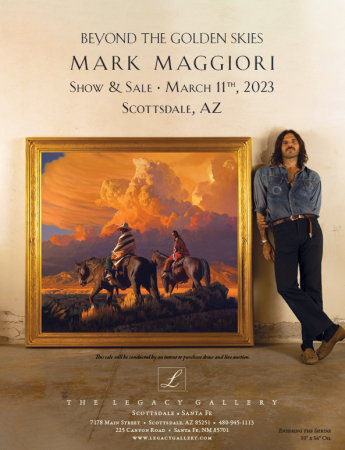
Michael Duchemin, president of the Briscoe, remembers the scene vividly and still chuckles when retelling it. It was like Maggiori had pulled a pin out of a hand grenade and rolled it onto the floor in front of him. The concussive blast rocked the room, but the painter stood there, unfazed. “It was so contrary to what was being said by the panelists. Artists can be very conservative with their work, but then there was Mark wanting to take these huge risks,” Duchemin says. “It fits nicely with his unorthodox style.”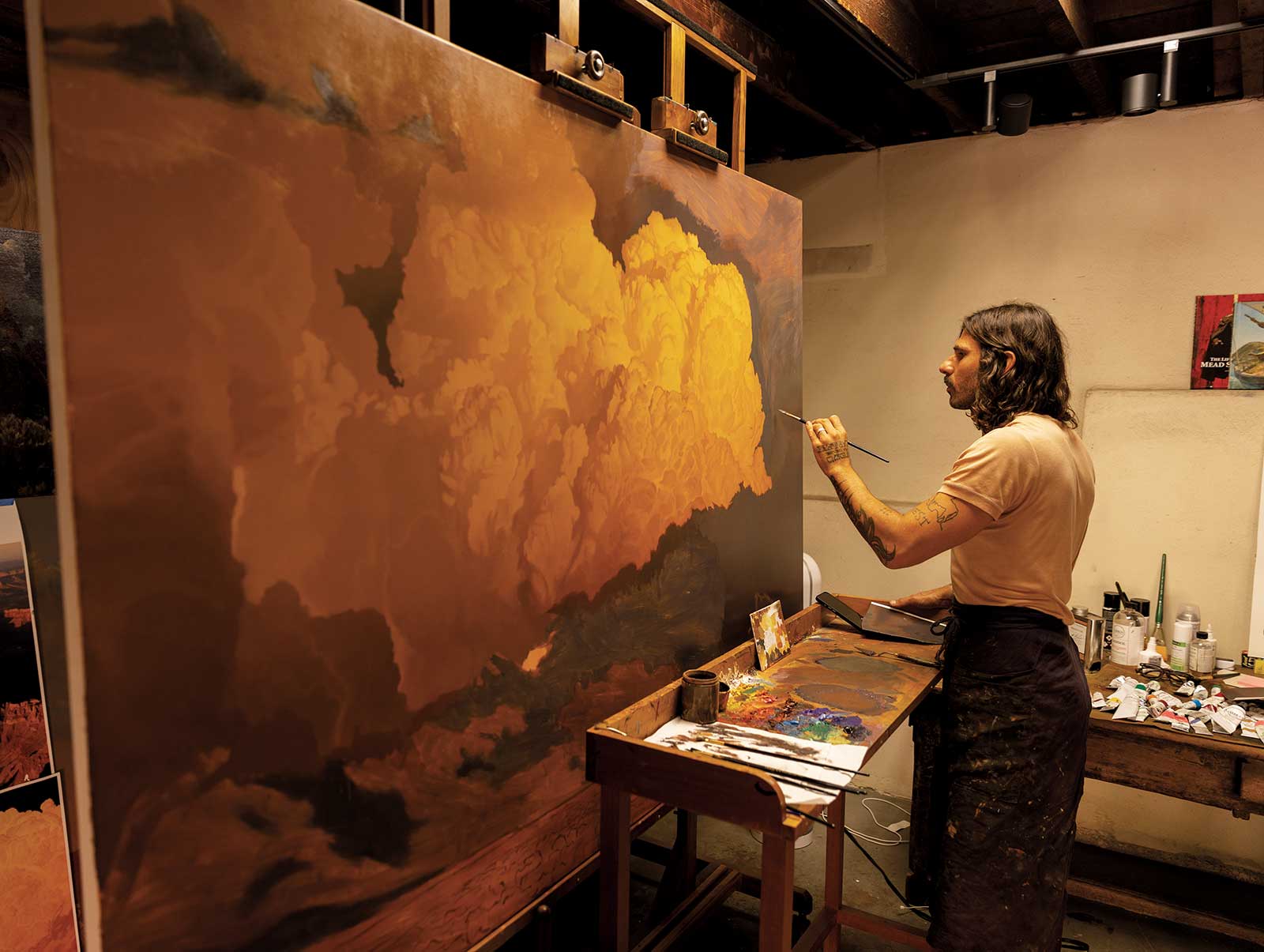 Mark Maggiori in his studio working on Tuah-Tah.Was the Western art world ready for Maggiori then? Is it ready for him now? It doesn’t matter either way because he’s here and he’s blazing his own trails, wherever they may take him. His next stop is Legacy Gallery on March 11 in Scottsdale, Arizona, where he will open his newest and largest solo show, Beyond the Golden Skies. The show will have a collection of 20-plus paintings that have taken nearly two years to assemble. Works include a number of stunning cowboy scenes with his famous “Mark Maggiori clouds” bursting over horse and rider. The new paintings reveal the artist’s continued fascination with high angles looking down, revealing riders on the edges of vast canyons awash with shadows, or low angles looking up, showing the rider seemingly larger than life yet still dwarfed by the epic size of the sky.
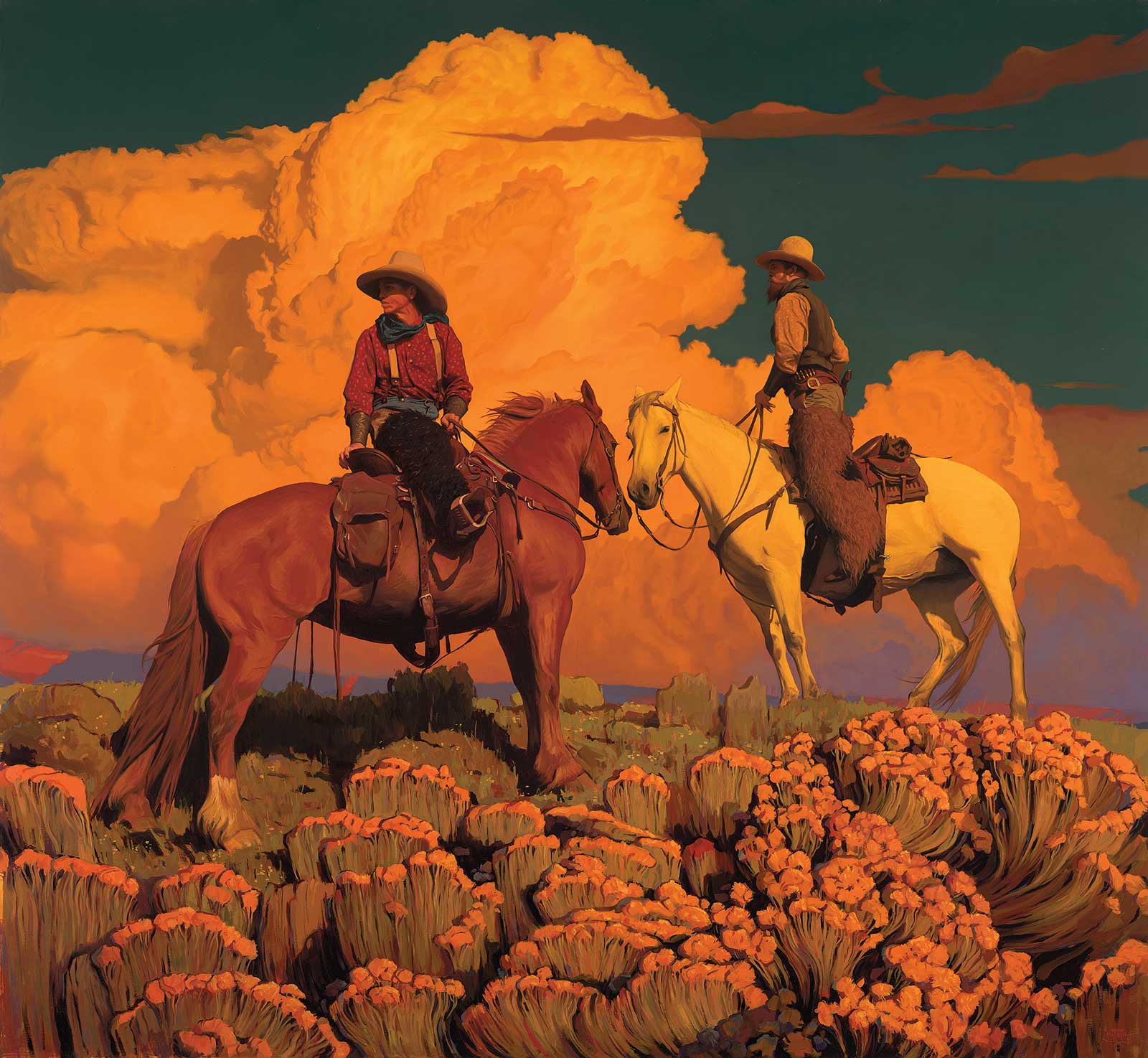 Emerald Sky, oil, 50 x 54”In Emerald Sky, it would seem like he amplifies the color to an unrealistic level, but there is truth in its intensity. “The color in Taos, [New Mexico,] is just incredible,” he says. “You see it in Arizona and Utah, and then also New Mexico. If you’ve lived in the desert, you’ve seen this exact light before.” In Sonoran Magnetism, he paints another light effect: the way the sun sets on the surface of the earth, but still shines on the 40,000-foot clouds lingering over the desert floor. It creates an eerie glow in the sky that is both beautiful, but also terrifying in its immensity and presence.
For the painting Tuah-Tah, Maggiori hired a Native American model for a photoshoot that took place in Taos by the Rio Grande Gorge. He liked the idea of big clouds but with a very small figure, a scene he captured in the painting.
“I kept thinking about the name Taos, and what it meant, so I asked Lyle, my model, ‘What do you call this land?’ and he told me it’s called Tuah-Tah, which is the Tiwa word,” the artist says. “He then pointed all over, to the mountains, into town, toward the Taos Pueblo—it was all Tuah-Tah. It felt right calling the painting that, so I asked him if I could and he said yes.”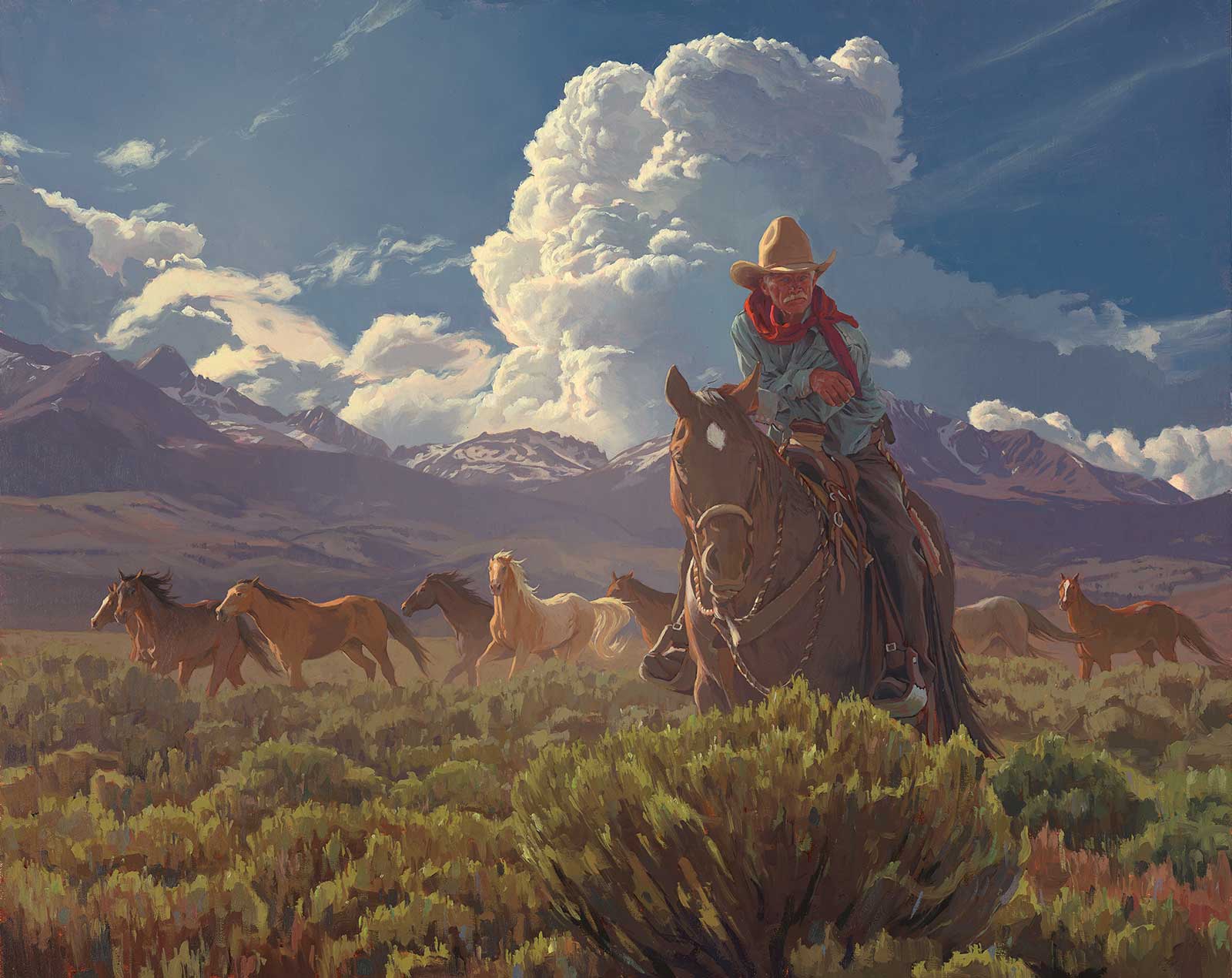 The Horse Whisperer, oil, 24 x 30”Several paintings are set in or near Taos, but others originated from different locations with very diverse landscapes. In the Middle Runs a River was painted in Canyonlands, Utah, while The Horse Whisperer came from the Diamond Cross Ranch in Wyoming. “Grant [Golliher] is the rider in the painting,” Maggiori says, “and he was a real horse whisperer and incredible human being.”
Like the mega-successful Legacy Gallery shows for John Coleman and Martin Grelle, Maggiori has been largely absent from the market as he prepped the work for the show, letting anticipation build. “[Legacy owner] Brad Richardson and I have been talking since day one. I was working with Maxwell Alexander Gallery in 2014, and then Trailside Galleries a little as well, and Brad and I were looking at each other from a distance. I told him maybe we could do something together in the future. Seeing his shows for his artists, especially John Coleman, I knew we would work together eventually,” Maggiori says. “One of the things we did was dry the market out a little to make sure collectors are hungry for my work. That was his strategy and I thought it was great. It’s been a trip for me because I work better with urgency. But here I had no deadlines except the final one.”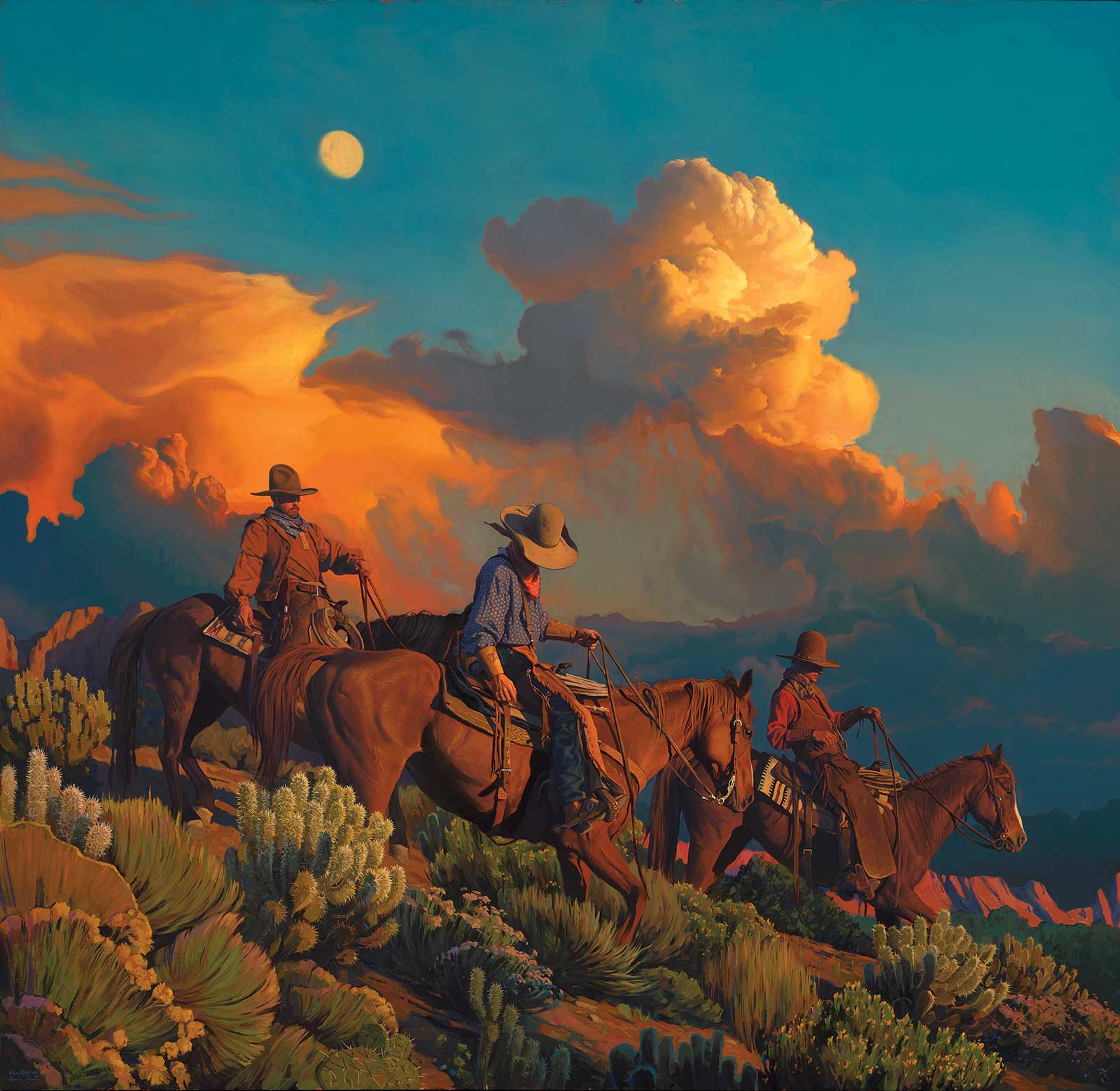 Superstition, Land of Thorn, oil, 58 x 60”
For most artists, taking two years away from selling art—or, you know, making money—could break them. For Maggiori, though, he was flush thanks to a thriving market for reproductions of his work. He could release a handful of prints every year and his fans, including 464,000 followers on Instagram, would scoop them up in huge numbers. Besides being an influential gateway into Western art for new collectors, the prints also allowed him to horde some of the new paintings and let them quietly marinate in the build-up to the Legacy show. By the time the show opens, his fans are going to be frantic for new paintings. Richardson, who can fit hundreds of people in his upstairs gallery, is trying to plan ahead with the space, food and drinks, and making sure the collectors who will be bidding can get inside. It’s been suggested jokingly that he needs to reinforce the hinges on his doors or rent the convention center, and he hasn’t said either are off the table. “It’s a unique place to be in, that’s for sure,” Richardson says. “We’ve never had this problem to think about—too many people at a show. That’s a first. But it shows how popular Mark’s work is. We’ve had a piece on display here in the gallery and we could have sold it 20 times over.”For anyone wondering how Western art arrived here—to a point where a French painter could come into a genre of art he had no experience with and amass half a million supporters, lower the median age of Western collectors by two decades and sell millions worth of prints, all in less than 10 years—it’s easy to forget that Maggiori found success almost instantly when he arrived on the scene around 2014. And he also had a fascinating story.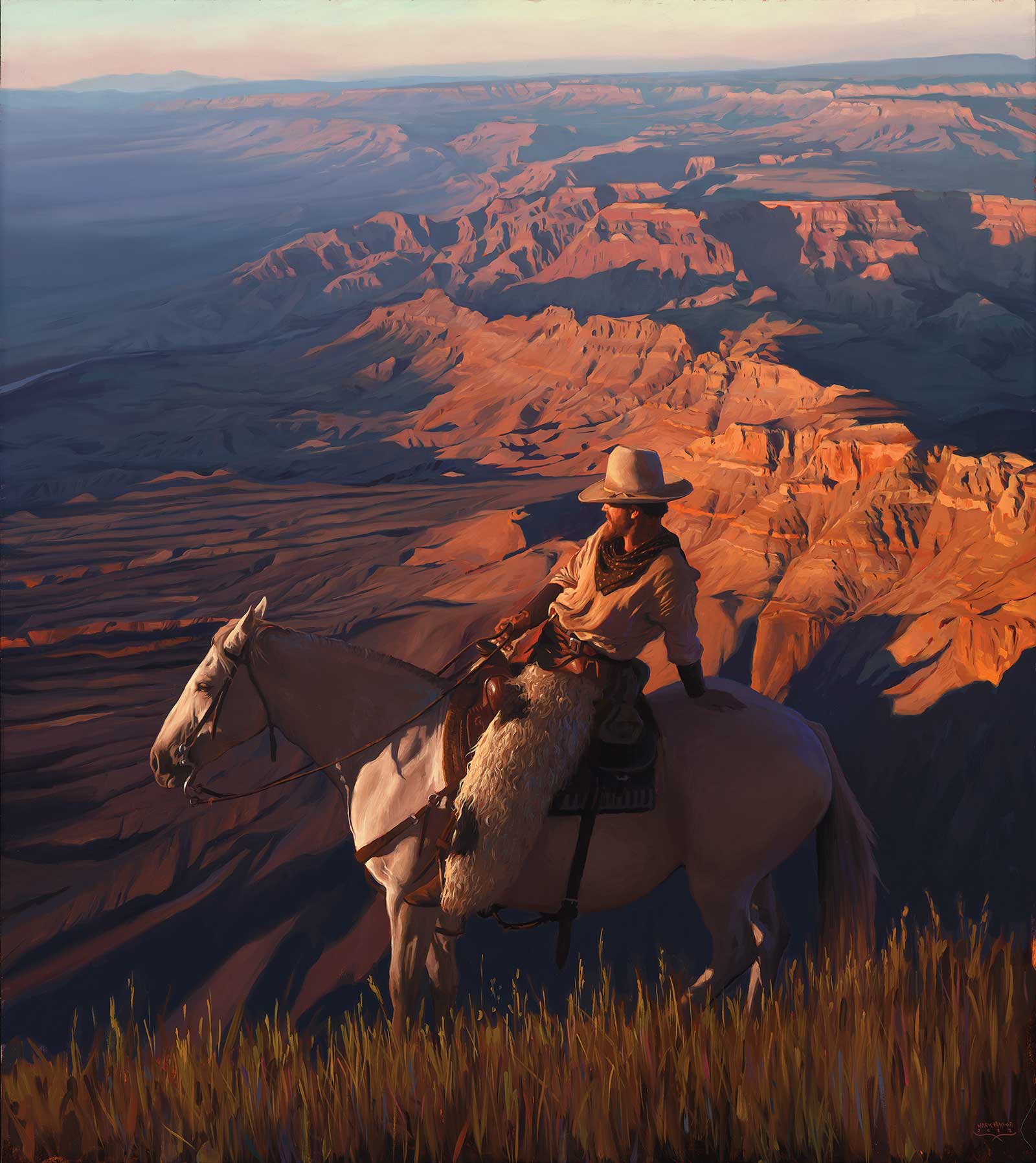 In the Middle Runs a River, oil, 36 x 32”
Born in France to a pair of teachers—a French mother and an Italian father—15-year-old Maggiori experienced America for the first time in a road trip from coast to coast. When the car passed through the Southwest, the teen was thunderstruck by the light, the heat and the intensity of the desert. It was transformative. But back in France, other things were calling, including careers in filmmaking, photography and music. His largest success was the metal band Pleymo, which had a solid run in the early 2000s and a hit reunion in 2017. By 2007, America was calling and Maggiori, then just a semi-retired singer, was living in Arizona and experiencing his own version of the West.
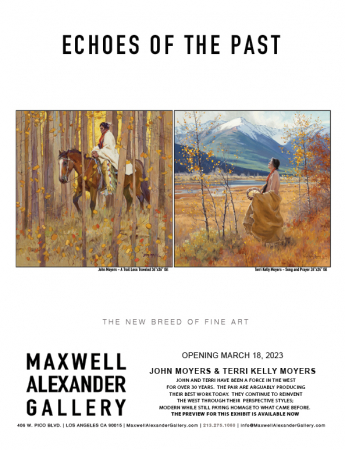
Later, while he was living in Los Angeles, he would meet Logan Maxwell Hagege and the other artists at Maxwell Alexander Gallery, which showed some of his first paintings and hosted his debut solo show. With a small foothold in the market, Maggiori started to chug away at his work and develop his style. There was also that famous mystique that would serve him so well: the vintage jeans and Western shirts with pearl snaps, the long hair and French accent, the rock star energy that swirled around him, his focused intensity within this new world he entered. All of it added up to something very new and very exciting. He was also an outsider who brought in fresh perspectives on Western iconography.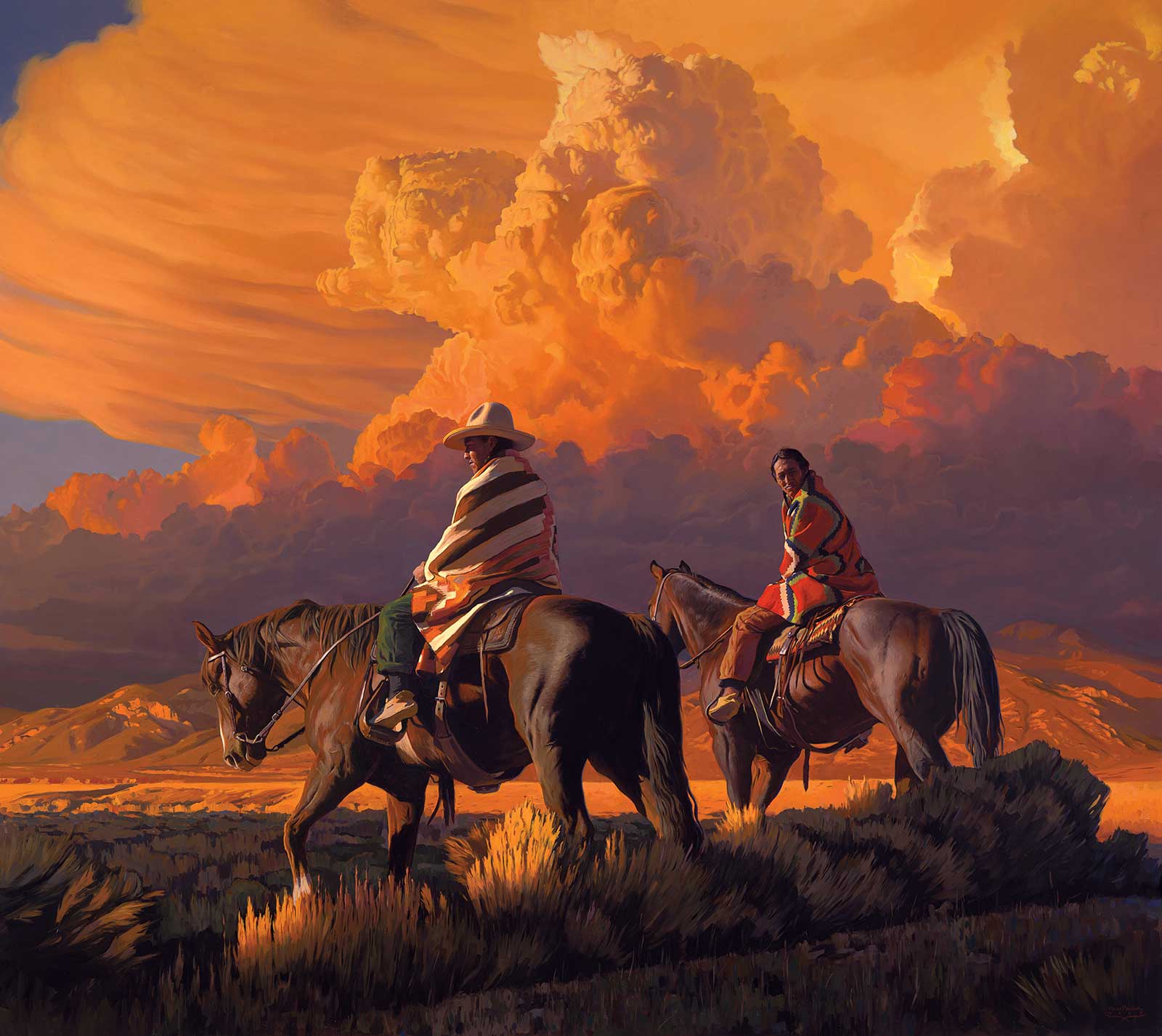 Entering the Shrine, oil, 50 x 56”These days, the 45-year-old artist is a family man with his wife, Petecia, and their young daughter, Wilderness. They lived for a spell in Taos, New Mexico, where his formal studio is still located, but are currently living in Los Angeles to be close to schools for their daughter. (He has two older daughters from a previous marriage who live in France.) His work has also remained consistent: incredible vistas, vibrant color, cowboy riders perched on dangerous cliffs and huge clouds erupting from his horizons. Those desert scenes that captivated his 15-year-old self are still pulling him into the West today.
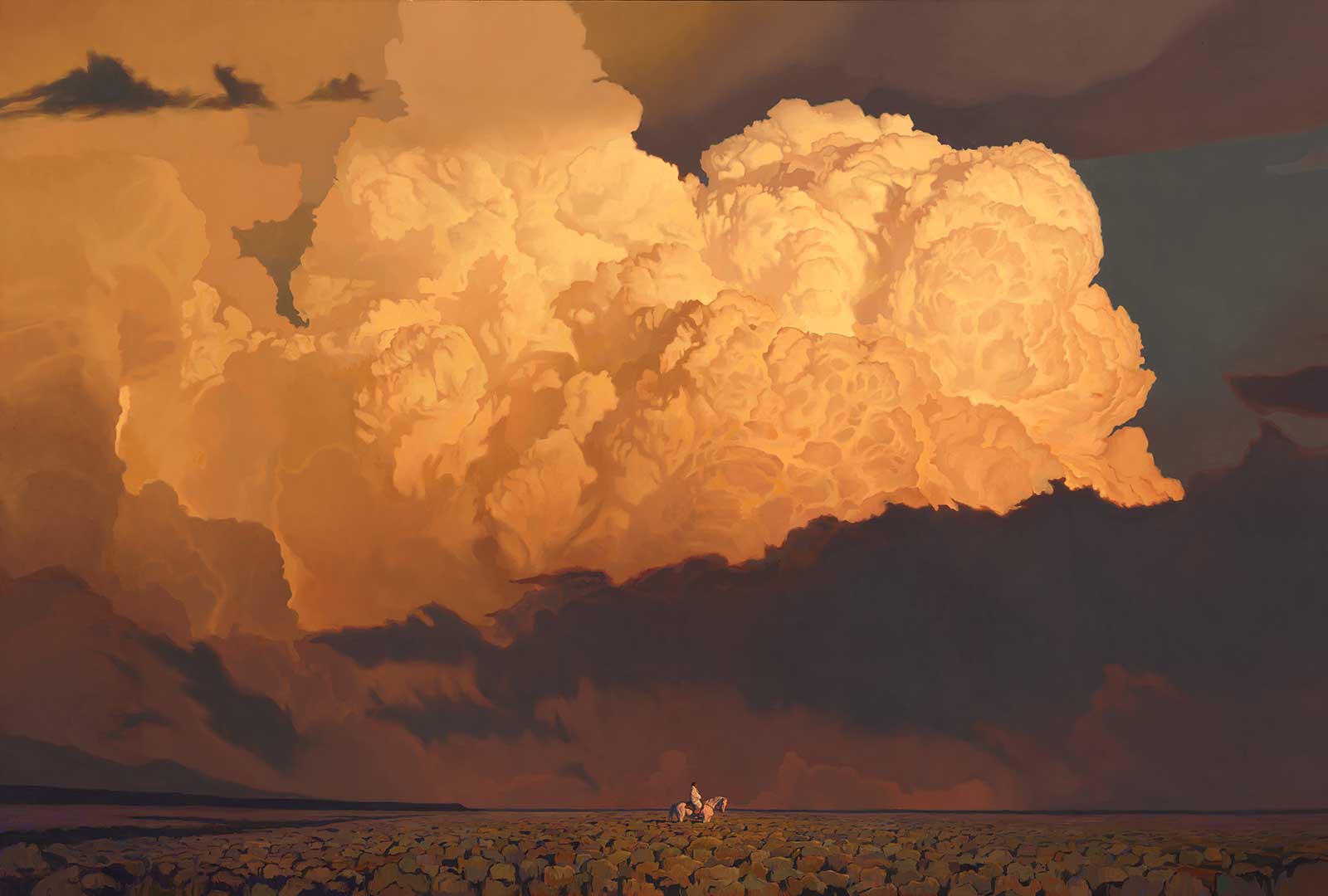 Tuah-Tah, oil, 54 x 80”Although he is at the pinnacle of the Western art world—not so much in price since he’s raised prices carefully, but certainly the pinnacle of fame and recognition—Maggiori doesn’t really analyze the market too much, nor does he ponder how his work has changed the genre. “It’s hard to say. I don’t think I’m changing Western art because I think Western art is changing on its own, and there’s no way you can stop it. I have spent so much time here in the West. I talk to people. I observe. I see what is happening, and it’s an art form that is evolving,” he says. “And I paint in a classical way. I don’t think I’m breaking the mold. I use the tools I have to create images of what I see. The West is a movement forward, and I’m just riding on it.”
His success has also become a lightning rod of criticism, jealousy and odd forms of cowboy gatekeeping. “He’s not even from the West,” was a comment seen online recently—as if not being from the West stopped Frederic Remington, Thomas Moran or, a fellow Frenchman, Henry Farny. Maggiori just shrugs it all off, possibly a skill learned back in his music days. There’s not enough time in the day to dwell on gossip or online criticism when he has to move forward. “I’ve heard there can be some negativity, but I tune it out. It’s hard because I just want to be me, to keep painting,” he says.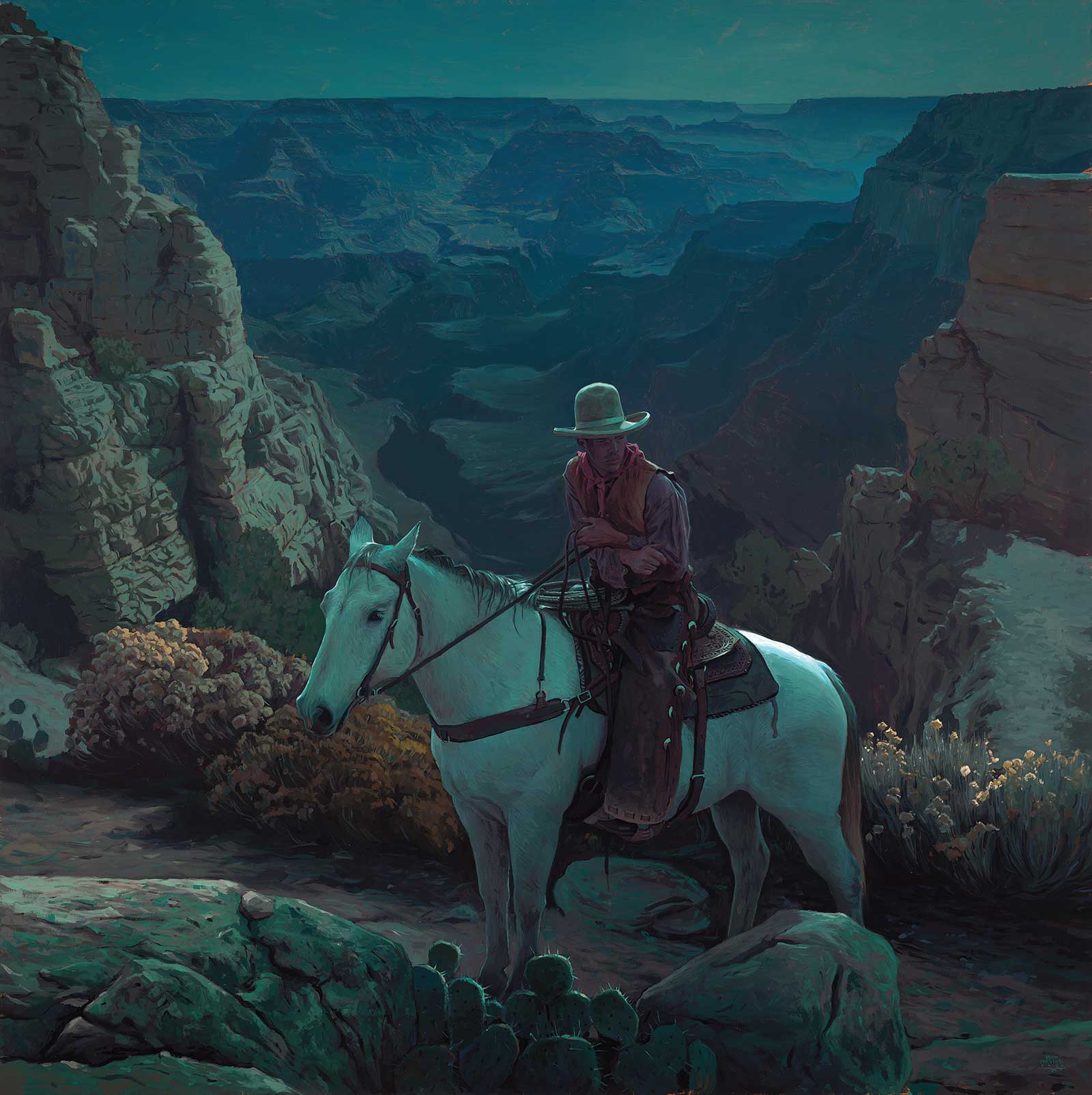 Silence of the Canyon Walls, oil, 40 x 40”He downplays how important his rise through Western art has been, but make no mistake, Maggiori has shattered through some fascinating milestones, including the Holy Grail of the West—how to get young people interested in Western art. This is the million-dollar question among dealers, auction specialists, museum curators and industry leaders, and an answer has been elusive. There has been a perennial fear that older collectors will die off, as would interest in Western art. And yet here’s an artist who is contradicting that assessment, with numbers to prove it. He’s shown that Western art can not only survive, but thrive. And not just as the primetime “Mark Maggiori Show,” but as a diverse market of contemporary and traditional artists, collectors and enthusiasts who were brought into the genre because they love the West and what it represents.
His success is what makes a show like Beyond the Golden Skies at Legacy Gallery so exciting. It’s a high point for the artist, but it also has the opportunity to be a pivotal moment for all of Western art. Maggiori is standing on a corner with a megaphone and more than half a million people are listening. It has the stakes of a make-or-break shot. It’s intense. It’s thrilling.
And for Maggiori, it’s a little dangerous. But that’s the way he likes it. —
Mark Maggiori: Beyond the Golden Skies
March 11, 2023
• Presentation from the artist, 10 a.m.
• Show opens, 5 p.m.
• All works will be sold via by-draw sale, starting at 6 p.m., followed by a live auction
Legacy Gallery, 7178 E. Main Street, Scottsdale, AZ 85251
(480) 945-1113, www.legacygallery.com
Powered by Froala Editor