In Tony Hillerman’s slim compendium The Spell of New Mexico, D. H. Lawrence lamented how modern transportation distances us from nature, observing that “our great-grandfathers, who never went anywhere, in actuality had more experience of the world than we have, who have seen everything.”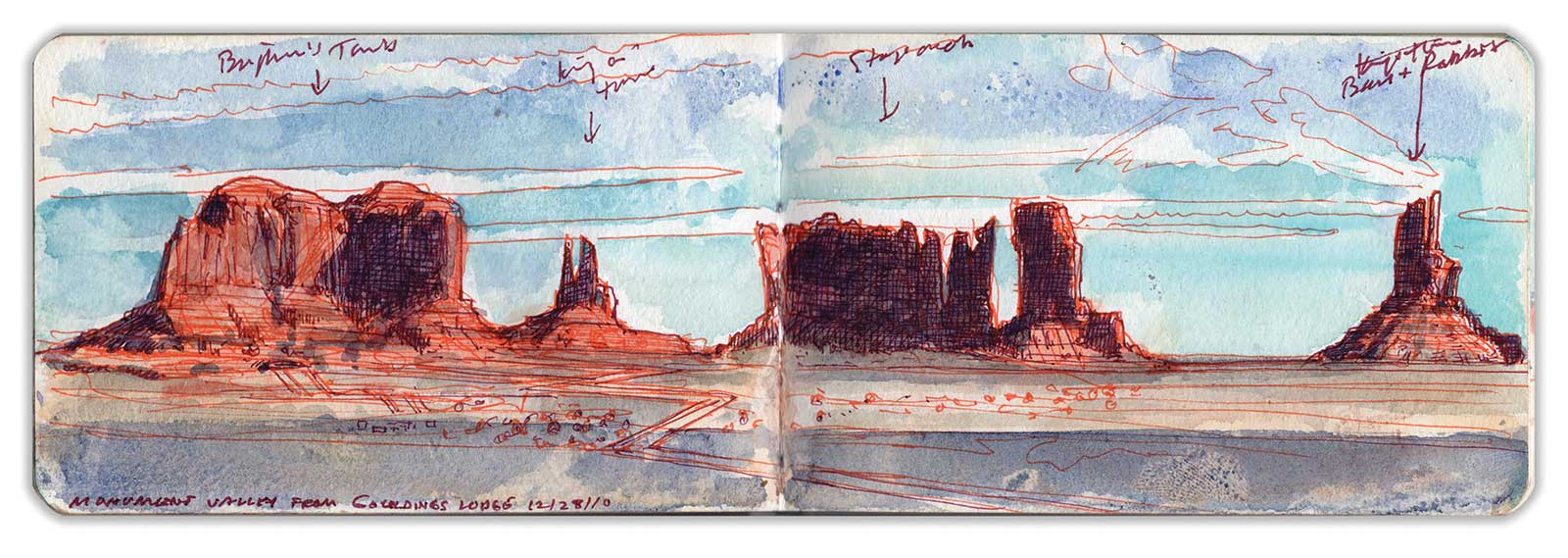 Four Buttes from Goulding’s Lodge, Tsé Bii’ Ndzisgaii (Monument Valley, Navajo Nation), 2010, watercolor and mixed media on paper (sketchbook), 4½ x 13½”
Between 1922 and 1925, Lawrence and his wife paid several visits to New Mexico. In 1924, their friend and patron made them a gift of a small ranch 20 miles north of Taos. Passing away during a sojourn in Venice in 1930, Lawrence, or what was left of him, was exhumed and shipped to Marseille for cremation. The plan was for his widow’s boyfriend to deliver the ashes to the New Mexico ranch, where Frieda von Richtofen Lawrence (1879-1956) was preparing to build a memorial to her late husband. Dodging customs and red tape, the courier later confessed to dumping the remains into the Mediterranean before crossing the Atlantic. Frieda went to her grave never suspecting that the ashes enshrined at the ranch might have belonged to somebody she never met. Another story claims that Frieda did receive Lawrence’s ashes, but she mixed them into the wet concrete used to create his memorial.The property today is owned and operated by the University of New Mexico. During her first visit to Taos in 1929, Georgia O’Keeffe claims to have lain supine on Lawrence’s writing bench. Gazing heavenward from beneath the spreading branches of the large ponderosa pine inspired her to devote a canvas to The Lawrence Tree, completed the same year. Of the tree, Lawrence wrote, “One goes out of the door and the tree-trunk is there, like a guardian angel.”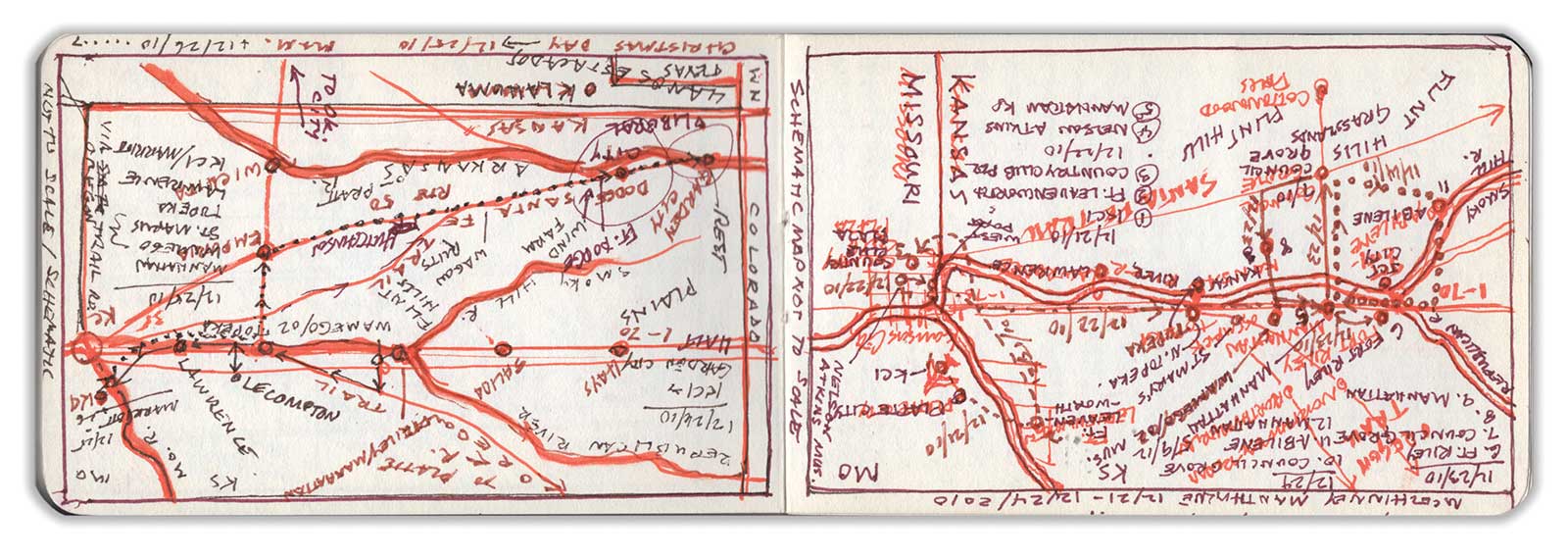 Map of Road Trip from Kansas City to Monument Valley, December 25-29, 2010, watercolor and mixed media on paper (sketchbook), 4½ x 13½”
During our last visit to the ranch, Kathie Manthorne and I found the large wire-fence gate locked with a stout chain. Upon close inspection, I discovered it was a ruse. The padlock dangled from one link. The remainder of the chain had been deceptively wrapped around the gate’s pipe frame. As we swung open the gates, the caretaker rolled up in a pickup truck. We followed him up to the house.
After trudging up the path to visit Lorenzo’s monument, we headed back to the garden. Taking turns lying on the bench, we gazed up through the branches of the great tree, as O’Keeffe and many others had done. Performing this ritual felt like kissing the Blarney Stone or rubbing the nose of the Bowling Green Bull, except that we were partaking in an experience that had sparked creativity in others.
Driving downhill through a pine forest, we reached the valley below. Spreading out to the north, south, and west, punctuated by ancient cinder cones and volcanic uplifts like Ute Mountain, the broad plain was broken by the distant serpentine gash of the Rio Grande Gorge. Somehow, in the unknowable vastness of the American Southwest, ordinary rocks and trees seem to gather around them, unbidden powers that offer protection one minute and peril the next. Its ungovernable spaces inspire awe, invite meditation and summon visions.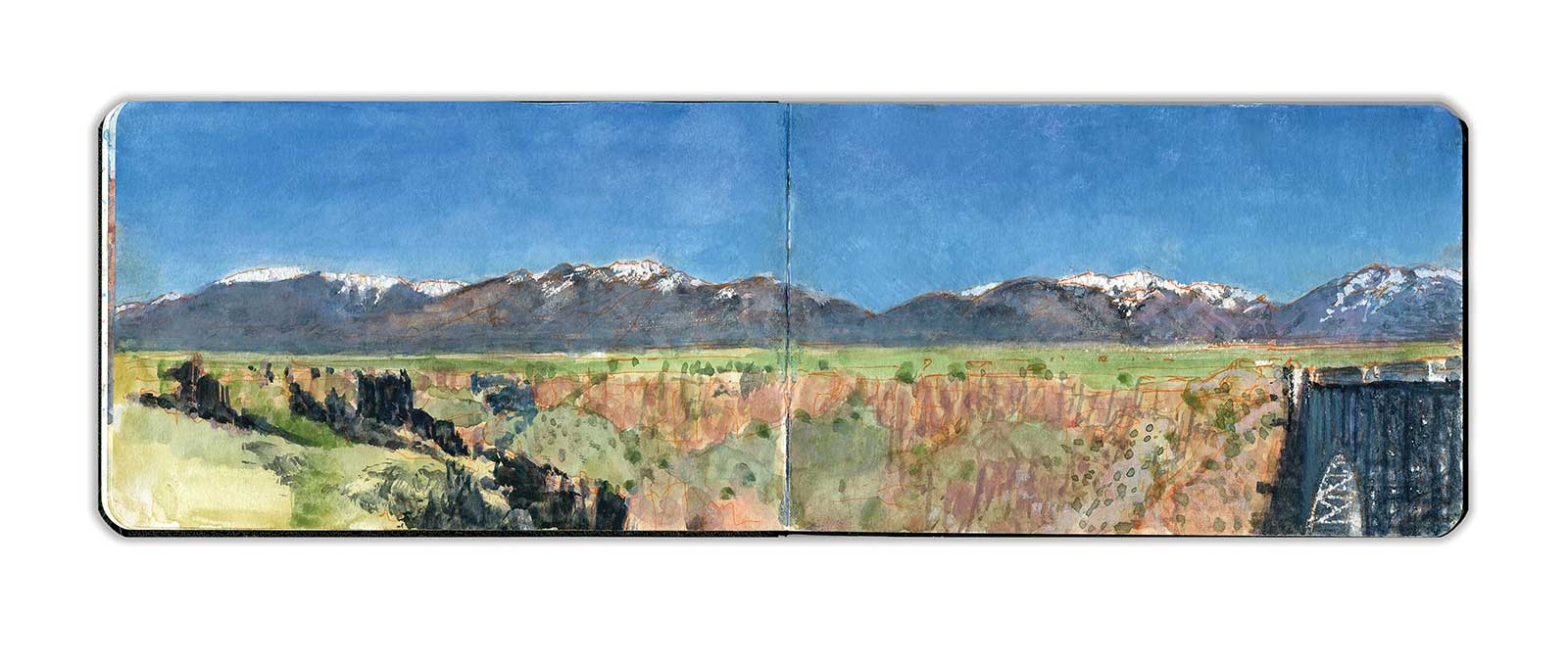 Rio Grande Forge Bridge, watercolor and mixed media on paper (sketchbook), 4½ x 13½”
Many years ago, hiking along the edge of Tsankawi Mesa, it occurred to me that were I to lose my footing and plunge to my death, it might take days or even weeks to find the body, unless Raven and Coyote had already made a feast of my corpse and scattered its bones. In a landscape bereft of physical sustenance, only spirits can dwell. Gazing east from the rim across Buckman Mesa I beheld the warm earth, submerged in cool shadows. Above the deepening gloom, Sangre de Cristo mountains arose, awash in the ruddy glow of sunset. Alighting on a bushy pinyon beside me, a talkative crow kept me company at nightfall, as a swarm of stars filled the heavens. How unlike being alone in the wild, on the edge of a precipice, is solitude of each point of light, adrift in an infinite universe? Hovering below the mountains, off to the southwest, the electric glow of Santa Fe shattered my reverie. Heading back to the parking area, I backtracked through rocks and scrub across the mesa. Flying from one treetop to another, my corvid companion shadowed my footsteps back to the car.
My first visit to New Mexico was in the late 1970s, in the company of a dear friend whom I would later marry. Our union did not last, but my love affair with the Southwest has endured. Having grown up in the Delaware Valley in southeastern Pennsylvania, I was keenly aware of a tradition of artists’ colonies in Bucks County and the Brandywine Valley. Members of the Wyeth family of Chadds Ford established beachheads in both Maine and New Mexico. Pennsylvania native John Sloan made several trips to the Southwest, as did Marsden Hartley, John Marin, Stuart Davis, Edward Hopper, Josephine Nivison Hopper, Dorothy Brett, Georgia O’Keeffe, and Agnes Martin. Philadelphia painters such as Tom Palmore and abstract illusionist James Havard relocated to New Mexico, as did other prominent artists including Larry Bell, Ron Davis, Richard Diebenkorn, Bruce Nauman and Susan Rothenberg. The story goes that more than a century ago, a group of artists moved to Taos, enchanted by the crystal-clear light and gob-smacking scenery. Nicolai Fechin, Ernest Blumenschein, Joseph Henry Sharp, Walter Ufer, Gustave Baumann, Bert Geer Phillips and Victor Higgins established studios in what had been a sleepy town on the edge of the mountains.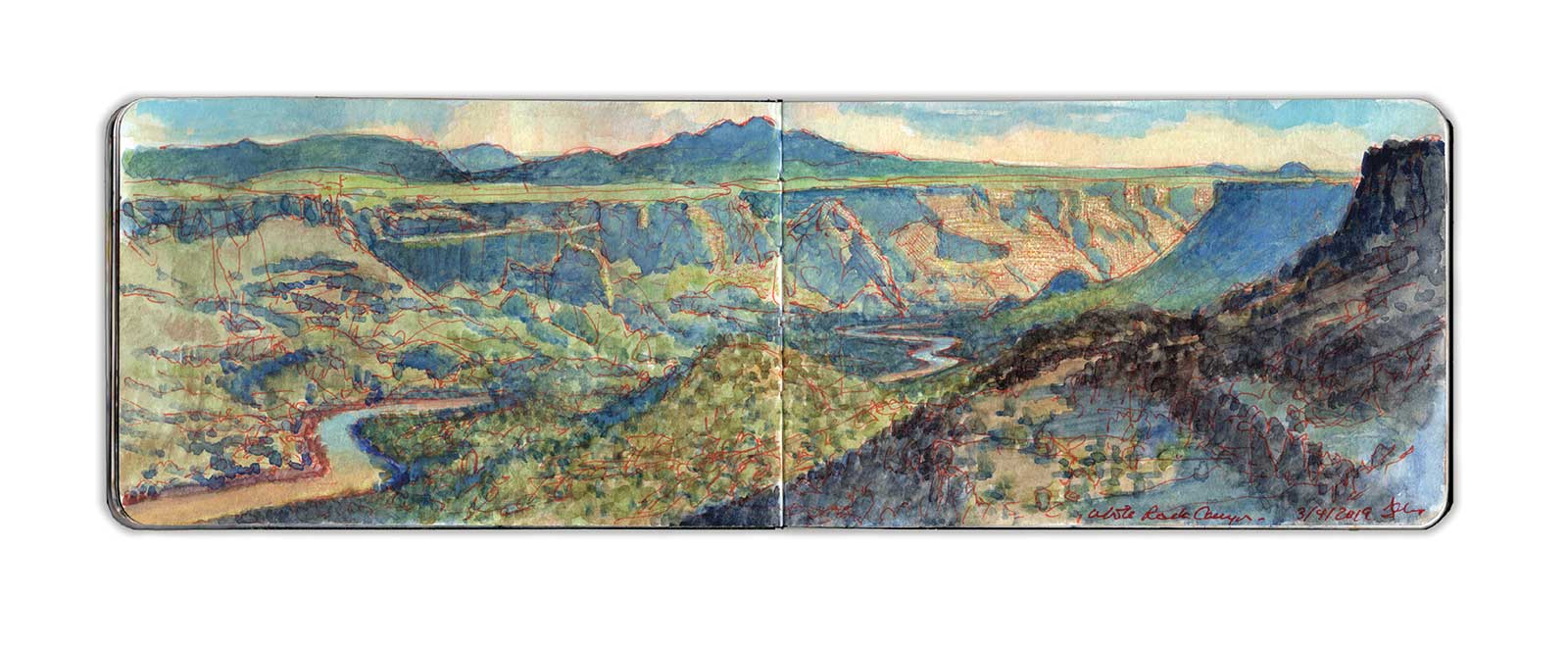 White Rock Canyon, Late Night, 2019, watercolor and mixed media on paper (sketchbook), 4½ x 13½”
Cultural tourism in the area had been successfully promoted by Fred Harvey (1835-1901), who established a chain of restaurants, hotels and souvenir shops along the Atchison, Topeka, and Santa Fe Railroad. The Harvey Company staffed its facilities with Harvey Girls, reputable educated white women between the ages of 18 and 30. It also escorted passengers on “Indian Detours” to visit pueblos and trading posts where they could purchase Native American weavings, pottery and jewelry. This planted the seed for Santa Fe becoming one of the four leading art markets in the United States, a position it still holds today. It proved also to be the genesis of the annual markets that specialize in traditional and contemporary arts and crafts by Native American and New Mexico Spanish makers. One of the attractive features of the Southwestern art scene is a causal indifference toward Eurocentric distinctions between fine art, folk art and crafts, which seems to reflect the ethnic diversity that characterizes much of the region.
In a nutshell, New Mexican society is divided into three primary groups. Indigenous communities include the more ancient Tewa, Tiwa and Keresan Puebloans, and the Athabaskan Diné (Navajo) and Apache, who migrated into the area a thousand years ago. The Navajo Nation, which straddles New Mexico, Utah and Arizona, is the largest Indigenous sovereign territory within the United States. Puebloan Hopi lands exist as an administrative island, surrounded by Navajo lands.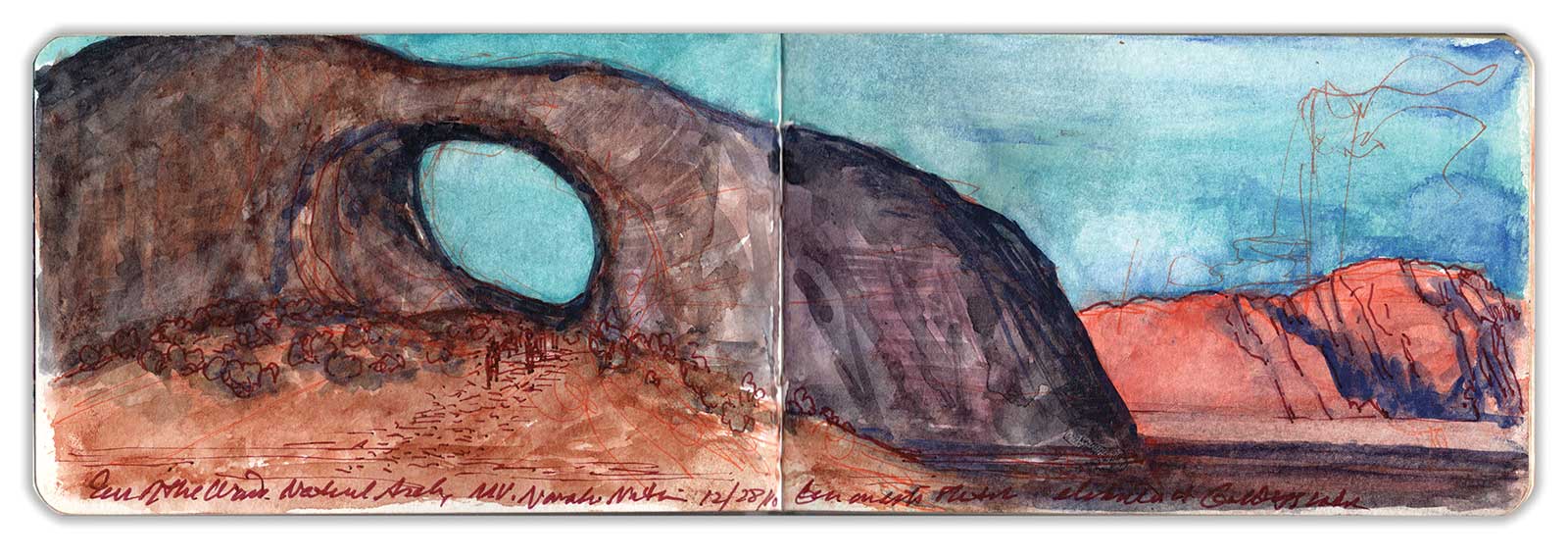 Ear of the Wind, Monument Valley, 2010, watercolor and mixed media on paper (sketchbook), 4½ x 13½”
Spanish settlers arrived in the late-16th century, only to be expelled by a Native revolt in 1680. Returning 12 years later, Spanish conquerors reached an uneasy accord with their hosts, settling colonists on royal land grants that extended north to the Arkansas River.
The opening of the Santa Fe trail, and the outcome of the Mexican-American War of 1846-48 triggered an influx of a non-Native, non-Spanish Anglo population. The term is applied universally to anyone who is neither Native nor Spanish, be they of European, African or Asian descent.
Part of this book is devoted to Tsé Bii’ Ndzisgaii (Valley of the Rocks), better known as Monument Valley, located in the northeast corner of the Diné reservation. This impressive array of red sandstone buttes has become synonymous with the American West, appearing in such films as The Harvey Girls (1941), Easy Rider (1969), National Lampoon’s Vacation (1983), Thelma & Louise (1991) and Forrest Gump (1994). None of these stunning geological formations were visited by 19th-century explorers, whose focus was on discovering mineral resources or viable railroad rights of way. John Ford valued it not only as a location for such classic Westerns as Stagecoach (1939) and The Searchers (1956) but also because it was far enough from Hollywood to discourage micromanaging studio executives from pestering the director with unwelcome visits. The fame of Monument Valley has proved to be a mixed blessing to the local Diné, whose revenue has come to depend on tourism by hosting strangers on sacred lands.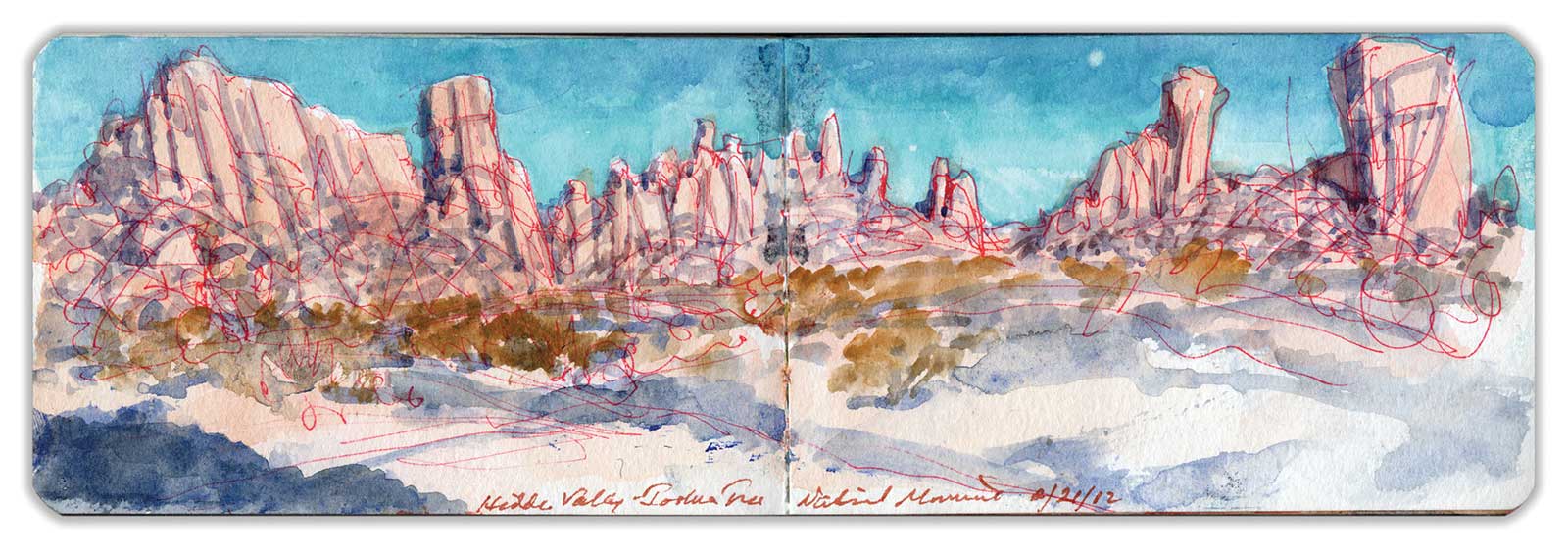 Hidden Valley, Joshua Tree National Park, 2012, watercolor and mixed media on paper (sketchbook), 4½ x 13½”
Three hours east of Los Angeles, photogenic Joshua Tree National Park and Coachella Valley in Southern California have also provided filming locations for It’s a Mad, Mad, Mad, Mad World (1963), Tell Them Willie Boy is Here (1969), The Big Year (2011) and countless television commercials. The arid desolation of the Southern Mojave Desert makes New Mexican deserts seem Edenic by comparison. Yet perched at Keys View, overlooking Coachella Valley toward Mount San Jacinto, or south along the ridge of the San Andreas Fault toward the Salton Sea, one is gripped by a sense of awe, a terrible and liberating feeling of profound insignificance. Clinging to the surface of a planet spinning at more than a thousand miles per hour, orbiting the sun at more than nine times the speed of sound, the clustered petals of Atriplex canescens tremble gently in a warm breeze. The land itself seems to possess a beating heart, a mind and a purpose. In his book The Man Made of Words: Essays, Stories, Passages, Pulitzer Prize-winning author N. Scott Momaday (1934-) observes:
“…We look at a given landscape and take possession of it in our blood and brain. For this happens, I am certain, in the ordinary motion of life. None of us lives apart from the land entirely; such an isolation is unimaginable.”
The American Southwest has become a magnet for those seeking spiritual renewal, or a place to pursue unconventional lifestyles. Perhaps the region’s ethnic and social diversity nurtures a higher degree of tolerance, despite abiding contrasts between these groups in terms of wealth and power. The region today faces an imminent crisis caused by a sharp uptick in population, exerting unsustainable pressure on limited sources of water for drinking and irrigation. History may be repeating itself. Seven hundred years ago, the depletion of resources forced the abandonment of urban and ceremonial centers at Chaco Canyon, triggering a diaspora that established new settlements along the Rio Grande and elsewhere.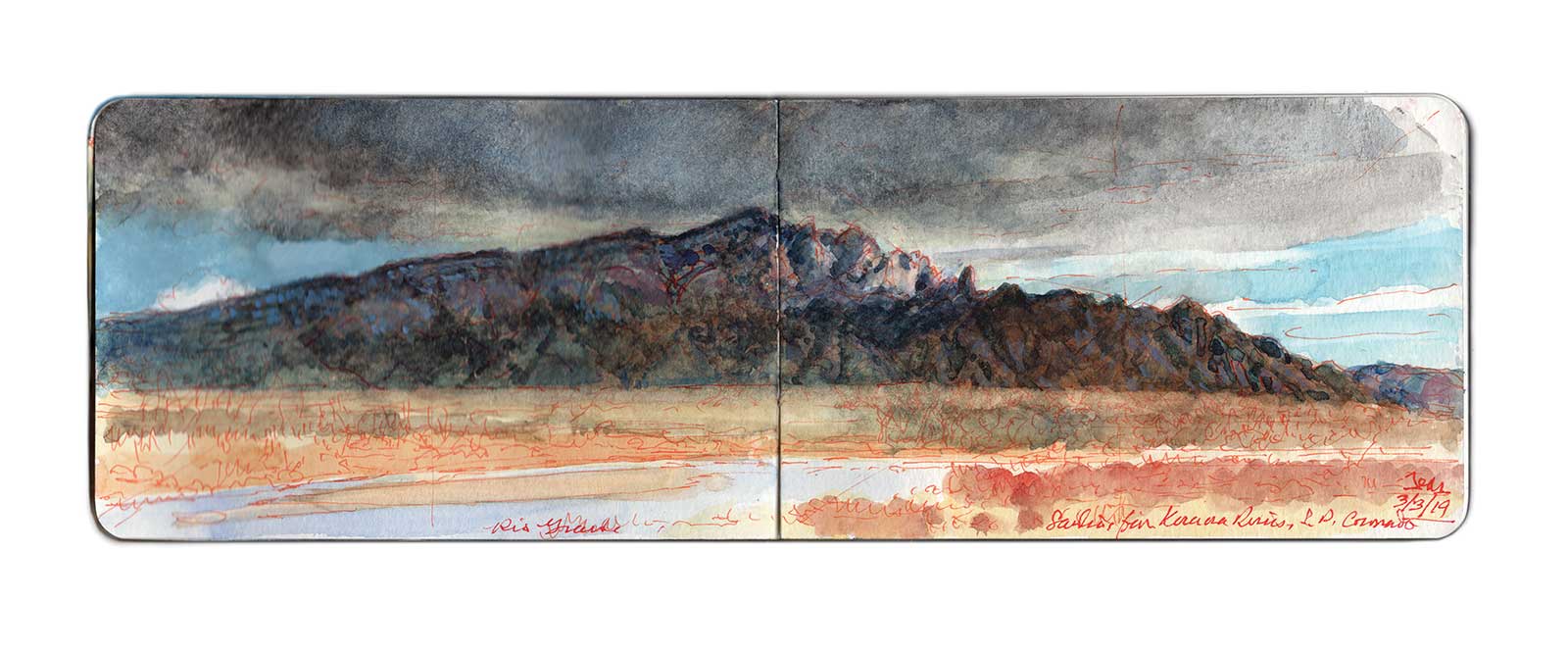 Sandia Mountains from Kuaua, 2019, watercolor and mixed media on paper (sketchbook), 4½ x 13½”
No better place can be found for the development of mindful practices than vast expanses of raw terrain. Absent of lush forests, untamed by pastoral cultivation, like the Biblical trope of wilderness, these are the places where one may battle dark forces, commune with the Divine, and discover oneself. Let’s return to Tony Hillerman (1925-2008), who recalled, “I have never yet made that long monotonous drive through the great vacancy between Albuquerque and Roswell without finding my head filling with ideas crying to be written.” Hillerman’s words apply also to drawing, which is nothing more than writing in visual terms.
For inspiration to find us, we must first take action—with the scratch of a pen or the stroke of a brush. —
+++
James Lancel McElhinney is a visual artist, author and essayist known for travel journals and other works exploring American rivers and Civil War landscapes. Exhibited widely, McElhinney earned a BFA from Tyler School of Art and MFA from Yale, and he is the recipient of grants from the Pollock-Krasner Foundation Grant and the National Endowment for the Arts. His art is represented in many public and private collections, including the Denver Art Museum and the Museum of the Southwest. McElhinney lives in Manhattan and the Champlain Valley with his wife, the scholar and author Dr. Katherine E. Manthorne. Learn more at www.mcelhinneyart.com.
Powered by Froala Editor