Near East to Far West: Fictions of French and American Colonialism is the first exhibition to consider the influence of French Orientalism on Western American art between 1830 and 1930. Initial comparisons between artworks from these two seemingly disparate genres articulate important similarities: Léon Belly’s Pilgrims Going to Mecca and Ernest Blumenschein’s Church at Ranchos de Taos both feature people indigenous to desert geographies bathed in the light of those arid environments. Eugène Fromentin’s The Bab-el-Gharbi Street in Laghouat and Henry Farny’s Mesa Village could feature the same white-draped figures and adobe architecture until close inspection reveals important differences.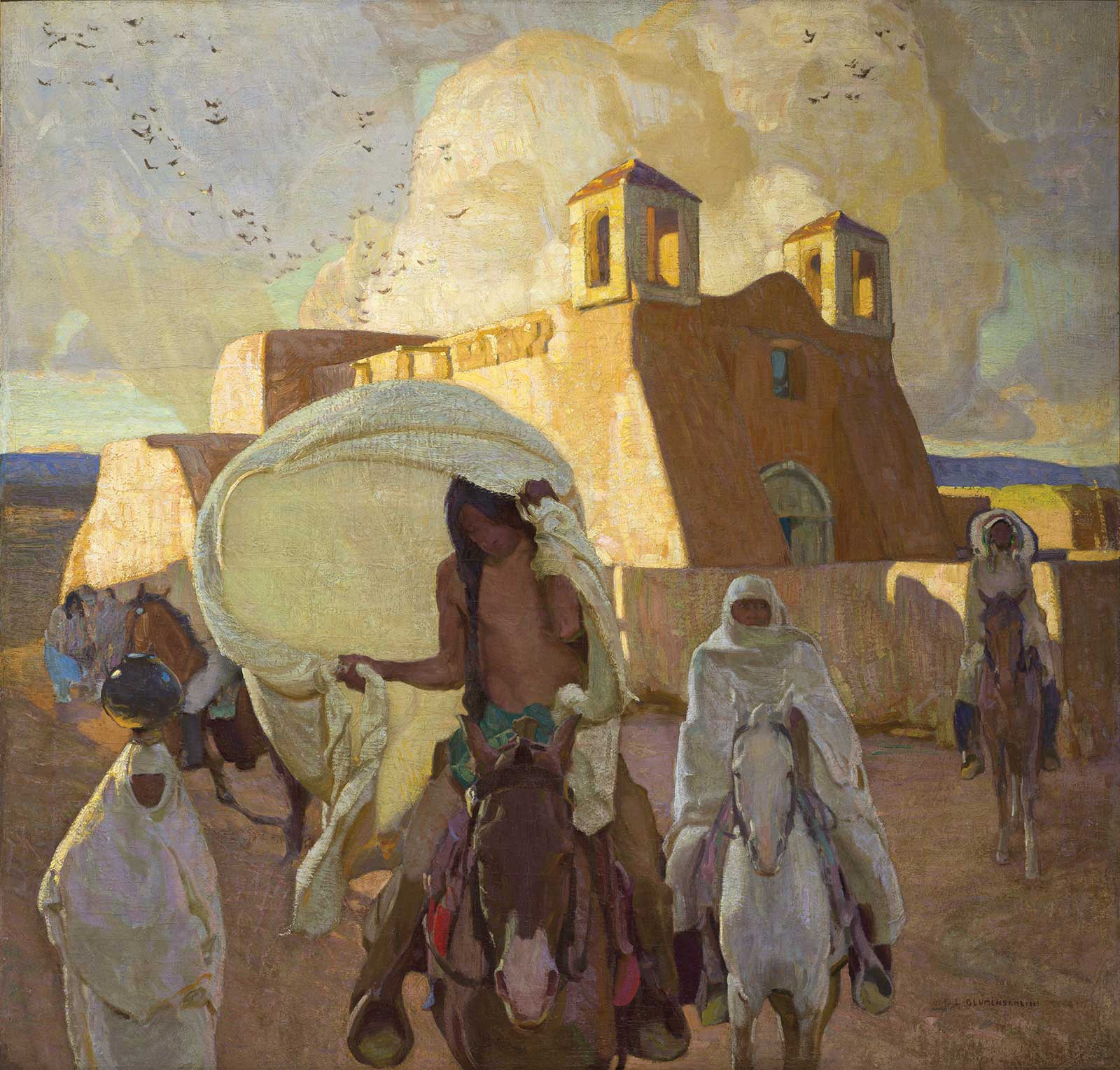 Ernest L. Blumenschein (1874-1960), Church at Ranchos de Taos, before 1917, oil paint on canvas, 45½ x 47½”. Courtesy of American Museum of Western Art — The Anschutz Collection. Photograph by William J. O’Connor.Connections between French Orientalism (depictions of the Arab and Muslim world produced by French artists during the 1800s) and Western American art run much deeper than a shared fascination with desert landscapes and global Indigenous cultures, as Near East to Far West demonstrates. The visual language produced by French Orientalists provided a template for American artists seeking to unite their international training with American subjects and to express what were, to many of their viewers and patrons, unfamiliar landscapes and cultures. A shared context of colonial expansion—France into Algeria and the United States into the West—reinforced the popularity and usefulness of Orientalizing motifs.
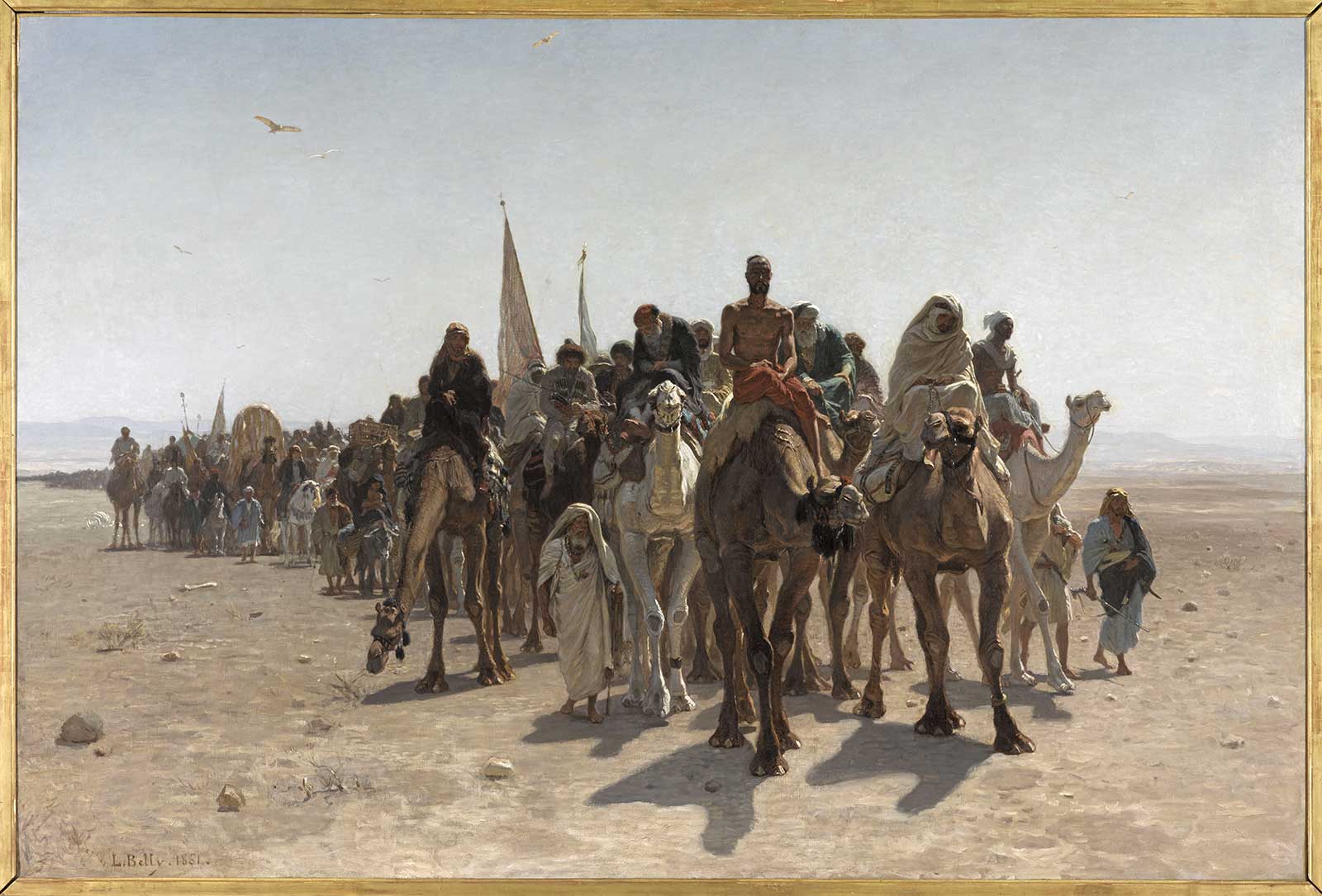 Léon Belly (1827-1877), Pilgrims going to Mecca (Pèlerins allant à la Mecque), 1861, oil paint on canvas, 63 x 95¼”. Musee d’Orsay, Paris. © RMN-Grand Palais/Art Resource, NY. Photograph by Franck Raux.Leading French Orientalists included Eugène Delacroix, Jean-Léon Gérome, Jean-Joseph Benjamin-Constant and Eugène Fromentin. Many American students traveled to Paris to learn from these artists. Some, including Alfred Jacob Miller, George de Forest Brush, Ernest Blumenschein, Bert Phillips, Joseph Henry Sharp, E. Irving Couse and Catharine Critcher, returned home eager to combine their international training with American themes. Others who did not study abroad, such as Frederic Remington and Charles M. Russell, absorbed Orientalist imagery through their peers, print media, popular culture, photography and world’s fairs. Both consciously and subconsciously, the tropes and techniques of French Orientalism seeped into the visual language of the American West.
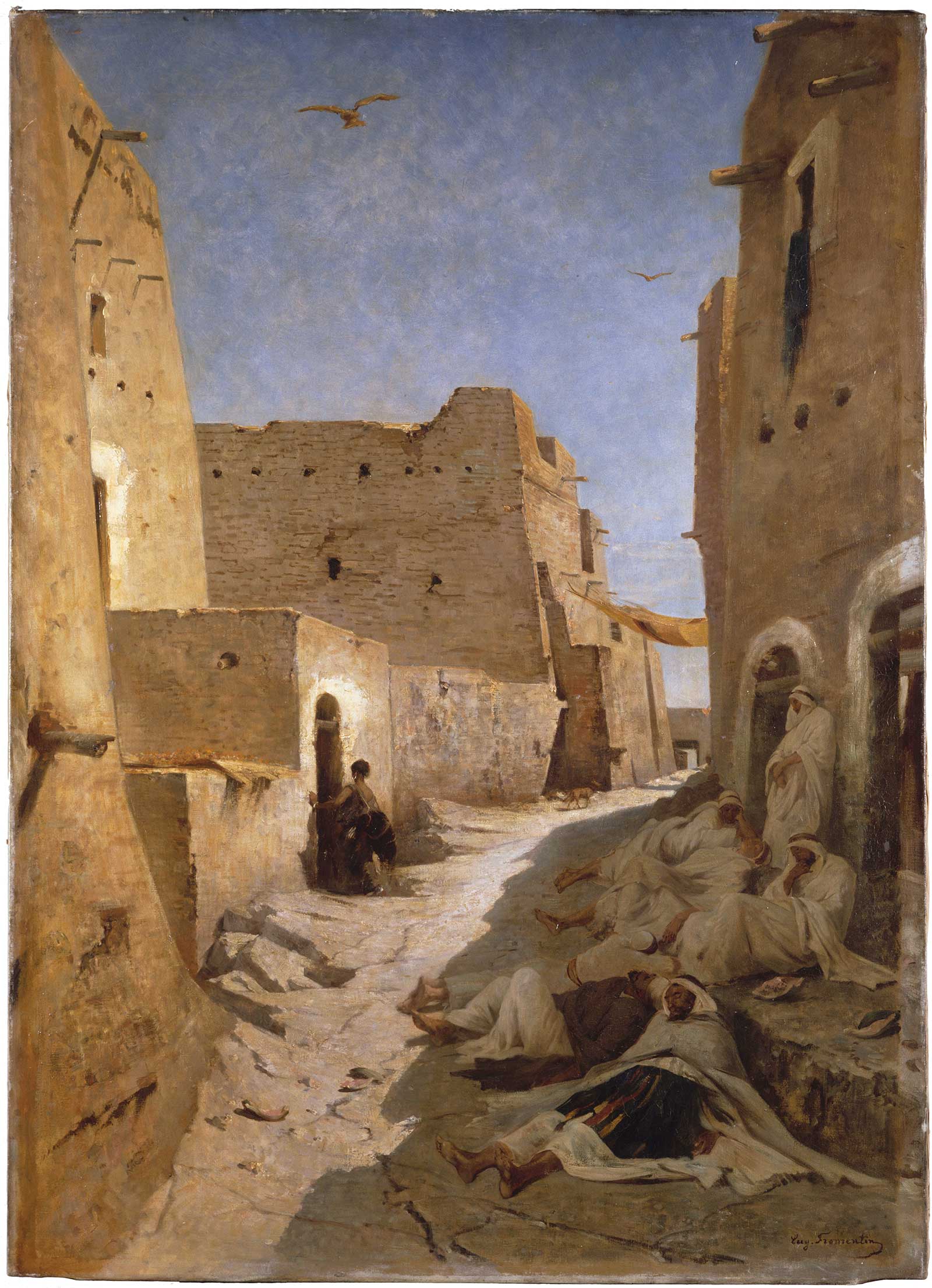 Eugène Fromentin (1820-1876), Bab-el-Gharbi Street in Laghouat (La Rue Bab-el-Gharbi à Laghouat), 1859, oil paint on canvas, 55⅞ x 40½”. Musée de la Chartreuse, Douai, France, 148 ancien dépôt. © RMN-Grand Palais/Art Resource, NY.Alfred Jacob Miller’s renditions of the West present one of the earliest examples, for Miller harnessed the romantic expression and color of Eugène Delacroix. While in Paris in 1832, Miller sketched works by Delacroix who, that same year, was on his first and only trip to Morocco and Algeria. For the remainder of Delacroix’s career, he created brightly painted North African–themed works for French audiences. Similarly, after returning to the United States and spending one memorable summer at a fur trappers’ rendezvous in what is now Wyoming in 1837, Miller created Western-themed works from his Baltimore studio for wealthy urban patrons. Indebted to European romanticism, a movement in arts and philosophy that emphasized feeling and expression, Delacroix and Miller produced visions of foreign places that underscored nobility, energy and sensuality. Similar examples of artist-to-artist transmission on display in Near East to Far West include the work of George de Forest Brush with his teacher Jean-Léon Gérome and eventual members of the Taos Society of Artists including Ernest Blumenschein, Bert Phillips and Joseph H. Sharp with their teacher Jean-Joseph Benjamin-Constant. These comparisons reveal the degree to which American artists were inspired by their teachers but also the ways in which they developed their own modes of expression.
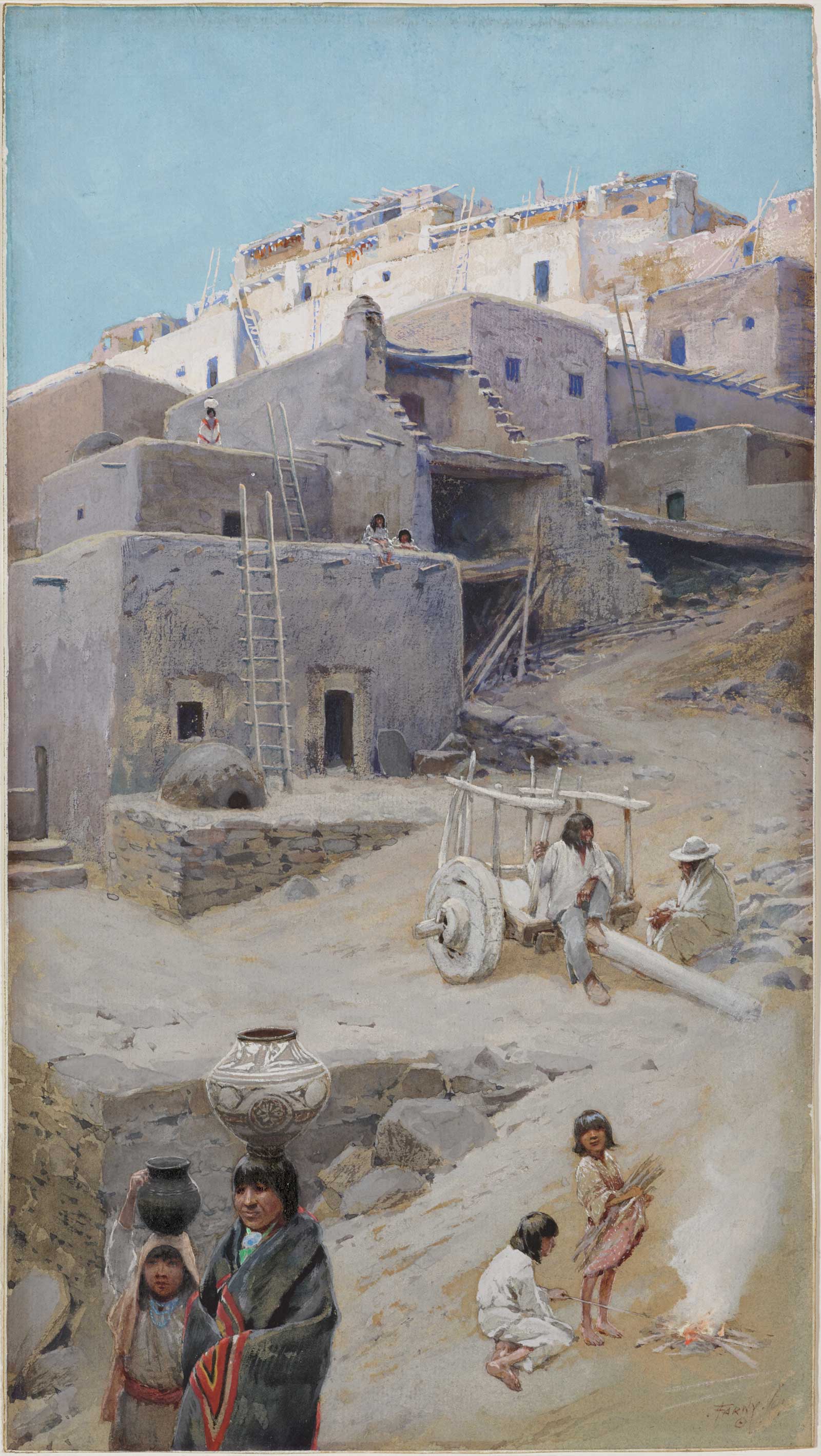 Henry Farny (1847-1916), Mesa Village, ca. 1891, gouache on paper, 15 x 9⅜”. Denver Art Museum: The Roath Collection, 2014.374.In 1853, Delacroix wrote in his journal that he only began to make successful paintings of his North African experience “when I had forgotten the trivial details and remembered nothing but the striking and poetic side of the subject.” Up to then, he continued, he had been “haunted by this passion for accuracy that most people mistake for truth.”1 Questions about accuracy and truth permeate this exhibition. Motivated by market demands and professional ambition, mediated by period attitudes, and composed from diverse sources including memory, imagination and observation, the artworks on display present a powerful visual authority that frequently obscures their nature as constructed objects. To what degree can we disentangle fact from fiction? How can we cultivate a critical eye in the face of beauty, simultaneously holding multiple, contradictory thoughts and feelings about “Orientalized” perspectives that persist in art and popular culture and continue to inform how we think about U.S. involvement in the modern Arab world and Indigenous sovereignty in the Americas?
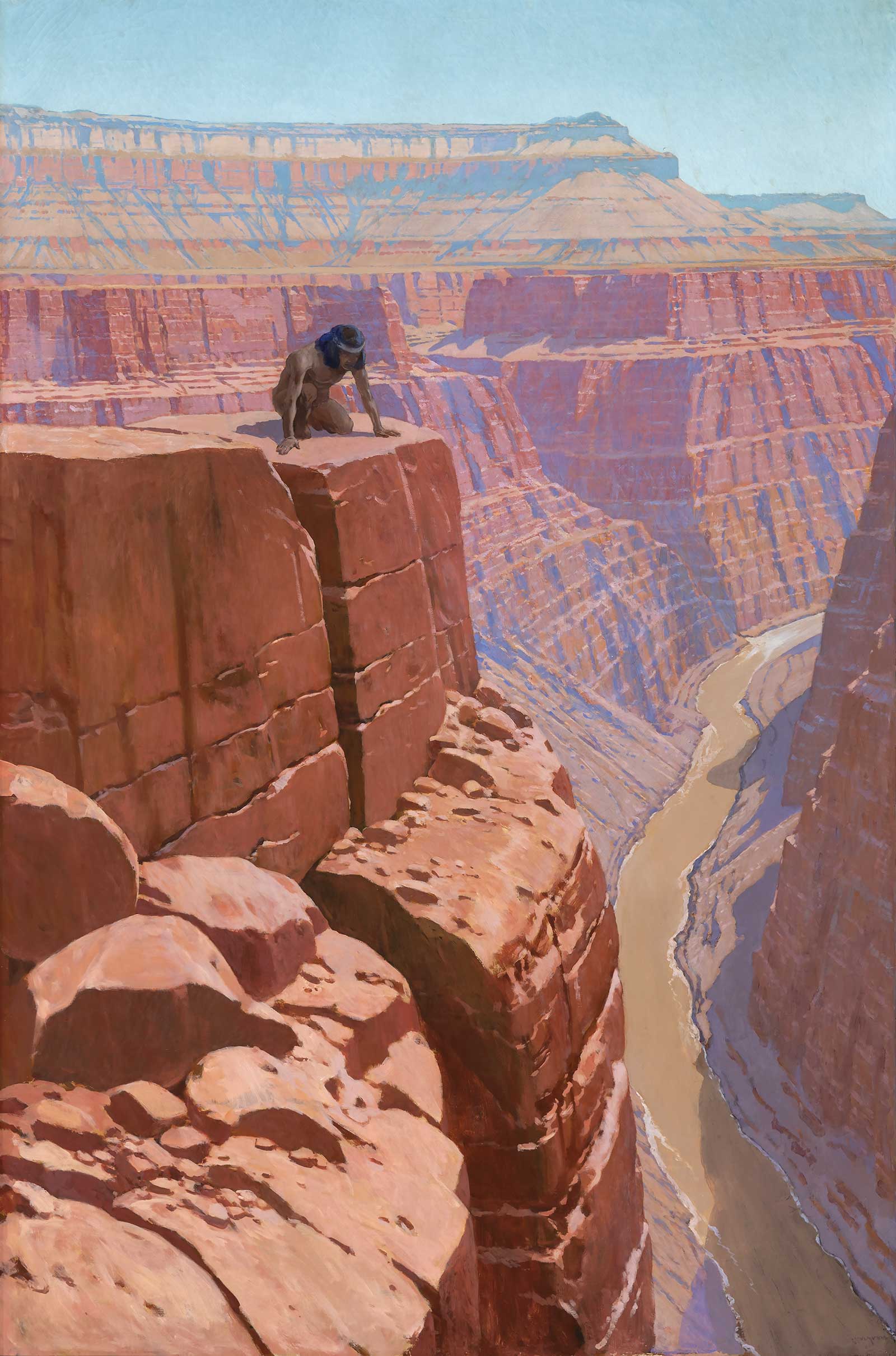 Fernand Lungren (1857-1932), In the Abyss: Grand Canyon, ca. 1896, oil paint on canvas, 60¼ x 40”. The Art, Design & Architecture Museum, University of California, Santa Barbara: Fernand Lungren Bequest, 1964.659.Colonial processes including military incursion, the construction of transportation infrastructure, and the seizure of Indigenous lands in Algeria and the American West enabled artists’ unprecedented access to geographies and cultures that were new to them. Frequently ambivalent about the impacts of colonization, artists sometimes subtly referred to its impacts on Indigenous people. Eugène Fromentin was among the earliest painters to visit Algeria and, in 1853, arrived at Laghouat, an Algerian city whose inhabitants had suffered thousands of deaths six months earlier when attacked by the French. Because Fromentin was indebted to the French military and government, his The Bab-el-Gharbi Street in Laghouat only hints at that violence: the birds are possibly carrion birds, and, as noted by contemporary critic Théophile Gautier, the strange stillness of the resting figures could evoke shrouded corpses. To provide a Western example, the title Cui Bono?, which Ira Diamond Gerald Cassidy gave to his life-size representation of a Puebloan man wrapped in a white blanket, may provide a subtle critique of colonial expansion. Its Latin title translates to “Who benefits?” and may reference debates about New Mexico becoming a state (which it did in 1912) and, by extension, concerns about Puebloan sovereignty.
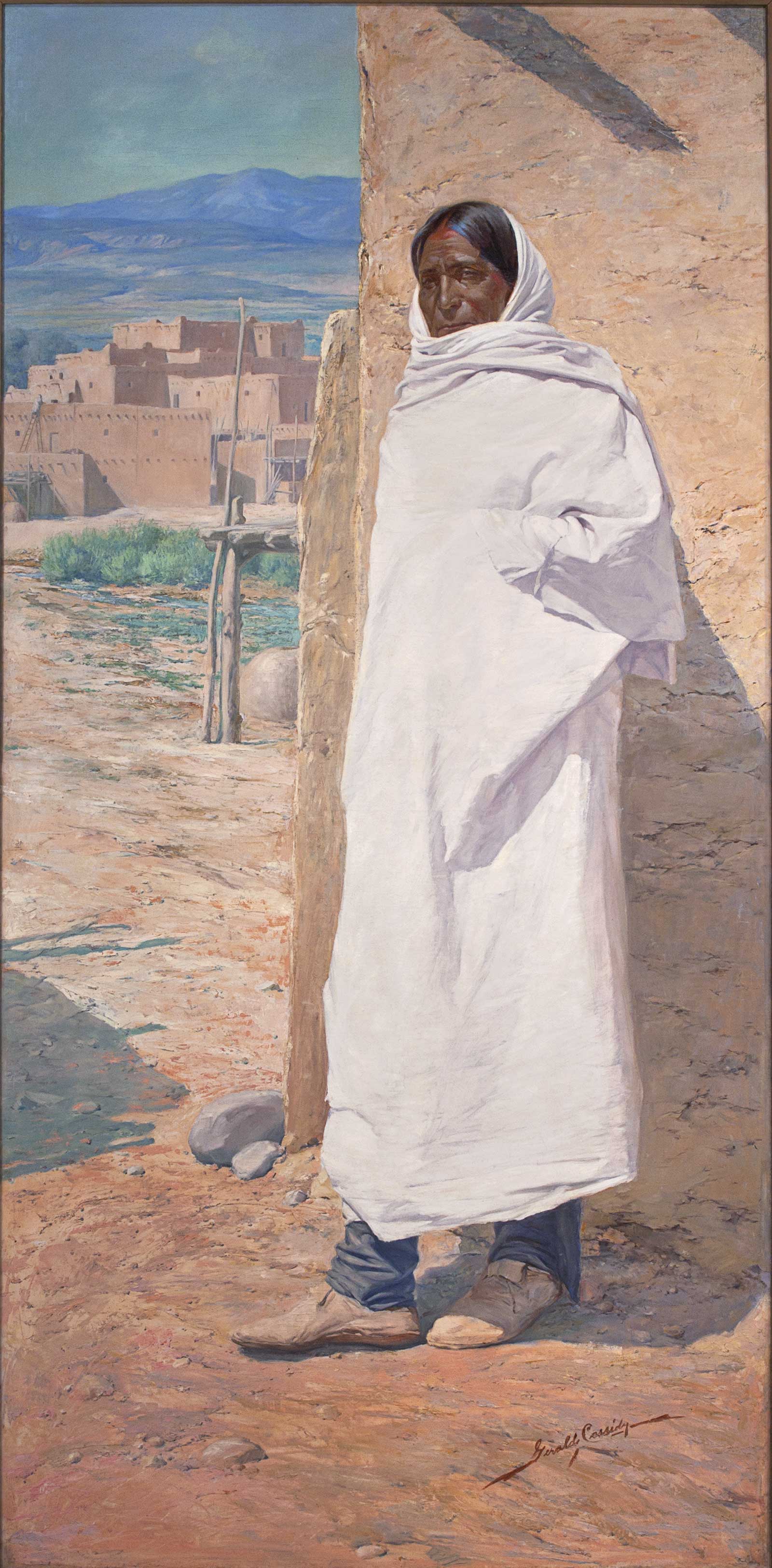 Gerald Cassidy (1869-1934), Cui Bono?, ca. 1911, oil paint on canvas, 93½ x 48”. Collection of the New Mexico Museum of Art: Gift of Gerald Cassidy, 1915 (282.23P). Photo by Blair Clark.
Racialized stereotypes such as the “Noble Savage” and odalisque (a woman in a female-only domestic space or harem, who is often overly sexualized in European art) circulated throughout French Orientalism and Western American art. They served as a kind of visual shorthand that quickly identified exotic differences and reinforced biased assumptions about behavior and sexuality. Frequently, individual artists’ oeuvres display a range of representations from stereotyped to sympathetic. French artist Alphonse-Étienne Dinet, for example, ultimately moved to Algeria and converted to Islam, changing his first name to Nasreddine. His psychologically poignant portrait of an Algerian man in Man in a Large Hat may highlight his respect for the Algerian people and culture with whom he chose to live, but his paintings of Algerian girls and women are often overly sensual and sexually stereotyped. This kind of representation, which denies the multifaceted roles of women by objectifying them as exotic commodities, transferred to depictions of Indigenous women in the West and play a part in the ongoing crimes against missing and murdered Indigenous women, girls and Two-Spirit people.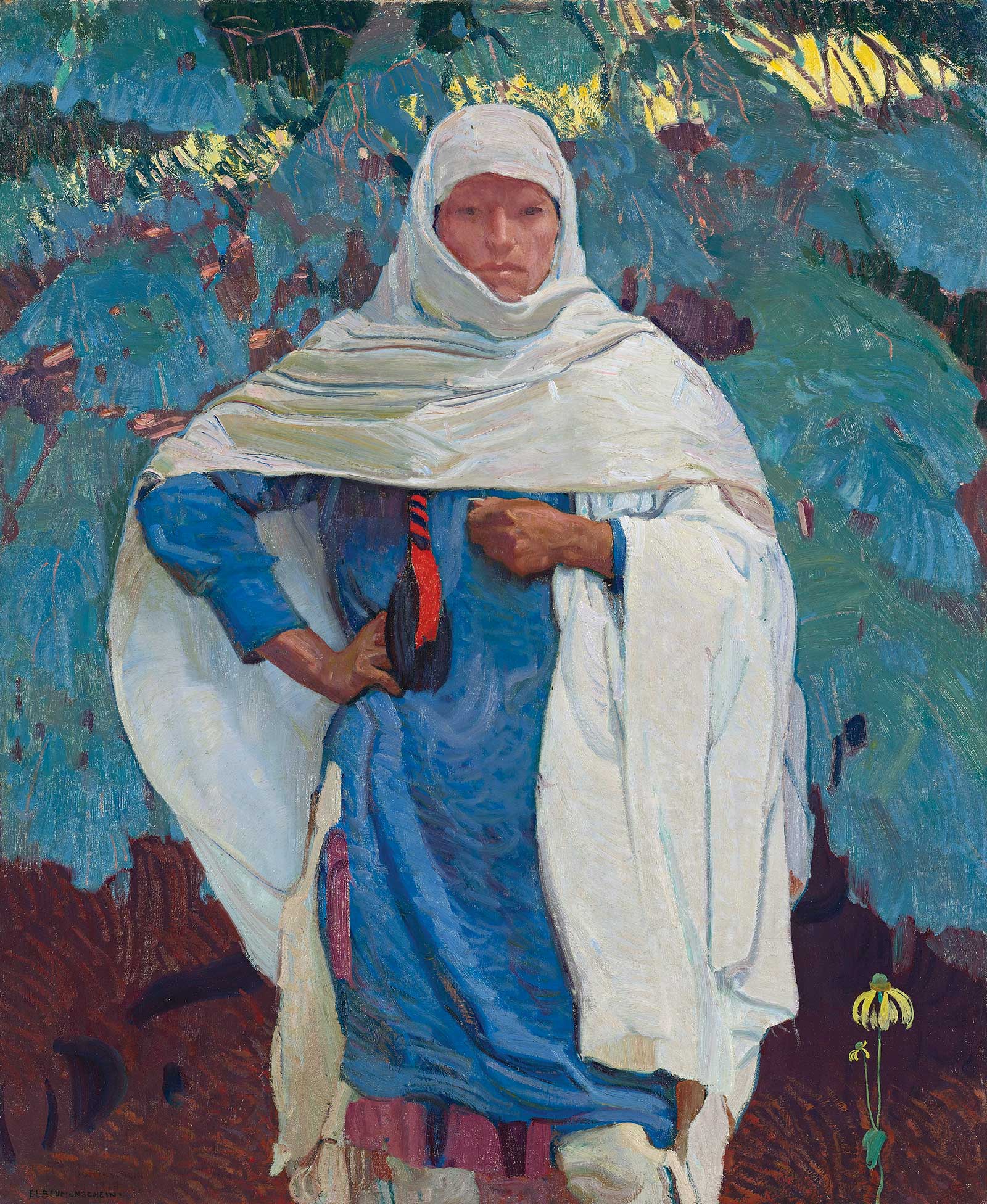 Ernest L. Blumenschein (1874-1960), White Blanket and Blue Spruce, 1922, oil on linen mounted, on paperboard, 34⅛ x 28⅛”. Collection of Vaughn O. Vennerberg II, Dallas, Texas. Courtesy Sotheby’s.
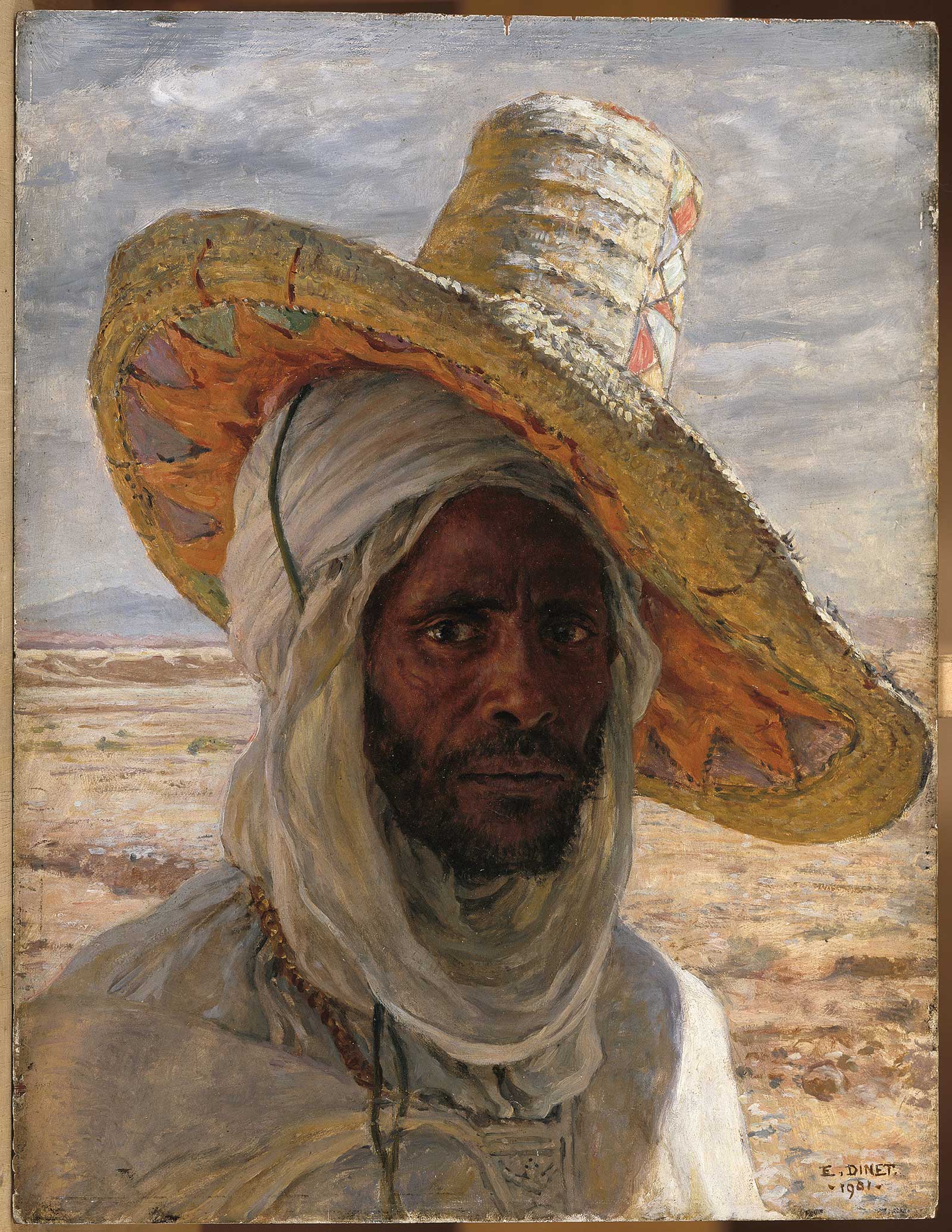 Alphonse-Étienne Dinet (1861-1929), Man in a Large Hat (Homme au Grand Chapeau), 1901, oil paint on canvas, 15¼ x 10½”. Musée d’Orsay and Cité nationale de L’histoire et de l’immigration, Paris: MAAO 9720, LUX 527. © RMN-Grand Palais/Art Resource, NY. Photograph by Daniel Arnaudet.Near East to Far West celebrates artistic achievement, questions the line between fact and fiction, and considers the legacy of colonial stereotypes. Additionally, it asks the viewer to consider what lies outside the frame and how socio-cultural and political contexts may have impacted an artist’s choices. Fernand Lungren’s In the Abyss: Grand Canyon features a Diné (Navajo) man crouching above the Grand Canyon’s stark cliffs. The Santa Fe Railway funded Lungren’s initial trips to the Southwest and the Grand Canyon between 1892 and 1897, part of a larger campaign to recruit artists to promote the region. Lungren’s resulting painting is seemingly timeless, without any trappings of the changes already underway that would render the Grand Canyon one of the most notable tourist sites in the country. While he presents a single Indigenous figure, the historical context outside the frame of this painting is peppered with Euro-American artists and tourists and the many people of diverse ethnicities who populate the American West. Lungren’s painting is just as extraordinary for its visual richness of color and composition as it is for its absence of modernity, colonialism and tourism: all components of the context that allowed Lungren to create it in the first place.
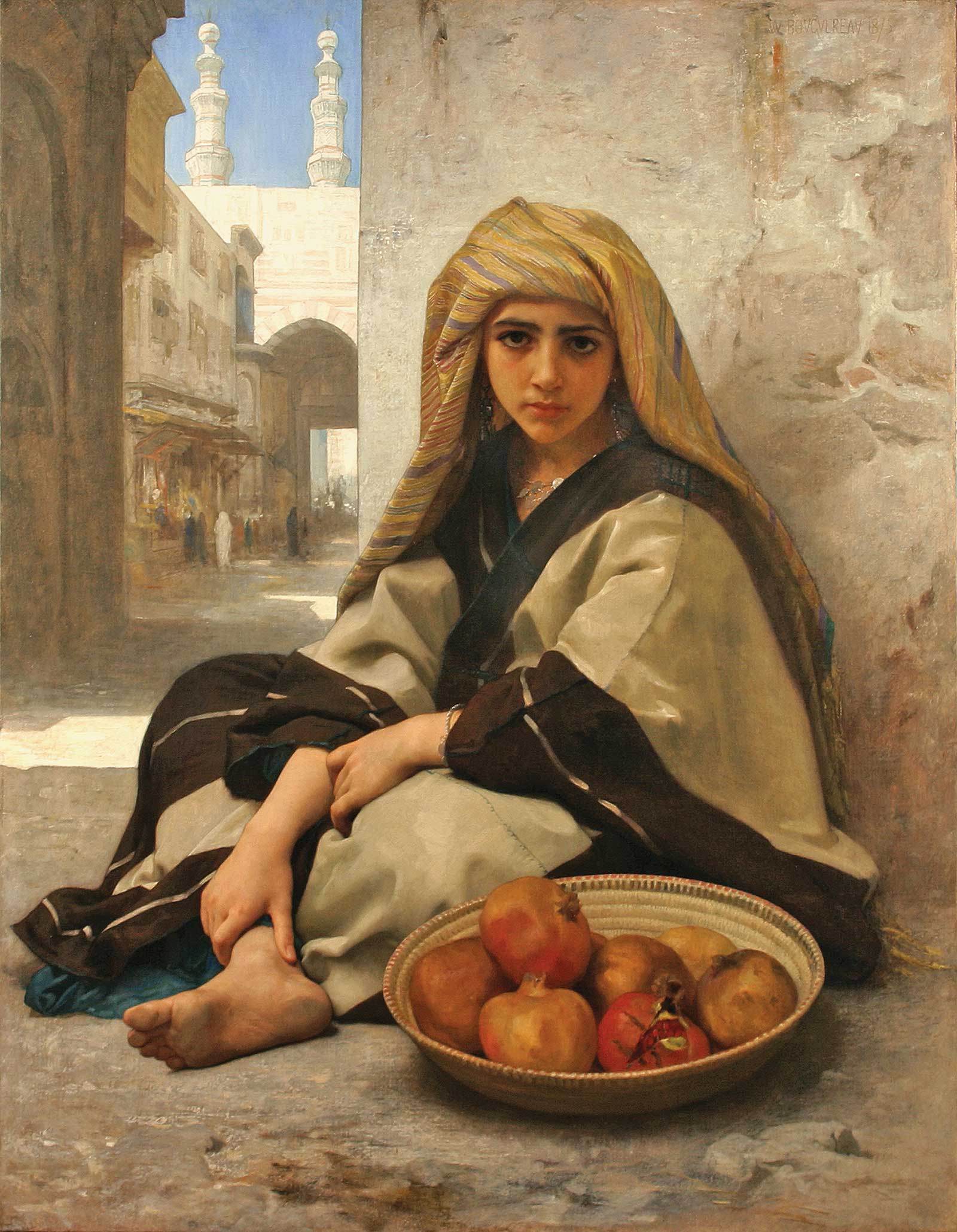 William-Adolphe Bouguereau (1825-1905), The Pomegranate Seller, 1875, oil paint on canvas, 45½ x 35”. Private collection. Image courtesy Rehs Galleries, Inc., New York City.The point, however, is not to condemn artists for what they did or did not choose to represent. Many artists of this period were not interested as much in historical facts as they were in concepts of aesthetic beauty, imagination and what they perceived as universal truths. Rather, the point is to consider how, because of their powerful combination of technical excellence and emotive expression, the artworks on display are frequently interpreted as documentary statements of truth or fact. Such a position does a disservice to the artistic process by minimizing the role of creativity and imagination, avoids the realities of colonial histories, and risks rendering the works one-dimensional, when in fact they (and viewers’ responses to them) can create many meanings over time.
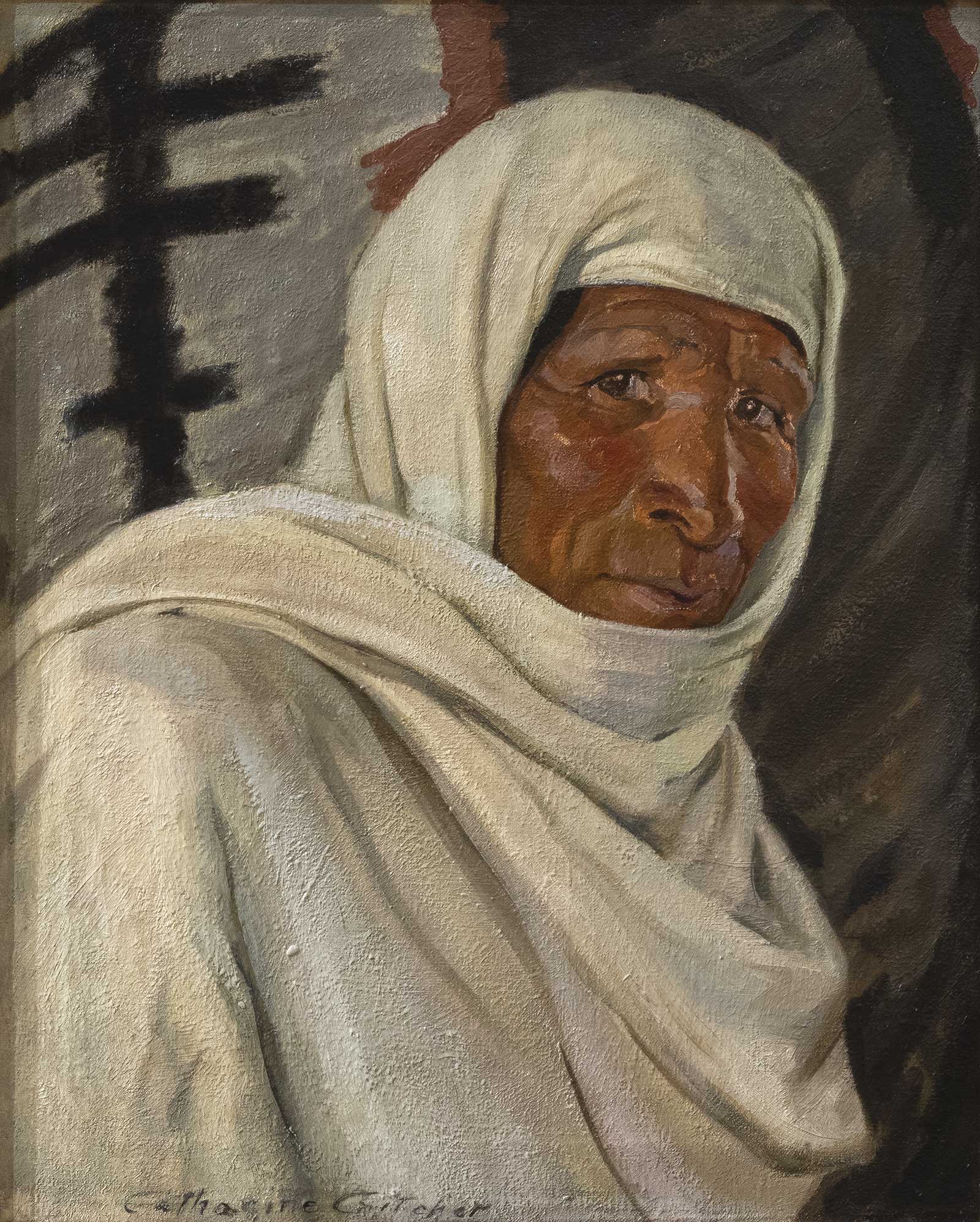 Catharine Carter Critcher (1868-1964), Indian Mystic, ca. 1924, oil paint on canvas, 22 x 18”. The Peterson Family collection. Courtesy Loren Anderson Photography.Near East to Far West creates a foundation for continued conversations about the power and possibilities of historical artworks. Exploring the roots of Western American art in French Orientalism creates opportunities to ask questions about visual and historical absence and to better understand the ongoing legacies of colonial visual vocabularies. Community and scholarly consultants played a crucial role in the development of this project through focus groups that surfaced themes and concerns of most relevance to today’s audiences. Within the exhibition, their perspectives are captured in labels that reveal diverse ways of approaching and understanding the artworks. Additionally, the thoughtful contributions of thirteen authors in the accompanying catalog provide deeper dives into the project’s themes and questions. Near East to Far West situates artworks in their time while reminding us of limits to our own perspectives, knowledge, vision and memory. Like the artists in this exhibition, may we be open to the challenge, reward and discomfort of the journey. —
JR (Jennifer) Henneman, Ph.D., is director and curator of the Petrie Institute of Western American Art at the Denver Art Museum. Her research reflects her upbringing on a farm and cattle ranch in Montana and her interest in the art and culture of the 19th century.
Powered by Froala Editor