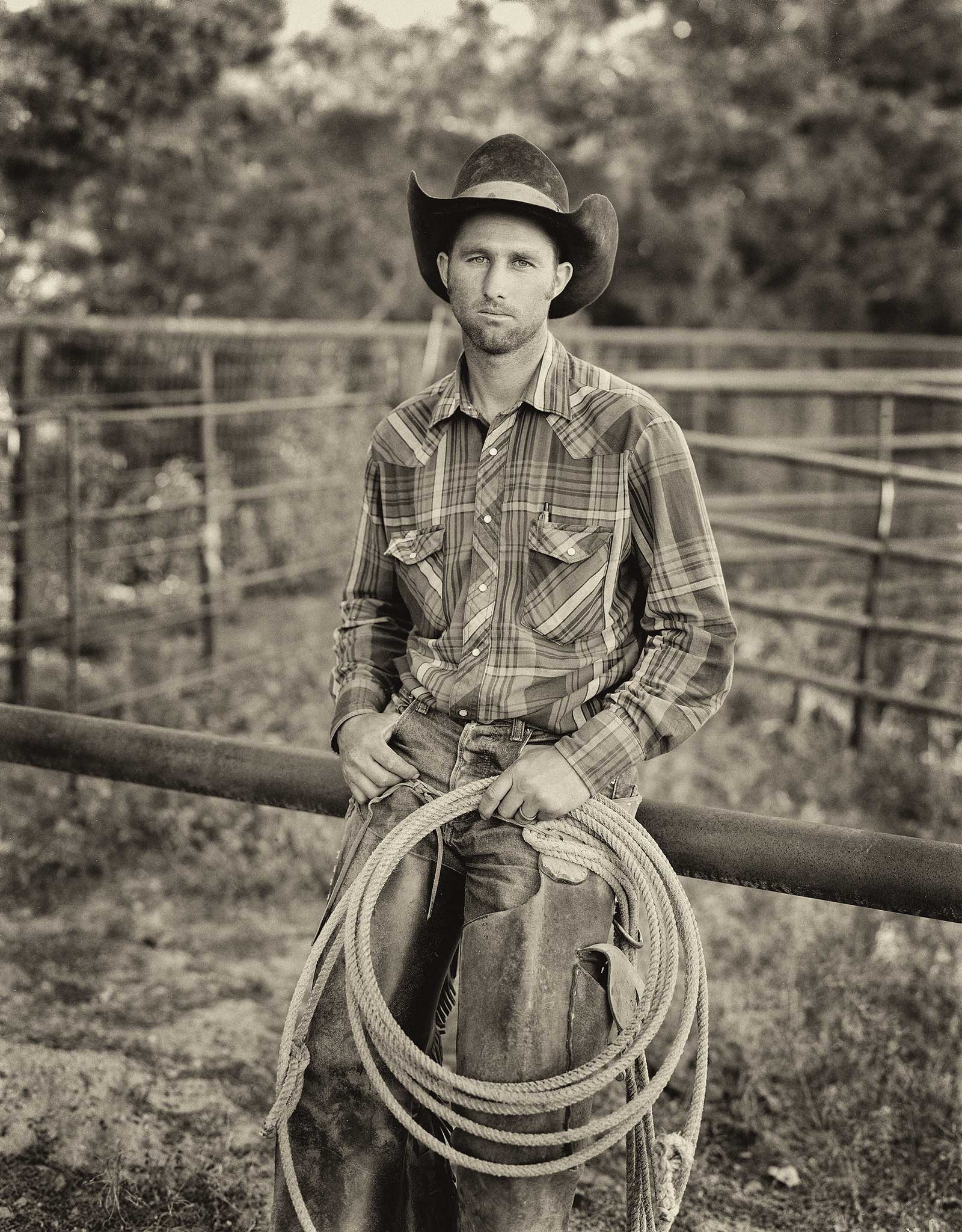
It should have come as no surprise, having looked at Scott Baxter’s surprising, striking images, that the artist himself would have surprising stories and striking ideas about art, ranch life, and the past and future of the American West. And yet, after a wide-ranging conversation with Scott, and after looking again at his arresting photographs, his stories and ideas seemed, well, not so surprising. In fact, they made perfect sense. Confused? Lost? I’ll just say what I would say to anyone thinking of visiting The Gather—A Portrait of the American West—Scott Baxter, the new exhibition of Baxter’s photographs, now on view at Western Spirit: Scottsdale’s Museum of the West—“You’ll see.”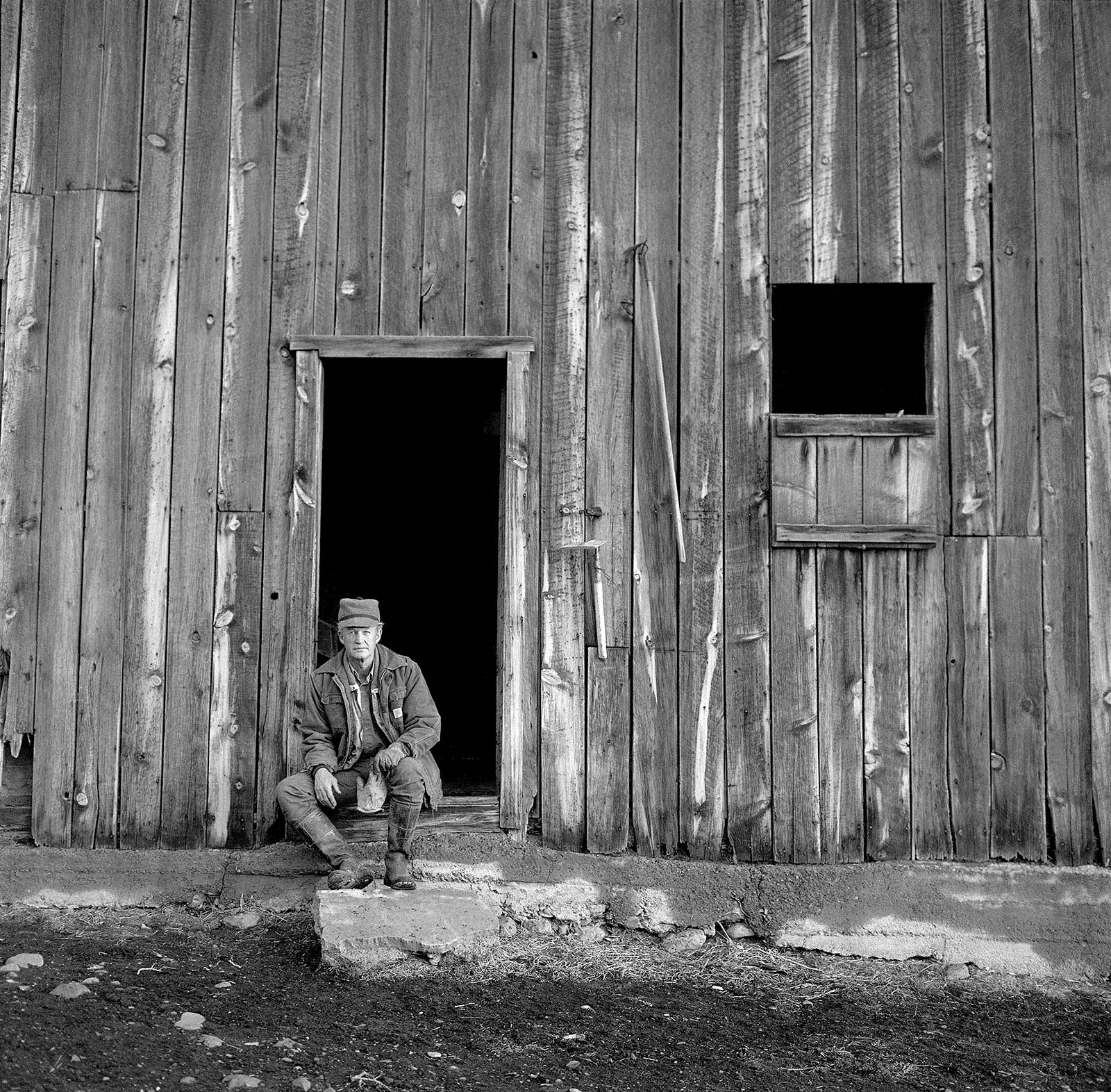 Sam in the Scotch Cap, 1999, toned silver gelatin print, 20 x 16”Scott Baxter, as you quickly learn, isn’t just a photographer. He’s a storyteller. Photography is his medium, but, as he himself says, “Story trumps image.”
Even the name of the exhibition, The Gather, has a story, a story that becomes a metaphor. A gather is a seasonal, spring-fall ritual that “gathers” a cattle herd “for branding,” Baxter says, “to see that calves are doctored and ear-tagged, and to ship some animals out. When it’s over, the animals go back to where they’re supposed to be.” For Baxter, however, the Gather is also a metaphor for the process of gathering the works in the exhibition from disparate projects, galleries, and collectors, bringing them together for a time, then sending them back where they came from. The Gather—A Portrait of the American West—Scott Baxter draws from Baxter’s 100 Years, 100 Ranchers and Top Hand; from the first photos from his new project, documenting the 150-year-old Sierra Bonita Ranch; from images on loan from the Ryan Gallery; and from private collections. The Gather, then, is a kind of culmination, a ritual retrospective of sorts, and the largest exhibition of the artist’s work to date.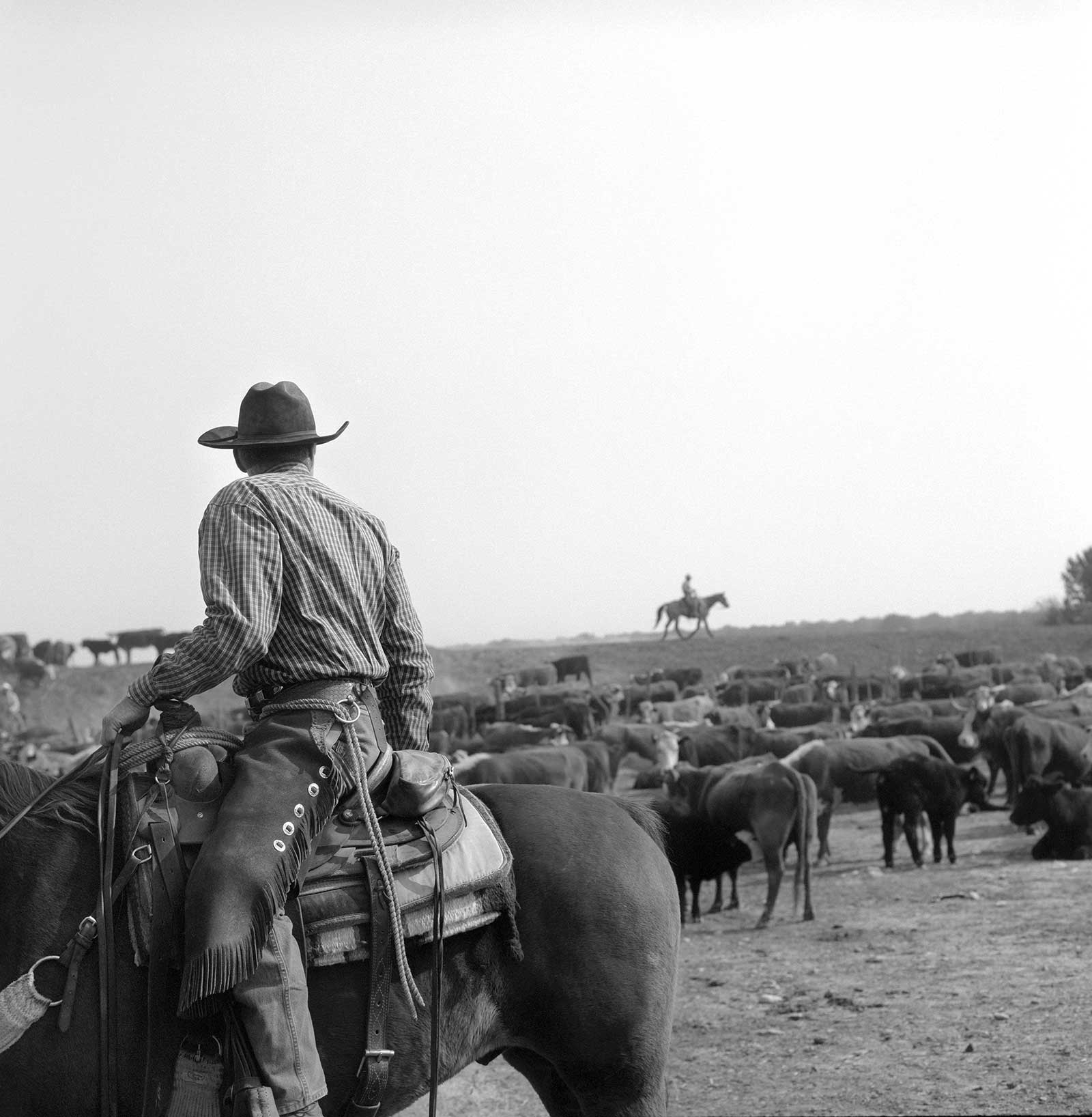 The Gather, O’Haco Cattle Company, Coconino County, 2006, toned silver gelatin print, 28 x 22”That connection is a mild surprise, but when Baxter says that he tries not to romanticize the West, that he strives for accuracy and authenticity, and that he depends on the people he photographs to help him achieve these goals, he stresses his careful consideration of the historical criteria that form the armature of his images. Then he says, “My degree is in history. I’ve never taken a class in photography.” Surprise? Perhaps. Or perhaps not.
  Joel Maloney, Arizona, 2013, platinum/palladium print, 26 x 22”Unlike many contemporary photographers who are looking for the spontaneity of the quick snap, Baxter’s process requires time, that is, an amassing of conversations that allow him to get to know his subjects and create a history. In this, his work is more akin to classical painted portraiture than to portrait photography as we generally conceive it. One of the greatest portrait painters in history, Anthony Van Dyck (1599-1641), for example, required his subjects—kings and queens among them—to visit his studio on numerous occasions, creating a kind of salon where he offered meals and entertainment while he worked, and even between sittings. Observing them while they ate, danced, took in performances, and watched others do the same, caught them off their aristocratic guard. As they befriended Van Dyck, their ease with him is what led to his insightful, revelatory portraits. Van Dyck himself derived this more informal approach to portraiture from conversations with Sofonisba Anguissola (1532-1625), the most celebrated woman artist of her time, who, in turn, studied with Michelangelo, among other Renaissance luminaries. Baxter’s philosophy of getting to know the people he portrays has a long and distinguished history.
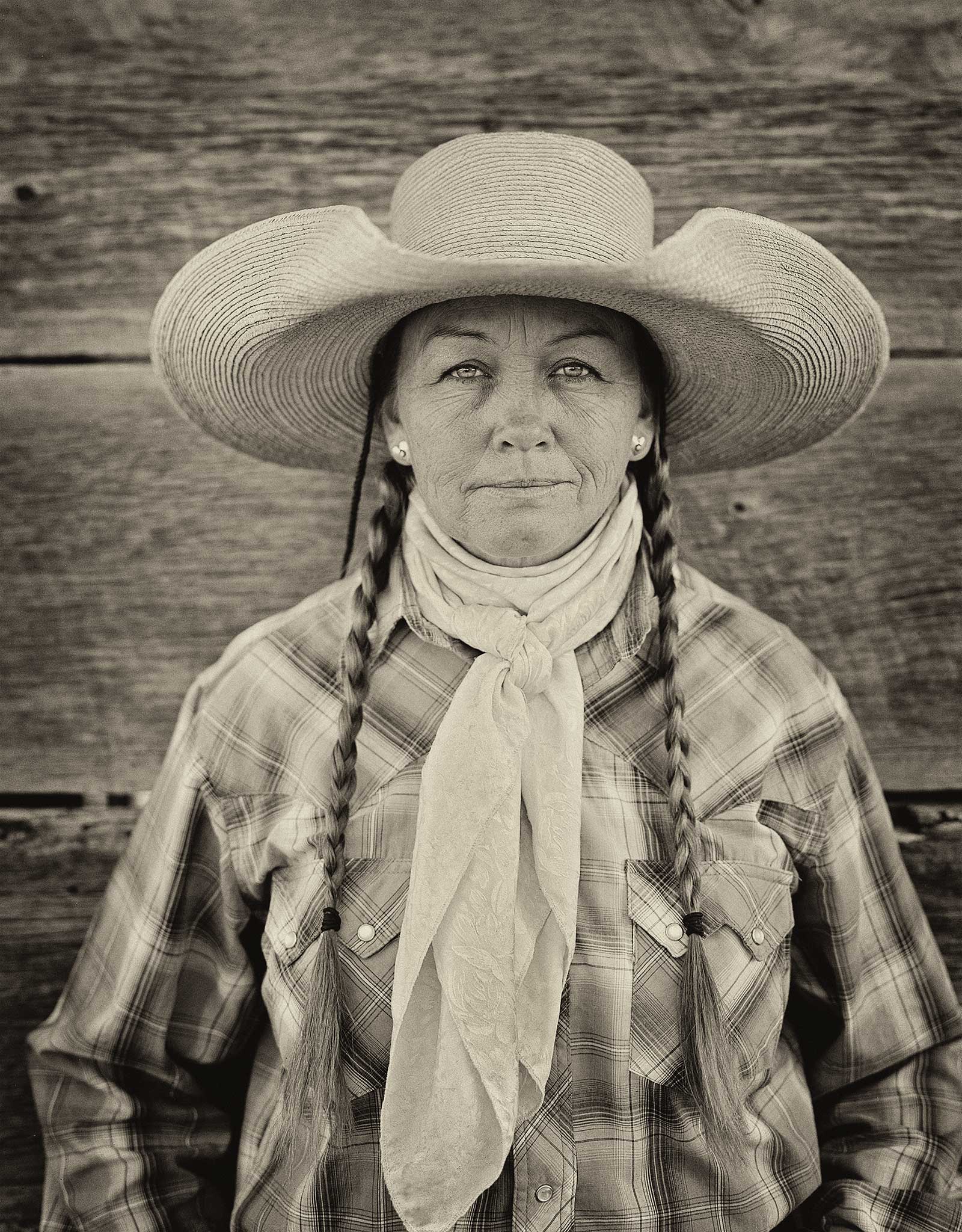 Sheila Carlson, Arizona, 2013, platinum/palladium print, 26 x 22”Of the people who people his photographs, the ranchers and ranch hands on the small, family-run outfits, some of them dating back a century or more, Baxter says, to “give the gift of who they are on film,” and to be “given the gift, I don’t carry a camera every day. I ask for and send letters of introduction, talk to people, show them a photograph, let them talk, stay in touch, and allow things to come to me. I have hours of audio recordings. I met one child when she was two or three years old. I went back to photograph her some 16 years later.”
This sense of organic continuity in Baxter’s work respects and in many ways pays homage to long-held ranch traditions and the rapidly disappearing way of life his images capture, preserve, and celebrate. The same is true of the large-format (4 by 5 inches and 8 by 10 inches) cameras he uses and the “painstakingly arduous but rewarding” platinum palladium photographic process he favors. Baxter, who does all his own processing, imagines “how it would have been to make these photographs a hundred years ago.” Accordingly, he doesn’t work with lights, limits himself to a camera, tripod and film, and uses a single, “normal” lens.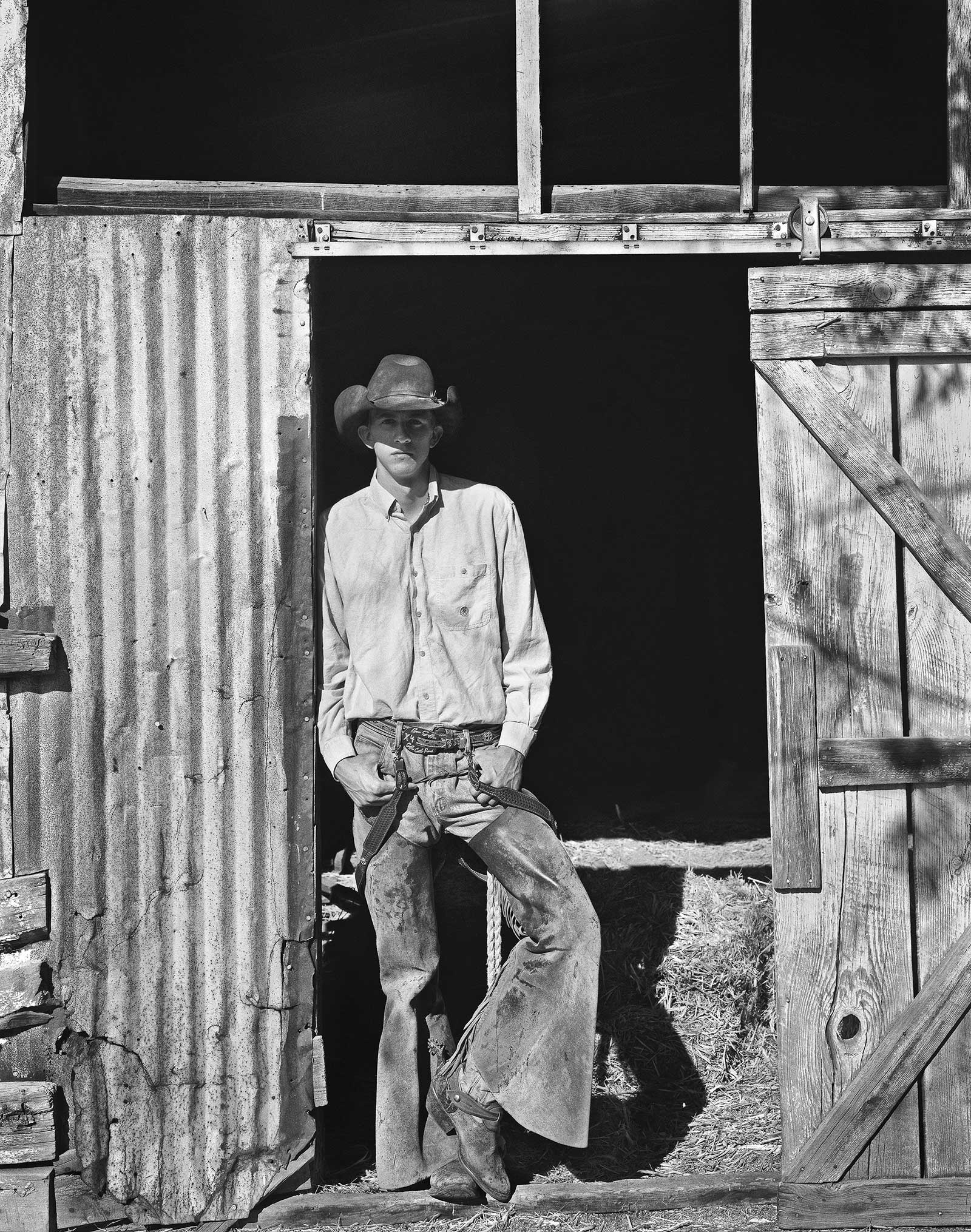 Bennett Austin Clark Griffin at the Adobes barn, 2011, Griffin Cattle Ranch, Gila County, north of Globe, Arizona ranching family since 1905, archival pigment print from film negative, 36 x 30”
When he does shoot, Baxter says, “he tends to shoot in bunches,” but deliberately. “You’re under the cloth. The way these large-format cameras work, you’re looking at an image that’s upside down and reversed—which is the way images appear before the prism in our brains corrects them. But so much is at stake, so much can go wrong. You really slow yourself down. You know how athletes talk about moments in a game when everything slows down, when it gets quiet? That’s what happens. And it’s because you’re paying attention. Making connections. It sounds mysterious, but it’s not. You just know. And then you take the shot.”
Because of his approach, there’s a “now as then—then as now” look and feel to Baxter’s images. You feel at first as if every detail is sharp, delineated, but close viewing reveals blurred background areas, light lights, dark darks, leading to a joyous vertigo that makes you want to get close, then back away, then close in again. Bennett Austin Clark Griffin at the Adobes barn, 2011 depicts a young cowboy striking a pose with all the easy confidence of youth. Deep black voids, weathered wood and corrugated tin frame and flank him in a modernist mode. To paraphrase William Blake, Griffin is a song of innocence, a young gunslinger without a gun, while his surroundings sing of time, experience, and wear. In Connie Brown, 2011, on the other hand, Brown wears her experience like a badge of honor: her mouth and eyes see through the viewer, brooking no nonsense; the lines on her face are a topographical map of her life.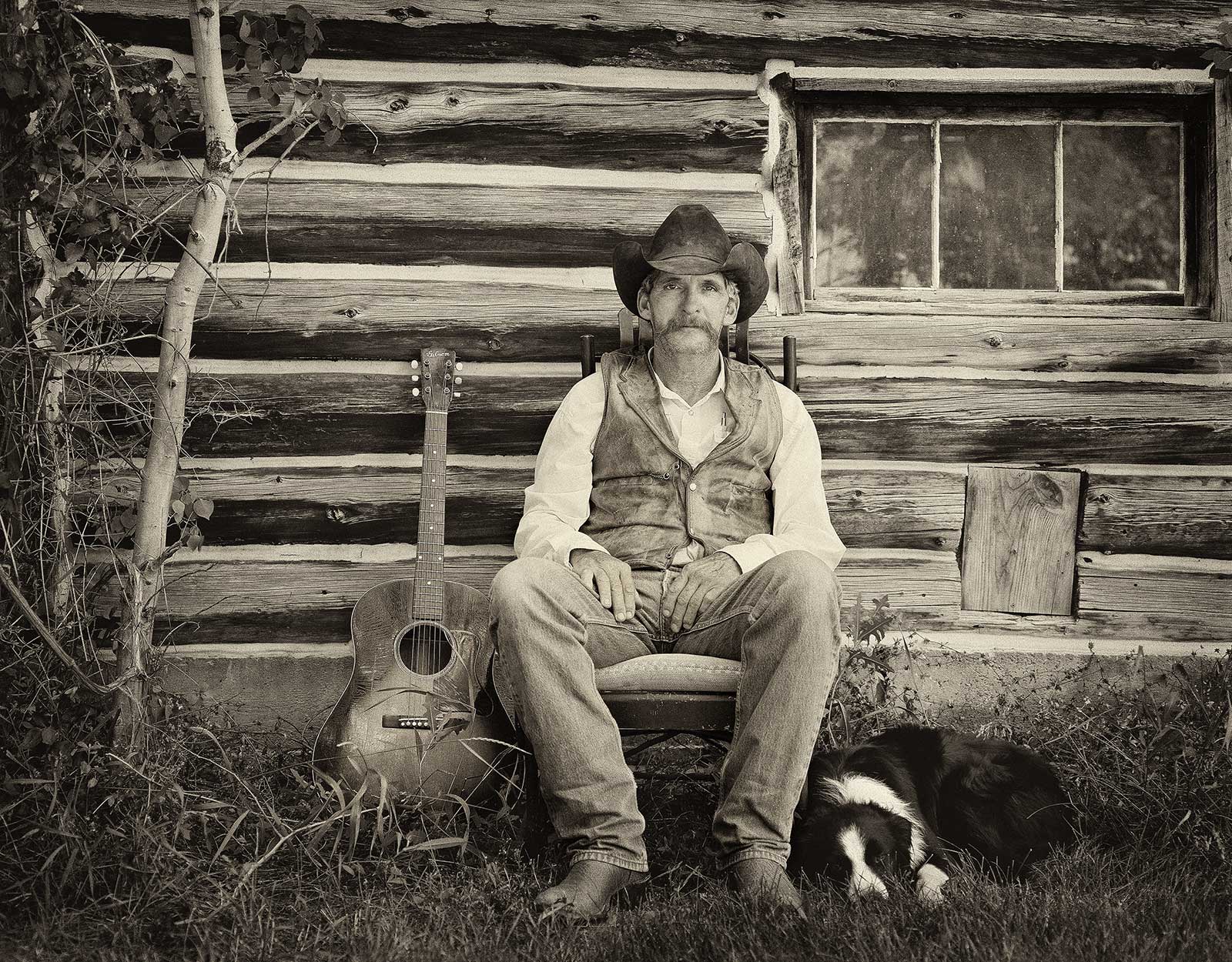 Joe Hall, Montana, 2014, platinum/palladium print, 22 x 26”A sly wryness animates Sheila Carlson, Arizona, 2013, as if she knows something you don’t. Carlson tells the story of the shoot—and the hat—and speaks to the obstacles Baxter faces at times when wrestling with his medium. “When Scott first came out in April of 2013 to take the pics, I was wearing my felt hat. When he was processing the film, most every photo had a weird flare, making them unusable. He called and asked me if we could do the pics again, and he told me about the weird lights. When he came back out, I decided to wear the palm leaf hat that had belonged to my fiancé, Rowe. I told him Rowe had passed away a few months before the first photo shoot and that he always liked me in the palm leaf and not the felt. I kinda think Rowe was behind the flares and lights that showed up when I was in the felt. No weird flares or lights when I wore the palm leaf…” In Sheila Carlson, Arizona, 2013, Baxter might agree, story—story as history, as memory, as spirit—trumped image, or at least came out neck and neck.
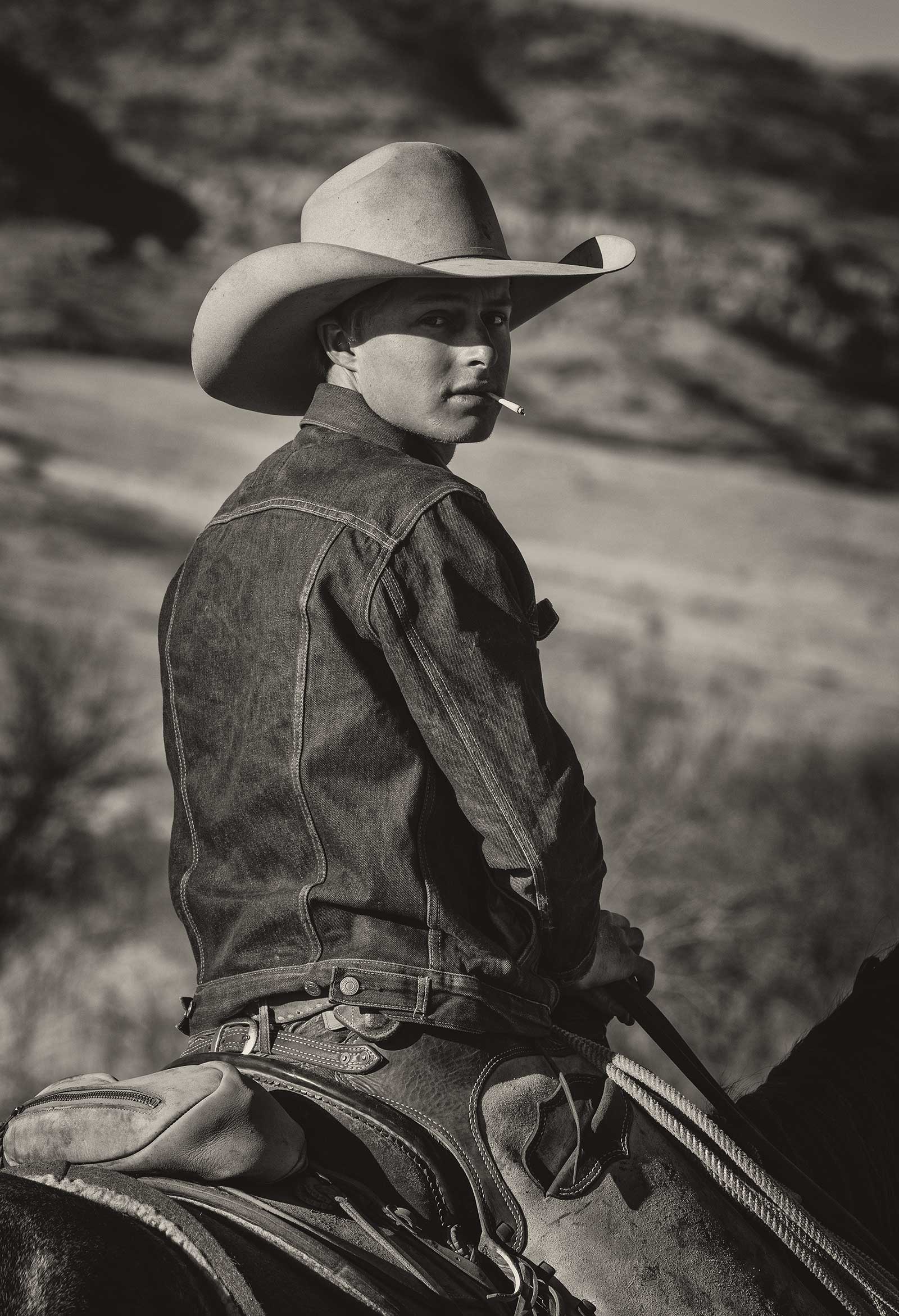 Jacob Todd, Sierra Bonita Ranch, Graham County, 2022, archival pigment print, 36 x 30”
Looking back at Sam Udall, 1999, one of the earliest images in the exhibition, Baxter recounts a story with a subject at ease, the artist being schooled as to the details of ranch life, and yet another small moment of surprise, one that was right there all along. “Sam had a pen and pad the pocket of his shirt,” Baxter says, “and I made the suggestion that he take it out for the photograph.” Udall looked at me and said, “‘Scotsman’—he always called me ‘Scotsman’—how am
I supposed to count my damn cattle!” Baxter learned two things: one, a rancher never goes anywhere without a tally book; and two: all real Western shirts have a buttonhole sewn into the pocket flap for a pen or pencil. Both the tally book and the button hole are subtle but evident in the image, adding just that touch of realism that has set Baxter’s work apart in the intervening years.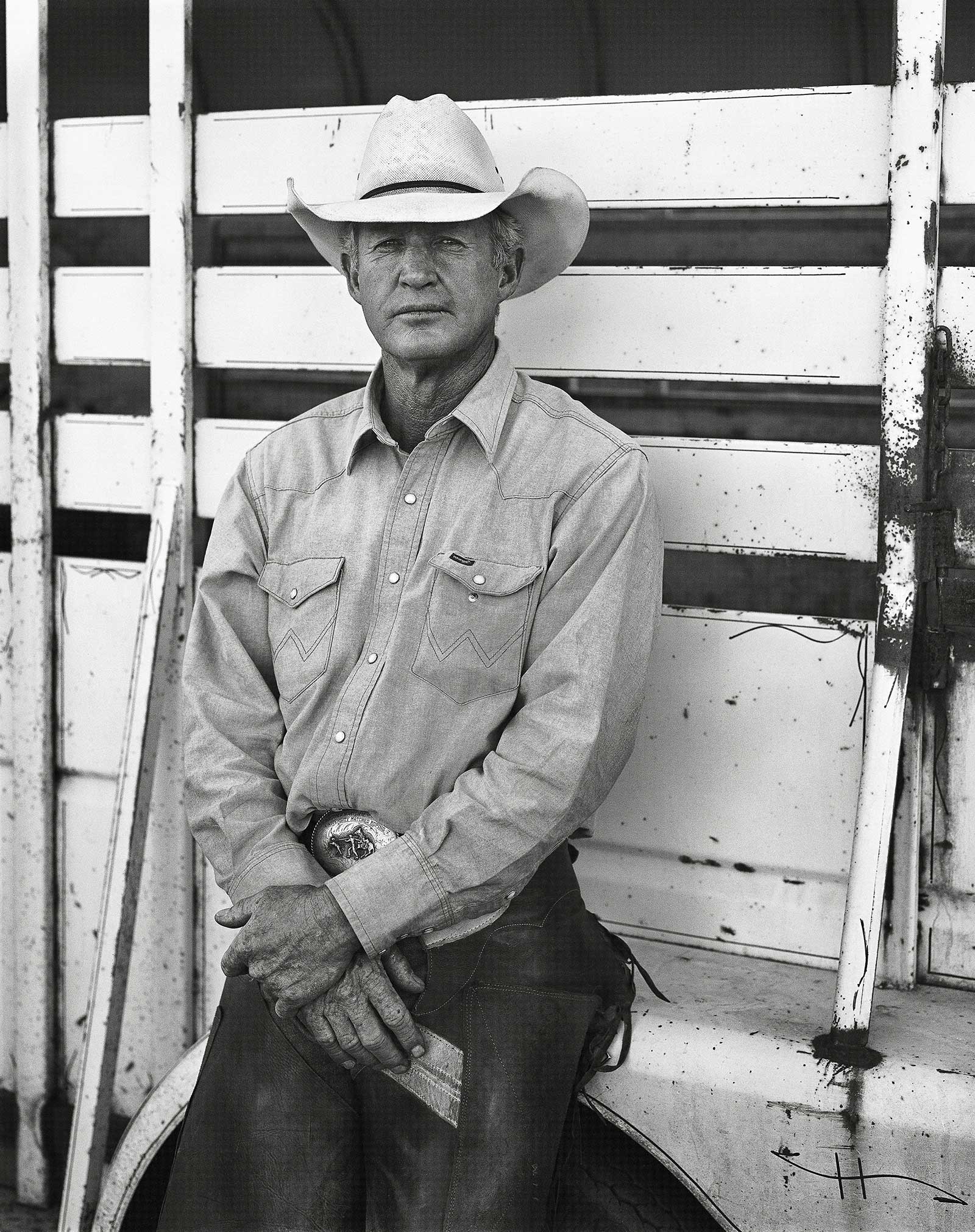 Sam Udall, 1999, Y Cross Ranch, Apache County, Eagar, Arizona, ranching family since 1897, archival pigment print from film negative, 62 x 51”
As for the future, Baxter says, “I’m eager to get back to the Sierra Bonita Ranch project, but I’m also involved with the smaller ranchers who are facing uncertainty due to competition from corporate ranches, rising costs, and climate change. Things have changed since I started. They’ve changed since I finished. I’ve spent time with Dennis Moroney, from the 47 Ranch in McNeal, Arizona, who practices holistic land management. He’s also introduced a North African breed of cattle, the Criollo, that’s more drought tolerant. And Walt Meyers is a rancher who also has a Ph.D. in Range Science. He and his daughter Katie, from Pinal County, are well-regarded range specialists, and I’ve gone out with them to do research.” 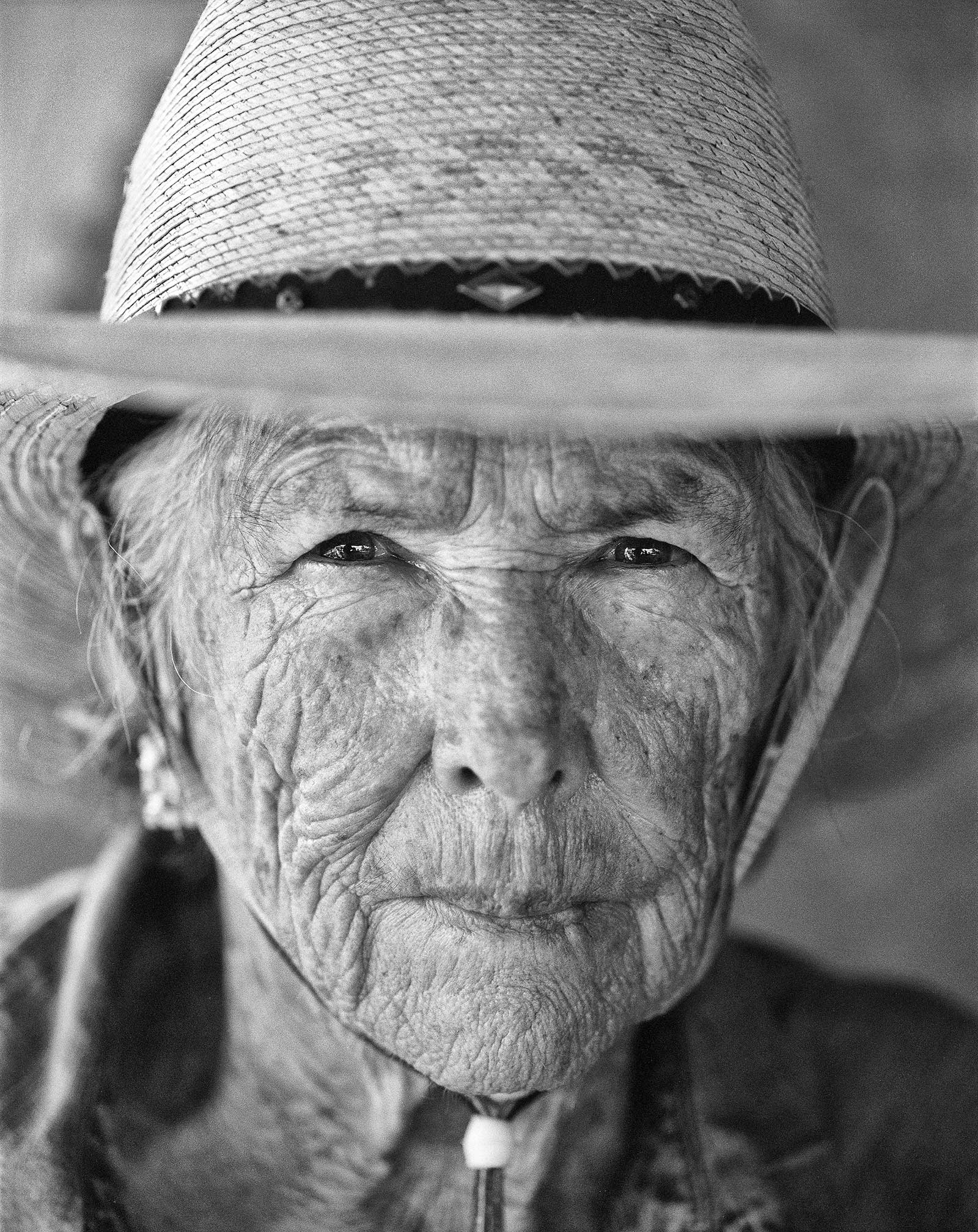 Connie Brown, 2011, H4 Ranch, Gila County, Punkin Center, Arizona ranching family since 1880, archival pigment print from film negative, 44 x 38”As the indelible images attest in The Gather—A Portrait of the American West—Scott Baxter, Baxter is an artist who is acutely interested in the story of ranching in the American West. That he is actively engaged as with the future of the West as well, as ranchers adapt to new realities, should, by this time, come as no surprise at all. —
Gather—A Portrait of the American West—Scott Baxter
Through July 30, 2023
Western Spirit: Scottsdale’s Museum of the West, 3830 N. Marshall Way, Scottsdale, AZ 85251
(480) 686-9539, www.scottsdalemuseumwest.org
+++
James D. Balestrieri is the proprietor of Balestrieri Fine Arts, specializing in arts consulting, sales, research and writing. He is currently the writer-in-residence for the Clark Hulings Foundation, as well as estate and collections consultant for the Couse Foundation and communications manager for Western Spirit: Scottsdale’s Museum of the West. He was director of J.N. Bartfield Galleries for 20 years, worked with Scottsdale Art Auction for 15 years and has written more than 150 essays for various art publications.
Powered by Froala Editor