Almost a decade ago, I had the privilege of accompanying Shonto Begay on a tour of his homeland on the Navajo Reservation in anticipation of The Map of My Heart, a retrospective of the artist’s work at the Museum of Northern Arizona in Flagstaff. We drove to the far northeast corner of the state until reaching the high Sonoran Desert of the Colorado Plateau—a crystalline landscape of cedar mesa sandstone, blue sky, juniper, piñon and ponderosa pine, and blue-green sage.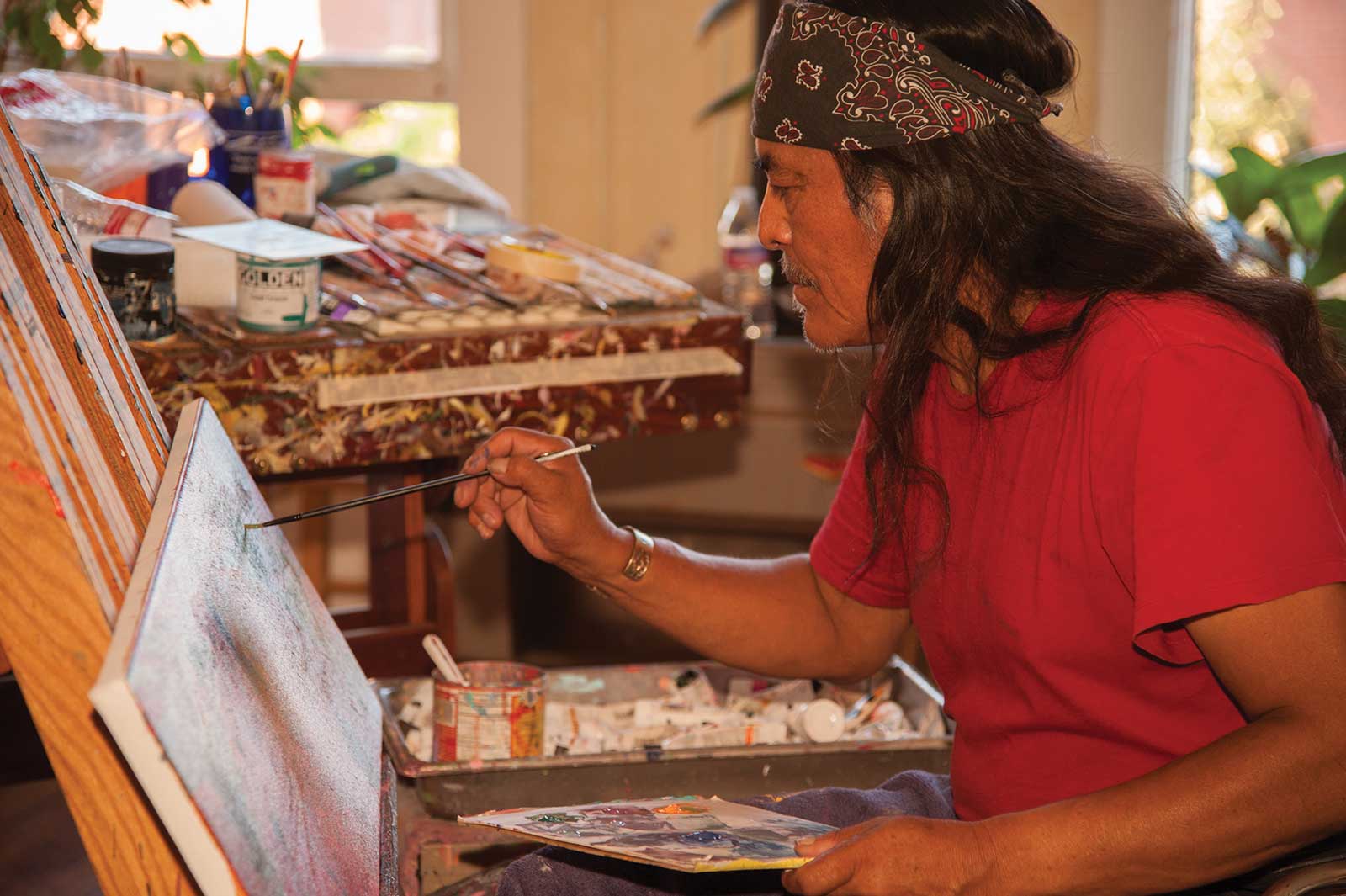 The artist at work in his Flagstaff, Arizona, studio. Photo by Dawn Kish.Below the steep edge of a cliff, he pointed to his grandmother’s homestead, a lush, spring-fed flatland spilling out of two canyons that converge to form Shonto Canyon, land ideal for farming, shepherding and its abundance of shade. It was here that Begay remembers the first painter he ever saw, sitting under a cottonwood tree.
“I peered over the shoulder of this plein air painter and I saw brilliant green,” he recalled. “I saw the red canyon wall; I saw the sunlight; I saw the deep shadows. The other kids scratched their heads and walked away. But I never forgot that interpretation of my canyon from under the cottonwood tree.”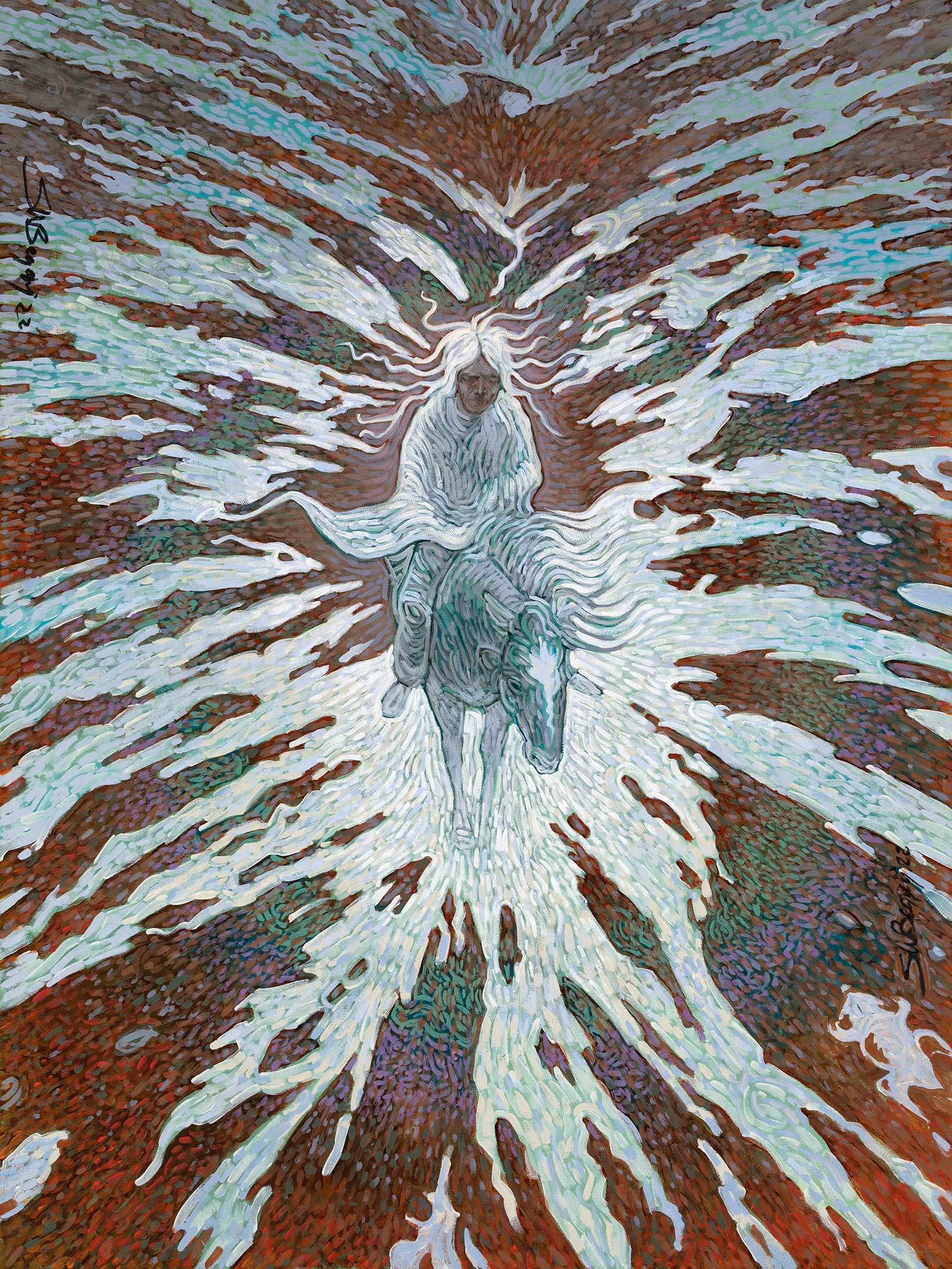 Winter Rides In, acrylic on canvas, 30 x 40”
Art-making was discouraged in the harsh environment of the U.S. government American Indian boarding schools Begay and other Navajo (Diné) children were forced to attend. Surrounded by barbed wire and guards, they were punished severely for speaking their native language and assigned Christian religions based on their height. “You go play their game for the whole year and have your hair cut, wear ties and shoes,” he shared. “And when you come home for the summer, you throw your shoes away, and run barefoot in ceremony all summer long.”
Begay would draw on the air if he had to and was able to see the lines, suspended there, for as long as he liked. “I started on the journey of creating art to stay alive,” he said. “It externalizes pain. It’s finding a sense of pride, a sense of strength, a sense of godliness in creating, a sense of some power when all else was taken away from you. You still had the power of that gesture, that movement, that line, that great calligraphy to the spirit.”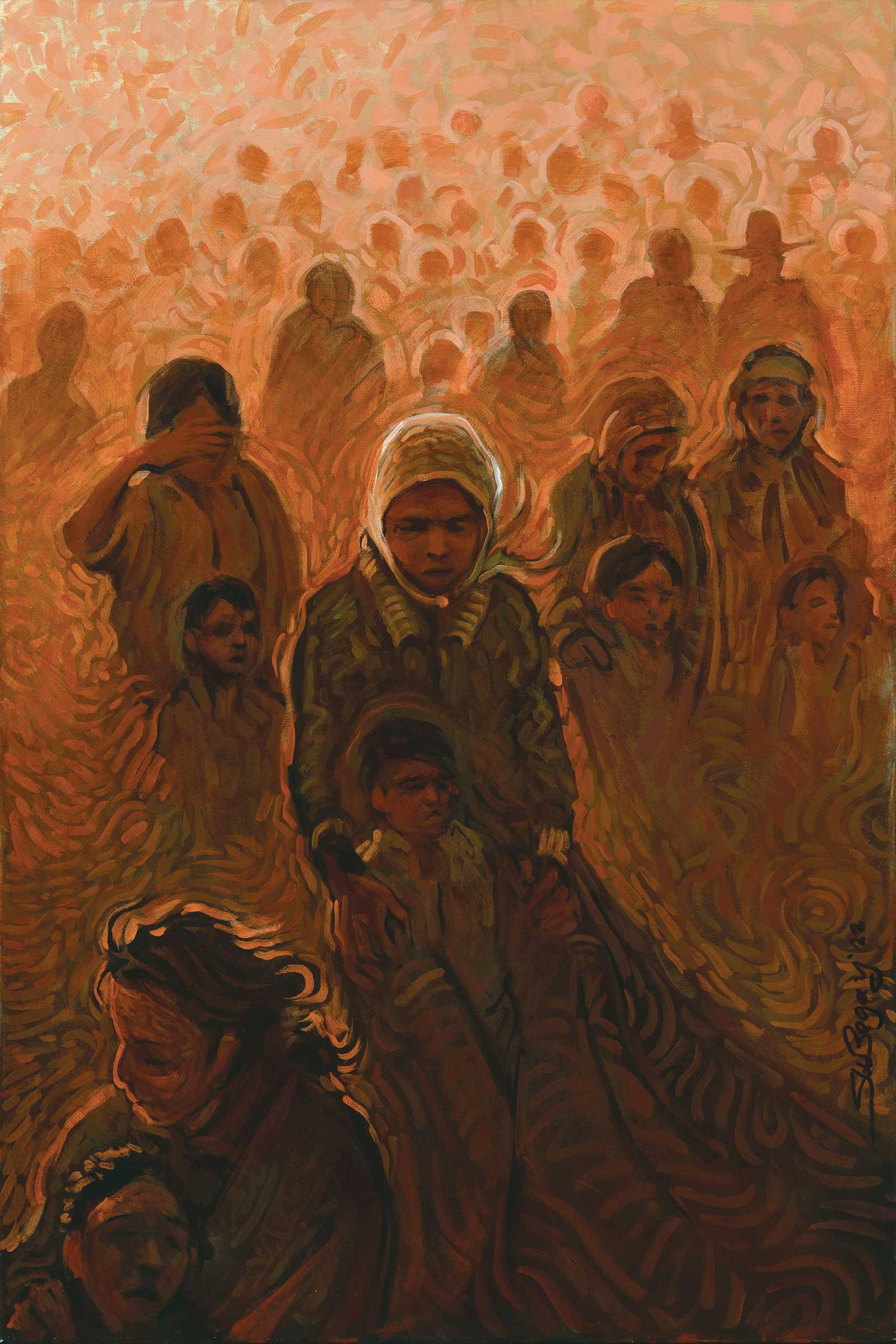 A Dusty Return to School, acrylic on canvas, 24 x 18”
Ten years later, the body of work he has created for an upcoming solo exhibition at Modern West Fine Art in Salt Lake City, is an even more expansive expression of the spectrum of experiences—from utter joy to deep sorrow—that Begay has witnessed and withstood over the course of his lifetime.
There are jewel-like scenes in alpine meadows singing with wildflowers such as Mountain Ceremony in which a sacred ritual is taking place. There is Searching the Undergrowth for Lost Goats depicting a boy on a donkey communing with wildlife in a scene alive with fall color. And, revisiting a favorite theme of his, Golden Rapture, which captures the poignant innocence of youth, with one of two children lifting a hand skyward as if to catch the light spilling through the flickering leaves of an impressionistic aspen grove.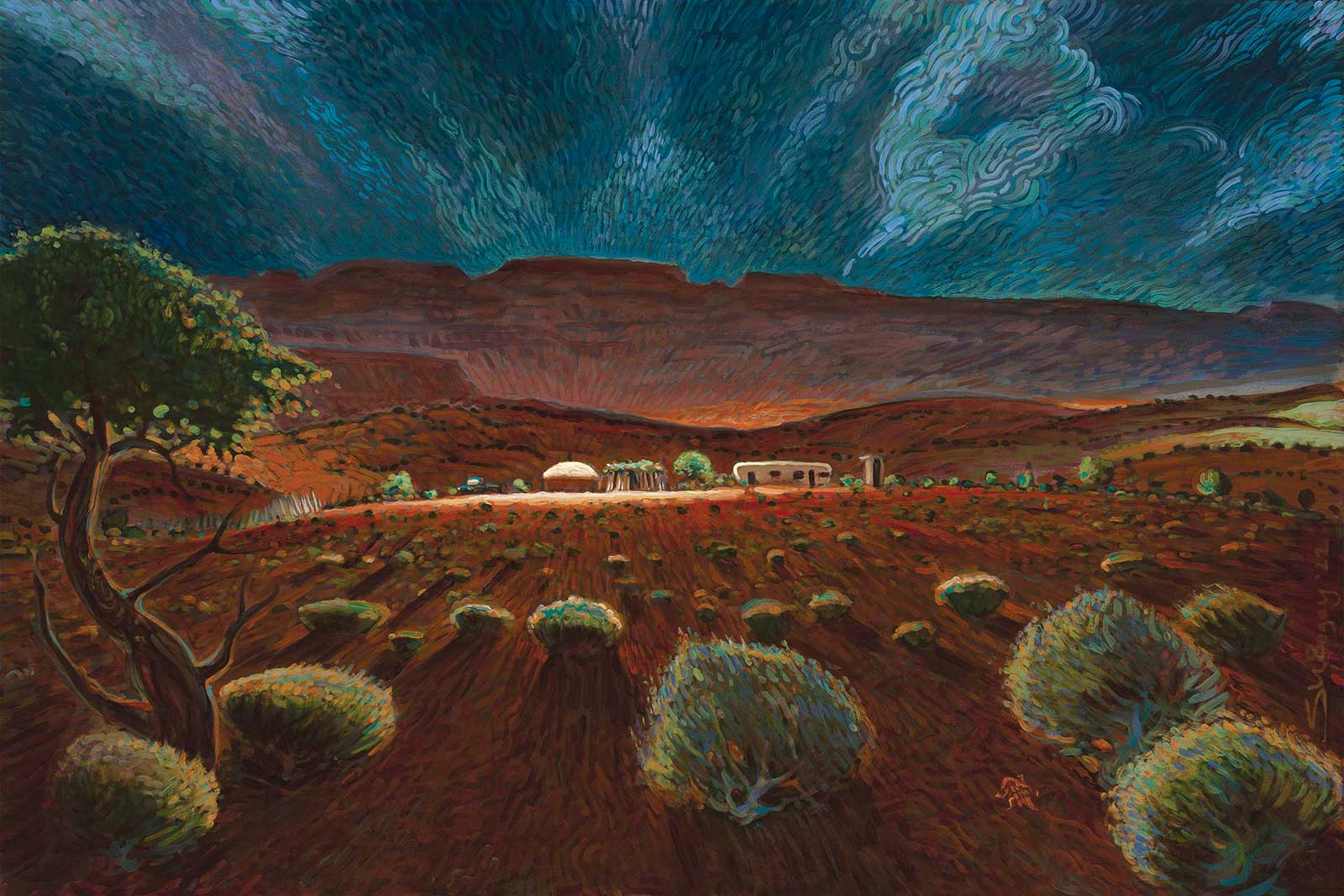 Light Play, acrylic on canvas, 24 x 36”These works speak to Begay’s strong sense of connectedness with spirit, nature, the land and family. The son of a revered medicine man, he doesn’t remember a time when that understanding wasn’t part of him. “I grew up at his foot and was always present during the chants and stories and ceremonies,” Begay says. “I still see and feel the energy within that sacred space, when people were being blessed and healed through those prayers. We are always being blessed. We are always being healed. I hope the viewers of my work can also be blessed by these scriptings to the universal god.”
He calls his paintings “visual chants,” because “each stroke is a syllable to a Navajo word, each word to a sentence, each sentence to a paragraph, to complete prayers or just a conversation,” he explains. “I like to think of each painting as a completion of a blessing or healing ceremony. That’s the purpose of art. That’s the spiritual void it should fill.”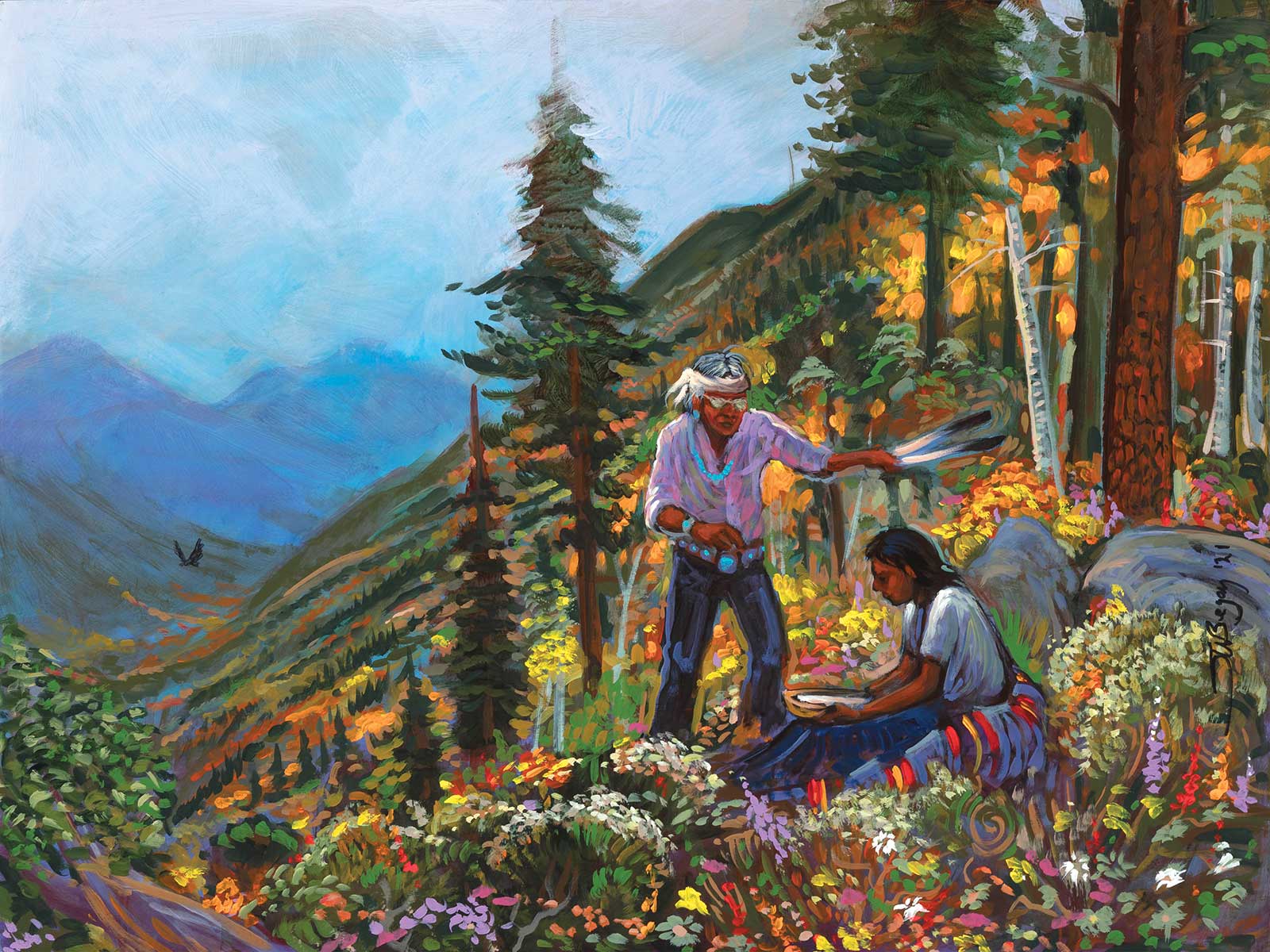 Mountain Ceremony, acrylic on board, 18 x 24”In this collection of new work, there are also paintings tinged with sadness. They draw from the cruelty endured in the government boarding schools, humanity’s attempts to numb or forget the pain, the recent loss of several dear friends and the devastating effects of Covid-19—especially on the Navajo people. These paintings are like the flip side, the shadowy underbelly, of those that emanate light, color, beauty and connection.
Begay conveys this heavier mood through his choice of palette, style and subject matter.
A Dusty Return to School conjures thoughts of the huddled masses—a sea of mothers and children bundled up against the gritty red wind as they make their way back to the boarding school after a summer of freedom and familiarity.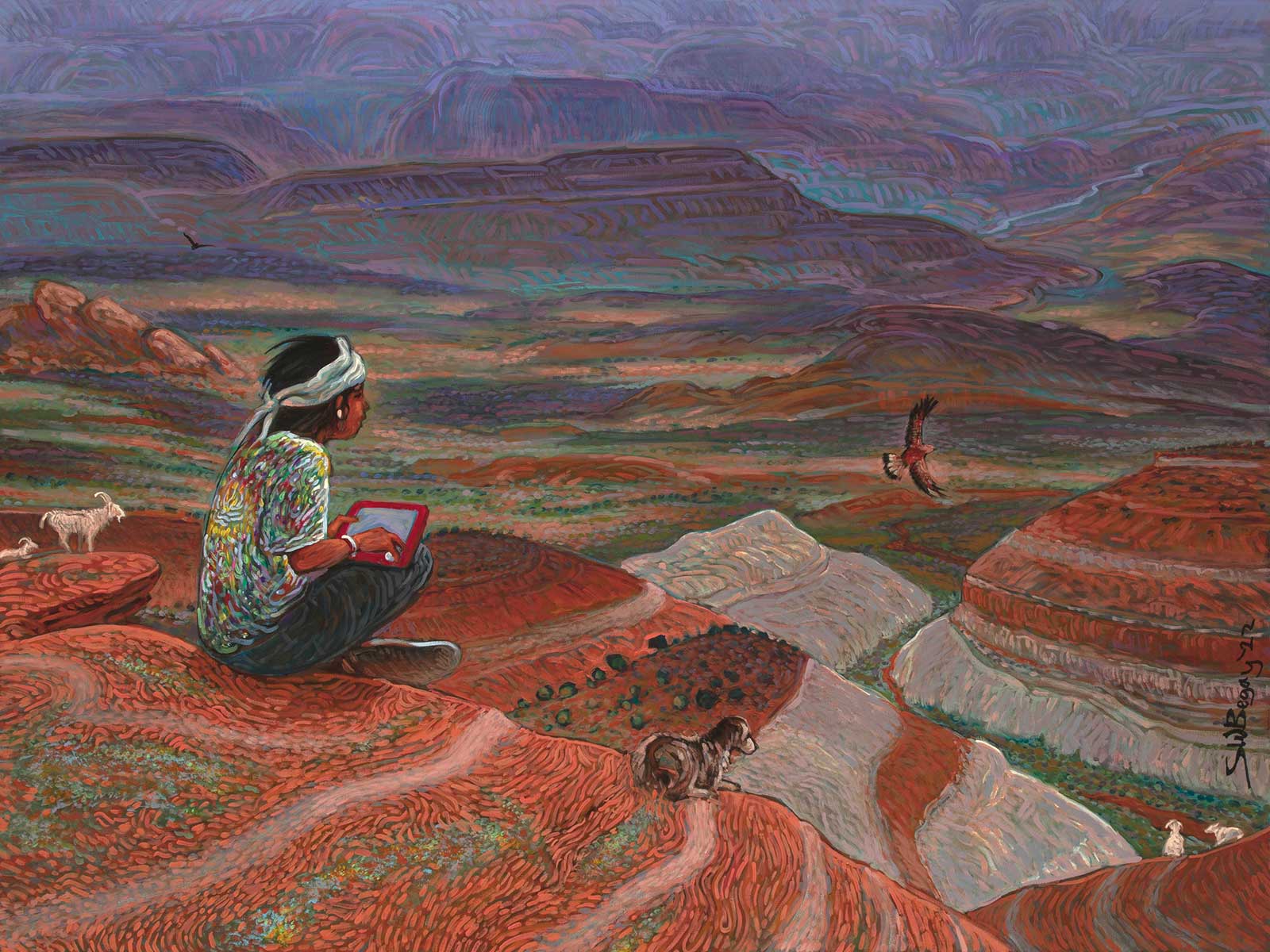 Divine Connecting, acrylic on canvas, 36 x 48”“It was a sad time, a harsh moment, kids clinging to their mother’s skirts, kids crying…,” Begay recalls. “You can never shake it; it’s always there. The brutality of it. We’re walking traumas. We still carry a lot. Some of us still suffer. I try to deal with it the best I can and that’s through the art. If I didn’t express the joy and pain and all the emotions that come with it I would internalize it and that would not be good. Some people write, act, sing. Some are angry, some march—I sit in my studio and paint.”
Party to Some Saint depicts revelers drinking and dancing in a hazy scene of unconscious abandon. Rendered in muted gray-greens, the artist’s signature undulating strokes are loose and undefined. A ghoulish figure prays in the center; another clutches a bottle on the fringe—a sense of emptiness pervades the occasion.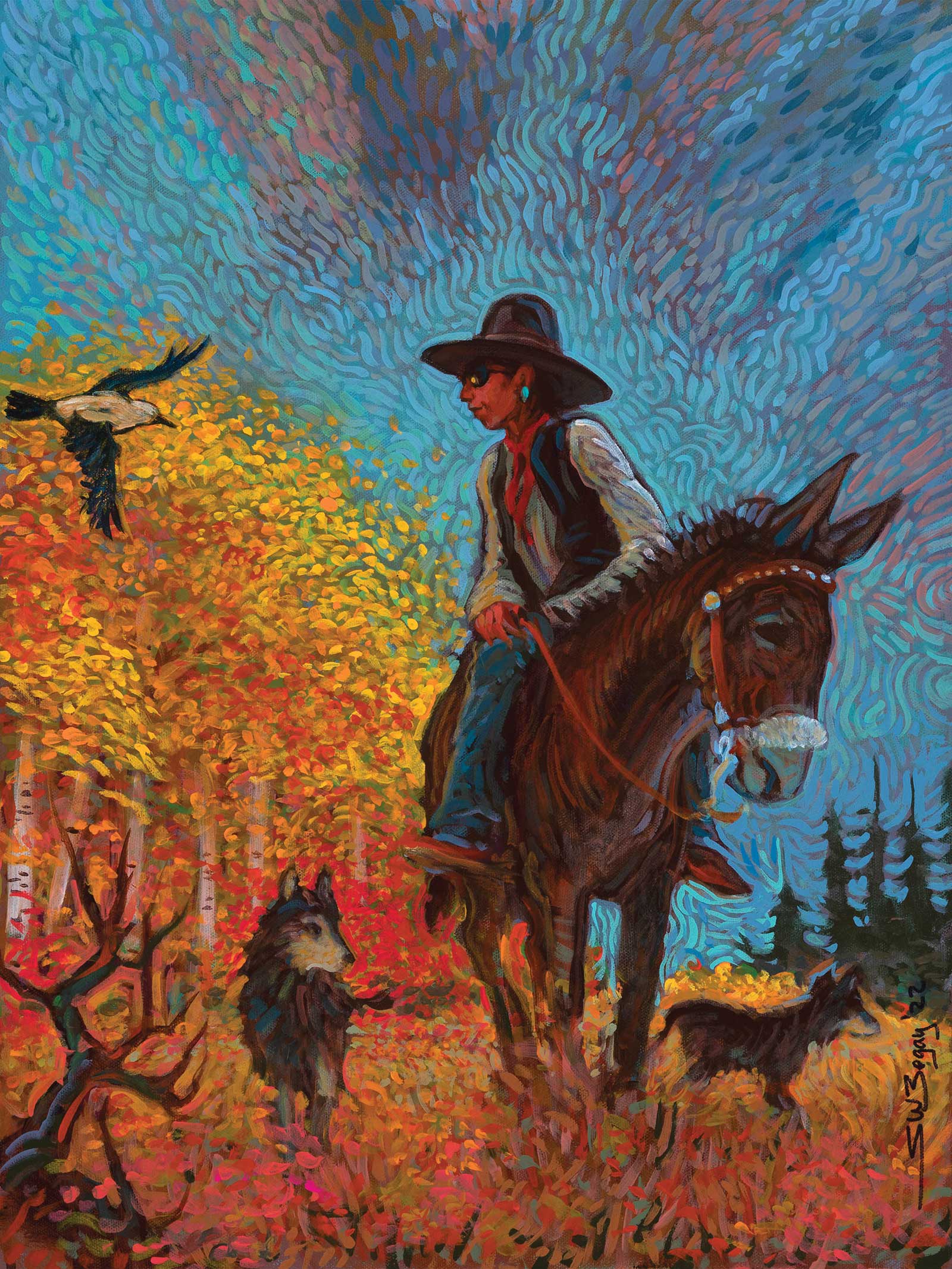 Searching the Undergrowth for Lost Goats, acrylic on canvas, 24 x 18”
“This is not a birthday cake, balloon and confetti type of party,” says Begay. “It’s out on the rez where people are making their own party. The saints are all foreign to me so I don’t allow them too much color. The mountain is something I am very associated with. It’s something I know. The color, the movement… I see ceremony in the birds and the plants. They’re all homages to nature and what the sacred mountain gives so of course there is color, sanctity, sacredness.”
After Happy Hour, a scene in a bar has a similar feel—as a detached observer you see the sadness in it. “I know those [scenes] too,” Begay admits. “They are also what I see and what I know. I did participate in those crazy beautiful events. I’m exploring all sides, all aspects. It’s just another texture to life. [Art] a way of exorcising a lot of the harshness of it, the harder edges of those experiences.”
Also represented in the new work are several of Begay’s distinctive landscapes, expansive desert vistas that draw the viewer in toward the horizon with an almost magnetic pull of line, color and perspective. Rendered in the wavy, swirly style that Begay is most associated with and for which he has long drawn comparisons to van Gogh.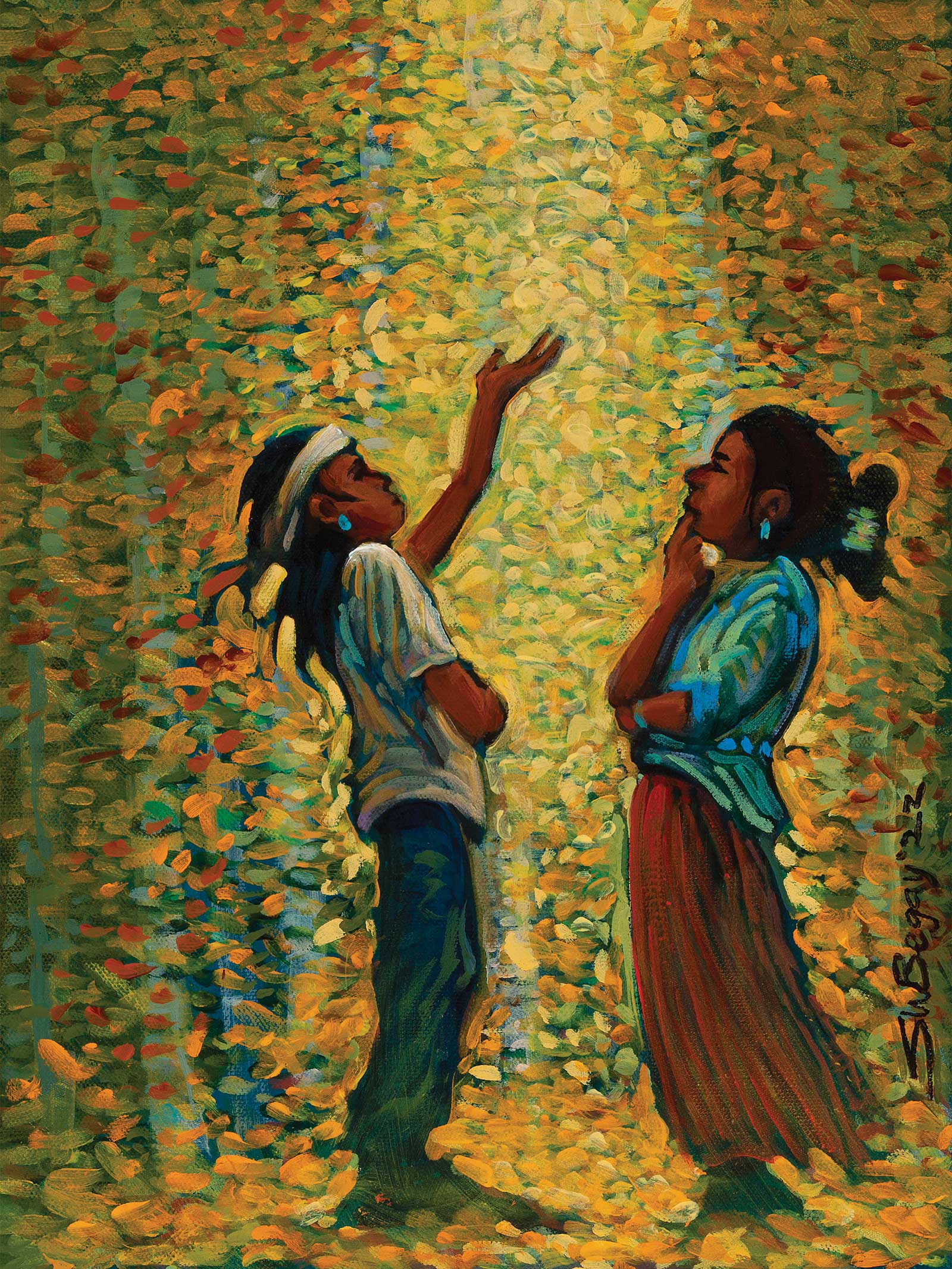 Golden Rapture, acrylic on canvas, 16 x 12”If it irks Begay, he graciously keeps it hid, ascribing any similarities to tapping into the same energy.
“The dots, strokes, lines, circles and curlies—these are my scripting to the universe,” he says. “These are languages, these are the alphabet as I see it. I make those lines marks very consciously. They are designed. They are my alphabet.”
When we spoke for this story, Begay was in his Flagstaff, Arizona, studio “watching the paint dry” on one of the centerpieces of his show at Modern West. Measuring 3 feet by 4 feet, the piece depicts an elder seated beneath a gnarled juniper tree being “visited by ravens” in the soft glow of warm light. It’s a scene Begay is revisiting, this time, he says, with a little less sadness. Another anchor piece, Divine Connecting, also depicts a solitary figure, this time a boy perched on a mesa plateau doodling with an Etch A Sketch, a medium Begay continues to doodle with today.
These pieces are two of more than a dozen works in the Modern West show, all of which were created in 2022.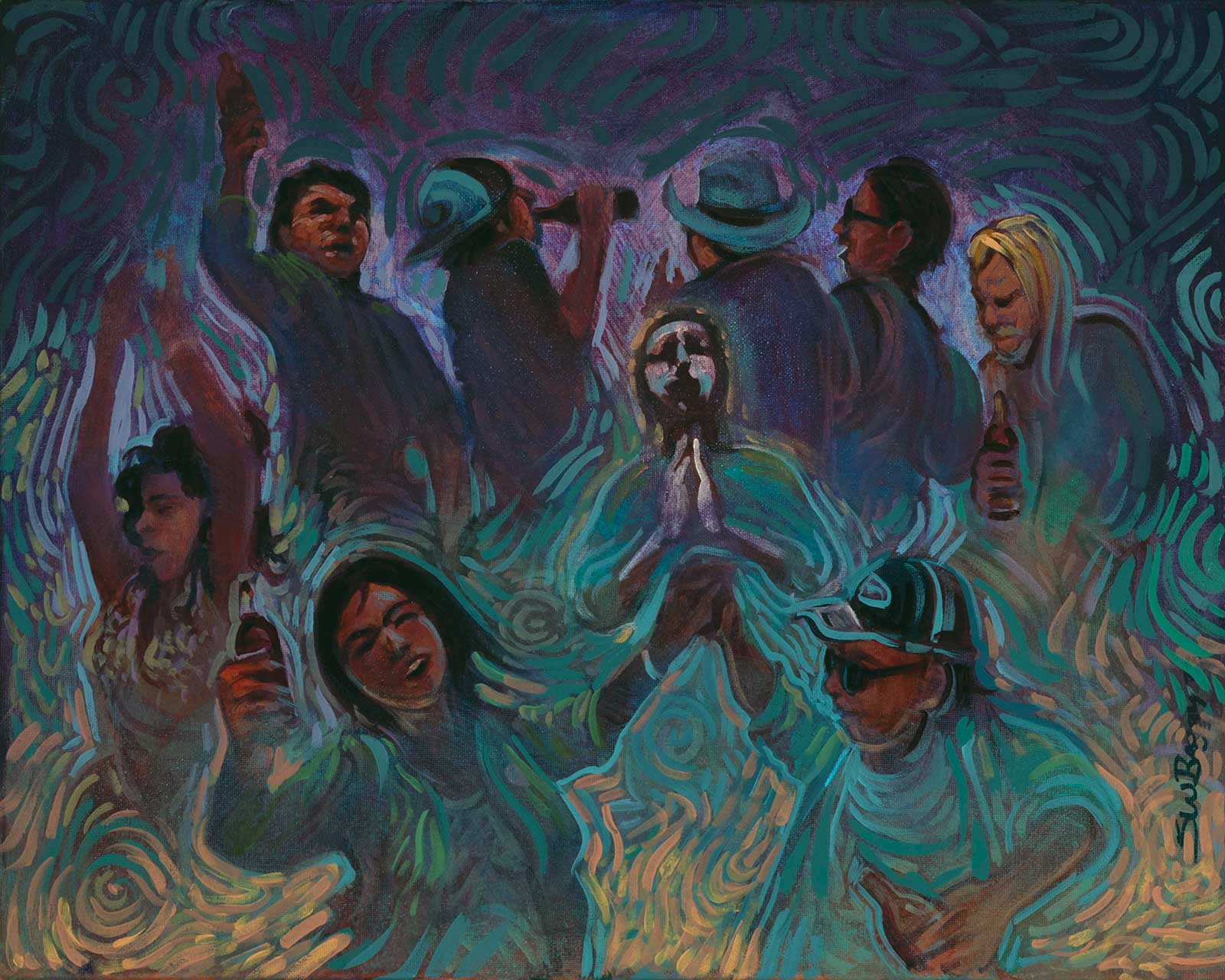 Party to Some Saint, acrylic on canvas, 16 x 20” Painting photography by Tom Alexander PhotographyBefore the pandemic, Begay would visit his hogan on the reservation every week where he would spend time with his extended family and mother, who turned 100 years old in November. Now that the Covid-19 situation has improved, he is starting to return more frequently.
“Post Covid, [this work] is a way of taking a deep sigh. We’re getting back our blessed ways. We survived; we’re surviving, but it’s still there,” he says. “It is a way of showing gratitude and celebration. I guess it makes me a little bit more determined to document my own vision because you never know when your number is coming up. It is a continual honoring of the gift I have on loan from the great spirit.” —
Shonto Begay: A World of Light
January 20, March 4, 2023
Modern West, 412 South 700 West, Salt Lake City, UT 84104
(801) 355-3383, www.modernwestfineart.com
Powered by Froala Editor