During the 1870s, the photographer William Henry Jackson (1843-1942) traveled throughout the West documenting the landscape. His mule team carried his 8-by-10-inch and 20-by-24-inch cameras, tripods, glass plates, chemicals and trays, as well as a dark tent to coat and develop the large glass plate negatives. On one fateful day, a mule lost its footing and Jackson lost a month’s worth of finished negatives.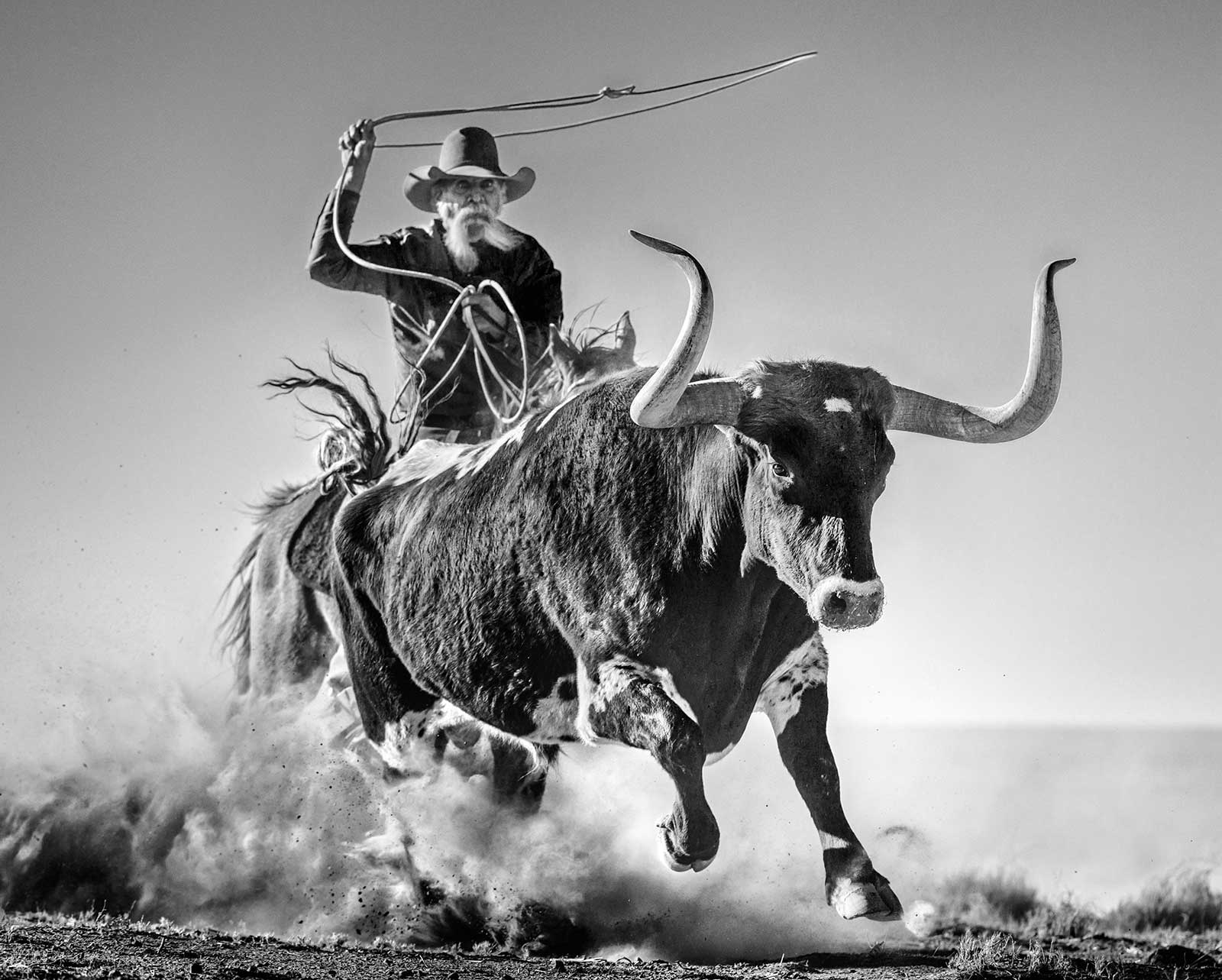 Relévant Galleries, Ain’t My First Rodeo, archival pigment print, large (framed): 71 x 85", standard (framed): 52 x 61", by David Yarrow.
Thomas Moran (1837-1926) camped out, hiked and road horseback to get to locations where he made his watercolor paintings and pencil sketches of the West and later did large oil paintings back in his studio, often combining different aspects of a scene to make a more pleasing composition. His watercolors were reproduced for the general public as high-quality chromolithographs.
Today, photographing, composing and even painting are accomplished in ways Jackson and Moran could never have imagined.
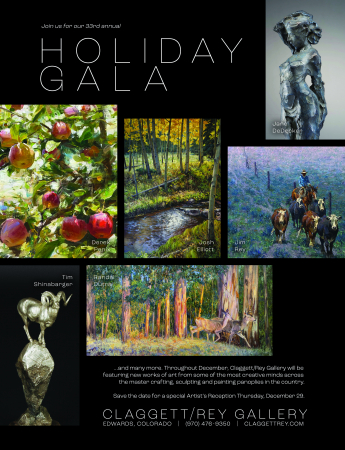
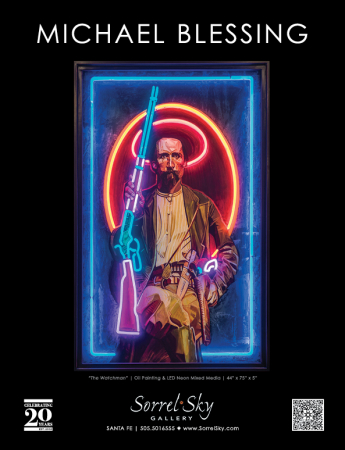
Jim Rey, a master of horse and cowboy drawings, paintings and etchings, acquired a digital tablet in 2012 wondering how he might use it in his daily sketching sessions. He says, “When an artist works on a still life or works with a model, he arranges his subjects in a way that is pleasing. [With the e-pen] I’m able to shift and rearrange, to make items bigger or smaller, to crop to get my final arrangement.” He comments, “I’m still very traditional, when you get right down to it. This is simply a new tool, a new medium. I don’t know how it will evolve technically. I don’t precisely see where it is going and that’s part of the fun of it.”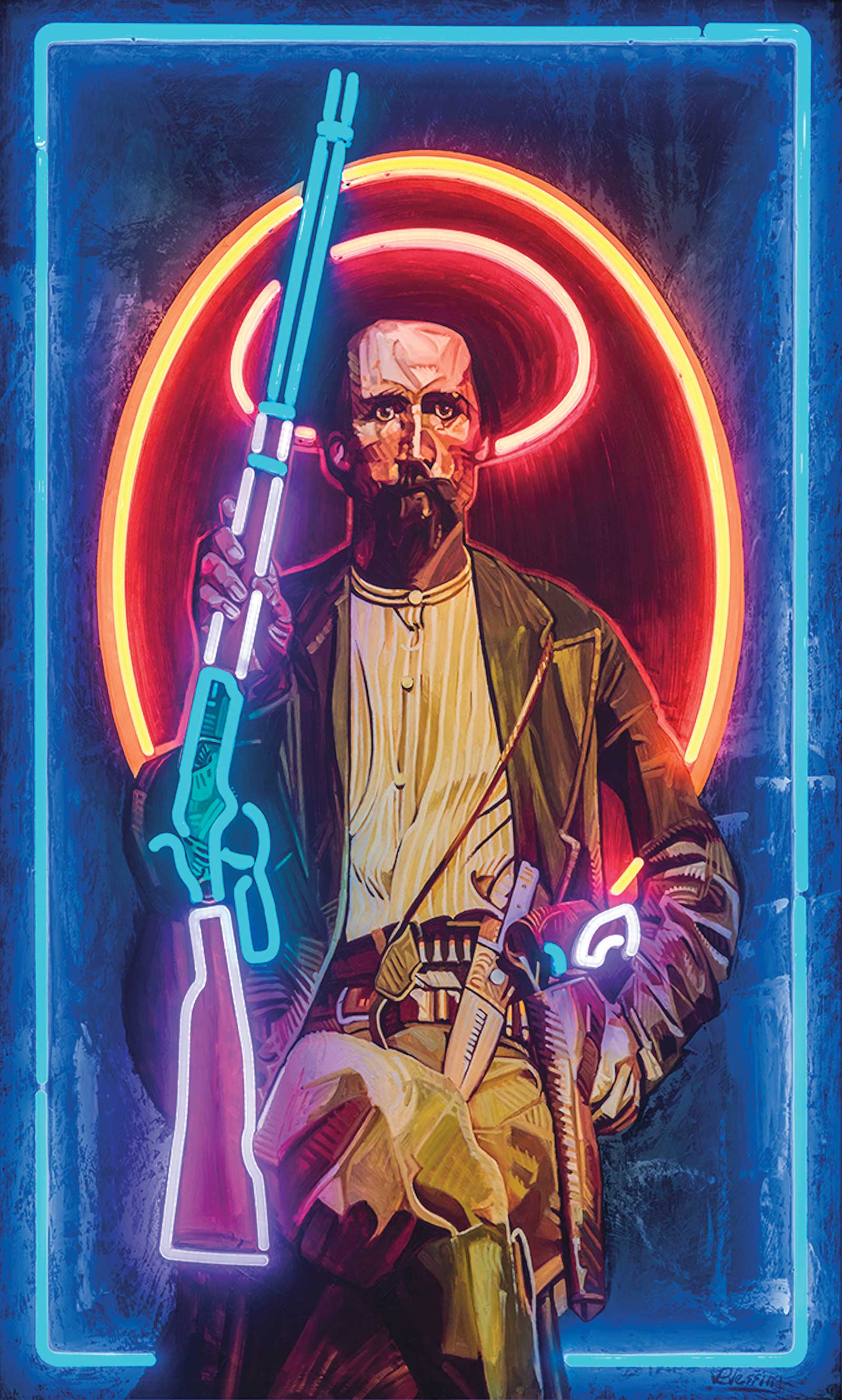 Sorrel Sky Gallery, The Watchman, original oil painting and LED neon mixed media, 75 x 44 x 5", by Michael Blessing.
Many of his digital sketches and paintings are now available in open editions, printed on aluminum in a variety of sizes. On the Trail, which can be purchased in sizes from 44 to 88 inches wide, is a rhythmic composition of cowboys on horseback with the figures in the foreground intensely colored while distant cattle and riders recede into the dusty distance.
Michael Blessing paints “larger than life historical characters” in a larger than life format, along with paintings of long-gone neon signs. Recalling an impressive, colorful neon cowboy sign he saw as a boy, he is now incorporating vibrant, colorful LED with his paintings.  Claggett/Rey Gallery, On the Trail, digital on aluminum, multiple sizes, by Jim Rey.The Watchman, at just over 6 feet tall, is Blessing’s interpretation of the Texas Ranger James (“Jim”) Hawkins who looks fearful in the vintage photo Blessing used as a reference. But, a writer at the time described: the “Sheriff of Custer County and residing at Miles City was elected on the ticket of the People’s party in 1892 and is a model Sheriff. He neither drinks intoxicants nor uses tobacco in any form…he was elected and his fidelity to his official duties proves the wisdom of the majority of voters in the county as all now agree that he is the right man in the right place. He is both vigilant and wisely courageous and withal a genial gentleman.”The neon echoes his vibrancy and highlights his rifle and pistol as well as his hat, suggesting he was a hallowed man of the West.
David Yarrow stages and shoots large-scale photos often combining the wild and contemporary West. The Scottish artist says, “The mythical cowboy, whose image has been shaped by history, fiction and folklore, is unquestionably America’s predominant symbolic native son.” For Ain’t My First Rodeo he enlisted his “go-to Texan cowboy” Ryon Marshall to rope a Texas Longhorn. Horse, rider, steer and lariat are in the air as they pass the photographer lying on the ground. His skill and high-resolution camera allowed him to capture the drama of the intense moment as well as the ferocious intent of the cowboy to rope the steer and the steer’s determination to escape—seen in the glint of their eyes.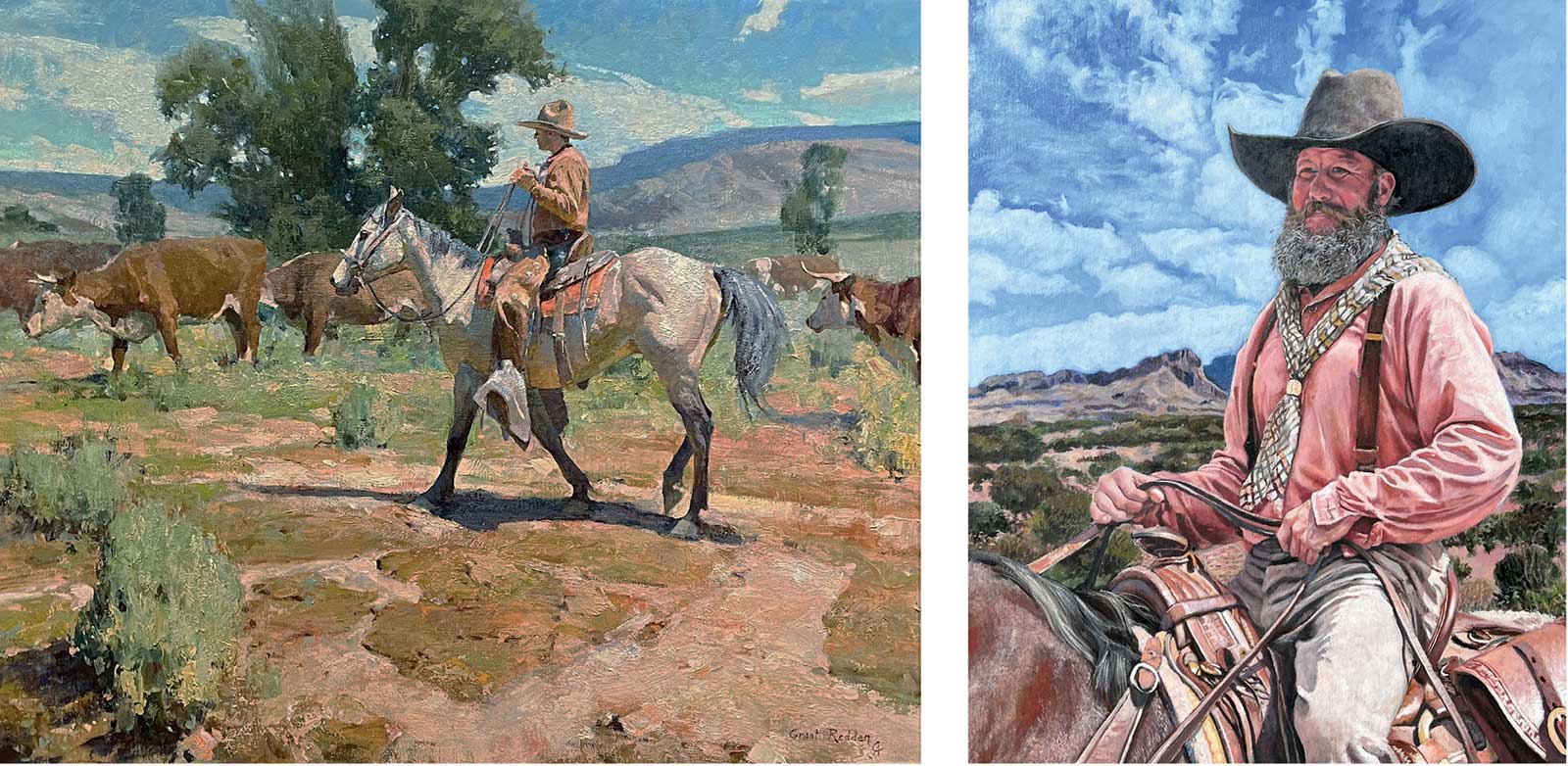 Legacy Gallery, Lonetree Cowboy, oil, 30 x 36”, by Grant Redden; Victor Blakey, No Fear, oil on canvas, 30 x 24”
Moving through the pages of this special section, you can explore even more scenes that capture the heart of the cowboy and their enduring way of life.
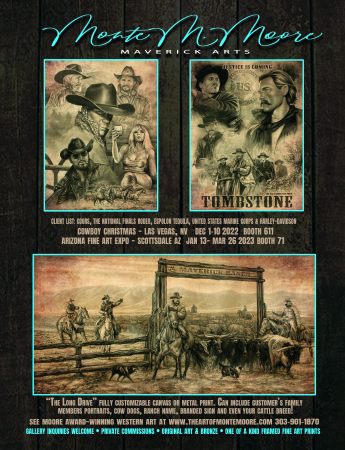
The influence of the American cowboy is iconic in American culture. The sense of wonder and adventure in the cowboy lifestyle has been inspiring to many great artists. That inspiration mixed with the experience of growing up surrounded by beautiful landscapes is what fuels artists Tom Browning, Grant Redden and Bill Anton. 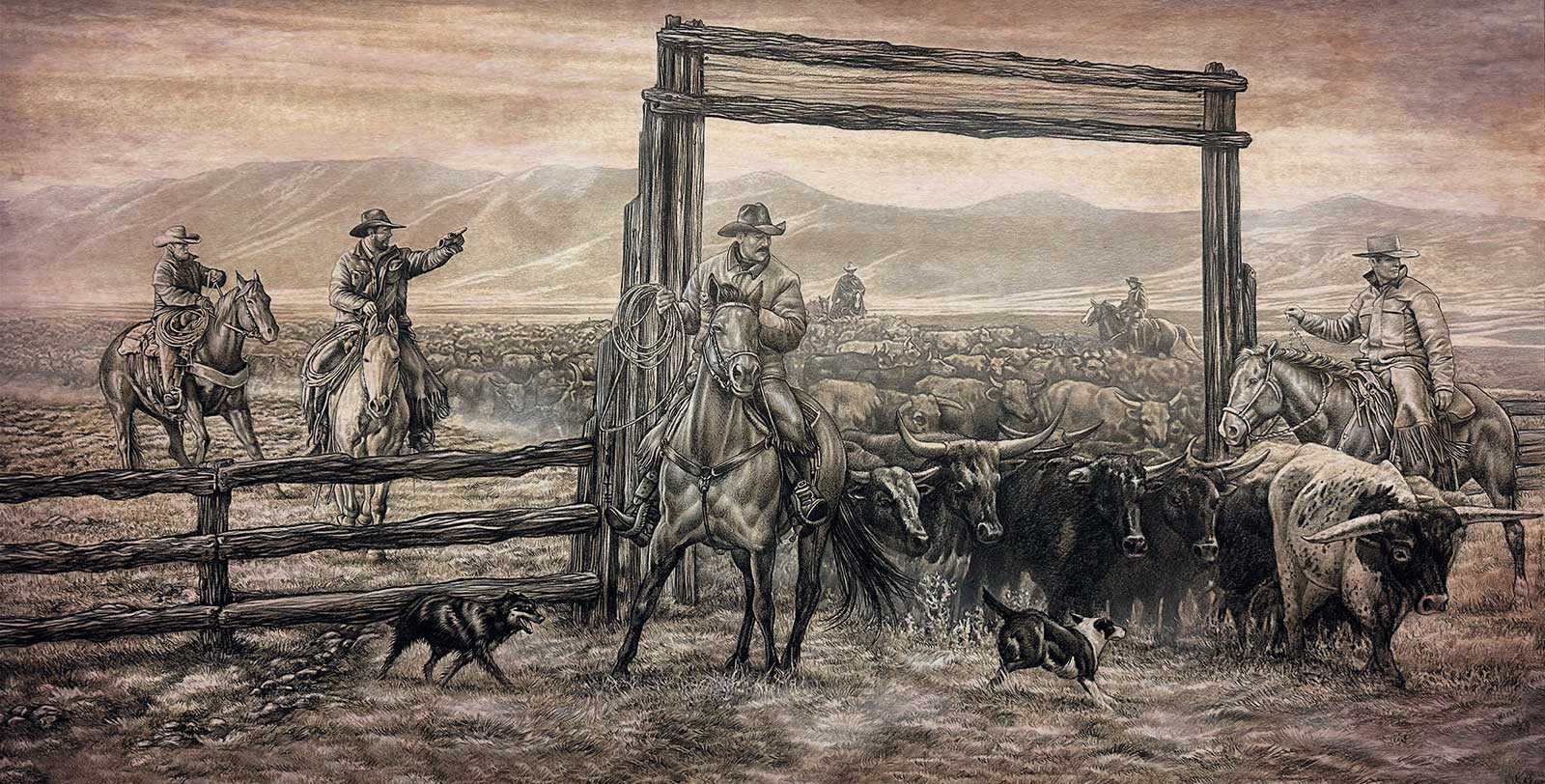 Monte M. Moore, The Long Drive, mixed media on parchment, 15 x 30"
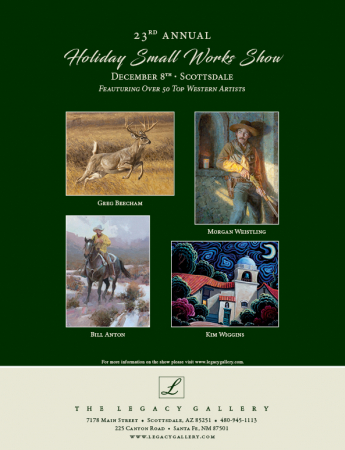
Browning has been painting professionally since 1972. Starting out with Western and wildlife as a choice of subject matter, he has had a multifaceted career that has provided many incredible paintings of different subjects and mediums. His love of the West has always been his biggest inspiration that has kept the Western theme alive on his easel. Redden always had the desire to paint, so he naturally looked at the landscape, the animals and the people as subjects for his creative impulse. Anton was born in Chicago. During his college years, he transferred to Northern Arizona University, where his love for the West grew even more. “An artist under the spell of the West has the privilege of marshaling the virtues of landscape, figure and equine painting into one supremely paintable subject: the American cowboy,” says Anton.
All three artists are represented by Legacy Gallery in Scottsdale, Arizona.
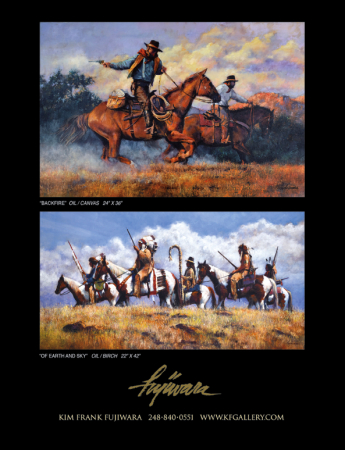
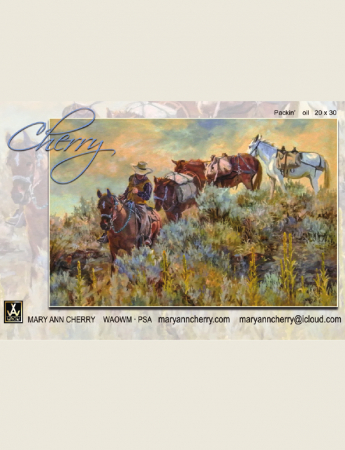
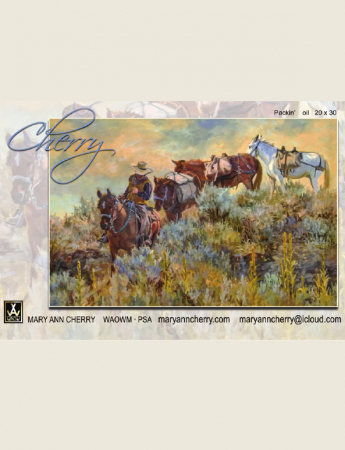
Kim Frank Fujiwara has spent more than 40 years as an award-winning artist/illustrator and the last 10 years delving into the fine art of the American West. He plans to open a studio in Arizona in the near future. “The American West has everything you need to fuel the creative soul and utilize all artistic skills and knowledge at the same time, from concept and composition, to color and mood,” says Fujiwara. “The American West offers an open range of subjects from cowboys and Native Americans to history and storytelling…From beautiful landscapes of national parks to the old towns of the West, it is a major part of American history.”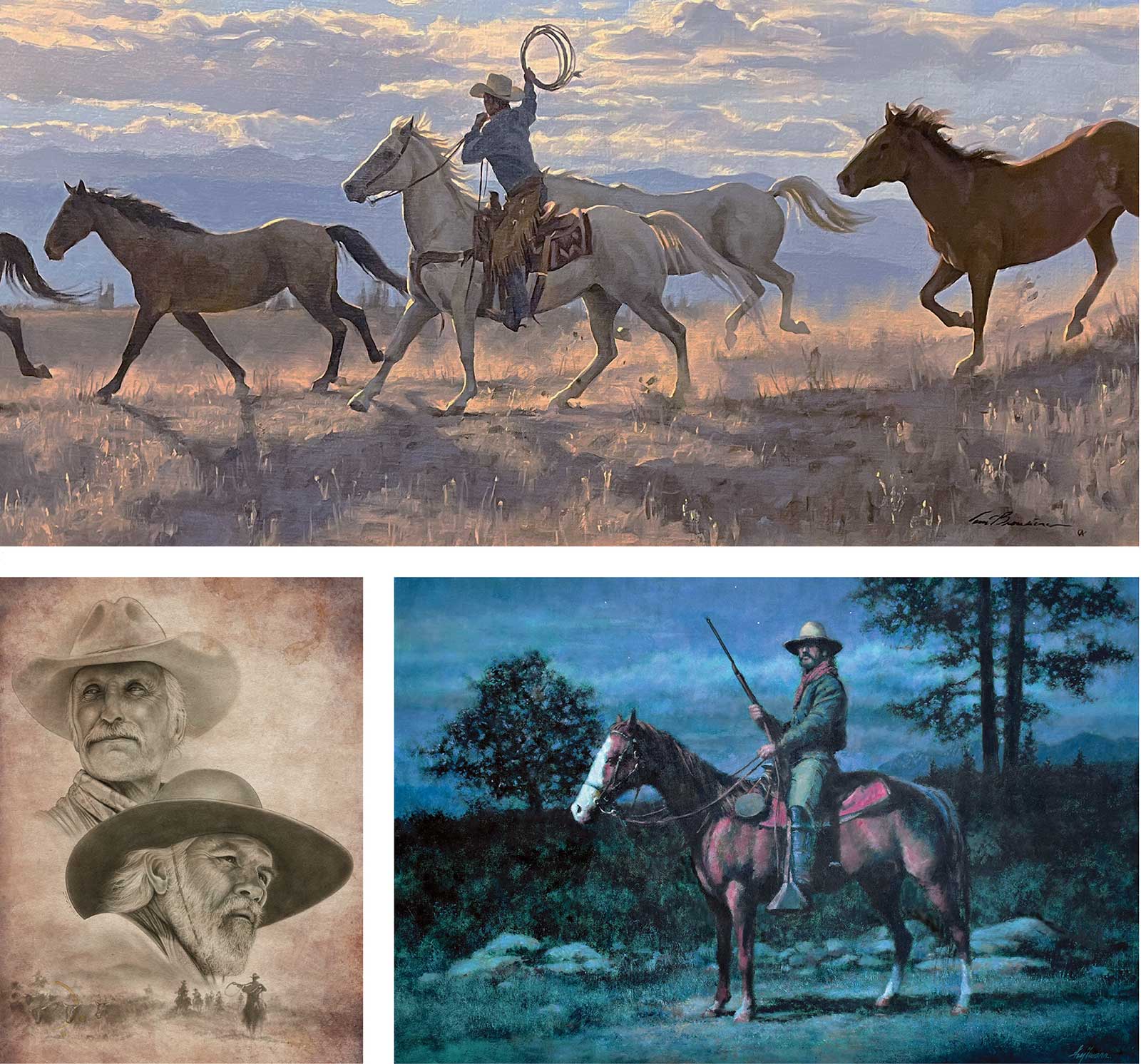 Top: Legacy Gallery, Run-in’ the Ridge, oil, 18 x 36”, by Tom Browning. Bottom, from left: Monte M. Moore, The Rangers, pencil on paper, 18 x 24”; Kim Frank Fujiwara, Moonlighting, oil on canvas, 24 x 36”Mary Ann Cherry loves painting horses, and through this passion, she also enjoys painting cowboys and “those rough-and-ready, hard-working cowgirls.” She says, “I had a horse growing up, but I’m the first to admit that I was never a great rider. I fed a few bum calves and tossed the occasional hay bale. But with two strapping older brothers, I never worked as hard as the lone women whose cattle depend on them. Most of society doesn’t see how much effort goes into calving season…A piece of art portraying that cowboy culture is as close as we come to sitting the saddle. It’s a way of life that is slowly disappearing, and I appreciate those art collectors who want a reminder of it on their wall.”
Having been raised on a 30,000-acre working cattle ranch, Monte M. Moore draws much of his inspiration from personal experiences and a deep love of the Old West, including the classic Western films. The artist grew up around the stunning paintings and drawings of Russell, Remington and many others. “I find myself ‘returning to the ranch’ as it were with my own series of work I call Portraits of the West,” he says.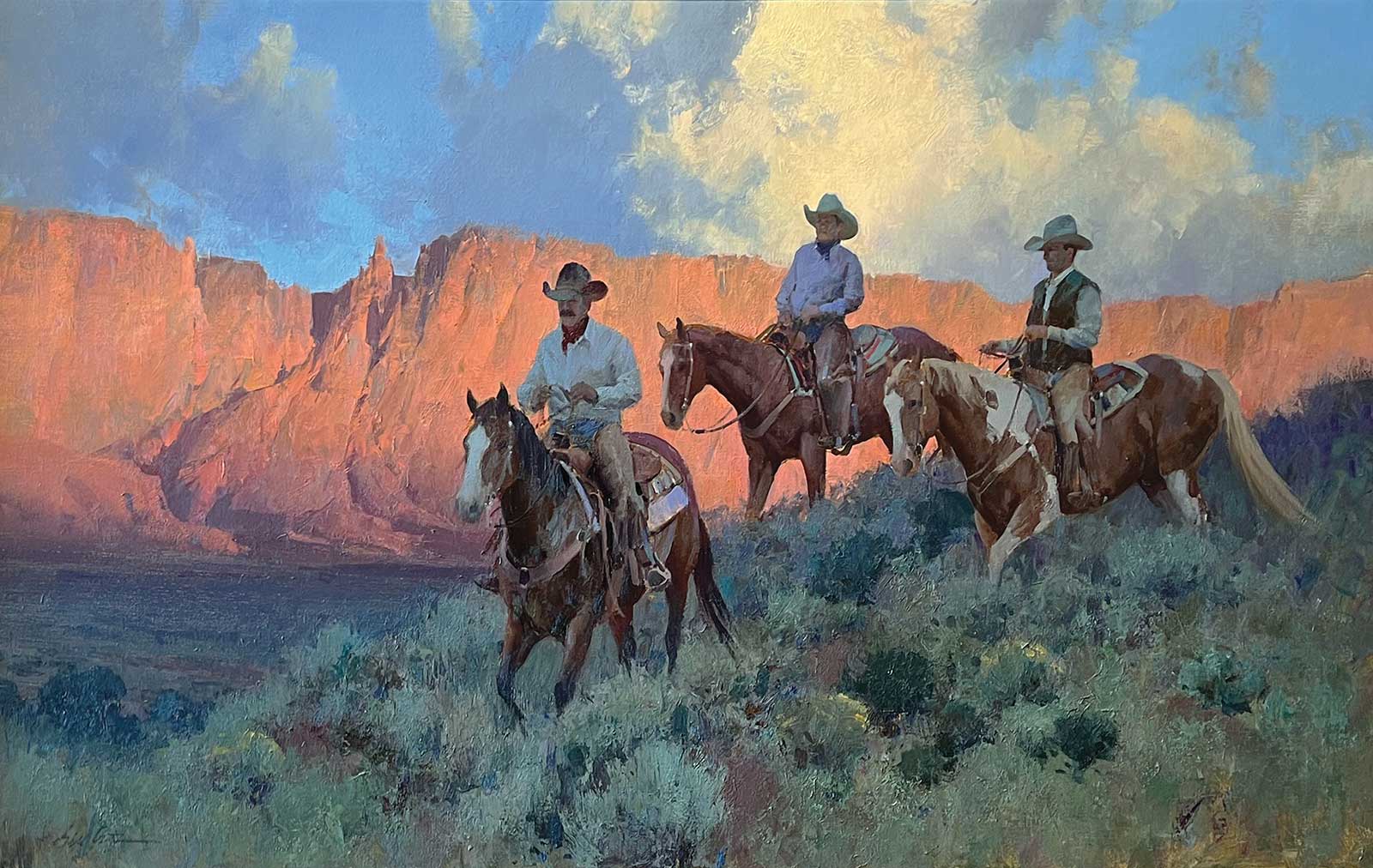 Legacy Gallery, Desert Silhouettes, oil, 40 x 65", by Bill Anton
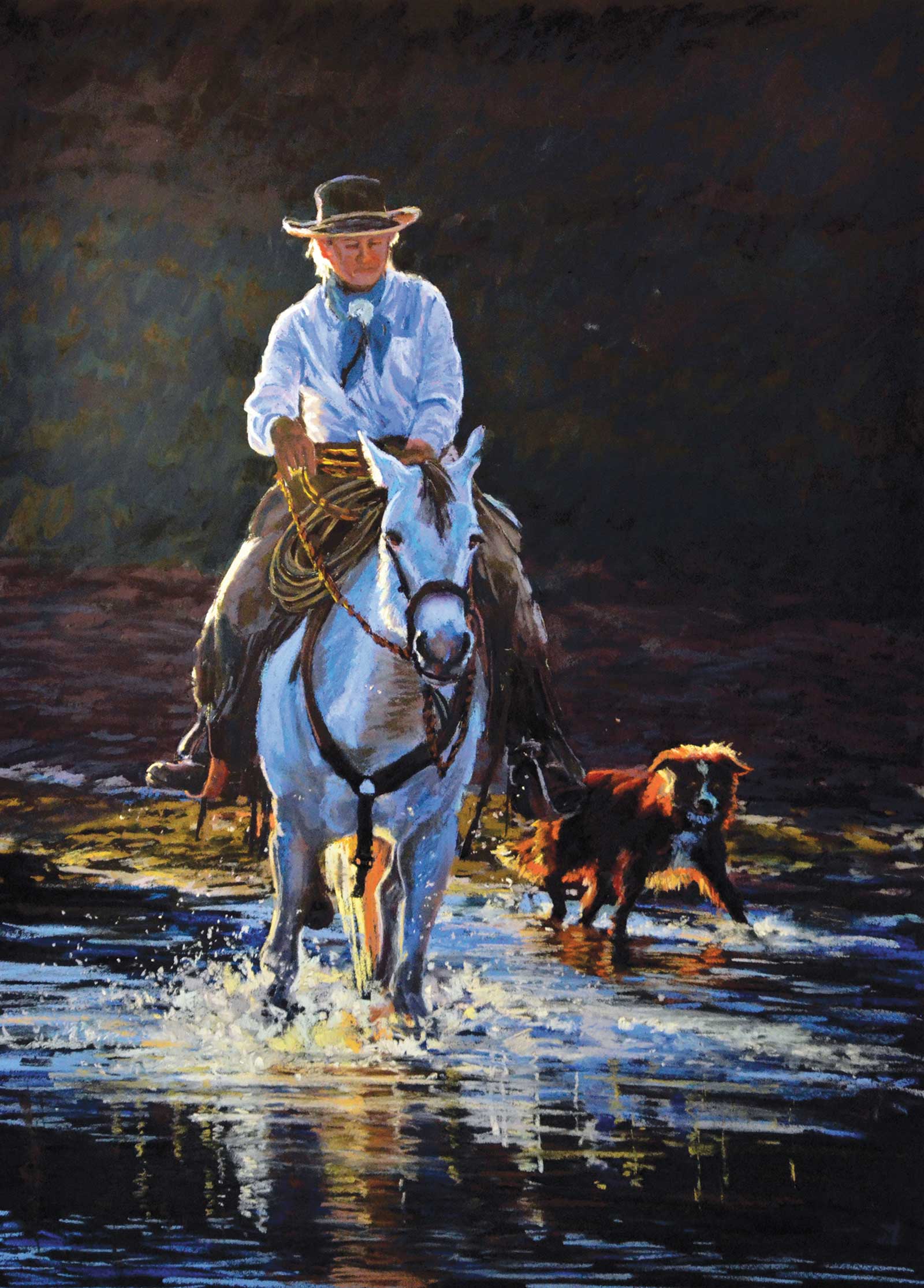 Mary Ann Cherry, End of an Eighteen Hour Day, pastel, 18 x 22"
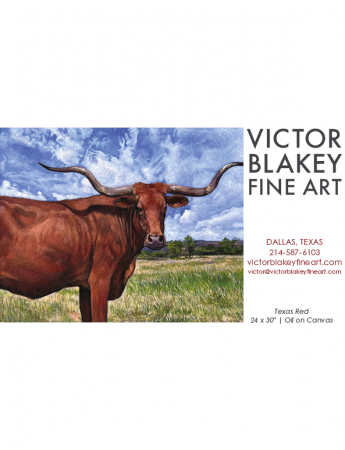
“Cowboys hold a special place in the imagination of Texans,” says artist Victor Blakey. “In a very real way, he is a reflection of the common man struggling against an unforgiving environment. I try to create this feeling of struggle in my paintings by using facial expressions. My background is that of a portrait painter, so I place a great deal of importance on the face. I build the painting around the facial expression, [as] conveying strength and vulnerability is one of the main goals in my work…I want the viewer to wonder about the life and hardships of my main character. My advice to anyone seeking to collect Western art is to find work that reflects the struggle of the iconic cowboy.” —
Featured Artists & Galleries
Claggett/Rey Gallery
216 Main Street, Suite C-100
Edwards, CO 81632, (970) 476-9350
www.claggettrey.com
Kim Frank Fujiwara
(248) 840-0551, www.kfgallery.com
Legacy Gallery
7178 Main Street, Scottsdale, AZ 85251
(480) 945-1113, www.legacygallery.com
Mary Ann Cherry
maryanncherry@icloud.com
www.maryanncherry.com
Monte M. Moore
5765 Aspen Leaf Drive, Littleton, CO 80125
(303) 901-1870, www.theartofmontemoore.com
Sorrel Sky Gallery
Durango, CO • Santa Fe, NM
(970) 247-3555, (505) 501-6555
www.sorrelsky.com
Relévant Galleries
Denver, CO • Scottsdale, AZ
www.relevantgalleries.com
Victor Blakey Fine Art
Dallas, TX, (214) 587-6103
victor@victorblakeyfineart.com
www.victorblakeyfineart.com
Powered by Froala Editor