Jane Rosen is fond of quoting Auguste Rodin who wrote, “The realities of nature surpass our most ambitious dreams.” She has spent a lifetime exploring the realities of nature from having a pet duck when she was a girl to living on her 40-acre ranch in California with its horses, foxes, birds and her beloved rescue dogs. Her experiences, her friends, students, apprentices and her mentors have helped Rosen hone her observation skills and to express the deeper realities of nature in stone, blown glass, drawings and paintings.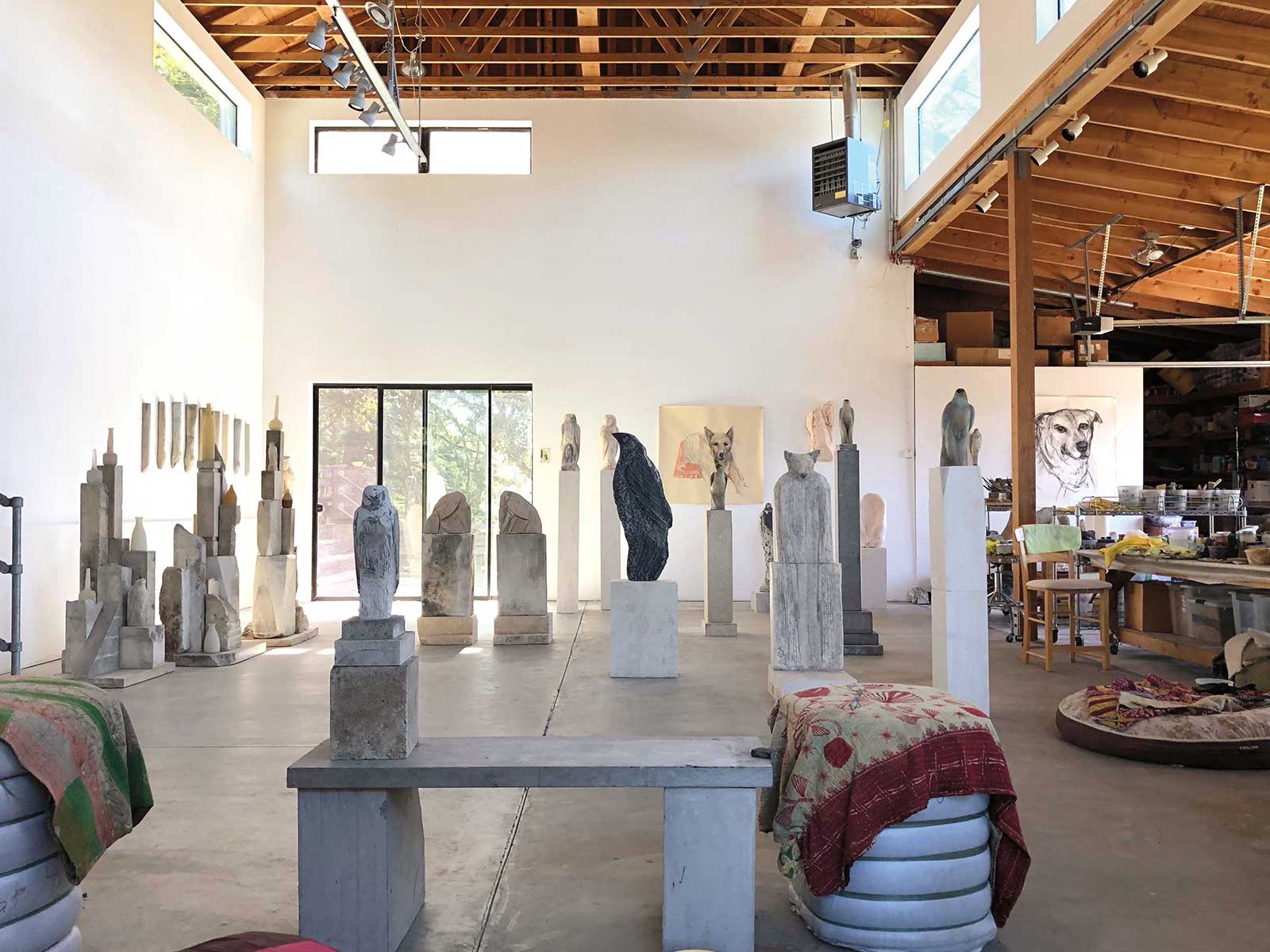 A view of Jane Rosen’s studio.
I first saw her work at Chris Winfield’s gallery in Carmel-by-the-Sea, California. A sensuous blown glass and pigmented falcon sat on a tall, rough-hewn limestone plinth. I was, uncharacteristically, struck dumb. The form of the falcon reminded me of ancient Egypt and the limestone reminded me of the long history of creation. A whole world of associations coursed through my mind as I stood and gazed at the sculpture—the evolution of the planet, of mankind, of art. I was as much in admiration of the sculpture as I would become of the artist—who, I thought, had to be living on a different plane, aloof and unapproachable. I later discovered, however, a warm, very funny woman very much on this plane.
Rosen studied at New York University at a time when minimalism was the accepted mode of expression, but she went to the Art Students League to learn Renaissance drawing and anatomy from Robert Beverly Hale who had been the first curator of contemporary American art at the Met. She recalls her experience at NYU and that “Marilynn Karp as my teacher and mentor, Ross Bleckner as a studio mate, Chuck Close as a painting teacher, Sol LeWitt for three-dimensional work, and Irving Sandler for his class on ‘Art since 1945,’ opened up so many possibilities in my work—work that could address both the minimalist art around me and the questions raised by art and science throughout history.”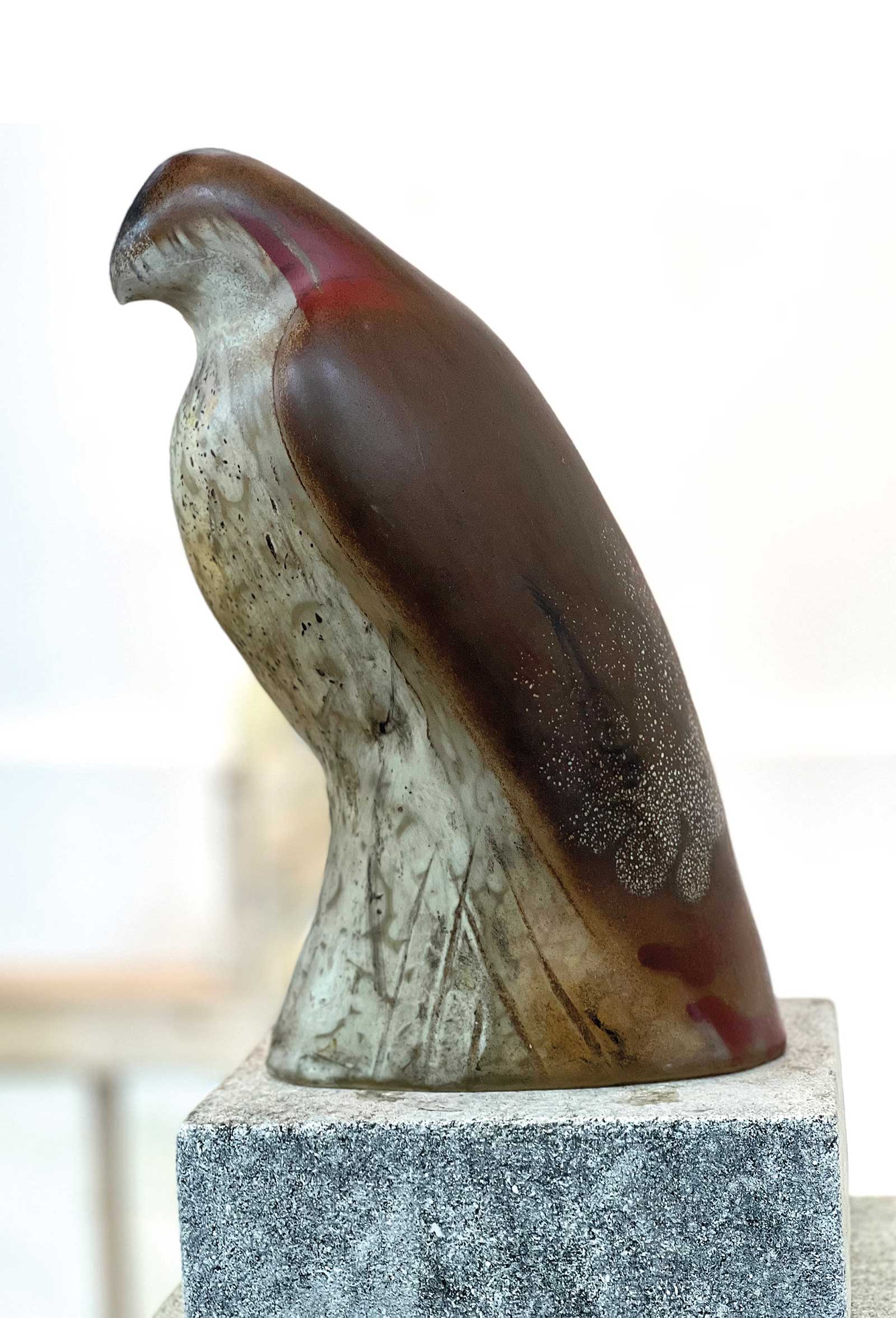 Lola on Stone, 2022, hand-blown pigmented glass and limestone, 65 x 8 x 11”. Courtesy Winfield Gallery, Carmel-by-the-Sea, CA.
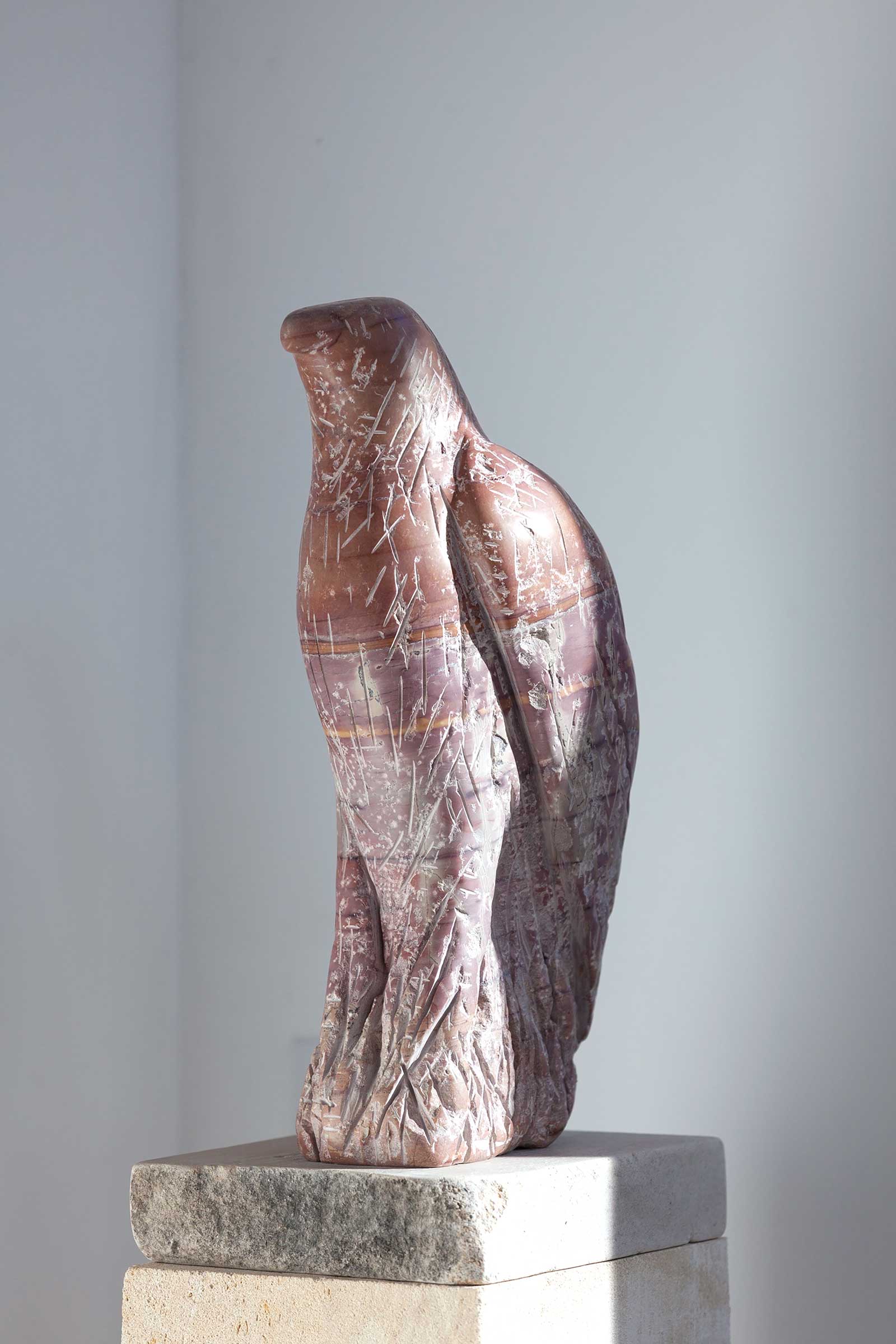 Red Marble Hawk, 2015, Portuguese marble and limestone, 63 x 8 x 12”. Courtesy Tayloe Piggott Gallery, Jackson, WY.
Nature and its denizens remain a fascination. The desire to express their essence animates her work. Her friend, artist and writer, Richard Whittaker writes, in the book Dual Nature, “An early recollection is of how intensely she spoke about nature, about the curl of a wave, the shape of a hawk’s wing—I see her hand making the shapes—and their similarities. And then there were the spirals in pinecones, sunflowers and seashells! In some basic way, there seemed to be laws of form in nature, an underlying mathematics.”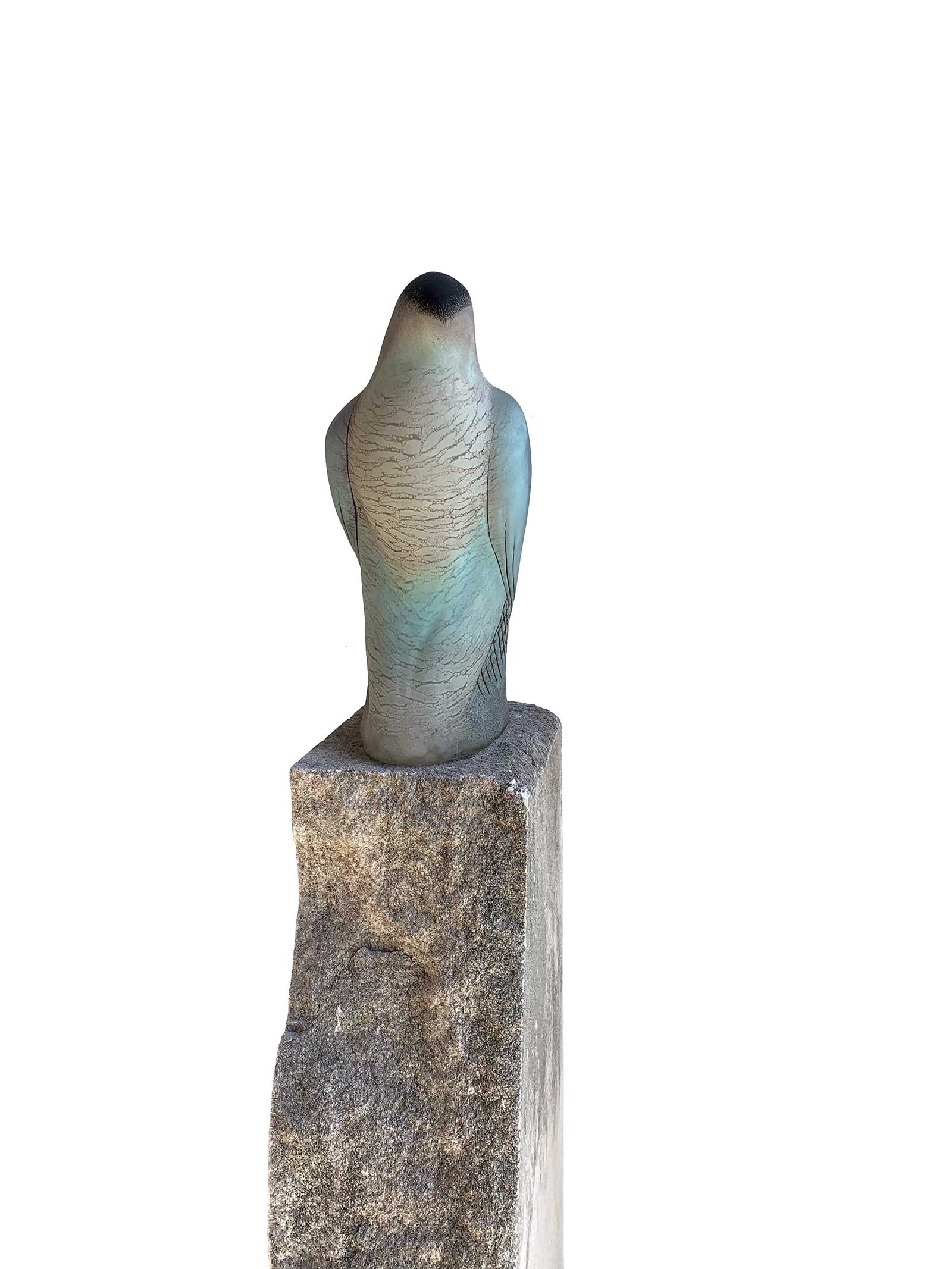 Sand & Celadon Goshawk on Stone, 2020, hand-blown pigmented glass on limestone, 58 x 8 x 20”. Courtesy Tayloe Piggott Gallery, Jackson, WY.
Jane comments that when she was young “all the other kids were reading Nancy Drew. I was reading Kahlil Gibran.” Her work today draws on a breadth of spiritual and scientific exploration. She explains, “I don’t want to make pictures of something. I want to embody the essence.” She refers to a definition of essence as “the permanent rather than the transitory element of being.” Her sculptures of animals express her experience of them rather than being portraits of them. She gives just enough information. She explains, “The minute you have a name for something, like a hawk, you stop looking. I want my work to sit on that moment before complete recognition. You have to really look and listen with all of yourself. The making of art puts you in a state of attention to what is there.”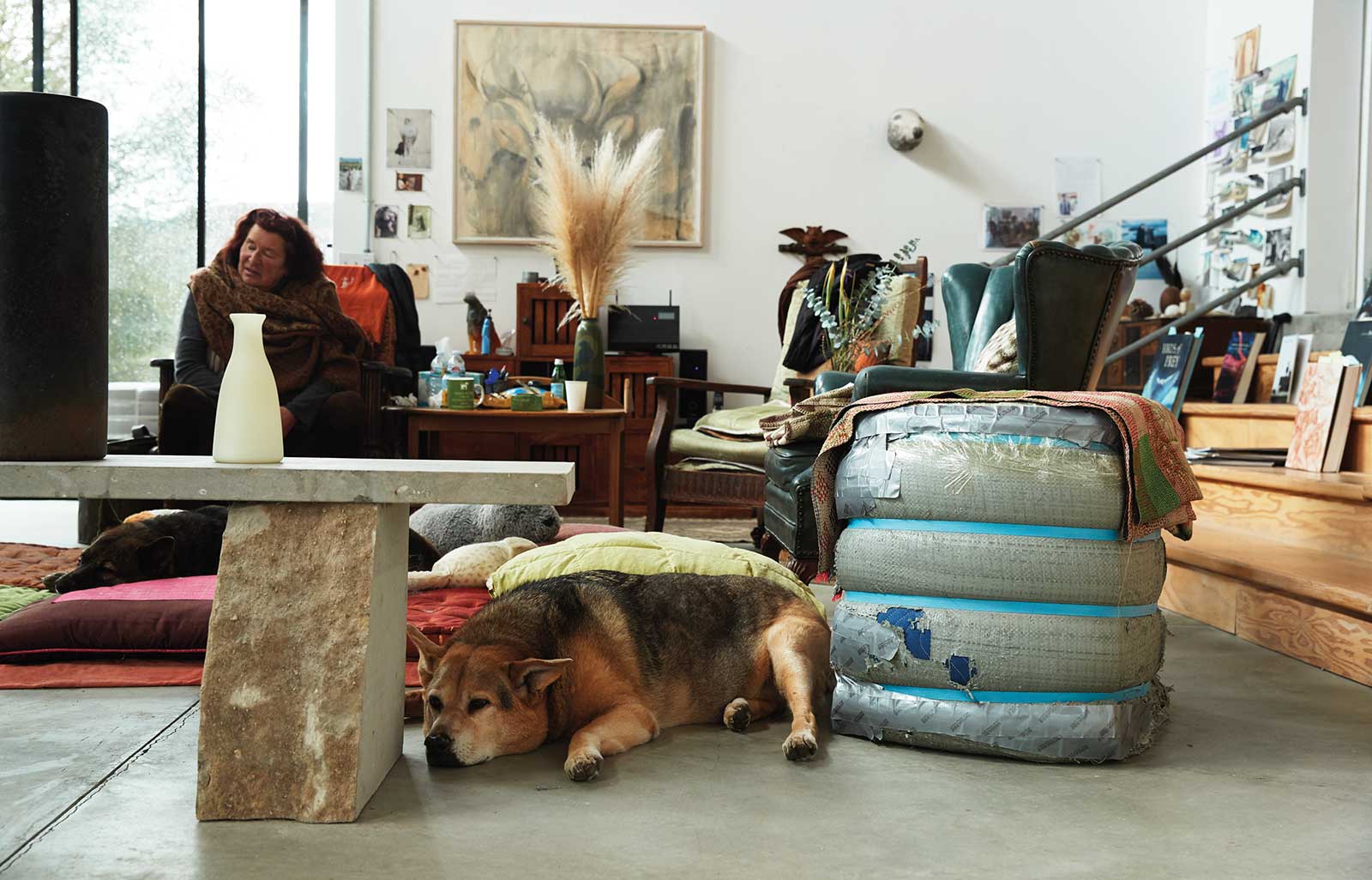 Jane Rosen in her favorite studio chair with her two rescue dog companions, Mei Mei and Rook.
She recalls being artist in residence at Pilchuck Glass School. “I remember working with Dante Marioni, a wonderful glass artist who was my gaffer for the first session. As he worked the glass on the punte, his head was slowly turning with the glass, like Stevie Wonder listening to music. I asked him why he was rotating his head in that way and he replied, ‘I am listening for the center.’”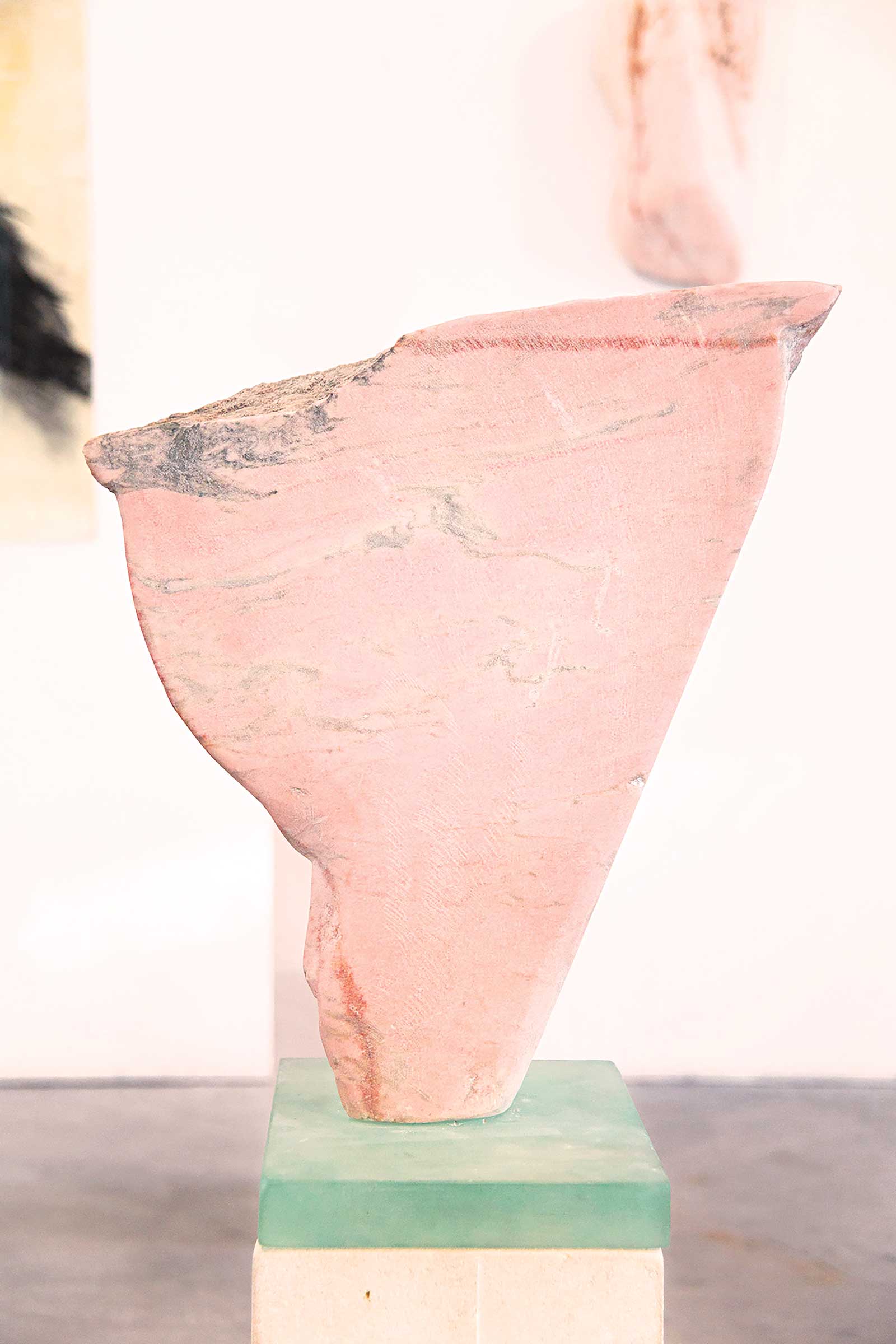 Horse Drinking Water, 2018, Portuguese marble, kiln-cast crystal and Provencal limestone, 48 x 16½ x 9”. Courtesy Traver Gallery, Seattle, WA.As Marioni listened for the center—to control the molten glass and keep it from slumping to the floor—Jane listens for the center. She hears the form she is creating and hears the stone she is releasing it from. In conversation with Richard Whittaker, she said, “I have something called synesthesia. I hear form. So when I’m looking at your shoulders, it could be a staccato note if you’re tense.”
As a child of 10 or 12, she would take the train into New York City, go to the Met, and “sit in the Egyptian Wing, captivated by Horus.” The Egyptian god Horus was depicted as falcon-headed and continues to be an inspiration for many of her sculptures.
A New Yorker intimately immersed in the New York art world, she resolved to take a sabbatical “and spend six months in California working outside. In January of 1990, I rented a house on a horse ranch. Looking up at the sky, I saw a red-tailed hawk making slow circles riding the air waves above. I heard him speak to me, clear as day: ‘Stay here, tell my story.’” Eventually, she did and acquired her land in San Gregorio.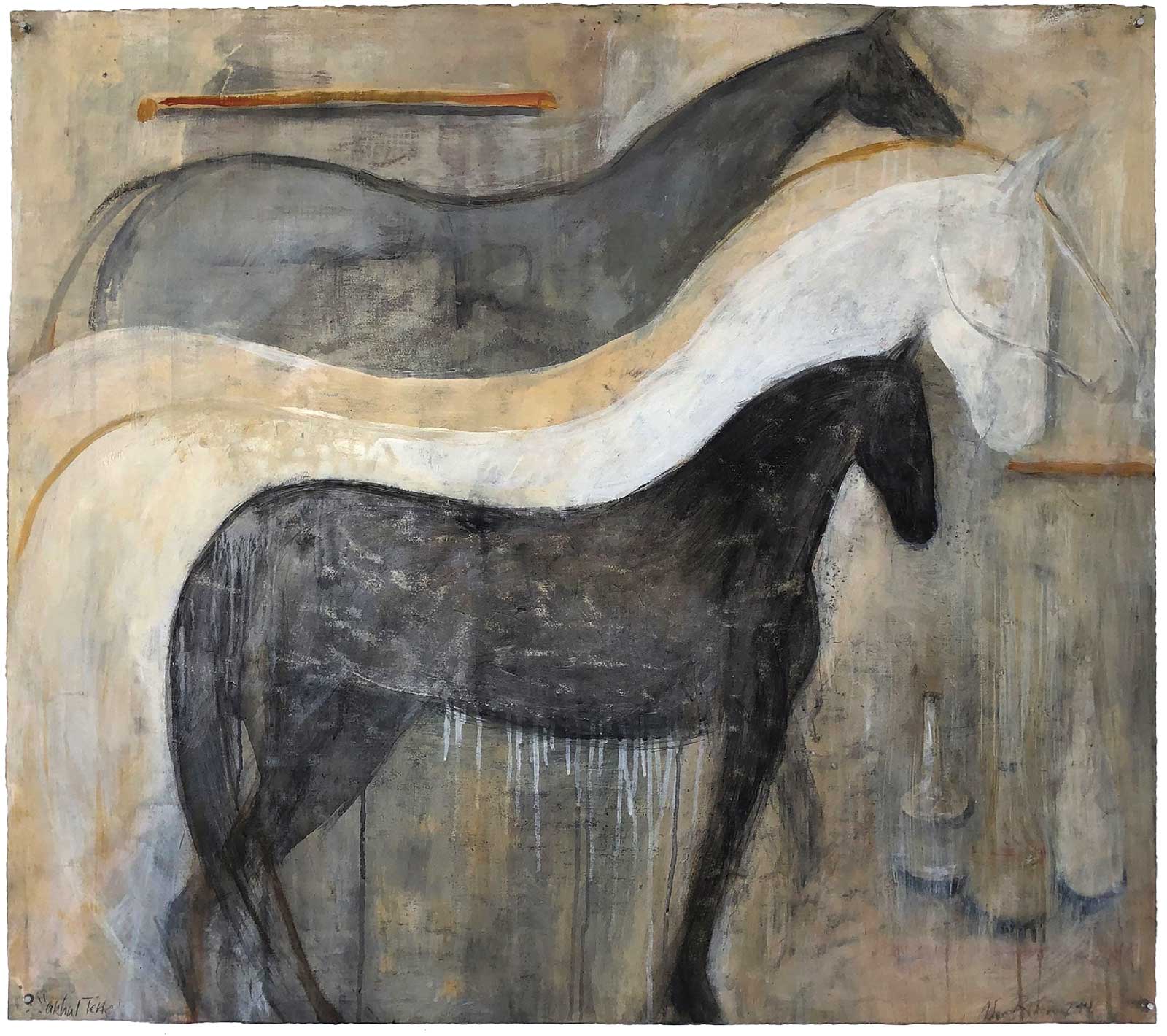 Cash Akhal Tekke, 2015, casein, beeswax, charcoal, ink and coffee, 39½ x 45”. Courtesy Tayloe Piggott Gallery, Jackson, WY.
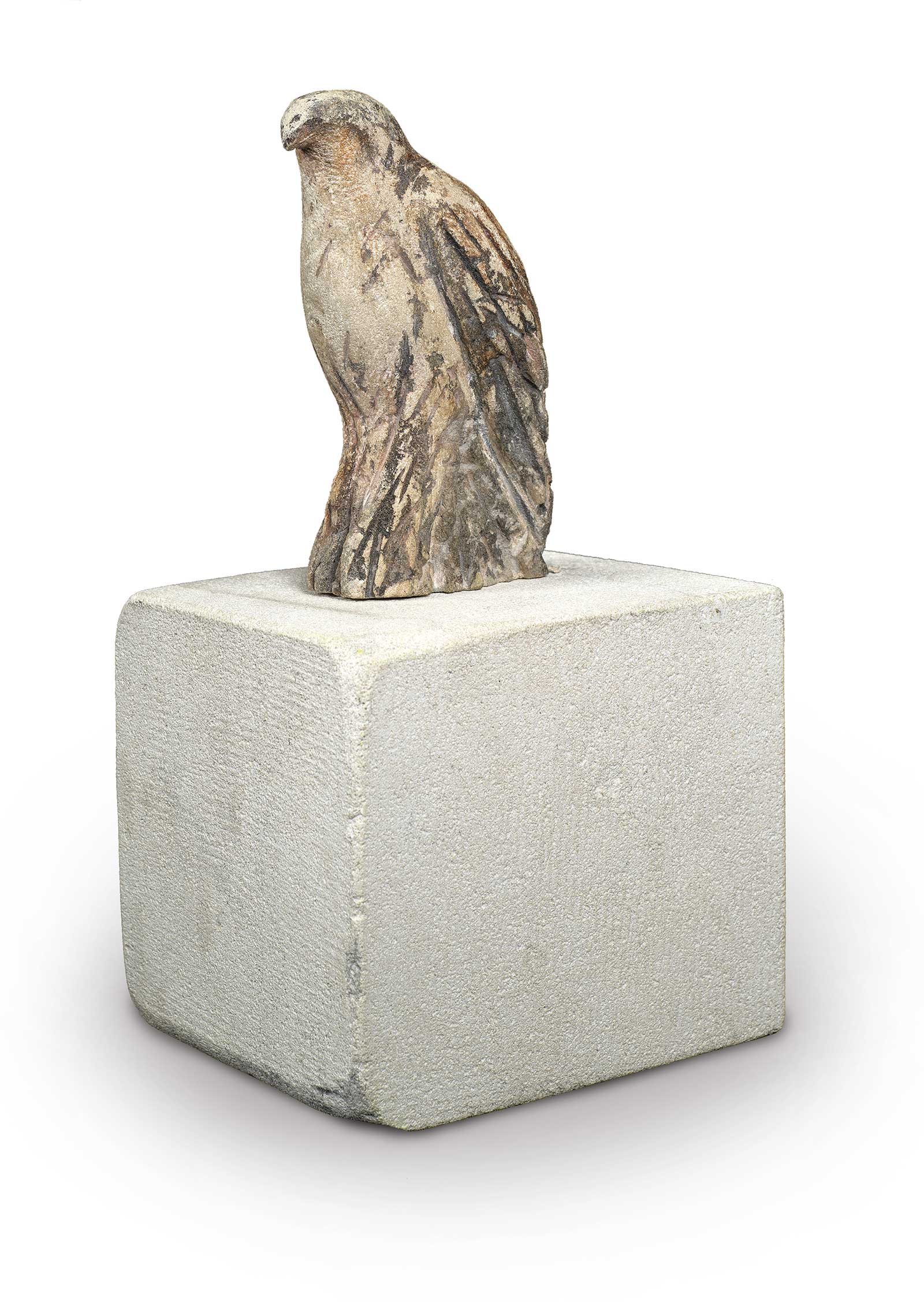 Pescadero Bird, 2017, painted limestone, 39½ x 8 x 10”. Courtesy Winfield Gallery, Carmel-by-the-Sea, CA.
She spent stretches of time at her family’s house on Oak Island in Long Island’s Great South Bay. It was accessible only by their own boat and had no electricity. She writes in Dual Nature, “Oak Island and the boat forms, gentle waters, and changing weather made me aware of the spiral formations in the curves of shorebirds, the solitude of still nights, and finding my place in the weather and the marshes. San Gregorio had a largeness to its trees, its coastal cliffs, and complete quiet. Both places addressed my desire to understand my work in a place where nature was larger than culture. Both taught me to listen to what is given in nature.”
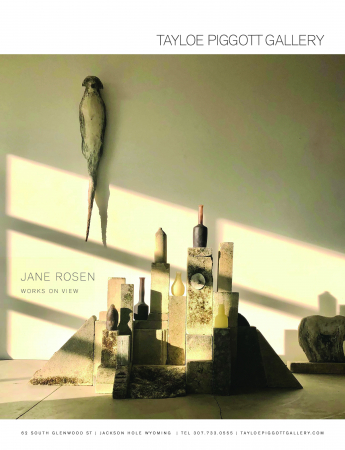
Her sculptural installations involve not only nature but an homage to the painter Giorgio Morandi. She writes, “I study Morandi’s still lifes and think so much about him drawing the outlines of various vessels on his tables, the sensitivity of those drawings, and how he would never dust the bottles that were his models. They felt like translucent glass and simultaneously his landscapes contained the stillness I experienced in these magical coastal hills.
“We started making vessels in honor of Morandi—translucent glass vessels that demanded an exact geometry and proportion. The subtle color of the vessels and the stones were placed in city-like groupings much like Morandi two-dimensional still lifes but made in three dimensions.”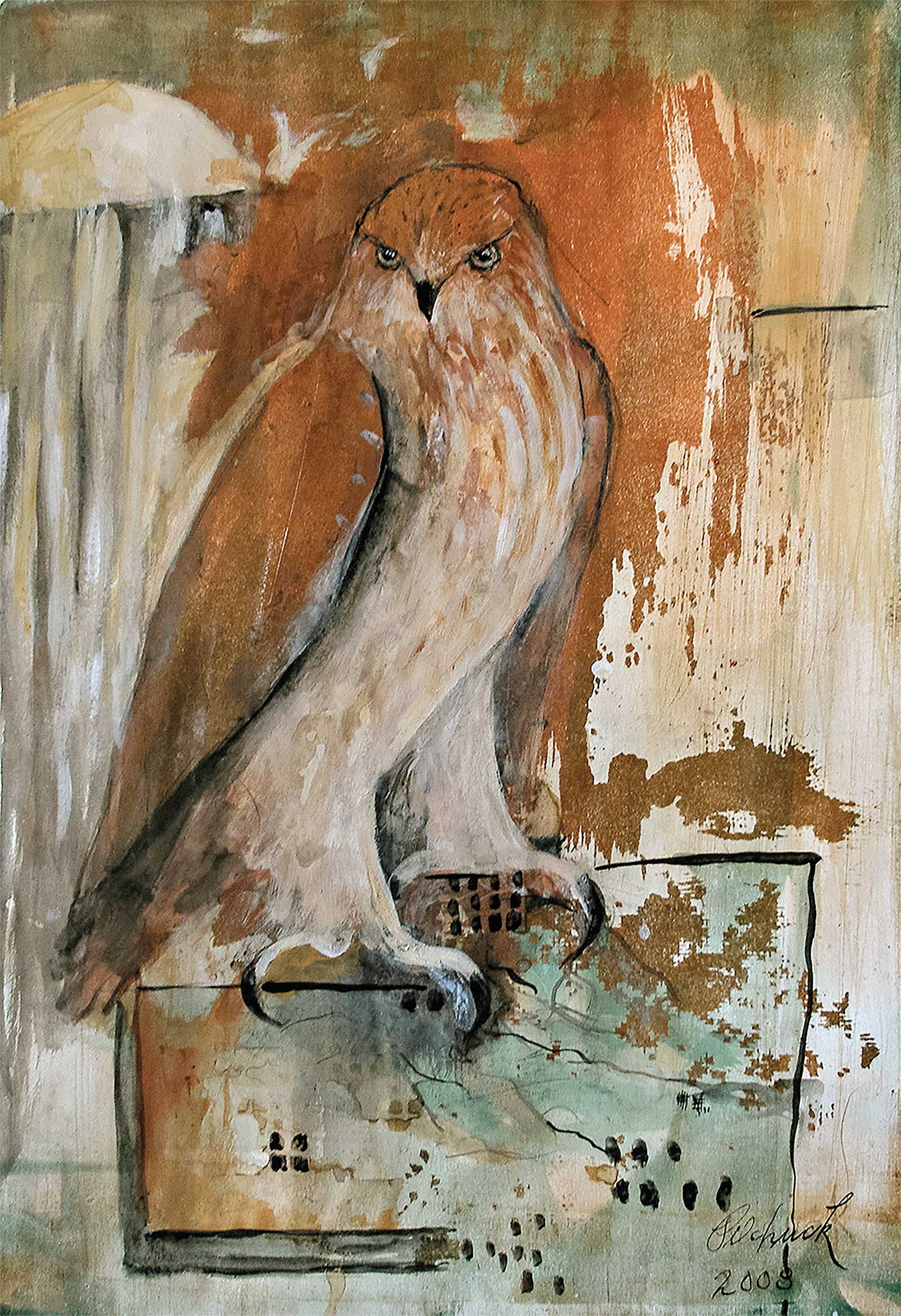 Twenty Minutes, 2008, handpainted vitreography, 20 x 13”. Courtesy Traver Gallery, Seattle, WA.
Rosen reviews her career and forecasts the future, writing, “It is a time rich with new explorations of how nature can be the story to be told through the history of the language of art. I have always felt that if people saw what I see in nature, in the animals around me, and in the trees, that they would not destroy them. It is my hope that this story can be heard.” —
Powered by Froala Editor