With glorious color and visible brushwork, combined with the grandeur of his subjects and the monumental size of his canvases, Edgar Payne’s works are indeed something to behold. Today, the early 20th-century American artist is a highly respected and iconic painter whose works are admired by collectors and artists alike.
Born in Cassville, Missouri, Payne began as a carpenter and painted homes, signs, murals and theater sets. He later made his way to Chicago and enrolled in the School of the Art Institute of Chicago where he studied portraiture. He lasted only two weeks, however, finding it too structured, and determined to teach himself instead. He arrived in California in 1909 at the age of 26 where he spent time painting in Laguna Beach and the San Francisco area. There he met many like-minded artists and eventually his wife-to-be, commercial artist Elsie palmer (1884-1971), with whom he moved back to Chicago where both became well known in the art society and the Palette & Chisel art group. Later, with the Great Depression at hand, the Paynes, with their new daughter, Evelyn, returned to Southern California where Payne would soon spend much of his time painting in the High Sierra mountains, one of his favorite subjects and hallmarks of his work.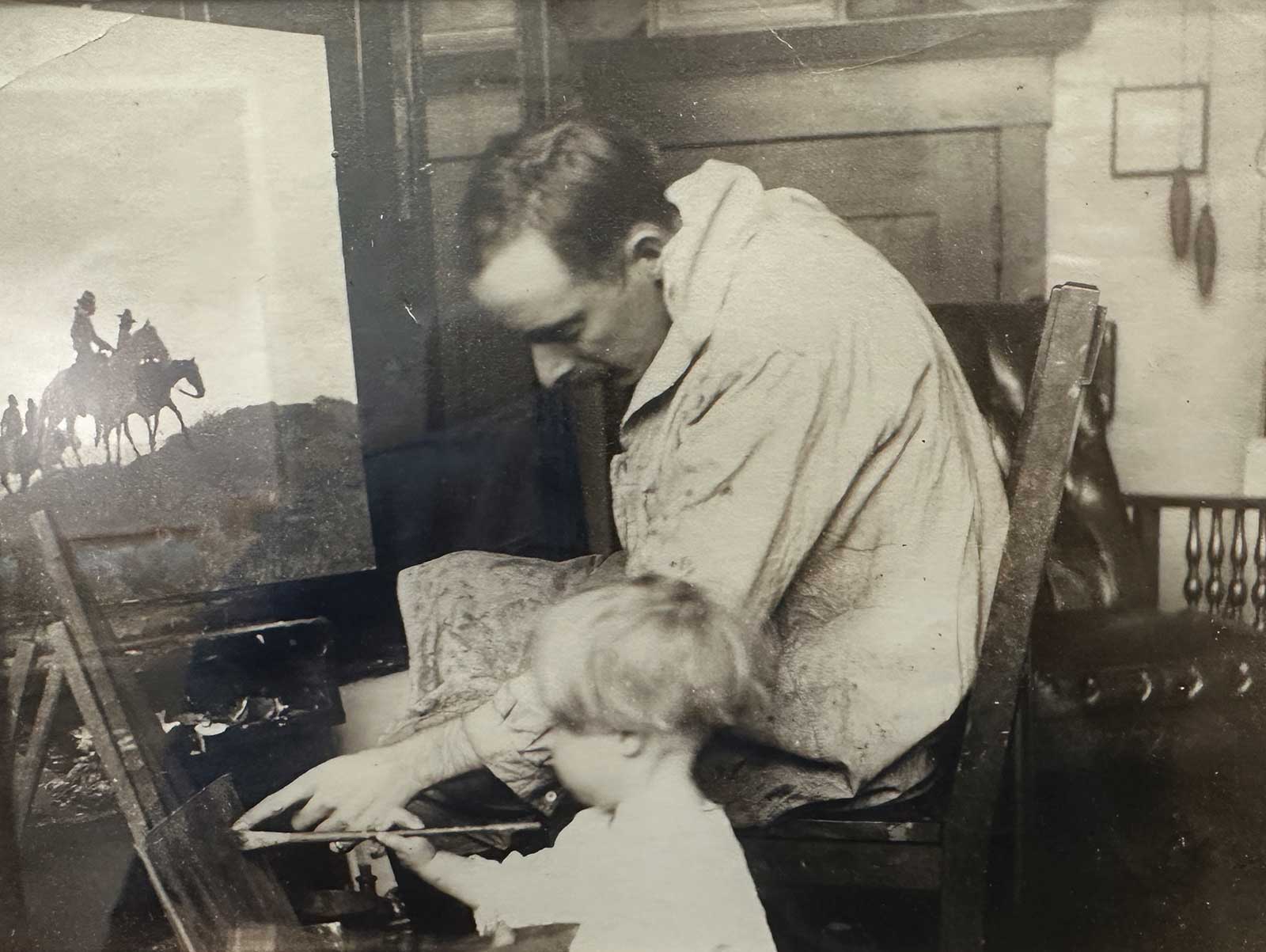 Photo of Edgar Payne with daughter Evelyn painting at their easels. Original photograph courtesy Steven Stern.
Throughout his career, Payne’s work focused on scenes in the Sierra Nevada mountain range, beautiful French and Italian boating scenes and, later, stunning Western and Southwestern landscapes that would preoccupy his work for 20 years. He was perhaps first influenced to paint the West by Edward Henry Potthast’s work he had seen at the Art Institute of Chicago such as Deepening Shadows, Potthast’s painting of the Grand Canyon, and Albert Groll’s etching of the Superstition Mountains in Arizona. From Canyon de Chelly to Monument Valley to the Grand Canyon, the adventurous artist painted en plein air on location and created large-scale works in his studio. On his art trips, many taken around 1929, he would often camp out at painting locations, climb mountains and do sketches in ink and watercolor along the way. Payne sought to capture the grandeur of the Western landscape and often with his large works, felt he was further able to give his viewers a better idea of what it was like to stand in front of these monumental scenes. His free style of handling paint in a bold, unblended fashion conveyed the sense that emotional content was valued over realism. The genres before had focused on precise representation, but the new trend was moving toward impressionism.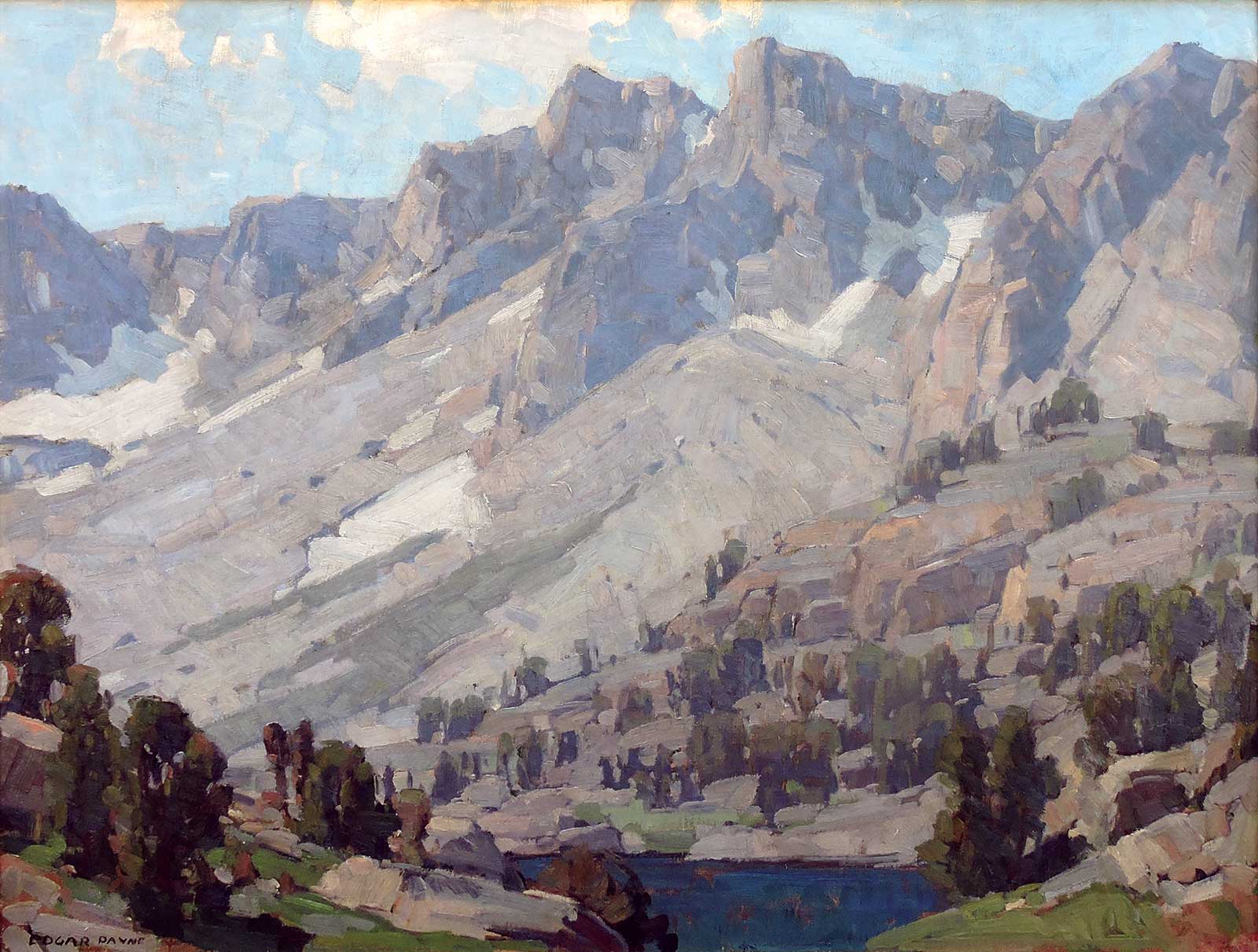 Edgar Payne (1883-1947), Rugged Peaks, oil on canvas, 28 x 34". Courtesy Steve Stern Fine Arts.
Today Payne’s works can be found in revered museums, esteemed private collections and in live sales by the leading auction houses. Some of this interest has origins in the 1970s and 1980s with exhibitions and books published on the California impressionists and their movement that thrived in an endless summer from approximately 1912 to 1950. Payne was among those greats. Payne’s rare on-location sketches that capture the West and Native American culture, as well as his large-scale works, can be found in top museums such as the Chicago Art Museum; Crocker Art Museum in Sacramento, California; National Collection of Fine Arts in Washington, D.C.; and many more. Payne’s works are often considered prize possessions in private California impressionist collections and can be found with impressionist art dealers around the globe.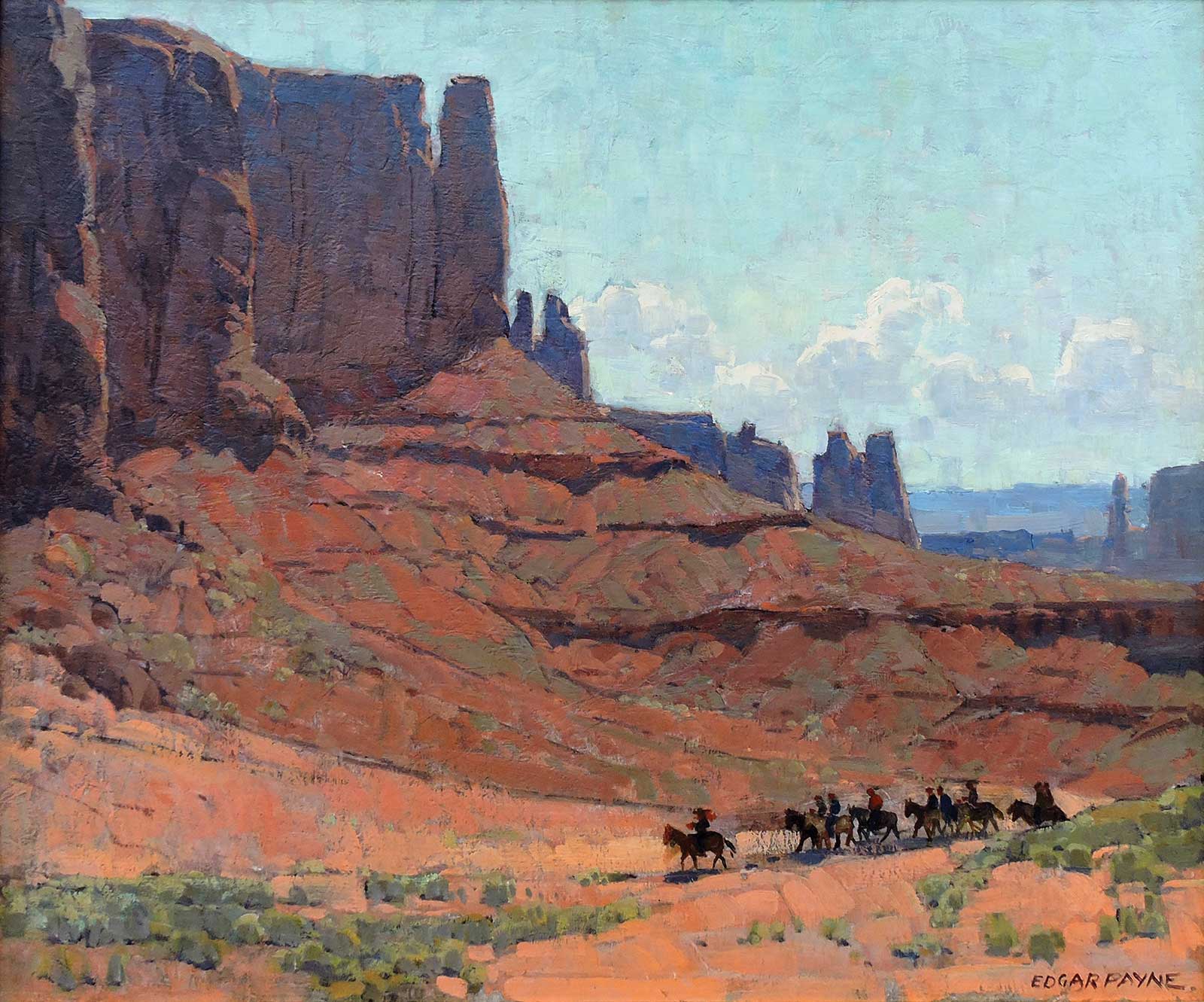 Edgar Payne (1883-1947), Riders in Monument Valley, oil on canvas, 28¼ x 341/8”. Courtesy George Stern Fine Arts.
Steven Stern, a respected fine art dealer in California, has handled Payne’s works for many decades. “Edgar Payne was a prolific career artist. Unlike other artists in Southern California that moonlighted working for the film studios or animation, Payne adhered strictly to landscape paintings and extensively painting en plein air,” Stern explains. “That being said, the market has traded many pieces that are non-Western in subject and can be identified as California impressionist paintings. Payne gained significant notoriety painting the beautiful Sierra Nevada mountain range and the rolling lavender foothills of the San Gabriel mountains.”
In recent private and public sales, Payne’s Western works have commanded up to double the estimated value and interest in his work has become somewhat of a phenomenon. Hammer prices frequently soar over high estimates, in some cases by 50 percent, especially for iconic pieces with horses and riders.
“Edgar Payne has always been a staple of our gallery," Stern adds. “The quality of his work and wide appeal to collectors across the art market is extraordinary. In recent years we have seen an influx of Western art collectors actively pursuing Payne works and recognizing him to be one of the masters of Western art. Most notably, Canyon de Chelly paintings by Payne with riders are the most coveted in the marketplace. We recently brought to market an extremely rare Canyon de Chelly (1917-1919) painting that might have been one of his first attempts at tackling the daunting challenge of capturing the shifting light, warm terra-cotta color of the canyon and grandeur all to scale. Most collectors that own his desirable Western pieces tend to hold them and thus the ones that surface at auction or in gallery inventory tend to be priced at a higher premium than his traditional California landscapes. Payne works were [recently offered] at Coeur d’Alene Art Auction in Reno, Nevada. They showcased 10 paintings by Payne that all sold, and several topping the high estimates by double.”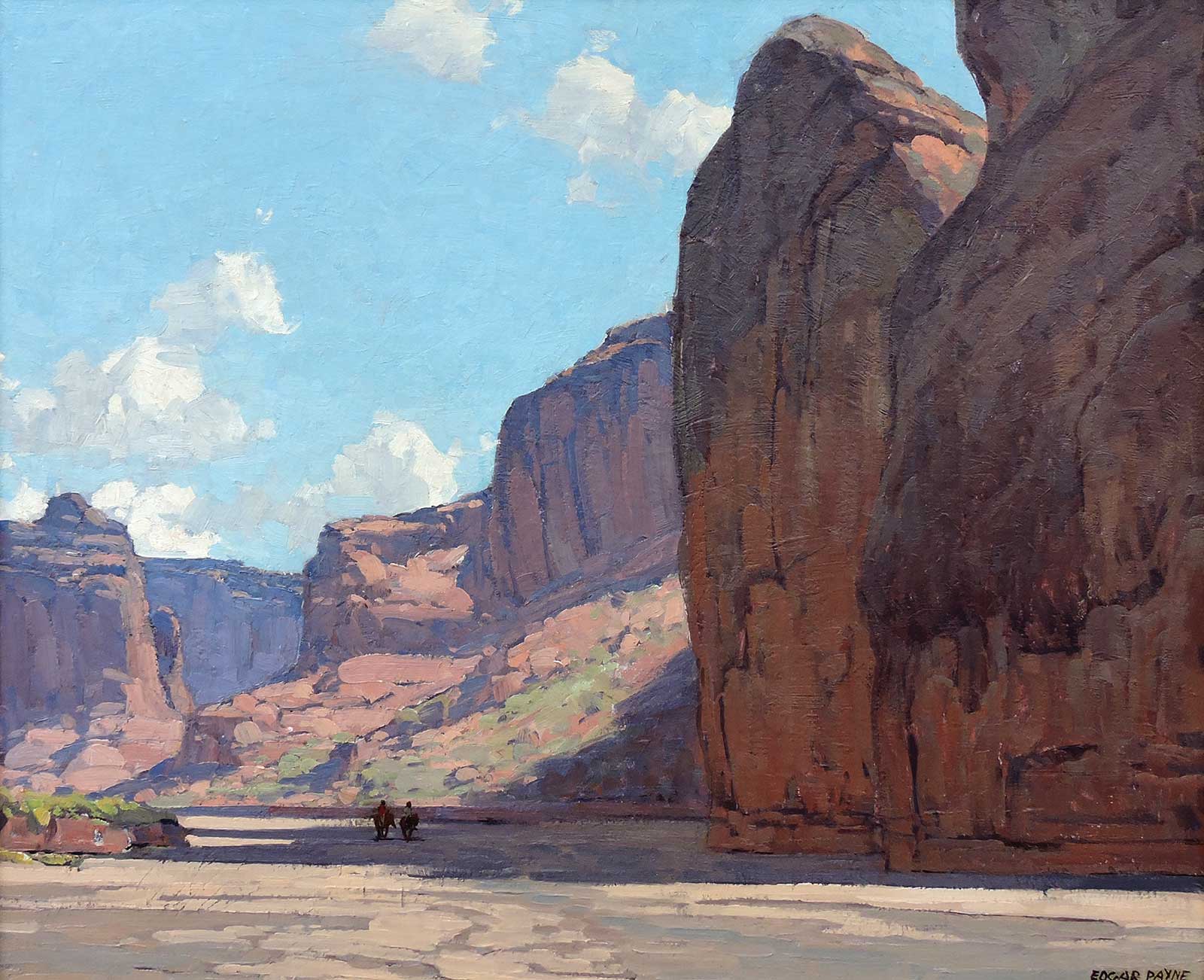 Edgar Payne (1883-1947), Canyon de Chelly, oil on canvas, 28 x 34”. Courtesy George Stern Fine Arts.
One of the Coeur d’Alene Art Auction works came from Stern’s inventory. The painting features towering canyon walls with a single stream of light coming through to the valley floor between the cliffs. Several riders are dwarfed by the majestic scene. It was listed with an estimated value of $125,000 to $250,000. It sold for $484,000.
Another work that recently sold, this one from Bonhams’ summer California art sale, was Rider and Pack Horse in the Sierras. The 20-by-24-inch work had a high estimate of $35,000 and sold for $57,000. Another notable sale took place at Bonhams American art auction in May that featured many prints, paintings, photographs and sculpture from the last several centuries. Among the auction’s top-performing works was Payne’s Topmost Trail, which had been in a private collection since the 1930s. The image included a scene from the eastern Sierras and two horses with a lone rider. It sold for $100,000, topping its high estimate of $90,000.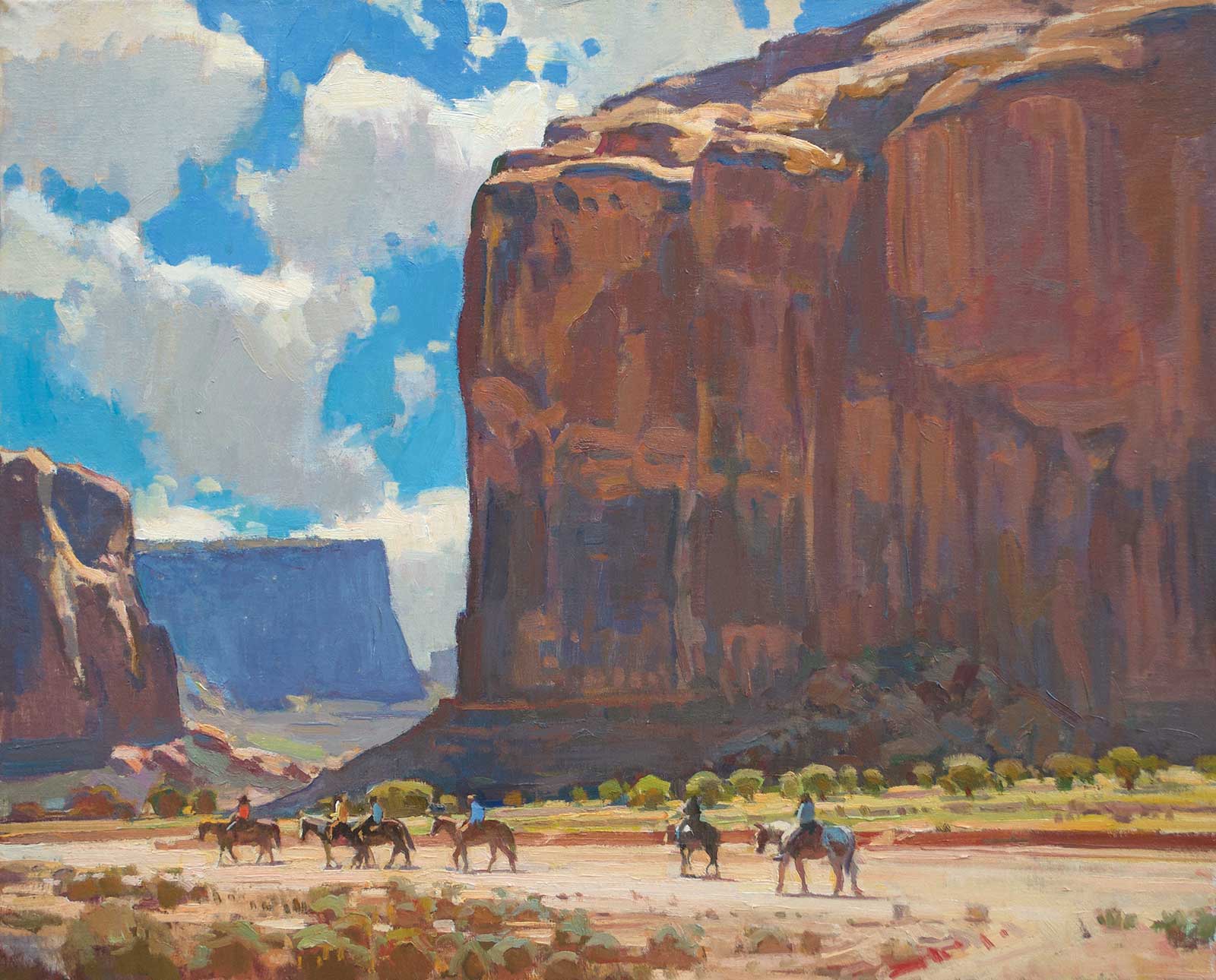 Ray Roberts, Riders at Monument Valley, oil on linen, 24 x 30”. Courtesy the artist.
Edgar Payne continues to play a role in the art world today. He not only influenced the artists of his time but continues to be an inspiration to contemporary landscape painters today. Many of the leading painters in the Western genre have read his famed book on composition and admire his lively color and brushwork, his subtle color harmonies and the transitions in his works.
Famed figure and landscape artist Jeremy Lipking has been influenced by his work since he was young in his summers growing up near June Lake in the Sierras. “My dad introduced me to Edgar Payne’s work early on. I knew of his work long before some of the other artists who later influenced my work like [John Singer] Sargent, [Anders] Zorn and [Joaquín] Sorolla,” Lipking shares. “It was Payne’s paintings of the Sierra Nevadas that had the biggest impact on me. In the late 1990s I was living in a small mountain town in Eastern Sierra, climbing in summer and snowboarding in winter and painting in between.“ 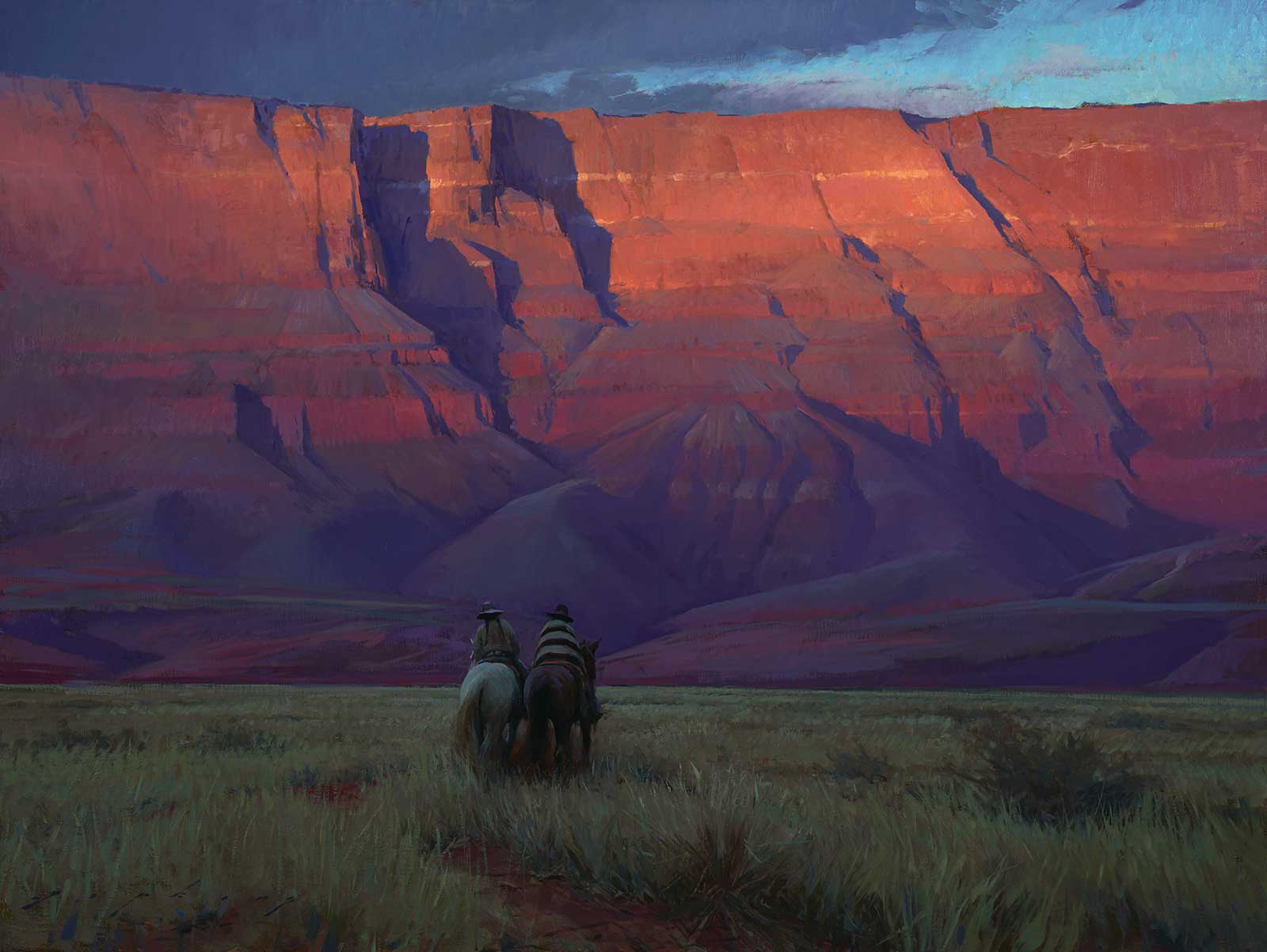 Jeremy Lipking, Riders Under Vermilion Cliffs, 2015, oil on linen, 30 x 40”. Courtesy the artist.
Around that time Lipking started studying Payne very carefully, and began painting outdoors from life.
Lipking continues, “Payne’s subject was a landscape I was already very familiar with. I knew he wasn’t copying what he saw. Sometimes the subject would look very different from his painting because he was simplifying in a poetic manner, leaving out the unnecessary information, but at the same time, he was able to capture the essence of the Sierra perfectly. At first, it was Payne’s subject and simple heavy brush that interested me but later it was the less tangible stuff like his design and composition.”
Lipking’s work included here, Rider at Vermilion Cliffs, is tighter in a realist style, and yet it shows the admiration of Payne’s color harmonies of purple, cool shadows and warm hills with the iconic sagebrush in the foreground. Lipking’s large work, measuring 30 by 40 inches, also helps to convey the scale of the subject, reinforced by the riders under the monumental hills.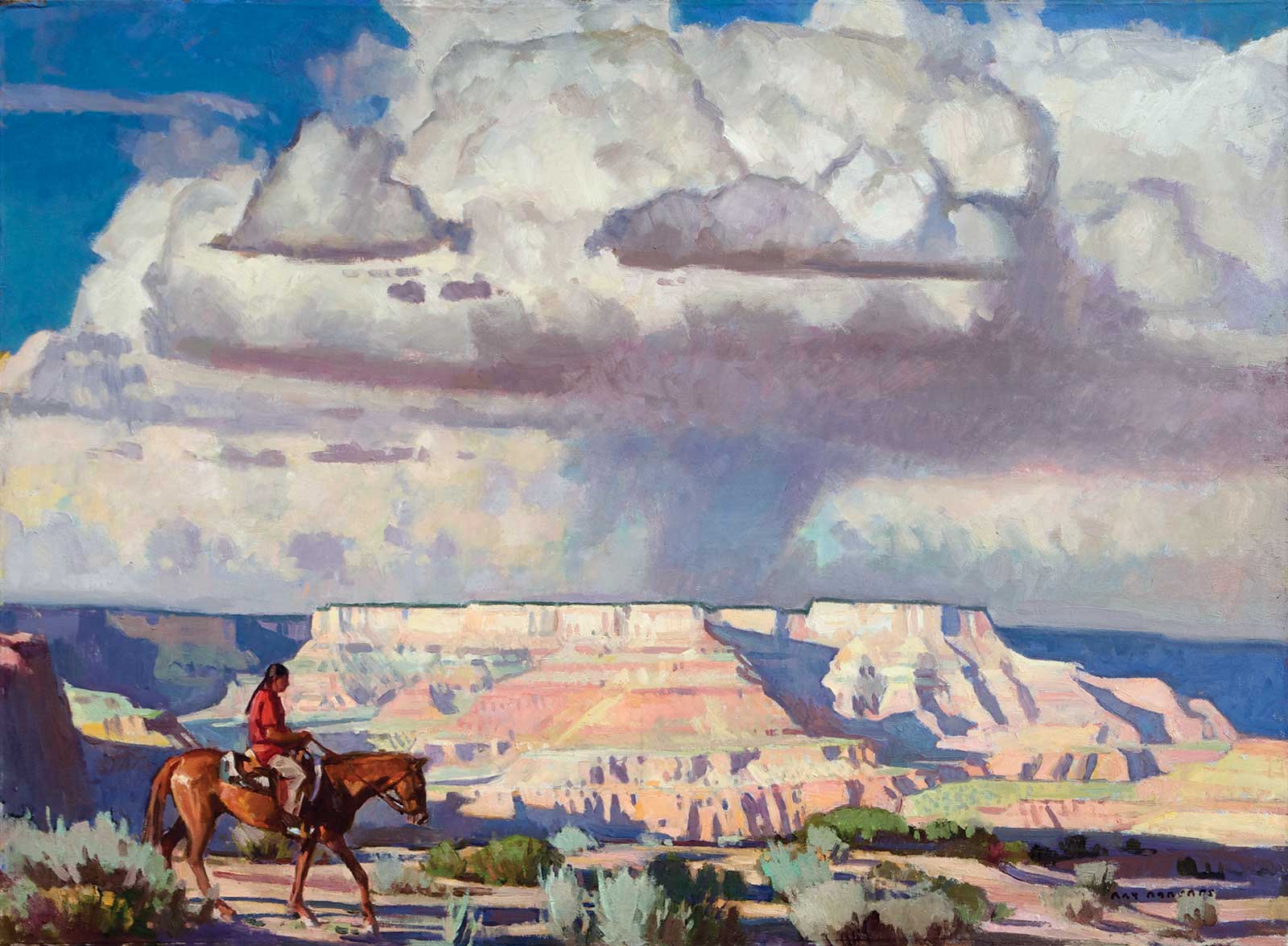 Ray Roberts, Lone Rider, 2017, oil on linen, 30 x 40”. Courtesy the artist.
Another modern-day California painter inspired by Payne is Ray Roberts. His works shown here, Riders in Monument Valley and Lone Rider, mimic the color and brushwork of Payne and again aim to convey the sheer scale of the hills. Roberts muses about Payne’s influence on his work, “Edgar Payne is a giant among artists. Courageous, adventurous and resourceful, are among the words I’d use beyond the glowing words of artistic achievements,” Roberts says. “My first exposure was a chance walk-in to a gallery in the 1970s, admiring and at the same time disappointed that this form of art was not something an artist did in the 1970s. A dozen or so years later I found Edgar Payne again through his book as a source for getting unstuck with my own art. Observing one of his paintings, an admirer will see a bold and beautiful scene with wonderful brushwork. I see an inventor, a master in the science of light, a keen observer of nature and a teacher.”
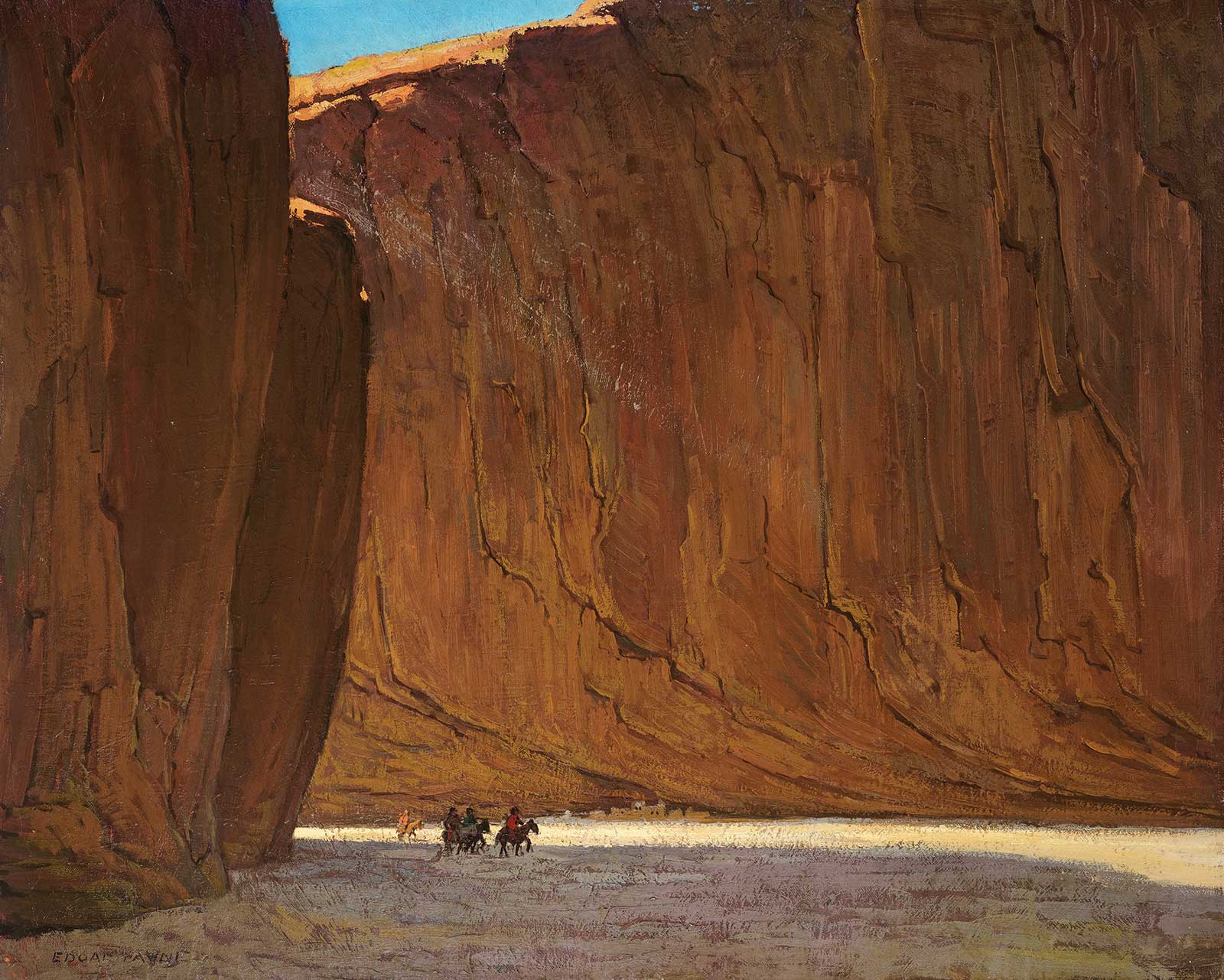 Edgar Payne (1883-1947), Canyon De Chelly, ca. 1916-1919, oil on canvas, 26 x 32”. Courtesy Steven Stern Fine Art.
Sold at Coeur d’Alene Art Auction in 2022 for $484,000.
Roberts continues to be enamored with Western landscapes and Native Americans. Today he creates not only vibrant landscapes but captures figures in colorful blankets, capturing the West as Payne once did.
With record prices occurring at auction houses, and only a few available currently in the market, Payne’s Western works, as well as his other subjects, seem to have become even more celebrated, coveted and rare as of late. His legend lives on as his art continues to influence the artists of today, delight collectors and viewers in homes and museums, as he brings us back to a time when the land was untouched and the allure of the West can be seen and felt on a grand scale. —
Vanessa Françoise Rothe is a curator, editor/writer, art dealer and fine artist.
Powered by Froala Editor