Mary and Jay Jordan have been happily married for 32 years, traveling between their homes in Colorado and New Mexico and enjoying the art in each.
Mary’s mother “loved to read about the pioneers going west,” she relates. “She had lots of paintings. Everything was Western and she would share stories about the West and Native Americans.” The three works above the fireplace are by Kirby Sattler: on the left is I am Crow, early 1990s, giclée; Speaks with Crows, 2016, acrylic on linen, is on the top right; and Tears the Sky, 2014, acrylic on linen, is on the bottom left.
When Jay was a boy he collected practically everything—coins, stamps, lead soldiers, baseball cards. “Even after we were married,” Mary exclaims, “we went to baseball card shows!” Jay’s father was a collector of Civil War items and had hand-painted a collection of lead figures. When Jay suggested displaying them in their home, she said “Not on your life.”
Happily, the couple have similar tastes in art, a love of the West and an empathy for the history of Indigenous peoples. Mary recalls becoming interested in their story from her mother as well as from representations on television when she was a girl. She recalls the plight of Geronimo who was a medicine man of the Bedonkohe band of the Chiricahua Apache. He eventually became their leader. He successfully escaped three times from reservations. When he finally surrendered in 1886, he was the last Indian leader to do so. “Little did he know,” Mary recounts, “that he would become the popular face of the American Indian.”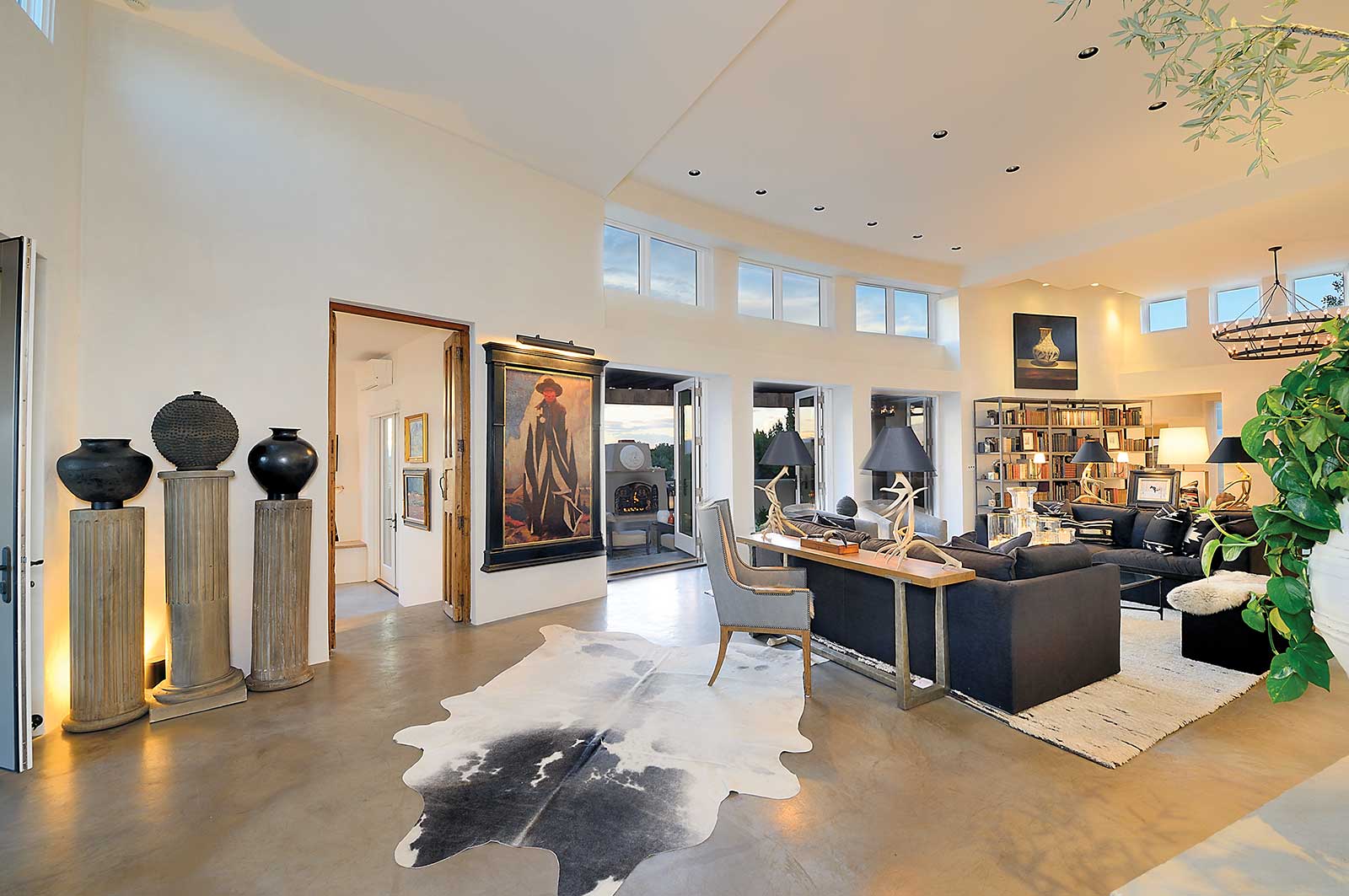 The large pots were inherited from Mary Jordan’s mother. The large painting is Sean Diediker’s Medicine Man, 2015, oil on canvas. The painting above the bookshelves is Roseta Santiago’s Acoma Legacy, 2020, oil on canvas.
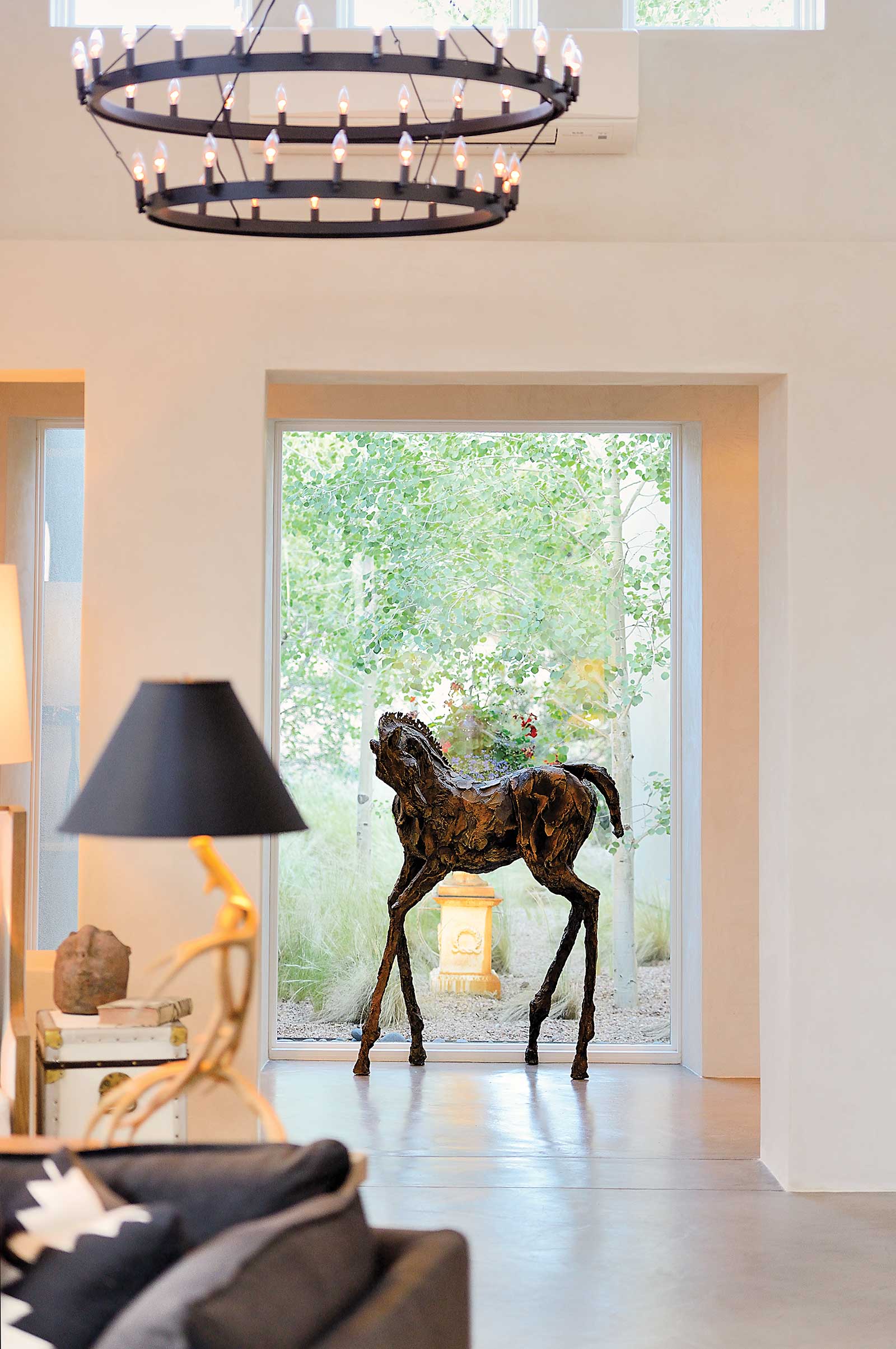 In front of the window is a bronze horse by Siri Hollander.
Pointing out Native portraits by Kirby Sattler in their living room, Mary remarks, “Look at those faces. My heart bleeds for them. I look in their faces and see their sadness and what was taken from them. It stirs my soul.” Jay remarks, “They were spiritually separated from their land.” Their expressive faces adorned with symbolic regalia gaze at viewers and command their attention. Sattler says his paintings “evolve from the history, ceremony, mythology and spirituality of the Native American. The ultra-detailed interpretations examine the inseparable relationship between the Indian and his natural world, reflecting a culture that had no hard line between the sacred and the mundane. Each painting functions on the premise that all natural phenomena have souls independent of their physical beings.”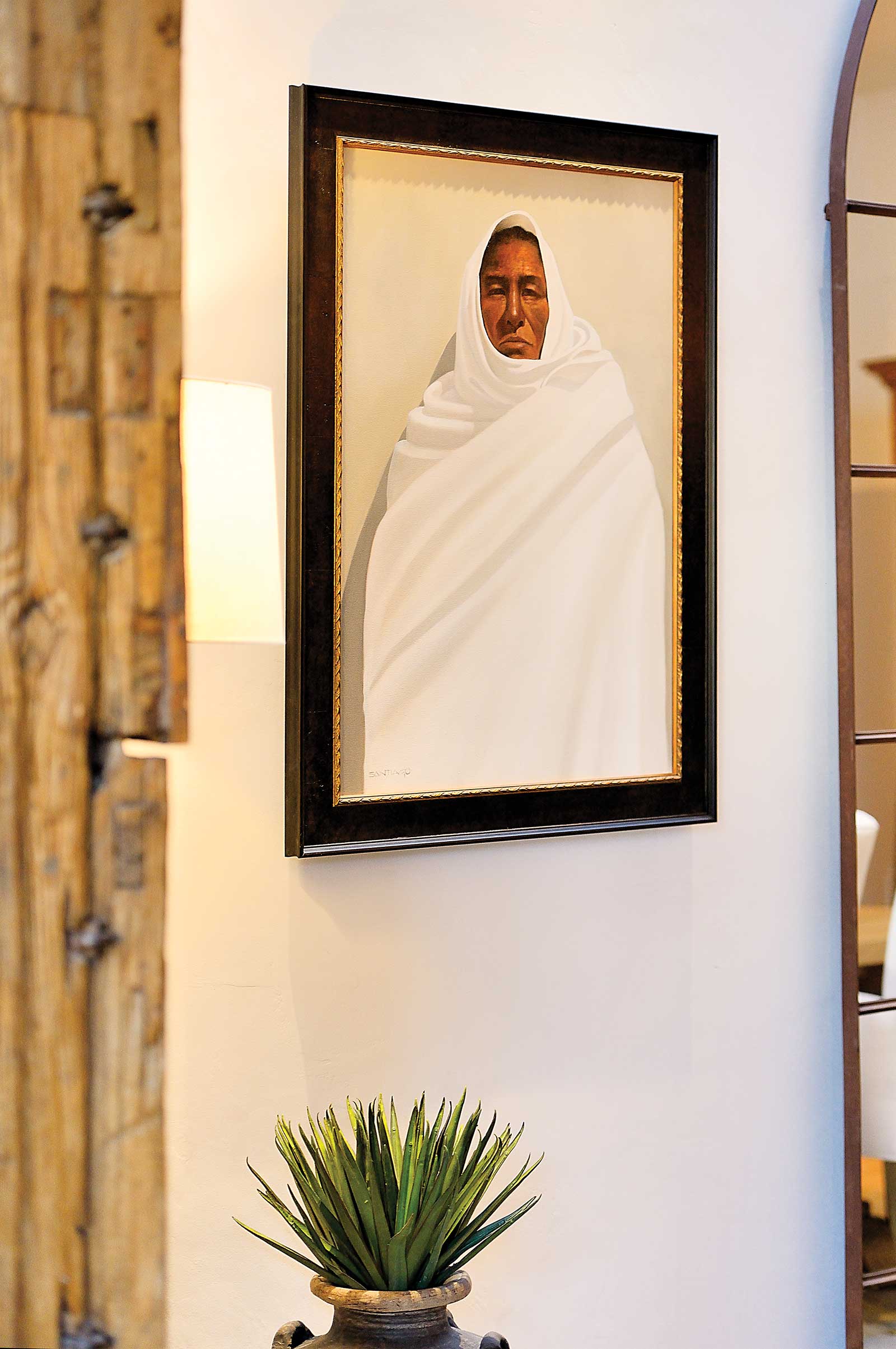 The commissioned painting for the dining room is Peace and Beauty, 2021, oil on canvas, by Roseta Santiago.
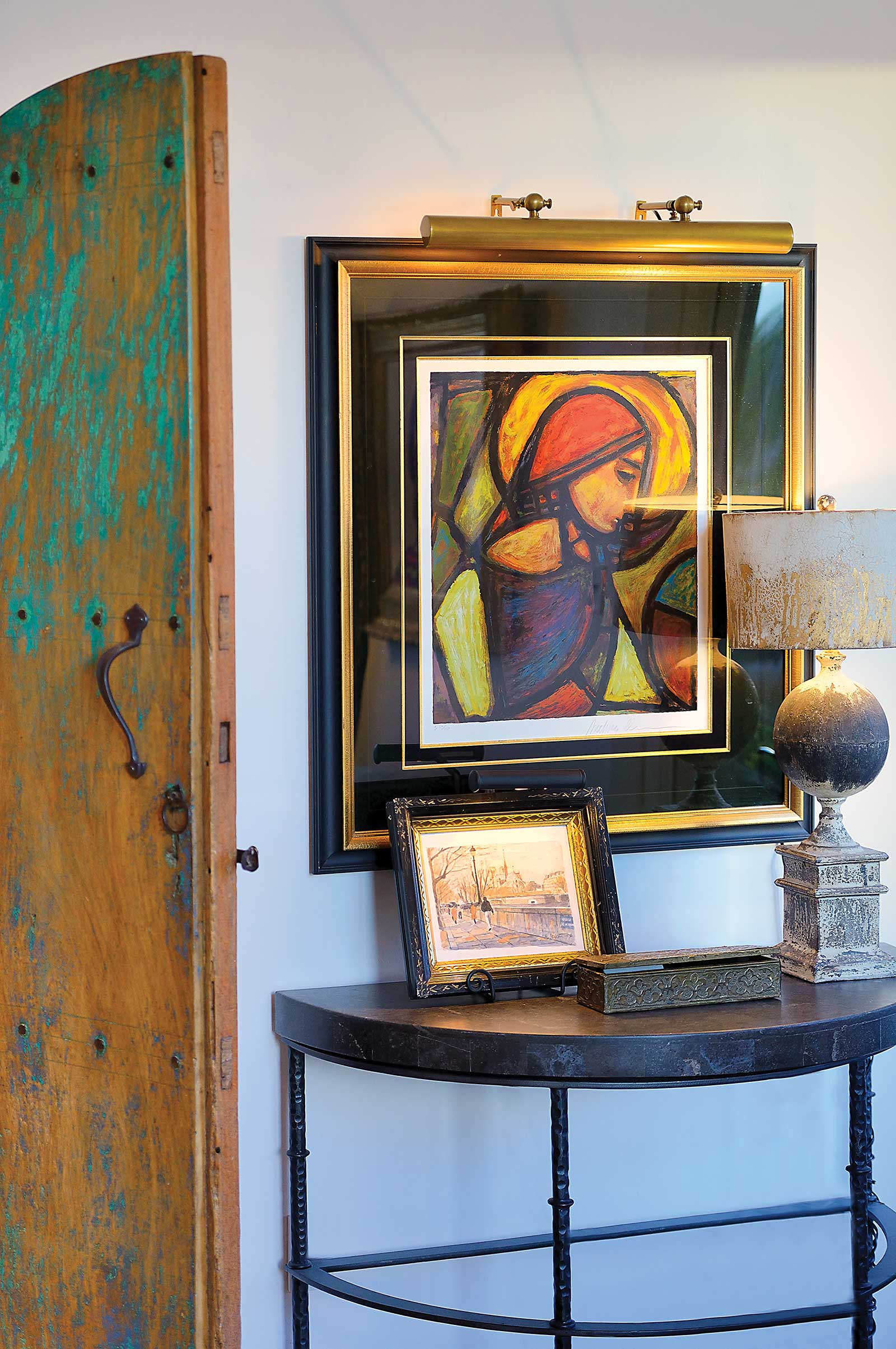 Above the table is La Femme Ideale, 1984, limited edition serigraphy by actor and artist Anthony Quinn (1915-2001).
Jay explains that he prefers a more impressionistic feel in paintings rather than their being photographic. His and Mary’s taste runs from naturalism to impressionism as in the work of work of Earl Biss (Apsáalooke, 1947-1998), for example, who Mary met early on in her visits to Santa Fe. Biss was part of the “miracle generation” of artists at the Institute of American Indian Arts (IAIA) in the 1960s, working with, among others, Kevin Red Star, T.C. Cannon and Doug Hyde. Both collectors admire Biss’ A Favorite Spotted Pony, in their collection. Biss wrote, “I like my paintings to be experienced for the quality of the paint much more than the images that I portray. Because that is what truly makes an oil painter.” His figures emerge from the expressionistic paint. “They were already there,” he said. “I just let them out.”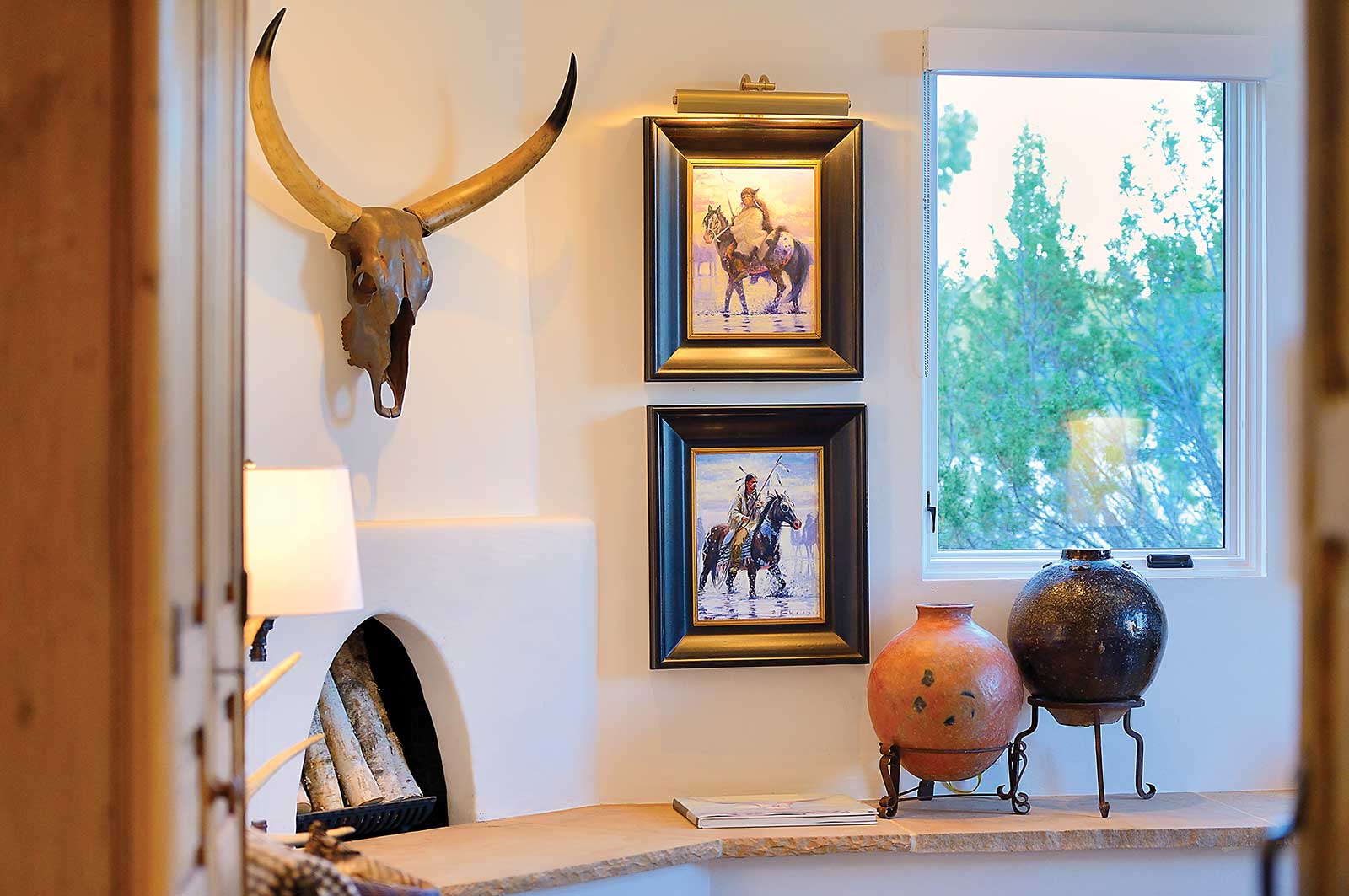 The two oils on canvas are by J. Wodark, 2016.Among the contemporary painters in their collection is Roseta Santiago. Mary recalls, “I was at Inn of the Anasazi and behind the desk there was the most magnificent 4-by4-foot painting of a pueblo pot. I kept thinking about it and after I returned home I called the hotel and asked the person at the front desk to look at the painting and to give me the name of the artist. We now own three of her large paintings of pots and a number of her portraits. We commissioned Peace and Beauty especially for a spot in our dining room.”
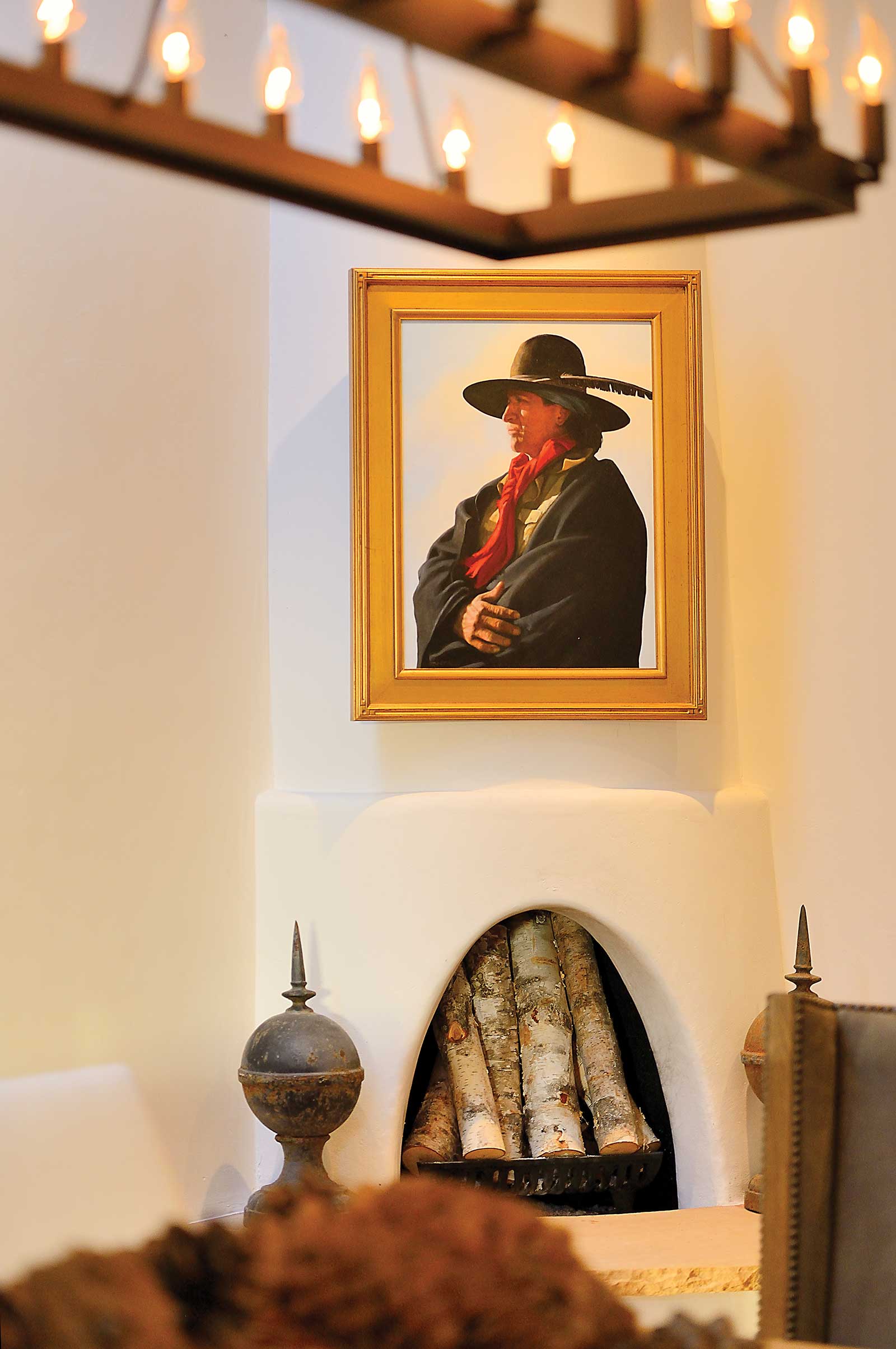 Above the dining room fireplace is Looking to the Future, 2020, oil on canvas, by Roseta Santiago.
Also in the dining room is Roseta’s Looking to the Future in which the model is wearing a red scarf that belonged to her father. Mary fell in love with the painting but declared she didn’t have any room for another painting. Roseta relates, “The next day she called and had found a place for it. She had fallen in love.”
The artist and the couple have become great friends, Mary and she sharing both refined artistic and business talents. Roseta says, “Once I met Jay and learned about his music choices while fly fishing we bonded instantly!”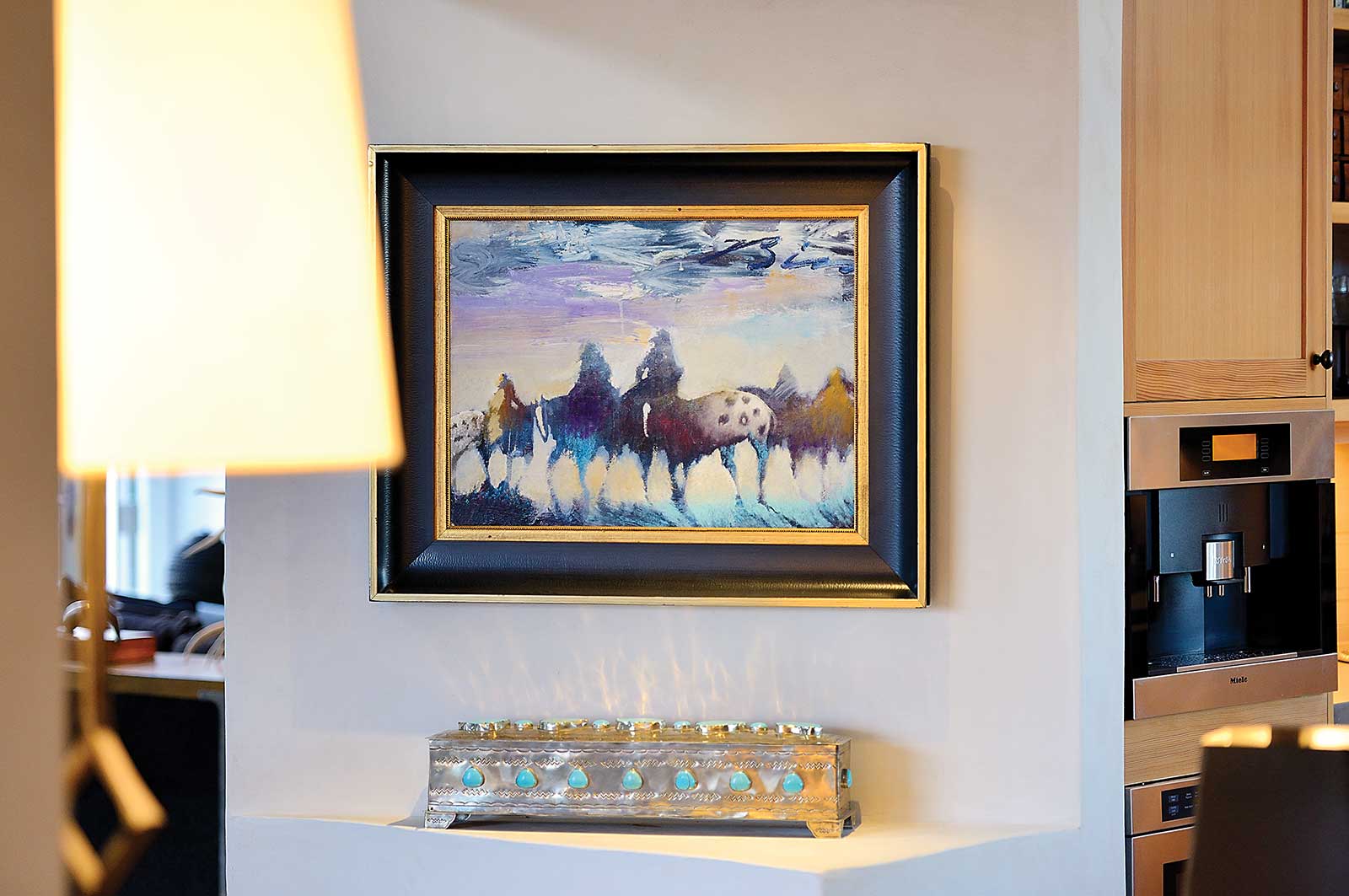 Above the turquoise and silver mantel box by J. Alexander is A Favorite Spotted Pony, 1998, oil on canvas, by Earl Biss (1947-1998).
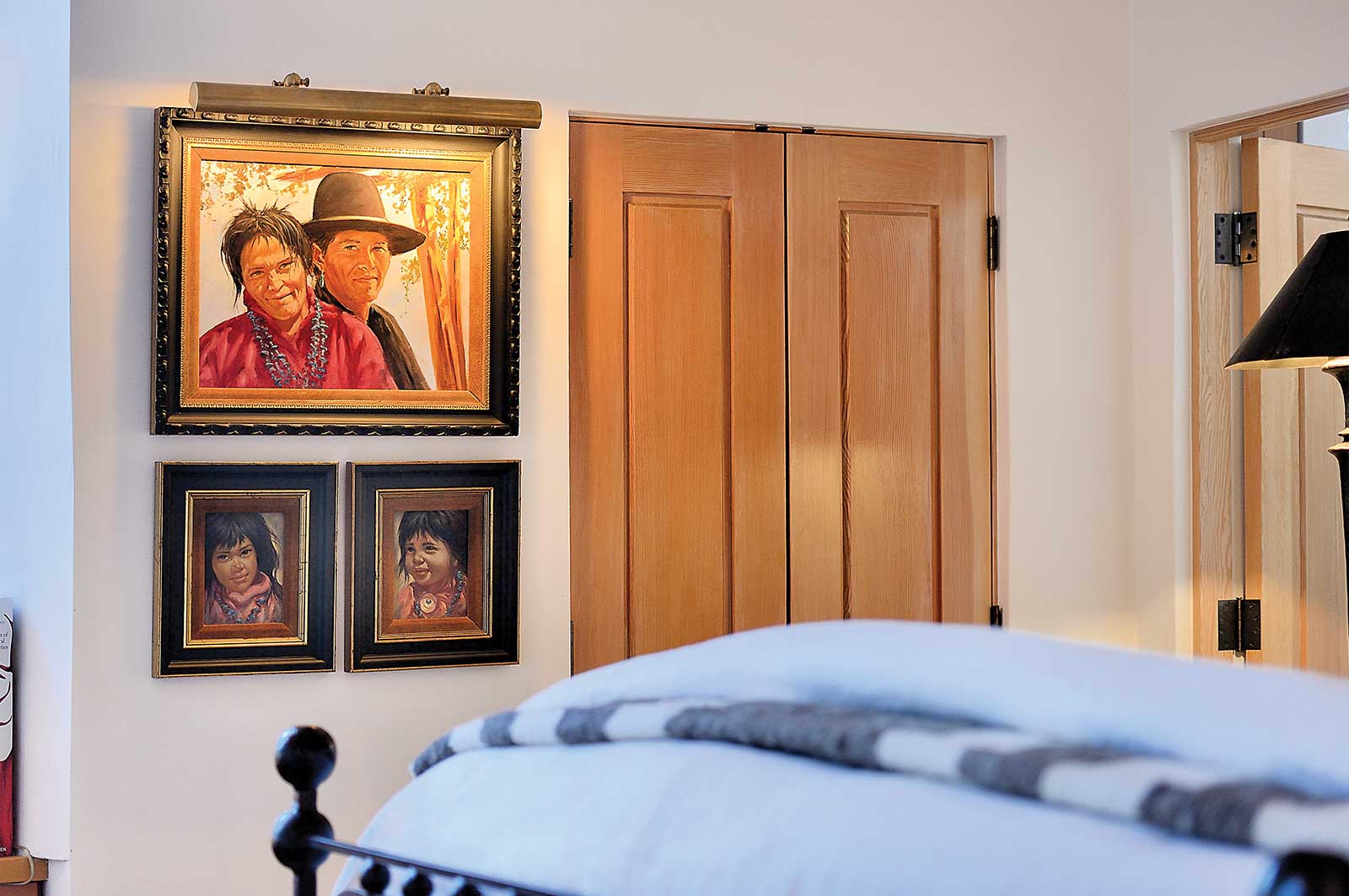 The three untitled oil portraits from the 1950s are by Harold Watt.
Jay explains, “I appreciate the art and Mary is spatially aware in the way she places pieces and makes juxtapositions.”
She had seen Sean Diediker’s imposing Medicine Man at Blue Rain Gallery in Santa Fe. “I walked around the corner and it spoke to me,” she recalls. “We didn’t buy it. It was intimidating and big but I never forgot about it. A couple of years later when we moved from our city house to our home in the mountains, I had a place for it.” Four years ago, when they purchased their home in Santa Fe, the painting found its permanent home, a surprisingly small wall, from which it commands the room.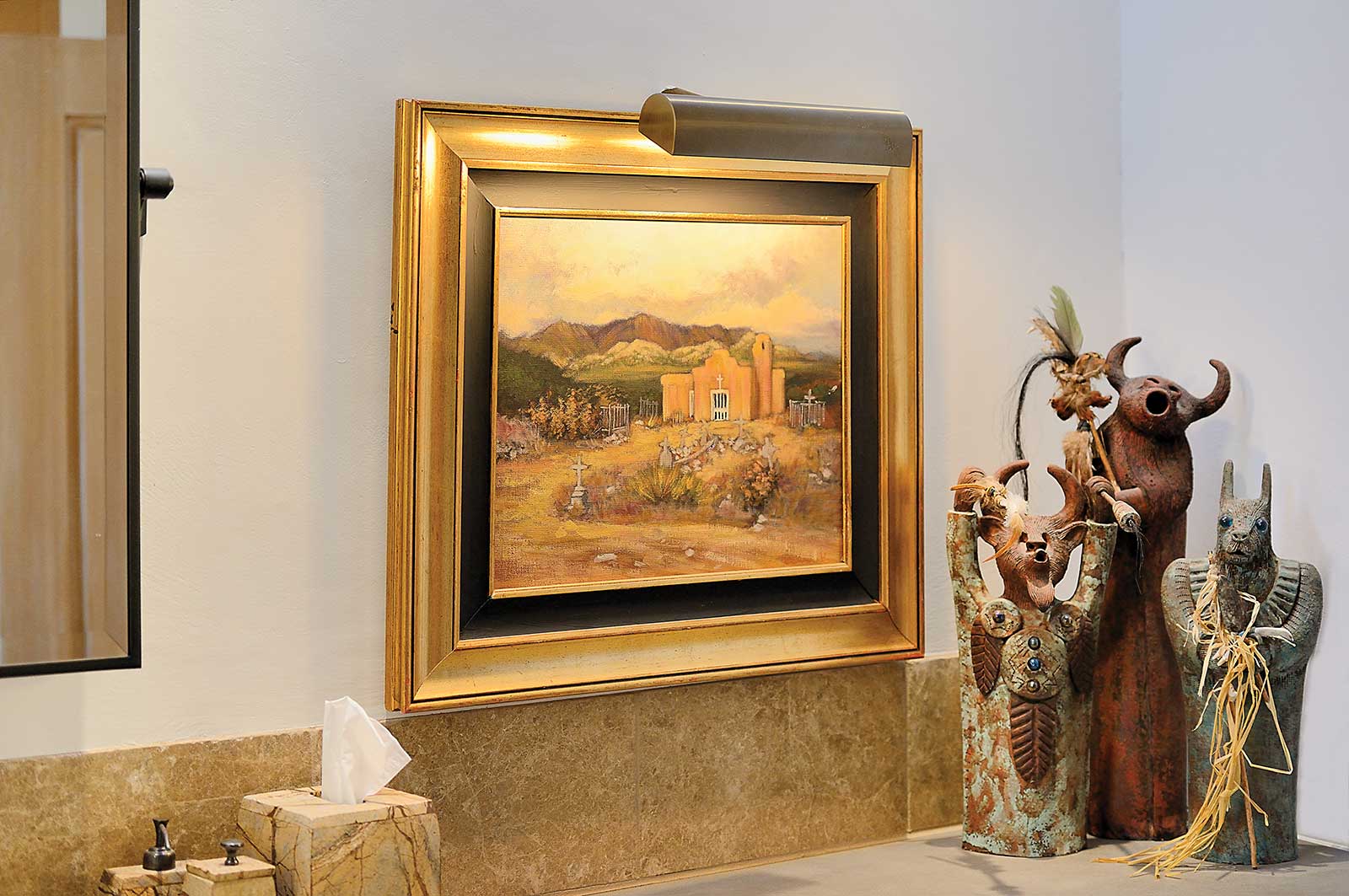 The oil painting is from the collection of Mary’s mother, circa 1930s. The three clay figures, circa 1985, were purchased in Taos, New Mexico.
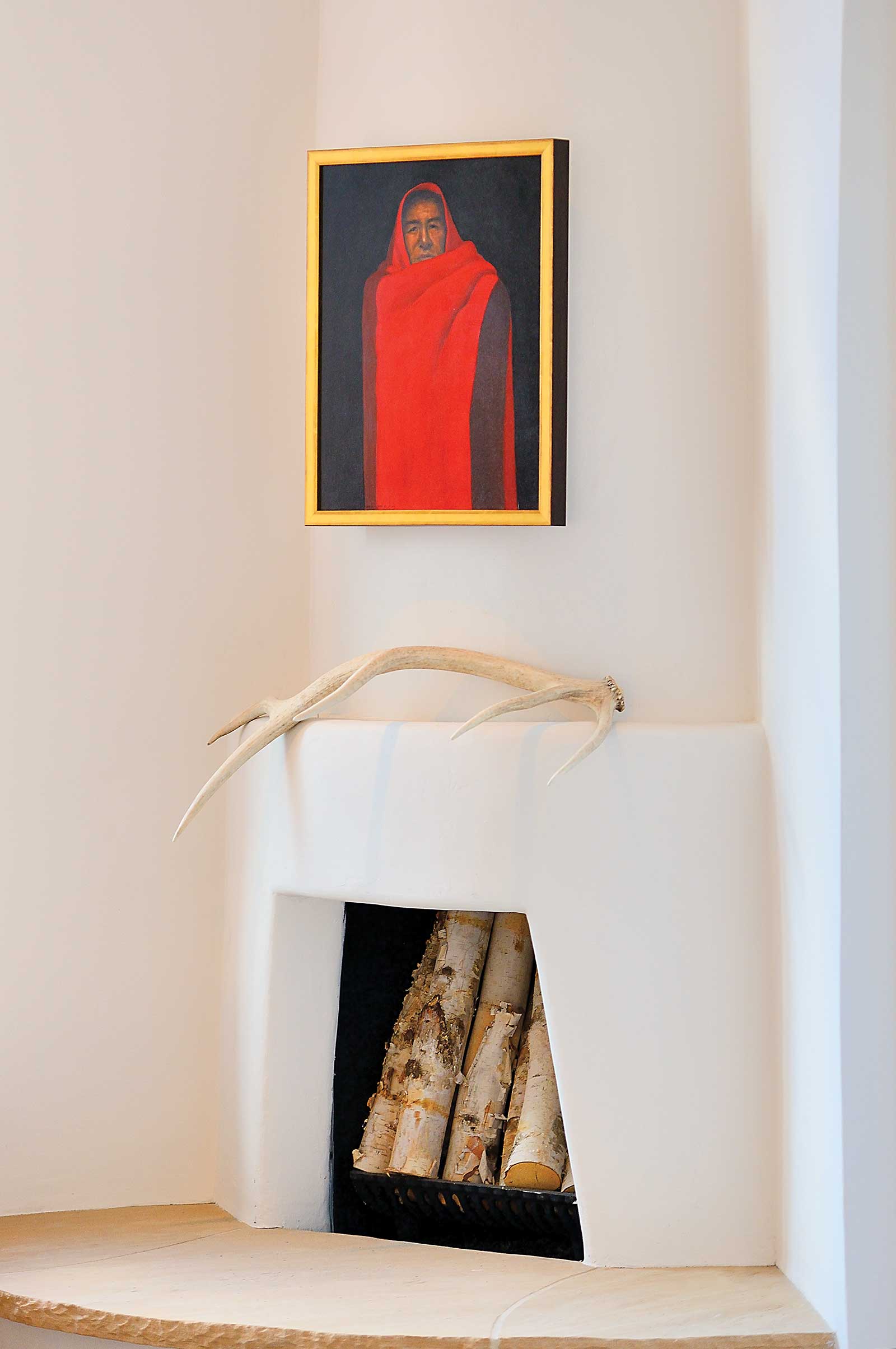 Above the fireplace is Tony in Red, 2019, oil on canvas, by Roseta Santiago.
Mary had moved from Dallas to Denver when she was in her 20s. Her first road trip was to Santa Fe. She came back frequently and introduced her friends to the area. She stayed regularly at Rancho Encantado in the foothills of the Sangre de Cristo Mountains. When it became a Four Seasons Resort, the sculptor Siri Hollander began showing her bronze colts there and they immediately caught Mary’s eye. “I saw her horses in various places here in Santa Fe including a large installation at the New Mexico School for the Deaf. I went to her home and studio and eventually found a colt that fits beautifully in this house.”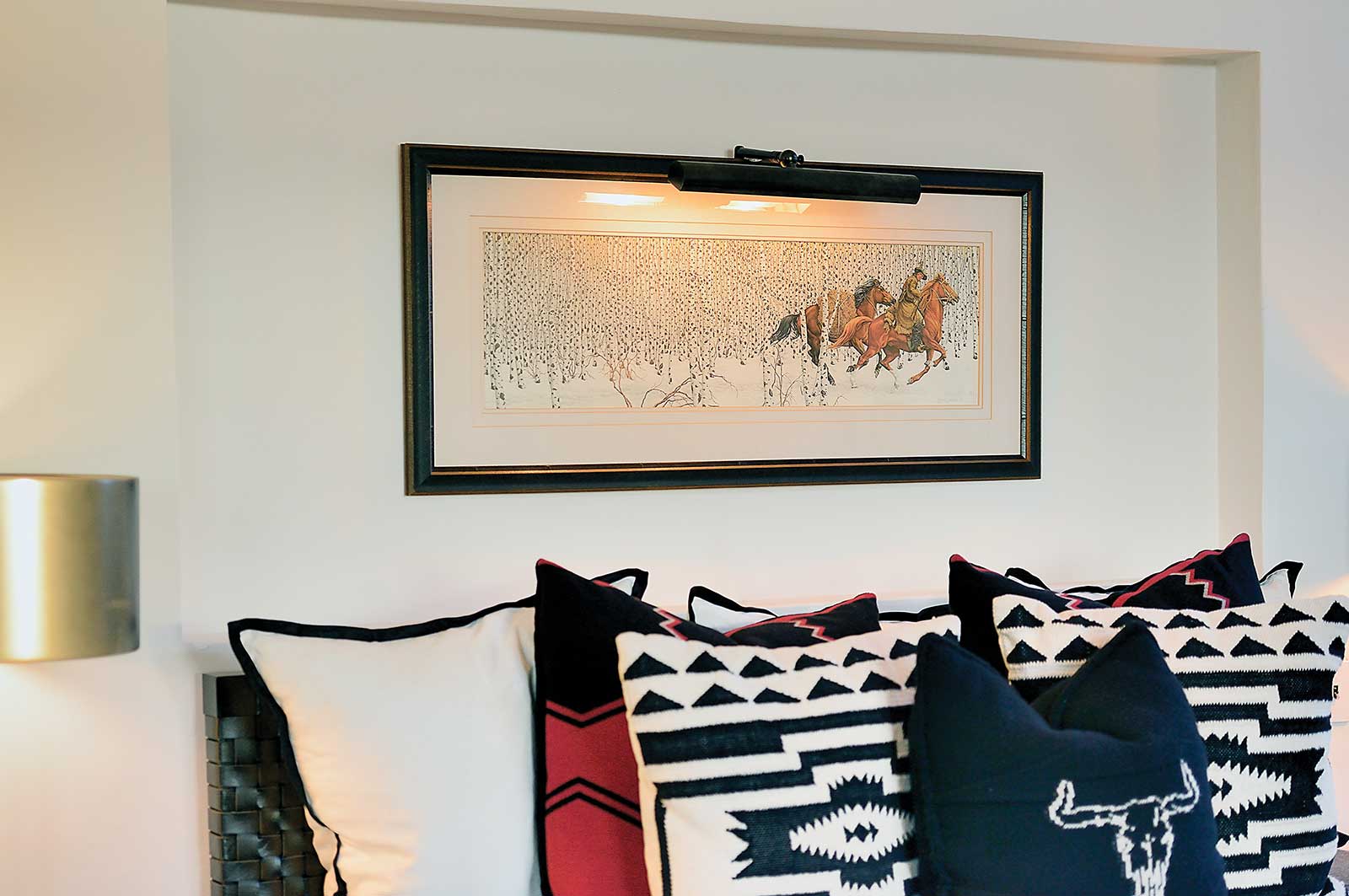 Bev Doolittle’s lithograph, Sacred Ground, 1989, hangs in a bedroom.
“We’re very active,” she says. “We love being outside skiing or cycling. But we just can’t wait to come home. We have art that we enjoy. It’s not for show. It’s for us. We don’t go out looking for art. The art finds us. We buy something because of the feeling we have when we look at it.” “The art speaks to us,” Jay comments. “It’s an important part of the gestalt.” —
Powered by Froala Editor