William Herbert Dunton (1878-1936) was born in Augusta, Maine. As a boy, he went camping, fishing and hunting with his grandfather. His mother recalled, “He was out in the wilds with his gun and sketchbook at every opportunity. He roamed the fields, swamps, and timber. His sketchbook and pencil were ever his companions. He was using a pencil before he had successfully mastered the use of a teaspoon.”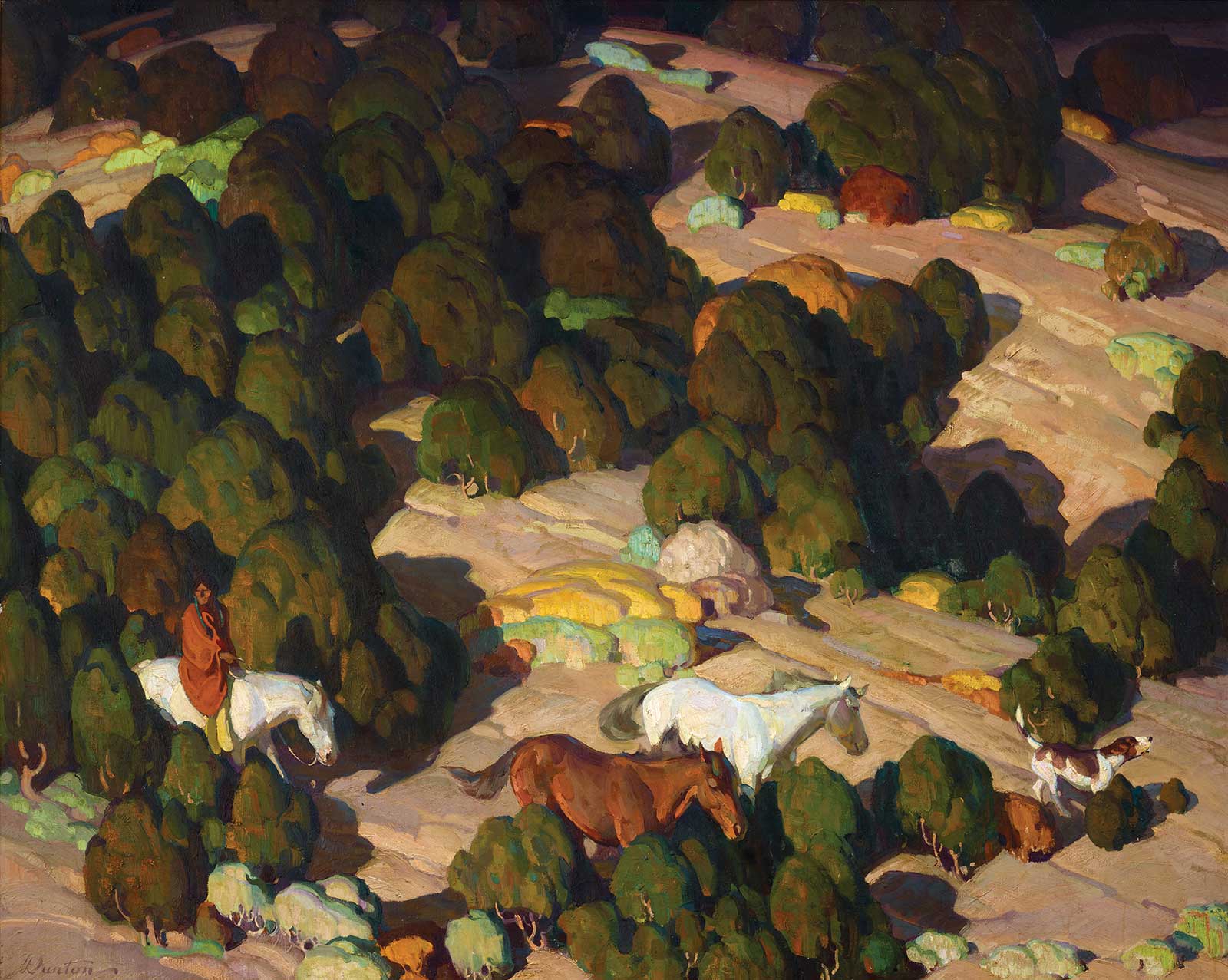 Sunset in the Foothills, ca. 1930, oil on canvas, 40 1/8 x 50 1/8”. Stark Museum of Art, Orange, Texas, Bequest of Nelda C. Stark, 1999, 31.21.398.
His grandfather entertained him with yarns about the West, and he came across the dime novels that were popular in the east during the 1870s. Later, he wrote and illustrated articles for hunting magazines as well as several unpublished stories. In one of them, “Two Boys and a Gun,” he recounts building camps in the woods with his brother and a cousin.
“…[W]e became strongly influenced by stories we read of the West. We began to slink about the pasture in broad-brimmed hats, our belts bristling with discarded pistols and butcher knives borrowed from the kitchen. Thus living in the atmosphere of the frontier, our conversation naturally…dwelled principally on grizzly ‘b’ars’ and ‘Injuns.’ We addressed each other as ‘pards’ and…one of us was almost certain to be relating a personal encounter with Indians or a hard fight with a grizzly.”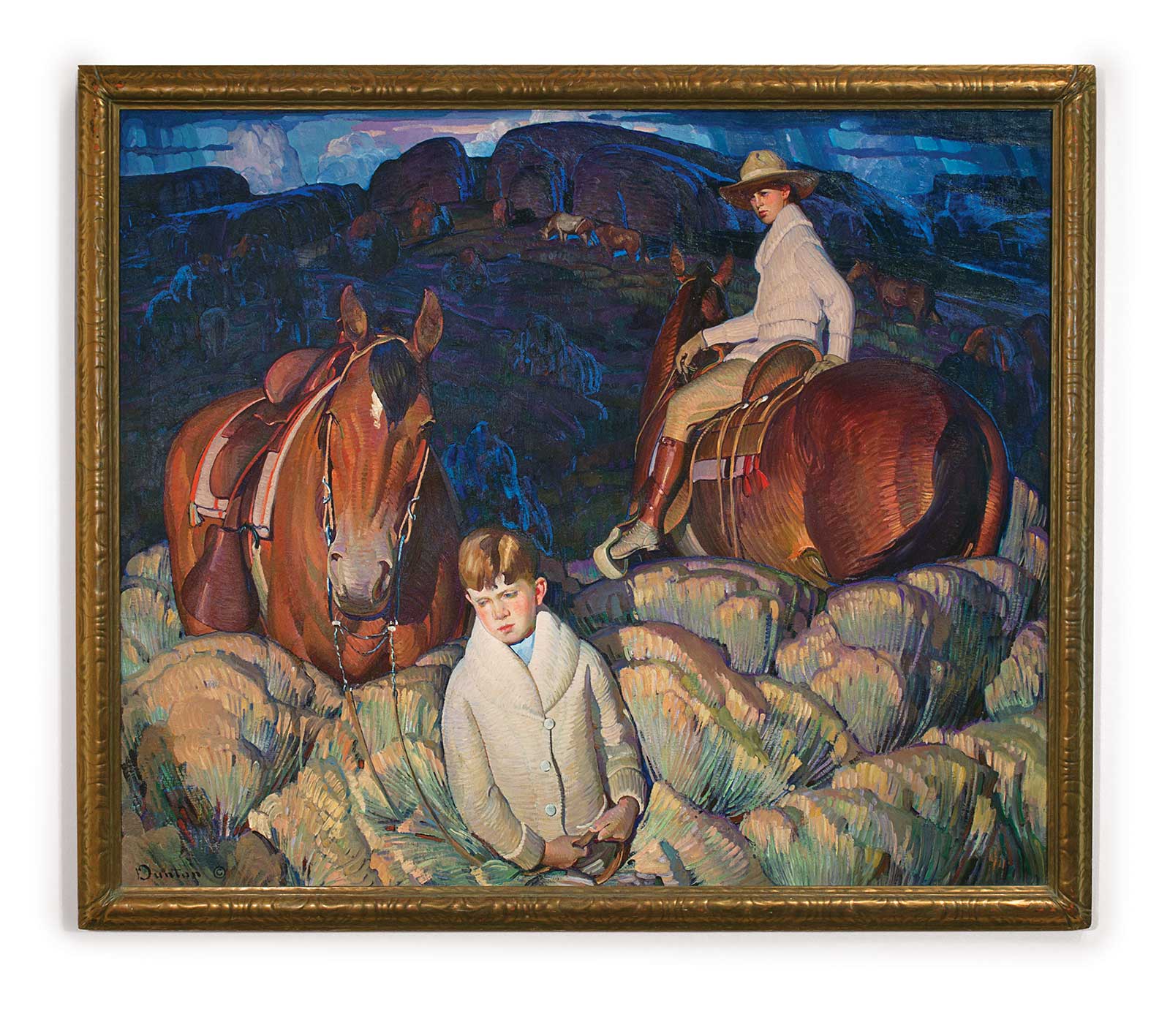 My Children, ca. 1922, oil on canvas, 50 x 60”. Collection of the New Mexico Museum of Art. Gift of a friend, 1927 (351.23P). Photo by Blair Clark.Dunton, later known to his friends as “Buck,” is known as a founding member of the Taos Society of Artists in New Mexico and for his romantic portrait and landscape paintings of the Southwest. An exhibition at the Harwood Museum in Taos, New Mexico, William Herbert “Buck” Dunton: A Mainer Goes West, is now open and runs through May 21, 2023.
His love of the West had begun years earlier in the summer of 1896 when he went to Montana on a camping trip. From that time on he spent most summers on trips in the West, working as a cowboy and hunter in Wyoming, Oregon, Colorado, Nebraska and New Mexico. During the academic year he studied at the Cowles Art School in Boston and worked as an illustrator.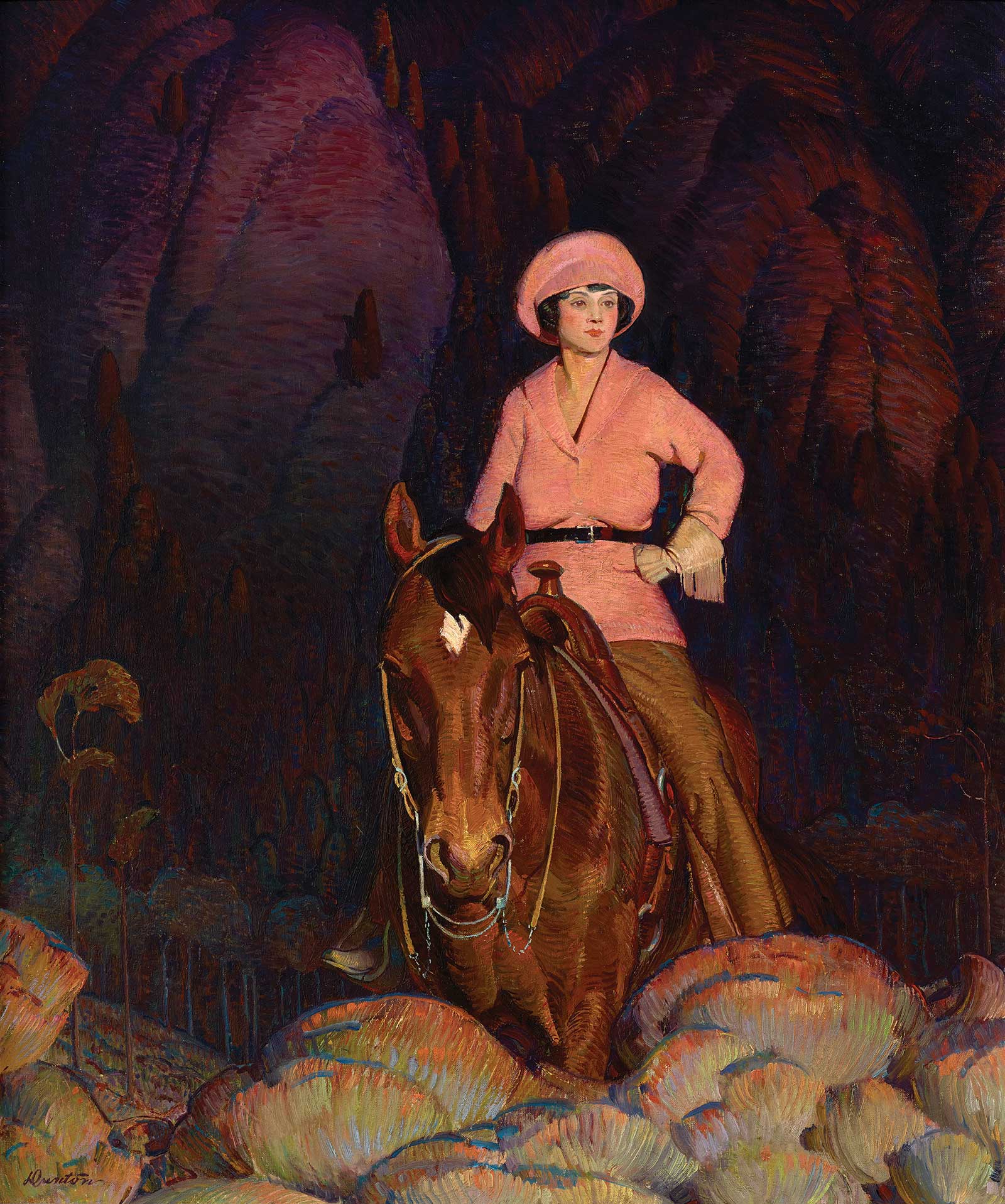 Romaldita, ca. 1922, oil on canvas, 30 x 25”. Stark Museum of Art, Orange, Texas, Bequest of Nelda C. Stark, 1999, 31.21.401.
His illustration career flourished after he moved to New York but he had become dissatisfied with illustration and decided to turn to fine art. He wrote, “I had wanted to paint for some time. I finally decided to get at it before I was too old. I had begun to lose the enthusiasm of youth in the ‘grind’ that, I assume, comes sooner or later to every illustrator.” He first visited Taos in 1912 at the behest of his teacher at New York’s Art Students League, Ernest L. Blumenschein, also a founder of the Taos Society.
Michael K. Komanecky, a guest curator of the exhibition, writes, “The Taos Society of Artists was an immensely important group of painters. Their paintings of Taos and its surroundings really helped define some Americans’ view of the West. Dunton’s subjects were cowboys, guides, cowgirls, sometimes American Indians, and the nature and wildlife that are so striking around Taos.”
Dunton declared in a 1913 interview, “This is the ideal place for me because there are more varieties of atmosphere than I have found in any other place…There are several varieties of sage and cactus for backgrounds, according to the elevation that you choose.”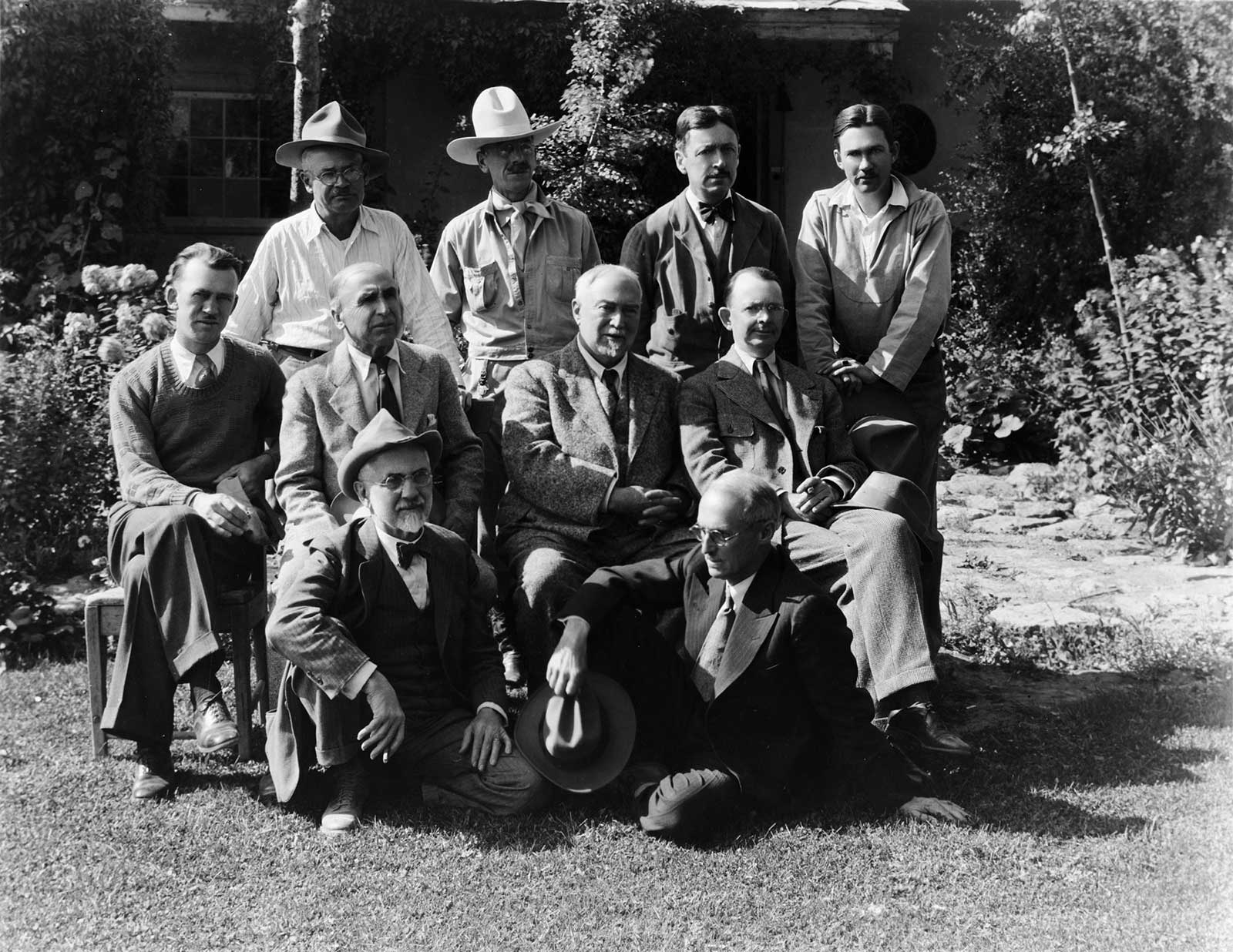 Members of the Taos Society of Artists, photographed in 1932, five years after the group disbanded. Back row, from left: Walter Ufer, William Herbert “Buck” Dunton, Victor Higgins and Kenneth Adams. Seated, from left: E. Martin Hennings, Bert Geer Phillips, Eanger Irving Couse, Oscar E. Berninghaus. Front row, from left: Joseph Henry Sharp and Ernest L. Blumenschein. Photo by by C.E. Lord in the Couse garden.The exhibition has been organized by the Harwood Museum of Art and the Phoenix Art Museum where it will appear after Taos. The Harwood notes, “Despite his contributions to American art, Dunton has received little attention beyond inclusion in shows featuring the work of the Taos Society of Artists.” Julie Schimmel’s monograph, The Art and Life of W. Herbert Dunton, 1878-1936, was published in 1984 by the Stark Museum of Art in Orange, Texas, where she was the inaugural curator. The museum houses the largest collection of Dunton’s work.
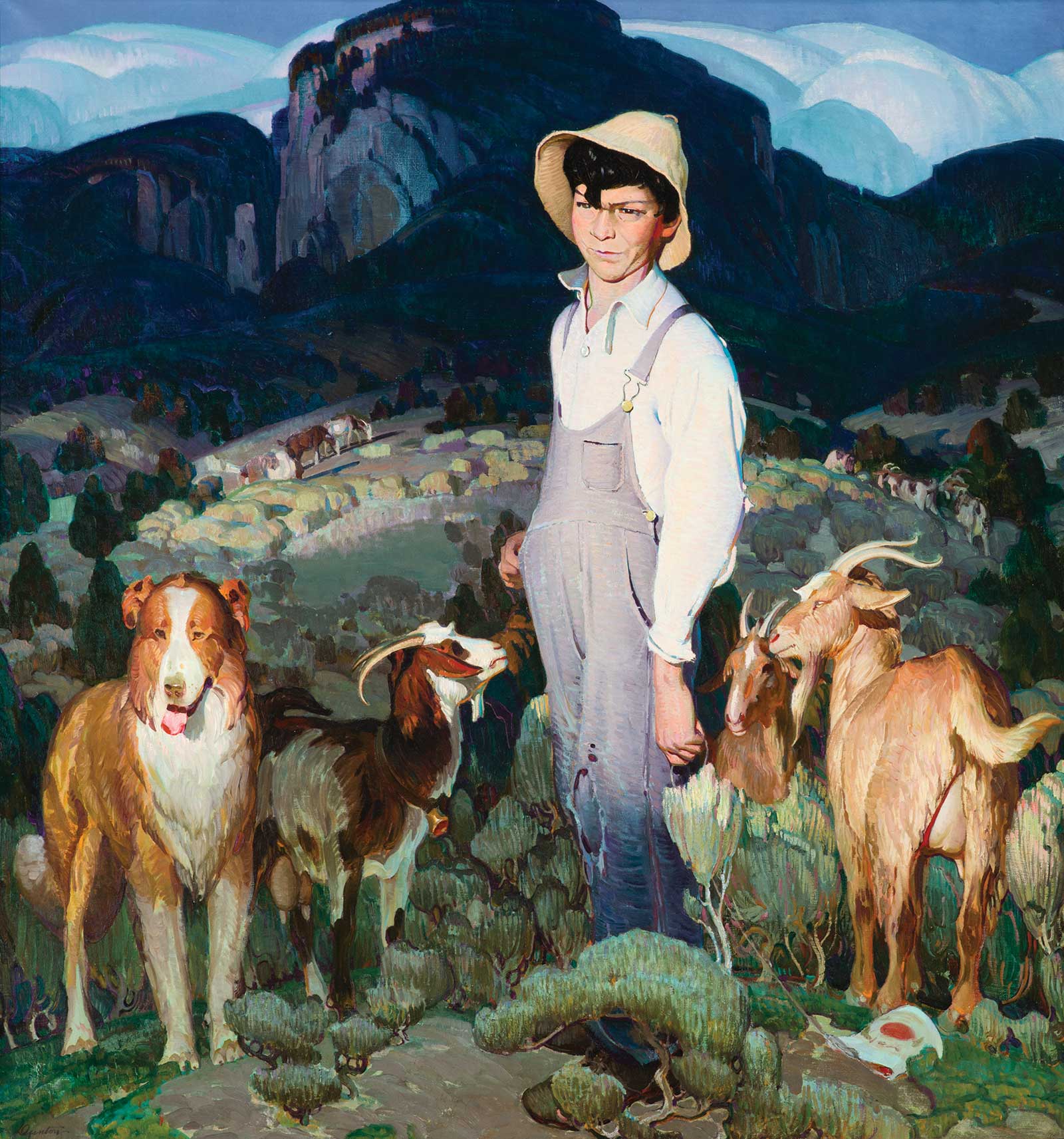 Pastor de Cabras, 1926, oil on canvas, 52 x 50”. Courtesy of Albuquerque Museum, museum purchase, 1993 General Obligation Bonds, PC1994.44.1.In the catalog to the current exhibition, Betsy Fahlman of the Phoenix Museum writes an essay, “The New Woman Goes West: Gender and Mythmaking in the Work of W. Herbert Dunton.” She writes, “I explore that modern creature, the New Woman in her manifestations in the American West as seen through the lens of Dunton’s work. These Western women were often beautiful and stylish…and embody many of the iconic characteristics of her sisters in the East but one situated in the dry landscapes of the West and for whom a horse is a major character.”
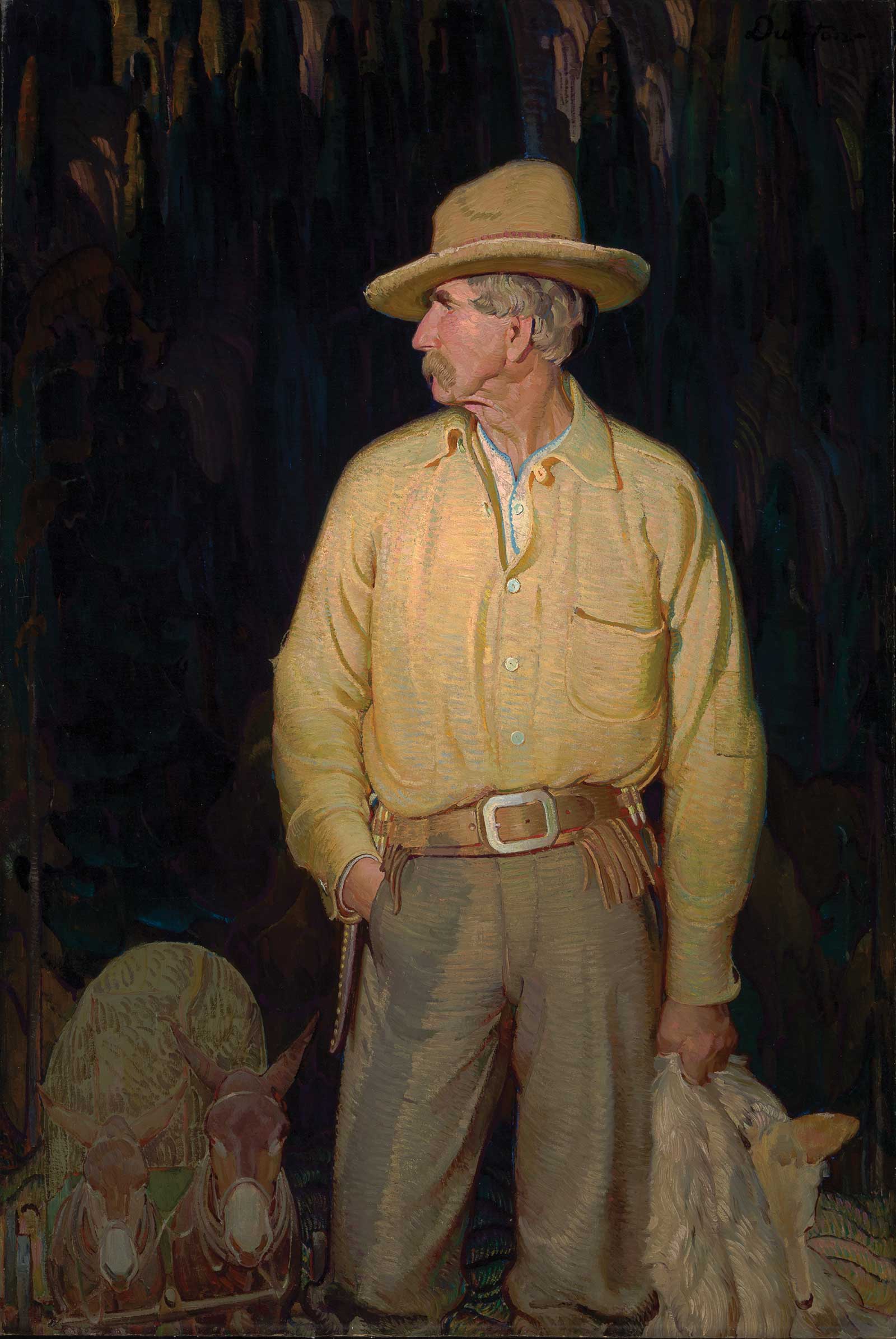 Ginger, ca. 1932, oil on canvas, 50 13 ⁄ 16 x 33 7/8”. Gift of Vivian Dunton, Harwood Museum of Art of the University of New Mexico.
In her monograph, Julie Schimmel writes, “Dunton, probably more than any other illustrator of the West, portrayed Western women not simply as they stood by the side of a cowboy but as they independently took on the West.”
In its catalog note for its Dunton painting, Romaldita, the Stark Museum of Art observes, “Women often seem to be marginalized in Western art. Yet Dunton created strong images of women as in this painting of a model that he titled Romaldita. This mounted woman is glamorous yet conveys mastery of her world. She wears up-to-date attire of fashionable knitted hat and hip-length sweater as she rides horseback. She indicates the presence of the modern New Woman in the American desert West.”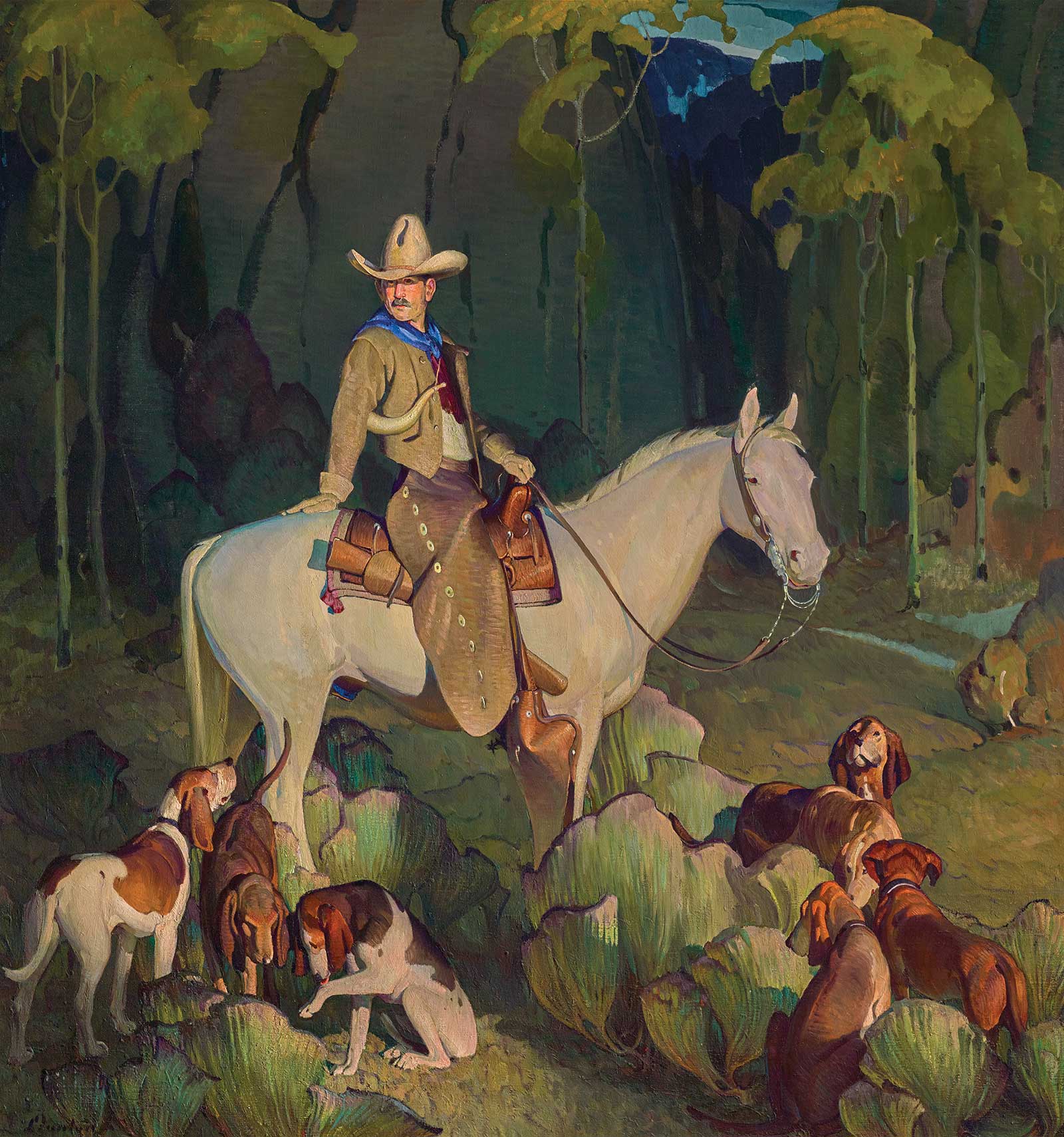 McMullin, Guide, ca. 1934, oil on canvas, 60 x 56”. Stark Museum of Art, Orange, Texas, Bequest of H.J. Lutcher Stark, 1965, 31.21.222.
Dunton was often plagued with the opprobrium of being “merely an illustrator.” In 1927, his friend, the painter Alexandre Hogue wrote, “Unlike many painters, Dunton does not excel in one phase of his work at the expense of all others; his landscapes, animals, human figures, are equally well done. The ability to do all these things well; his ‘range,’ or extremes of color from lightest to darkest; and, above all the third-dimensional effect which he achieves, place him in the front rank of living American painter.”
The “third-dimensional effect” is often pronounced in his figures in the landscape, brightly lit against a darker, stylized background. Julian Duran herded his father’s dairy goats in upper Taos Canyon. Dunton asked for permission to use him as a model in Pastor de Cabras and depicted him with his dog and his charges, standing out against the dark mountain.
Dunton wrote, “What I want is to paint for connoisseurs, yet have the people out ‘in God’s country’ say ‘That man’s been there.’” —
William Herbert “Buck” Dunton: A Mainer Goes West
Through May 21, 2023
The Harwood Museum of Art
238 Ledoux Street, Taos, NM 87571
(575) 758-9826, www.harwoodmuseum.org
Powered by Froala Editor