In the 19th century, black-and-white and hand-colored lithographs on paper made fine art available to larger audiences.
George Catlin (1796-1872), was a lawyer in Pennsylvania. He was also an artist and, in the 1820s, decided to dedicate his work to the life and culture of American Indians living on the Great Plains. He said, “The history and customs of such a people, preserved by pictorial illustrations, are themes worthy the lifetime of one man, and nothing short of the loss of my life shall prevent me from visiting their country and becoming their historian.” He created some 500 paintings and collected Native American artifacts which he toured as his “Indian Gallery” in the United States and in Europe.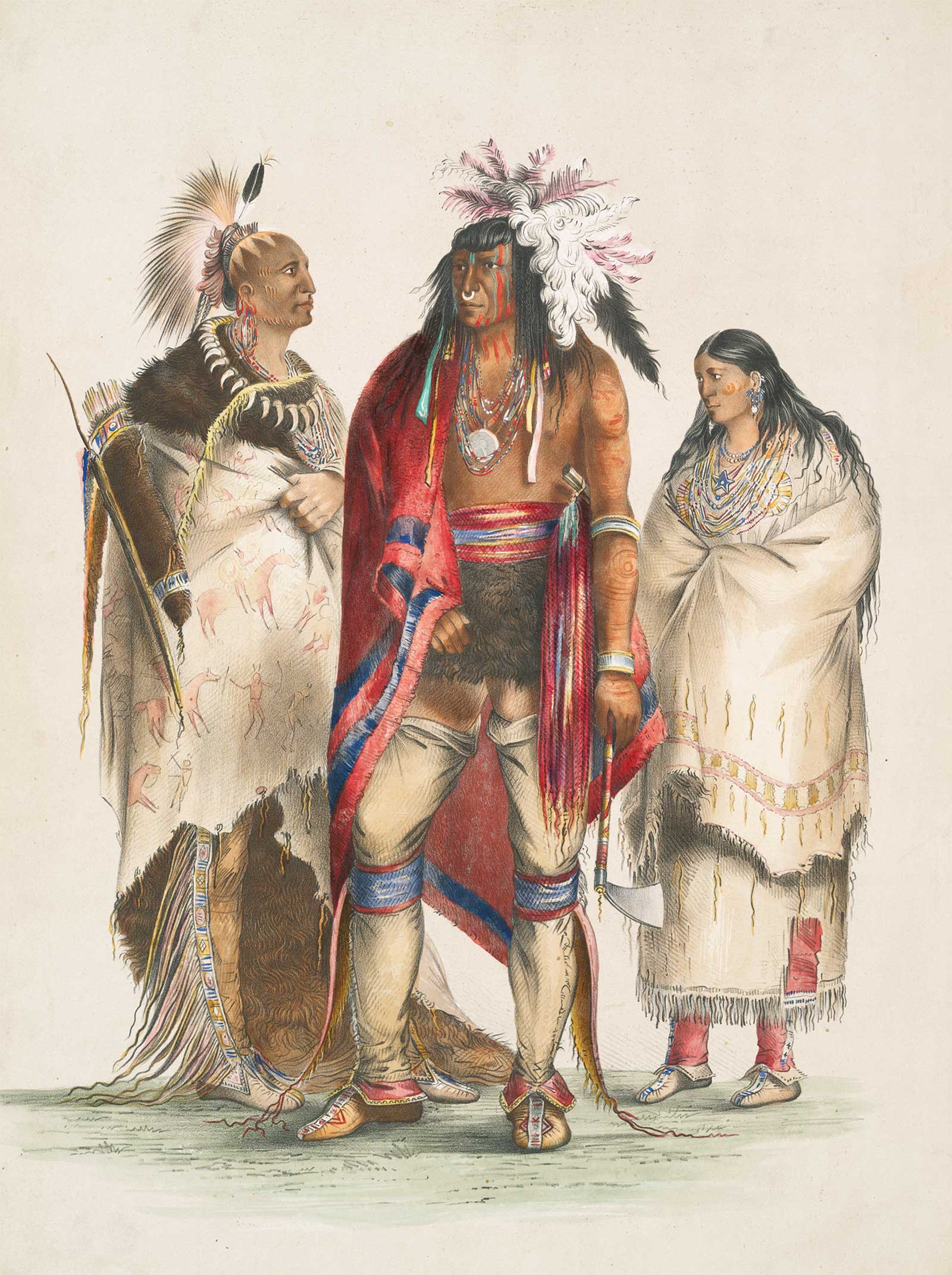 Arader Galleries, North American Indians, From The North American Indian Portfolio, London, 1844, lithograph with original hand-coloring, sheet size: approx. 23 x 16½”, by George Catlin (1796-1872).
He produced a portfolio of 25 hand-colored lithographs for his North American Indian Portfolio which was printed in London in 1844 and published in the United States in 1845. Plate No. 1 is illustrated here. His accompanying description notes, “The group in Plate No. 1 is composed of three portraits from my collection, representing three different tribes of various latitudes and well illustrating a number of the leading characteristics of this interesting part of the human family.”
Phil Epp was born in Nebraska and lives in Kansas “imprinted,” as he says, “with the open spaces of the Great Plains.” He is noted for his colorful paintings of horses on the plains under vast, cloud-filled “Phil Epp skies.” He says, “In college I learned printmaking, mostly intaglio, from Robert Regier. I bought an etching press and wanted to just mess with it like a hobby. I experimented with what imagery works on a small plate.”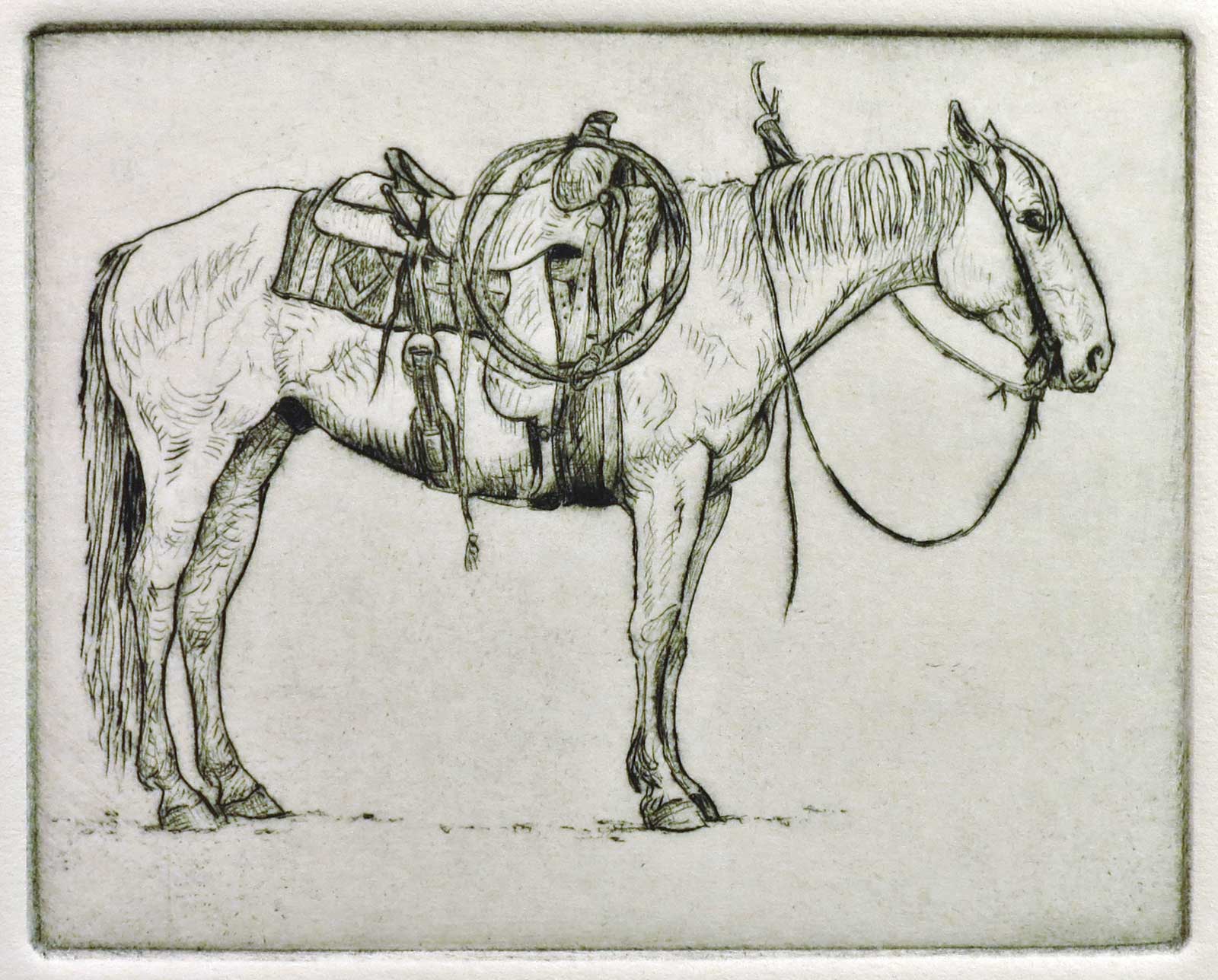 7 Sundays Art, Salebarn Horse, drypoint etching, 4 x 5”, by Phil Epp.
His experiments most often focus on horses and riders or details of ranches and lone buildings in the landscape. He explains that his work “celebrates the naïve, the simple, the pure, the unspoiled and spiritual.” In 1985, he received the Kansas Governor’s Award. In 2016, he was invited to be a member of Cowboy Artists of America, a group dedicated “to authentically preserve and perpetuate the culture of Western life in fine art.”
Daniel McCoy received his formal training at the Institute of American Indian Arts in Santa Fe. Used to making large, colorful paintings, he found himself without a studio during Covid. The experience opened up new ventures “such as murals, printmaking, drawing and writing,” he explains. “This change in routine has been one of the many blessings I have experienced during this strange time.”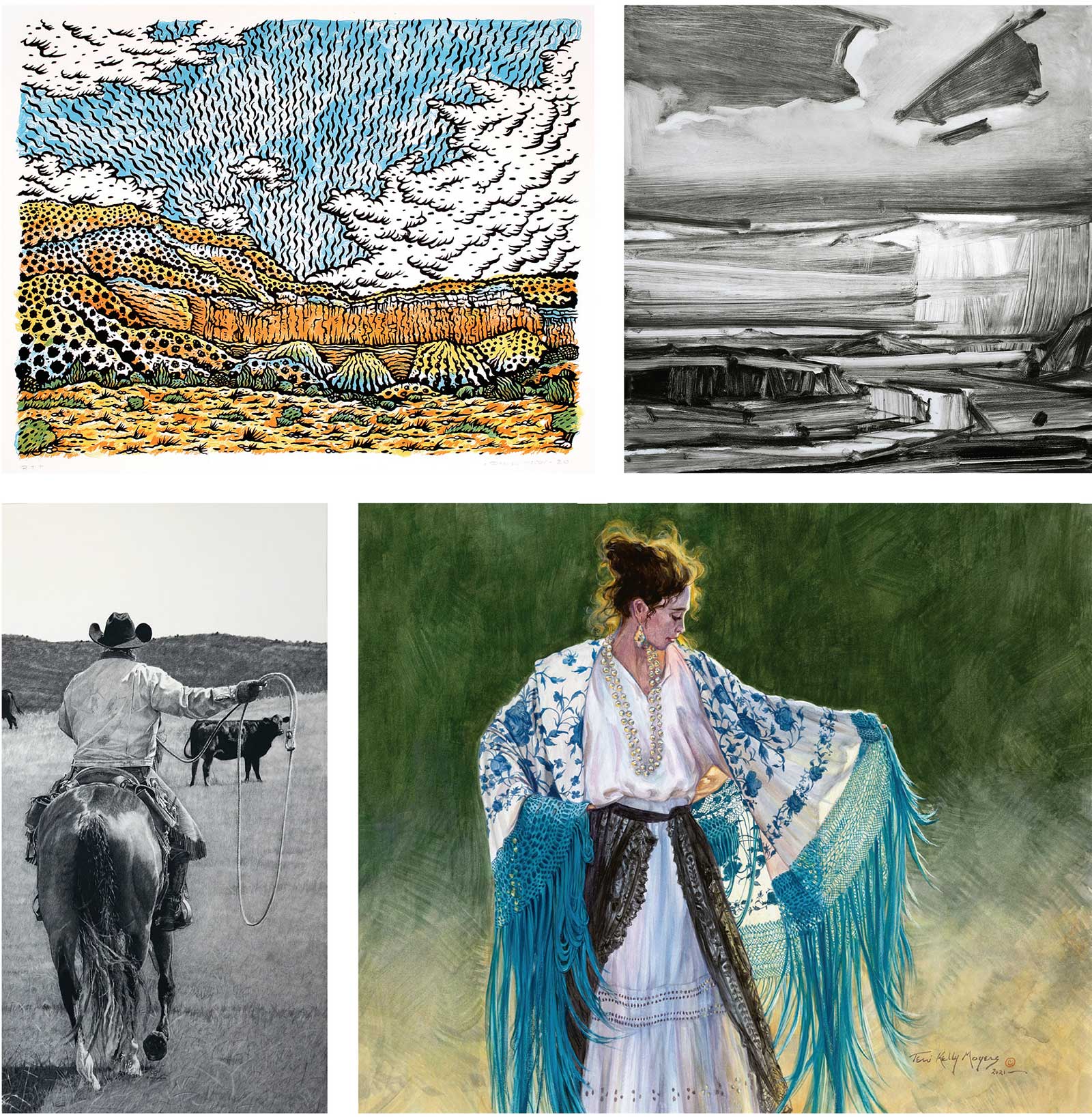 Top: Hecho a Mano, Canyon Walls Near Abiquiu, four-color lithograph, ed. of 50, 21 x 25½”, by Daniel McCoy; EVOKE Contemporary, The Basin, monotype on paper, 28 x 28”, by Christopher Benson. Bottom: Rachel Brownlee, Who, Me?, charcoal, 28 x 15”; Legacy Gallery, The Golden Hour, watercolor, 20 x 24”, by Terri Kelly Moyers.
Hecho a Mano Gallery in Santa Fe invited him to be the first artist to participate in Hecho a Mano Editions, which publishes limited-edition prints by New Mexican and Mexican artists. They collaborated with the renowned Black Rock Editions in Santa Fe to produce their first print, McCoy’s Canyon Walls Near Abiquiu.
“When it comes to the landscapes,” he explained, “I like to pick subject matter that is historically a point of interest in New Mexican art. I am also quite aware that an original landscape can be produced from ordinary, almost bland scenery. It is then the responsibility of the artist and their mark making to produce a piece of work that is unique. The reference photo and drawing were from an area known as ‘Christ in the Desert’ which is a Benedictine Monastery on the banks of the Chama River near Abiquiu, New Mexico. The canyon walls along the Chama River were particularly interesting to me—at any angle a proper landscape could be produced… I wanted to combine the New Mexican landscape, The Group of Seven, Comics and printmaking to create something I had never attempted previously.”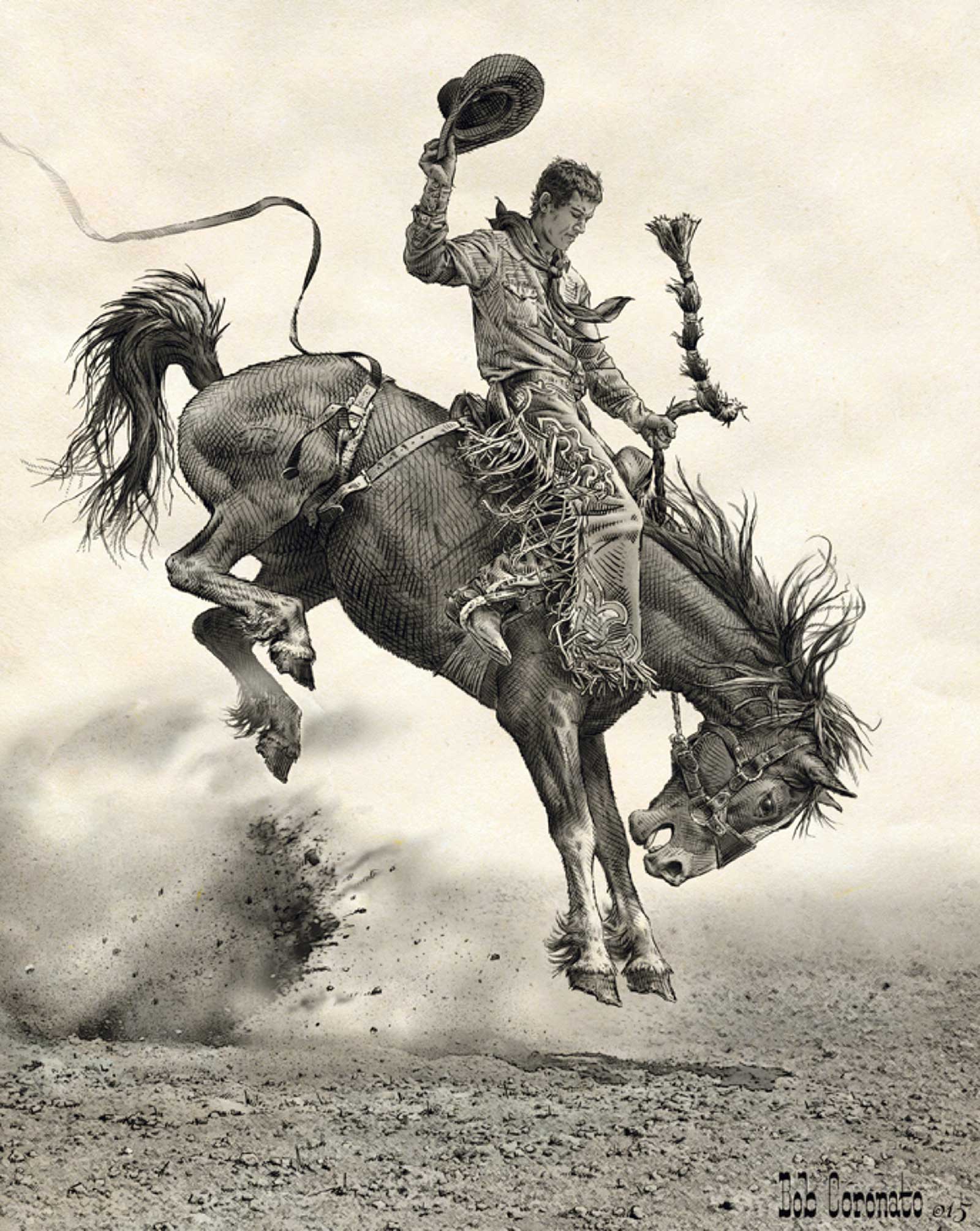 Legacy Gallery, Just Another Day at the Office, etching, ed. 3 of 50, 13 x 10", by Bob Coronato.
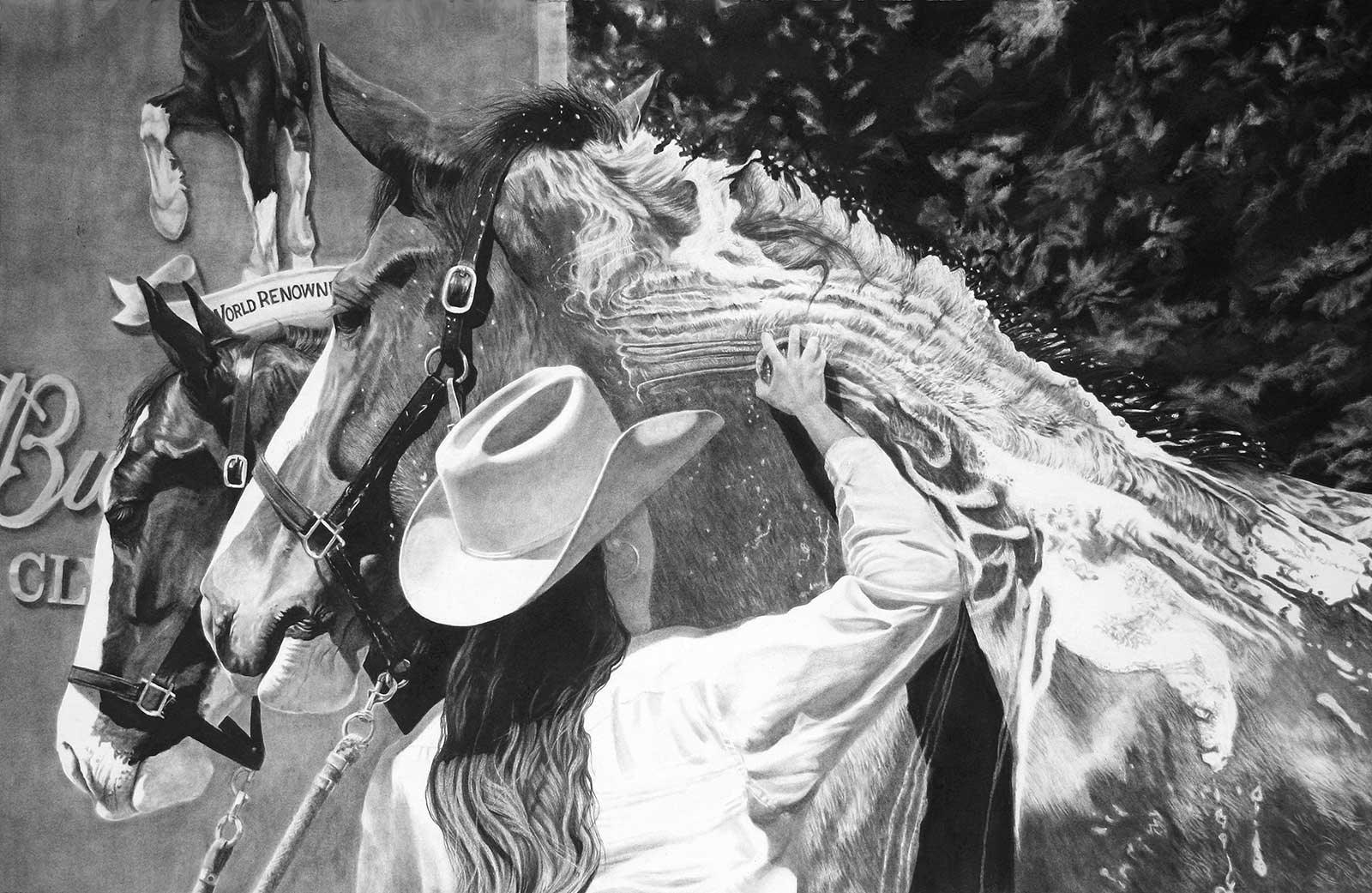 Rox Corbett, Pageant Material, charcoal on cotton archival paper, 16¼ x 25"
Continue reading through this special section to learn about other artists and galleries that specialize in works on paper, from watercolor and gouache, to charcoal and graphite, to printmaking and other forms of artwork. We hope you enjoy this inaugural section devoted to works on paper.
Legacy Gallery in both Scottsdale, Arizona, and Santa Fe, New Mexico, has had a long history of showing and supporting works on paper. Presently, the gallery has work by Stan Davis, whose mixed media collage uses different styles and textures to tell stories about Western subjects; Terri Kelly Moyers, who painted the breathtaking watercolor The Golden Hour, showing a woman in traditional clothing; and Bob Coronato, who works with cowboy and rodeo subjects in his etchings. The gallery also has a long history with drawings as well.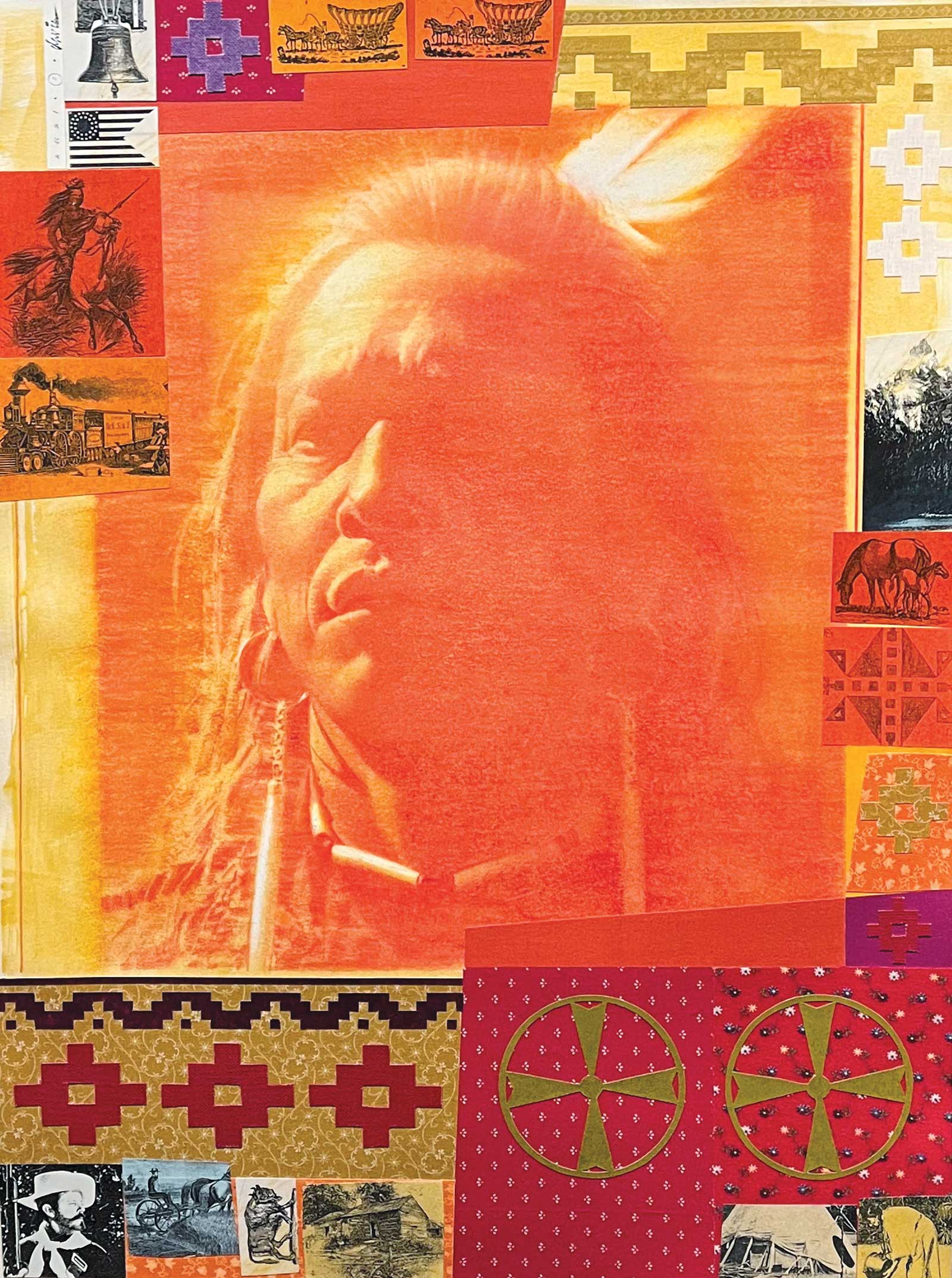 Legacy Gallery, Universal Forms: Canto III, mixed media collage, 24 x 18", by Stan Davis.
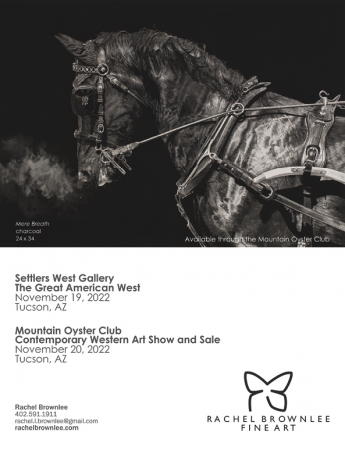
Rachel Brownlee calls the medium of charcoal a “wild” medium, but also “unforgiving and messy, but dramatic and precise. My work is incredibly detailed and time consuming,” she says. “It feels like a tribute to each person and animal I portray because their beauty is also the result of time, weather and wear. The invisible, unwanted hours of the day, those before dawn, usually provide the foundation upon which much visible success is built. Hard working people, in agriculture and otherwise, exert their efforts in the dark, using hours that many people don’t even know exist or ever have intention to use. I discipline myself and my work similarly with the intention of driving my art to ever-greater limits of clarity in representing an alive and multifaceted lifestyle.”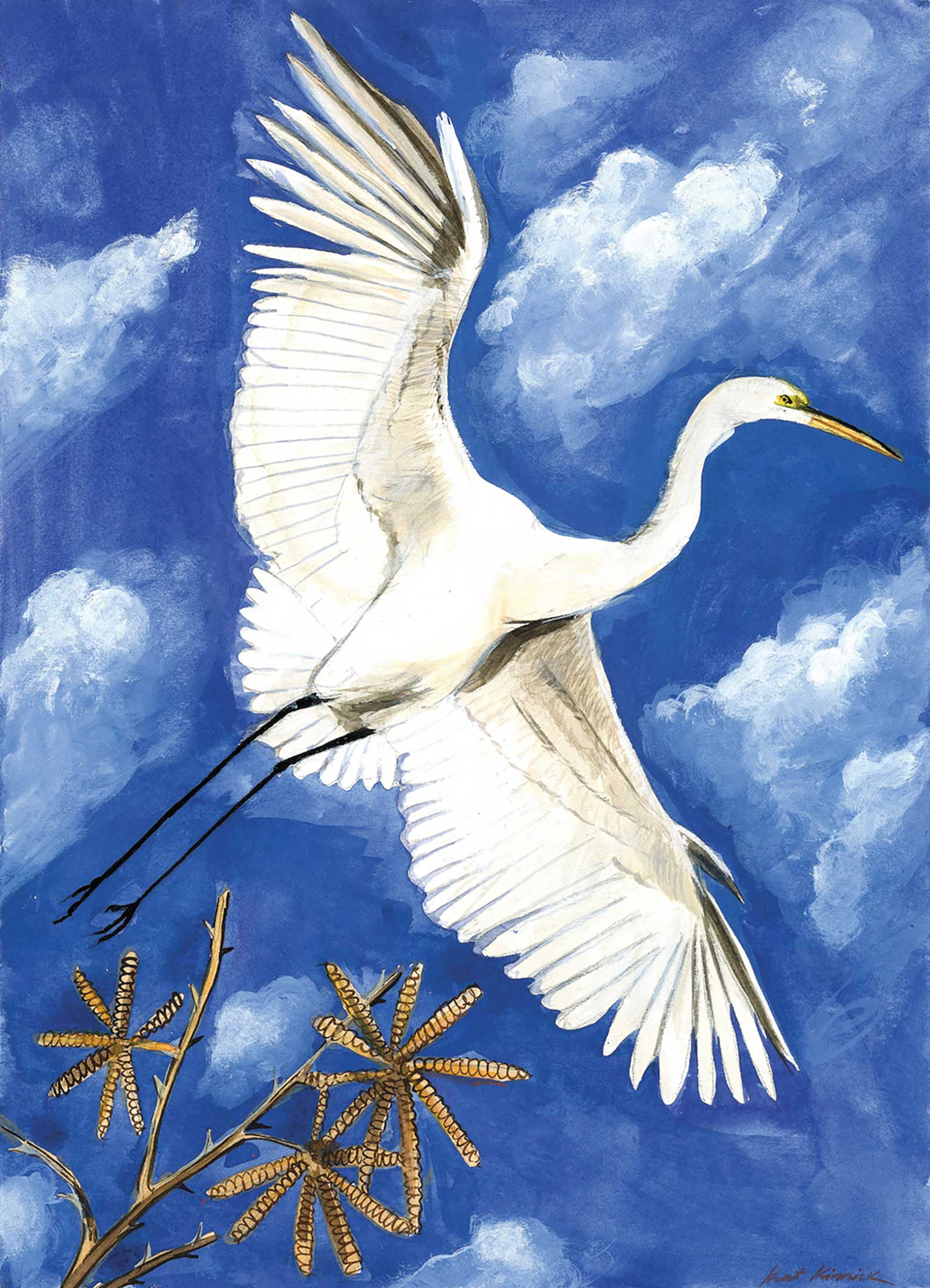 Hecho Gallery, Heron & Screwbean Mesquite, gouache on paper, 15 x 11", by Kat Kinnick.
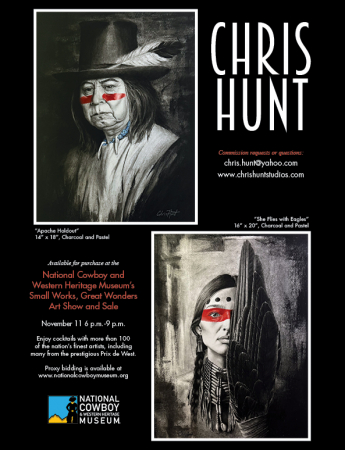
Her advice to aspiring collectors: “Do not fear either the archival or investment quality of the medium or the distance glazing provides. Some of the greatest artists in history are known for their charcoal or ink works on paper and there are many options for using non-reflective glazing or even avoiding it altogether.”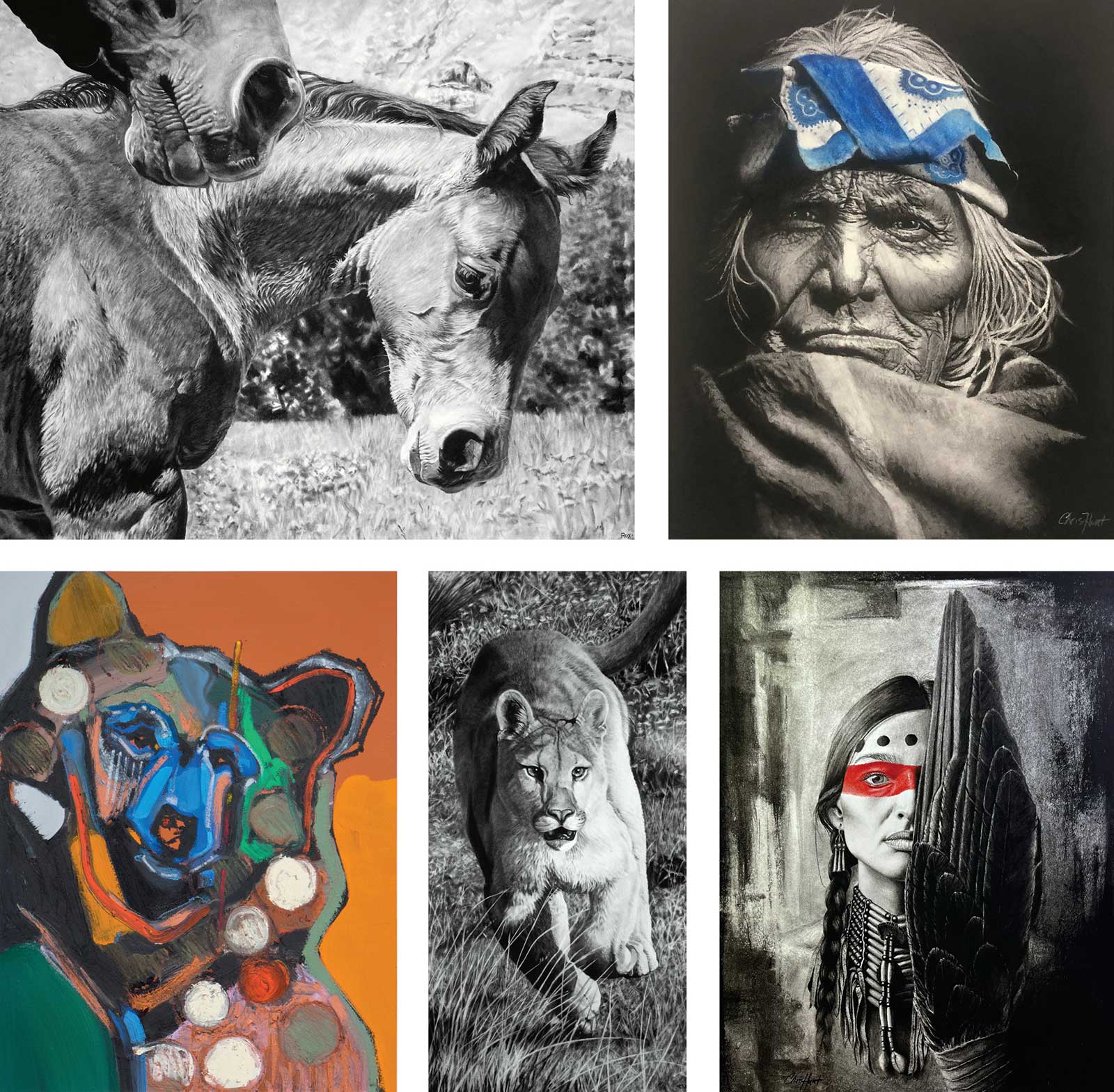 Top: Rox Corbett, Quarter Horse Child, charcoal on cotton archival paper, 18 x 21”; Chris Hunt, Zuni Blue, mixed media on paper, 14½ x 12”. Bottom: Connor Liljestrom, Thousand Series #114, oil, oil stick and oil pastel on paper, 30 x 22½”; Rox Corbett, Acceleration, charcoal on cotton archival paper, 24½ x 12”; Chris Hunt, She Flies with the Eagles, mixed media on paper, 20 x 16”
Chris Hunt is a nationally recognized artist who specializes in charcoal and pastel drawings on paper, as well as bronze sculpture. His realistic portrayals of past and present figures bring their unique stories to life with remarkable detail and drama. He has a breathtaking flair for capturing and evoking emotion in every work, ranging from the noble and striking Native American, the historic vaquero, to the hard working American cowboy. “I use my work to build a bridge from the past to the present and awaken the senses through vivid realism and bold composition,” Hunt says. “I want the deep tones of my charcoal to convey the feeling of yesteryear, to pull one’s imagination to a place they’ve never been before, to live the story of my subject, and then with a touch of brilliant color, the viewer is transported to the here and now while still being engrossed in the history of the West.”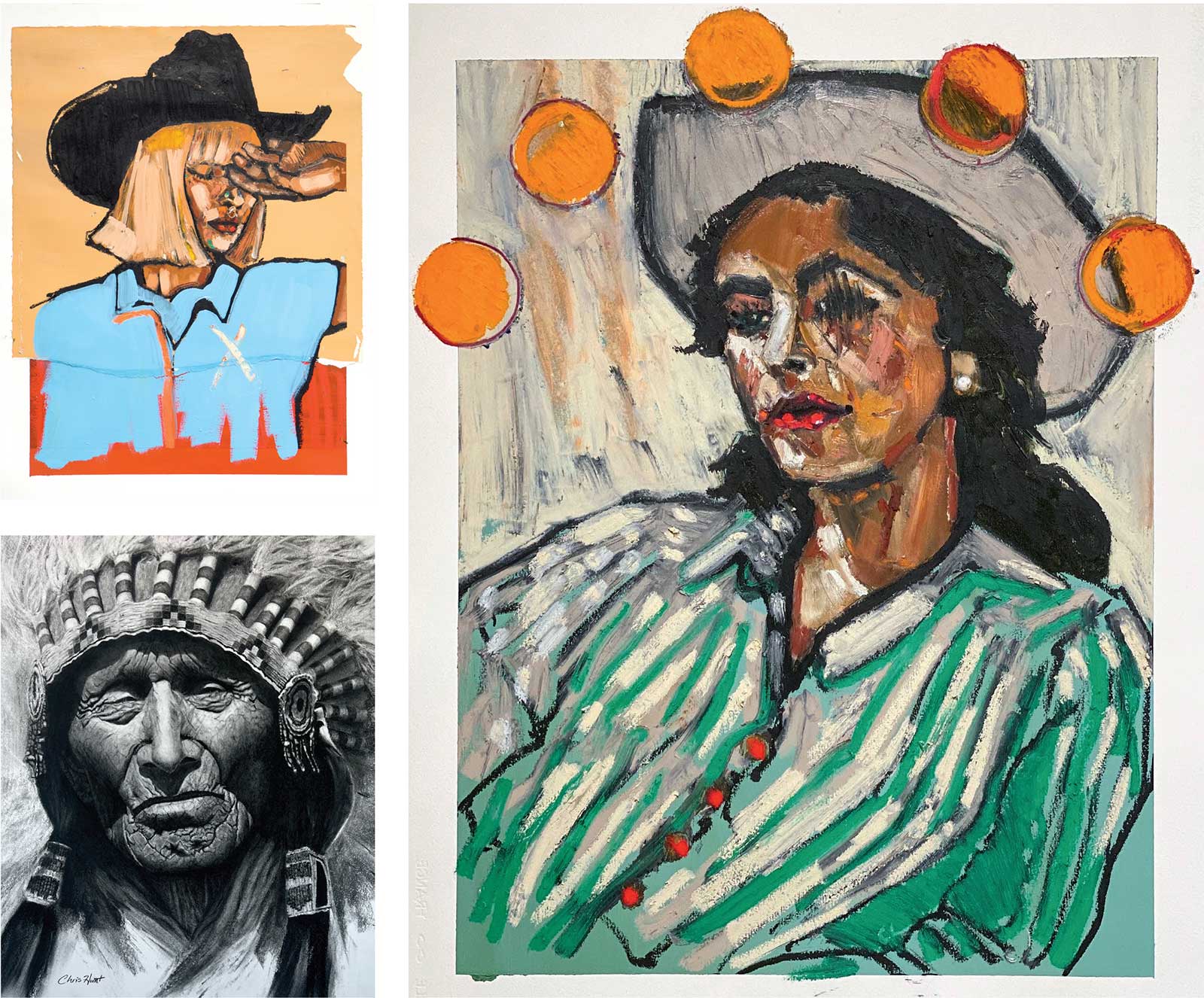 Clockwise from top left: Connor Liljestrom, Thousand Series #117, oil, oil stick and oil pastel on paper, 30 x 22½”; Connor Liljestrom, Thousand Series #102, oil, oil stick and oil pastel on paper, 30 x 22½”; Chris Hunt, He has Danced with the Sun, mixed media on paper, 16½ x 14”
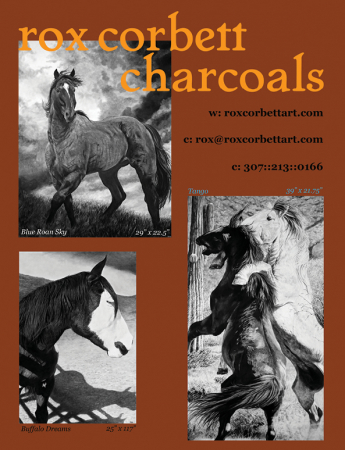
Rox Corbett has been working in charcoal for many years and she is a big believer in the medium and its possibilities. Because she’s so experienced with charcoal, she has also refined her process down to what works best for her. “I make tools to create different textures: soft chamois leather, denim or rough-textured fabric. I then load charcoal onto the tools by rubbing them against big sticks of compressed charcoal and work the medium into the paper. I also use charcoal pencils, homemade willow charcoal and erasers,” Corbett says. “My drawings aren’t loose sketches or underdrawings, but finished, dry ‘paintings’ on paper. The paper I use is made from cotton, just as canvas is. Since I started using charcoal as my preferred medium in the 1980s, I have been told that a charcoal drawing, or any work on paper, is somehow ‘less than.’ The subject of longevity is brought up, but Leonardo da Vinci’s 500-year-old charcoal drawings are as crisp and fresh as if they had been made yesterday. There is a lot of fascinating work available that is not just another oil painting.” 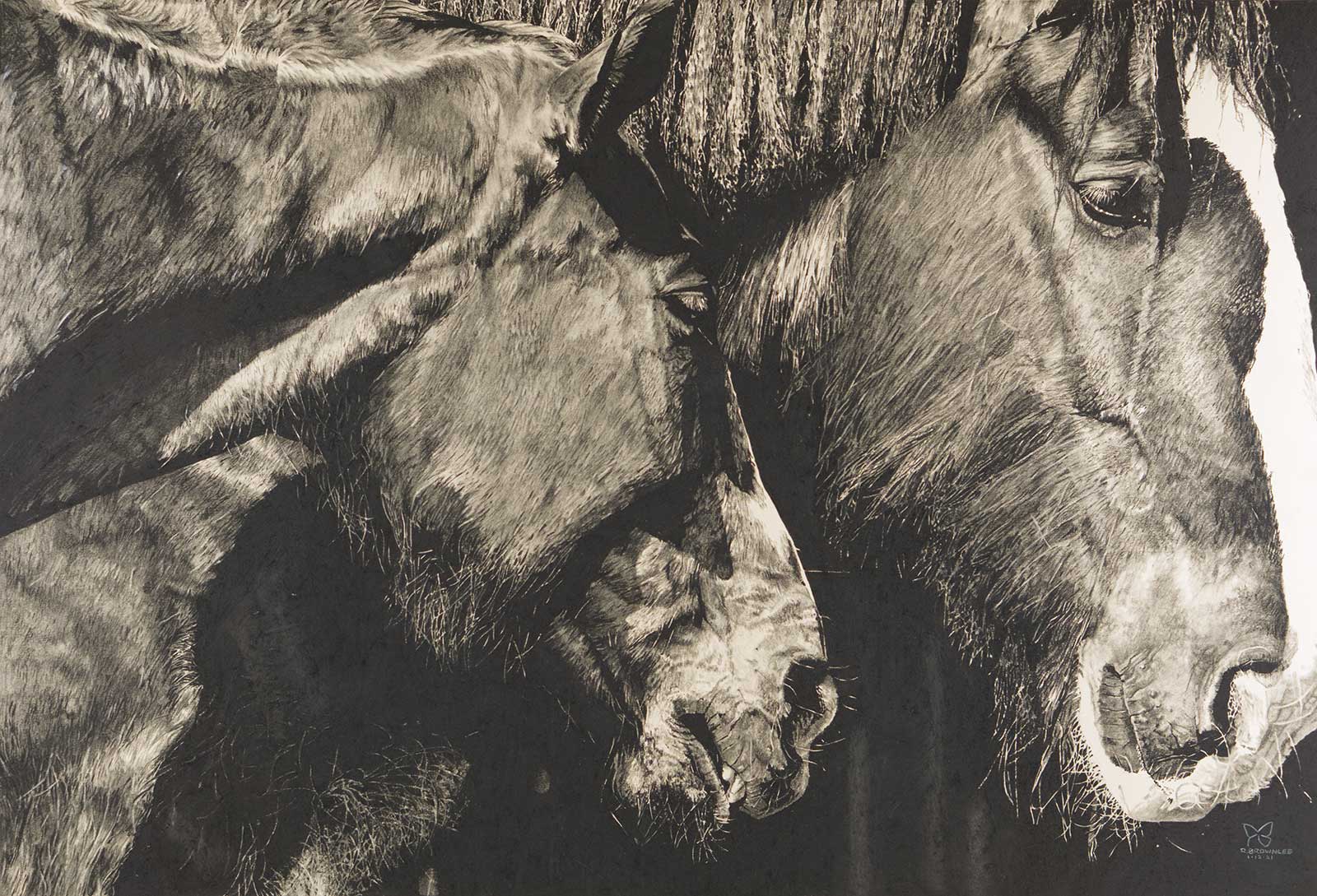 Rachel Brownlee, Old Fathers, charcoal, 22 x 28"
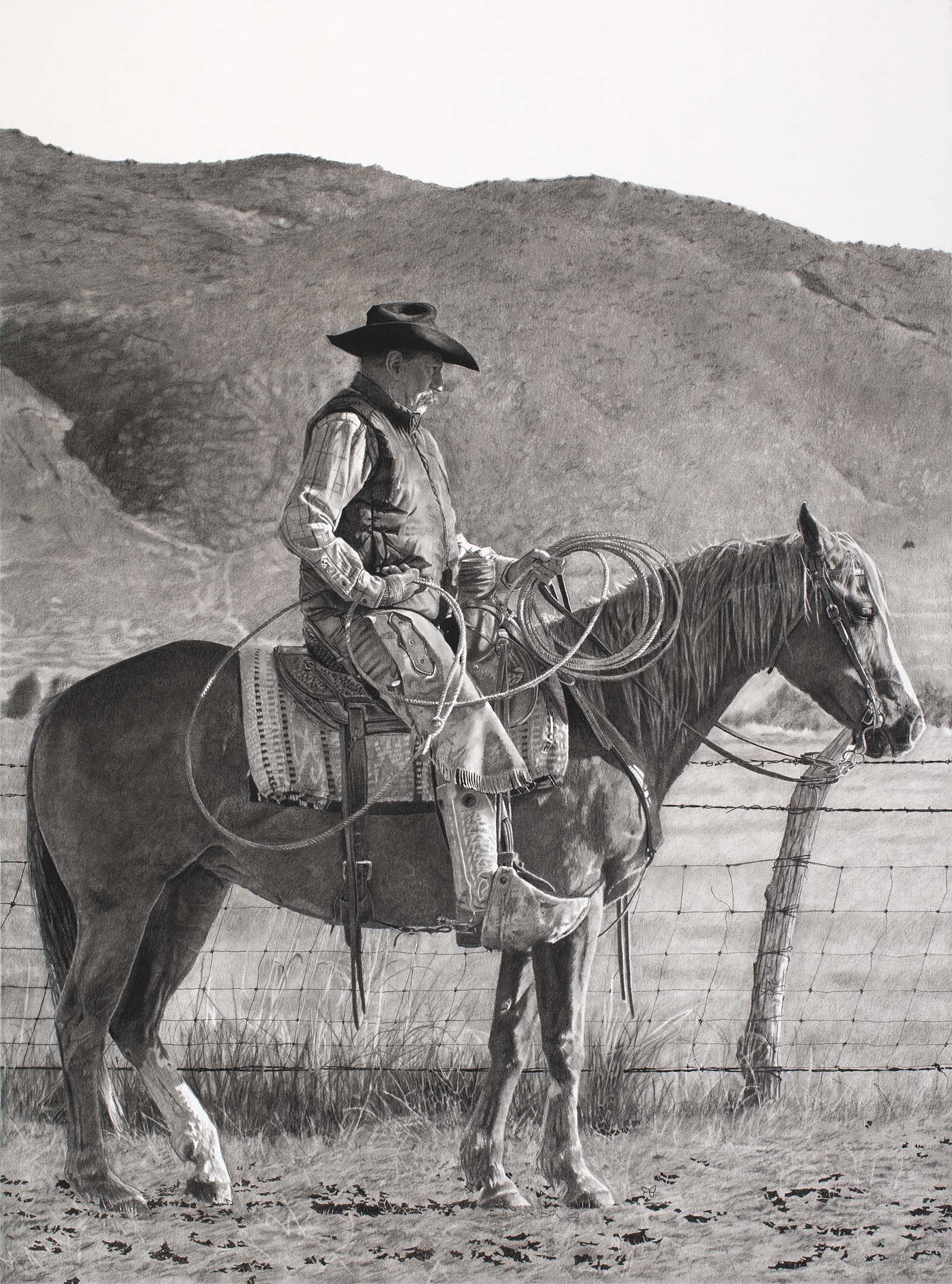 Rachel Brownlee, Welcome Dawn, charcoal, 32 x 25"
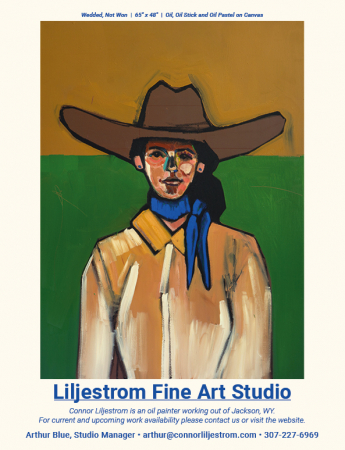
Connor Liljestrom grew up in Wyoming and his heritage was in cattle ranching. Today his work is based on observation, particularly how the past echoes in the present, and how those echoes can inspire work happening now. He’s been enjoying capturing some of that inspiration on paper. “I think that it is an interesting consideration for collectors to ask why the decision was made to do the work on paper as opposed to another substrate. The answer can vary but it may be significant to the piece. Reasons may be because it is a travel piece so it has size or weight/portability restraints or there is a unique aspect to the aesthetic of the piece that is better achieved by being on paper. Ask how that medium performs on that substrate in a way that it doesn’t perform on other substrates. Ask why an artist is leaning into that and how they are taking advantage of, and making the strength of the paper shine through,” he says. “As an artist who works on paper but also many other substrates, it’s a different visual effect and painting experience that comes with working on paper. That’s a meaningful consideration before I start working on a new project. In addition, if all other aspects are equal, works on paper can be more financially accessible than work on other substrates, and that factors into collection building as well.” —
Featured Artists & Galleries
7 Sundays Art
www.7sundaysart.com
Arader Galleries
1308 Walnut Street, Philadelphia, PA 19107
(215) 735-8811, www.aradergalleries.com
Chris Hunt
chris.hunt@yahoo.com
www.chrishuntstudios.com
Connor Liljestrom
Liljestrom Fine Art Studio, Jackson, WY
arthur@connorliljestrom.com
(307) 227-6969
www.connorliljestrom.com
EVOKE Contemporary
550 S. Guadalupe Street, Santa Fe, NM 87501
(505) 995-9902, www.evokecontemporary.com
Hecho a Mano
830 Canyon Road, Santa Fe, NM 87501
(505) 916-1341, www.hechoamano.org
Hecho Gallery
129 W. Palace Avenue, Santa Fe, NM 87501
(505) 455-6882, www.hecho.gallery
Legacy Gallery
7178 Main Street, Scottsdale, AZ 85251
(480) 945-1113
225 Canyon Road, Santa Fe, NM 87501
(505) 986-9833
www.legacygallery.com
Rachel Brownlee
(402) 591-1911, rachel.l.brownlee@gmail.com
www.rachelbrownlee.com
Rox Corbett
(307) 213-0166, rox@roxcorbettart.com
www.roxcorbettart.com
Powered by Froala Editor