Sometimes what unites artists is not their similarities, but their differences.
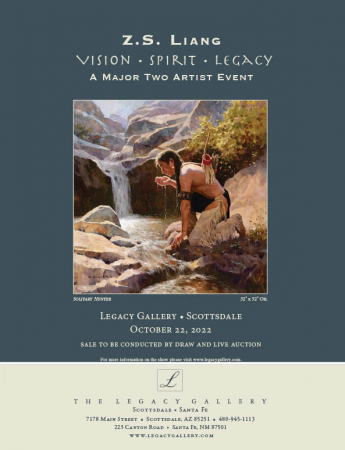
Two of today’s true master Western artists, Z.S. Liang and Kyle Polzin—whose works are vastly different, yet similarly respectful to history and detail—will be joining forces in a highly anticipated two-artist show at Legacy Gallery in Scottsdale, Arizona.
The show, titled Vision – Spirit – Legacy, will take place October 22 and will shine a spotlight on the exceptional and highly sought-after works of these two artists. Z.S.’s paintings involve Native American figurative compositions that depict various forms of daily life and historical events. Kyle paints exclusively still life works, including Native American subjects and various other Western items. Neither artist hesitated when asked by gallery owner Brad Richardson to take part in the two-man show because they felt their contrasting styles and subject matter would nicely complement each other.
And not only do their styles contrast, but also their methods.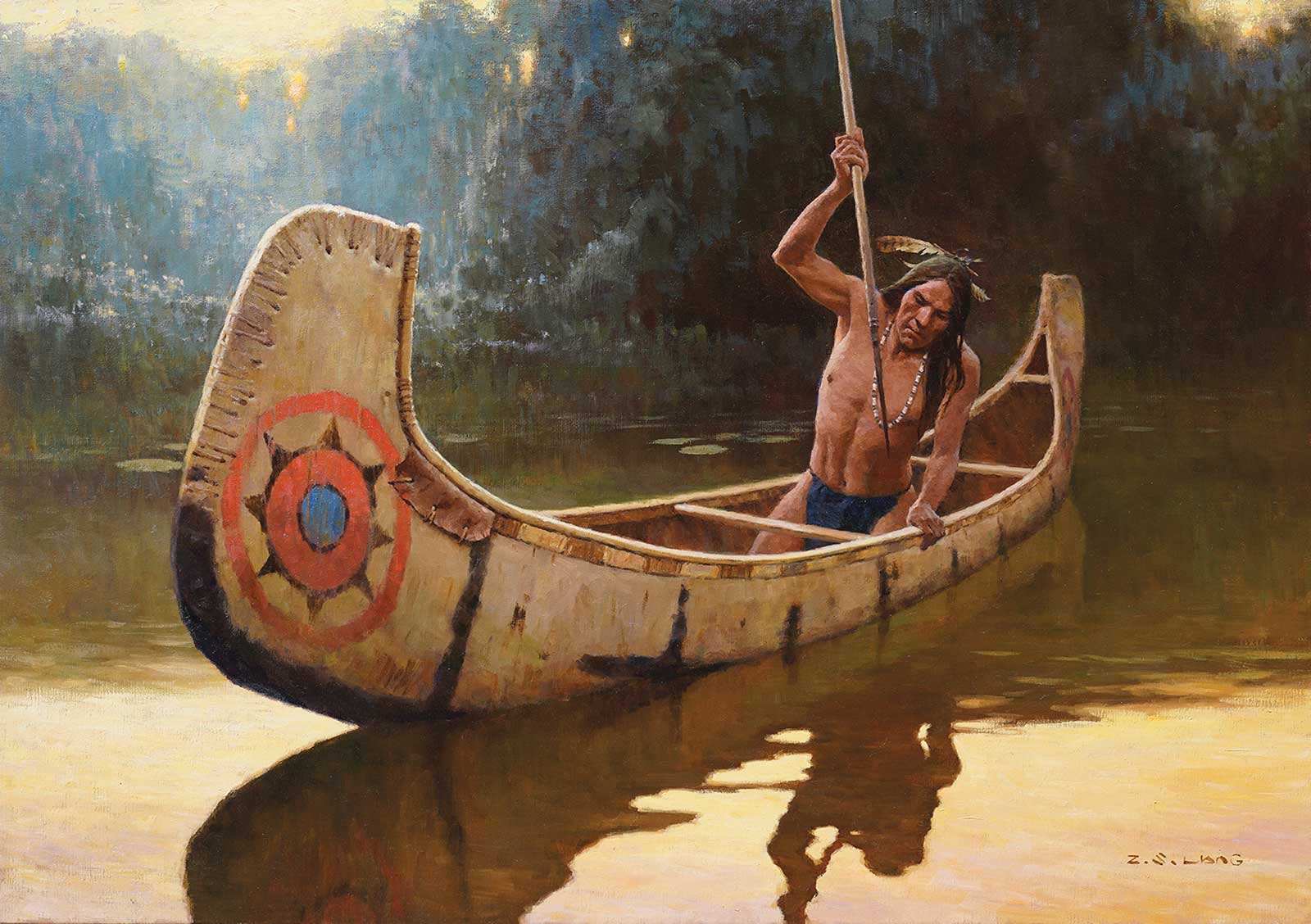 Z.S. Liang, Calm Water, oil, 34 x 48”
To create his realism paintings, Z.S. employs live models. When he is doing a portrait, he will use a single model that is dressed in clothing that is authentic to a specific Native American tribe. For more complex works, when he is “telling a story,” he will use multiple models for his photo sessions. They are dressed by an individual who is an expert in all forms of Native American clothing, headdresses and other items. Fortunately, I recently had the opportunity to travel with Z.S. to the Crow Reservation outside of Billings, Montana. We were there for a private modeling session and photo shoot that he scheduled several months earlier. Z.S. primarily uses private modeling sessions instead of group sessions for his reference photos. These private sessions give him the ability to plan compositions for his paintings which are completely unique to him because they don’t resemble paintings that other artists might create during more crowded group sessions.
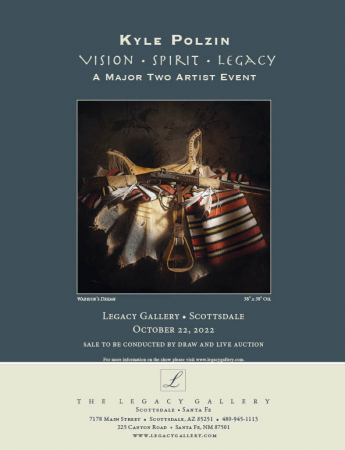
Before he schedules a photoshoot, Z.S. spends a considerable amount time doing research on the Plains Indians to find information on events or happenings that he thinks could be the basis for several new paintings. After doing his research, he then begins the task of planning and sketching compositions that he thinks would be interesting and appealing to collectors. Once his ideas for the paintings are formulated, he proceeds to make eight rough sketches to determine how he could successfully tell each story.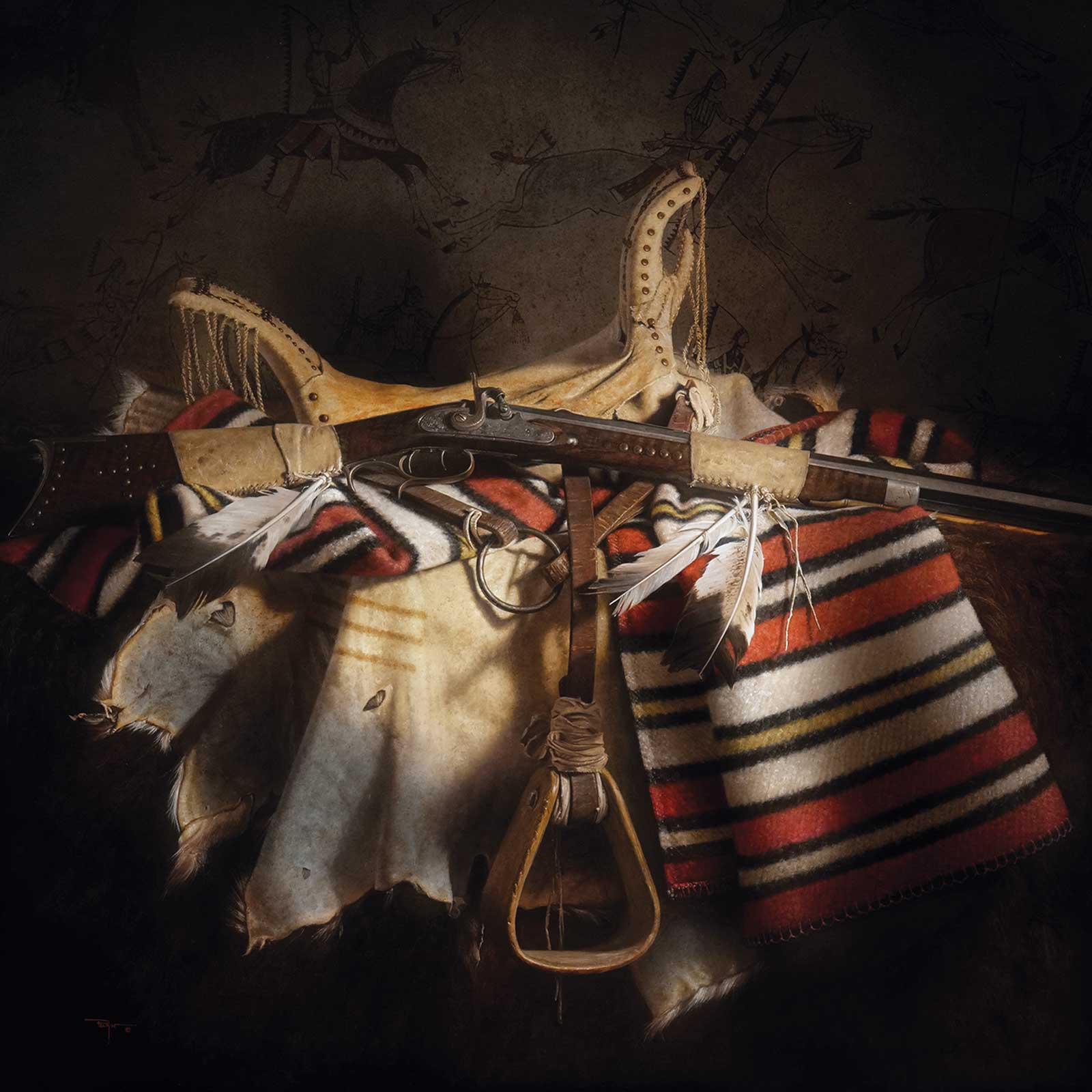 Kyle Polzin, Warrior’s Dream, oil, 38 x 38”
In working on the sketches, he initially determines how many figures would be included in each of the compositions, how the figures would be positioned, what they would be wearing and what they might be holding in their hands. Based on that, and in order to best tell the story, he decides upon the size of his final painting. At this stage, the background for the composition is left abstract. Once he completes his initial planning, Z.S. schedules the private modeling session and in doing so, he requests the specific number of models he would like to have for the session. The event coordinator selects the correct type of clothing, instruments and other elements that were worn and used by each specific tribe in order to make certain that all aspects of the photo session are historically accurate.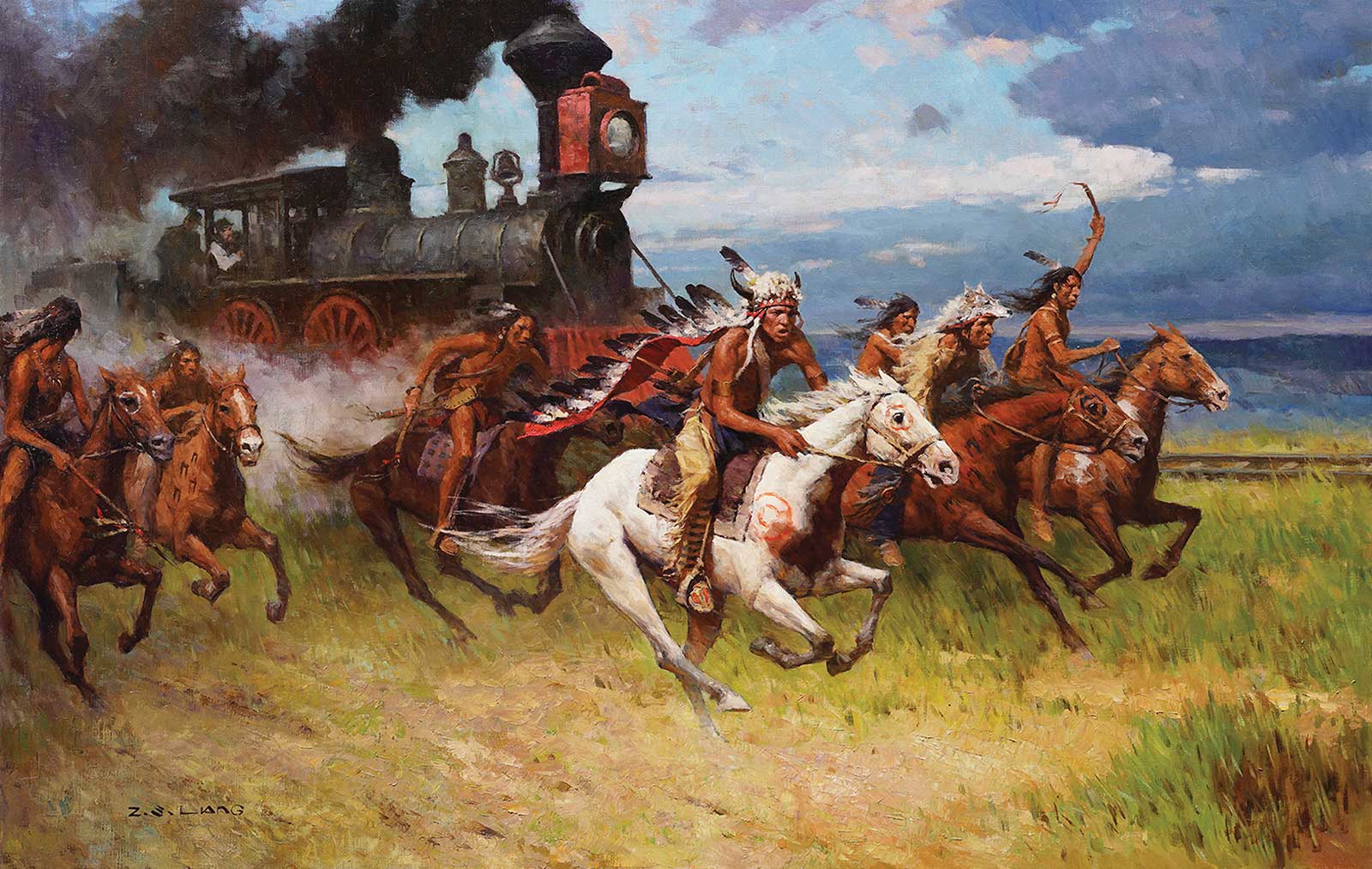 Z.S. Liang, Beating the Iron Horse, oil, 38 x 50”
The coordinator then meets with the models and, based on the specific Native American tribe that is being portrayed, he supplies the models with the correct type of clothing, the appropriate types of weapons and, if necessary, hairpieces. For each session, the artist explains to the models how he wants them positioned or holding a particular weapon. As Z.S. takes the photos, he will stop briefly only to reposition a model and or to add or remove certain elements in the scene. This process is repeated numerous times over a period, often exceeding six hours. He leaves the shoot with plenty of reference material for future paintings.
One of the many interesting things that I came to understand, from accompanying the artist on a photo shoot, is how he uses his reference photos when he is doing a painting. He doesn’t try to “just copy” the scene that he has photographed. Instead, he uses the photo to simply help him conceptualize how he wants the painted composition to look and he changes, modifies, adds or deletes certain elements when he is preparing his sketches from the photos. That is where his imagination, creativity, knowledge of the many different Plains Indian tribes and his technical training come into play. Depending on the composition, he may do as many as four or five different sketches before he prepares a study of the painting. Once he is satisfied with the study, he then draws the composition onto the canvas that he has selected for the painting.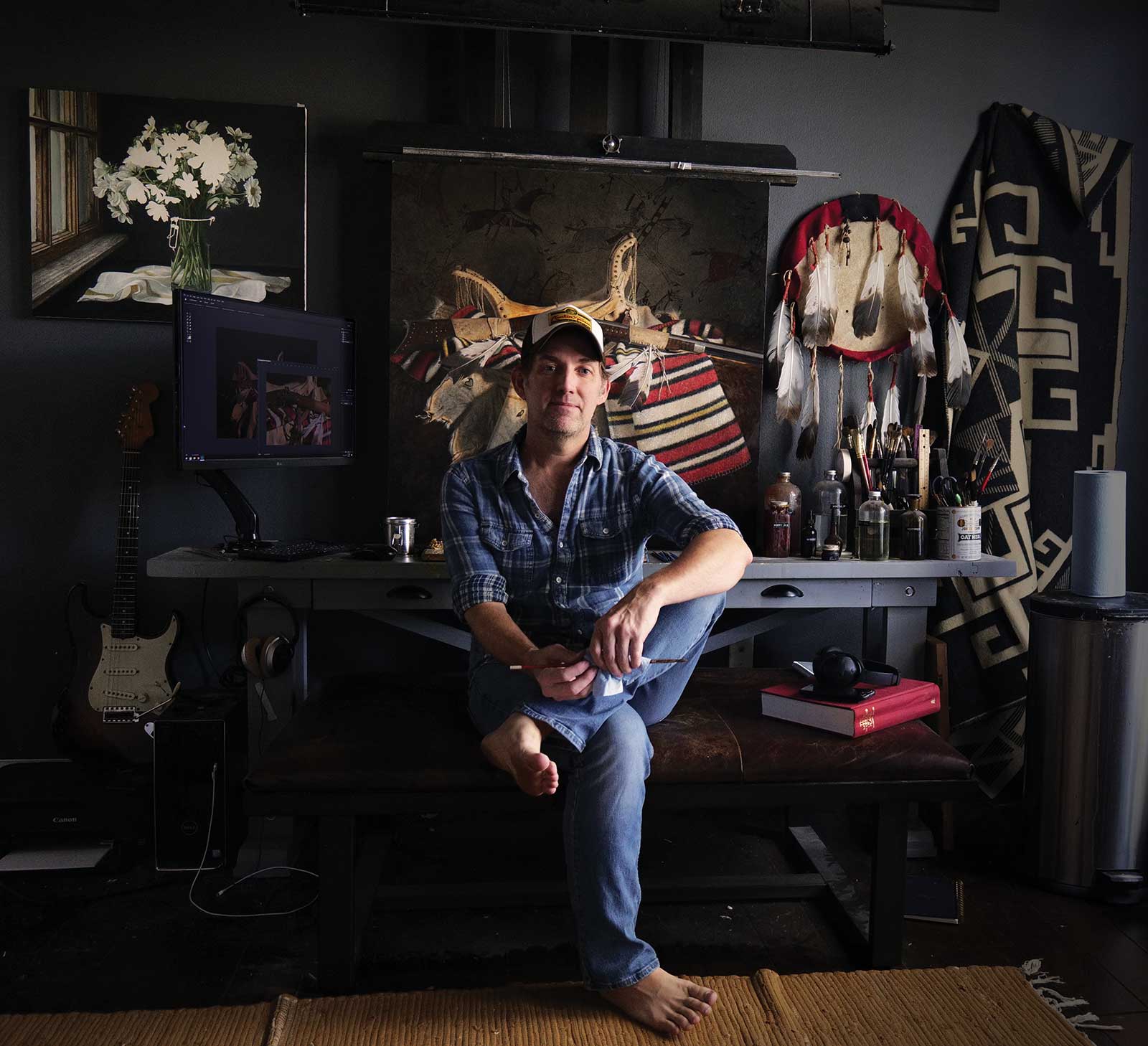 Kyle Polzin in his Texas studio, August 2022.
After laying in the main elements of the composition, he determines the type of background to add and the elements, if any, to include in the foreground. While doing this, he is also determining how to use light and shadow in order to achieve the right depth or perspective in the scene. At the same time, he is fine tuning his figures to ensure that the final painting has a natural appearance and that it “doesn’t seem staged” to the viewer.
Looking back on that photo shoot, I found it extremely enlightening for me to better understand how a master artist utilizes his photo reference material to create a true work of art. This became even more evident to me when I finally saw the first painting that he created from that shoot. Seeing the completed painting gave me a better understanding and appreciation for his process. And although the finished painting somewhat resembled the reference photos that he took, the composition is significantly different because the figures were moved and repositioned, headdresses were changed, clothing was modified and other elements were added. The painting, which is titled Honoring a Courageous Soldier after the Fetterman Fight, tells the story of a little-known yet very significant and unique historical event involving the Plains Indians and the U.S. Army that took place in 1866 near Fort Phil Kearny in Banner, Wyoming.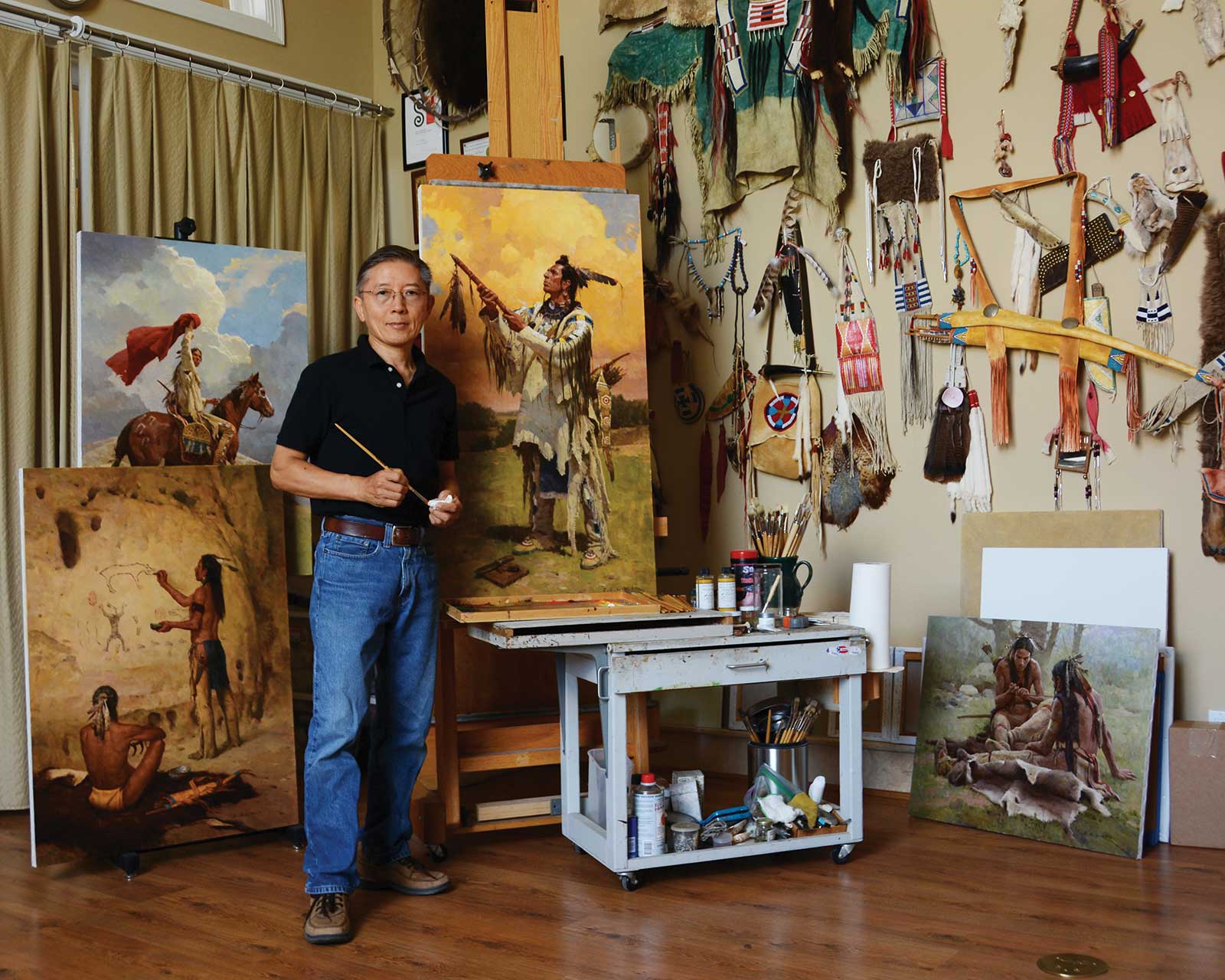 Z.S. Liang in his California studio, August 2022.
During the Fetterman Fight, the warriors took notice of one particular soldier, a bugler by the name of Adolph Metzger, who displayed extraordinary bravery and courage by continuing to sound his bugle and use it as a weapon, even as he was struck by arrows, to fend off the attacking warriors. Although he died during the fight, the supreme act of Metzger’s bravery so impressed the victorious warriors that after the battle, when they saw his lifeless body full of arrows on the ground, they felt a need to honor this exceptionally brave soldier who had fought against them on that day. In an unprecedented sign of their complete respect and admiration for his courage and for his bravery in battle, the warriors performed a simple act that poignantly demonstrated their feelings by ceremoniously and respectfully covering the body of this brave soldier with one of their painted buffalo robes.
Although this painting, which is now in the permanent collection of the Raymond James Museum in St. Petersburg, Florida, is not in the show, it is representative of the masterfully created Z.S. Liang paintings that originate from detailed research, and which then transition to a rough sketch of an idea, to a modeling photo session, to multiple refined sketches that are fine-tuned, to a study and, finally, to an marvelous work of art on canvas.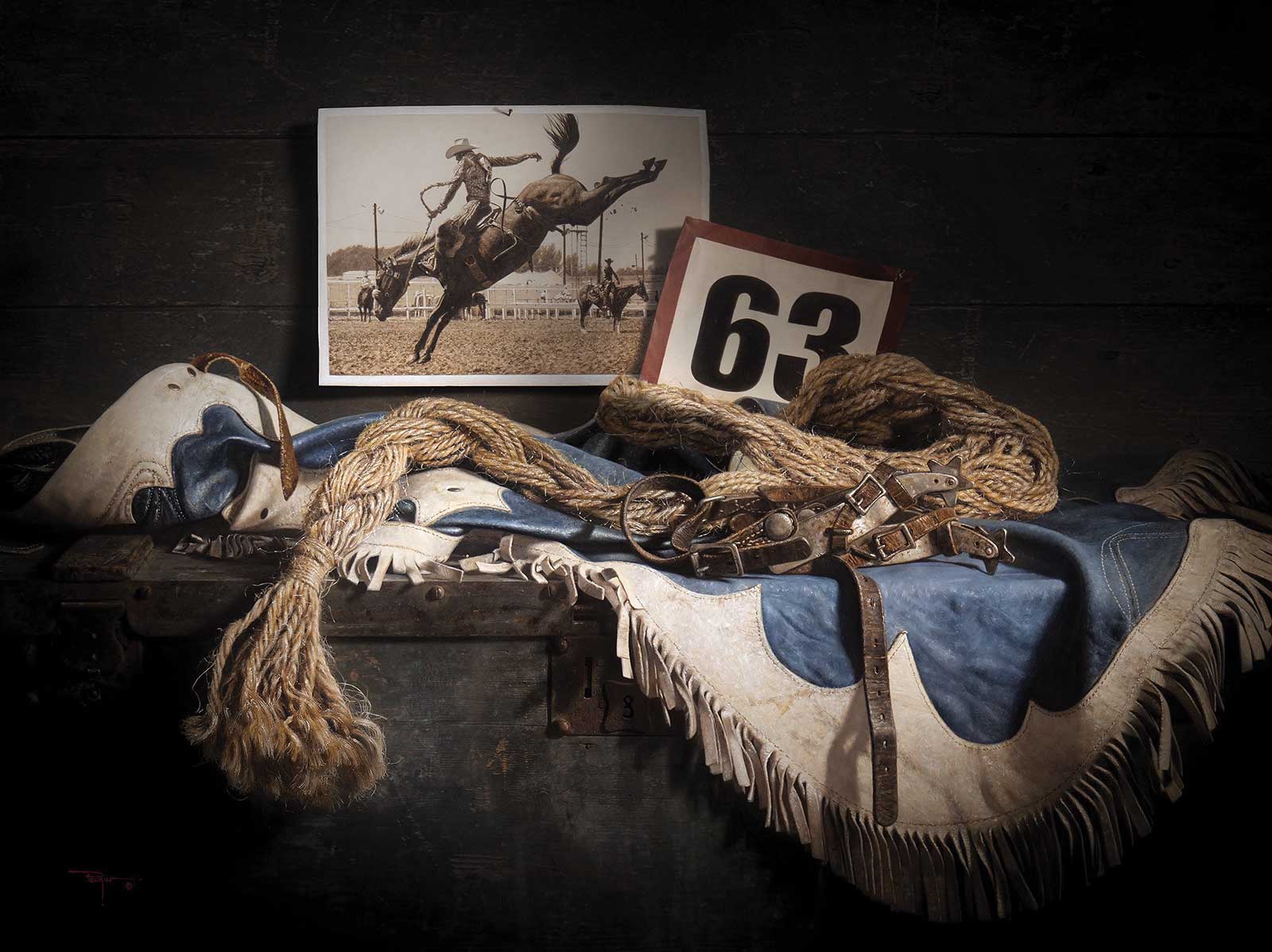 Kyle Polzin, Bronc Rider, oil, 27 x 36”
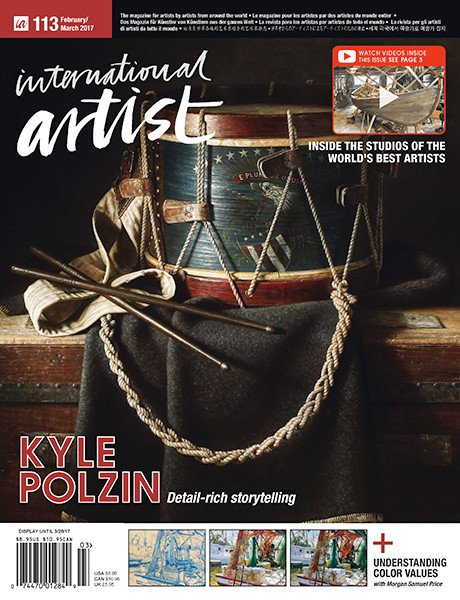
As a still-life artist, Kyle’s painting process is naturally quite different than that of Z.S.’s. In some respects, it is also different from the work of most other still life artists. In addition to being a talented artist who masterfully reproduces arrangements of objects—saddles, spurs, vintage guns, blankets, flowers and various types of cowboy and Native American apparel—Kyle is also a very skilled artisan who very often will actually take the time to design and craft some of his objects.
Over the years, I have learned from my conversations with Kyle that he has always had an innate curiosity about things that are old and nostalgic. Like so many things that happen in all of our respective lives, Kyle actually did not start off with a plan to make or fabricate items that he would use in his still life paintings. In a way, it all started by accident years ago when he was showing his young daughter a book that contained photos of Plains Indian dolls that were made of buckskin and buffalo hair. After examining these photos, he thought he might like to do a painting which contained a Plains Indian doll. But since he couldn’t find exactly what he had in mind, Kyle decided to make a doll that matched what he had envisioned.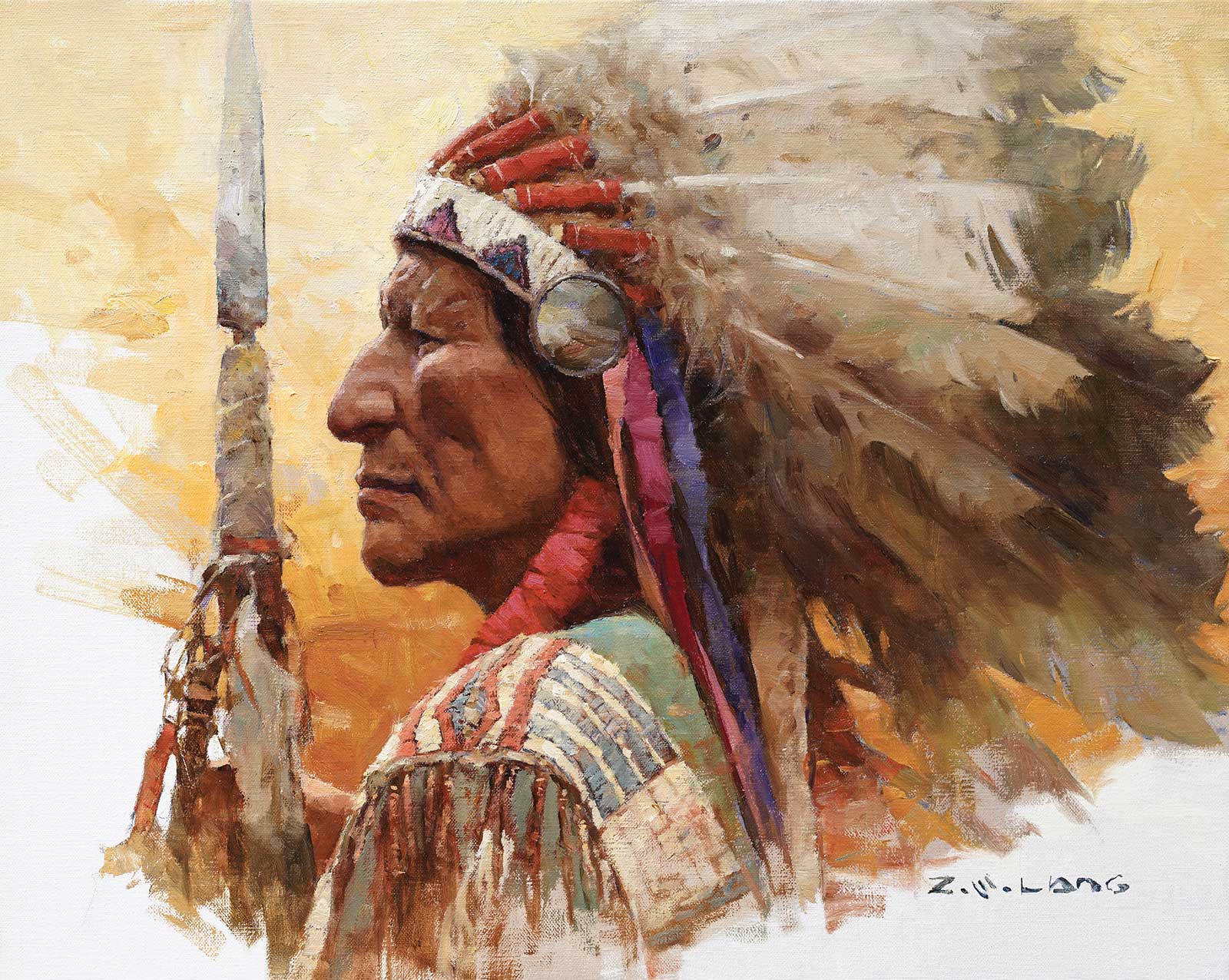 Z.S. Liang, The Spirit of the Plains, oil, 16 x 20”
Knowing that his very detailed style of painting takes a great deal of time, I asked Kyle why he would take the time to hand craft some of the objects that he decides to paint. His answer, to my question, was fascinating: “Often times, painting ideas come to me after I might see a photo of an object in a book or online, or if I see a scene in a movie, hear a lyric in a song, or see an interesting artifact in a museum. This tends to stir my curiosity and naturally I want to learn as much as I can about the subject,” he said. “Because of my painting technique, it is very important for my painting process that I have the object that I am painting in hand so that I can move it around to find just the perfect angle and the optimum lighting effect to make it work in my composition. Once I have done all my research and gathered as much knowledge as I can about the subject, I will combine some of the most interesting visual aspects of the subject to craft an ideal piece for my painting. This allows me to match my original idea for the painting as opposed to limiting my creativity by only working with the item or items that I have access to. Also, before I begin to paint the subject and since I own the object, I can disassemble and manipulate it to work best in my composition. This is something that I would definitely not be able to do if I were using a very valuable collectible and or an authentic museum piece.”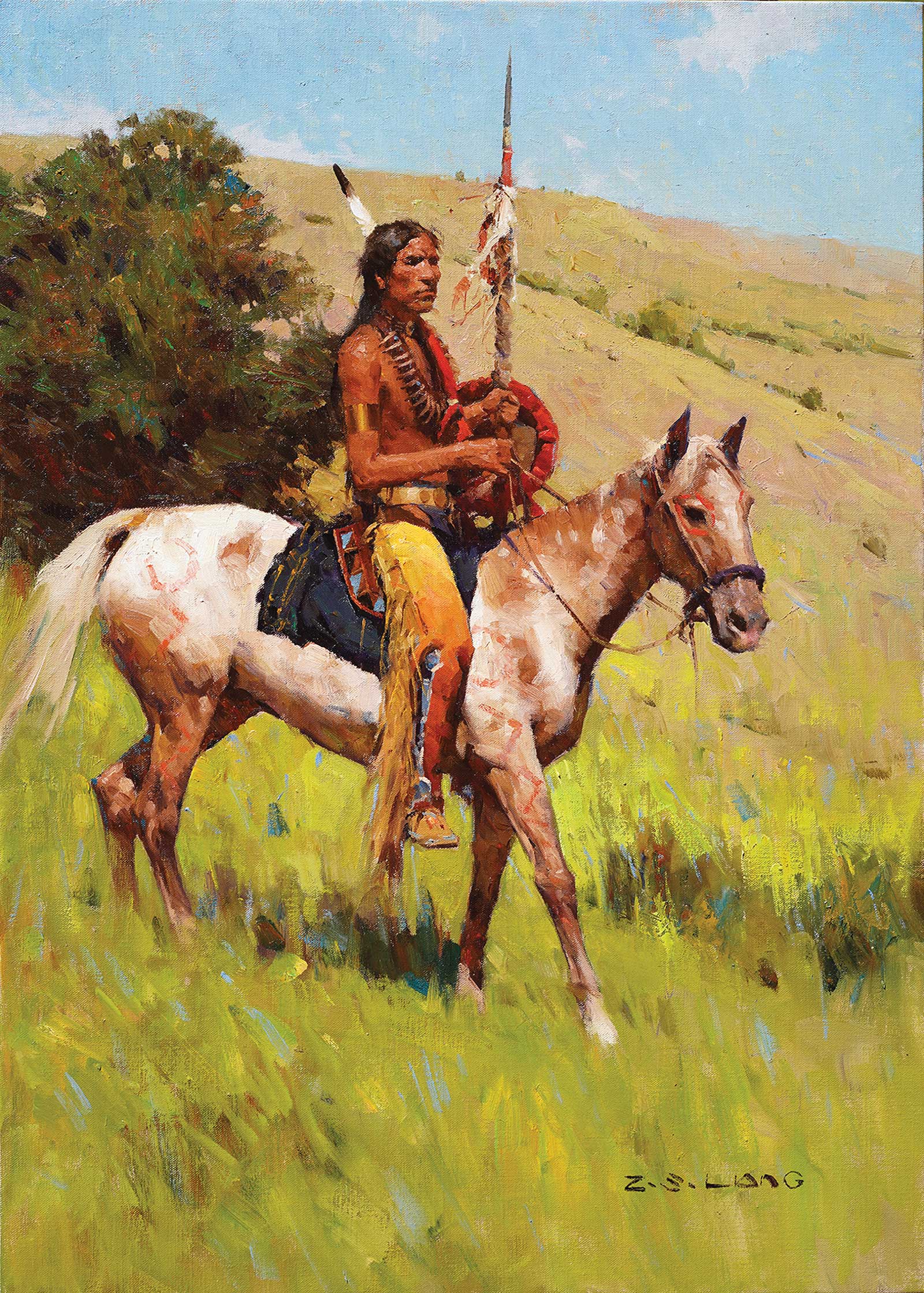 Z.S. Liang, Cheyenne Scout, oil, 28 x 20”
Once Kyle has the main item that he plans to use for a painting in place, he then gathers all of the other elements that will be included in the composition. Next, he sets up the objects, adds the desired lighting effect to the layout and, finally, he takes a series of photographs. Kyle uses the photographs as his main reference tools in the painting process. He paints directly from them rather than from a live setup because the colors, the shadows, the lighting effect and the three-dimensional look are constant in the photographs. If he painted the composition from life, all of those things would greatly vary based on the changing light that is in his studio throughout the day and based on where he might be standing when he is painting.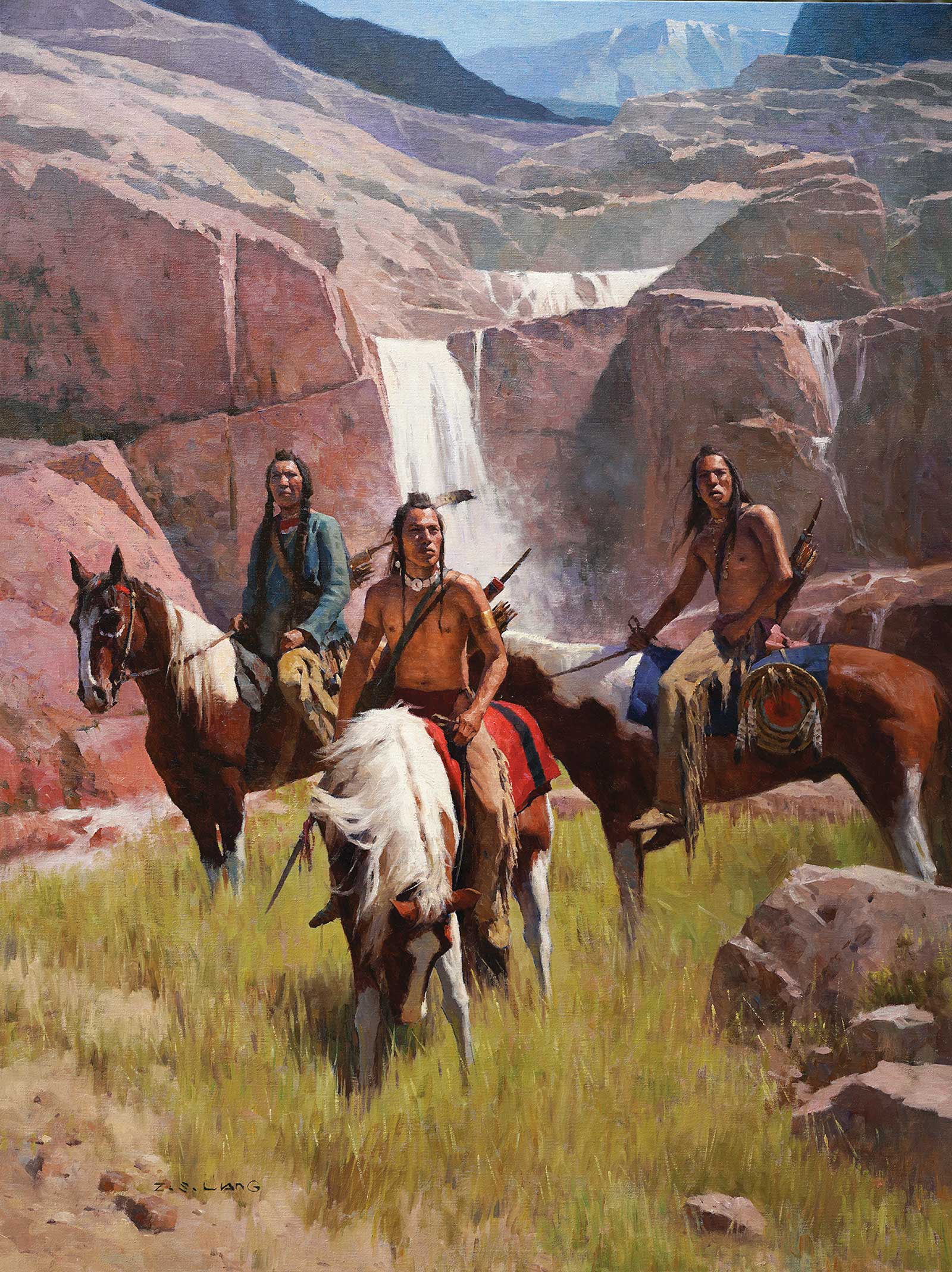 Z.S. Liang, Where the River Begins, oil, 48 x 36”
“Over the years I have managed to collect many Native American-inspired pieces that eventually become subjects in my paintings. Most of these pieces I have crafted myself or had the fortune to borrow from collector friends,” the artist says. “When I get an idea for a painting, a lot of the fun is in finding the right pieces of the puzzle that all fit together and help tell a narrative. In Warrior’s Dream, I paired an old, tacked percussion rifle along with a Plains Indian-style rawhide saddle. In my mind, the two pieces conjured up thoughts of bravery and hard-won battles. The images of warriors charging on horseback painted in the background represent the memories that have been passed down through history,”
After learning about the distinctive painting processes that these two artists skillfully use, hopefully you now have a better understanding of and a greater appreciation for the reasons why their works are masterfully done and why the paintings of Z.S. Liang and Kyle Polzin are so highly sought after by today’s collectors. —
Z.S. Liang & Kyle Polzin: Vision – Spirit – Legacy
October 22-November 4, 2022; reception, Oct. 22, 5-7 p.m.
Legacy Gallery, 7178 Main Street, Scottsdale, AZ 85251
(480) 945-1113, www.legacygallery.com
Powered by Froala Editor