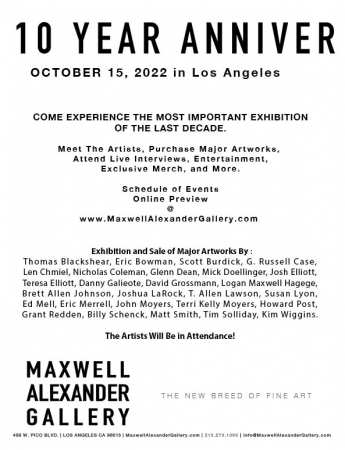
This is not a story about age, and yet the age component is fascinating, particularly in a market where there is some occasional grumbling about where all the “young collectors” are at. In 2012, 32-year-old Logan Maxwell Hagege and his younger brother, Beau Alexander, started an art gallery in Southern California. The Western art world didn’t know it at the time, but something profound had just happened. A decade later, on the eve of a momentous anniversary, it’s crystal clear: Maxwell Alexander Gallery is one of the driving forces behind a new wave of contemporary Western art and the younger generation of collectors coming to the market looking for it.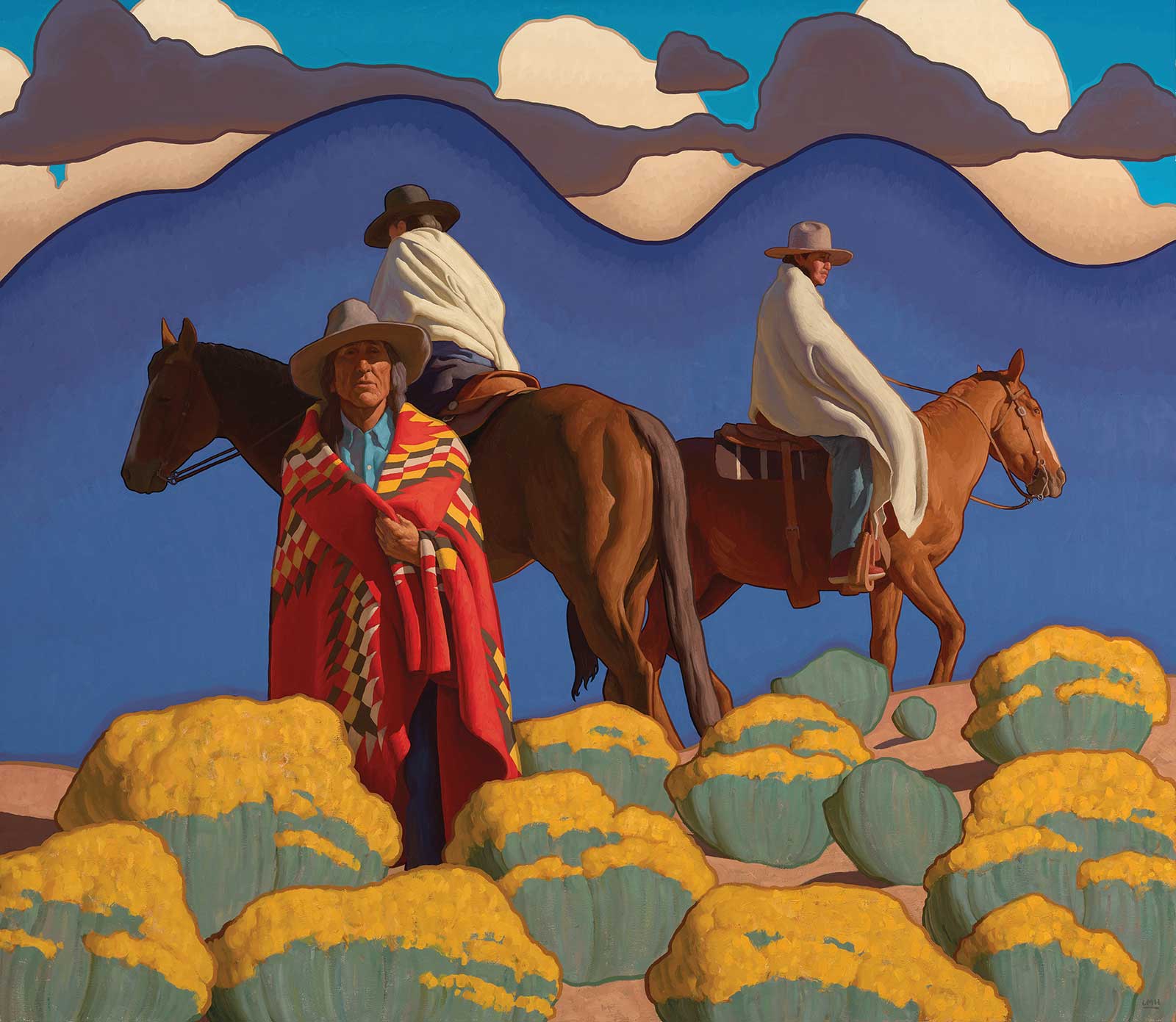 Logan Maxwell Hagege, Runaway Clouds Over a Blue Sky (detail), oil, 52 x 60”
But that was never the plan. It all started as a way to bring their friends together and show some artwork. Hagege, who had not long before been a plein air and beach painter—the SoCal Sorolla, if you will—had seen how galleries worked as he transitioned into a contemporary Western artist. He had also heard horror stories from other painters about their experiences with galleries. Surely, he thought, there could be a better way.
“The initial idea came to us back when Beau was my studio manager. He was managing my shows and ordering my frames and just taking care of the business and advertising side. We would do lunch every day and naturally this idea of a gallery started coming up. I had some unpleasant situations with galleries, and so did some of our friends, and we just wanted a place that would treat artists and collectors a little differently. We wanted to be transparent and honest and just run it our own way,” Hagege says. “And I didn’t want it to be a vanity project, which is how we ended up with a mixture of our names for Maxwell Alexander Gallery—Maxwell is my middle name and Beau uses Alexander as his last name. I knew if my name was not on the gallery other artists would see it as a safe haven. And it worked.”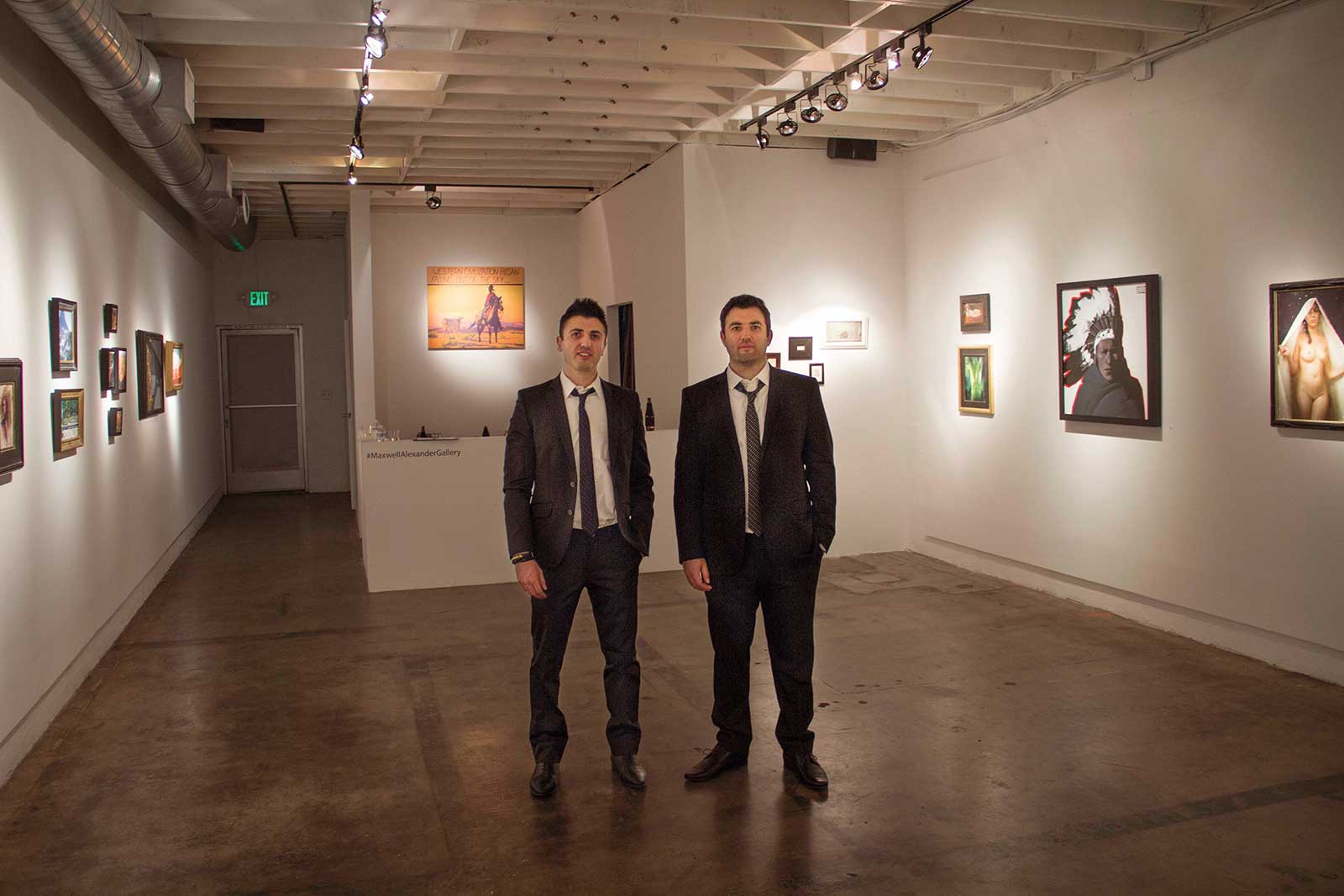 Logan Maxwell Hagege, right, and Beau Alexander following the opening night of their first exhibition, December 2012.
The brothers rounded up artwork from some friends and leased out a space in Culver City, California, to show it all in. Hagege would supply his own paintings, and Alexander would run the day-to-day business of the gallery. On opening night in December of 2012, there was a line around the block and guests were let in as others left so as not to exceed capacity limits. Video shot during the opening night (use the QR code in this article to view it) shows a fashionable young crowd sipping beers and snapping selfies. The room is lively and exciting. Critics of Maxwell Alexander’s different approach would argue, “But were they buying art?” The answer was, and is still today, yes.
“It all started as Logan’s brainchild. Other than wanting a safe place for artists, he also wanted the gallery to be highly curated. We had seen some galleries that were more focused on quantity, and not quality—they were just sort of adding filler to the walls. The idea was to have fewer artists, but the ones we did have would be top of the top,” Alexander says, adding that early artists included Glenn Dean, Kim Cogan, Billy Schenck, Jeremy Lipking, Tim Solliday, Josh Elliott and others. Some of the art would be Western, but then some was also more contemporary, including classic still life arrangements, cityscapes and nudes. “The big thing was that the artists could do what they wanted. They could experiment and they would never feel pigeonholed by us.” The brothers both remember an early show called Grey Matter, that had a theme of skulls. Would skulls sell? They didn’t care because they found the subject fulfilling and unique. (The pieces did sell, by the way.)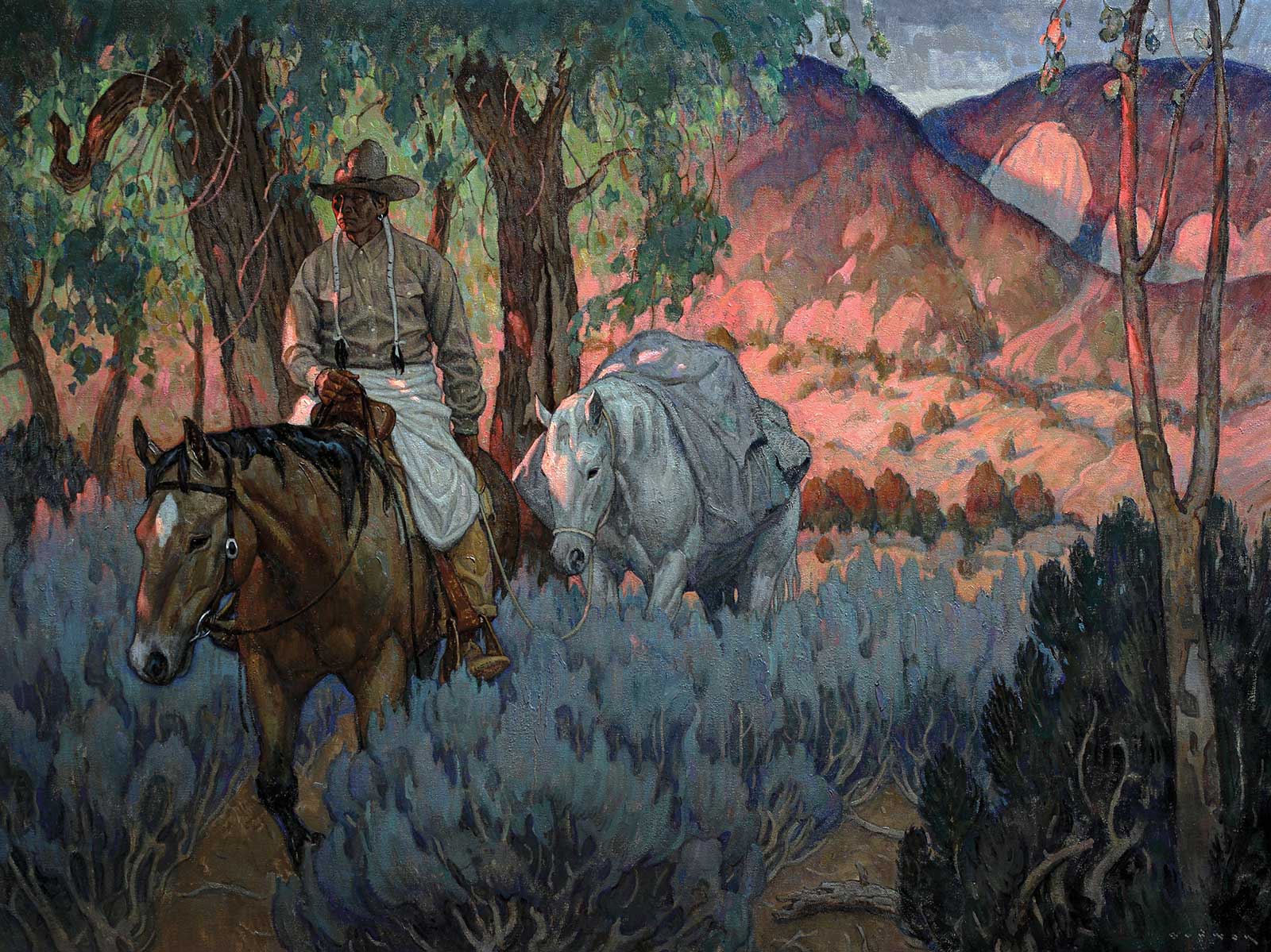 Eric Bowman, Long Way Home, oil, 36 x 48”
As Hagege’s work developed and he became a prominent voice in Western art, that success gave them a mandate to keep pushing forward, which allowed him and Alexander to bring in new artists and also eventually move to Downtown Los Angeles. For the brothers, though, it was a surreal experience. They were raised in the San Fernando Valley on a steady diet of skateboarding, surfing, video games, comic books and arcades. Neither could have foreseen careers in art, and certainly not Western art. But the West struck a chord with both of them. “It’s an endless source of inspiration,” Hagege says. “I always come back to this, but the West and art of the West has strong American roots. It’s an iconic aspect of our shared history. Even in other countries, people recognize this imagery. I don’t see it going away. I think these images will always be with us.”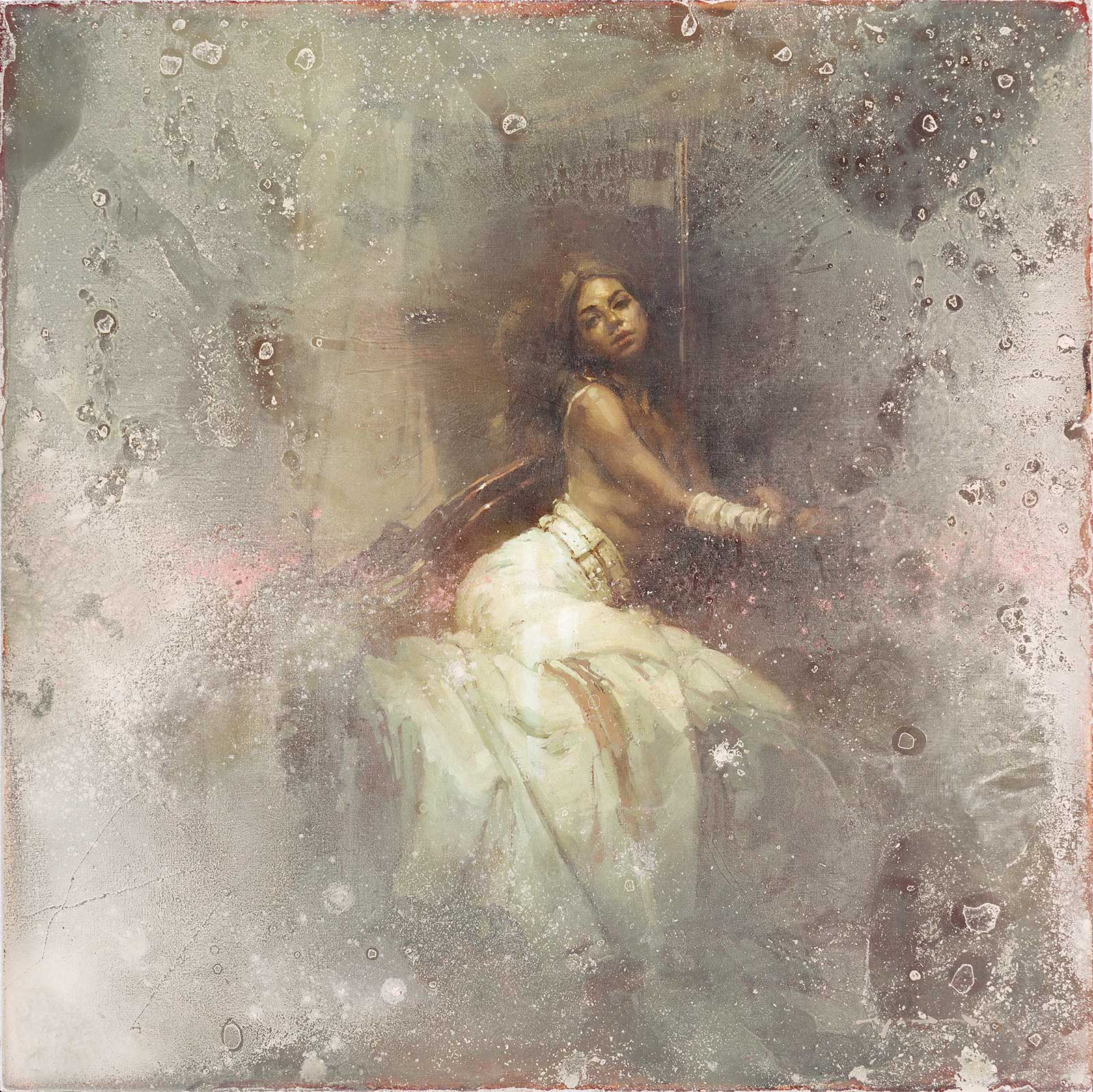 Jeremy Mann, One, oil, 35 x 35”
With important work from a number of other up-and-coming and established artists, the gallery quickly found its footing, but it also wanted to stay one step in front of the market as well, which is why they relied on innovation and remained adaptable to changing forces. For instance, they are exceptional at social media and, years before Covid would force everyone to figure out online shows, Alexander was organizing online-only exhibitions, including the annual Black Friday Show. He would post all the artwork on the website and time it to go live all at once, forcing collectors to be on their toes as the sale opened. In past years they’ve sold 100-plus pieces in 15 minutes. They would also discover new artists on social media, including Brett Allen Johnson, who was working in Utah as a carpenter when Hagege found his work and brought him into the fold. Today, Johnson is one of those major rising stars with works selling out at gallery and museum shows alike.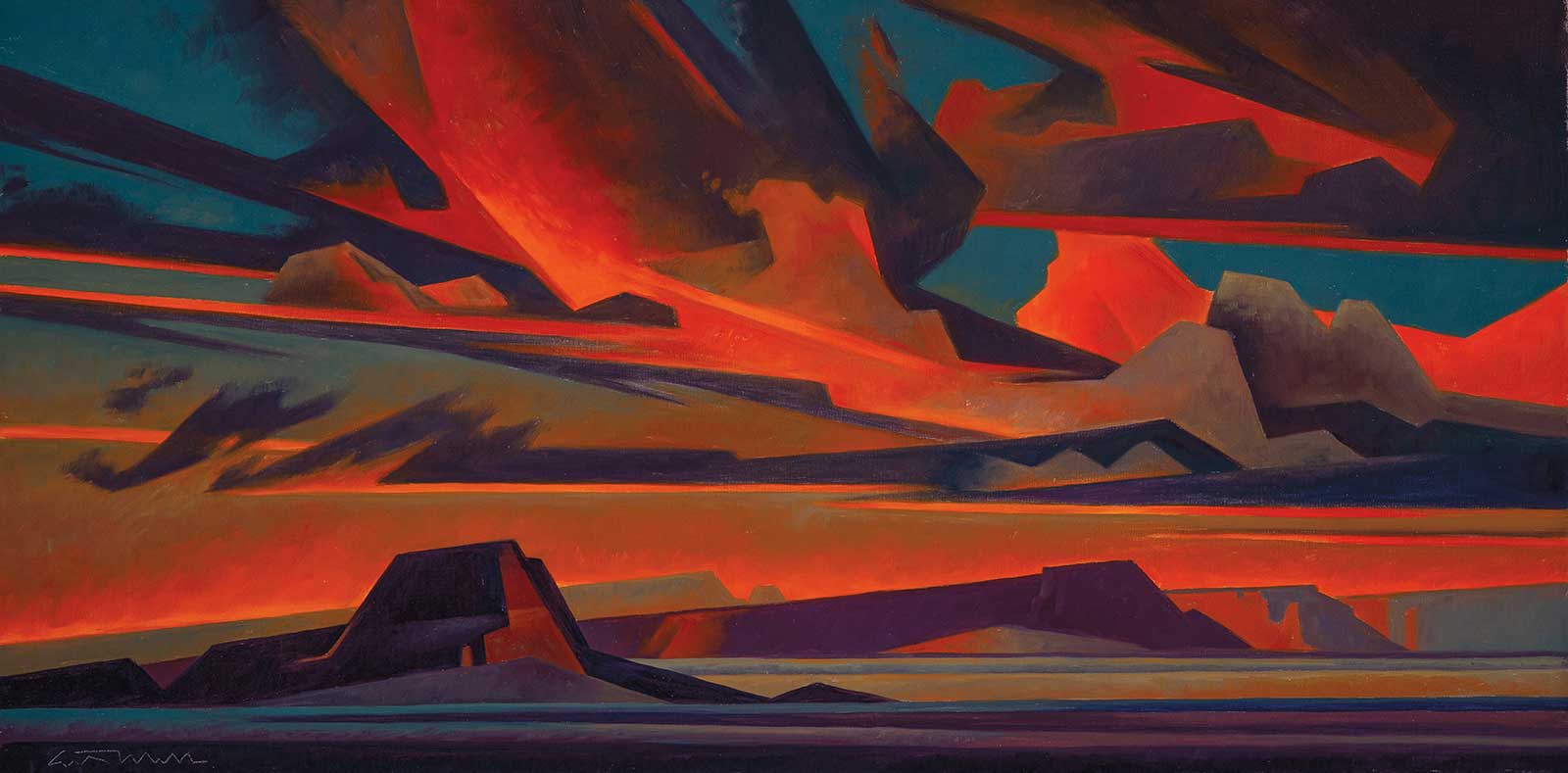 Ed Mell, Scarlet Reflections, oil on linen, 24 x 48”
“At the time I wasn’t focused at all on my art career. I just never felt like I was ready, so I put my work on Instagram for fun. I guess
I thought I had to take a set path if I wanted to be an artist: show my work at an art fair, or a local gallery or even just a local coffeeshop,” Johnson says. “After Logan saw my work, Beau called me and invited me to be part of their small works show. It was a big deal for me because it meant I got to skip all the other stuff. I lucked out, but I definitely wasn’t ready. My work wasn’t mature enough yet. I think even Beau and Logan knew my work wasn’t ready, but for some reason they saw something in it, some kind of potential. Them seeing that made all the difference in bringing that potential to life.”
Another artist to benefit from the gallery’s support is Eric Bowman, who already had a successful career before the gallery but has seen his work elevated even further now that he is exploring aspects of the West. Like Johnson, Bowman was offered a slot in one of the online shows and quickly saw more and more interest in his paintings. “Their involvement in my career is everything,” Bowman says from his Oregon studio. “I give them all the credit for the exposure I’ve had. I can’t do this alone because it would be so much harder, but having a gallery like Maxwell Alexander is huge deal for me. I’ve always liked the way they serve the artists and the collectors, certainly because Logan is an artist himself so he knows what it’s like. They strike a dynamic balance that creates a great working relationship between me and them, and also the collectors.”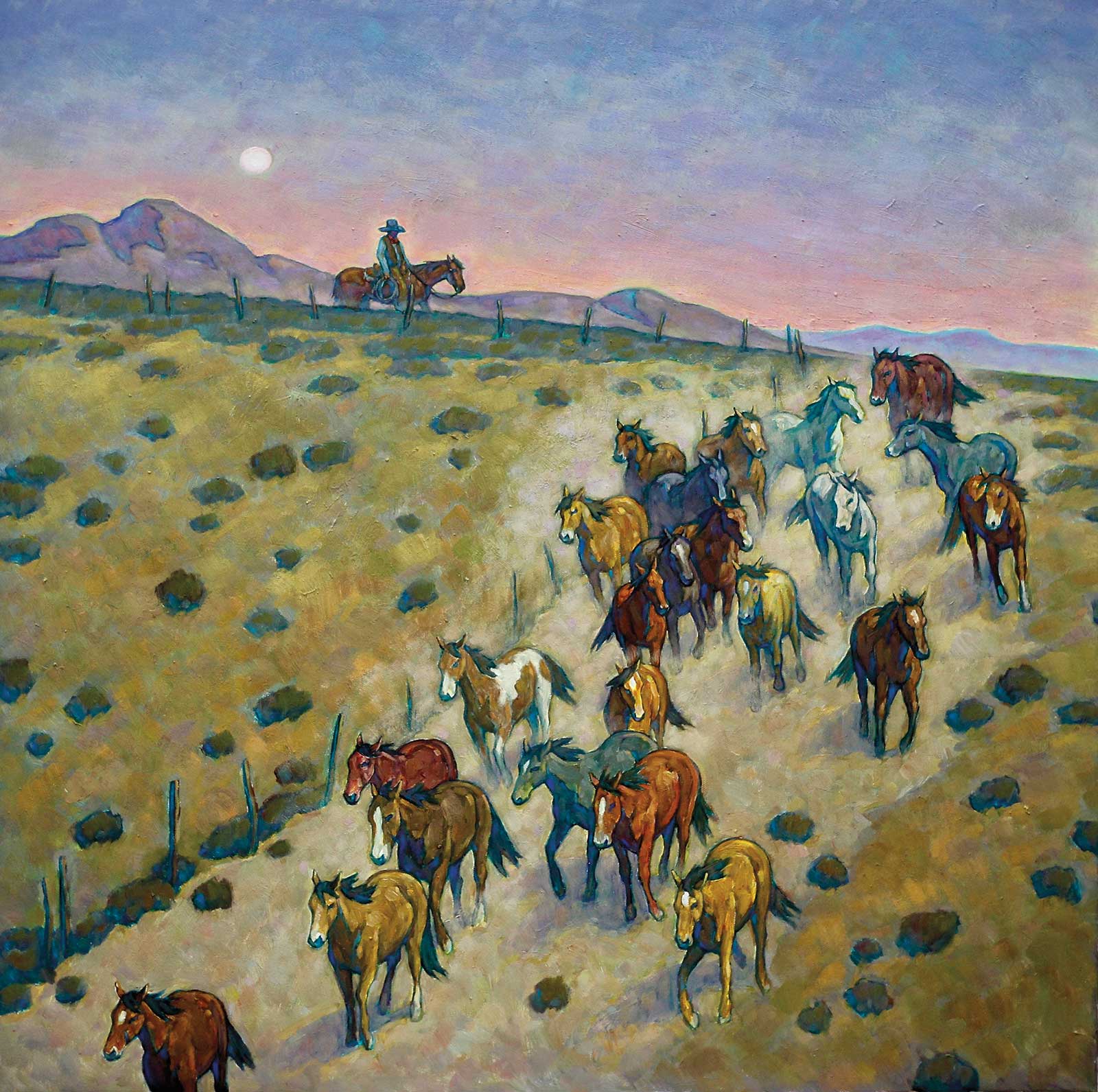 Howard Post, Changing Pastures, oil, 30 x 30”
After the 2012 founding, and those initial first years, the gallery experienced a jolt of creative growth, and along the way Hagege and Alexander were winning new and impassioned fans and collectors. Maxwell Alexander Gallery artists also started winning awards at the Prix de West at the National Cowboy & Western Heritage Museum, the Quest for the West at the Eiteljorg Museum and the Autry Museum’s Masters of the American West. It was at the Autry, in 2017, where Hagege won the Thomas Moran Painting Award. The previous recipient, Howard Terpning, had won it 12 consecutive years, so when Hagege’s name was called at the awards ceremony, and with Terpning in the crowd, it was widely seen as a historic passing of the torch from one generation to the next. Additionally, his work was being added to major public and private collections around the country, it was being collected by celebrities like Bruno Mars, and Hagege even started working with brands such as Pendleton. And yet there has always been a modesty in him about his success and career, and his soft-spoken nature aligns closely with that quietness. He’s not one to be boisterous about his work. If anything, he just wants to see those around him succeed. “I think of what we’re doing at the gallery as more curation,” he says. “We want to curate the best art out there and bring it all here to show. We want people to like this work, because it’s the art we like, because these are the artists we want to support.”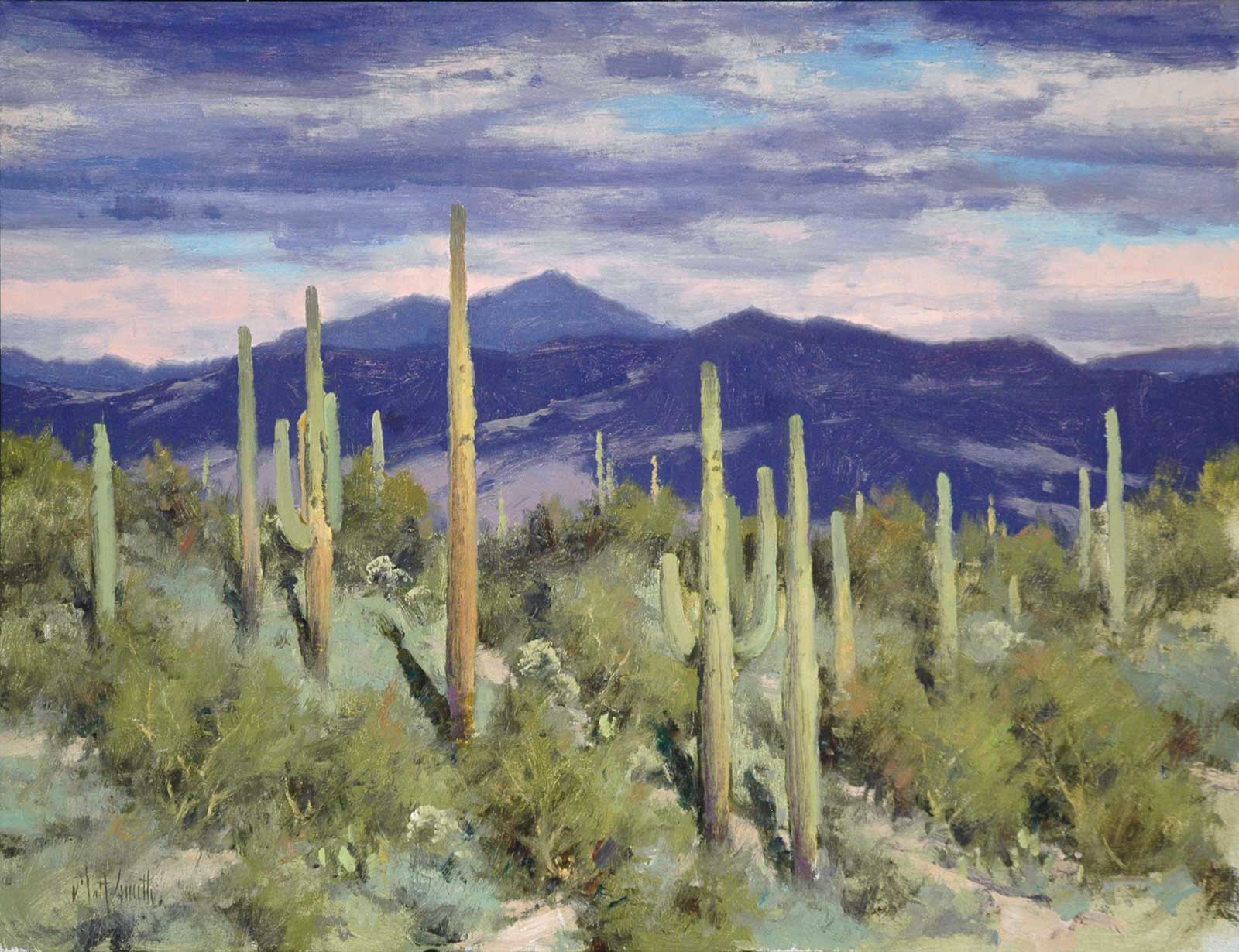 Matt Smith, Winter Skies Over the Tonto, oil, 20 x 26”
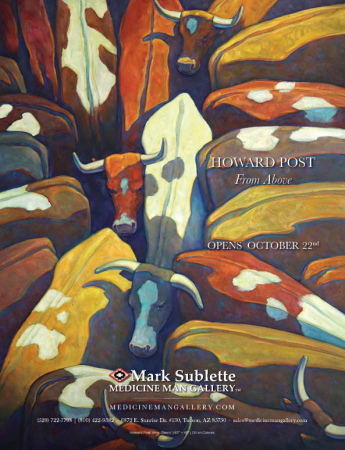
As modest as he is, though, Hagege does recognize that he and his brother have been disruptors within the market—first and foremost because of the competitive business model that Maxwell Alexander utilizes, but also because of the contemporary art style that Hagege and many of the gallery artists are using. Just look at the current line-up: Thomas Blackshear II, an illustrator turned “Western Nouveau” painter; Kim Wiggins, whose works straddle an interesting place between modernism and regionalism; Billy Schenck, the Western Pop superstar; Len Chmiel and T. Allen Lawson, the skilled technicians so respected by other artists; Teresa Elliott, portrait artist of every variety of cow; Ed Mell, the master modernist of the desert; and Howard Post, whose Western paintings are more Wayne Thiebaud than Frederic Remington. And then there are a variety of others—Johnson, Bowman, Glenn Dean, John and Terri Kelly Moyers and even Hagege himself—who are greatly influenced by Maynard Dixon, the Taos Society of Artists and New Mexico Modernism. These artists are keeping contemporary Western art—Hagege recoils slightly at the phrase “New West”—at the forefront of the discussion.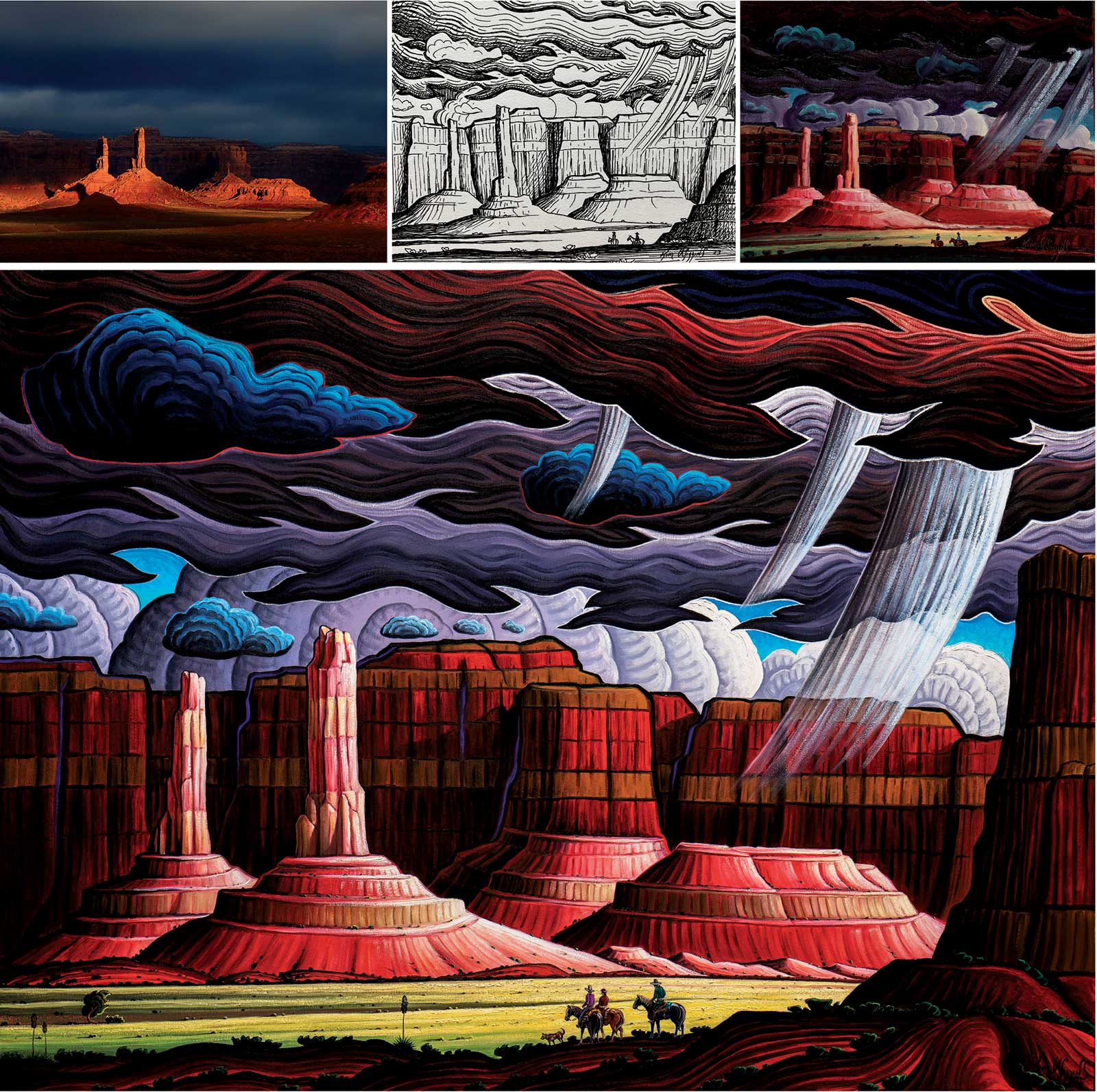 Clockwise from top left: Kim Wiggins’ photographic reference from an October 2021 trip to the Valley of the Gods in Utah; Valley of the Gods, pen and ink, 6 x 8”; Storm in the Valley of the Gods, oil, 6 x 8”; Kim Wiggins, Valley of the Gods, oil, 36 x 48”.
“We never intended on being that disruptor to the market,” Hagege says, “but we came into it with a fresh vision. We don’t like to follow the status quo. And we’re from a younger generation. We take pride in our approach.”
Maxwell Alexander Gallery will celebrate its 10th anniversary with a huge new show on October 14 and 15 in Los Angeles. Events kick off on Friday, October 14, with an invite-only preview and dinner. Accompanying the opening night kick-off will be a live discussion with Hagege and Alexander led by Western Art Collector. There will be an artist panel on Saturday, October 15, followed by the by-draw sale that evening. The Saturday events are open to the public. Alexander is expecting around 75 paintings, including as many as 30 larger works. Artists in the show include most of the gallery’s stable (many mentioned here), including Jeremy Mann, Matt Smith, Grant Redden, Joshua LaRock, Michael Klein, Susan Lyon, Danny Galieote, G. Russell Case, Scott Burdick, David Grossmann and many others. The gallery will even expand into a neighboring space to accommodate more, and larger, paintings.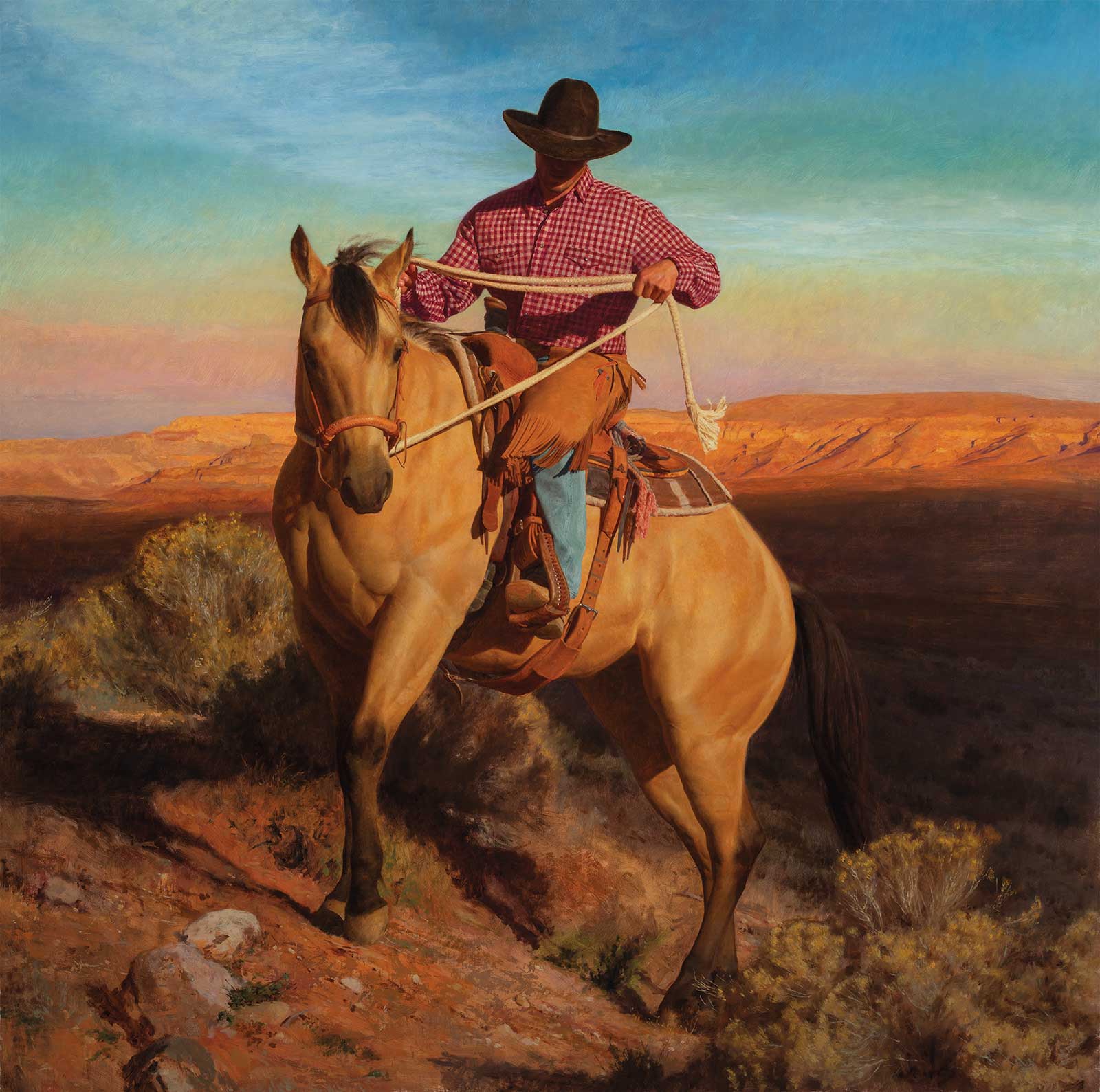 Joshua LaRock, Shadow Valley, oil, 50 x 50”
The event is a show, but it’s also a victory lap for the California brothers. Ten years ago they took a risky idea and ran with it. Not only was it successful, it has brought new collectors into Western art. That is no small feat.
“There’s always a new and different way of doing things,” Alexander says. “And that’s what we wanted to do when we started this gallery. We took it as a challenge. We wanted to challenge ourselves, but also the market and the collectors. This has been our vision since the beginning.” —
Maxwell Alexander Gallery’s 10-Year Anniversary Exhibition
October 14-15, 2022
Maxwell Alexander Gallery
406 W. Pico Boulevard, Los Angeles, CA 90015
(213) 275-1060
www.maxwellalexandergallery.com
Powered by Froala Editor