In 1830 George Catlin packed up his paints and made a fateful journey West that would change his life and help establish Western art at the same time. Far away from his comfortable East Coast enclaves, Catlin would meet up with a sympathetic general from the Louisiana Territory who was willing to take him 400 miles up the Mississippi River to meet Native American tribes in what is present day Wisconsin. There, over the course of six years, Catlin painted nearly 500 paintings, including 300 portraits of Indigenous people. The resulting works are some of the most famous portraits in all of American art.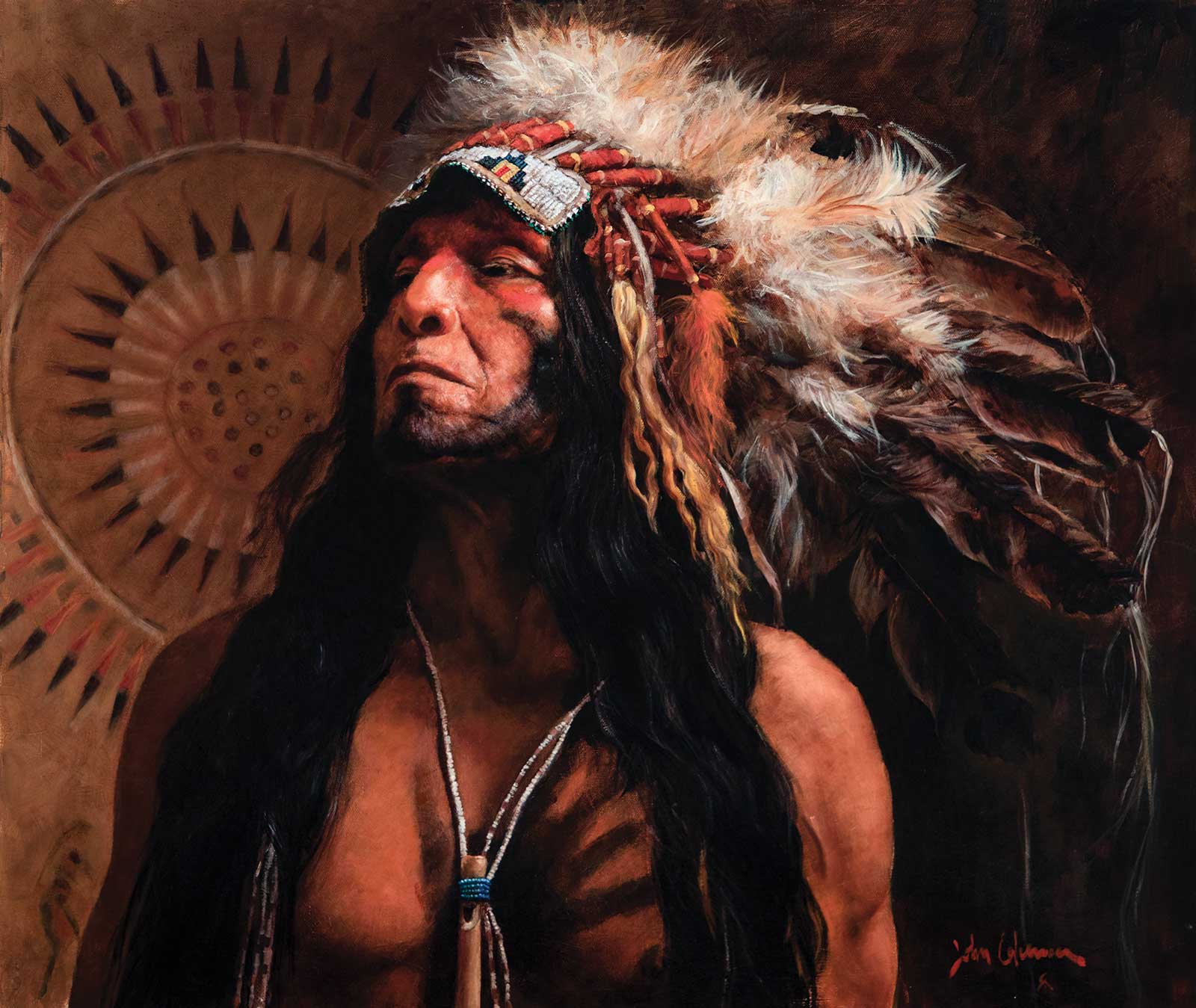 Leader of Men, oil on canvas, 22¼ x 26”
“More than a century and a half later, there remains something startling and immediate about the faces,” writes Bruce Watson for the Smithsonian. “At first glance, they seem condemning, as if daring us to look at them without guilt. But after contemplating them awhile, they appear less forbidding. Catlin called his gallery a ‘collection of nature’s dignitaries,’ and dignity indeed makes certain individuals stand out.”
Though his work is vastly different than that of Catlin’s—the settings are more natural, the faces are more realistic and the light and shadow create moody and dramatic settings—John Coleman benefits from that same word that aided Catlin. The word is dignity.
“I remember when I came to Prescott, Arizona, from California, I remember feeling how relevant the West was on those streets, including with all the cowboys and the ranchers. But what really hit me, though, were the Native Americans and this great mythology they carried within them,” Coleman says. “It’s impossible to not feel great respect and admiration for their stories, their history and their culture. That’s what I want to convey in each work.”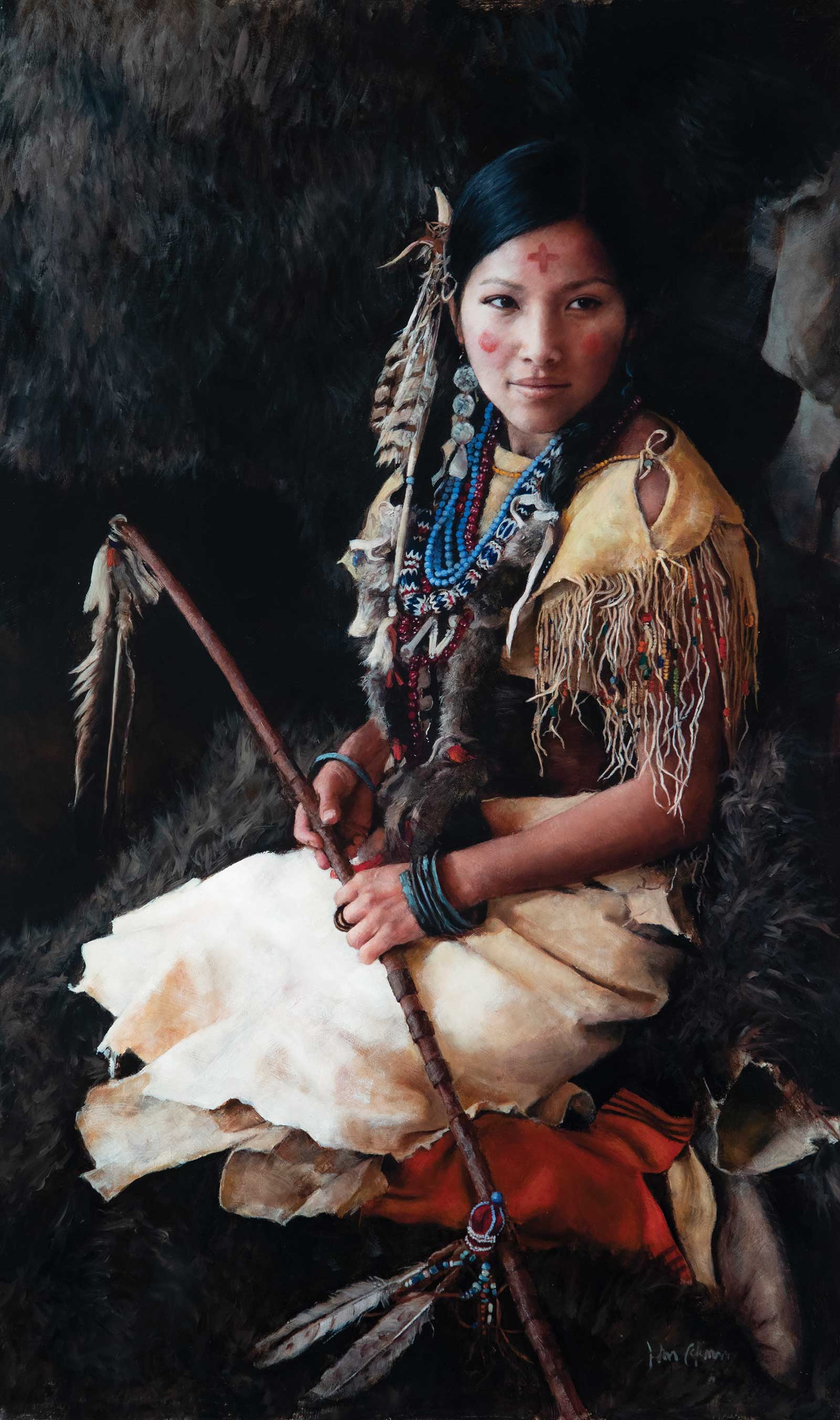 Society Sister, oil on canvas, 37 x 23”
And while dignity certainly links their work, there is also a sense of truth: historical truth in Catlin’s case, because after all, Catlin witnessed his subjects firsthand and saw their clothing, customs and attitudes; and emotional truth for Coleman, who conveys all of his researched storytelling through faces, from piercing eyes and tightened jaws to relaxed brows and solemn gazes. (They lived a century apart, but a Coleman bronze inspired by a Catlin painting now stands over Catlin’s grave in Brooklyn, New York.)
Coleman’s newest works showing dignified faces will be part of a major new show, Lives and Legends of the Mystic Plains, opening October 2 at InSight Gallery in Fredericksburg, Texas. The Arizona artist is expecting to have 10 new pieces, including brand new bronzes, a handful of oil paintings and several charcoal works, one of which is a larger-than-life drawing inspired by the late model, musician and performer Chesley Wilson. Coleman is excited about the show, especially coming after two monumental shows at Legacy Gallery in 2016 and 2020.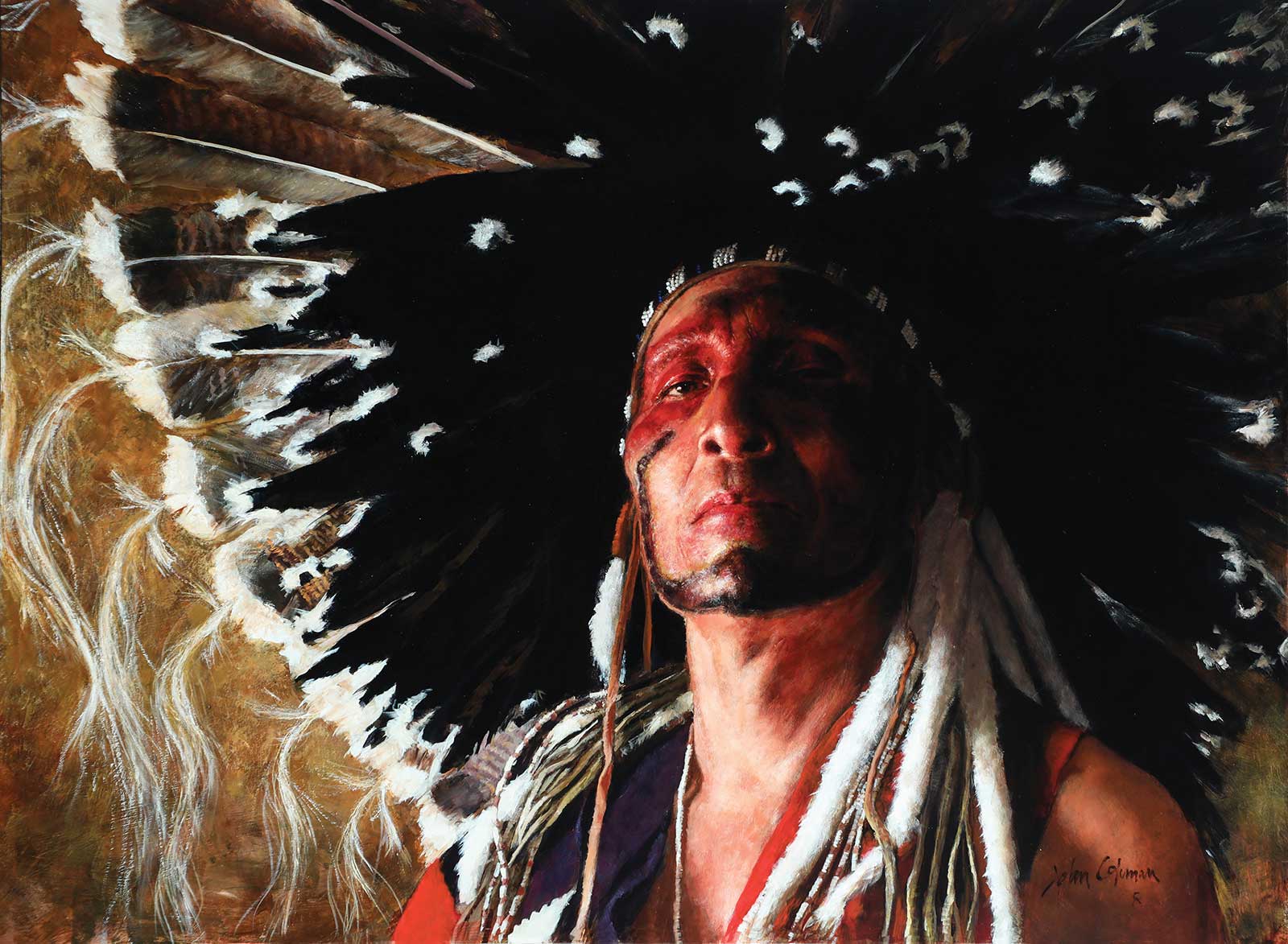 Pariskaroopa, Dog Soldier, 1834, oil on canvas, 21½ x 29”
“I’m excited about the opportunity for this show, particularly in this really great town of Fredericksburg. There’s a lot of history there, including with the Comanche,” he says. “I’ve done more drawings for this show than some of my others, and I’m excited for those pieces, including the bigger ones. I love doing things different than the past because it keeps me pumped up and the energy high.”
Of the new work, one of the pieces he’s most excited to share is Pariskaroopa, Dog Soldier, 1834. Coleman has sculpted the figure before, which was modeled after a Catlin painting from 1832, but he’s never painted an oil of the famous warrior. “I am really fond of this design with the magpie headdress. In the painting you can’t see the whole thing because I’ve used a dramatic composition that crops it out. It’s just such a striking element, so it’s fun to paint,” he says. “You can only see part of it, but he’s also wearing a shawl or scarf, and during the battle they would take their lance and pin themselves to the battlefield so they couldn’t move. It was a way of glorifying their heroism. Some wouldn’t make it through, but others would and when they returned to their camp everyone knew they survived something unsurvivable. It was heroic, but it also scared the hell out of their enemies. These were elite fighters.”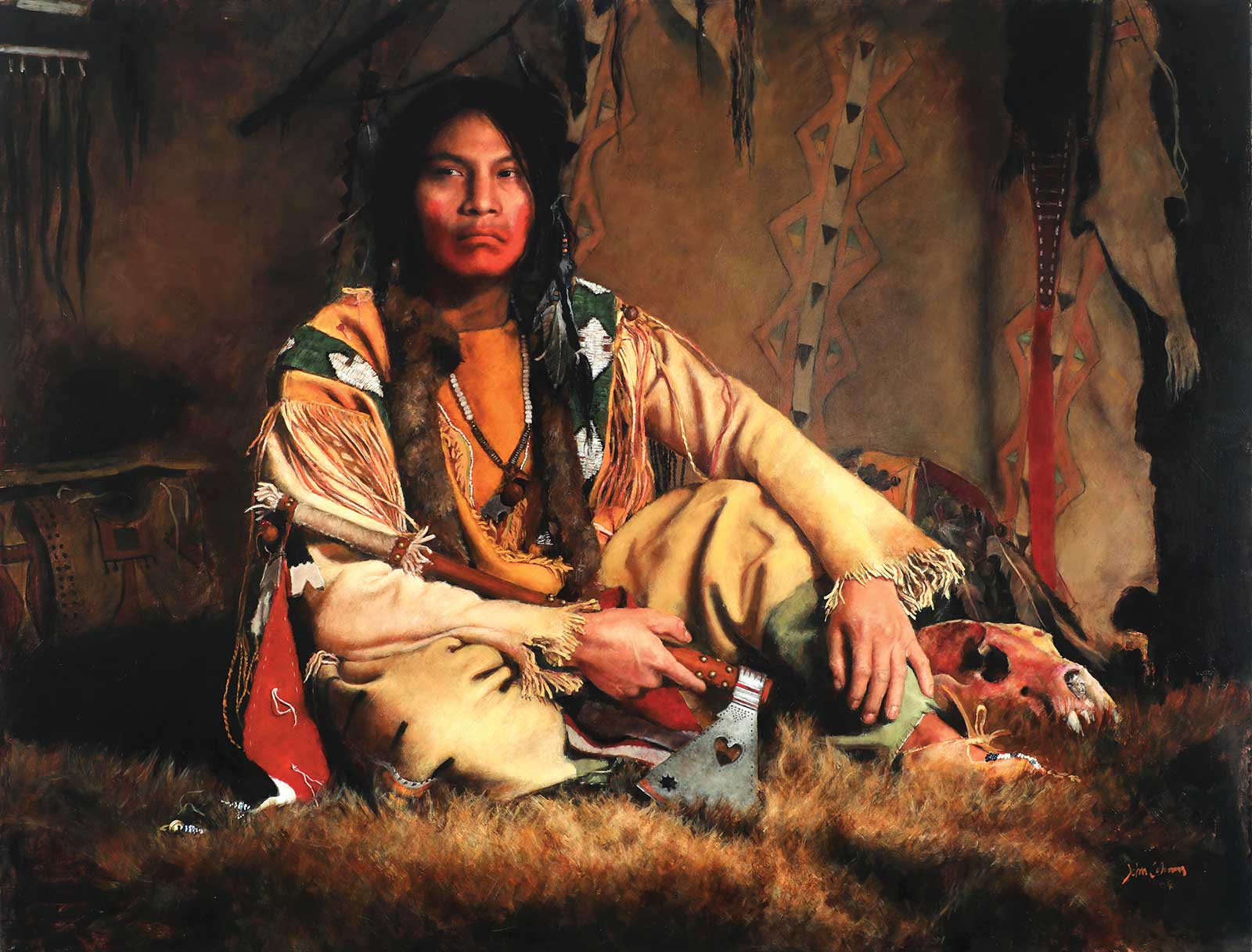 Lodge of the Bear Clan, oil on canvas, 33½ x 44”
Someone Coleman has turned to recently for stories, details of Native American life in the Old West and council when it comes to historical accuracy is Michael Bad Hand, who is an artist himself. Coleman calls Bad Hand his “first heckler” because he’s unafraid to call out errors in design, history or use of debunked myths. “He’s really good at being totally transparent, which is what historians like,” Coleman adds. “He wants to be totally accurate because he’s on the firing line if something isn’t true. So that keeps him very accurate.”
Bad Hand helped him work through some of the details of Crazy Horse, the new bronze work that will be in the InSight show. It was Bad Hand who encouraged Coleman to include a kestrel atop Crazy Horse’s head. “The accounts differ for Crazy Horse at the Custer site [during the Battle of the Little Bighorn]. Some are simply that Crazy Horse was adorned with a hawk feather he tied to his hair. Other accounts say he was wearing a small hawk or falcon. It was Michael Bad Hand who said it was likely a kestrel, which is a little smaller,” Coleman says. “There are no photographs of Crazy Horse, so we have to look at what had historical connections, but also what was even possible.”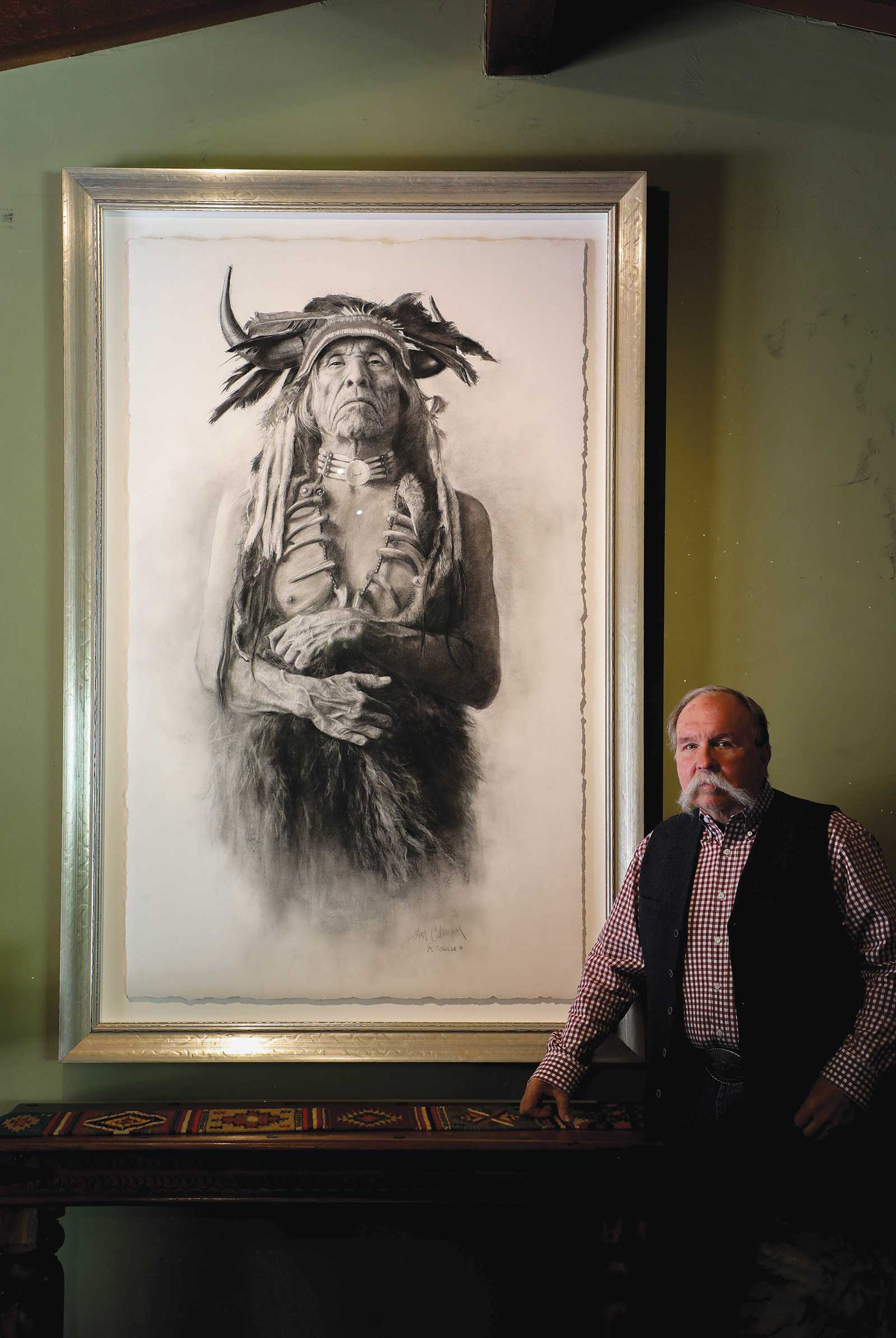 John Coleman stands with his larger-than-life charcoal drawing Oracle III.
The bronze version of Crazy Horse also wears a buffalo robe off one shoulder. It’s a robe that Bad Hand created for the Custer Battlefield Museum in Montana. When Coleman saw it, he was so struck by the design and level of detail he asked to have another created, and now it’s twin lives in the Coleman studio in Prescott.
Elsewhere in the show is Lodge of the Bear Clan, showing a male figure sitting as if for a formal portrait within a decorated lodge. The man is wearing a magnificent quilled coat and he holds an expertly made hatchet with cut-outs in the body of the blade. “I was all geared up for this Bear Clan image and even had a headdress made, but then I found this young model who had this perfect look, and he helped the work evolve into what it is now,” the artist says. “I got that grizzly skull along the way and it really helped dress the scene. For the hatchet, with that intricate design on it, that would have likely come from the Hudson Bay Company, which would have needed goods to trade for fur and pelts. It would have likely been made in England or France. Sometimes those cut-out shapes would be stars or diamonds. This shape is called the weeping heart.”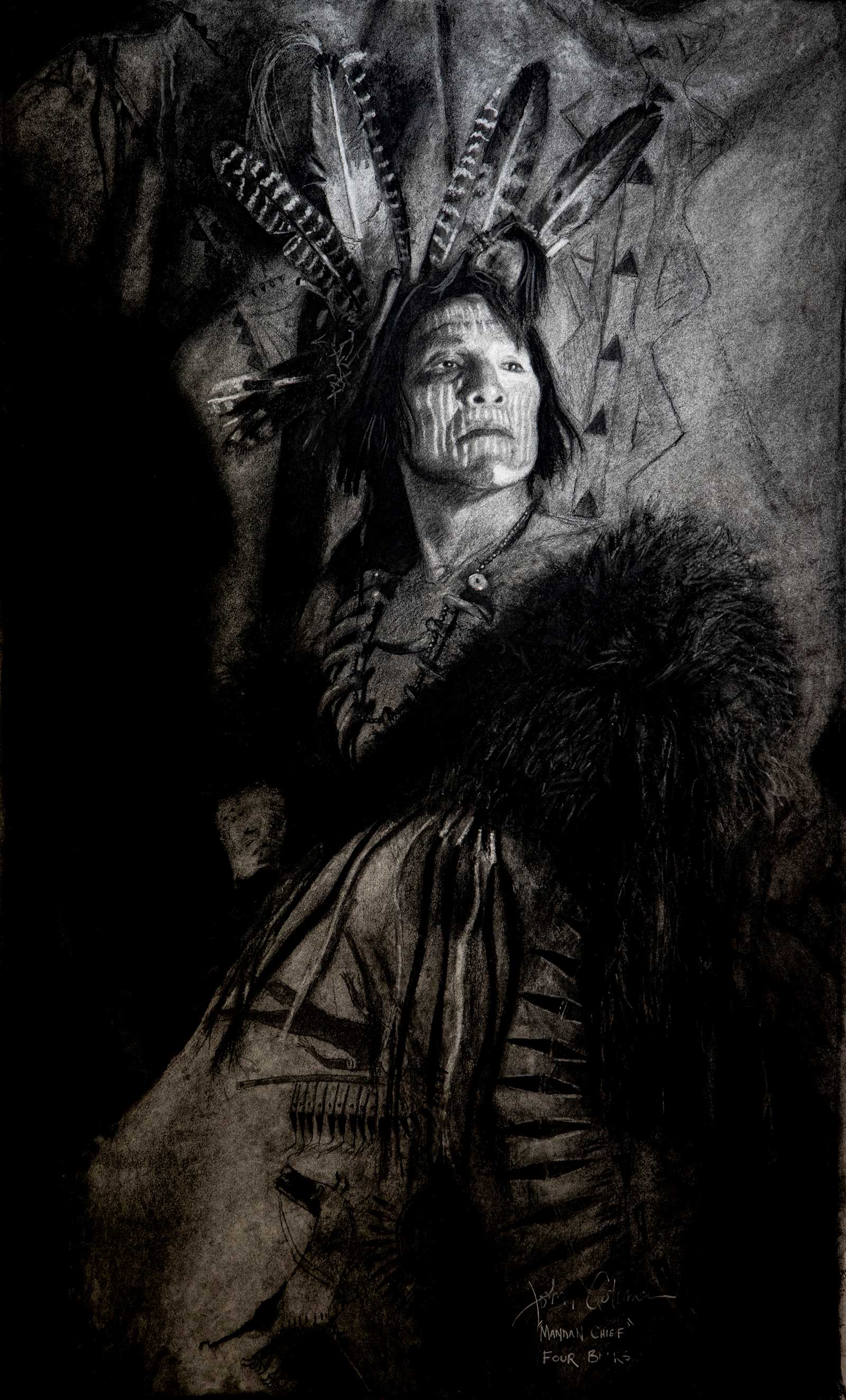 Mandan Chief Four Bears, charcoal, 39½ x 23½”
For Coleman’s newest charcoal works, he spent a great deal of time dialing in the values—so the darkest blacks would be deep and rich, and the whitest whites were essentially untouched paper. “I really have to hunt for the blackest charcoal that works for me. There are four or five different ones that all have different levels and darkness and softness. Really what I’m hoping for is the darkest they make,” he says, specifically drawing attention to Mandan Chief Four Bears. “Before I start I know where the lights and the darks are going to be, so the trick is keeping the light areas clean so the whites can stay fresh on the paper. They are interesting to work on, but it’s definitely an orchestration. If I don’t get it right the first try I have to do it again. For Oracle III, that was my second shot at that. The first was more of a rehearsal. It helps to have good paper. I buy this thick stuff that’s a little unwieldy but the texture is fairly rough. You’d think the finer paper would get you better detail, but it’s counterintuitive because the coarser texture is better for enhancing your strokes.”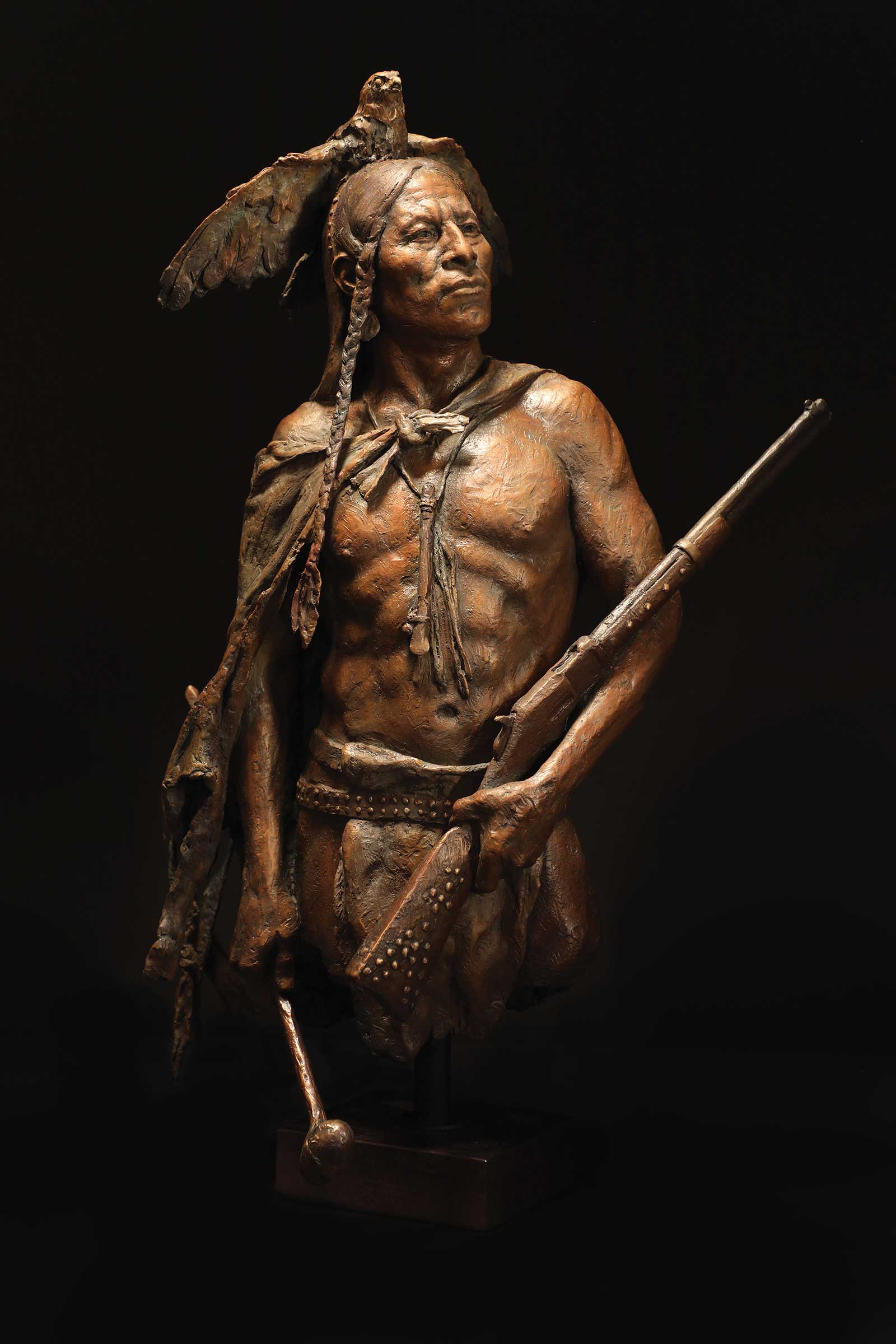 Crazy Horse, bronze, 33½ x 21 x 12”
Elizabeth and Stephen Harris, owners of InSight Gallery, are thrilled to have Coleman showing with them in Texas. “Although John Coleman is widely considered one of the most sought-after sculptors and painters of our day, he considers himself, foremost, a storyteller,” Elizabeth says. “In his work he strives to tell the stories of our ancestors so that we may understand our past and those who came before us. His stories, transmitted skillfully through his hands into bronze sculpture, charcoal drawings and oil paintings are manifestations of historical references fused with emotional undertones of his Native American subjects. The air of strength and stoicism in the stature of a chief, the face of wisdom and age on the medicine man, the essence of innocence in the young maiden with her doll—each leads the viewers’ imagination down the path of history and understanding.”
The show will kick off with an artist reception on October 7, followed by a by-draw sale on October 8. The show will continue through October 23. —
John Coleman: Lives and Legends of the Mystic Plains
October 2-23, 2022
InSight Gallery, 214 W. Main Street, Fredericksburg, TX 78624
(830) 997-9920, www.insightgallery.com
Powered by Froala Editor