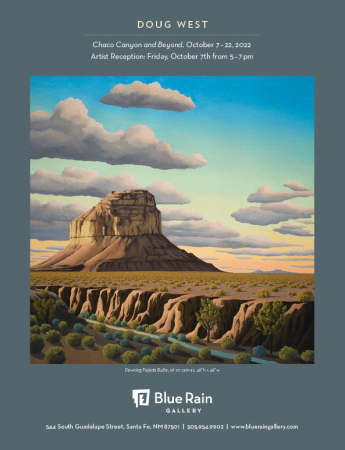
At 75, Doug West is still chasing after that deep desert space. His latest show at Blue Rain Gallery, Chaco Canyon and Beyond, brings West’s vision of Arizona and New Mexico alive in oil. Neatly receding sagebrush in The One, the Only, a playful take on Shiprock, and Dawning Fajada Butte nod to the artist’s background as a printmaker and his proclivity for a well-composed canvas. From White Sands to the Grand Canyon’s South Rim, the artist pairs desert landmarks with botanical elements in a design forward style that’s made him a New Mexico luminary.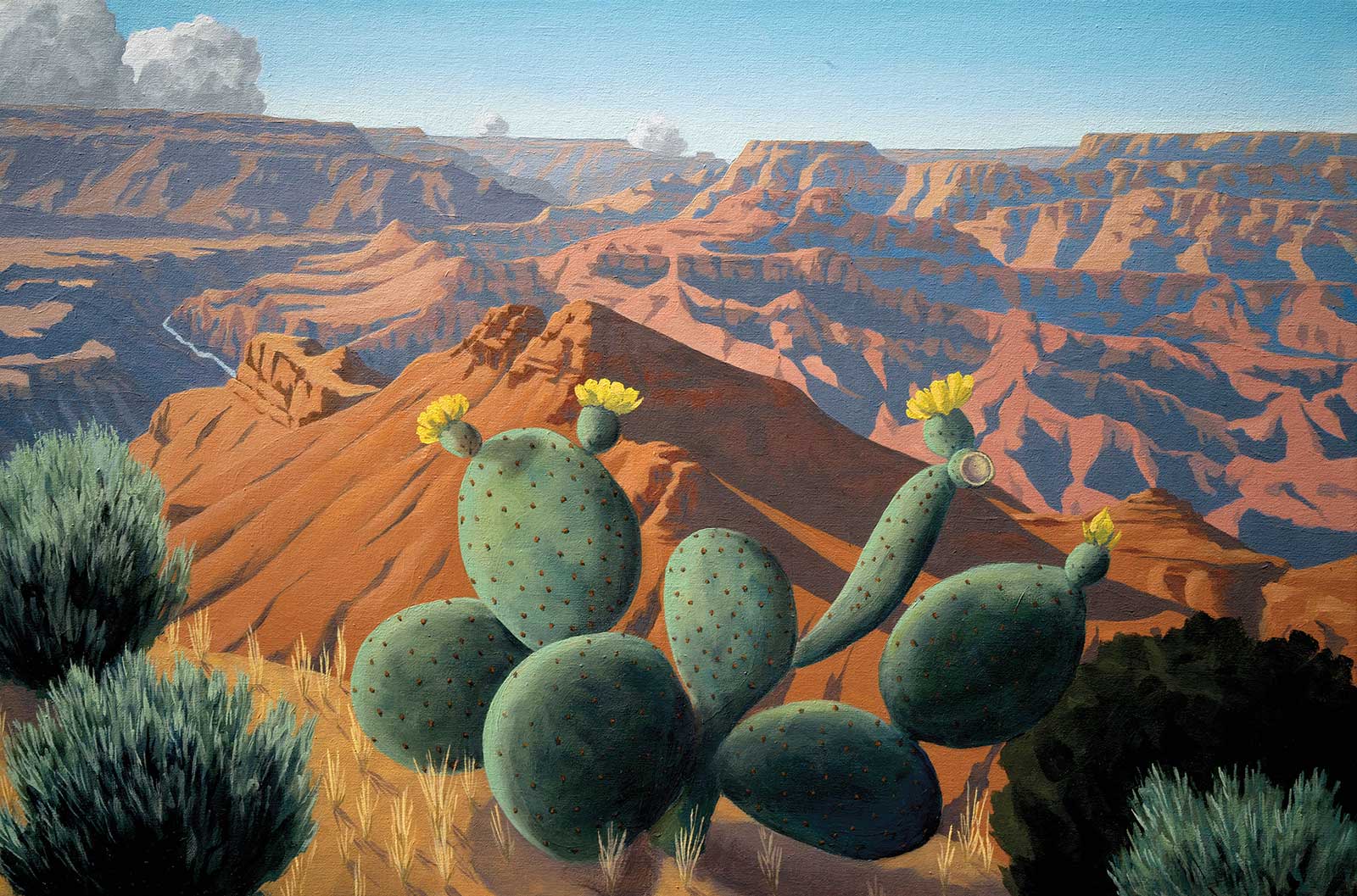 South Rim Bloom, oil on canvas, 20 x 30”
“We’re super proud to have Doug West in our stable of artists,’’ says Blue Rain executive director Denise Phetteplace. “He’s kind of an icon of the Southwest, really.” He’s in the permanent collection of the Museum of Northern Arizona. And, in 2012, West was tapped to take part in New Mexico’s centennial celebration with his artwork appearing on the commemorative U.S. postage stamp. For another centennial, this time New Mexico Magazine’s, his dynamic desert landscapes will be featured in their forthcoming 2023 calendar.
“The entire calendar is devoted to Doug West and his imagery because they feel like he’s the essence of New Mexico in his paintings. He really just sort of embodies the majesty of this place,” says Phetteplace. “It’s a huge honor and we’re thrilled for him.”
“The state that we live in, this geographic region, just provides a wellspring of inspiration for him,” she adds. “He’s such an adventurer in a sense that he’s not afraid to explore these places to further tap into that creative possibility.”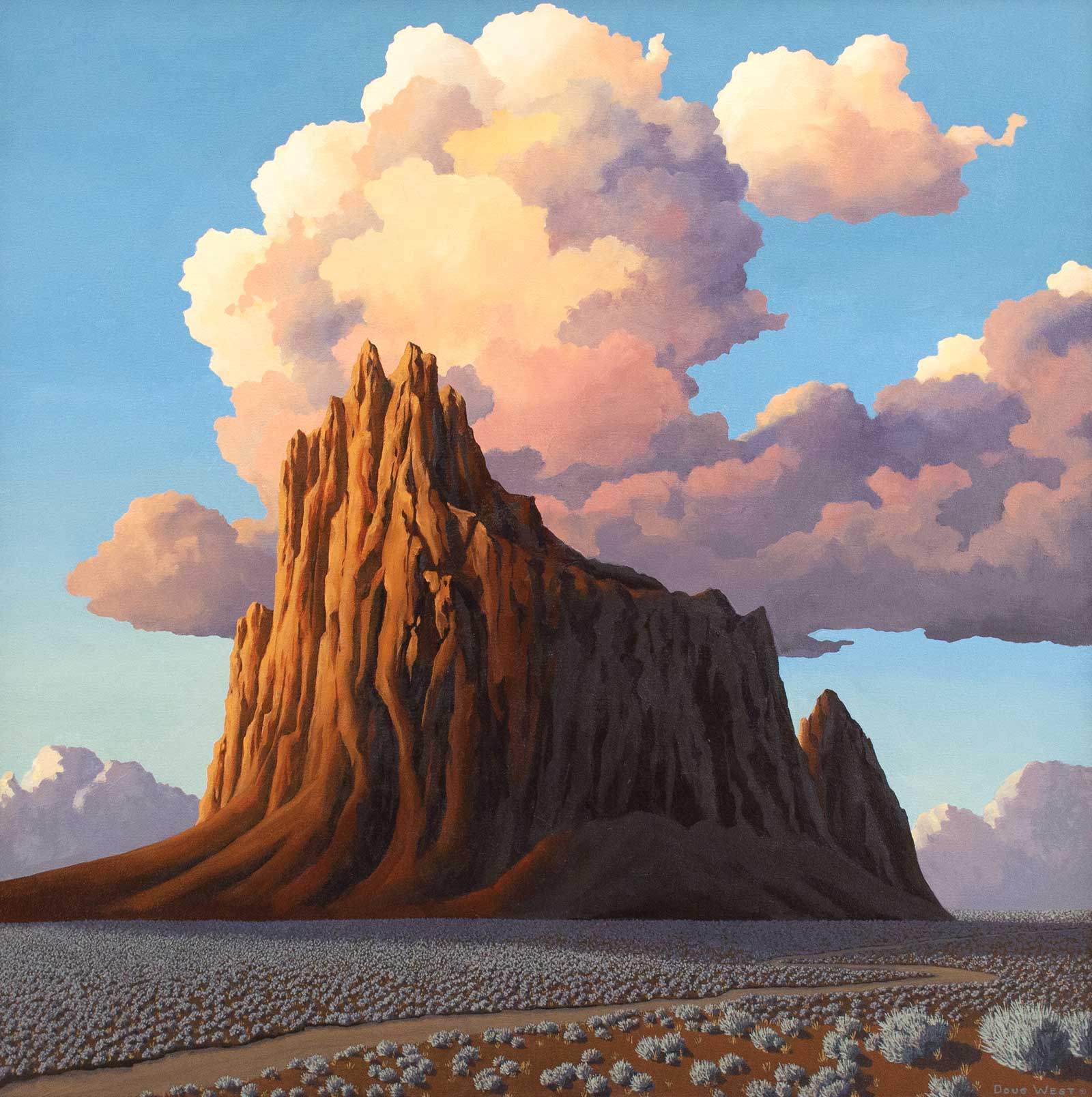 The One, the Only, oil on canvas, 40 x 40”
West’s adventure began in 1950s Southern California. A Riverside kid, tooling around the Sierra with his father, he hiked and camped and learned how to look at the landscape. “I saw California really kind of virgin, with a child’s eyes, and was exposed to the outdoors in a way that I was given a lot of freedom,” says West. “Somehow, over time, that became primary to me—my experiences with nature.”
After studying ceramics at the University of Southern California, a civilian role with the Army took West to Hawaii. And later, on little more than a coin flip, he landed in New Mexico just as the high-flying era of art dealer Elaine Horwitch was taking off. “It was just on the cusp of Santa Fe really being discovered and truly promoted nationally. I was lucky enough to see that,” says West. “Just by chance, we chose Santa Fe. I had never been there. And it was just a magical town.”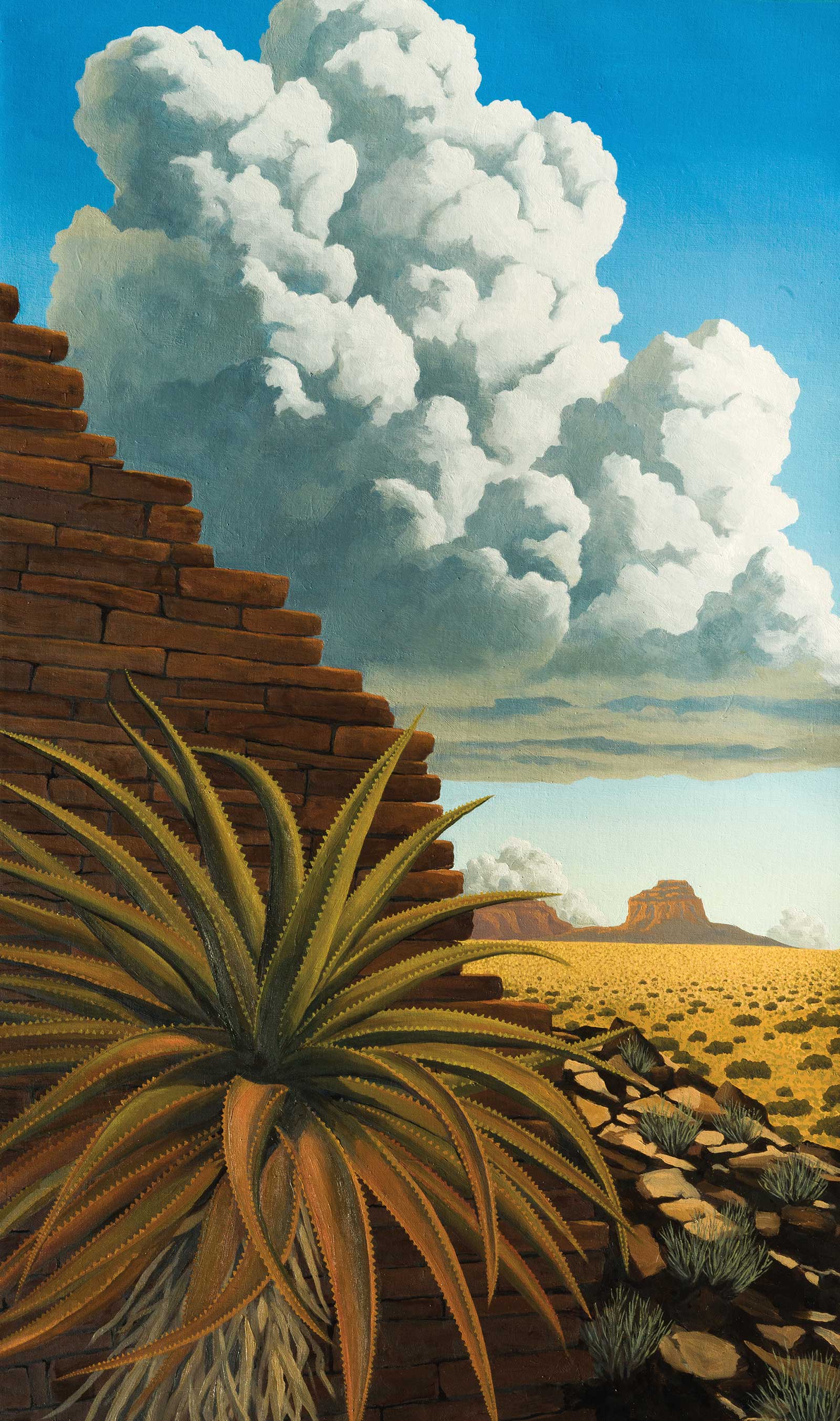 Ancient Ways, oil on canvas, 40 x 20”
While some of the flashier characters of the era zipped around in Lamborghinis and Rolls-Royces, fresh off the beaches of the North Shore, West and his wife rolled into Santa Fe in a VW van. “We came down Old Santa Fe Trail entering into the central part of town, and you could smell the piñon and juniper burning in the fireplaces,” he remembers, “So it had sort of an incense and these old historic adobes.” Their possessions were being shipped behind them, and they had planned on sleeping in the van while they got settled, a miscalculation perhaps in the cold December of the high desert.
While his training was in ceramics, West took a job at Los Alamos that kept a more traditional (and slightly warmer) roof over their heads. “I’d walk around and look at galleries and miss that side of me—being creative—and I’d have great things to see,” he says. Soon, he started learning screenprinting techniques on the side and landed representation with the “Annie Oakley of the art world,” as Horwitch biographer Julie Sasse calls the Southwest pop mega dealer.
“Earlier in my career I was kind of in the thick of it—in Santa Fe at a time when Southwestern art was being discovered and collected in the 1980s, and I was a printmaker making limited edition, hand-pulled silkscreen prints,” says West. Genre bending Native American artists like Jaune Quick-to-See Smith and Fritz Scholder were also showing in Santa Fe at the time, as were artists like Amado Peña and R.C. Gorman who, along with West, would go on to spread Southwest iconography throughout the country with their widely collected prints.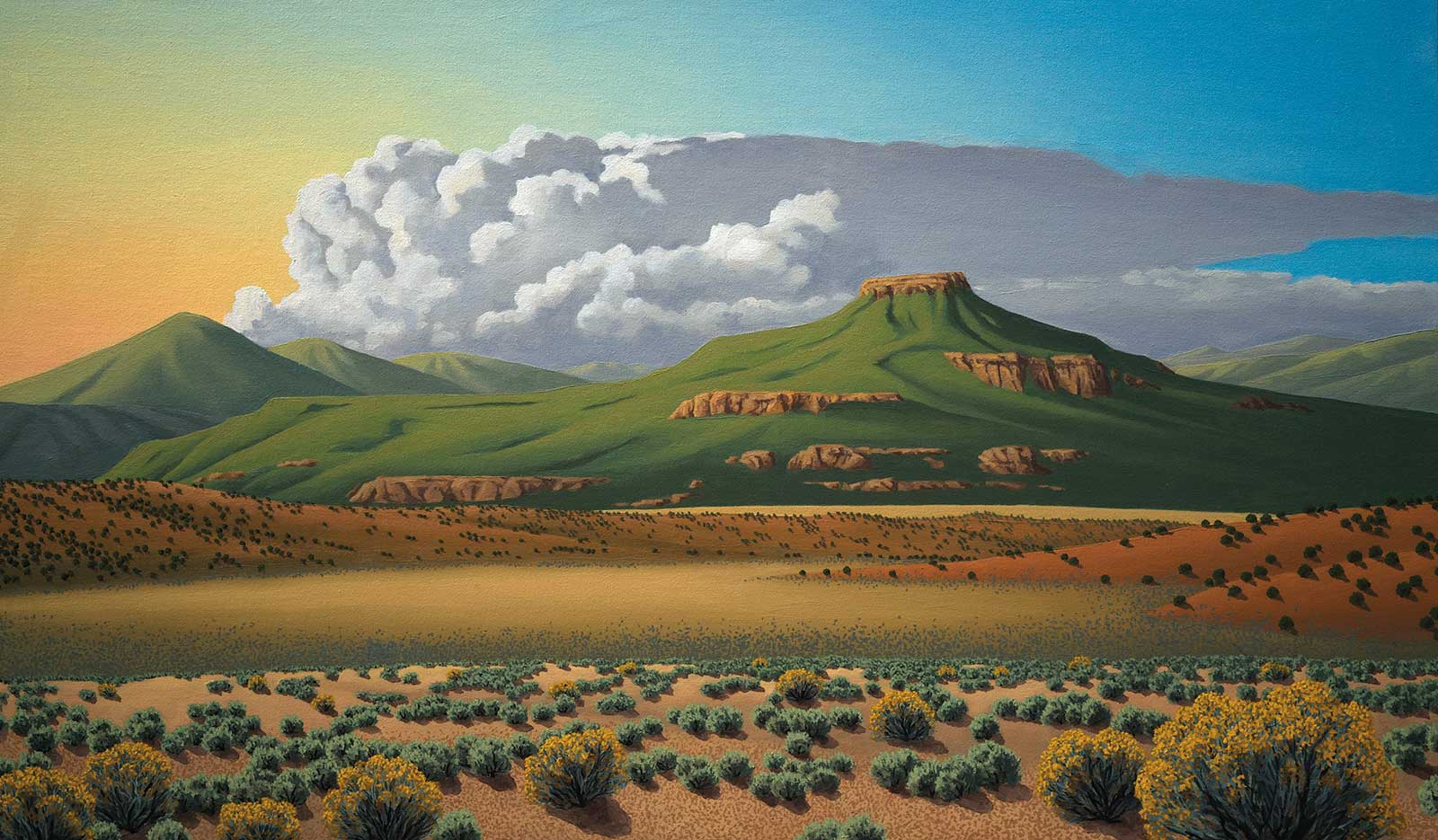 Pedernal Morning, oil on canvas, 24 x 40”
“It was small and artists did go to openings and shows. It was a tighter group then,” West says of the still nascent contemporary Western art market. West “rode the wave,” all the while focusing on the craftsmanship in the art of printmaking. “I think of it as a tangential sort of move in terms of the hands-on craft,” he says, “paying attention to detail that is so much a part of ceramics or woodcarving.”
“Overall, it’s like putting a jigsaw puzzle together,” he says of creating serigraphs. “It’s a sequential process where you’re bit by bit covering the white paper.” A fine art cousin to the screenprinting one might use for T-shirts or concert posters, West’s serigraphs were highly detailed landscapes requiring pass after pass with each additional “puzzle” piece. “When I was doing that, a small image might have 30 colors, a large image might have 60 to 70 colors,” he says. “The images ended up being really graphically complex and worked really well for landscapes because I could blend the inks.”
After two decades of printmaking, West tackled the new creative challenge of oil painting, his current medium. “His oils, I think, are incredible. It’s still very clear that there’s a printmaker inside the painter,” says Phetteplace. “I feel like the way he approaches painting, he does that with a little bit of a printmaker’s eye. So his pieces are graphic, his compositions are really quite dynamic, visual information in the painting is distilled,” she continues. “He gives us everything we need and nothing that we don’t.”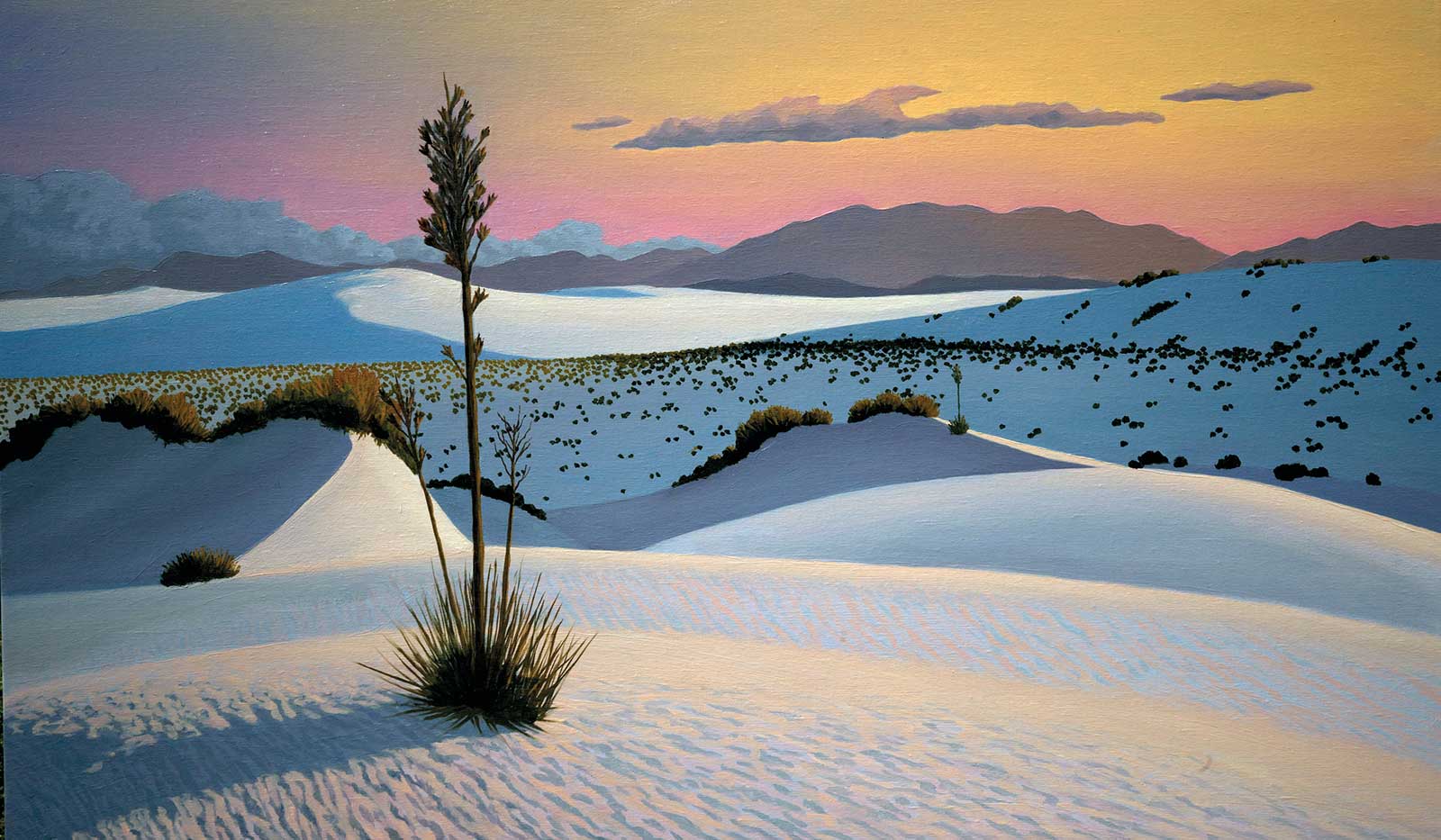 White Sands Dawn, oil on canvas, 24 x 40”
“Every new series presents struggles and self questioning and doubts,” says West. “That’s what I love about being an artist.” Of learning to paint with oils later in life he says, “I might as well have been starting over. Period.” But he doesn’t think the challenges of artmaking are unique to him. “Looking back, that’s the portal you have to force yourself to go through and then grow from,” says West. “In changing my mediums, I certainly went through that and continue to.”
“From this vantage point in life, it’s really revitalizing. Being open to change keeps me fluid and not stagnant,” says West. “So I’m playing around and reacting to my insecurities, but also where those have led me in trying to problem solve. It’s a constant renewal,” he says. “There’s a lot of juice in that.”
Now living in Baja, Mexico, West’s practice has room to take a more contemplative approach. “Honestly, I’m living down here far removed from the art market in Santa Fe. And yes,
I go up there once a year for my show, but I’m kind of painting for myself,” says West. “I like to tell people that I’m a journeyman artist. I’m doing my own thing in my private space, and actually, I taught myself to screenprint in much the same way,” he notes. “I can’t say that I’m trying to fit into a niche in the art world. I’m just responding to how I interact with nature, and I happen to be lucky enough to have found the vehicle to interpret that.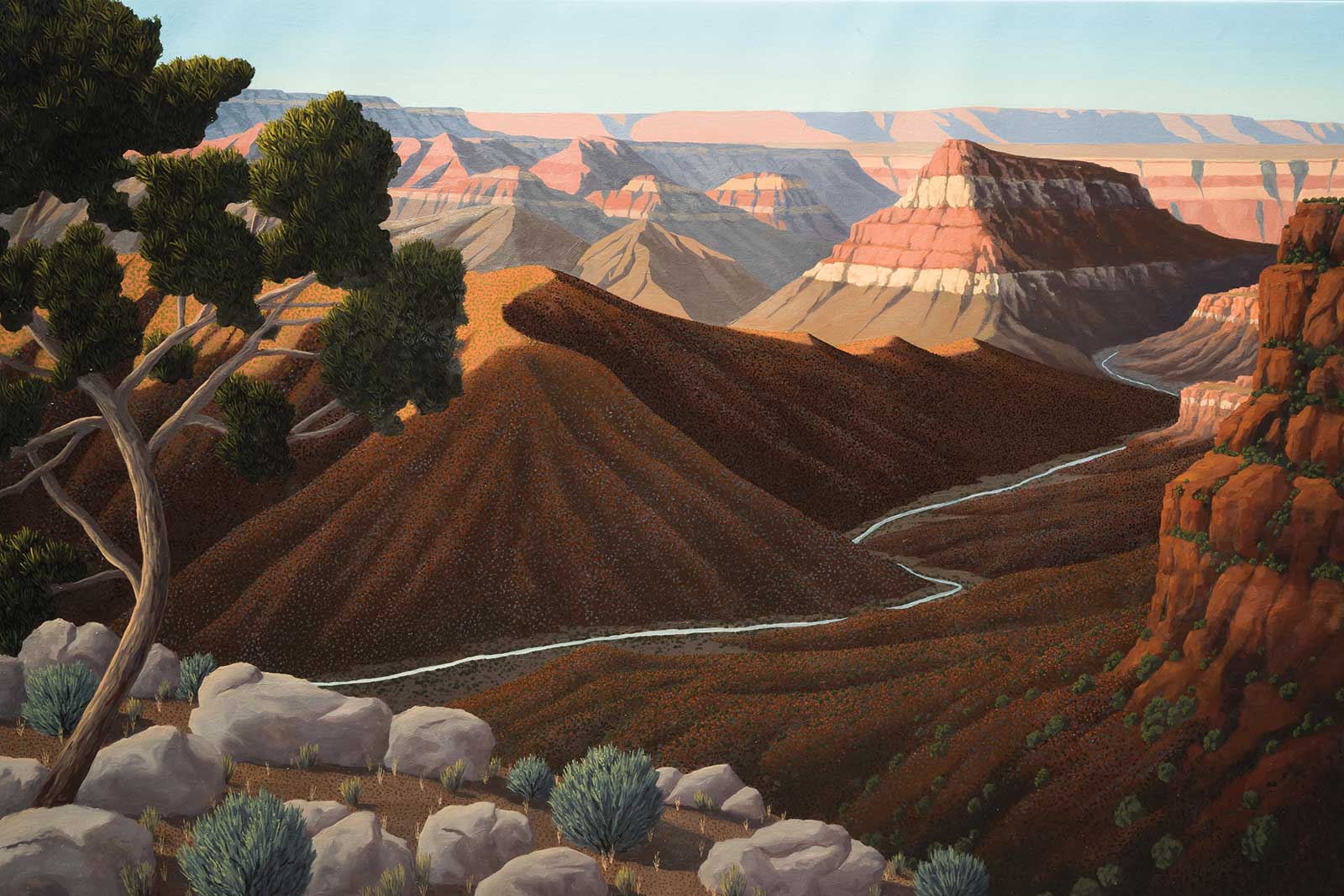 Passage Through Time, oil on canvas, 48 x 60”
“I feel so lucky that it enables my lifestyle living in Mexico and that it provides me with a daily feeling of purpose and I do not feel stagnant with my work. I really look forward to it, even when I’m insecure about it,” says West. “It’s really a solitary journey for me. And yet, I’ve had this really great career.”
Every passing year, West’s work gets better and better, Phetteplace tells us. “I definitely feel that he’s allowing himself the time to go deeper with every piece.”
As for Chaco Canyon and Beyond, “That’s as close to a theme as I’ve ever gotten,” says West. “This show’s a little bit different for me. I’m enjoying having the focus versus a random, scattershot approach.”
His take on the ancestral Puebloan ruins and scenes from the greater desert Southwest will be on view October 7 through 22 at Blue Rain Gallery in Santa Fe. An opening reception will take place on opening night from 5 to 7 p.m. —
Doug West: Chaco Canyon and Beyond
October 7-22, 2022; opening night reception, Oct. 7, 5-7 p.m.
Blue Rain Gallery, 544 S. Guadalupe Street, Santa Fe, NM 87501
(505) 954-9902, www.blueraingallery.com
Powered by Froala Editor