Jackson Hole, Wyoming, is not only known for its wildlife, but also how easy the wildlife is to see. And I’m not talking about catching a glimpse of a creature from a moving car on the highway. I’m talking about bears in the backyard, moose poking noses into open windows and elk grazing in gardens. It’s wildlife you can almost reach out and touch, except the rangers implore you, “No touching!”
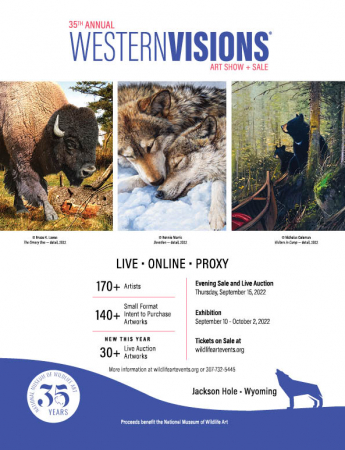
So it’s fitting one of the best wildlife art exhibitions takes place in Jackson Hole’s famous National Museum of Wildlife Art, which hosts the annual Western Visions exhibition every September in the shadow of the Grand Tetons. This year’s show, which opens September 10, is expected to be a stellar example of the exhibition as the museum celebrates 35 years of bringing wildlife art to Wyoming. “It’s going to be a great opportunity to celebrate the legacy and vision of the museum and its founder, Bill Kerr,” says Michelle Dickson, the museum’s director of programs and events.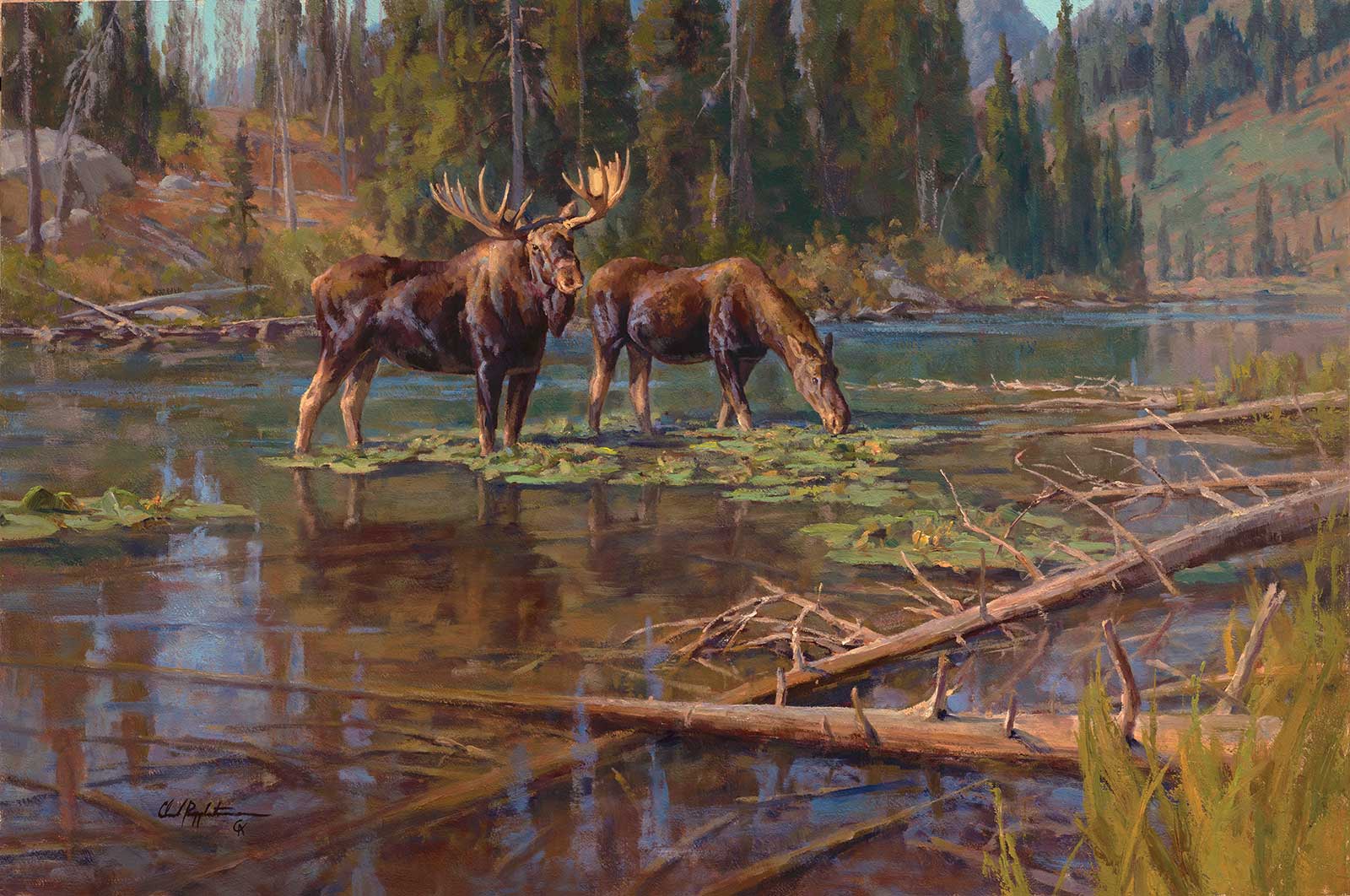 Chad Poppleton, String Lake Society (detail), oil on panel, 24 x 36”
This year’s presentation of Western Visions will feature 140 juried artists, each one submitting a painted work measuring no more than 320 square inches or a bronze work smaller than 18 inches on its longest side. Although the show is juried, the museum does give artists an opportunity to apply and usually selects from the list of artists in hopes of capturing a fuller record of the wildlife artists working in Western art today. Artists include William Alther, Bruce Cheever, Michael Coleman, Brent Cotton, Ewoud de Groot, Luke Frazier, Donna Howell-Sickles, Francois Koch, Bruce Lawes, T. Allen Lawson, Amy Lay, Bonnie Marris, Krystii Melaine, Brett James Smith, Tucker Smith, Theodore Waddell, Jim Wilcox, John Banovich, Greg Beecham and many others.
The exhibition opens on September 10, and on September 14 there will be a panel discussion titled “The Intersection of Relationships and Art.” On September 15 the museum will roll out the red carpet for the sale, reception and other events that begin at 5 p.m. This year’s show will feature a live auction component featuring 34 works with no size limitations. The works will also be available for bidding on LiveAuctioneers and Invaluable for collectors who can’t make the trip to Wyoming. After the live auction will be the closing of the intent-to-purchase sale with winners announced at 8 p.m. The entire catalog of art is now available on the museum’s website.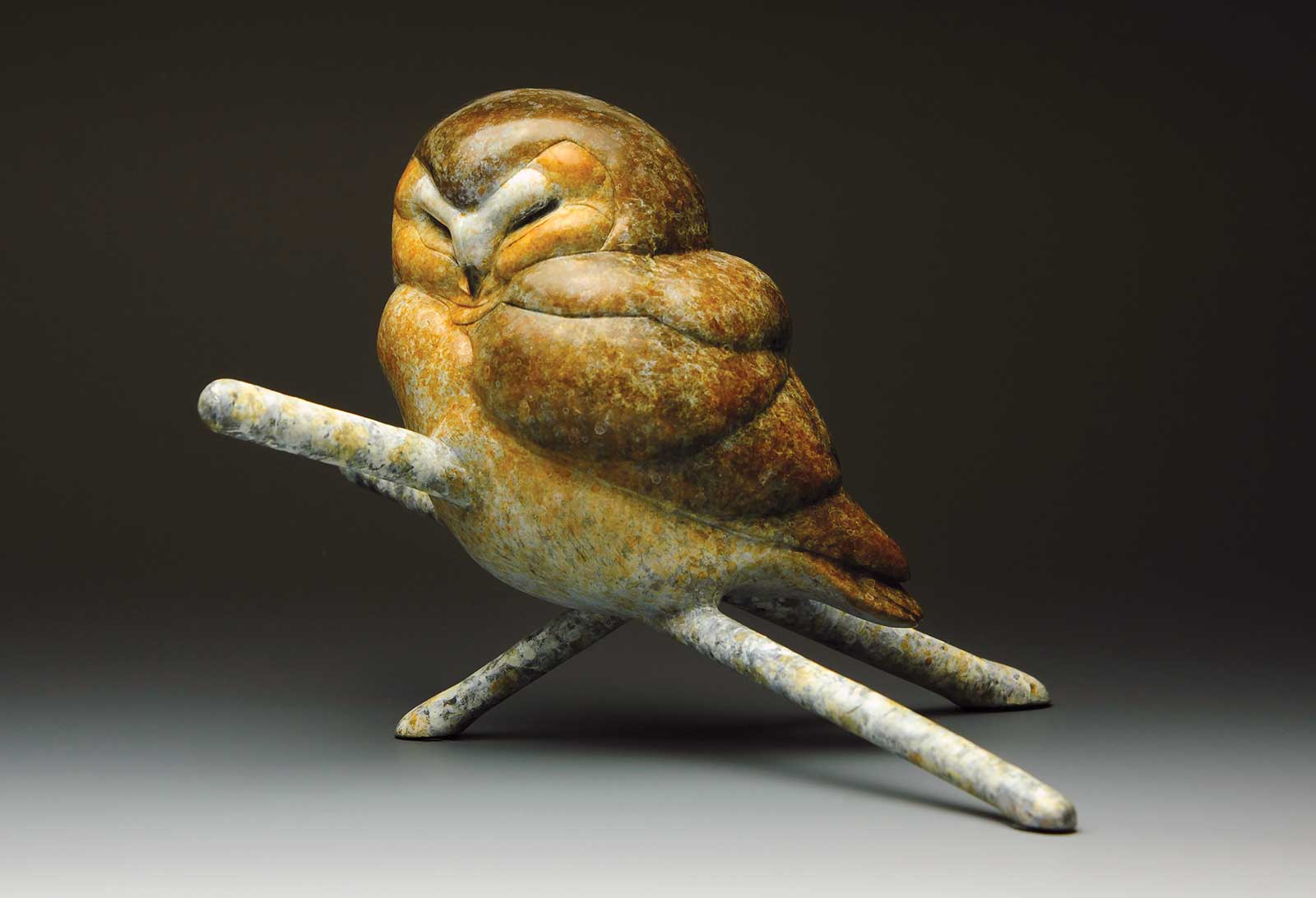 Jeremy Bradshaw, Saw-Whet Dreams, bronze, ed. of 25, 5 x 8 x 6”
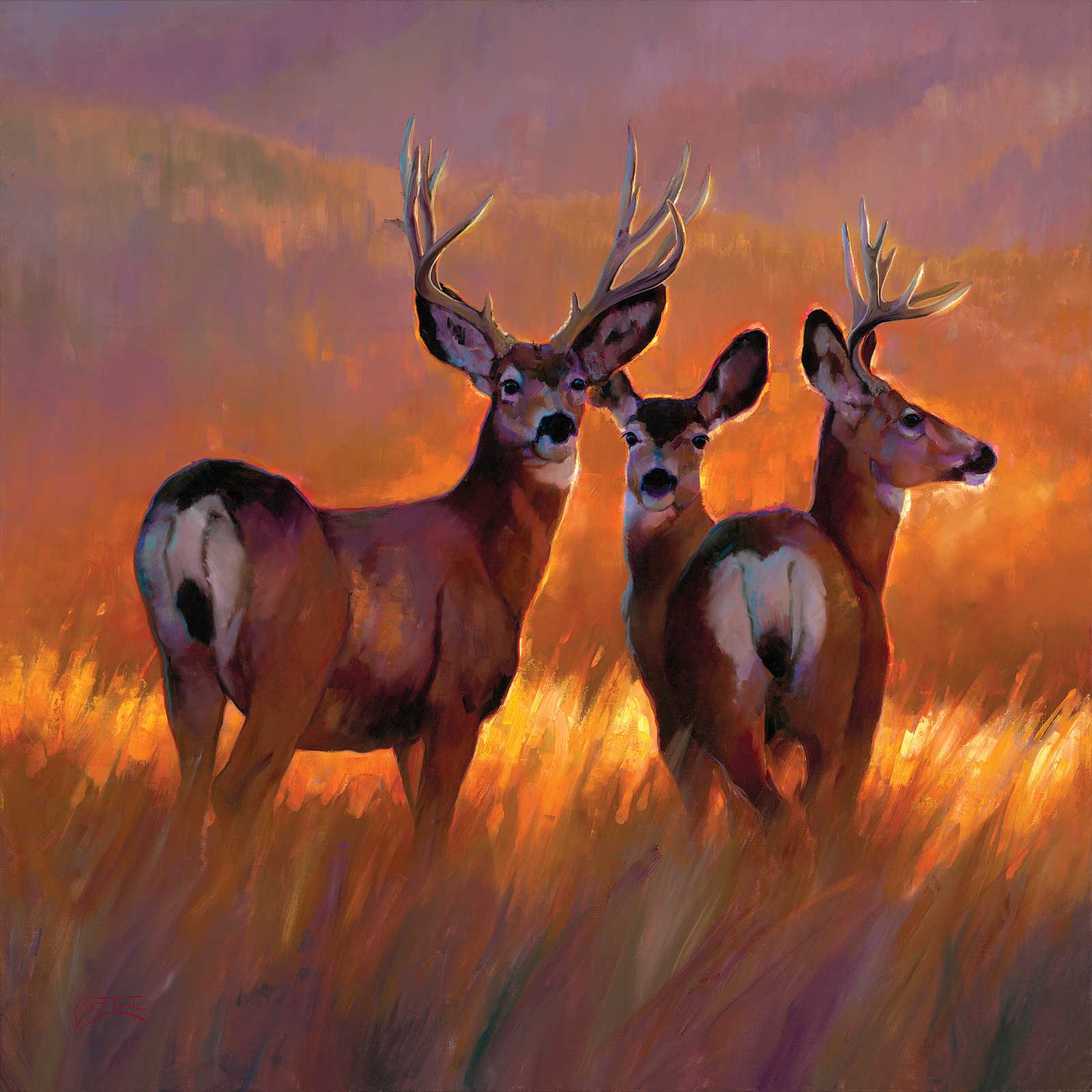 Colt Idol, No Butts About It, oil on linen, 48 x 48”
Thomas Blackshear II will be presenting his work Cougar’s Song, showing a Native American figure playing a flute next to a magnificent cougar. “I always wanted to do a painting with a cougar in it. But I also wanted to try to come up with something different and unique. I’m happy with the composition, with the Indian and the cougar together,” Blackshear says. “It gives it that feeling of Western Nouveau to it. I added the background with the mesa to let you know it was happening in the West somewhere. I was really happy they called me to ask if I could be in the show. I’m mostly known for my figurative work, but I do enjoy painting animals.”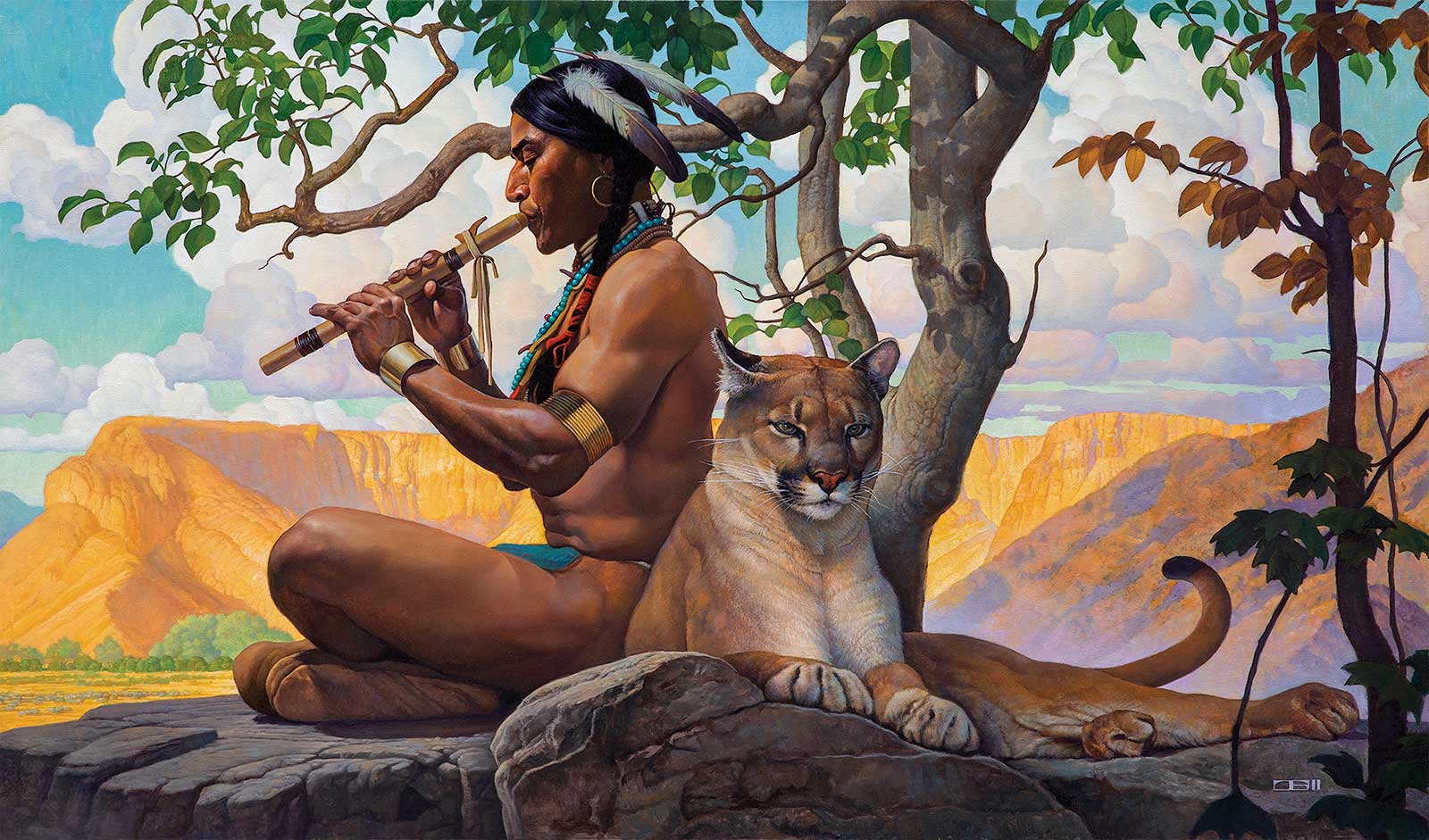 Thomas Blackshear II, Cougar’s Song, oil on canvas, 32 x 52¾”
Chad Poppleton will be bringing String Lake Society with two moose standing in the shallow water of a lake. “String lake is located in the Grand Teton National Park and is the overflow outlet of Leigh Lake. With shallow water and a soft sandy bottom, String Lake provides the ideal place to unwind and wade. It’s also prime moose habitat,” Poppleton says. “The warm shallow water offers the premium place for lily pads to garnish the shore line. Shiras moose are completely at home in this elegant mountain lake having the confirmation to dip their muzzles deep into the water and dine on the stems and shoots under the pad patch. Like a true gentleman, this bull moose watches over his damsel while she is enjoying the entree served to her on a platter of emerald water. Only the drizzle of water can be heard rolling off the chin and dripping back into the well.”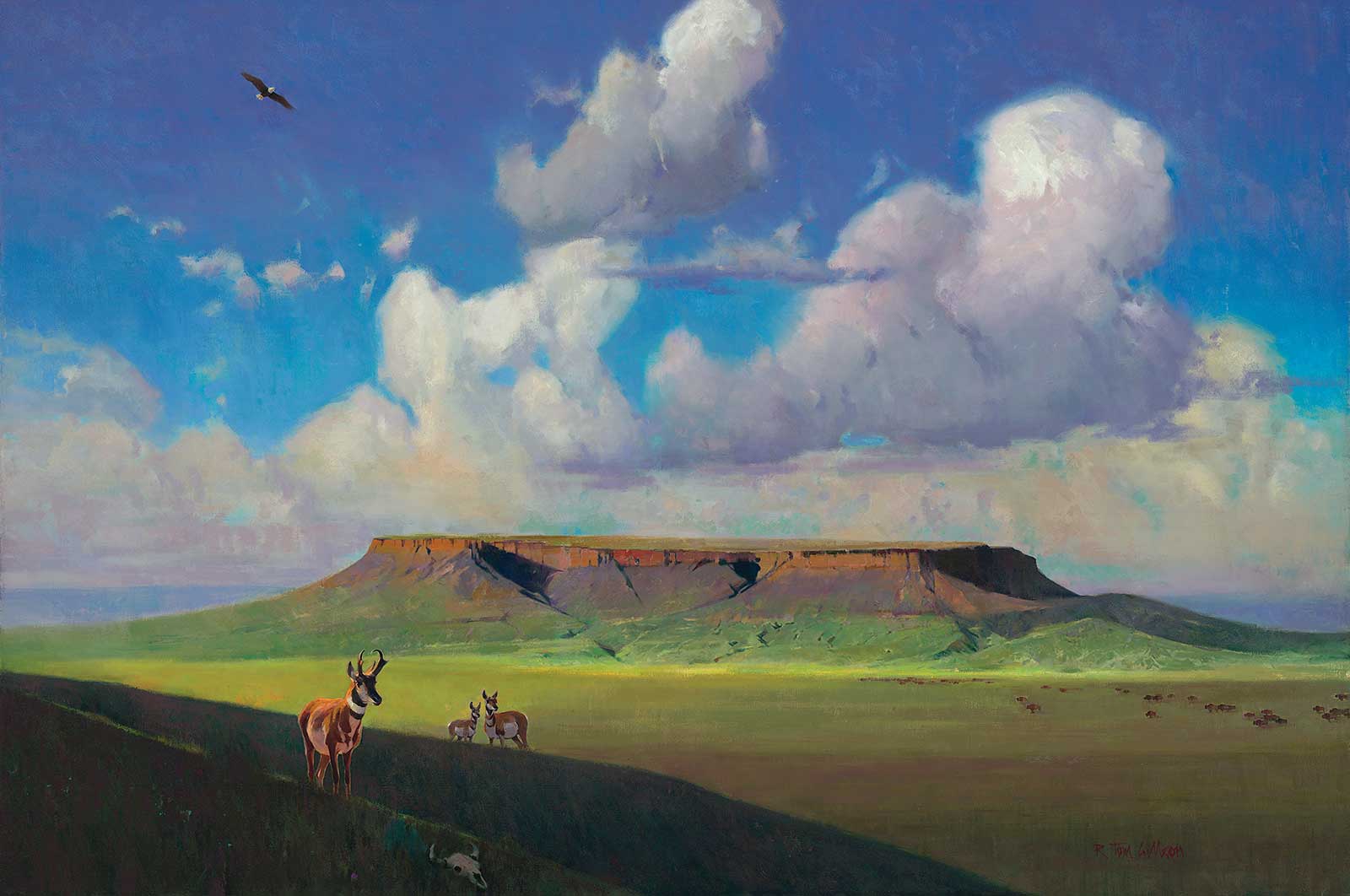 R. Tom Gilleon, Fort Mountain, oil on canvas, 40 x 60”
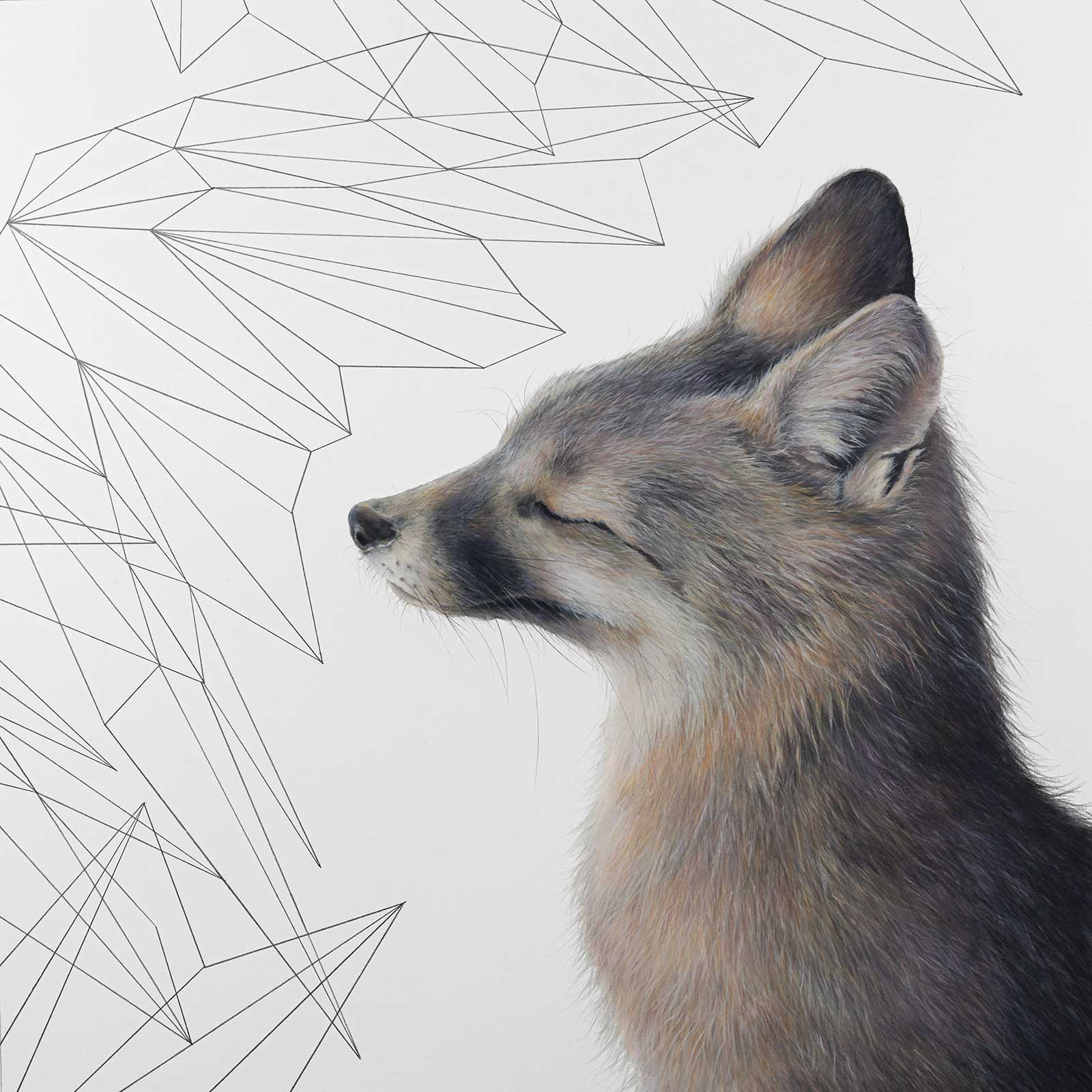 JenMarie Zeleznak, Just to Feel My Heart for a Second, watercolor pencil on paper, 18 x 18”
Jennifer Johnson offers a unique view in Cowboy Sunset with the neon sign above the Million Dollar Cowboy Bar, one of Jackson Hole’s most famous destinations. “The neon bucking bronco of the Million Dollar Cowboy Bar and the Grand Tetons are two icons of the Wild West,” she says. “Famous for Western swing dancing, country music, iconic saddle bar stools and the occasional cowboy brawl, the Million Dollar Cowboy Bar was known for gambling and drinking during probation. My first concept of this piece was purchased by the Million Dollar Cowboy Bar and is hanging in permanent collection in the bar. It has become a popular selfie backdrop for visitors and the occasional celebrity that wanders in. The idea to move the Tetons behind the neon of the Million Dollar Cowboy Bar is intentional and gives a unique and original feel to the piece.”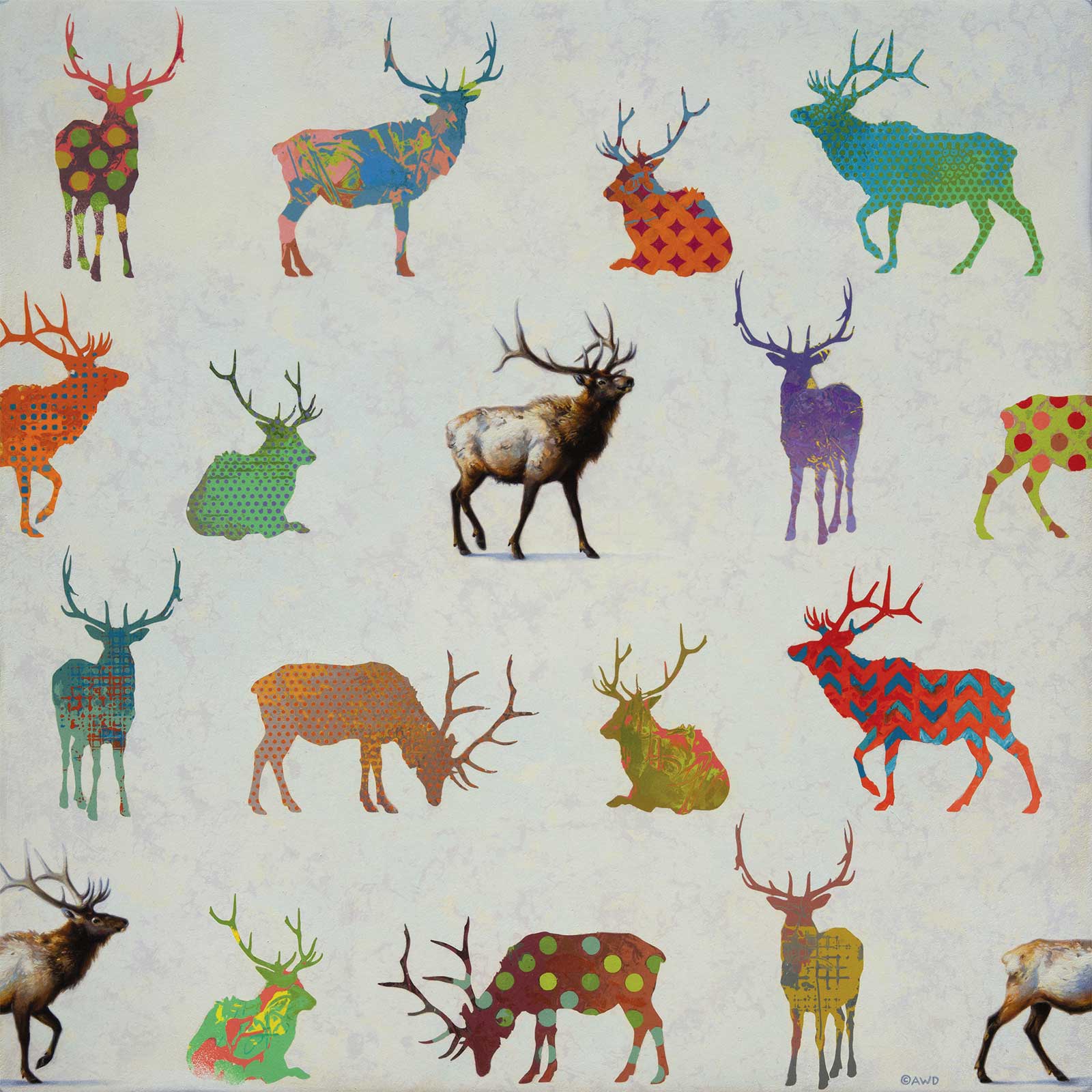 Andrew Denman, Study for The Bachelor Herd, acrylic on cradled board, 16 x 16”
Andrew Denman offers a very contemporary view of wildlife with his work Study for The Bachelor Herd. In the painting, the artist paints silhouettes of elk, each one painted in a different pattern except for one central elk that is painted realistically. “After spending some time on the National Elk Refuge in Jackson Hole, Wyoming, during the winter, when masses of elk descend from the snowed-in mountains to congregate in the Teton Valley, I was inspired to paint The Bachelor Herd. My goal was to capture the feeling of what
I witnessed (in this case a typically segregated congregation of males), but to systematize it into a composition that explores my love of pattern, something that many thousands of elk, darkly silhouetted against the gleaming white snow, certainly suggest,” he says. “The piece appearing in Western Visions is a 16-by-16-inch study of what eventually became a much larger 36-by-36-inch composition. It is an idea that I will probably revisit again on a still-larger scale. I have long been fascinated with pattern and repetition, both as it occurs naturally and in the context of the man-made. Just as all abstraction ultimately sinks its roots in a representation of nature, however distant and however dramatically stylized, so too do most man-made patterns take their original inspiration from the natural world.”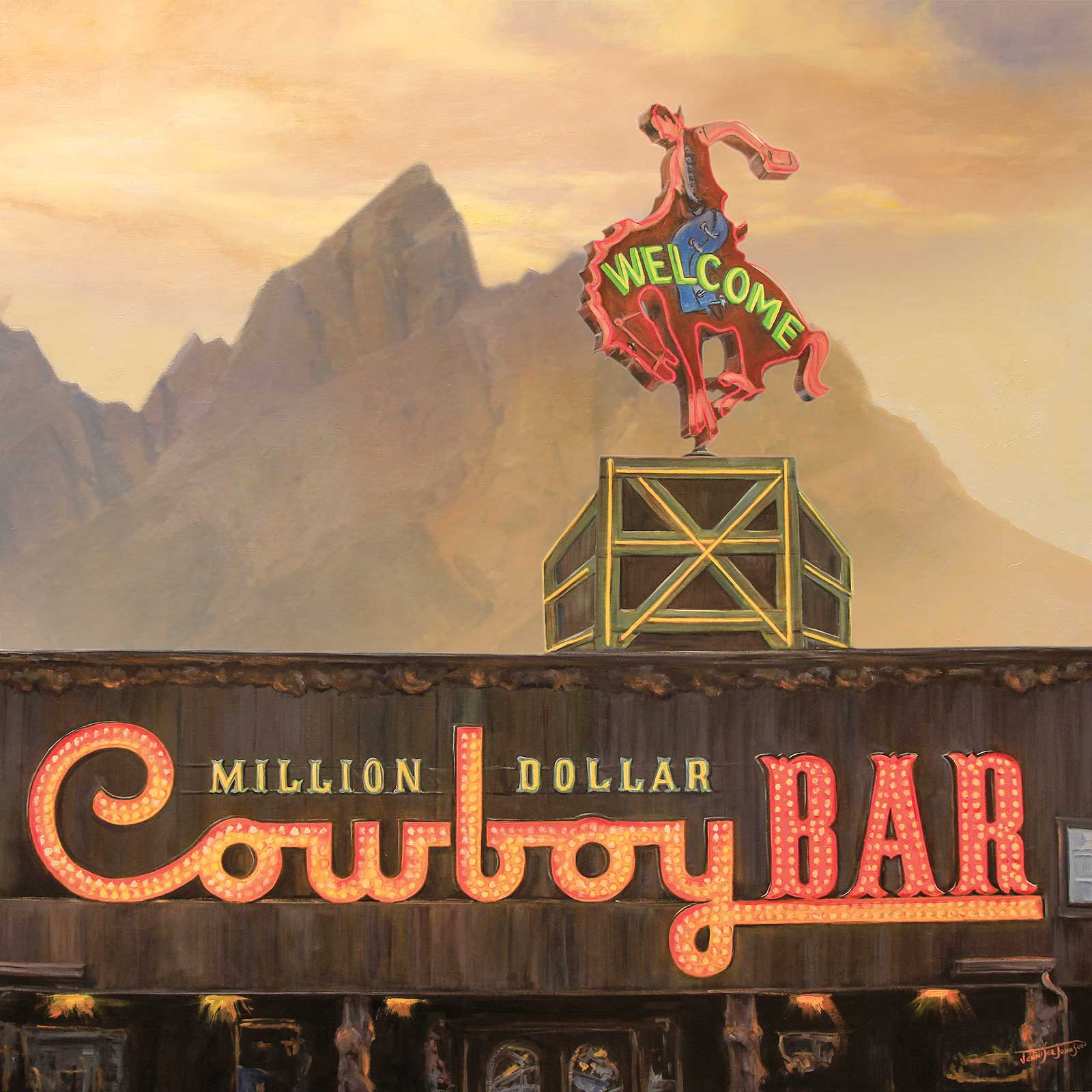 Jennifer Johnson, Cowboy Sunset, oil, 30 x 30”
Colt Idol turns to a similar subject, mule deer, for his work No Butts About It. His vibrant color helps capture the scene of the setting sun. “I love watching the athleticism of mule deer. We would do a lot of hiking on our many trips to Fort Peck Reservoir in eastern Montana. Sometimes we would reach an area where we became ‘cliffed out,’ too steep to find a route on foot and we would need to move back down and find another route,” he says. “I can’t tell you how many times we would spook a group of mule deer, and they would take off and run straight up the cliff. At times I couldn’t believe my eyes because they were sprinting up an almost vertical cliff. Watching those impressive displays has always stuck with me. In their element these animals are confidant and sure-footed, no doubt about it.”
The bulk of the artwork will be sold on September 15, but purchases can be made throughout the run of the exhibition, which ends on October 2. —
Western Visions
September 10-October 2, 2022 Evening Show + Sale, Sept. 15, 5-9:30 p.m.
National Museum of Wildlife Art
2820 Rungius Road, Jackson, WY 83001
(307) 733-5771, www.wildlifeart.org
Powered by Froala Editor