Painters who depict the West on canvas are very often pioneers in their own right, exploring new subject matter and blazing their own path in an often unpredictable art world. But at the height of their careers, three artists—Robert Griffing, John Buxton and H. David Wright—have succeeded in accomplishing what few of their peers can claim. After decades of persistence and outright hard work, the trio has truly broken fresh artistic ground and opened up an entirely new genre for Western art collectors.
For all three men, the creative journey in the fine art world began after successful careers in the advertising field. Wright labored as a commercial artist in Nashville, while Griffing and Buxton enjoyed a long working relationship in Pennsylvania. Griffing worked as an art director at a Pittsburgh agency, and regularly hired Buxton as an illustrator. “I’ve often joked about the fact that Griff bought my artwork for years,” says Buxton.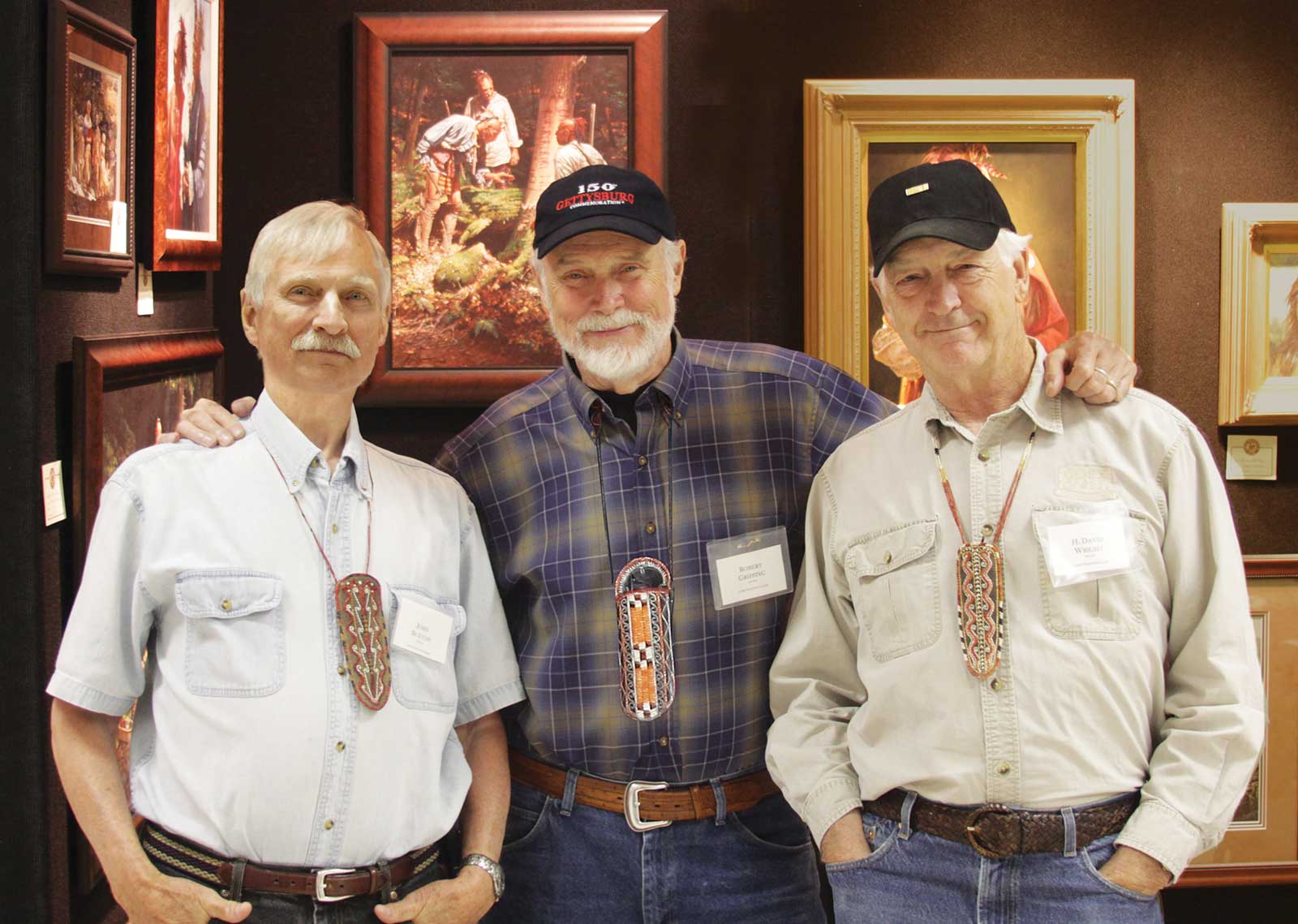 John Buxton, left, with Robert Griffing and H. David Wright. Courtesy H. David Wright.
As they neared retirement from the advertising field, Griffing and Buxton, who were close friends as well as business associates, discussed their options for the future. With computer-generated art fast taking over the advertising world, fine art painting seemed a logical option. But settling on ideal subject matter proved to be a process of trial and error. Buxton delved into painting birds and flowers; Griffing, who had maintained a life-long interest in Native American history, started producing images depicting Western Indians. Considering the demand for Western paintings, it seemed a logical choice.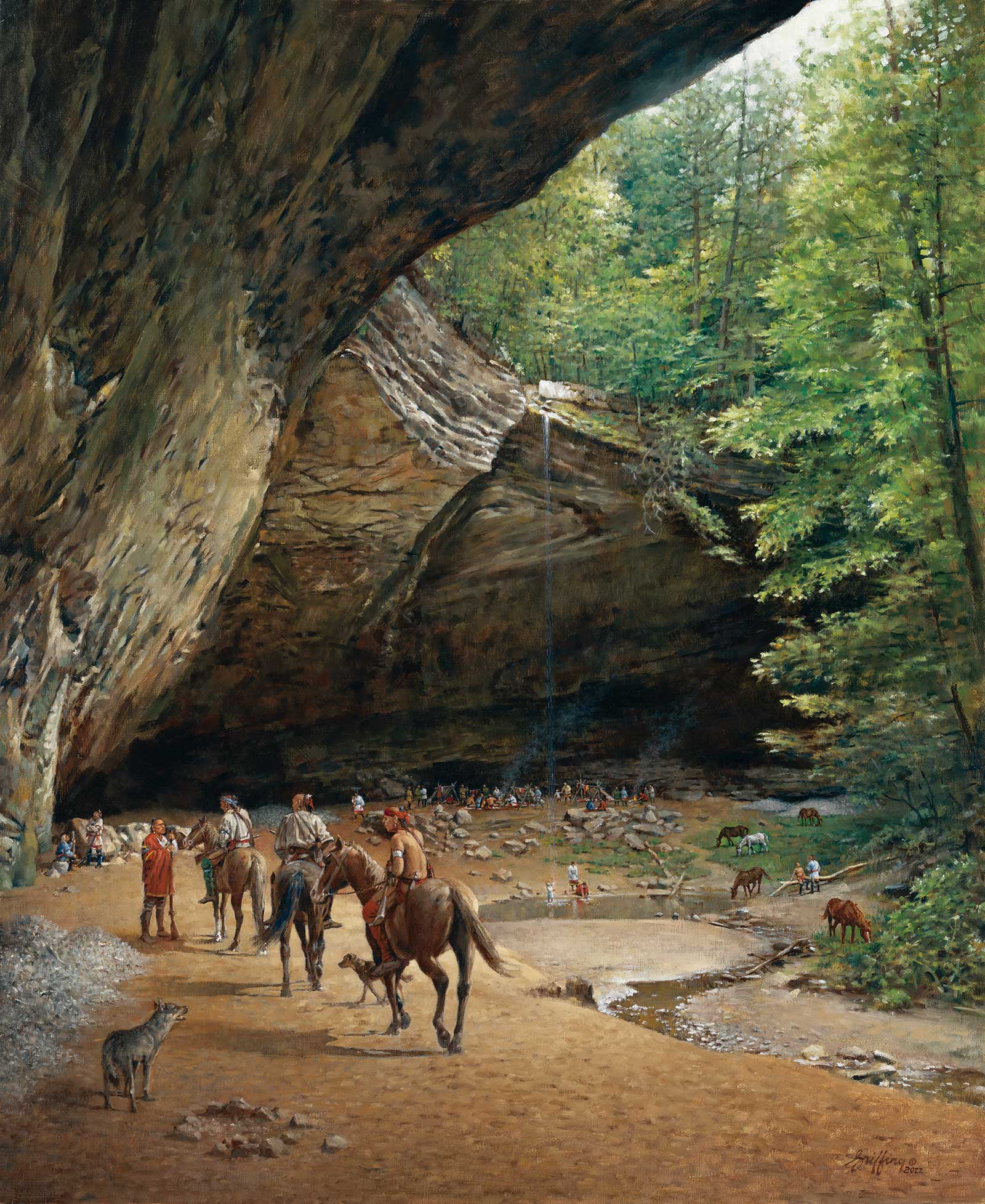 Robert Griffing, Camp at the Cave of Many Fires, 2022, oil, 44 x 36"
But Griffing couldn’t shake a persistent desire to depict the early tribal culture of his native Pennsylvania. Only a handful of painters had previously depicted the Eastern Woodland tribes in a significant way—one of them was a friend, Lee Teter—and the subject matter was a largely untapped source of inspiration within the art world. When Griffing voiced his desire to depict the Native American tribes of the Eastern Woodlands, fellow artists were concerned about the market viability of the subject matter. “You don’t want to do that,” friends warned Griffing, “you want to do Western Indians.”
But rather than stick to widely available subject matter that was already produced by dozens of painters, Griffing took an artistic leap of faith and began focusing his work on the Indians of the Eastern Woodlands, in particular the tribes of the Iroquois Confederacy who called colonial Pennsylvania and New York home. Buxton, also a Pennsylvanian who was enthralled with his state’s early history, enthusiastically began painting the early frontier as well. Despite the promise of easier success in more established genres, Buxton felt that he had little choice as an artist. “How could we not paint these scenes,” he wondered, “scenes of our very backyard 200 years earlier?”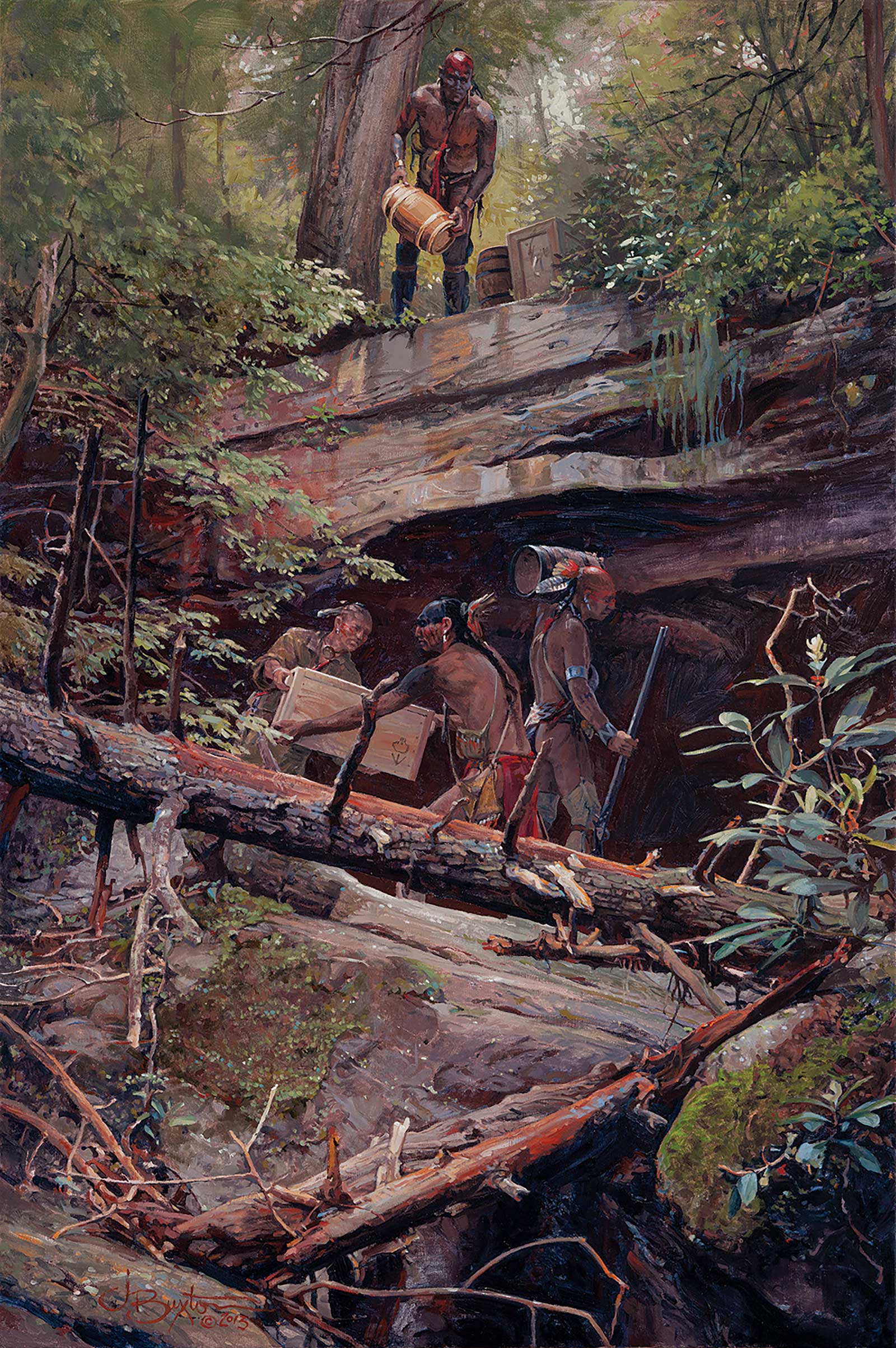 John Buxton, A Secret Cache, 2013, oil, 30 x 20”
Despite the artists’ interest in painting the “West” as it appeared in early America, fine art collectors were initially hesitant to purchase paintings that depicted an unfamiliar view of the frontier. Although prints sold well at the time, Griffing explains, “the market for originals was very weak.”
Looking for a few pointers on historical details and hoping to talk shop, Griffing reached out to fellow painter David Wright. By the early 1990s, Wright was considered one of the top artists of the Rocky Mountain fur trade as well as an authority on the material culture of the blackpowder era. A seasoned fine artist, Wright had also conducted extensive research in the era and was an avid outdoorsman and re-enactor who was well versed in the field craft of early frontiersmen.
When Griffing contacted Wright by telephone, he explains that, at the time, he was “a little nervous.” His reservations were misplaced. Wright, who was also occasionally painting Eastern Woodlands scenes, was delighted to help a fellow artist with an interest in the same history. It was the beginning of a long-lasting friendship.
Artistic persistence, paired with a little unexpected help from Hollywood, would forever change the trajectory of early frontier art. In 1992, Morgan Creek Entertainment released the epic big-screen adaptation of James Fennimore Cooper’s The Last of the Mohicans. The film met with critical and box office success, and likewise, sparked fresh interest in the tribes of the Eastern Woodlands.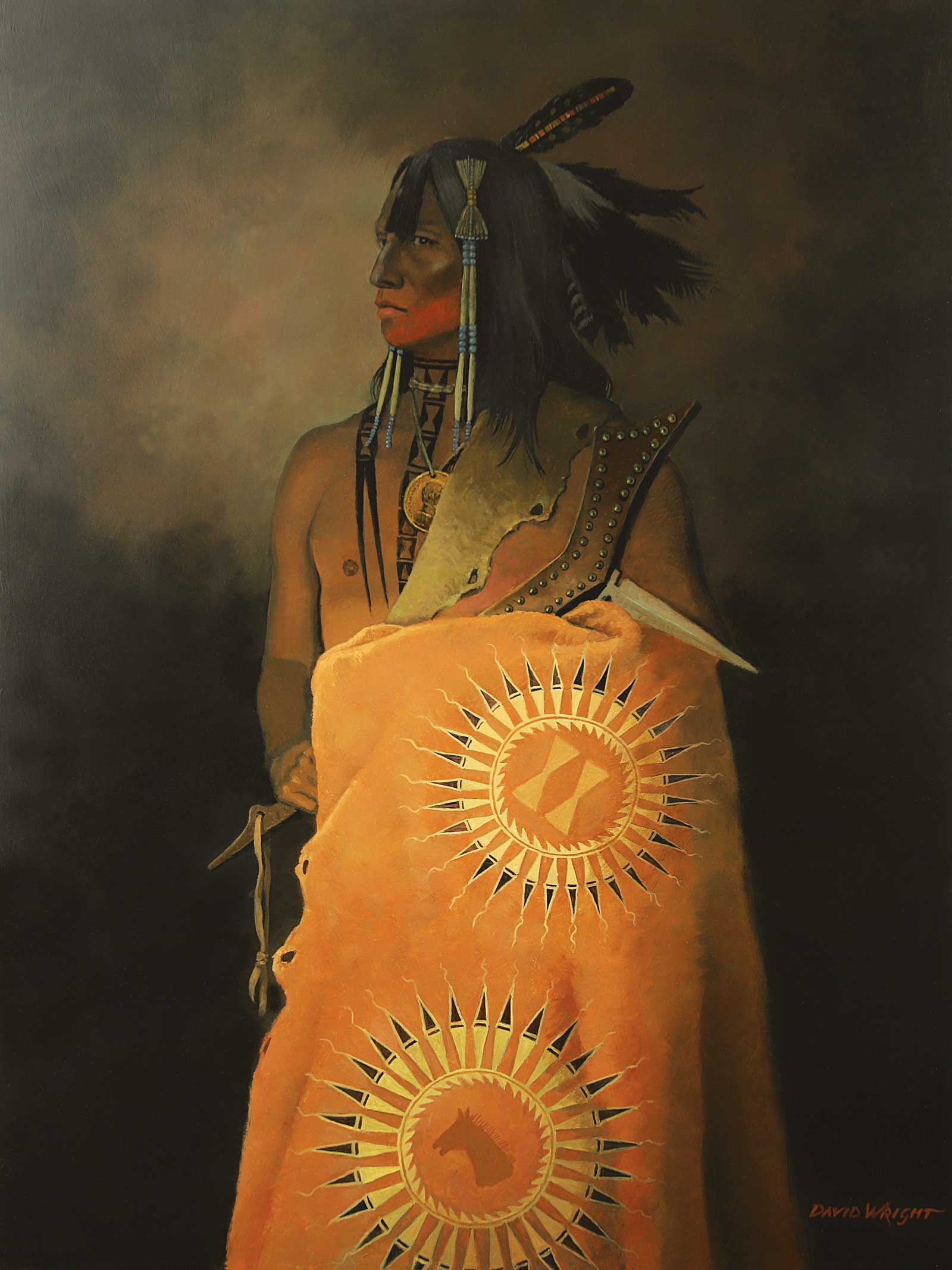 H. David Wright, In the Shadow of Karl Bodmer, oil on panel, 24 x 20”
Wright—who, fittingly enough, was on set as an extra during filming—recalls that in the wake of the movie’s release, a palpable shift occurred in the art market. Before the movie was released, he explains, there was little market interest in paintings of Eastern Indians. After the movie came out, he says, “it was a whole new world.”
As fine art collectors increasingly began to embrace a new vision of Native American life, Griffing, Buxton and Wright were free to focus their creative energies not on the familiar horse culture of the West, but on the Native tribes whose communities had flourished in the Eastern Woodlands for centuries. Artistic depictions of Eastern Indians, explains Griffing, constitute “a totally different look.” The response from collectors, he adds, was overwhelming. “People could really see, wow, this is new stuff.”
For a visual artist, the background research that’s necessary to accurately portray the colonial frontier can be an arduous task. Largely relying on written period accounts and rare museum examples of Native American artifacts, the three men strive for historical accuracy in their work. Wright is known to be particularly conscientious in portraying the past authentically.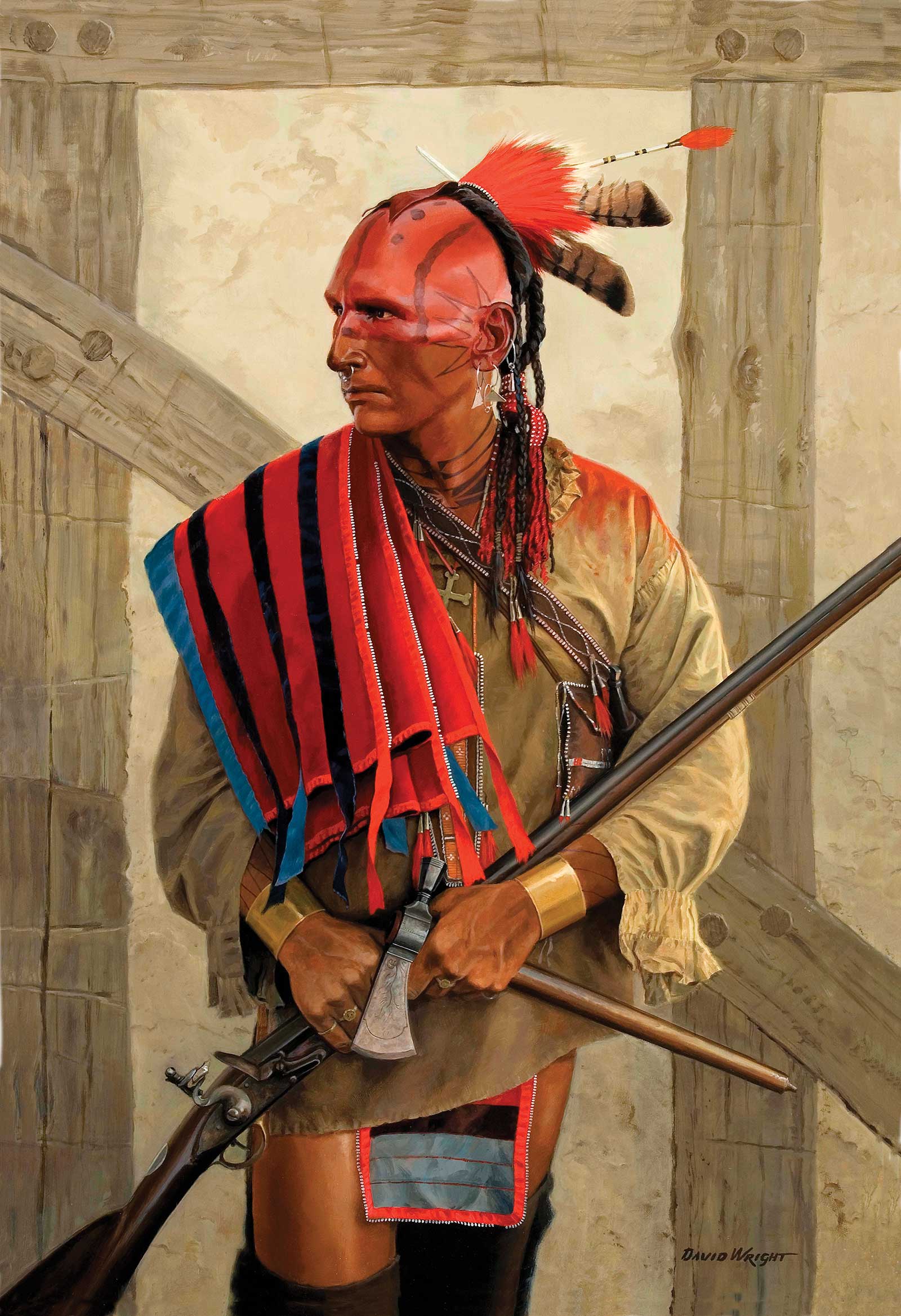 H. David Wright, At the French Post, 2007, oil, 34 x 23”
While some artists are content to simply capture a “feel” for the past, Wright explains that “it’s a historical artist’s obligation to present and future generations to paint the subject with as much accuracy as possible.” Such an approach entails as much time in research as time spent with paint and brush.
Such hard work, however, has resulted in a priceless legacy to the Western art world. The three artists have succeeded in producing a remarkable body of work that offers an accurate and fascinating glimpse of America’s frontier during the very dawn of the nation; when “the West,” quite literally, lay within a hundred miles of the East Coast.
Their paintings depict the haunting majesty of the colonial wilderness; the towering virgin forests, crystal waters and native villages of America’s first frontier. Although the Eastern Woodlands saw more than its fair share of violence, the artists rarely produce scenes of warfare. Rather, their art is characterized by charming vignettes of village life and captivating portraits of the European soldiers, American longhunters and resolute warriors who called the region home.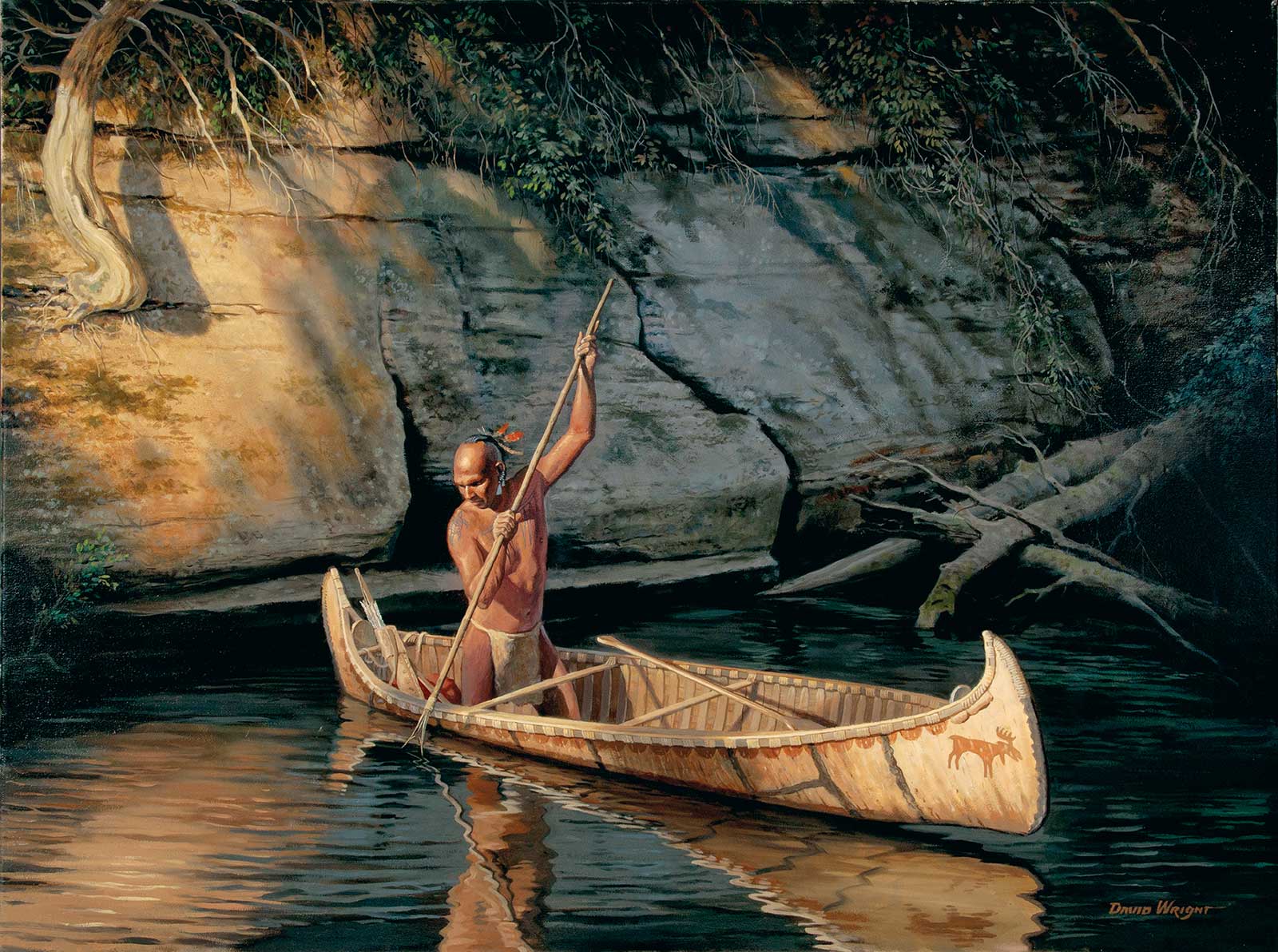 H. David Wright, A Long Way From Home, oil
Seth Hopkins, the executive director of the Booth Museum in Cartersville, Georgia, points out the pivotal role that the three men have played in the field. Prior to their careers, he says, “The effort to chronicle that part of our history was hit and miss, it hadn’t really been done in a systematic way.” Griffing, Buxton and Wright have helped to change that. “Collectors,” Hopkins explains, “have accepted their work as a part of Western art, it’s just an earlier part of the story than they were used to.”
Today, the work of the artistic trio has come to virtually define early frontier paintings, a genre that garners healthy interest from a dedicated following of collectors who are looking for something unique for their Western art collections: a visual chronicle of a rich frontier culture that tragically disappeared long before the advent of photography.
Widely considered the deans of American frontier art, the three artists remain consummate and unassuming gentlemen, always willing to offer advice, and help, to younger artists. They’re also warm friends and kindred souls who show together periodically, including at the Eiteljorg Museum’s Quest for the West show and sale and at the History Meets the Arts event which is held in Gettysburg, Pennsylvania. “They’re technically competitors in a very small niche market,” Seth Hopkins points out, “but they’re gentlemen of the first order. They’ve been so supportive of each other, and collectors love being around them.”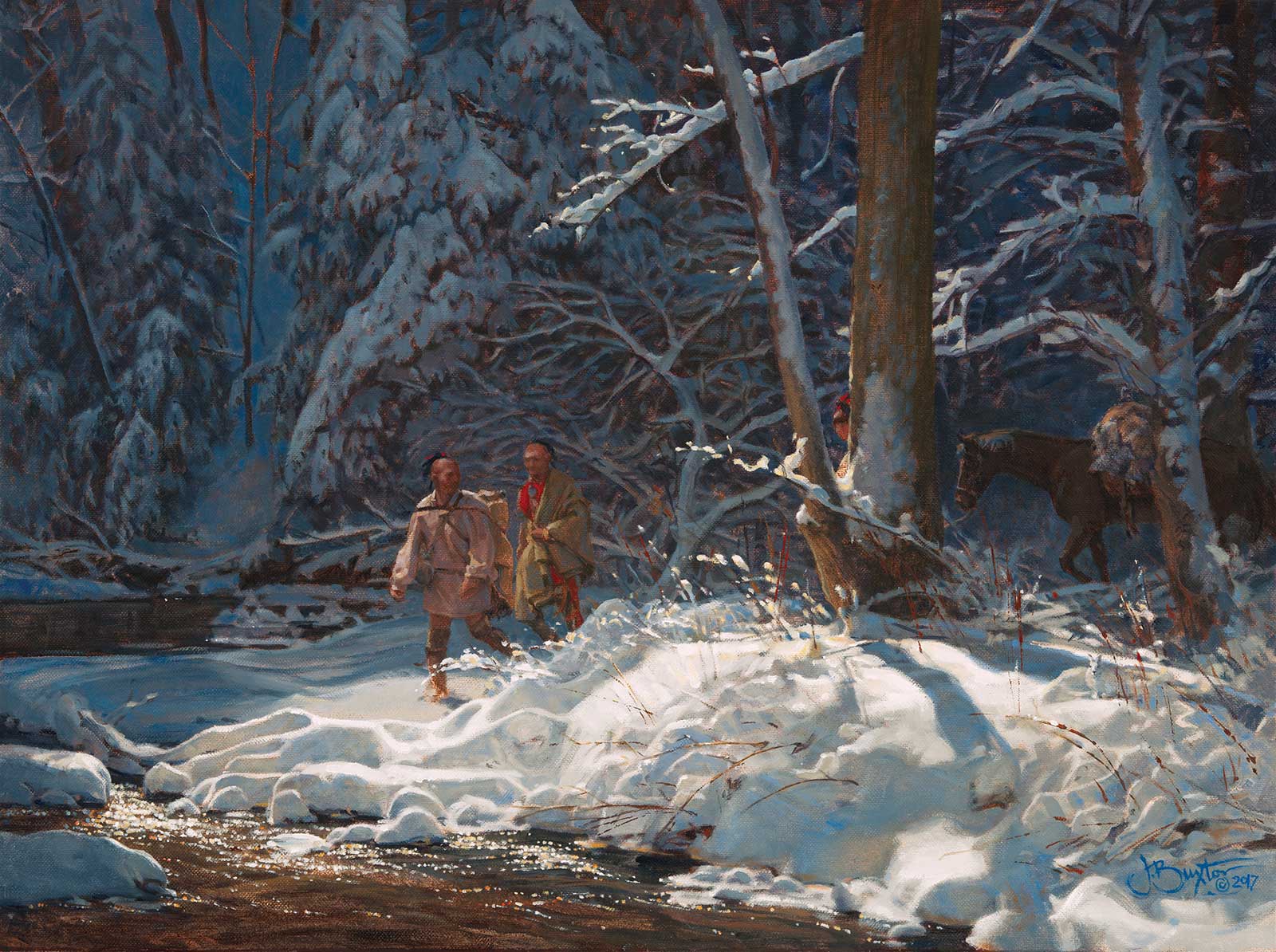 John Buxton, Almost Quiet, 2018, oil, 18 x 24”
“We’ve been friends ever since we met,” Wright says. He points out that Griffing and Buxton “are exceptional artists, and regardless of their subject matter, they would have succeeded as painters. The fact that they focused on the Eastern Frontier has brought the subject to a lot of folks.” Perhaps most importantly, Wright says, “both are good men.”
Like all gifted artists, Robert Griffing, John Buxton and H. David Wright remain instinctive creators; always developing new ideas and planning future paintings that chronicle the earliest vision of America’s West. “I have reams and reams of sketches,” Buxton explains, “fresh ideas every day.” “Even so, it’s still my obsession…all these years it has been the inner core and heart that keeps me alive. I am a painter. A painter of our history and heritage.
I have been truly blessed.” —
+++
Joshua Shepherd, a sculptor and author, has created more than 25 public monuments. His articles, with a special focus on American history and the early frontier, have appeared in publications including Military Heritage, Journal of the American Revolution, Civil War Quarterly, Muzzleloader and Military History Quarterly.
Powered by Froala Editor