When Don and Cathey Humphreys were growing up in Tulsa, Oklahoma, they went on school field trips to the Gilcrease Museum, the Philbrook Museum and the Woolaroc Museum. “When we were growing up, cowboys and Indians were popular themes,” Don recalls. “At the museums I was just really struck by the Remingtons and the William R. Leighs. They were all about the adventure of the West.”
He collected baseball cards as a boy and after they were married and living overseas as part of his work, they collected Chinese snuff bottles and embroidered children’s collars. Cathey also collects calligraphy brushes.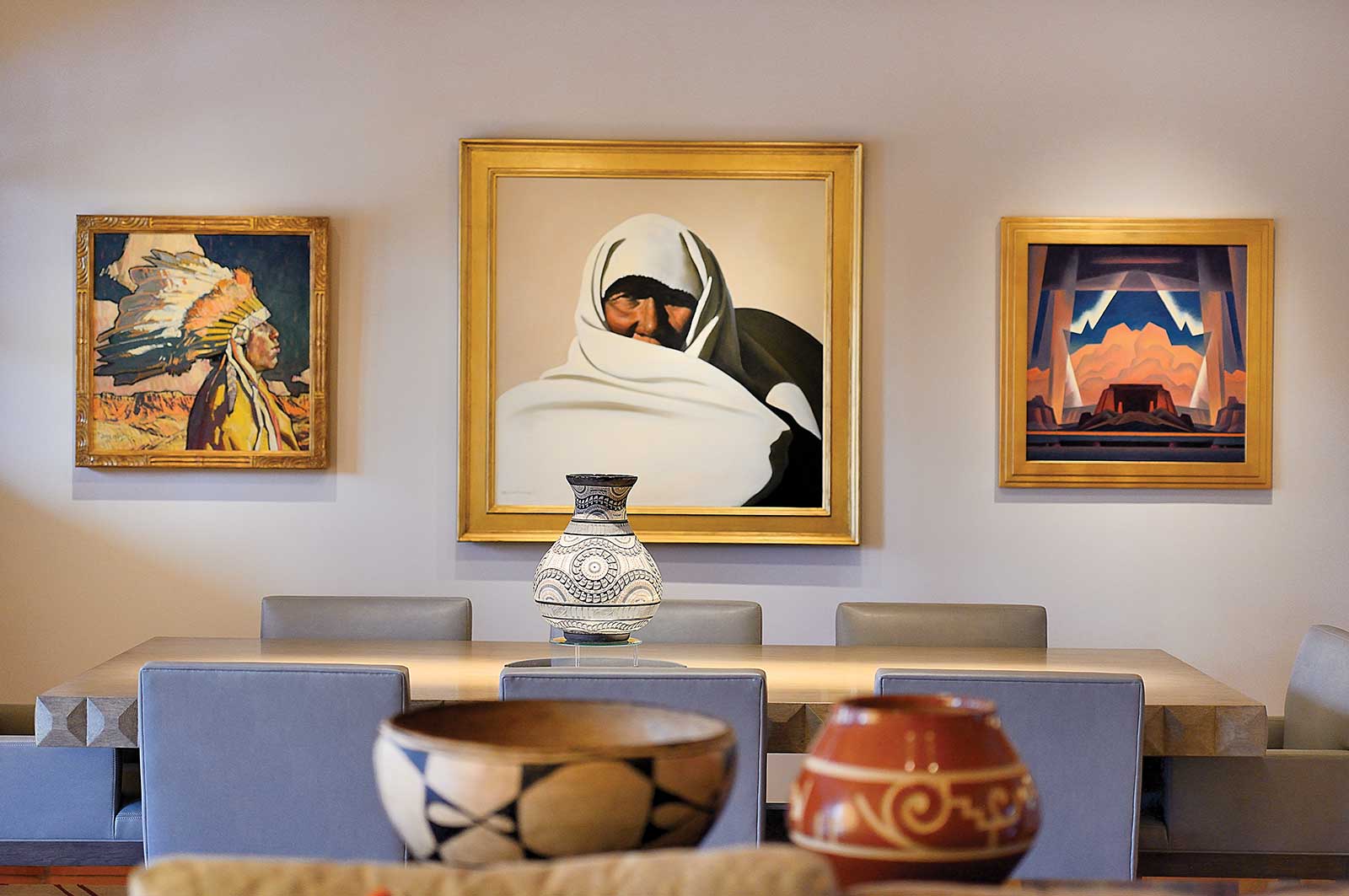 In the dining room are, left to right, South of Taos, 2017, oil, by John Moyers; Witness II, 2016, oil, by Roseta Santiago; and Nature’s Theatre, 2020, oil, by Ed Mell. On the table is Intricately Engraved Pot, 2019, by Marvin Blackmore. In the foreground are, left to right, a Santo Domingo Dough Bowl, ca. 1817, and a Carved Red Jar, 2018, by Daryl Whitegeese (Santa Clara).The collection in their home in Santa Fe reflects their interest in many aspects of the art of the American West. In Dallas, the collection is more modern, with artists like Robert Motherwell, Georgia O’Keeffe, John Marin, Marsden Hartley and Rockwell Kent. They built a home in Crested Butte, Colorado, in 2008 that has primarily mountain art and work by younger Western artists. The house is in an aspen grove which inspired them to seek out works with aspen trees. They found the woodblock prints of Gustave Baumann at the Owings Gallery in Santa Fe. The gallery owner, Nat Owings, has become one of their friends and trusted advisors.
They also seek the advice of Richard Lampert of Zaplin-Lampert and Jen Rohrig of Manitou Galleries in Santa Fe, Mark Sublette in Tucson, and Beau Alexander at Maxwell Alexander Gallery in Los Angeles.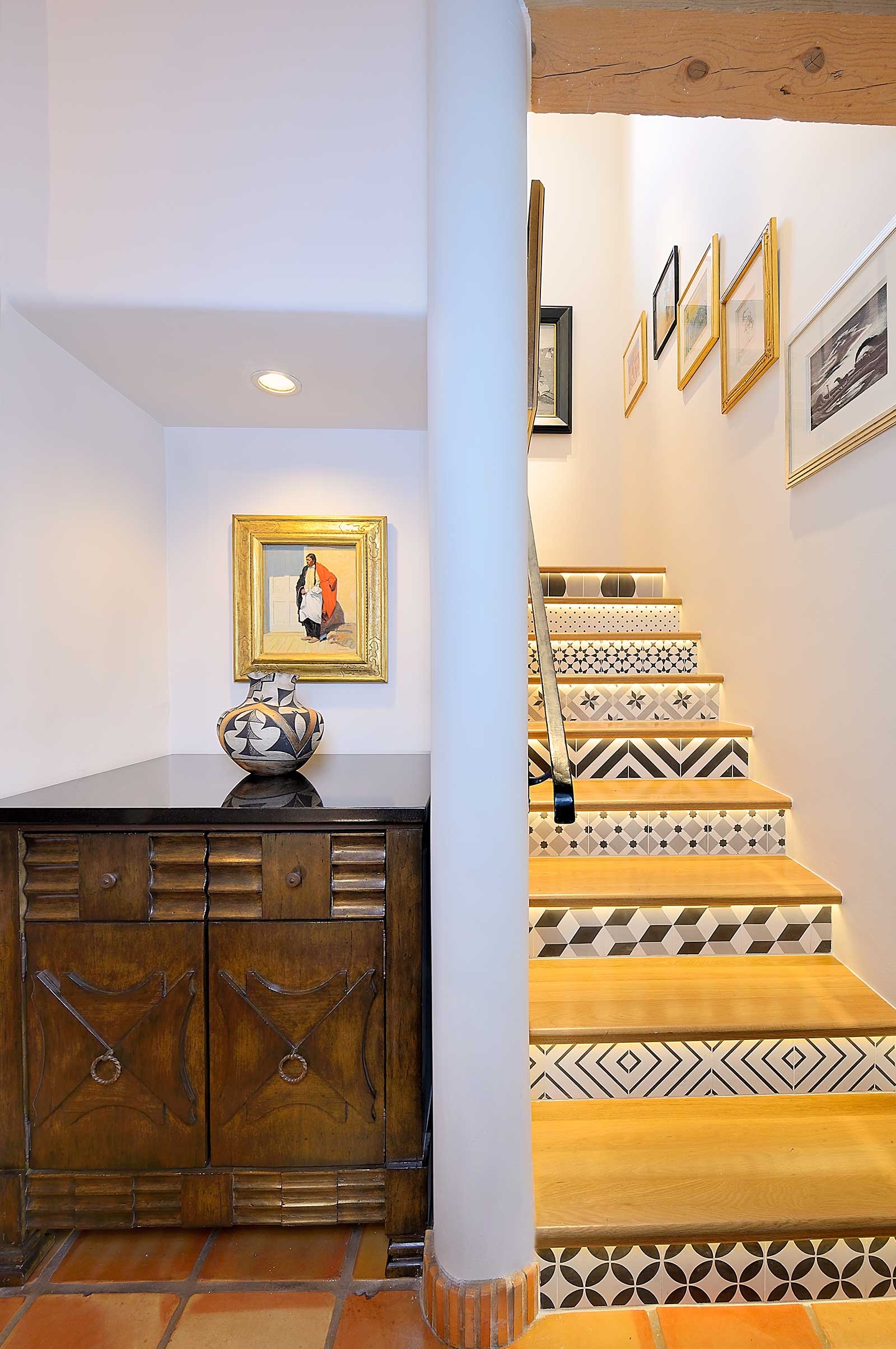 Above the chest is Under the Portal, Mid Morning Taos, 1920 by E. Martin Hennings. In front of the Hennings is an antique polychrome pot. The black-and-white stair tiles were designed by Cathey Humphreys and Edy Keeler.
The couple buy with their eyes and with their heart. “When you love a piece,” Don explains, “it really isn’t about value. If a work appreciates, that’s great, but you have to love it. I look for action and color. Over time we’ve collected a lot of Native American portraits and in those, the color pops out.”
Cathey comments, “There’s an emotional response. If it strikes me in the heart, that’s how I know we should buy it. If I walk away from a piece and begin to regret it, I know I need to go back. Often, there’s a personal connection. We weren’t looking for paintings by Nicolai Fechin but one of the first portraits we saw looked just like my mother. Later we saw a portrait of a boy that stopped us in our tracks. He looked like our eldest grandson.”
“Sometimes there’s a feeling of nostalgia,” Don adds. “My aunt and uncle lived in Denver and we explored the Red Rocks as kids. When Birger Sandzén’s Moonrise Among the Red Rocks became available, I knew we had to have it.”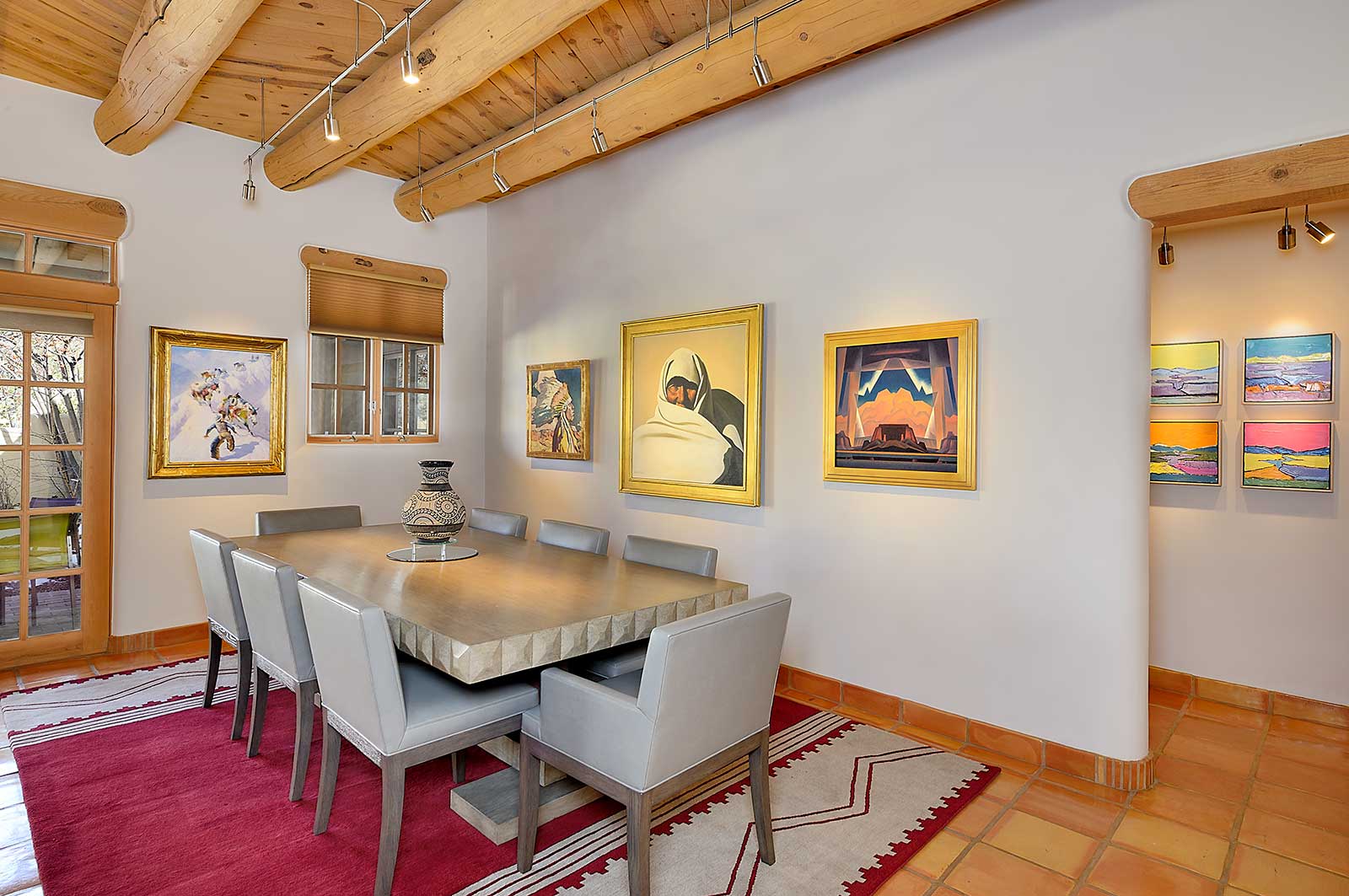 In the dining room, from left to right, are William R. Leigh's 1920 oil A Tough Alternative, John Moyers' 2017 oil South of Taos, Roseta Santiago's 2016 oil painting Witness II and Nature’s Theatre, a 2020 oil by Ed Mell. On the table is Intricately Engraved Pot, 2019, by Marvin Blackmore. In the hallway to the right are a series of oil paintings by Jivan Lee from 2019. The series is titled Taos Gorge Inversion.
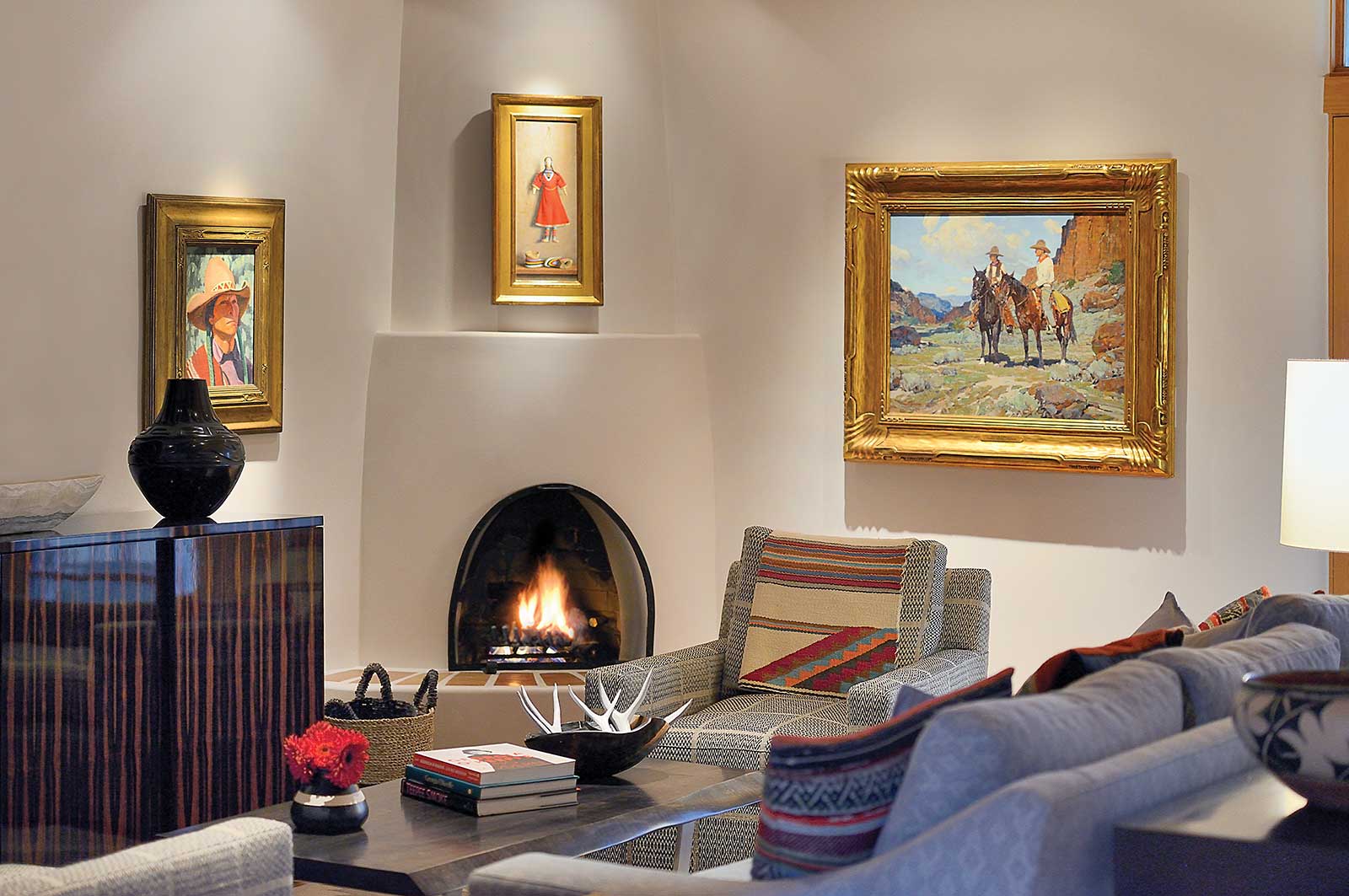 To the left of the kiva fireplace is Pueblo Scout, Taos, NM, oil, by Ernest L. Blumenschein (1847-1948). Above the fireplace is Doll with Mocs on a Shelf, 2017, oil, by William Acheff and Wyoming Cattlemen, 1934, oil, by Frank Tenney Johnson (1844-1939) from the collection of T. Boone Pickens. On the console on the left is a large Double Shouldered Black Jar by Ryan Roller (Santa Clara).Nostalgia also figured in their acquiring Frank Tenney Johnson’s Wyoming Cattlemen. “T. Boone Pickens, the financier, was a good friend of ours and we would visit him at his Texas ranch. He would hold court in his library that had a huge fireplace. Hanging above it was the Johnson. We would sit and admire it. After his death, it came on the market.”
Cathey was “mesmerized by John Singer Sargent’s portraits of women” at an exhibition in London. “The white dresses and the way he painted the shadows just hit me,” she says. Several paintings of women in white dresses have come into their collection. In Santa Fe, they have Roseta Santiago’s Witness II of a Native American in a white blanket with subtle dark shadows.
“We were looking for a W.R. Leigh whom I remembered from the Woolaroc,” Don relates, “but it took a long time to find the right one. There is a pack cowboy in the foreground. We bought it at auction and when we brought it home, Nat Owings thought it was kind of dirty. We had it cleaned and reframed and discovered another cowboy at the top of the painting.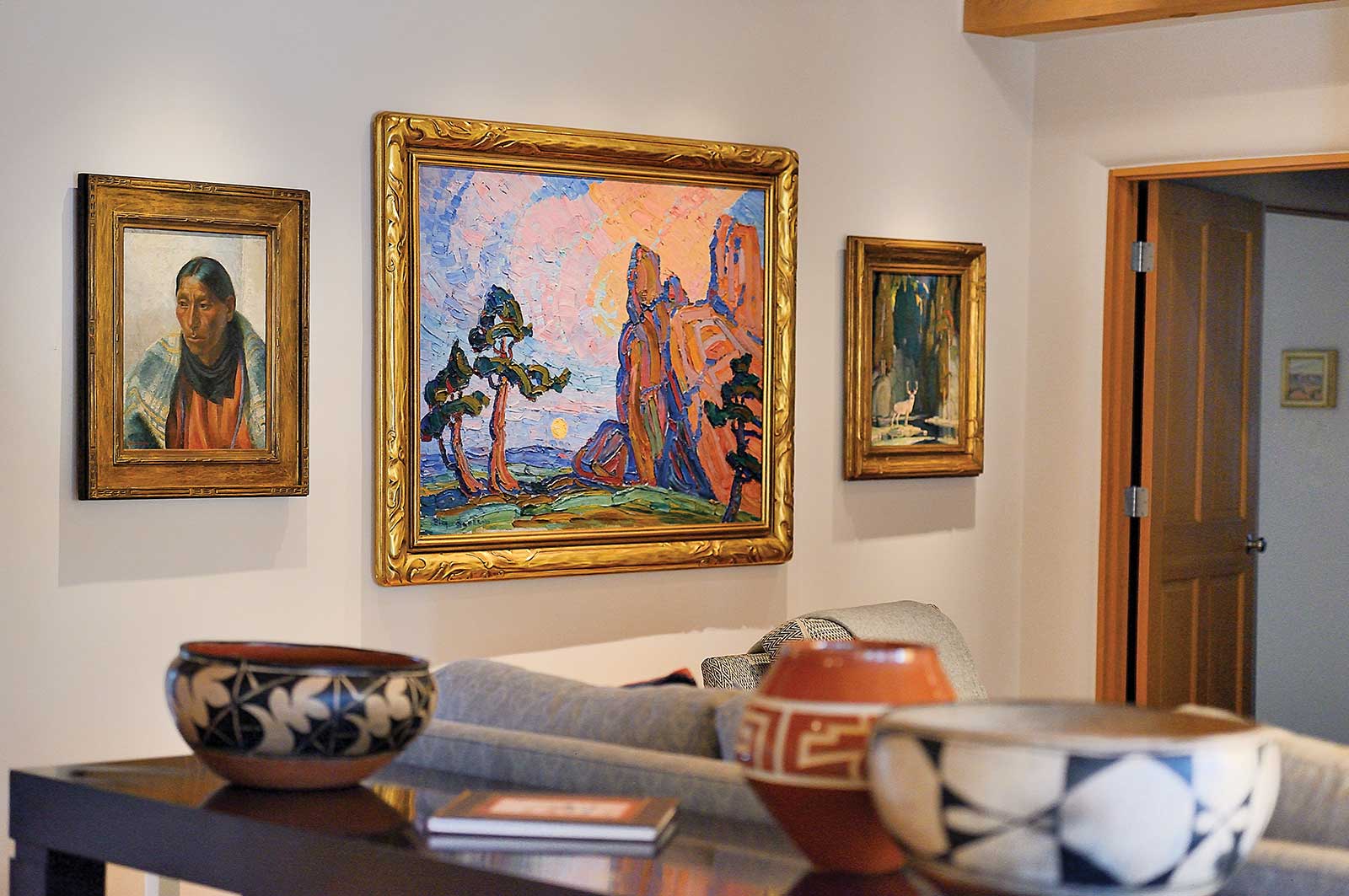 Three historic paintings hang in the living room. From left, they are: Untitled—Indian Portrait, oil, by Kenneth Adams (1897-1966); Moonrise Among the Red Rocks, oil, by Birger Sandzén (1871-1954); and Heart of the Wilderness, 1936, oil on board, by William Herbert “Buck” Dunton (1878-1936). In the foreground are, left to right, a Santo Domingo Dough Bowl, ca. 1910; a Carved Red Jar, 2018, by Daryl Whitegeese (Santa Clara); and a Santa Domingo Dough Bowl, ca. 1870.
“Our first foray into really expensive art occurred in Scottsdale when we were walking down the street and looked into a gallery that had a lot of Maynard Dixons. The colors of Fields of Toquerville were attractive to me, and I remembered having seen it in publications. It was more than I thought we could afford. Cathey and I went across the street and sat down on a bench to talk about the painting. Cathey said, ‘Buy it!’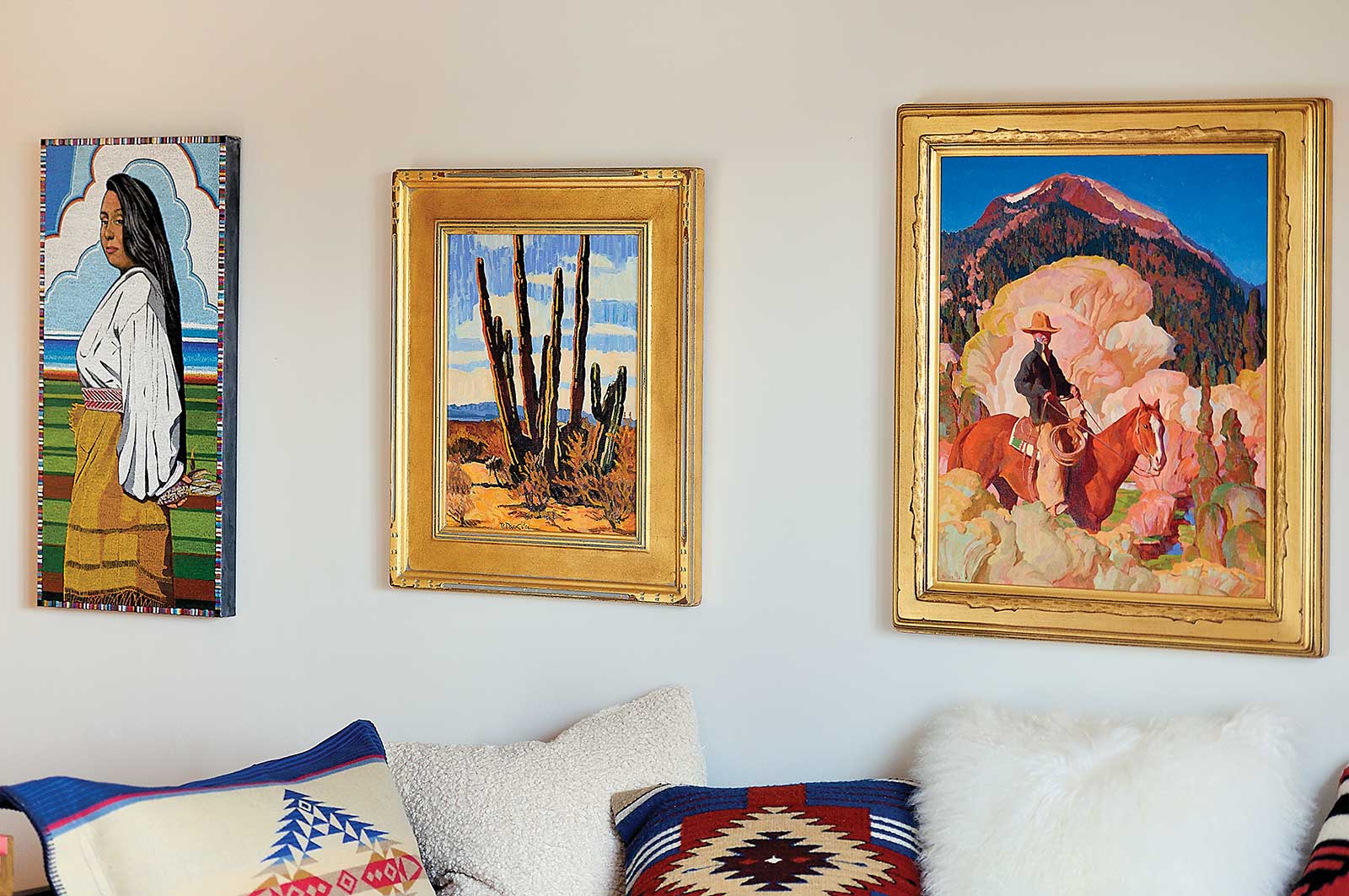 The paintings above the sofa are, left to right, White Corn Woman, oil, 2021, by Starr Hardridge; Sonoran Giants, oil, by Robert Daughters (1929-2013); and Brett Allen Johnson’s oil Return to the River, 2021.
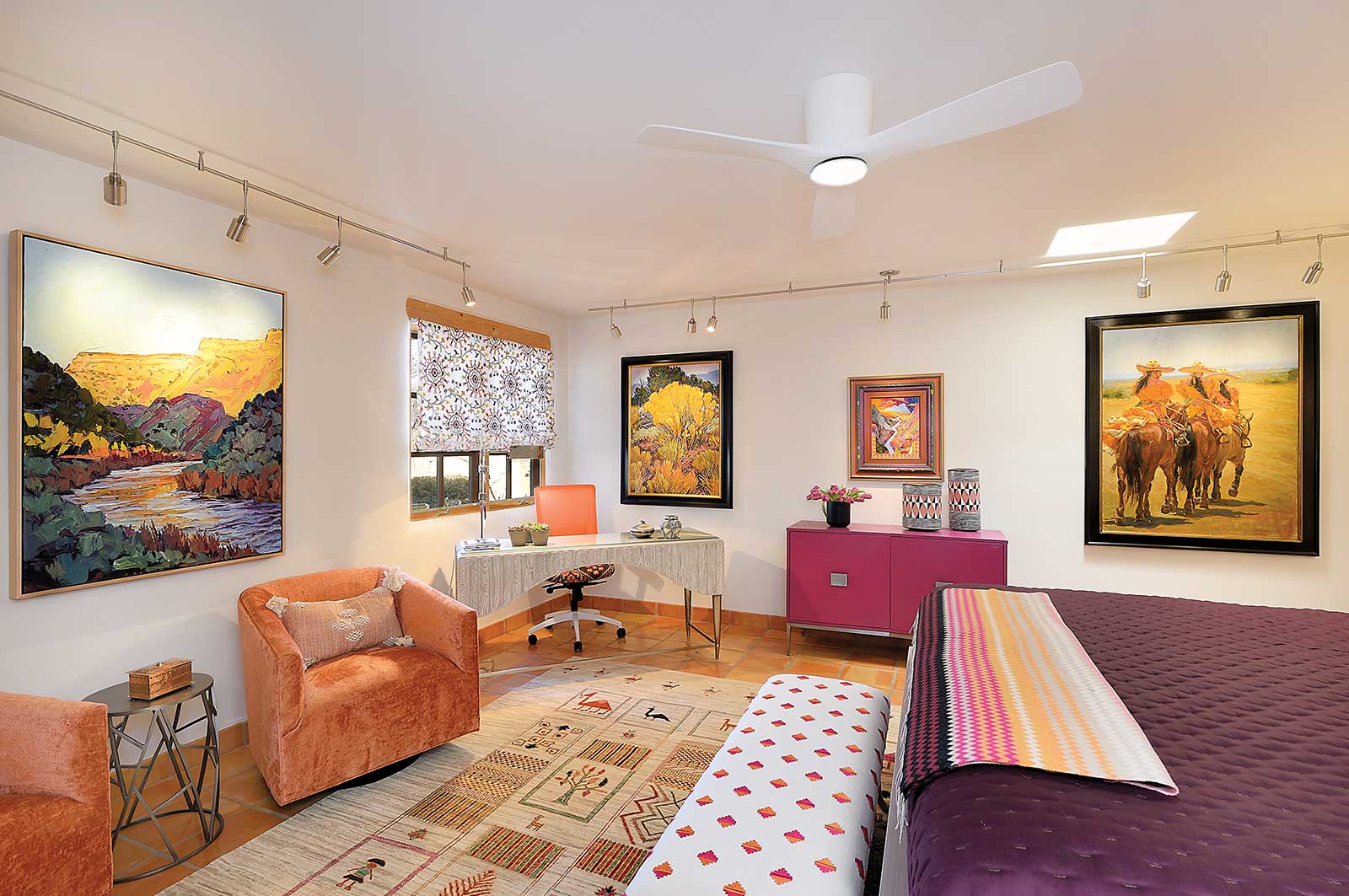 The paintings in Cathey’s office/guest bedroom are, left to right, Jivan Lee’s oil on panel Sunrise on Orilla Verde, 2017; Brad Price’s oil on canvas Fall Chamisa, 2018; Fran Larsen’s acrylic The Gorge and Blue Mountain, 2013; and On the Trail, 2014, an oil by Gladys Roldan-de-Moras.
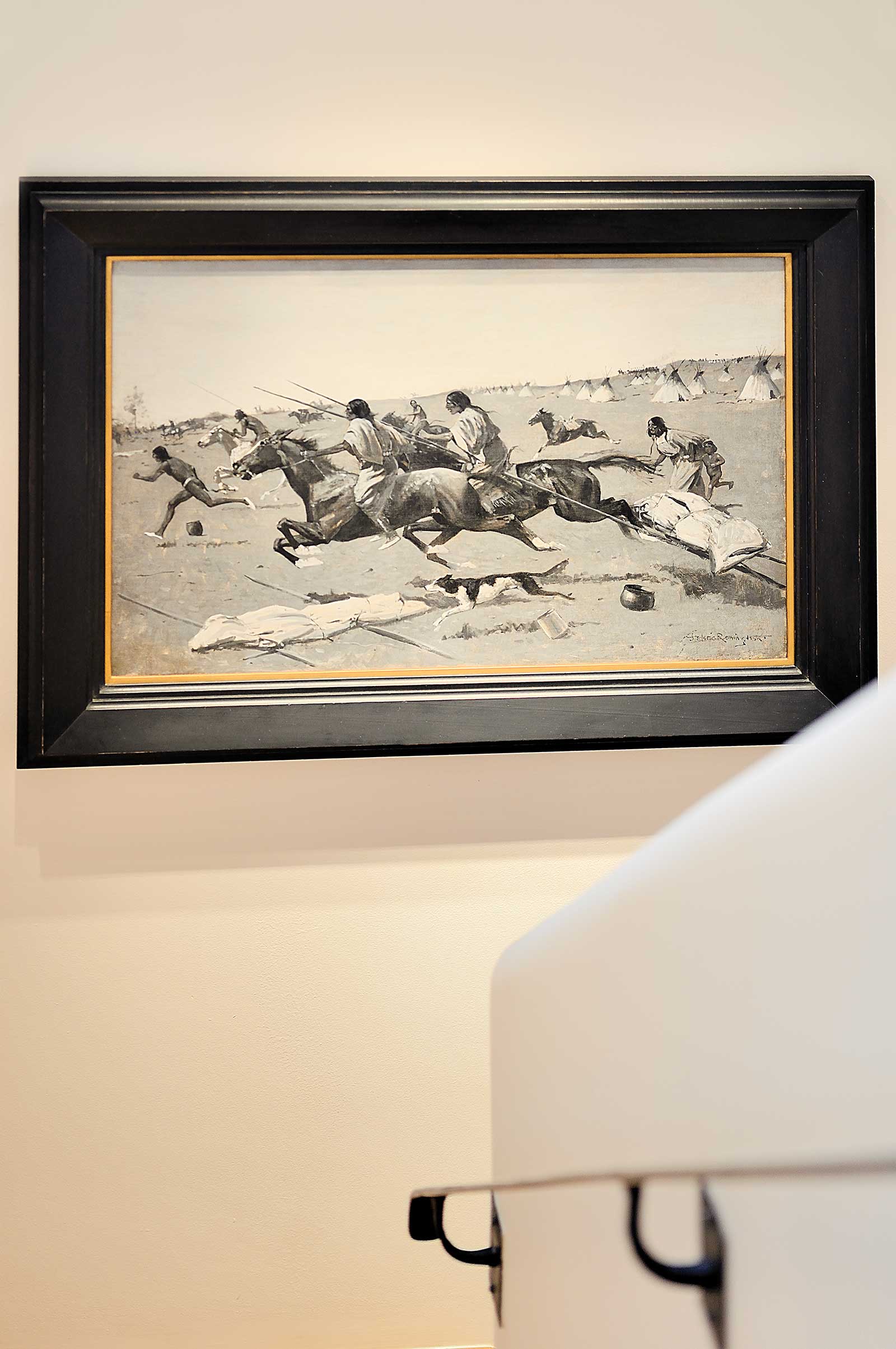 An oil, Indian Village Routed (The Fight of Geronimo: Troop Surprising a Camp), 1896, by Frederic Remington (1861-1909) hangs on the stair landing. It is from Personal Recollections and Observations of General Nelson A. Miles.
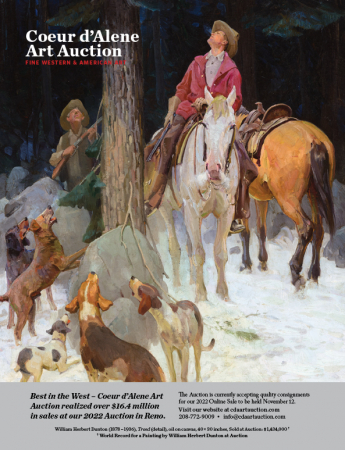
“Dixon’s Navajos in a Canyon was featured at a Coeur d’Alene Art Auction. I checked around to see if the price range was reasonable but decided not to bid. The painting didn’t sell at the auction. I called Nat Owings and gave him a firm offer and he negotiated the purchase. Later we were able to acquire the pencil study for the painting.”
The theme of their Santa Fe residence is primarily black and white, a suggestion of their interior designer Edy Keeler of Santa Fe. “We were remodeling the Santa Fe condo, and the contractor Laura Long of Jørgensen Builders recommended her,” Cathey explains. “Laura was great to work with, too. Edy was in Dallas and stopped by for a visit. She’s from Oklahoma like us. She understood what we wanted, traditional with a modern twist, and she knew Don was very serious about where he wanted the art hung.” “She saw it,” Don adds.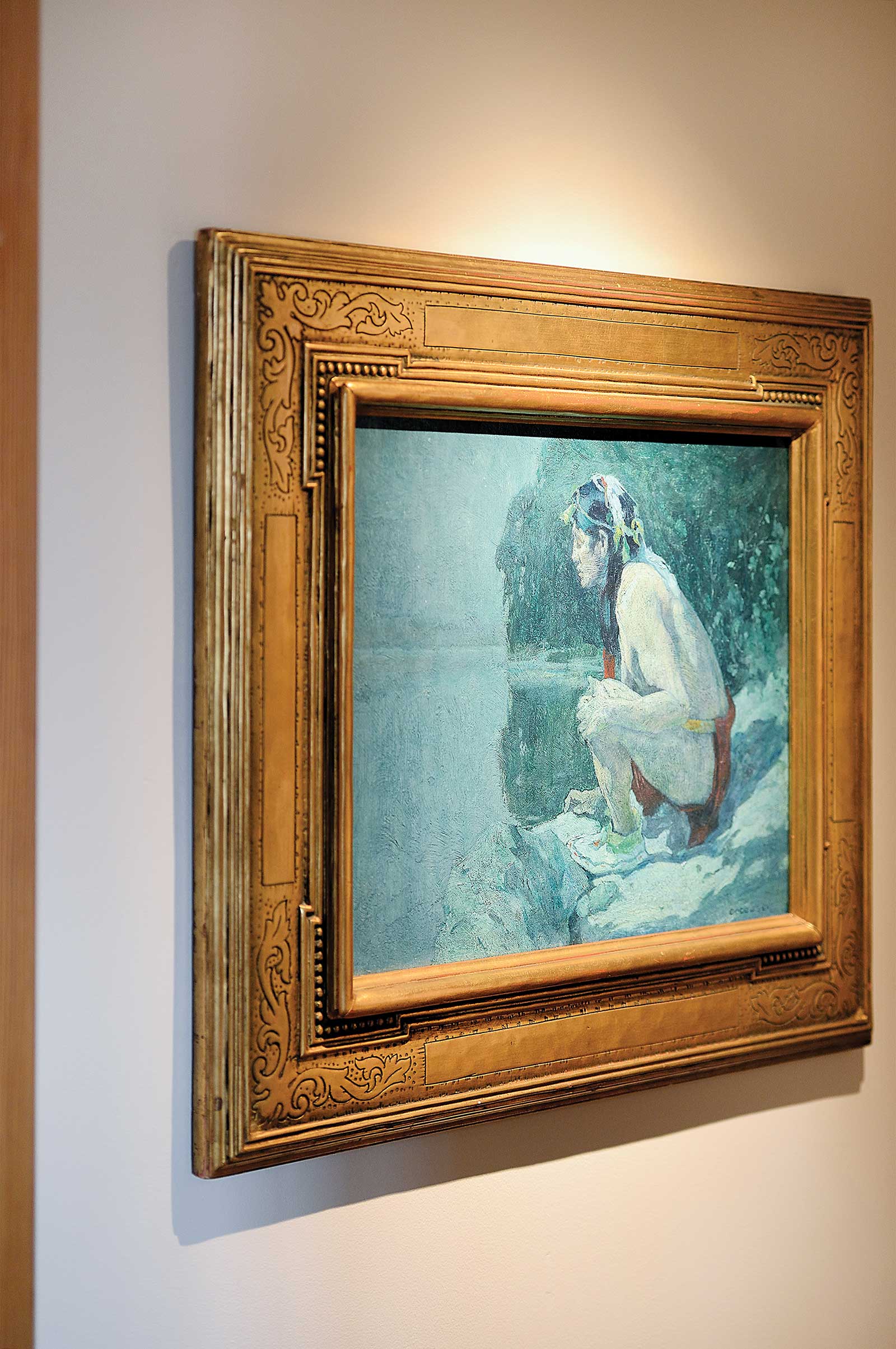 Water Music (Rio Grande), ca. 1907, oil on paper, is by Eanger Irving Couse (1866-1936).
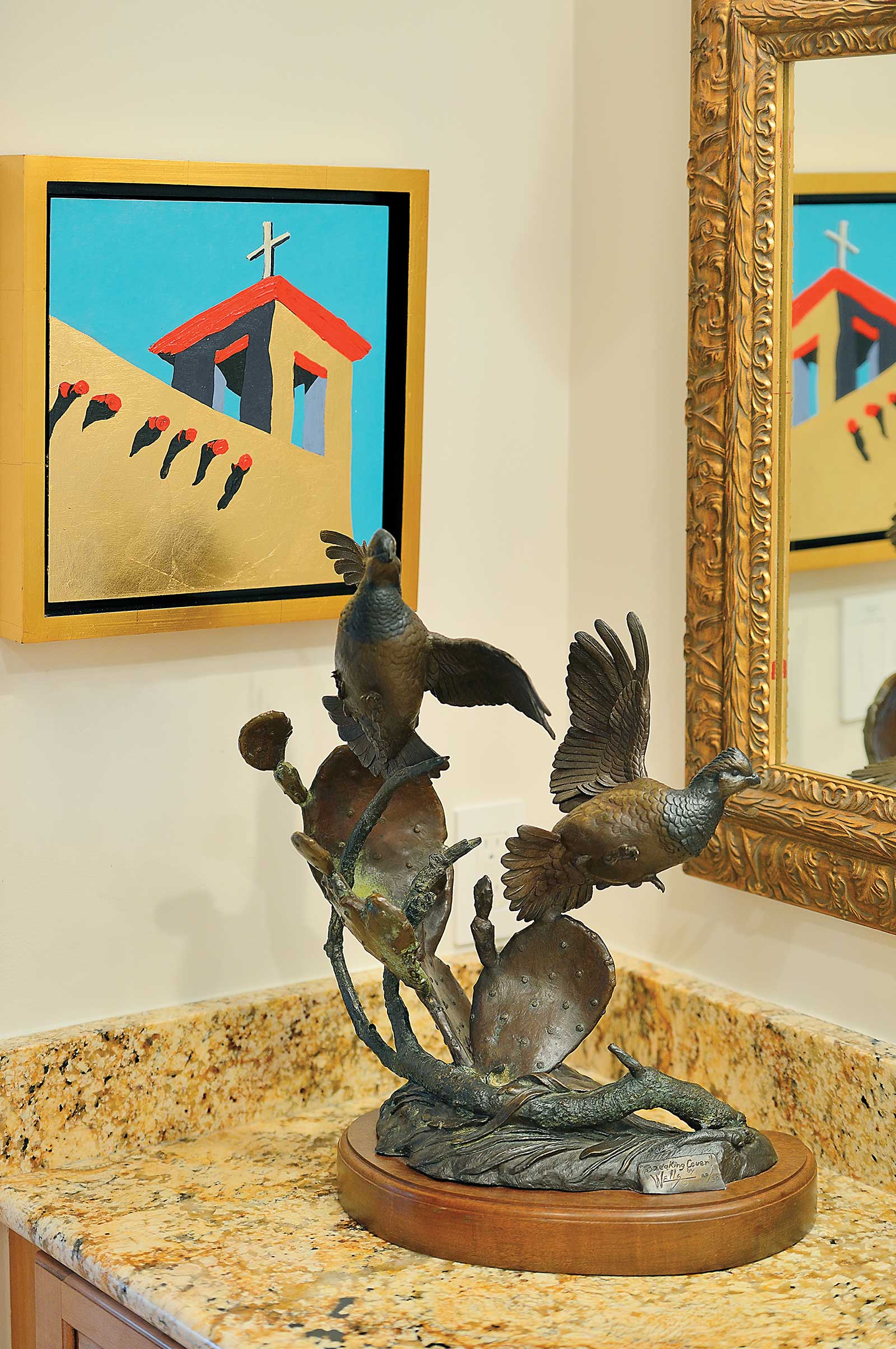 Taos—Ranchos, 2019, oil, by Alvin Gill-Tapia hangs above Breaking Cover, 2009, bronze, by Ronny Wells.
“Good lighting is essential for showing artwork. Eric Naughton of Electrical Logic has done the lighting for all three of our houses.”
There are several early dough bowls from Santo Domingo Pueblo in their Santa Fe collection. “I knew Cathy liked them and asked Nat to find them. I gave them to her for her birthday.” “I like the geometry of their black-and-white designs,” Cathey comments.
“We’re learning more about Native pottery,” Don explains. “We’re also becoming more interested in Native American art and have acquired pieces by Tony Abeyta, Oreland Joe, T.C. Cannon and Shonto Begay. There’s a small outdoor space at the Santa Fe condo and Nat is looking for an Allan Houser for us.
“We had begun thinking about the Taos founders and wanted to acquire a painting by each of the Taos Society of Artists members. Richard Lampert and Nat have helped us build out the collection.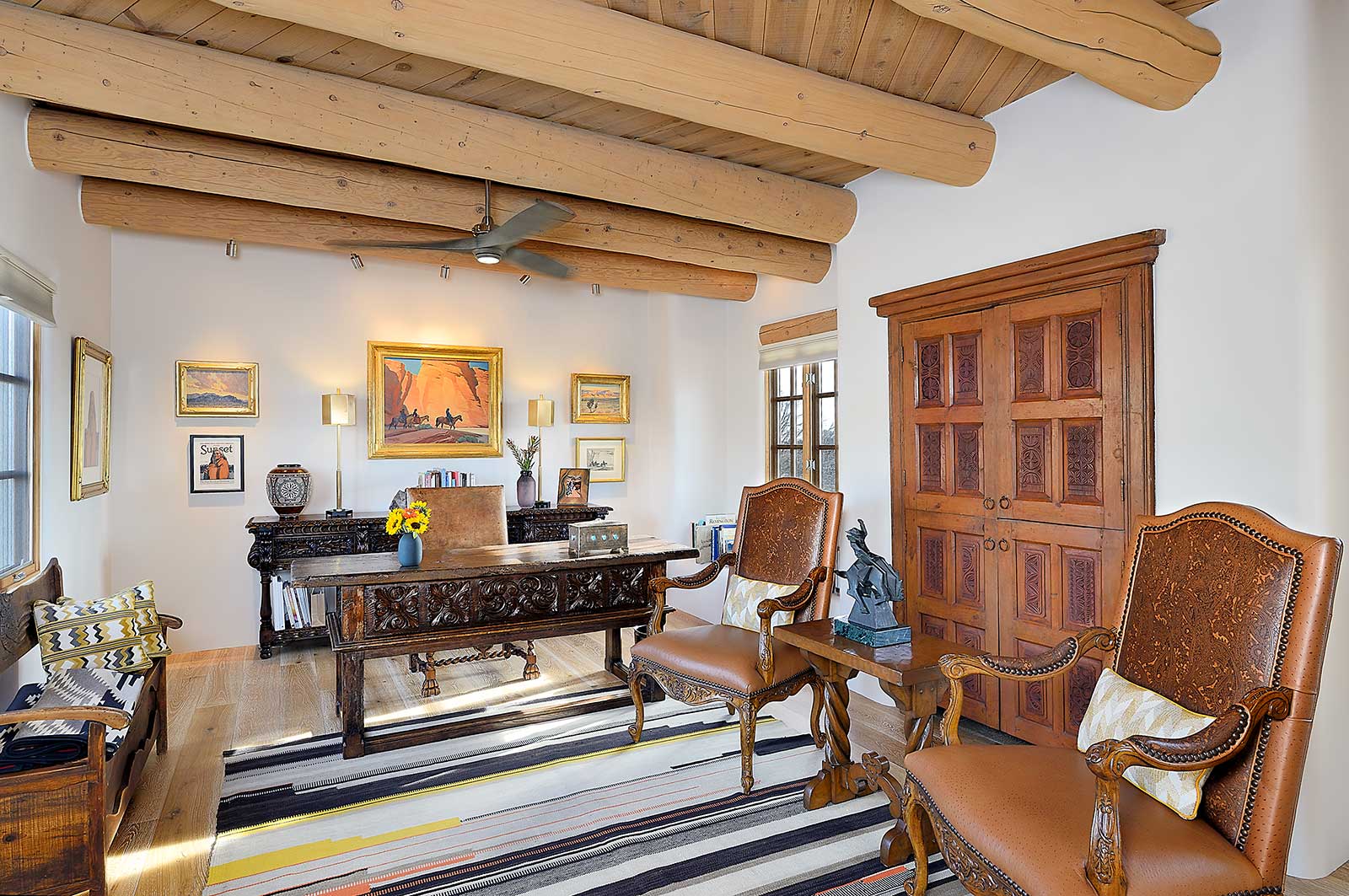 A collection of paintings by Maynard Dixon (1875-1946) hangs behind the desk. They are on top, left to right: Mountains and Rainstorms, 1934, oil; Navajos in a Canyon, 1945, oil; and Fields of Toquerville, 1933, oil. On the bottom left is Indian Chief (The Vulture’s Prey), 1924, gouache and casein on paper, reproduced on the cover of Sunset Magazine. The original is on the facing wall. On the right is Study for “Navajos in a Canyon,” 1944, pencil on paper. The vase on the credenza is a Beaded Wooden Vessel, 2019, by Euclid Moore and Marilyn Endres.“I’m attracted to Frederic Remington’s black-and-white illustrations. We had bid on one unsuccessfully and told Nat we were interested in one. A month or so later we walked into his gallery and there was Indian Village Routed (The Fight of Geronimo: Troop Surprising a Camp), 1896. It had just arrived at the gallery. Typical of Remington, the feet of the dog, horses and people never touch the ground.
“Whenever we go to Santa Fe,” he continues, “it’s like meeting old friends. It’s the same in Colorado. Every painting has a story.”
Cathey adds, “Art is good for your soul. It’s good for your mental health.” —
Powered by Froala Editor