There are never any shortages of Charlie Russell works at the C.M. Russell Museum, especially during The Russell in August, but this year there is a shortage, and it is literal: the museum is hosting a small-works exhibition for the famous Western painter and sculptor.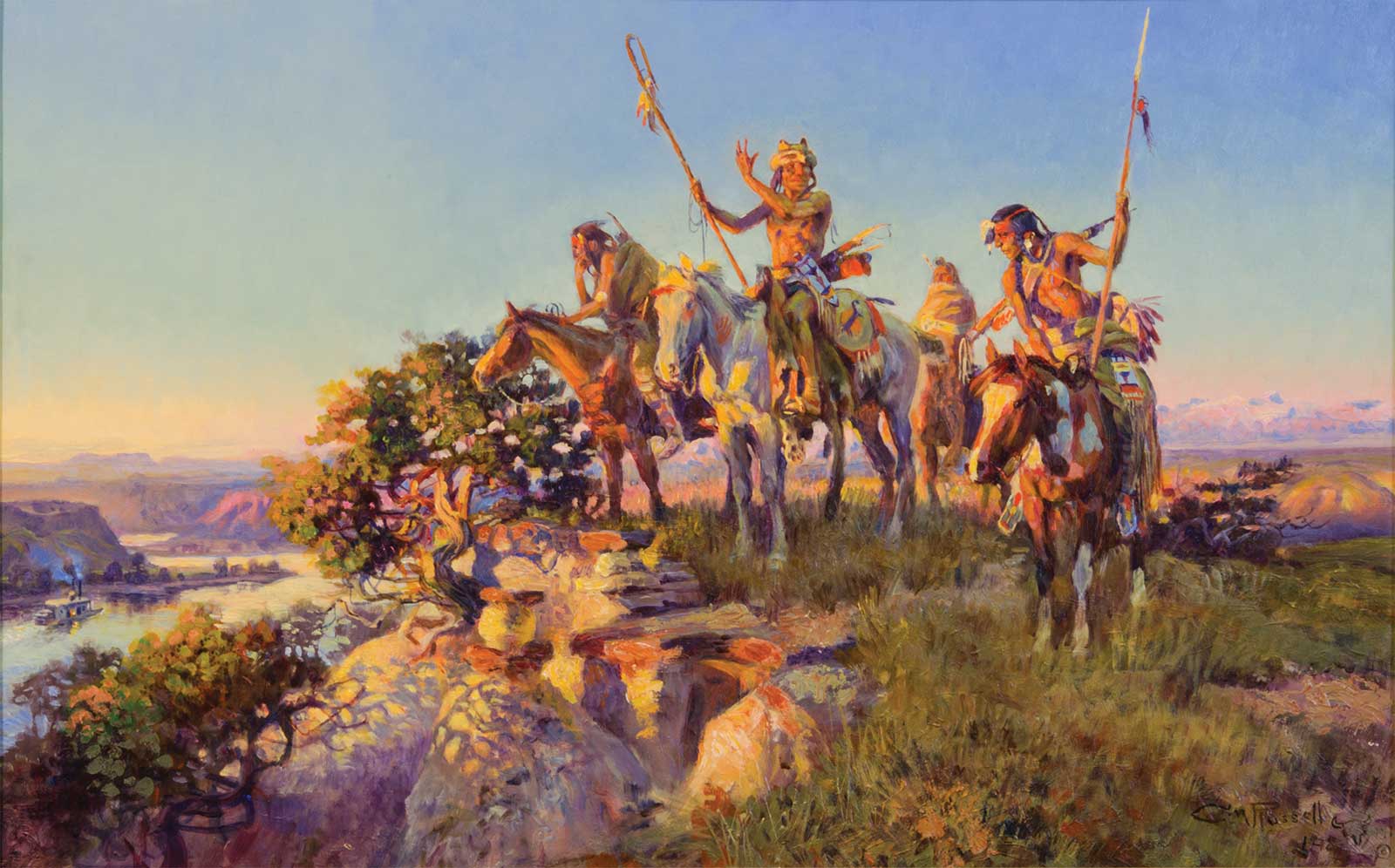 The Fireboat, 1918, oil on board. C.M. Russell Museum Collection. Gift of Mrs. Wade George in memory of Wade Hampton George.
“There is a perception that masterworks have to be big to stand the test of time,” says Sarah Adcock, associate curator at the Montana museum. “But what you see when you look at these smaller Russell works, is that he was doing some incredible things at basically 24-inches and smaller. These works are just as important as the big ones, especially when you look at these very detailed stories in these intimate little pieces.”
Modest Yet Masterful: Small Scale Masterworks by Charles M. Russell, featuring 18 Russell works, is now open and will remain on view through September. Adcock is expecting exceptional attendance, especially as visitors arrive to participate in The Russell, but also just regular tourists who are coming through on their way to Glacier National Park. “You just can’t really beat these summer months when the weather is so beautiful and people are out exploring the region,” Adcock says. “We plan these exhibitions so they reach the most people because we want these works seen.”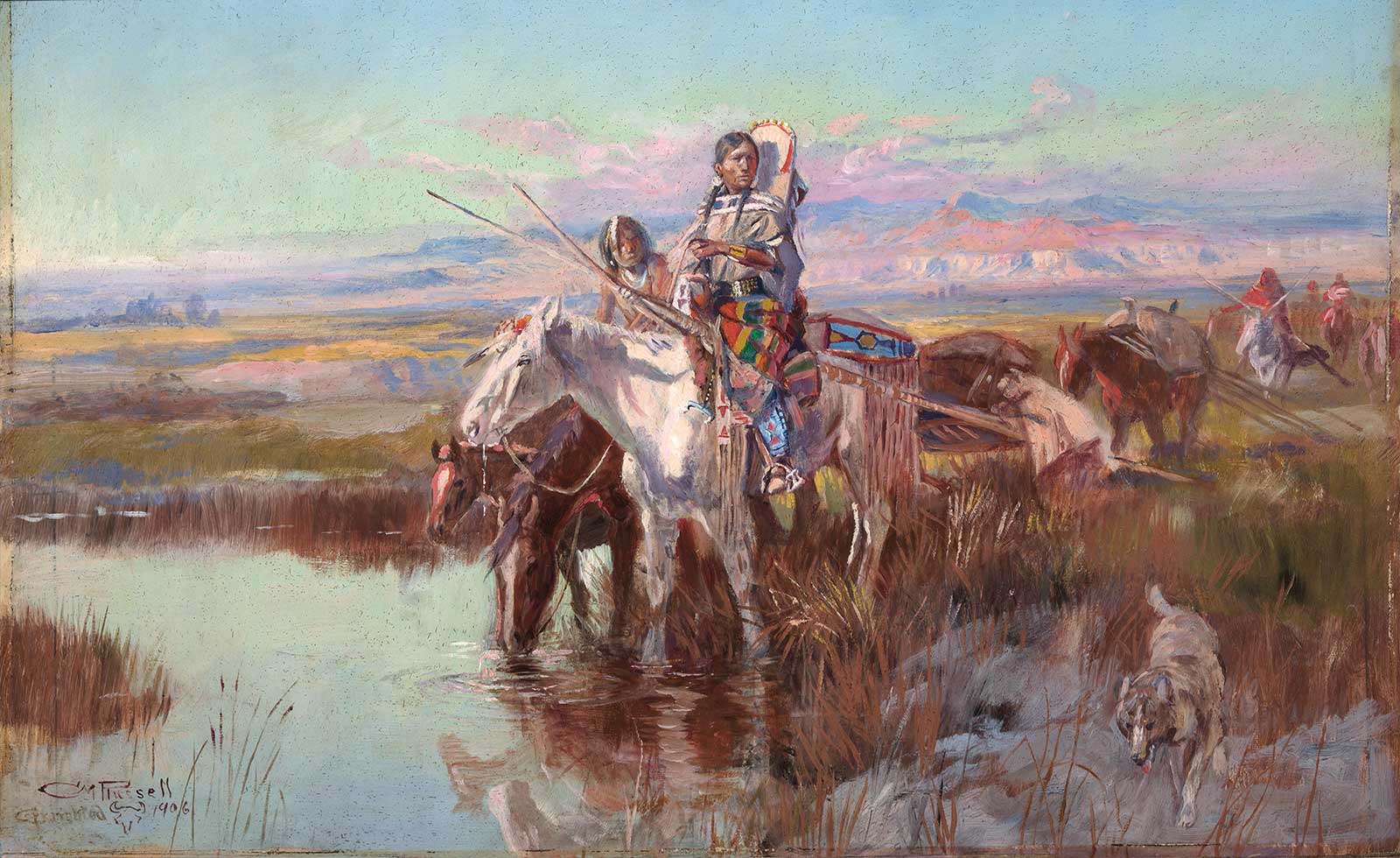 The Waterhole, 1906, oil on board. The Petrie Collection, Denver, Colorado.
Adcock notes that Russell had a long history of working in small works, whether it was impromptu watercolors, quick sketches on paper or even just miniature oil paintings—Russell was a voracious artist and would paint or draw on whatever was in front of him. Many of these small little masterpieces were included in letters he would write to friends and family, but some were also easel paintings that he spent more time on in his studio. Even Nancy Russell, Charlie’s wife, was aware of his interest in small works. She says as much during a trip to London that is documented in her recently released third book on her husband, Back-Tracking in Memory: The Life of Charles M. Russell, Artist. “[During our visits to galleries and museums] Charlie loved the smaller pictures of artists,” Nancy writes, “for instance, he especially enjoyed the Wallace collection in London because of the small picture of Mesange [a type of bird].”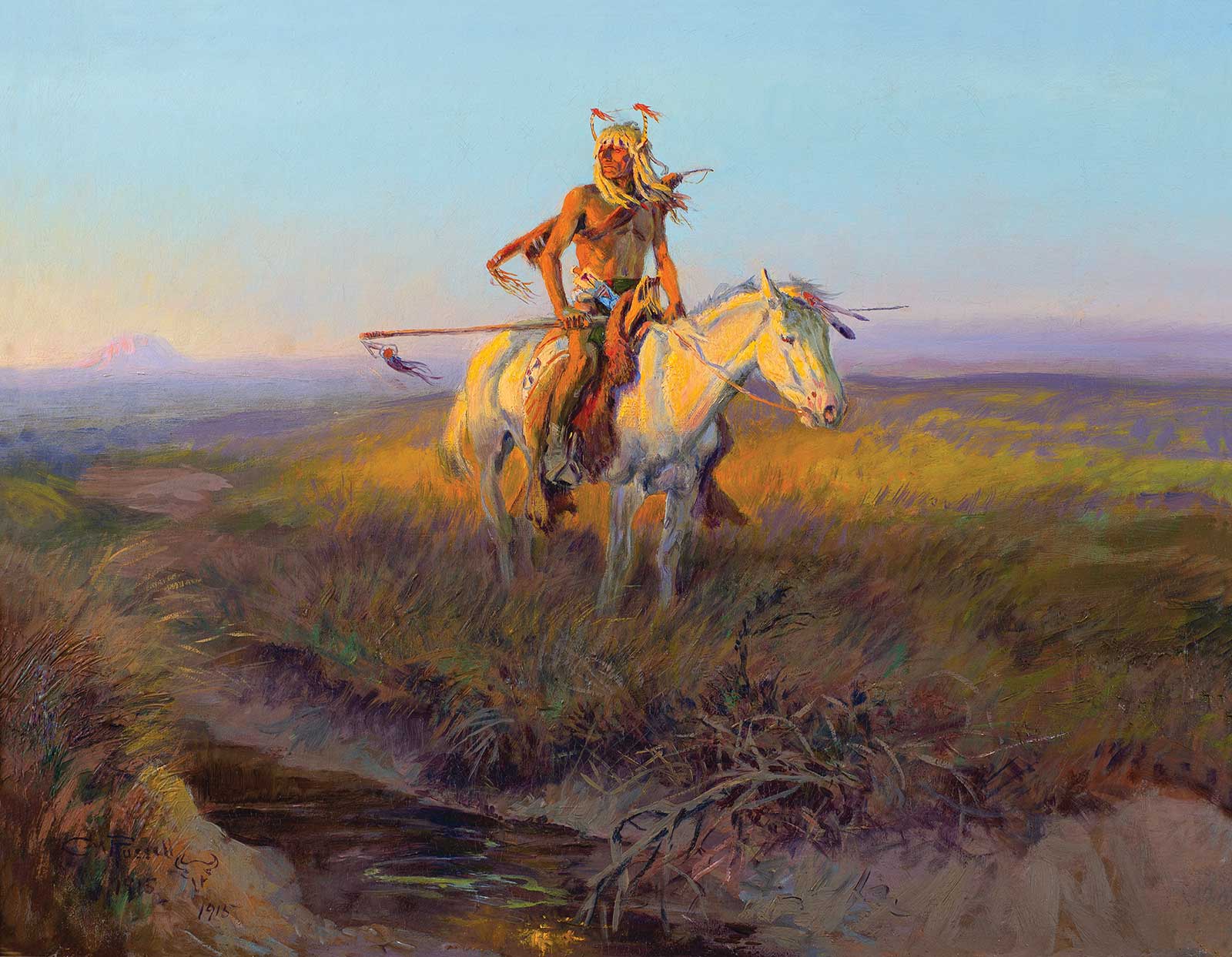 The Scout, 1915, oil on canvas. The Petrie Collection, Denver, Colorado.
Works in the show include some truly knock-out pieces, many of them on loan from a prominent collector and supporter of the museum. One highlight from the permanent collection is the 1918 oil on board painting The Fireboat, showing a group of Native American riders admiring a boat that is chugging along in a river, down in a cliff-lined valley. The male figures peer down at the boat with curious looks on their faces, while also maintaining their stoic composure. “The Fireboat is one of the masterworks in our collection and we’re just really fortunate to have it,” says Adcock. “Of course, Native Americans were very near and dear to his heart, so works like this one are important. I like The Fireboat because the painting is from the Native Americans’ perspective as they take in what they are seeing. Russell was such a great storyteller.”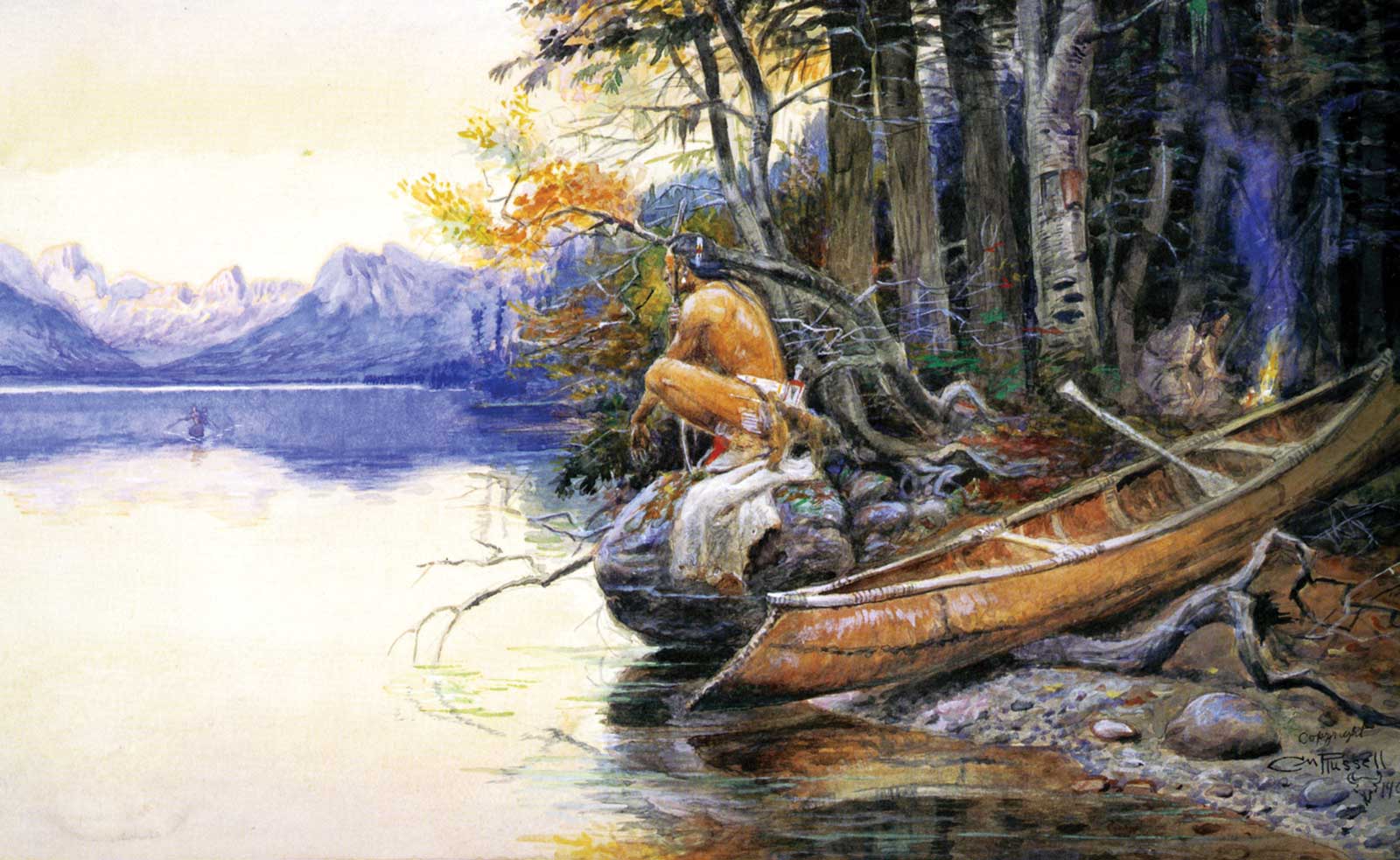 Land of the Kootenai, 1908, watercolor on paper. The Petrie Collection, Denver, Colorado.
Fireboats are addressed in George P. Horse Capture Sr.’s essay in The Masterworks of Charles M. Russell: A Retrospective of Paintings and Sculpture. “When white men forcibly brought the exclusive Native occupancy of this country to an end in what would become the state of Montana, they used the mighty Missouri River as their vehicle. Some did trek into the ‘wilderness’ of Montana on foot or horseback, but keelboats and steamboats hauled tons of people and supplies to the interior at every opportunity, accelerating the invasion. The Native people often followed the course of the waterway as well, so tribes of the region became familiar with ‘fireboats’ and their passengers, the ‘White Eyes.’”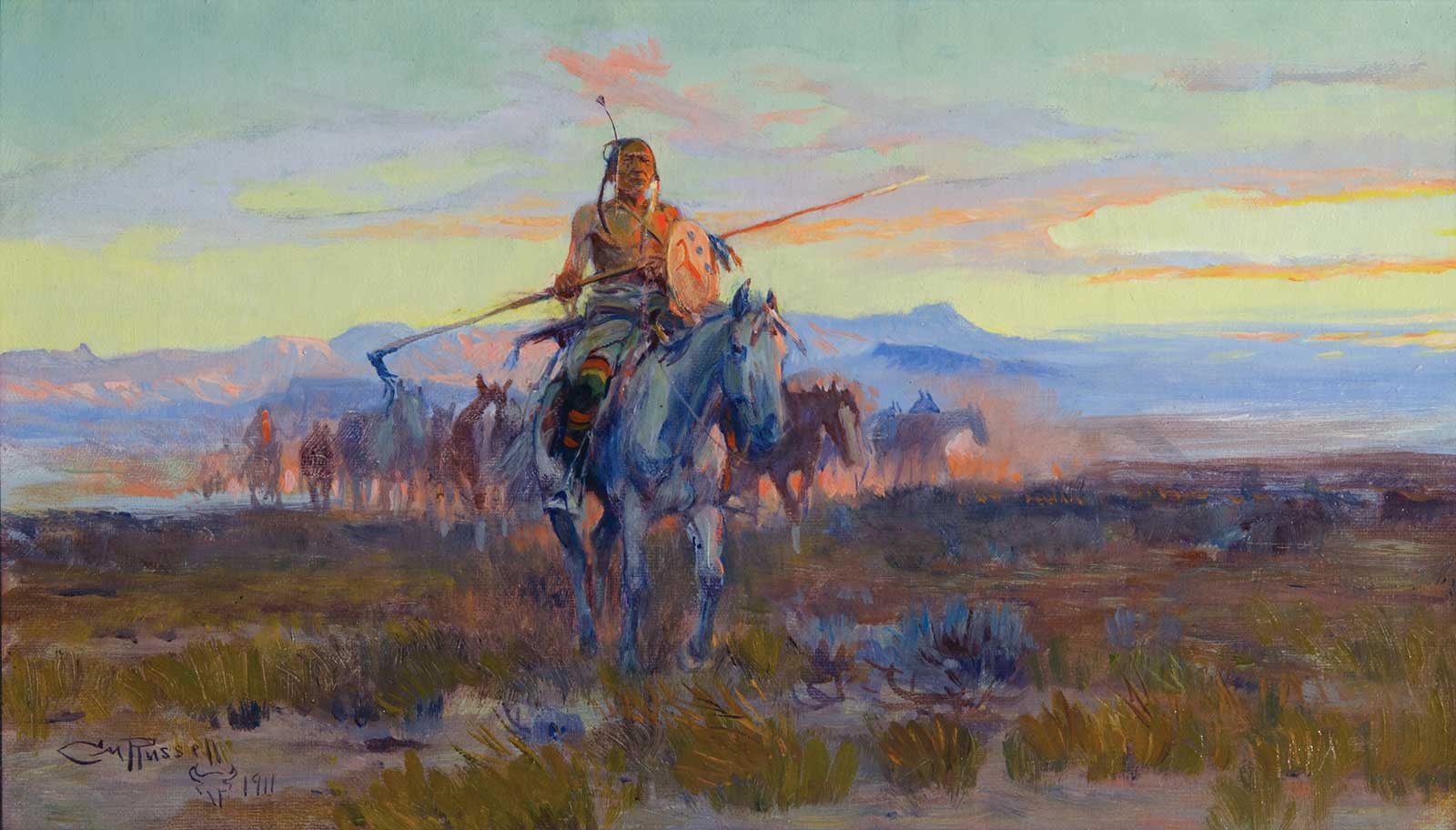 Stolen Horses, 1906, oil on board. The Petrie Collection, Denver, Colorado.
In another chapter of The Masterworks of Charles M. Russell, Joan Carpenter Troccoli writes at great length on The Scout, a work that is in the exhibition from the Thomas Petrie Collection, one of the major lenders to Modest Yet Masterful. The piece shows a singular figure looking into the setting sun as shadows work their way up his feet and his horse’s body. “The figure in The Scout, surely one of Russell’s finest essays in pure painting, assumes a motionless, watchful position, but little else in the picture is still. A breeze gently pushes the grasses to the right and animates the fringe and feathers in the dress, equipment and trappings of the figure and his mount,” Troccoli writes in a chapter titled “Poetry and Motion in the Art of Charles M. Russell.”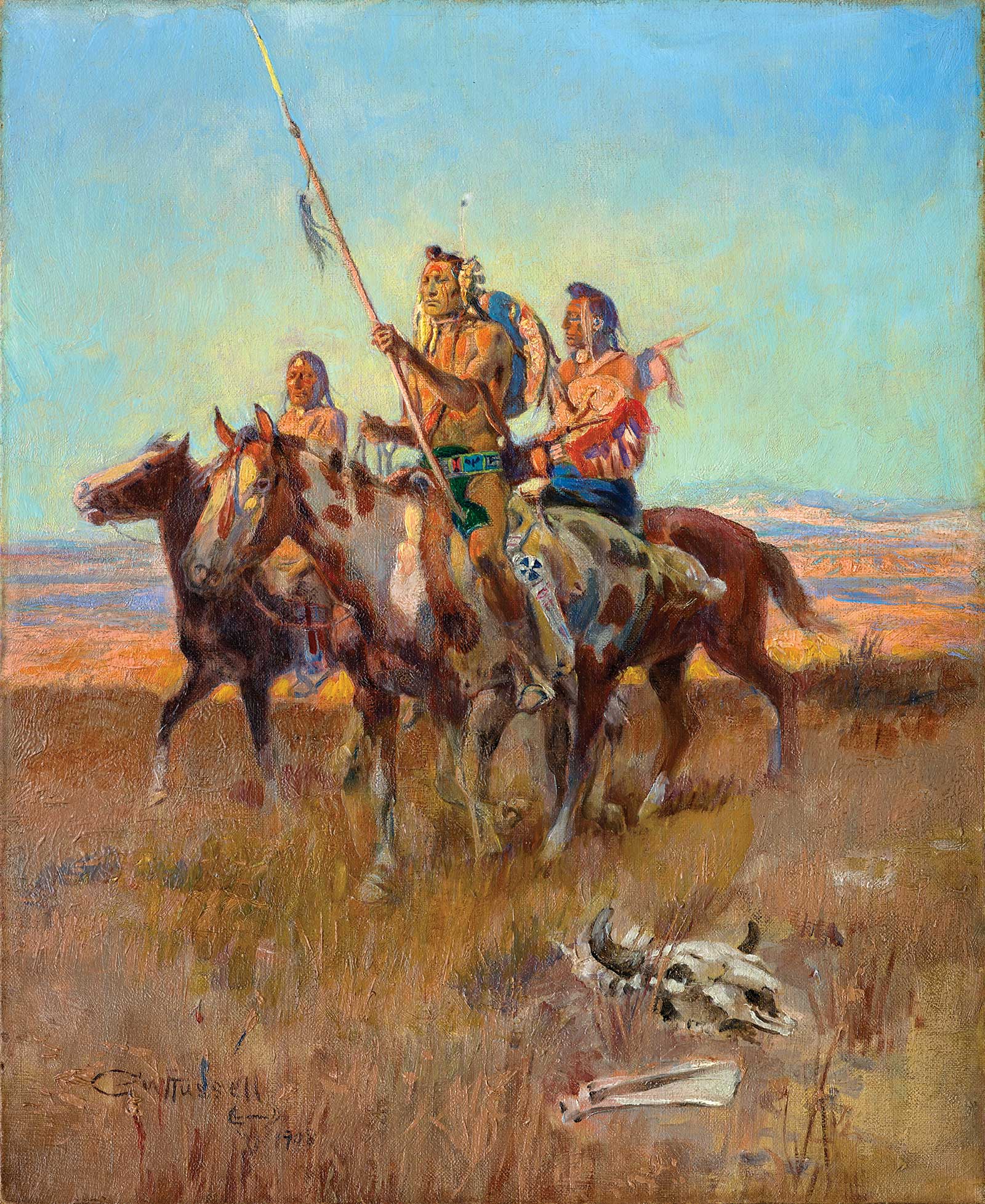
Piegans, 1908, oil on canvas. The Rees-Jones Collection, Dallas, Texas.
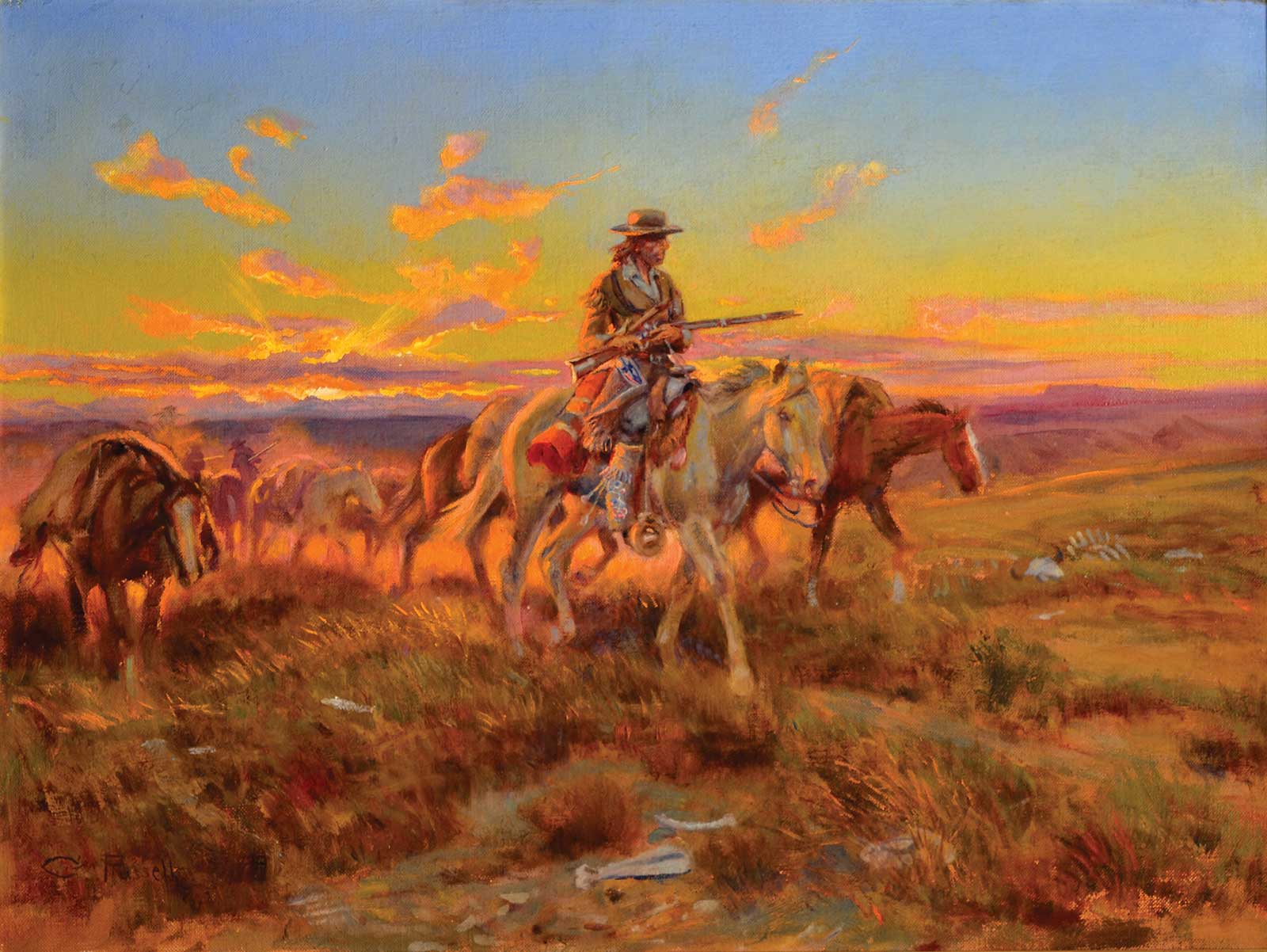 The Free Trader, ca. 1925, oil on canvas, 13 x 19.” The Petrie Collection, Denver, Colorado.
“This general sweep to the right is countered by the leftward twist of the figure’s head, a contrapposto position reinforced by the intensity of his gaze in that direction. The foreground grasses and parts of the stream that runs diagonally from the left middleground to the center foreground are defined by delicate raised strokes that project slightly from the canvas; here and there, they catch the fading illumination of the setting sun. Thus, although the foreground is in deep shadow, it is overlaid with a tracery of reflected light. Russell worked his canvases all over simultaneously, stepping in to dab in color and then back to appraise its effect. That practice is abundantly evident in The Scout: echoes of the most highly colored part of the picture—the mounted figure silhouetted against a brilliant backdrop of orange, gold and chartreuse that plays off the lavender and pink near the horizon and dissolves into the pale aqua of the sky—can be discovered in tiny touches of the brush throughout the canvas.For Adcock, who studied art herself, painting small was put into perspective as she undertook her own work, which gives her insight into Russell’s paintings. “With small works, they have to be great because you’re asking the viewer to get intimately closer to them than larger paintings,” she says. “When you’re looking at a smaller work, you end up looking at those details more. You have to accomplish more with less, and Russell knew how to do that.” —
Modest Yet Masterful: Small Scale Masterworks by Charles M. Russell
Through September 2022
C.M. Russell Museum, 400 13th Street N., Great Falls, MT 59401
(406) 727-8787, cmrussell.org
Powered by Froala Editor