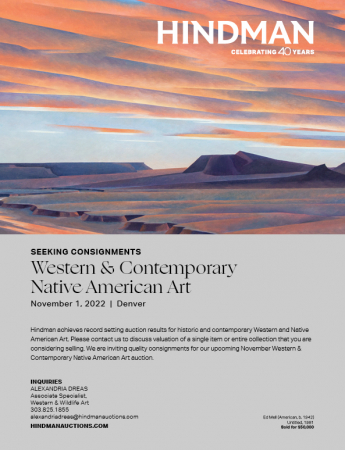
Mateo Romero was brought up in Berkeley, California, educated at Dartmouth College, the Institute of American Indian Arts and the University of New Mexico. Although much of his experience has been urban, he is deeply connected to the Rio Grande Pueblo world through his father’s Cochiti Pueblo roots. In 2019, the Museum of Indian Arts & Culture in Santa Fe, New Mexico, named him and his brother Diego as recipients of the Native Treasures Living Treasures award.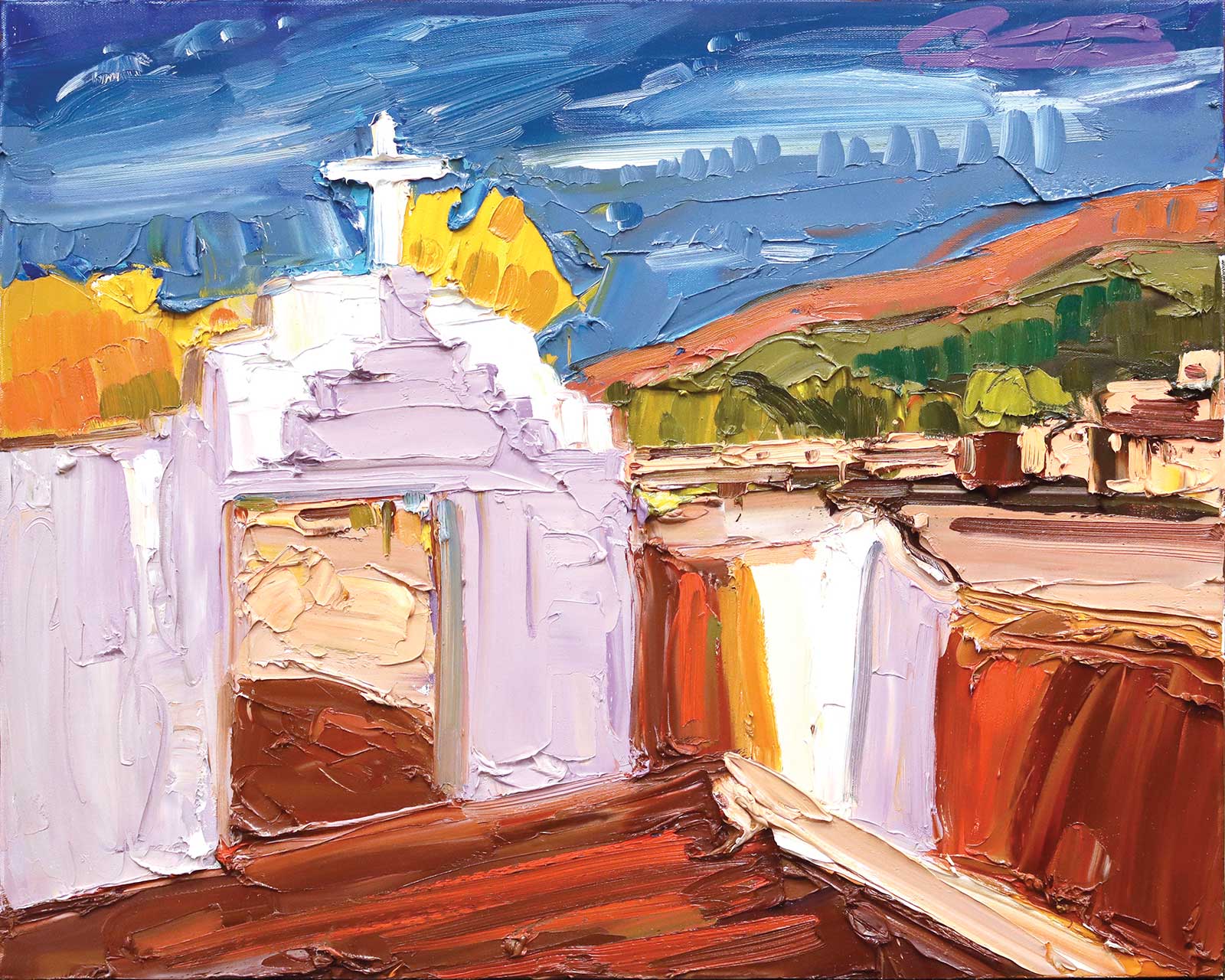 Misatay Series, oil on canvas, 24 x 30”
He explains: “The Rio Grande Pueblos worldview is different from that of mainstream America. Whereas Western European culture can be said to view man as distinct from the landscape and his environment, Indigenous culture tends to view man as an active part of the land. The Tewa have a word for this, ‘Poeh ha,’ which translates to breath of life. This is a life force that moves through and connects all things: rocks, water, trees, mountains, rain clouds, animals, man. In this worldview man is seen as an integral part of a living space as opposed to a voyeur of the sublime.”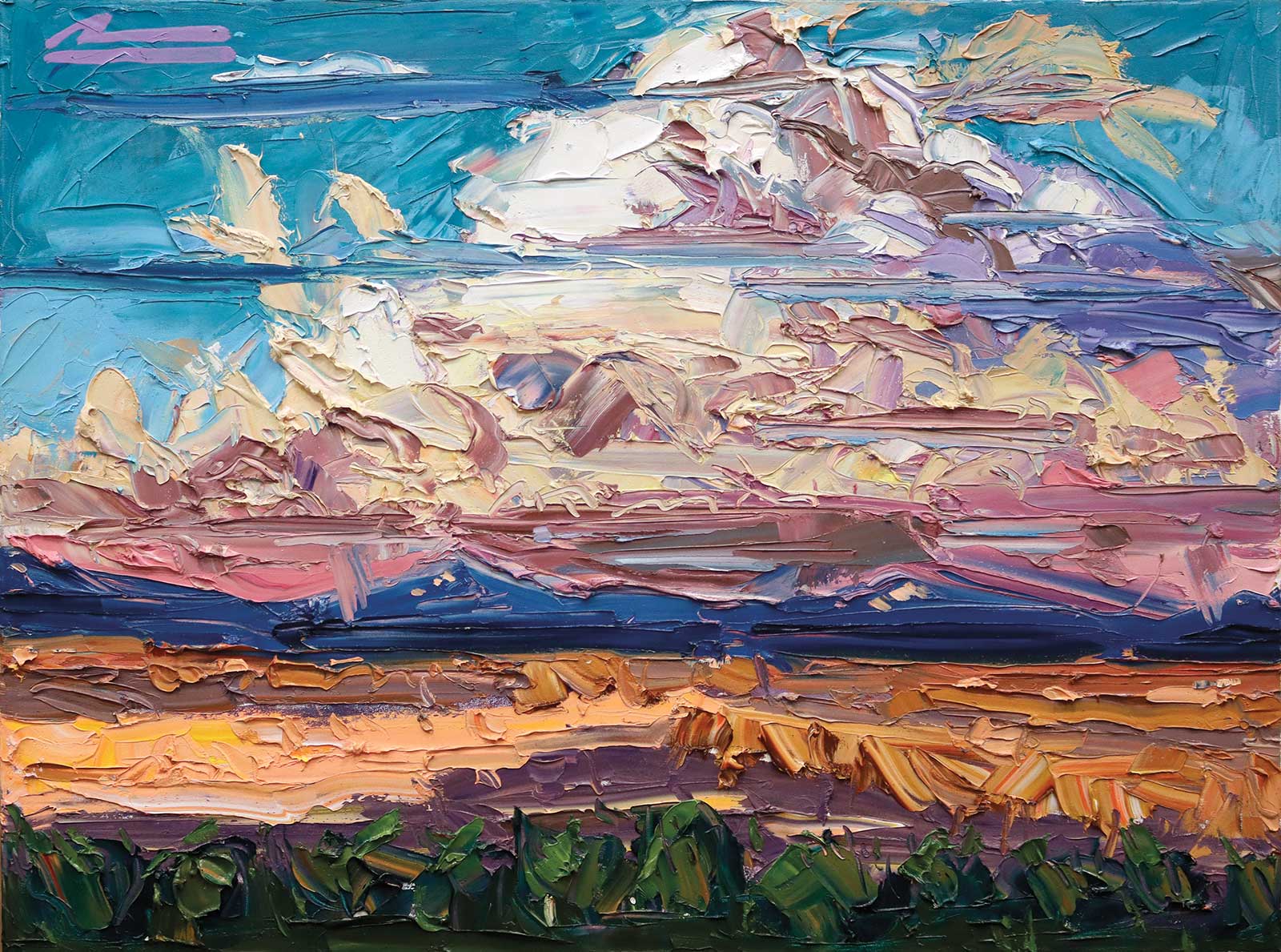 Ogapogeh Owingeh Series II, oil on canvas, 30 x 40”
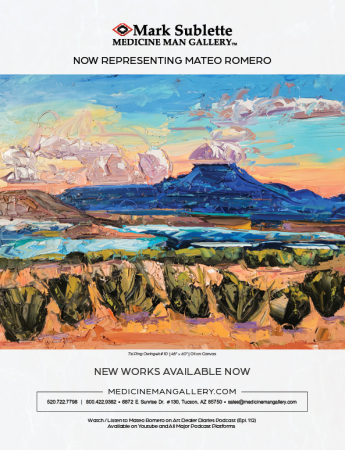
Romero’s paintings of the landscapes of the Rio Grande in Northern New Mexico vibrate with the energy of the land and retain the muscular gestures of his applying thick paint with palette knife and brush. His paintings are more than representations of the distinct features of the landscapes. They are a physical expression of his experience of them. “Although I do watercolor sketches, take notations and photographs on location,” he says, “the paintings are more remembered landscapes that reflect the experience. I am not distinct from the landscape. The act of making the paintings is a ceremony of creating space. They become like prayers that can touch other peoples’ lives”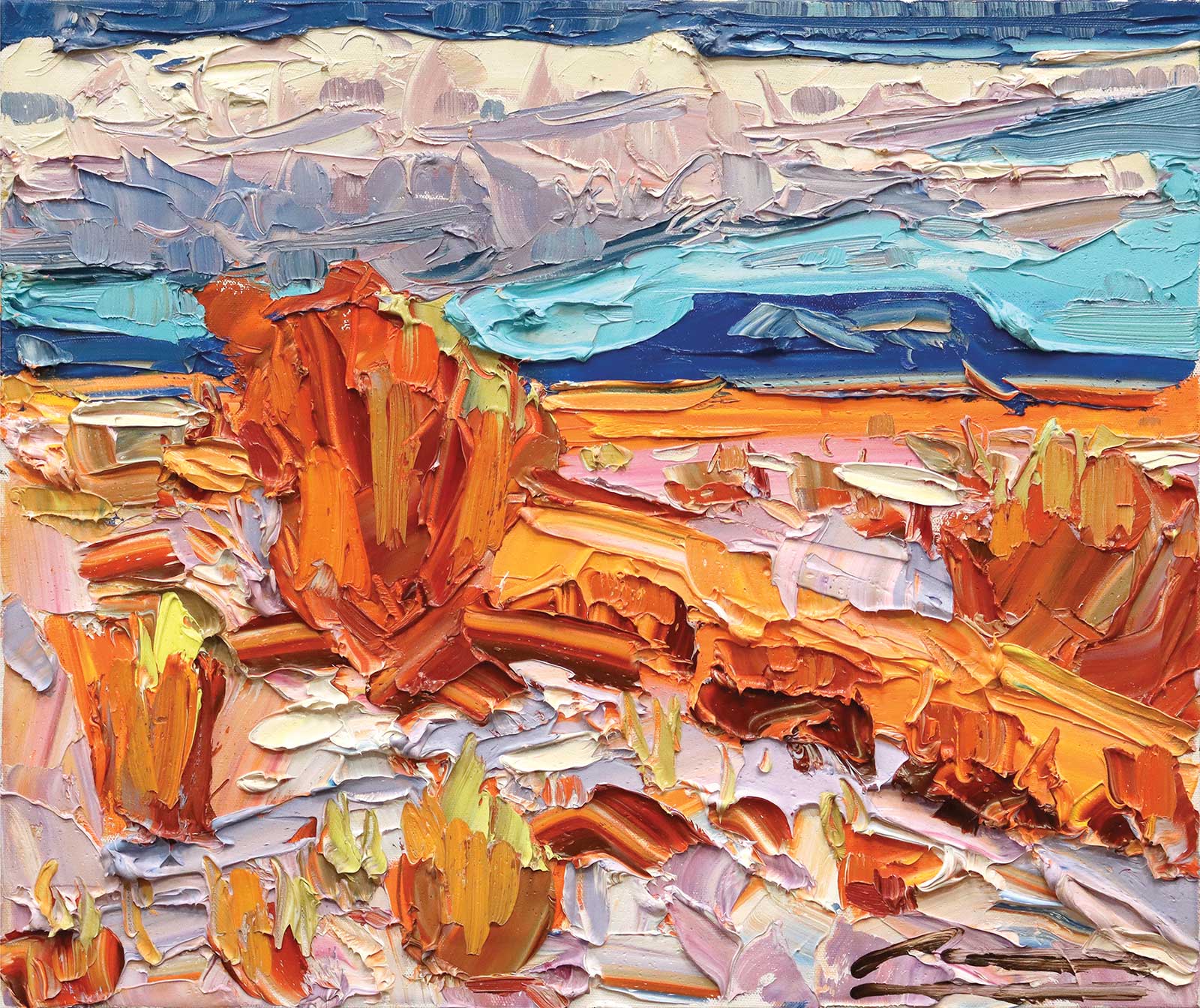 Aveh Tsugeh Series I, oil on canvas, 18 x 24”
He recalls walking among the basalt ridges of Comanche Gap in the nearby Galisteo Basin, site of more than 10,000 ancient and prehistoric petroglyphs. “It’s a somatic, physical experience. I feel connected to the space and to the ancestors. That’s how I also experience the breath of life in rain, light, clouds, the sound of thunder.”
His recent work will be shown at Medicine Man Gallery in Tucson, Arizona, August 1 through September 1.
Among the paintings is Ogapogeh Owingeh Series II. “Ogapogeh Owingeh” is the Tewa name for Santa Fe, meaning “White Water Shell Place.” In his Misatay Series (the Tewa word for “church”) he depicts San Geronimo de Taos, the church of Taos Pueblo often overlooked by visitors who flock to the iconic San Francisco de Asís Church in Rancho de Taos. —
Powered by Froala Editor